








Opening
Virtual Tour Statistics: What if you could visit a museum, explore a hotel, or walk around a famous landmark without actually being there? Virtual tours make this possible. They use 360-degree views and interactive digital features to give people a closer look at real places from anywhere. All you need is a smartphone, computer, or VR headset to start exploring.
Today, virtual tours are being used in tourism, education, real estate, travel, and entertainment. They also help businesses showcase their spaces in a more engaging way. As technology advances, virtual tours are becoming more realistic and easier to access.
Our Recommendation
- The global virtual tour market was valued at USD 1,576.3 million in 2025 and is expected to reach USD 2,038.2 million in 2026.
- 73% of participants were satisfied with virtual events, and 90% of firms say virtual tours strengthen marketing efforts.
- Travel and tourism records the highest VR user share at 40%, followed by movies at 36%.
- Around 51% of travelers find VR highly appealing.
- Virtual-tour listings receive 87% more views and keep visitors engaged 5-10 times longer.
- Dynamic visuals can also boost click-through rates by up to 40%.
- 97% of buyers now start their home search online.
- Over 50% of U.S. adults who use the internet have taken at least one virtual tour.
- CloudPano offers free tours, while paid plans range from USD 27 to USD 33 monthly, with custom pricing for businesses.
- The global virtual tour software market is expected to reach USD 559.2 million in 2026.
- Virtual tours keep visitors on websites 5 to 10 times longer and attract over 5 million visits daily.
- Virtual tours show a higher likelihood of double-booking, while 18-34-year-olds show a 130% higher booking likelihood.
Virtual Tour Market Size
(Source: market.us)
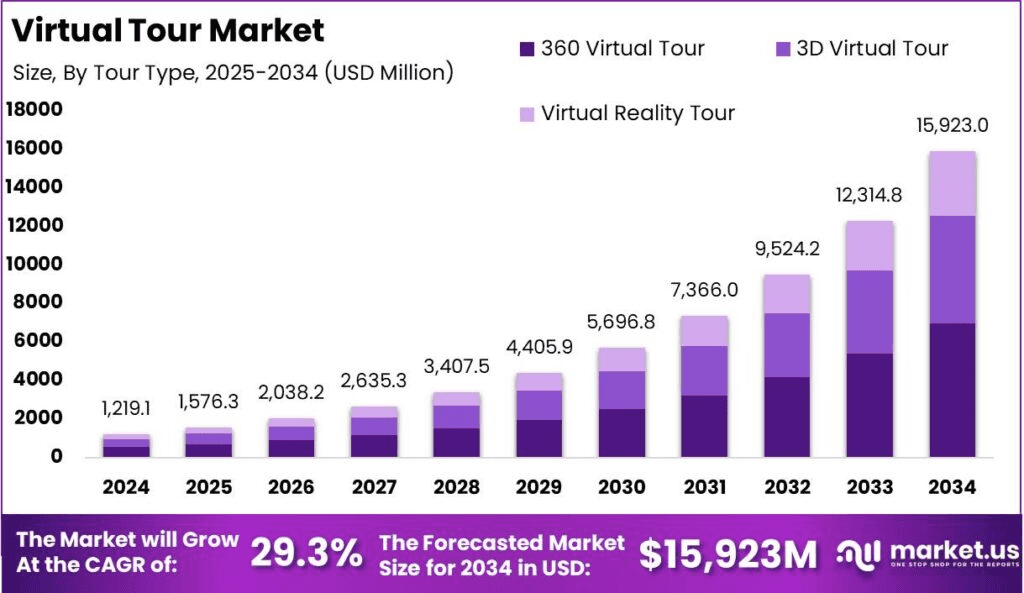
- The global virtual tour market was valued at USD 1,576.3 million in 2025 and is expected to reach USD 2,038.2 million in 2026.
- By 2034, the market is forecast to reach USD 15,923.0 million, growing at a strong CAGR of 29.3% from 2025 to 2034.
Virtual Tour Engagement Market Trends
- Kaltura found that 73% of participants were satisfied with virtual events.
- Virtual college tours increased by 258%, according to market.us.
- Google reported a 4,106% rise in online exhibit views.
- 68% of trip planners use online resources to find activities.
- Virtual events grew by 1,000% in 2020, and 84% of consumers want virtual event options.
(Source: revnomix.com)
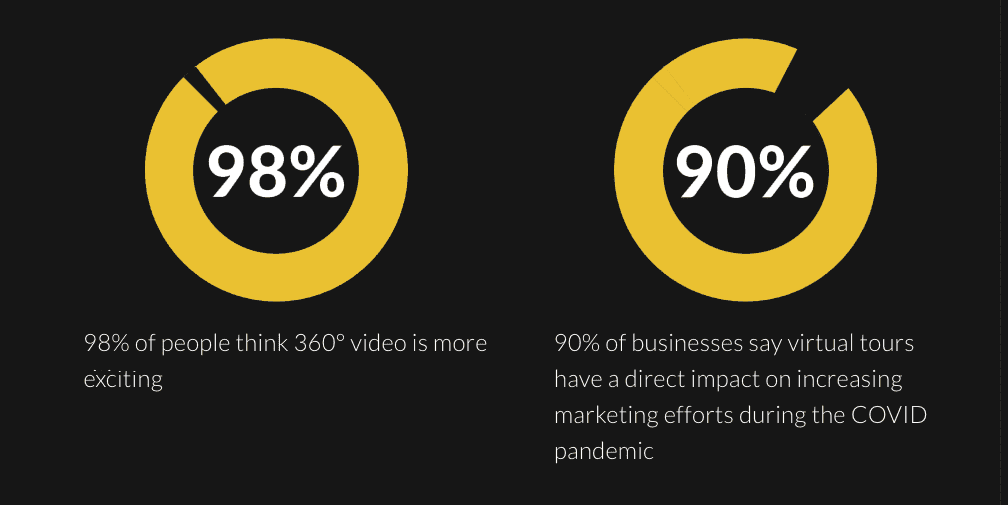
- 98% of people find 360° videos more exciting.
- 90% of firms say virtual tours strengthen marketing efforts.
- For customers aged 18-34, virtual tours increase the likelihood of booking by 130%.
- Users spend 5 to 10 times longer on websites featuring virtual tours.
- Virtual tours receive more than 5 million daily visits worldwide.
Virtual Reality Users Across Sectors
- According to a report published by Code Brew Labs, travel and tourism records the highest VR user share at 40%, followed by movies at 36%.
- VR usage reaches 34% for viewing 3D photos and 33% for exploring museum tours.
- Concerts and online shopping each account for 23% of VR users, while sports record the lowest share at 19%.
In Tourism
(Source: code-brew.com)
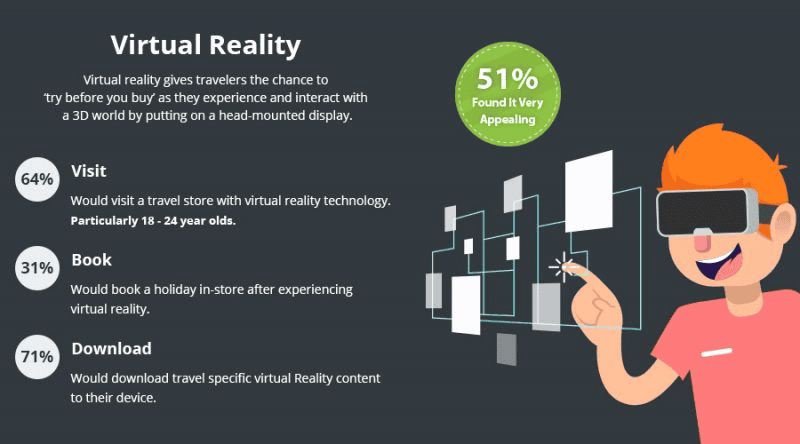
- Around 51% of travelers find VR highly appealing.
- Meanwhile, 64% would visit a VR-enabled travel store, particularly those aged 18-24.
- About 31% would book a holiday in-store after experiencing the destination through VR.
- 71% would download travel-specific VR content.
- Furthermore, 80% of VR users felt transported elsewhere, strengthening engagement and travel decisions.
Virtual Tour Usage Insights
(Source: cdn-wp.photoup.net)
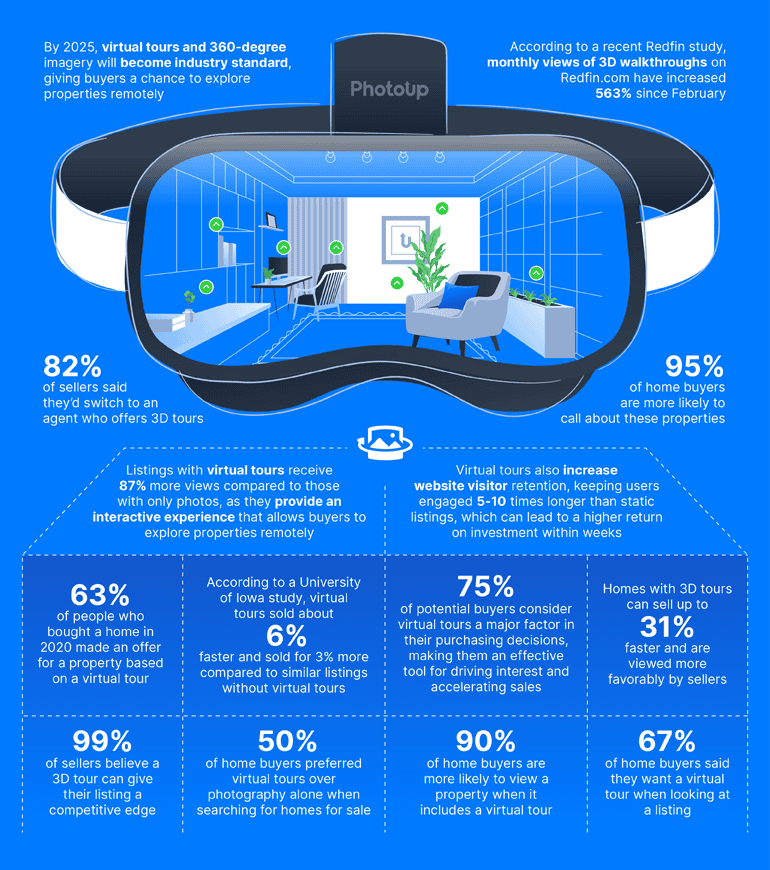
- By 2025, virtual tours and 360-degree images were expected to become standard tools for remote property viewing.
- Monthly views of 3D walkthroughs increased by 563% after February.
- About 82% of sellers would choose an agent offering 3D tours, while 95% of buyers would contact agents about properties with 3D tours.
- Virtual-tour listings receive 87% more views and keep visitors engaged 5-10 times longer.
- In 2020, 63% of buyers made offers without visiting properties.
- Homes with virtual tours sold 6% faster and for 3% more.
- About 75% of buyers consider virtual tours important, while homes with 3D tours can sell 31% faster.
- Around 99% of sellers see 3D tours as an advantage.
- 50% prefer tours over photographs, 90% are more likely to view listings, and 67% want virtual tours.
How Virtual Tours Influence Buyer Engagement and Decisions
- According to Visualista.ch, 3D tours generate 87% more views for property listings.
- Dynamic visuals can also boost click-through rates by up to 40%.
- Matterport listings keep visitors engaged 3-6 times longer.
- Online interactions may increase by approximately 600%.
- A Texas Tech study analyzed over 143,000 listings with 3D tours.
- These properties sold up to 31% faster and achieved prices up to 9% higher.
- 63% of buyers made offers on properties they had only viewed virtually.
How Virtual Tours Influence Home Buying
- The Travvir report further stated that 97% of buyers now start their home search online.
- Before viewing properties in person, they typically explore about 12 listings.
- Listings with virtual tours receive 5 times as much viewing time as photo-only listings.
- 74% of buyers may avoid properties without a virtual tour or 360° images.
- In 2025, 82% of sellers chose agents offering virtual tours.
- For properties above USD 500,000, the share climbed to 91%.
- Agents with virtual tours won 67% of competitive listing pitches.
Real Estate and Travel Virtual Tour Statistics
- Panorama Marketing’s report stated that over 50% of U.S. adults who use the internet have taken at least one virtual tour.
- 54% of buyers will not arrange a viewing without virtual images, while 50% say tours influence their decisions.
- Listings with virtual tours receive 87% more views and reduce wasted viewings by 40%.
- 75% of buyers consider virtual tours important before purchasing property.
- Hotel websites that use virtual tours increased bookings and conversions by 16%- 67%.
Impact of Virtual Tours in Real Estate
(Reference: globemarketresearch.com)
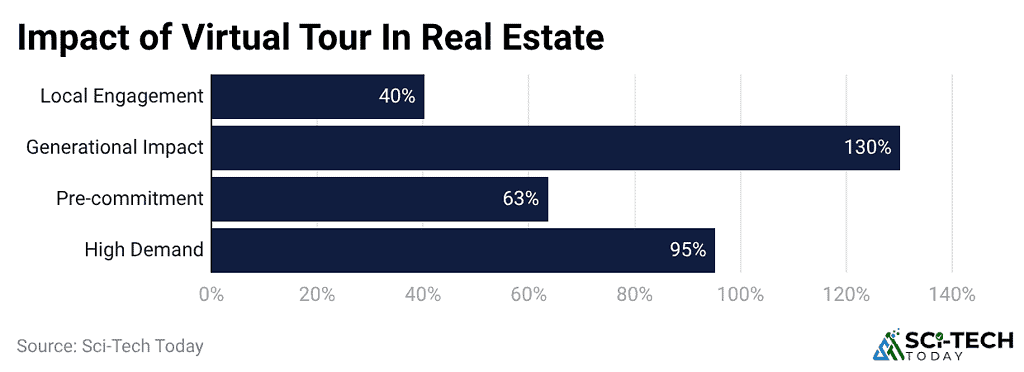
- Virtual tours increase local engagement by 40% and deliver a 130% impact across generations.
- Pre-commitment reaches 63.4%, while high buyer demand stands at 95%.
Virtual Tour Plans Statistics by Pricing, 2026
| Virtual-tour platform | Free plan | Entry / Basic | Professional | Business / Higher tier |
| CloudPano | USD 0/tour | USD 27/month- Pro | USD 33/month-Pro Plus | Custom pricing-Pro Plus Business |
| Kuula | USD 0/month-Basic | – | USD 20/month- Pro | USD 36/month-Business |
| Matterport | USD 0/month- Free Forever | Approximately USD 12/month- Starter | Approximately USD 58/month- Professional | Approximately USD 296/month- Business |
| VirtualTourEasy | USD 0/month- Free | USD 19/month-Solo | USD 59/month- Professional | USD 199/month-Business |
| Travvir | USD 0/month | USD 4.99/month- Pro | – | – |
| iGUIDE | – | USD 99-199/tour- Residential | – | USD 199-499/tour-Commercial |
Virtual Tour Software Market Report
(Source: fortunebusinessinsights.com)
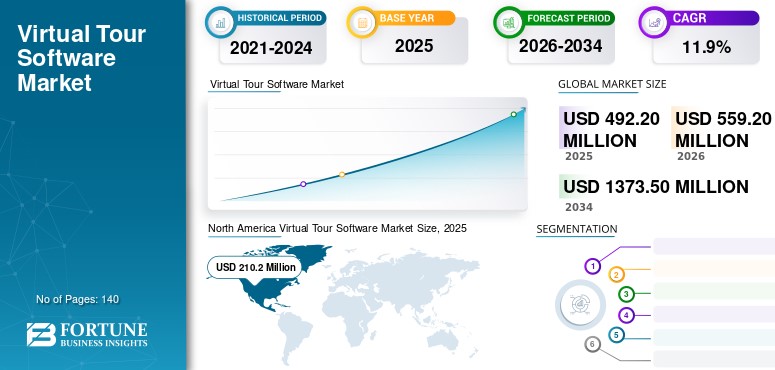
- The global virtual tour software market was valued at USD 492.2 million in 2025. It is expected to reach USD 559.2 million in 2026.
- The market will grow to USD 1,373.5 million by 2034, reflecting an 11.9% CAGR from 2026 to 2034.
- North America led the market with a 42.7% share in 2025.
- The U.S. market is projected to reach USD 390.9 million by 2032.
- Cloud solutions will lead with 69.40% in 2026, while real estate is expected to capture 31.71%.
Virtual Tour Business Impact
- According to 360 VR, businesses using virtual tours can recoup their investment in under 4 weeks.
- Virtual tours keep visitors on websites 5 to 10 times longer and attract over 5 million visits daily.
- Real estate listings with virtual tours receive 87% more views.
- Moreover, 67% of users want virtual tours for listings.
- Businesses with virtual tours can receive twice as much interest.
- Among people aged 18 to 34, prospects are 130% more likely to book services after viewing a virtual tour.
- Google listings with virtual tours showed 16% more appearances and 12% higher interactions on Maps.
How Virtual Tours Increase Customers’ Booking Interest
(Source: rodedwards.com)
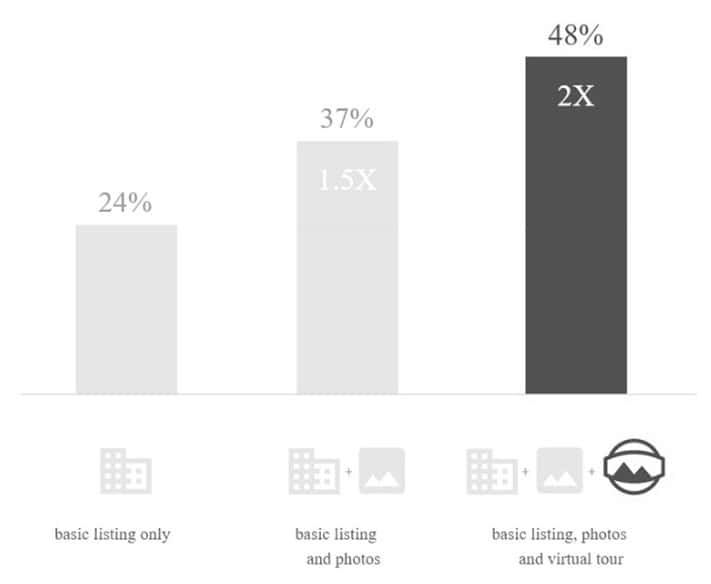
- Basic listings attract 24% interest, while photo listings reach 37%.
- Photos with virtual tours increase interest by 48%, double the basic rate.
- Virtual tours show a higher likelihood of double-booking, while 18-34-year-olds show a 130% higher booking likelihood.
Customer Demand
- Rodedwards further stated that 67% of consumers want more virtual tours.
- 26% remain neutral about additional virtual tours.
- Only 7% of consumers do not want more virtual tours.
Virtual Tour Measurement Accuracy
(Source: livethebushtemple.com/)
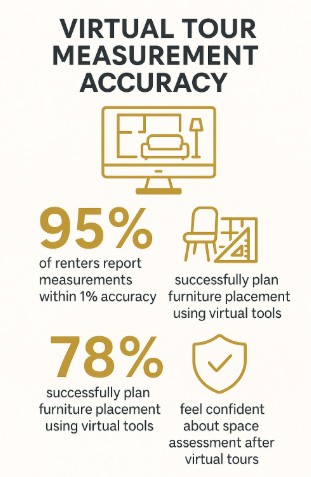
- 95% of renters reported virtual-tour measurements with 1% accuracy.
- Moreover, 78% successfully planned furniture placement using virtual tools.
Comparison of the Three Main Virtual Tour Types
| Feature | 360° Photo Tour | 3D Virtual Tour-Digital Twin | Video Tour |
| Core technology | Stitched equirectangular panoramic images. | LiDAR, photogrammetry, 3D scanning, or spatial data. | Pre-recorded video footage. |
| User control | Users can look in any direction and move between scenes. | Users can walk through rooms and open a top-down dollhouse view. | Limited control; users follow a fixed video sequence. |
| Interactivity | Hotspots, text, images, videos, forms, links, and e-commerce features. | Measurements, tags, 3D models, dollhouse views, and floor plans. | Mainly play, pause, rewind, and forward controls. |
| File size | Relatively light, particularly with multi-resolution tiling. | Heavy because it requires detailed 3D spatial data. | Medium, depending on video length and resolution. |
| Loading speed | Generally fast. | Slower and requires a dedicated 3D viewer. | It depends on video quality and internet speed. |
| Required hardware | Any compatible 360° camera, including Ricoh Theta or Insta360. | A phone, a compatible 360° camera, or a specialized LiDAR and 3D scanner, depending on accuracy needs. | Standard video camera or smartphone. |
| Typical cost | Low to medium. | High | Low to medium. |
| Best applications | Real estate, hospitality, education, retail, and tourism. | Architecture, construction, facility management, and insurance documentation. | Storytelling, destination marketing, and luxury-property listings. |
| VR-headset support | Yes | Yes | Usually no for standard linear video. |
| Main advantage | Affordable and highly interactive. | Provides spatial measurements and a detailed digital replica. | Simple to create and easy for viewers to understand. |
| Main limitation | It does not automatically provide precise spatial measurements. | Requires more processing, storage, and investment. | Viewers cannot freely explore the location. |
Four-Step Virtual Tour Creation Process
(Source: api.panoee.com)
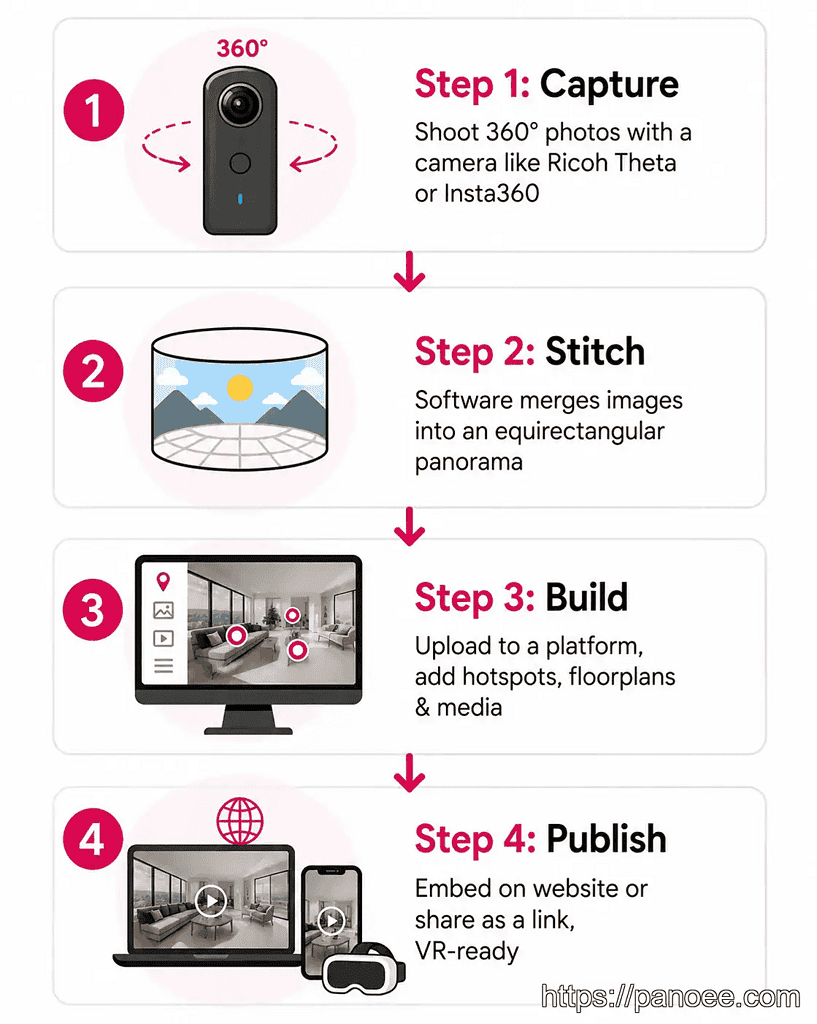
- Step 1-Capture: Take 360° photos using a compatible camera, such as Ricoh Theta or Insta360.
- Step 2-Stitch: Use software to combine the images into one equirectangular panorama.
- Step 3-Build: Upload the panorama to a platform and add hotspots, floor plans, and media.
- Step 4-Publish: Embed the completed tour on a website or share it through a VR-ready link.
Final perspective
Virtual tours offer an easy way to explore places from anywhere. People can visit hotels, museums, schools, tourist spots, and properties without being there physically. With better AI, VR, and 360-degree technology, these experiences are becoming more realistic and interactive.
As their use grows, virtual tours can help businesses attract visitors, improve online engagement, and give people a clearer idea of a place before they decide to visit.
FAQ
A virtual tour uses 360-degree images, videos, or interactive technology to let users explore a place online from different angles.
Virtual tours are commonly used in real estate, tourism, education, museums, hotels, and virtual events.
Virtual tours use 360-degree cameras, VR technology, 3D modeling, and interactive software.

Sources