









Beginning
AI In Trading Statistics: AI in trading refers to the application of machine learning, natural language processing, and predictive analytics to analyze financial data and support or automate buy and sell decisions. Typical uses include algorithmic execution, price forecasting, sentiment analysis of news and social media, portfolio optimization, fraud detection, and real-time risk monitoring.
These systems process structured market data alongside unstructured text, enabling faster and more consistent decisions than manual methods. Demand rises with wider use of machine learning in financial services, cloud-based trading platforms, and generative AI applied to large datasets of price history, volumes, and economic indicators.
Cloud tools also give smaller firms access at lower cost. The main barriers are high development and implementation expenses and limited risk valuation capability. Now let’s dive deep into this article.
Must Reads in the Editor’s Eye
- AI trading market: USD 18.2 billion in 2023, projected USD 50.4 billion in 2033 at 10.7% CAGR.
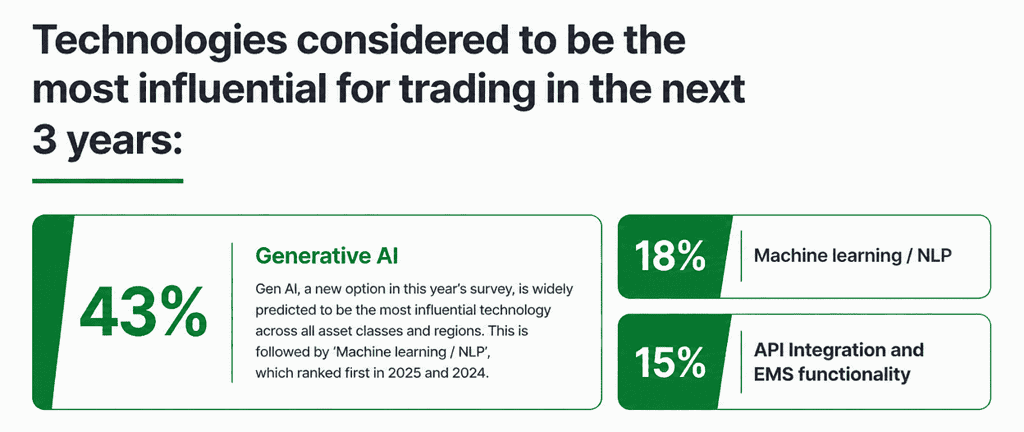
- J.P. Morgan’s 2026 trader survey: 43% ranked generative AI trading’s most influential technology over three years.
- MetaTrader 5 AI Assistant processed over 1 trillion tokens within three weeks of its July 2026 launch.
- Agent4Crypto’s 2026 tests returned 6.66% on Bitcoin, −4.77% on Ethereum and −2.36% on XRP, averaged across five runs.
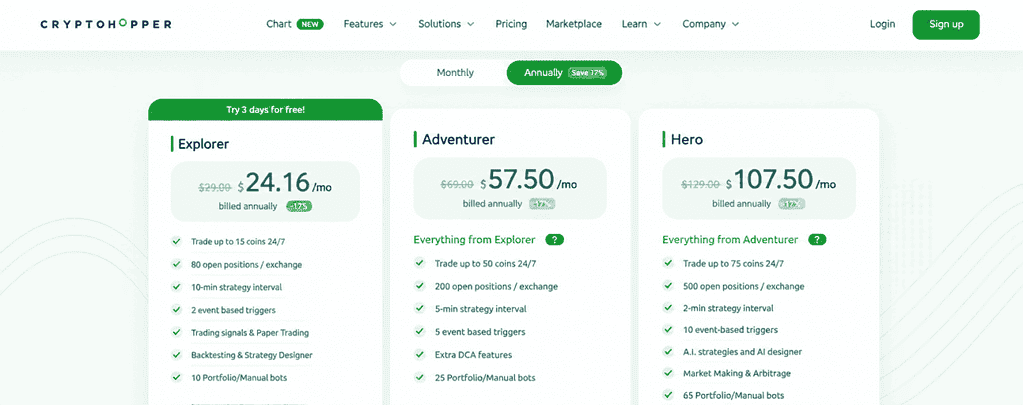
- Cryptohopper Hero costs USD 129 monthly; annual billing cuts it to USD 107.50, saving USD 258 yearly.
- Neural option-chain pricing ran about 400,000 times faster than matched-accuracy simulation in a June 2026 benchmark.
- FinDialogLens routing cut large-language-model calls 85%, saving over USD 300 daily at 70,000 quote requests.
- Interactive Brokers launched autonomous AI trading across 75,000+ listed stocks, options and ETFs in October 2026.
- Nasdaq’s AI surveillance pilot detected 80% of historical pump-and-dump schemes over eight months.
AI in Trading Market Growth
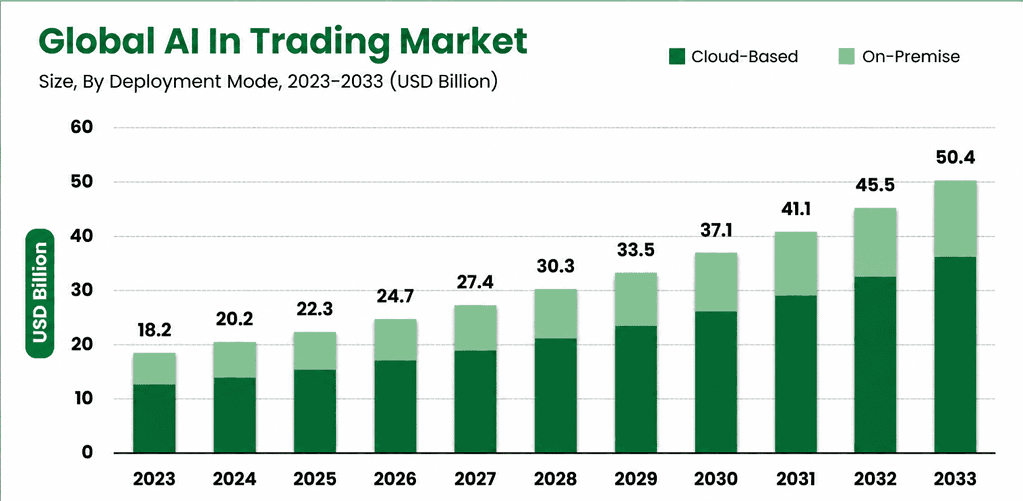
- The global AI trading market, covering cloud-based and on-premises solutions, is estimated at USD 18.2 billion in 2023, USD 20.2 billion in 2024, and USD 22.3 billion in 2025.
- The market is projected to reach USD 24.7 billion in 2026, USD 27.4 billion in 2027, and USD 30.3 billion in 2028.
- The market is expected to reach USD 45.5 billion in 2032 and USD 50.4 billion in 2033, reflecting a compound annual growth rate of 10.7% over 2023–2033.
How AI Is Reshaping Modern Trading
- In J.P. Morgan’s 2026 trader survey, 43% ranked generative AI as trading’s most influential technology over three years.
- Another 18% selected machine learning/NLP in 2026, highlighting continued demand for automated analysis alongside generative AI.
- FinDialogLens’s 2026 research achieved 92.1% final-price extraction accuracy, helping trading desks recover information buried in financial chatrooms.
- The same 2026 study achieved 94.3% trade-outcome extraction accuracy, supporting automated identification of missed trading opportunities.
- Fine-tuned models with only 3 billion parameters achieved comparable performance in 2026 tests, demonstrating alternatives to larger proprietary systems.
- FinDialogLens’s 2026 routing approach reduced large-language-model calls by 85%, lowering computational requirements for final-price extraction.
- At 70,000 quote requests daily, the 2026 study reported savings exceeding USD 300 per day through intelligent routing.
AI in Forex Trading
- On 23 July 2026, MetaTrader 5 build 6060 introduced native AI agents and Model Context Protocol integration.
- MetaQuotes reported over 1 trillion AI Assistant tokens processed within three weeks of launch, by 11 August 2026.
- Released 30 July 2026, build 6090 expanded AI capabilities to add chart indicators and retrieve their parameters.
- On 20 August 2026, build 6140 expanded AI-provider support, including Alibaba, Cerebras, Bitdeer AI, and z.ai.
- Released on 3 September 2026, build 6180 enabled AI retrieval of backtesting reports, optimization results, and diagnostic logs.
- On 24 September 2026, build 6230 enabled AI access to economic-calendar values, supporting macroeconomic analysis alongside currency prices.
- MetaQuotes’ 20 October 2026 demonstration showed AI testing trading robots across currency pairs using two years of historical data.
- MetaTrader 5’s July 2026 release offered free AI access and configurable trade approvals; generated responses remain informational, not investment advice.
AI in Cryptocurrency Trading
- A 2026 study evaluated four AI trading agents across 2,627 closed positions between February 12 and August 27.
- The 2026 study applied a 0.09% round-trip trading fee to positions simulated against live prices.
- Real Hyperliquid orders represented 18% of positions in the 2026 AI-agent evaluation; most positions were simulated.
- Each AI agent faced a five-open-position limit in the 2026 evaluation, providing an explicit exposure constraint.
- Six cryptocurrencies accounted for 89% of trades in the 2026 study, highlighting concentrated trading activity.
- Agent4Crypto’s 2026 Bitcoin test returned 6.66%, with a 0.10 Sharpe ratio, averaged across five runs.
- Agent4Crypto’s 2026 Ethereum test returned −4.77%, with a −0.08 Sharpe ratio, averaged across five runs.
- Agent4Crypto’s 2026 XRP test returned −2.36%, with a −0.04 Sharpe ratio, demonstrating that AI trading can lose money.
| Variant | Total Return (%) ↑ | Daily Return (%) ↑ | Sharpe Ratio ↑ | ||||||
|---|---|---|---|---|---|---|---|---|---|
| BTC | ETH | XRP | BTC | ETH | XRP | BTC | ETH | XRP | |
| w/o Data Team Specialization | 3.87 | -4.83 | -2.57 | 0.050.56 | -0.060.49 | -0.030.31 | 0.09 | -0.12 | -0.10 |
| w/o Inter-team Collaboration | 6.23 | -5.60 | -6.25 | 0.081.01 | -0.070.81 | -0.080.66 | 0.08 | -0.09 | -0.12 |
| w/o Trader Competition | 6.63 | -5.35 | -2.41 | 0.090.84 | -0.070.75 | -0.020.43 | 0.10 | -0.09 | -0.06 |
| Agent4Crypto | 6.66 | -4.77 | -2.36 | 0.09±0.89 | -0.06±0.74 | -0.02±0.48 | 0.10 | -0.08 | -0.04 |
Data Sources That Feed Trading Algorithms
- In 2026, Alpaca feeds equity algorithms consolidated US exchange data for USD 99/month, allowing 10,000 historical API calls/minute.
Equities
| Basic | Algo Trader Plus | |
| Pricing | Free | $99 / month |
| Securities coverage | US Stocks & ETFs | US Stocks & ETFs |
| Real-time market coverage | IEX | All US Stock Exchanges |
| Websocket subscriptions | 30 symbols | Unlimited |
| Historical data timeframe | Since 2016 | Since 2016 |
| Historical data limitation* | Latest 15 minutes | no restriction |
| Historical API calls | 200 / min | 10,000 / min |
- In 2026, Databento supplies order-book, trade, and quote data across 70+ supported venues for execution and liquidity algorithms.
- In 2026, Alpha Vantage supplies historical prices and technical indicators; standard free access permits 25 API requests daily.
- In 2026, FRED provides macroeconomic inputs spanning 853,000 economic time series from 127 sources.
- In 2026, SEC EDGAR supplies company filings and XBRL fundamentals, limiting automated access to 10 requests/second per user.
- In 2026, GDELT supplies global news-event and sentiment inputs, updating its event and knowledge-graph datasets every 15 minutes.
- In 2026, CoinGecko supplies cryptocurrency market inputs; its free Demo plan allows 10,000 monthly calls and 100 calls/minute.
AI in Options and Derivatives Pricing
- March 2026 FINN research reported most relative option-pricing deviations below 4%, with delta deviations typically 2–3%.
- March 2026 FINN results reduced mean absolute error by 60.5% and root-mean-square error by 53.9% against the study’s comparator.
- May 2026 American-option research found sector-specific neural surrogates reduced overall fitting error by 18% versus its parametric baseline.
- May 2026 tests found neural-calibrated pricing errors within USD 1 on liquid names, but LLY showed USD 2–6 biases.
- June 2026 GJR–GARCH research reported neural option-chain pricing approximately 400,000 times faster than matched-accuracy simulation in its benchmark.
- June 2026 research reported individual-option pricing taking microseconds on CPUs and under 1 microsecond on GPUs after training.
- August 2026 multi-asset option experiments reduced numerical root-mean-square errors approximately 4–12 times using neural corrections to mesh-based solutions.
AI Trading Bots for Individual Traders
| AI trading platform | Plan or billing option | Price (USD) | Bot limits and other numeric features | AI functionality |
| 3Commas | Starter, monthly billing | 15/month | 5 active DCA bots; 2 grid bots | AI assistance. |
| 3Commas | Pro, monthly billing | 38/month | 20 DCA bots; 10 grid bots; 3 active exchange connections | AI assistance. |
| 3Commas | Expert, monthly billing | 105/month | 1,000 DCA bots; 15 active exchange connections | AI assistance. |
| Cryptohopper | Hero, monthly billing | 129/month | 500 open positions per exchange; 75 tradable coins | AI strategies. |
| Cryptohopper | Hero, annual billing | 107.50/month equivalent | USD 258 yearly savings compared with monthly billing; before applicable VAT | AI strategies. |
| Bitsgap | Basic, monthly billing | 29/month | 3 grid bots; 10 DCA bots | AI assistance. |
| Bitsgap | Advanced, monthly billing | 69/month | 10 grid bots; 50 DCA bots; 180-day backtesting | AI assistance. |
| Bitsgap | Pro, monthly billing | 149/month | 50 grid bots; 250 DCA bots; 365-day backtesting | AI Portfolio Mode. |
Generative AI and Large Language Models in Trading
- In 2026, 3Commas Starter includes AI assistance, 5 active DCA bots, and 2 grid bots for USD 15/month.
- 3Commas Pro costs USD 38/month, supporting 20 DCA bots, 10 grid bots, and 3 active exchange connections.
- 3Commas Expert costs USD 105/month, supporting 1,000 DCA bots and 15 active exchange connections.
- Cryptohopper Hero includes AI strategies, 500 open positions per exchange, and 75 tradable coins for USD 129/month.
- Cryptohopper Hero’s annual billing reduces its monthly equivalent to USD 107.50, saving USD 258 yearly before applicable VAT.
- Bitsgap Basic includes AI assistance, 3 grid bots, and 10 DCA bots for USD 29/month.
- Bitsgap Advanced costs USD 69/month, supporting 10 grid bots, 50 DCA bots, and 180-day backtesting.
- Bitsgap Pro costs USD 149/month, providing AI Portfolio Mode, 50 grid bots, 250 DCA bots, and 365-day backtesting.
The Future of AI in Trading
- ESMA’s 2026 report finds 70% of surveyed firms anticipate increases during 2025–2027.
- ESMA’s 2026 findings show 45% of respondents lack deployed or experimental AI applications.
- ESMA’s 2026 presentation identifies 10 algorithmic-trading AI use cases and three high-frequency-trading applications.
Recent AI in Trading Statistics
- In October 2026, Interactive Brokers launched autonomous AI trading across 75,000+ listed stocks, options and ETFs, subject to eligibility and client-defined safeguards.
- In June 2026, LTX launched BondGPT execution agents on its platform, serving 40+ liquidity providers and 100 buy-side institutions.
- In May 2026, 5 major banks joined AI-powered LTX, alongside 40+ existing liquidity providers and 100+ buy-side investors.
- In April 2026, Moomoo launched API Skills, enabling no-code AI trading workflows and 24/7 monitoring across 5 markets, with paper-trading defaults.
- Trumid’s January 2026 update highlighted AI-enabled execution; approximately 40% of its trading users had used 3+ protocols during 2025.
- In October 2025, Nasdaq announced AI surveillance upgrades following an 8-month pilot detecting 80% of historical pump-and-dump schemes; its platform served 50 exchanges and 20 regulators.
- In September 2025, Robinhood announced Cortex-powered indicators and scans for early 2026, included with gold subscriptions costing USD 5/month or USD 50/year.
- In June 2025, Moomoo launched AI tools in Malaysia and Singapore, combining 3 components: stock analytics, a 24/7 assistant and no-code trading.
- Nasdaq’s 10th annual compliance survey in 2025 found 70% of 103 respondents planned AI investment within 12 months; 71.6% prioritized data quality.
The End
AI is becoming a standard layer in trading, supporting execution, research, pricing and surveillance across institutional desks and retail platforms. The market is projected to grow steadily, while brokers, trading venues and platform providers continue to add autonomous and agent-based tools.
Cloud data feeds and subscription bots widen access for smaller traders. Results remain uneven, as crypto agent tests produced both gains and losses, so risk controls, data quality, and human oversight remain essential.
FAQ
Algorithmic trading follows fixed rules written by humans, such as buying when a price crosses a set average. AI trading uses machine learning models that learn patterns from data and can adjust as conditions change. Many modern systems combine both, with AI generating signals and rule-based code handling execution and risk limits.
AI trading bots are software programs that connect to a brokerage or exchange account and place trades automatically. They analyze market data, generate buy or sell signals based on a trained model or strategy, and execute orders within user-defined limits. Most allow settings for position size, stop-loss levels and trading hours.
Models draw on price and volume history, order book data, technical indicators, economic releases, company filings and earnings reports. Many also use alternative data such as news text, social media sentiment, satellite imagery and web traffic. Data quality matters greatly, since errors or gaps can lead to unreliable signals.
Institutional firms use AI for forecasting, portfolio construction, risk modeling, trade execution and surveillance for market abuse. Quantitative hedge funds build models that scan thousands of securities at once, while banks apply AI to optimize order routing and reduce the market impact of large trades. Methods are usually proprietary and closely guarded.
Profitability varies widely and is never guaranteed. Strategies that worked in past conditions can stop working, and fees, slippage and poor risk management can erase gains. Claims of fixed or very high returns are a common warning sign of scams. Reviewing independent, verified performance records is far more reliable than marketing material.
AI is taking over repetitive, data-heavy work such as screening, execution and monitoring, and many trading desks now rely on automated systems. Humans still design strategies, supervise models, manage risk and respond to unusual events that models handle poorly. The more likely outcome is a shift in the trader’s role toward oversight and strategy, not full replacement.


Disclaimer: This press release/article is provided by a third party, which is solely responsible for its content. It is published on Sci-tech Today exactly as received from the issuing organization, without any edits, verification, or endorsement by Sci-tech Today.
Sci-tech Today does not guarantee the accuracy, completeness, or reliability of the information. Readers are advised to independently verify all information and do their research before acting on it or investing any money. Sci-tech Today is not responsible for any financial loss that may result from reliance on this content.

