









Introduction
Average Screen Time Statistics: Screens have become a major part of our daily lives; they have changed how people work, communicate, learn, and seek entertainment today, with the average screen time for internet users now occupying a large portion of their waking hours.
This rise in digital engagement is driven by the rapid global adoption of mobile technology, the pervasive influence of social media platforms, and the change toward remote professional and educational models.
Analyzing these detailed average screen time statistics is important for industries from public health to technology development firms. We offer concrete, data-based insights into changing consumer behavior, digital dependency, and the resulting health and societal challenges.
So, this report delivers a complete walk-around, breaking down the most current global, regional, and demographic patterns, emphasizing the facts that shape our relationship with technology. Let’s get started.
Editor’s Choice
- People worldwide currently spend an average of 6 hours and 40 minutes on internet-connected screens each day.
- The daily average screen time in the United States is notably higher than the global figure, reaching approximately 7 hours and 3 minutes for adults.
- A staggering 41% of American teenagers, aged 13 to 18, report having daily screen time that exceeds 8 hours.
- South Africa consistently records the highest national average screen time globally, with users logging an intensive average of 9 hours and 24 minutes of digital activity daily.
- The global average time dedicated solely to social media platforms is approximately 2 hours and 23 minutes per day, accounting for over 35% of an individual’s total online time.
- The average screen time for a Gen Z individual ages 16-24 is approximately 9 hours per day, making this demographic the heaviest user group.
- The average American is estimated to check their mobile phone an alarming 205 times each day, underscoring a pattern of hyperconnectivity and habitual device engagement.
- Children as young as 0 to 2 years old are already engaging with screens, with approximately 49% of this group interacting with smartphones.
- Teenagers who spend 4 or more hours on screens daily show heightened mental health risks, with 1% reporting anxiety symptoms and 25.9% reporting symptoms of depression.
- The average time spent streaming video content, including services like Netflix and YouTube, commands over 3 hours and 16 minutes of a person’s daily total average screen time.
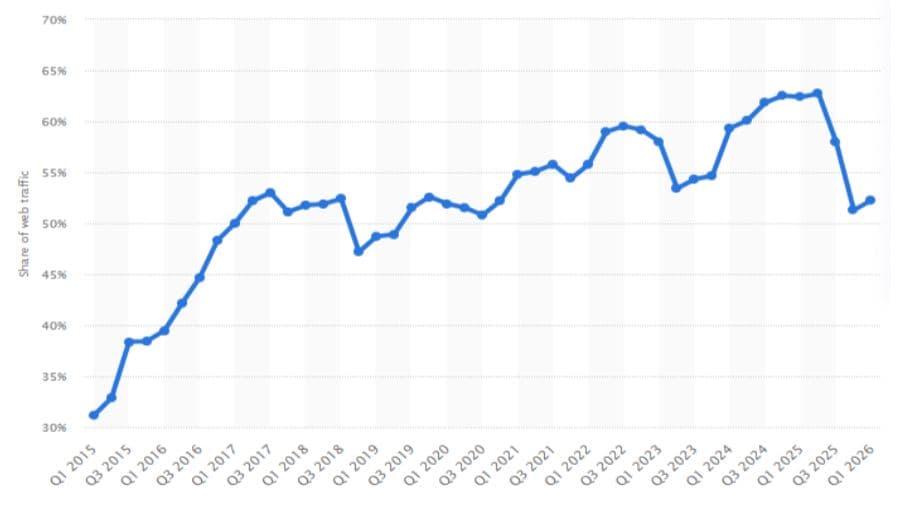
Share Of Web Traffic From Mobile Devices Worldwide
(Source: statista.com)
- By Q1 2025 Mobile web traffic has grown around 62.39%.
- By Q2 2025 Mobile web traffic has grown around 62.73%.
- By Q3 2025 Mobile web traffic has grown around 57.96%.
- By Q4 2025 Mobile web traffic has grown around 51.29%.
- Mobile web traffic has grown significantly from around 31.16% in Q1 2015 to approximately 52.27% in Q1 2026, reflecting a major shift in how users access the internet over the past decade.
Average Screen Time Breakdown By Device And Activity
- In 2026, the typical internet user spends roughly 6 hours 40 minutes per day on screens, up from under 6 hours in 2024.
- Globally, smartphones account for the largest single share of screen time, with the average screen time on mobile devices reaching an estimated 4 hours and 37 minutes per day as of 2026.
- Time spent on desktop and laptop computers averages around 2 hours and 51 minutes daily, a segment often characterized by professional, educational, or dedicated gaming activities rather than passive browsing.
- A staggering 96.5% of the world’s 5.35 billion internet users access the web via a mobile phone.
- The single largest activity contributing to average screen time is watching television and streaming online videos, which collectively command an estimated 3 hours and 16 minutes of a user’s day.
- Daily time dedicated to social media platforms is substantial, averaging 2 hours and 31 minutes globally, in 2026.
- Gaming activity adds a considerable amount to the total average screen time, estimated at approximately 1 hour and 46 minutes per day.
| Digital Activity | Global Average Screen Time Daily | Proportion of Total Time Approximate |
| Watching TV/Streaming Video | 3 hours and 16 minutes |
48.4% |
|
Social Media Usage | 2 hours and 31 minutes | 34% |
| Gaming Console, PC, Mobile | 1 hour and 46 minutes |
26.2% |
|
Browsing Websites Non-Social | 51 minutes | 12.6% |
| Video Chatting | 20 minutes |
4.9% |
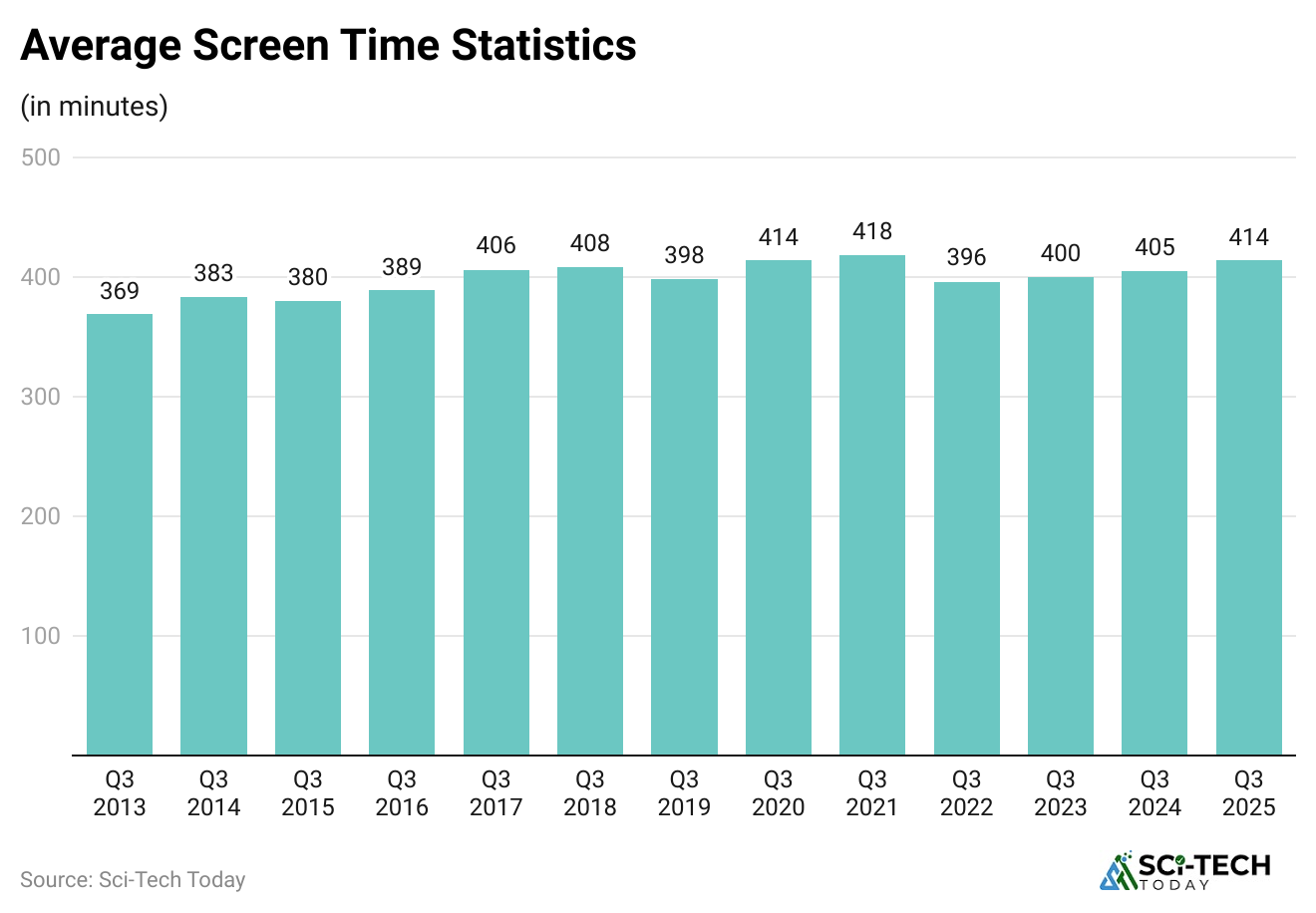
Average Screen Time Trends
(Reference: demandsage.com)
- As of 2024/2025, the global average screen time for internet users aged 16 to 64 stands at approximately 6 hours and 45 minutes per day, which equates to over 40% of an individual’s typical waking hours.
- Daily global average screen time has seen a substantial climb of nearly 45 to 50 minutes since 2013.
- The period around Q3 2021 saw a peak, reaching approximately 6 hours and 58 minutes daily, which was an approximate 1% rise over 2020.
- Following the pandemic-driven peak in 2021, the average screen time stabilized, with a slight decrease observed in Q3 2022 to 6 hours and 36 minutes, before ticking back up to the current 6 hours and 45 minutes in 2024.
- While annual fluctuations occur, the long-term trend remains positive, with projections estimating that the global daily average screen time may approach 6 hours and 54 minutes by the end of Q3 2025.
| Year/Period | Global Average Screen Time Daily | Annual Change Approximate |
| Q3 2013 | 6 hours and 9 minutes | Baseline |
| Q3 2017 | 6 hours and 46 minutes | 4.4% |
| Q3 2020 Pandemic Surge | 6 hours and 54 minutes | 4.0% |
| Q3 2022 Post-Surge Dip | 6 hours and 36 minutes | 5.1% |
| Q3 2024/2025 Current | 6 hours and 45 minutes | 1.4% Since Q3 2023 |
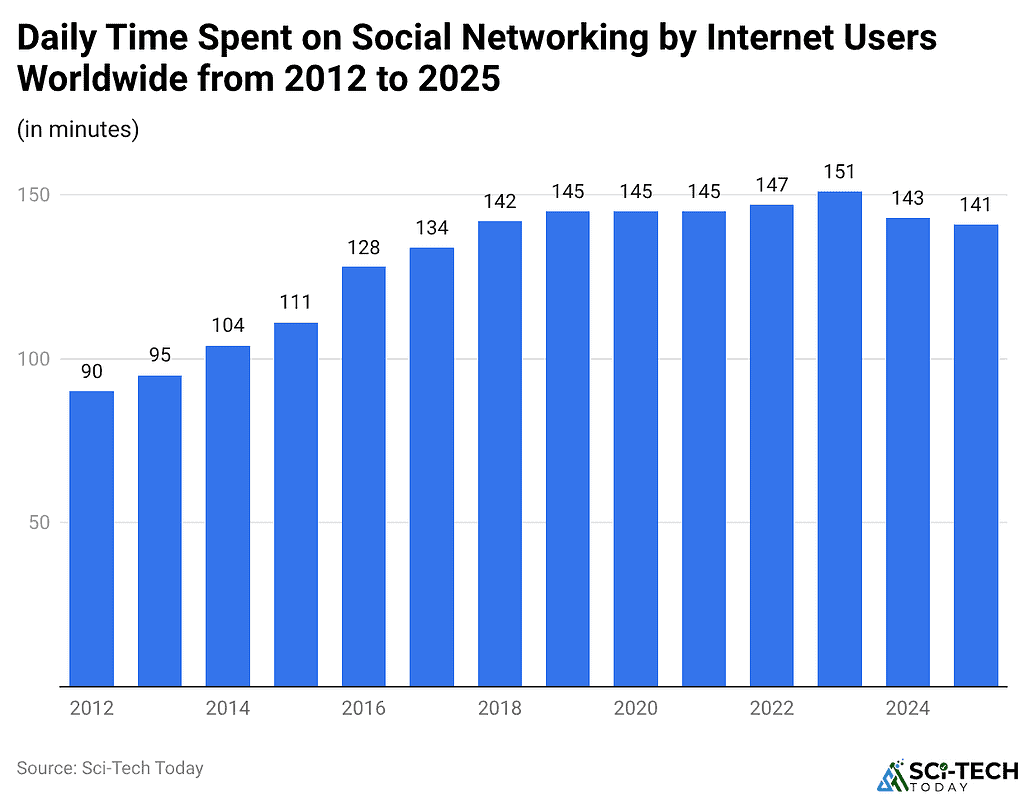
Daily Time Spent On Social Networking By Internet Users
(Reference: statista.com)
- Daily social media usage has grown significantly from 90 minutes in 2012 to 141 minutes in 2025, reflecting a more than 50% increase in time spent on social platforms over the past decade.
- A slight decline is observed in 2024 (143 minutes) and 2025 (141 minutes), possibly indicating user fatigue, growing concerns about screen time, or shifts toward more intentional digital habits.
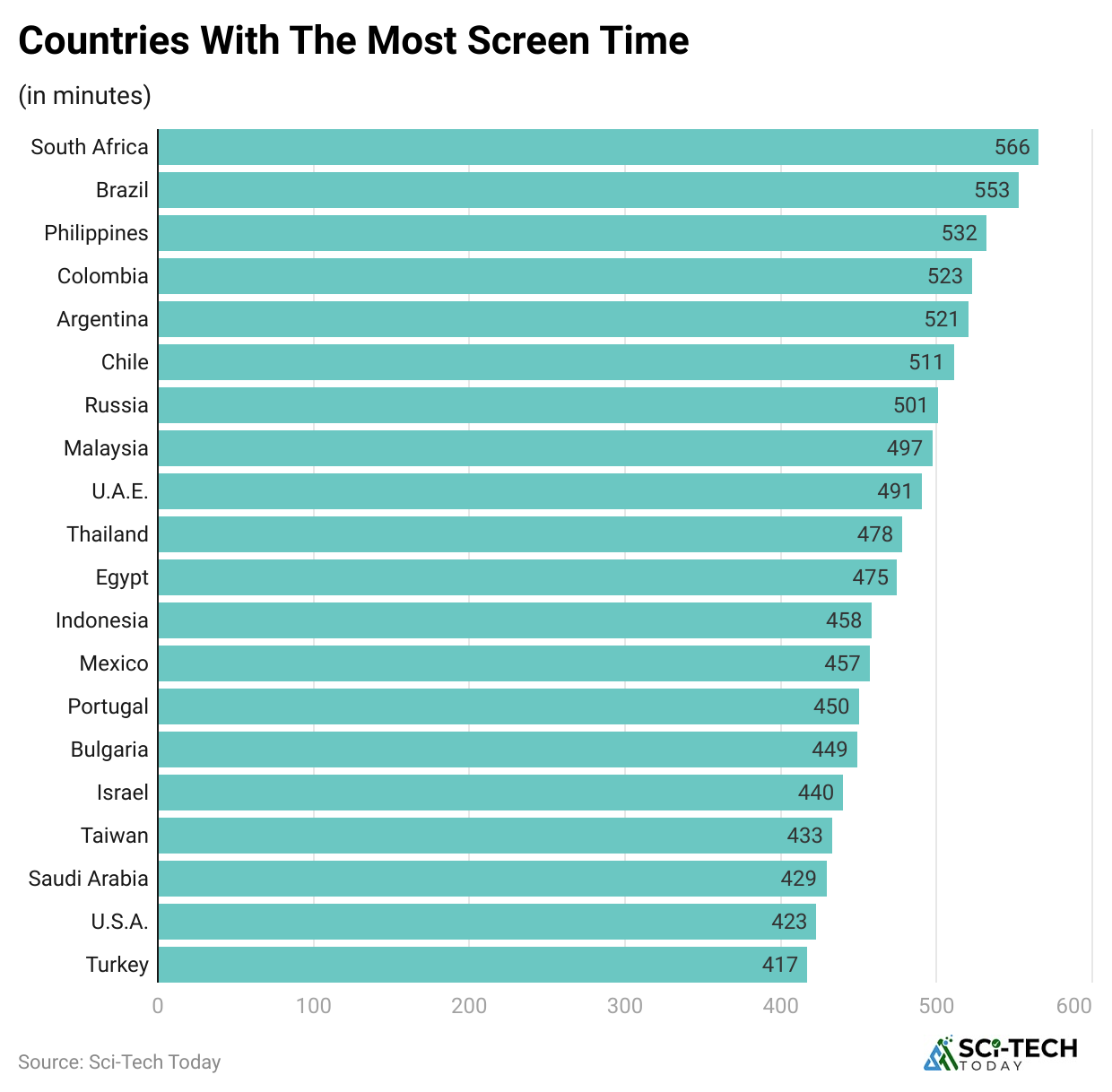
Geographic Disparities In Average Screen Time
(Reference: demandsage.com)
- South Africa consistently reports the highest average screen time globally, with users spending an alarming average of 9 hours and 24 minutes per day on internet-connected screens.
- Several countries follow closely behind, with Brazil reporting a daily average of 9 hours and 13 minutes and the Philippines at 8 hours and 52 minutes.
- The average screen time in the United States is slightly above the global average, recorded at approximately 7 hours and 2 minutes per day.
- Developed economies in Europe often show significantly lower average screen time figures; for instance, European countries generally average around 6 hours and 2 minutes daily, with countries like Austria and Switzerland reporting closer to 5 hours and 30 minutes.
- The global average time spent exclusively on a smartphone is approximately 4 hours and 37 minutes, while the US average sits lower at about 3 hours and 22 minutes.
| Country/Region | Total Average Screen Time Daily | Mobile Screen Time Daily |
| South Africa | 9 hours and 24 minutes | 5 hours and 11 minutes |
| Brazil | 9 hours and 13 minutes | 5 hours and 12 minutes |
| Philippines | 8 hours and 52 minutes | 5 hours and 21 minutes |
| Global Average | 6 hours and 45 minutes | 4 hours and 37 minutes |
| United States | 7 hours and 2 minutes | 3 hours and 22 minutes |
| Germany | 5 hours and 33 minutes | 2 hours and 42 minutes |
Average Screen Time By Generation
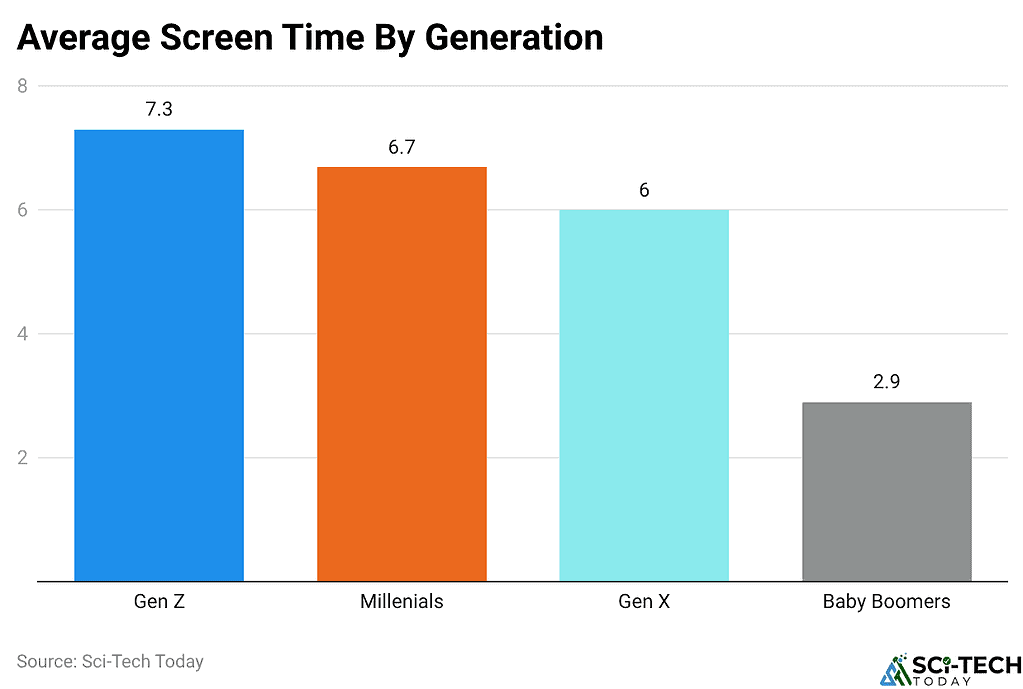
(Reference: zippia.com)
- Generation Z, typically aged 13 to 28, reports the most extensive digital engagement, logging a staggering average screen time of approximately 7.3 hours per day.
- Millennials ages 29 to 44 follow next, with their daily average screen time clocking in at about 6 hours and 7 minutes.
- Generation X, ages 45 to 59, maintains a more restrained average screen time, averaging roughly 6 hours per day.
- Baby Boomers and older adults 60+ register the lowest average screen time, typically around 2 hours and 9 minutes daily.
- In the most active age bracket, 16 to 24, females record an average screen time of about 7 hours and 32 minutes daily, which is notably higher than the 7 hours and 7 minutes reported by their male counterparts.
| Generation Age Range | Average Daily Screen Time | Highest Average Daily Mobile Time |
| Gen Z 13 to 28 | 7 hours 3 minutes | 6 hours and 27 minutes |
| Millennials 29 to 44 | 6 hours and 7 minutes | 4 hours and 36 minutes |
| Gen X 45 to 59 | 6 hours | 4 hours and 9 minutes |
| Baby Boomers 60+ | 2 hours and 9 minutes | 3 hours and 31 minutes |
Children And Teen Average Screen Time Data
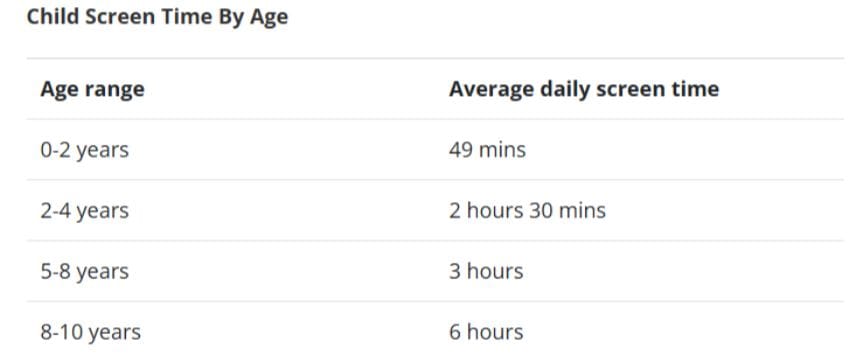
(Source: zippia.com)
- Children aged 0–2 years spend an average of 49 minutes per day on screens, indicating that even infants and toddlers are exposed to digital devices despite expert recommendations for minimal screen use at this stage.
- Screen time jumps sharply for children aged 2–4 years to 2 hours and 30 minutes daily, reflecting growing exposure to educational apps, cartoons, and interactive content during early childhood.
- Kids aged 5–8 years average 3 hours of daily screen time, as school-related digital learning, gaming, and entertainment become more prominent in their routines.
- Children aged 8–10 years’ experience a significant rise to 6 hours per day, highlighting the increasing role of smartphones, social media, online gaming, and streaming in pre-teen lifestyles.
| Age Group U.S. Estimates | Average Screen Time Entertainment Only | Parental Smartphone Ownership Rate |
| Ages 0 to 2 | Approximately 49 minutes | 40% ever interacted with a smartphone |
| Ages 2 to 4 | Approximately 2 hours 30 minutes | 29% of parents say their child has their own smartphone |
| Ages 5 to 8 | Approximately 3 hours | 60% of parents say their child has their own smartphone |
| Ages 8 to 10 | Approximately 6 hours | N/A |
Parental Control and Management of Average Screen Time

(Reference: meetcircle.com)
- A concerning 40% of parents report that they do not place any concrete limits on their child’s screen time.
- Nearly half, 49% of U.S. parents admit to relying on screen time daily to manage parenting challenges, with 28% conceding that they give in to screen time multiple times a week to avert tantrums.
- A substantial 60% of parents report feeling guilty about their child’s screen time, largely citing excessive duration and the feeling of using screens as a ‘babysitter’ as the primary sources of their concern.
- Despite recommendations to limit screen time for children aged 2 to 5 to just one hour per day, only about 1 in 3 children in this age group meet these guidelines globally.
- The majority of parents 68% agree that children should generally be at least 12 years old before receiving their own smartphone, even though 60% of 11 to 12-year-olds in the U.S. already own one.
| Parental Approach to Screen Time Limits U.S. | Percentage of Parents | Implication |
| Do not set any limits | 40% | Leads to significantly higher odds of excessive screen use. |
| Set a daily limit on time | 27% | The most common form of active restriction. |
| Permit screen use only on weekends | 17% | A less common but structured approach to limiting weekday exposure. |
The Health Implications of Average Screen Time
- Research continues to confirm that approximately 27.1% of teenagers who log 4 or more hours of daily screen time report symptoms of anxiety, while 25.9% report symptoms of depression.
- Teenagers who spend 6 to 7 or more hours a day on screens face approximately twice the risk of being diagnosed with anxiety or depression relative to those with lower usage habits.
- Elevated mental health risk begins at around 3 hours per day of social media use, and adolescents with addictive-pattern screen use face 2-3× higher risk of suicidal behaviours regardless of total hours.
- According to cross-national data 2026, nearly 280,000 young people aged 11–15 across 44 countries in Europe, Central Asia, and Canada found that 1 in 9 adolescents (11%) show signs of problematic social media behavior, up from 7% in 2018.
- Survey data from the US reveal that approximately 69% of Americans have experienced a phone-related physical health issue such as eye strain, neck or shoulder pain, or headaches in the past year.
- Newer data add that text neck syndrome affects an estimated 68% of intensive smartphone users, and nearly half of Americans (46%) now self-identify as addicted to their phones, checking their devices roughly 186 times per day.
- Adolescents in the highest screen time category are approximately 27% more likely to be overweight or obese (OR = 1.27), while among children logging 5+ hours daily, nearly 43% are overweight or obese.
Conclusion
Overall, the analysis of average screen time confirms that digital engagement has become a deep-seated structural element of modern human behavior, with individuals globally dedicating a substantial 6 hours and 45 minutes of their day to internet-connected screens.
This metric is amplified in certain demographics, with Gen Z exceeding 9 hours daily, effectively digitizing a full workday’s worth of time outside of traditional work. While technology delivers access to information, connection, and productivity, the volume of this usage, especially the high rates of mobile-centric social media and entertainment consumption, raises vital questions for public policy, education, and health.
This data makes it undeniable: from the 49% of two-year-olds interacting with a smartphone to the 27.1% of high-screen-time teens experiencing anxiety, this kinda digital has brought about a need for conscious, data-informed approaches.
So, the future of well-being lies in digital literacy and encouraging a mindful use of technology, ensuring that screens serve as a tool for a better quality of life rather than a source of detriment. I hope you agree with my conclusion. If you find this analysis helpful, kindly share it with your friends. If you have any questions, kindly let us know in the comments section. Thanks for staying up till the end.
FAQ
The recommended daily amount of recreational screen time for adults is 2-4 hours per day. Nevertheless, the recommended occupation-related amount of screen time is between 7 and 8 hours per day if your job requires you to work at a computer. It is important to strive for the proper balance.
Yes, 7 hours per day of screen use is pretty close to the global average for adults. That figure usually varies between 6 and 7 hours per day. Nevertheless, depending on your daily routine, this amount may be too much.
According to research, Gen Z uses screens 7 to 9 hours per day on average. In addition, this generation holds the record for the most used screens among generations because their daily use exceeds the one-hour mark. On the smartphone alone, the daily use exceeds 6.5 hours.

Sources