









Overview
Career Change Statistics: Thinking about changing your career? You’re not alone. Many people switch careers to earn more, find better work-life balance, learn new skills, or follow their passion. A career change can feel challenging, but it also creates exciting opportunities for personal and professional growth. With the right plan, you can move into a role that matches your interests, strengths, and future goals. The key is to understand your options, build the skills you need, and prepare for the transition.
This guide explains everything you need to know about changing careers, from choosing the right path to overcoming common challenges and making your career move a success.
Best Value
- The average employee stays in the same job for 4 years, with tenure increasing significantly with age.
- 52% of American employees are considering a career change this year, and 44% are actively planning one.
- Toxic workplaces drive career moves, with 43% leaving because of unhealthy work environments and 41% seeking better work-life balance.
- By 2030, 70% of job skills are expected to change, making continuous learning essential.
- 80% of career changers report being happier after switching careers.
- 77% earn the same or more within 2 years of changing careers.
- Workers completing certifications or online courses transition careers 40% faster than others.
- Financial concerns remain the biggest obstacle, with 69% saying they cannot afford a career change.
- 97% of professionals already know the career or life change they want, but many delay taking action.
- Work-life balance has overtaken salary as employees’ top workplace priority for the first time in 22 years.
What is Median Job Tenure?
- In 2020, the average time people stayed at a job was four years. Workers aged 25-34 usually keep a job for 2.8 years.
- This goes up to 4.9 years for those aged 35-44. For people aged 45-54, the average job duration is 7.6 years, and those aged 55-64 have a median tenure of 10.1 years.
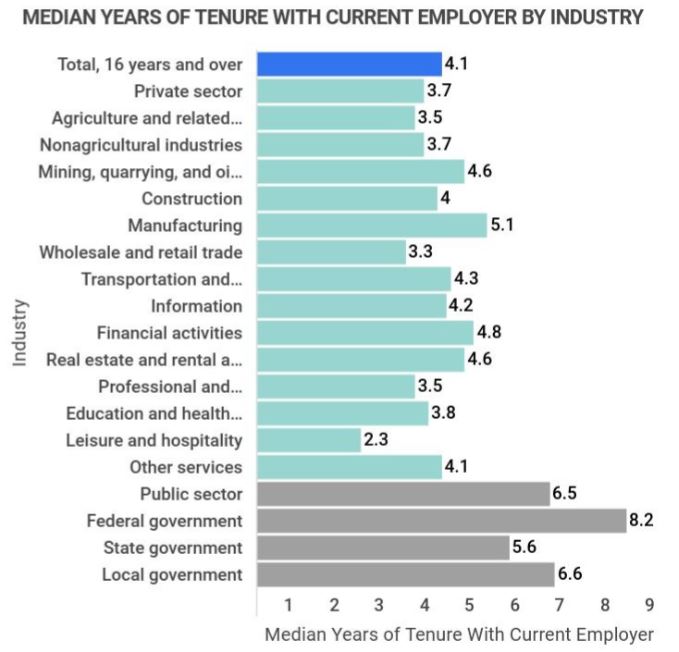
- Public sector workers tend to stay in their jobs almost twice as long as those in the private sector, with median tenures of 6.5 years and 3.7 years, respectively.
- Federal employees usually stay in the same job for an average of 8.2 years, local government employees for 6.6 years, and state employees for 5.6 years.
- In the private sector, people working in manufacturing have the longest job tenure, averaging 5.1 years, while those in the leisure and hospitality industry have the shortest tenure, averaging just 2.3 years.
- According to Career Change Statistics, food service workers have the shortest job duration at 1.9 years, while those in management and legal jobs stay the longest, with a median tenure of 5.8 years.
Career Change Trends and Employment Statistics
- According to Apollo Technical, there is a common belief that people change careers 7 times during their lifetime, but no reliable data confirms this claim.
- 52% of American employees are considering a career change this year, while 44% are already planning to switch careers.
- Financial limitations and limited time often prevent many people from making a career change.
- BLS data shows employees stay with their current employer for an average of 4.6 years, while Boterview estimates people change jobs every 3.9 years.
- Managers and professionals have the longest median job tenure at 5.5 years, while service workers average 3.2 years.
- Workers aged 65 or older stay with employers for 10.3 years, compared with 3.2 years for workers aged 25-34.
Key Statistics on Why People Change Careers
- According to careershifters.org, 43% of professionals change careers because of unhealthy work environments, 41% seek better work-life balance, and 40% leave due to a lack of purpose or values alignment. Pay motivates 30% of career changes.
- 51% of 2,600 UK adults worry that AI could affect their jobs or employment conditions.
- The World Economic Forum reported that 50% of employers plan to reshape their businesses for AI, 67% will hire AI-skilled talent, and 40% expect workforce reductions where AI can automate tasks.
- Poor leadership and unhealthy workplace culture remain the leading reasons employees leave, while supportive colleagues and flexible work encourage them to stay.
- Interest in career development is rising, with 41% willing to leave without future-proof learning opportunities. AI training is the top choice (23%), followed by IT skills (11%) and leadership training (7%).
- By 2030, 70% of job skills are expected to change, making continuous learning essential.
- Better work-life balance (41%), stronger career opportunities (24%), and improved values alignment (59%) remain major reasons people change careers.
Career Change Success Rates and Outcomes
- Around 80% of career changers say they are happier in their new jobs than in their previous careers. People who planned their transition reported the highest satisfaction.
- Income usually improves over time. Although some people earn less during the transition, about 77% earn the same or more within 2 years, according to U.S. Bureau of Labor Statistics research. Those moving into technology and healthcare often recover their income faster.
- Most professionals secure a new job within 6 to 12 months, depending on the industry and the amount of retraining required.
- Workers who completed targeted certifications or online courses changed careers up to 40% faster than those who relied only on networking or job applications.
- Only 17% of career changers regret switching careers. The most common regret is waiting too long to make the change.
Reasons for Career Pivots
- Better pay motivates 33% of workers to change careers.
- 29% seek greater job stability.
- 23% prioritize better work-life balance.
- 20% want more remote work flexibility.
- 17% report fewer opportunities in their current industry.
- 16% change careers because of burnout.
Career Pivot Trade-Offs
(Source: monster.com)
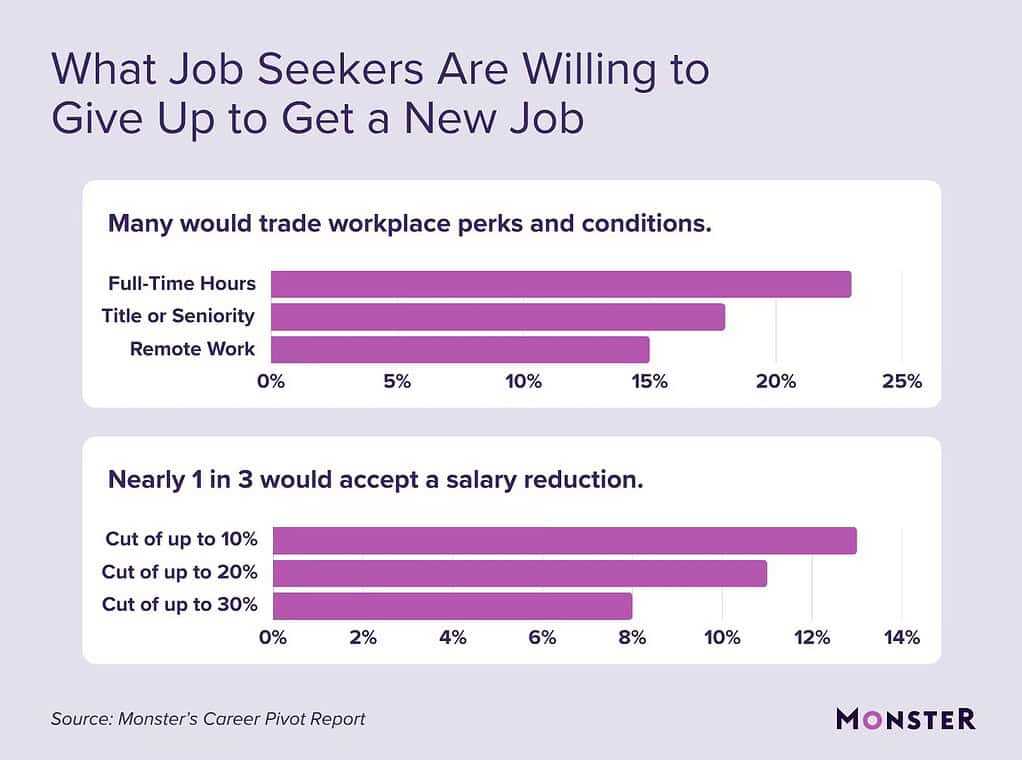
- 23% would give up full-time hours.
- 18% would accept a lower title or seniority.
- 15% would give up remote work.
- 13% would accept a pay cut of up to 10%, 11% up to 20%, and 8% up to 30%.
Career Change Demographics Statistics by Age
(Reference: zippia.com)
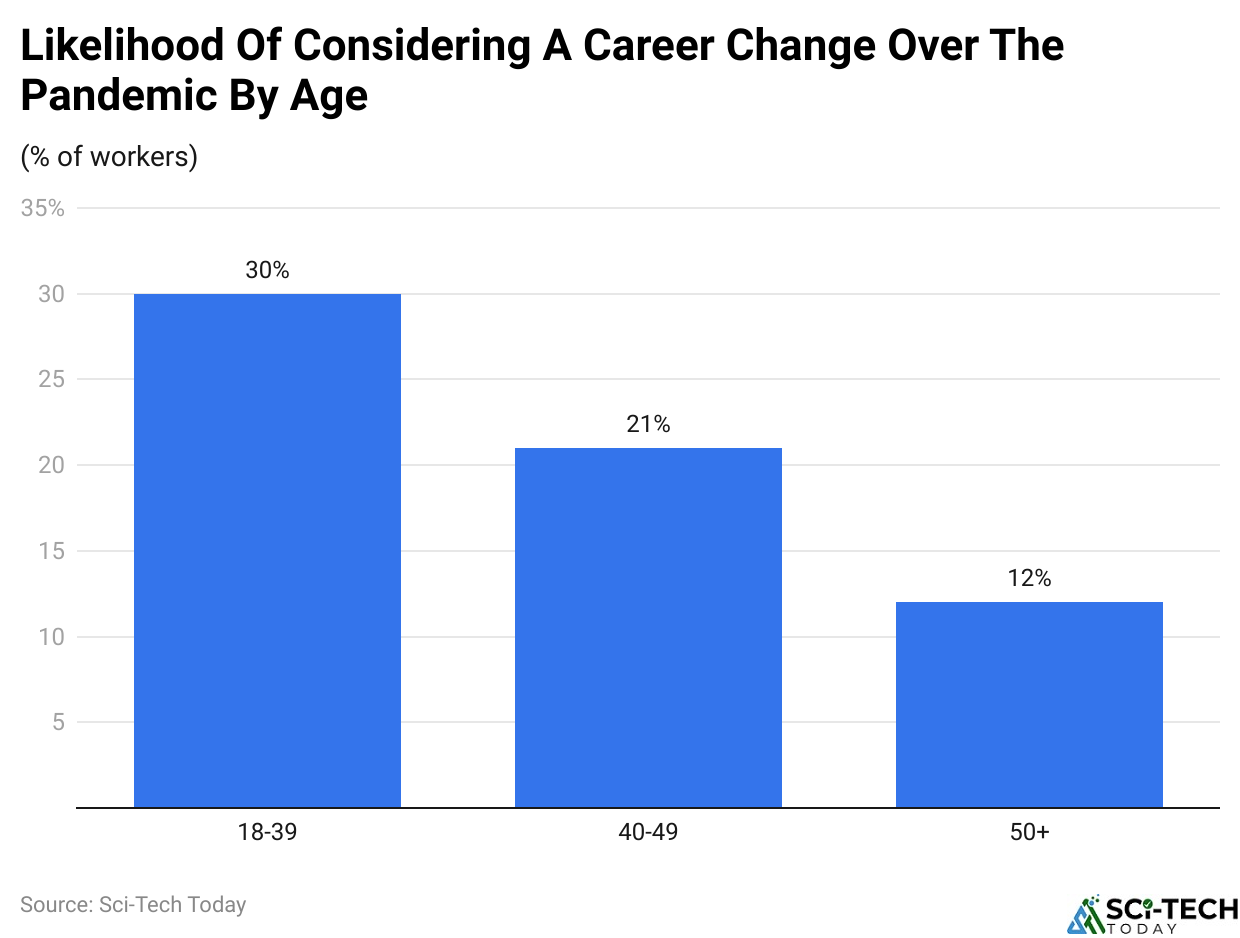
- 20s and 30s: Almost half (49%) of people in their 20s and 30s have switched jobs at least once. They often look for new experiences, challenges, and work that matches their interests and passions.
- 40s: About 33% of people aged 40 and up change jobs regularly. This is often due to a search for more satisfaction, midlife reflections, or adjusting to changes in their industry.
- 50s and Older: People aged 50 and above also think about changing careers, but less often. In 2022, 7% of Americans aged 55 or older changed jobs, usually to follow long-held dreams or respond to shifts in the job market.
- Between ages 25 and 34, workers typically hold 4.3 to 4.6 jobs. Between ages 35 and 44, they take on two or three more positions.
- As Career Change Statistics states, career changes can vary based on factors like country, industry, and economic conditions.
- Informal job changes, like self-employment or gig work, are becoming more common but are only sometimes included in official statistics.
Successful Career Changes
- To change careers successfully, planning, learning new skills, and expanding professional networks are important.
- Many people get help from career coaches or mentors to improve their chances of success.
(Source: zippia.com)
Gender and Career Changes
- Women: Women change careers more often than men. A 2022 LinkedIn survey found women were 20% more likely than men to switch industries. Women often look for better work-life balance, follow their passions, or leave bad work environments. Women make up 28% of all employees, while men account for 31%.
- Men: Men are often motivated by career advancement or higher pay.
(Reference: jobera.com)
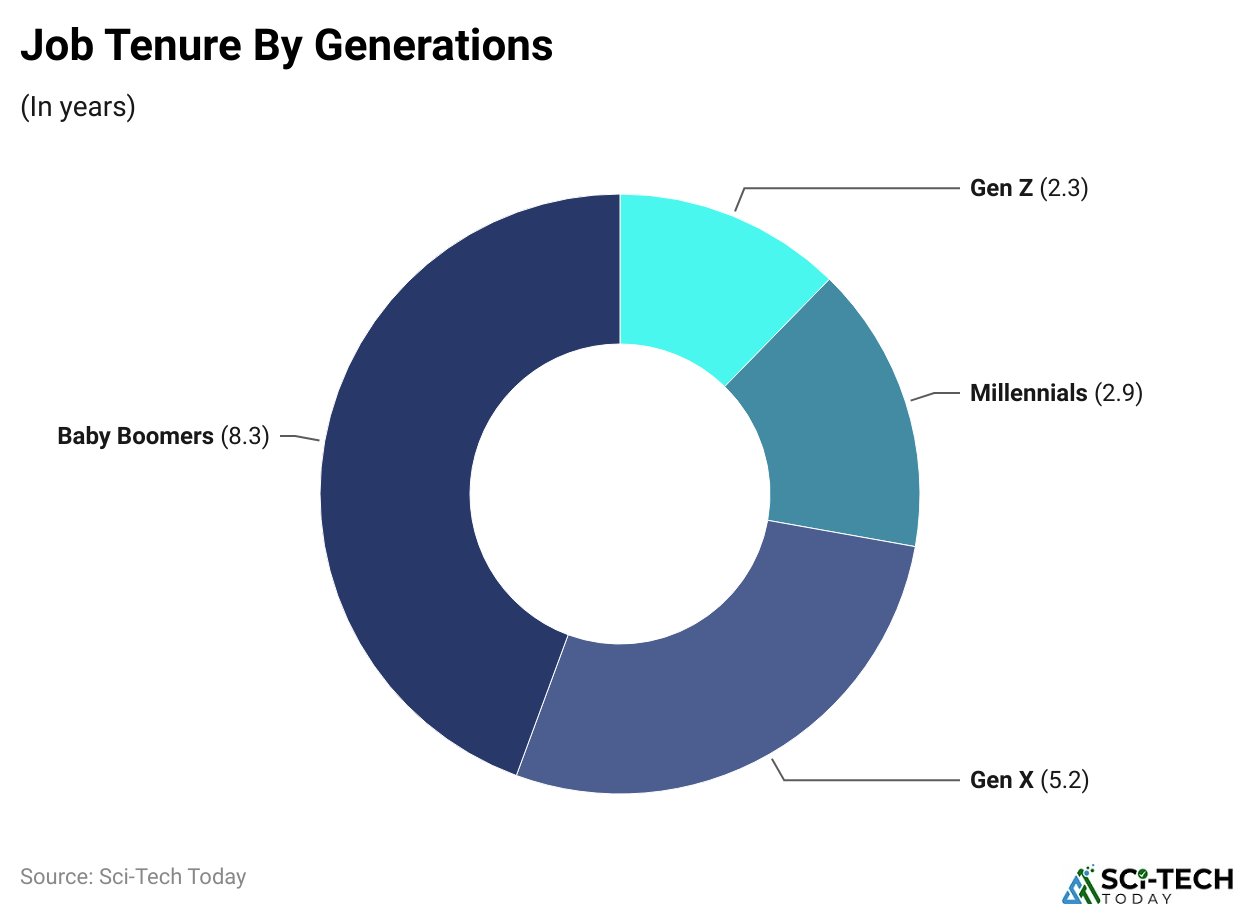
- In the above pie chart, we can see the Job tenure by generation:
| Gen X | 5.2 years |
| Baby Boomers | 8.3 years |
| Millennials | 2.9 years |
| Gen Z | 2.3 years |
- Women may switch to fields like technology, finance, entrepreneurship, or healthcare, while men might move into roles in healthcare or the arts.
- Life events like having children significantly impact women’s career changes, leading many to look for flexible work options, according to Career Change Statistics.
- Women may also change careers to break through glass ceilings or escape gender inequality in their current jobs.
- Many women are turning to self-employment and entrepreneurship for more independence.
Race and Career Changes
- Different racial groups experience varying rates of career changes, influenced by factors like education access, job opportunities, and professional networks.
- Underrepresented Groups: These individuals may face more obstacles and fewer opportunities for advancement, which can influence their job changes. Higher self-employment and entrepreneurship rates are seen among Asian Americans and African Americans.
- Career Change Statistics stated that people from marginalized backgrounds may find it harder to switch careers due to unequal access to resources like funding and professional networks.
Education and Career Changes
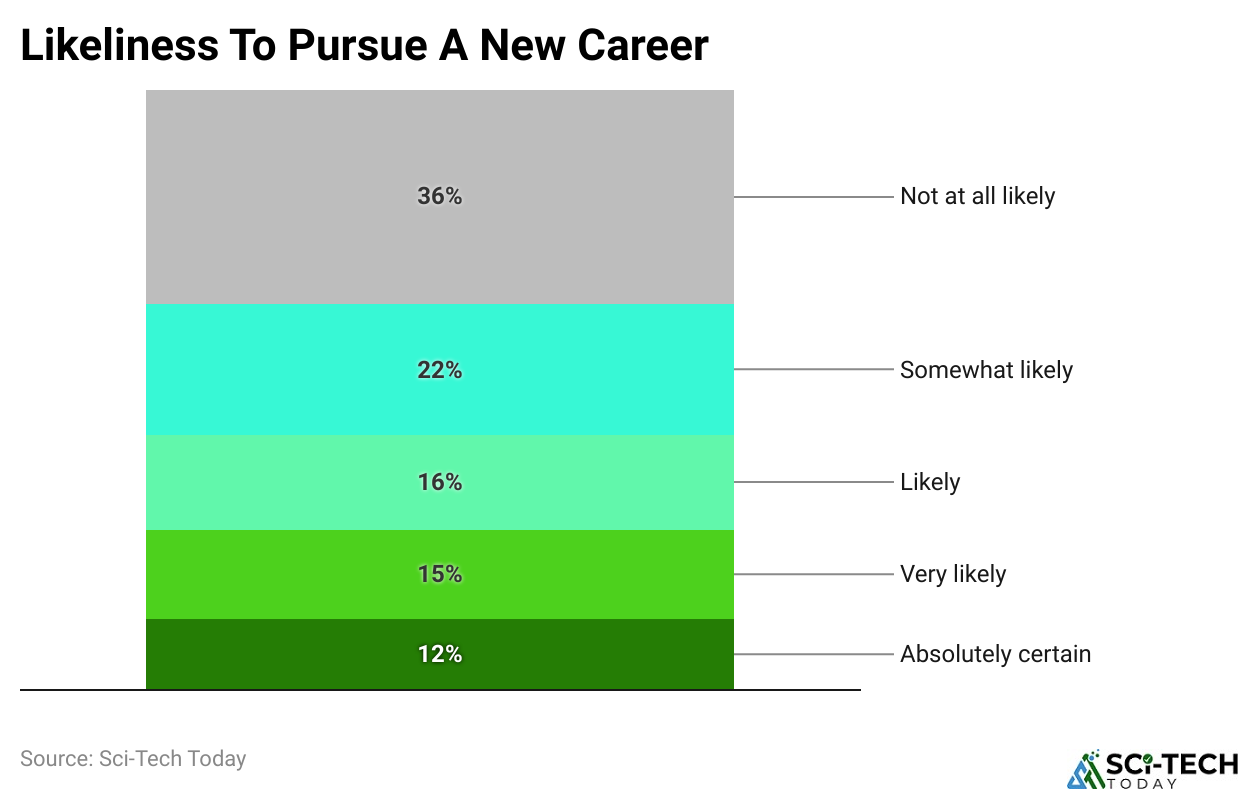
(Reference: enterpriseappstoday.com)
- In the above chart, we can see the likelihood of pursuing a new career.
- Higher education levels are linked to higher rates of career changes. People with degrees tend to adapt better to new job opportunities.
- Some people pursue more education or training, such as certificates or vocational programs, to move into their desired fields, as per Career Change Statistics.
- Graduates: About 29% of graduates have switched careers since starting their first post-graduate job.
- Industry Demands: Certification requirements can drive career changes. Some people return to school to improve their employability.
- Non-Traditional Education: Online courses, boot camps, and vocational training are becoming popular for career changers.
- Lifelong learning and skill enhancement are crucial for successful career changes.
| Occupation | Growth Rate 2020- 2030 | 2020 Median Pay |
| Film and video editors | 33% | USD 67,250 per year |
| Information security analysts | 0 | USD 103,590 per year |
| Miscellaneous entertainers and performers, sports and related workers | 34% | USD 15.70 per hour |
| Animal caretakers | 0 | USD 26,080 per year |
| Physical therapist assistants | 0 | USD 59,770 per year |
| Entertainment attendants and related workers, all other | 0 | USD 27,230 per year |
| Statisticians | 35% | USD 92,270 per year |
| Occupational therapy assistants | 0 | USD 62,940 per year |
| Makeup artists, theatrical and performance | 37% | USD 106,920 per year |
| Athletes and sports competitors | 38% | USD 50,850 per year |
| Model makers, wood | 39% | USD 64,050 per year |
| Exercise trainers and group fitness instructors | 39% | USD 40,510 per year |
| Costume attendants | 0 | USD 42,910 per year |
| Agents and business managers of artists, performers, and athletes | 0 | USD 75,420 per year |
| Cooks, restaurant | 49.00% | USD 28,800 per year |
| Solar photovoltaic installers | 52.00% | USD 46,470 per year |
| Nurse practitioners | 52.00% | USD 111,680 per year |
| Ushers, lobby attendants, and ticket takers | 62.00% | USD 25,110 per year |
| Wind turbine service technicians | 68.00% | USD 56,230 per year |
| Motion picture projectionists | 70% | USD 27,490 per year |
Career Change Statistics, Seniority Level Insights
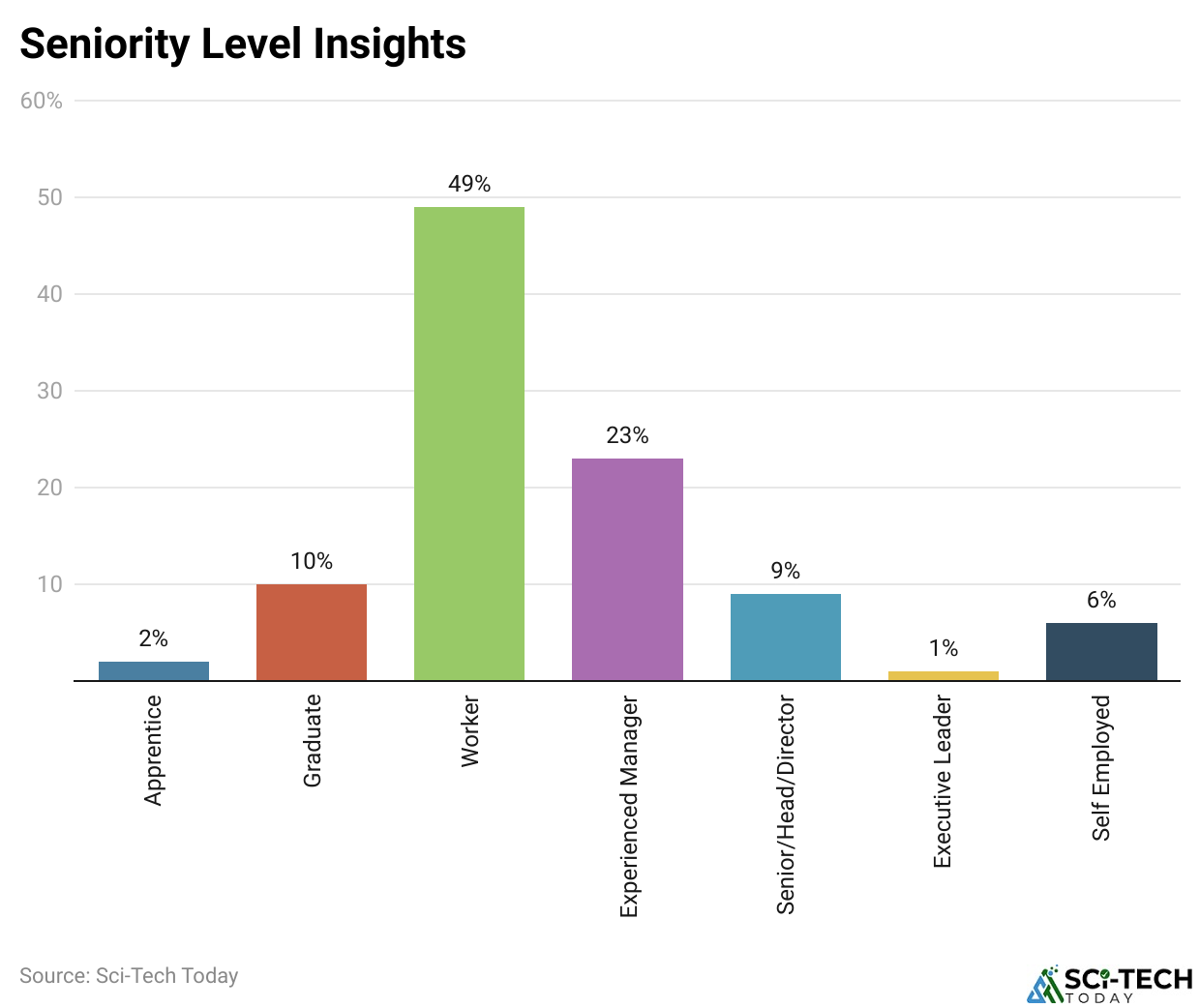
(Reference: tribeandseek.com)
- 72% of people changing careers are workers or managers.
- 94% of those changing careers work for someone else, while only 6% are self-employed. This shows that self-employed people might be more satisfied.
- Career growth tends to improve with age, but even by age 44, only 19% of those changing careers feel they have a senior role, according to Career Change Statistics.
- The biggest boost in career growth happens between the late twenties and early thirties, with the number of experienced managers nearly doubling from 16% to 29%.
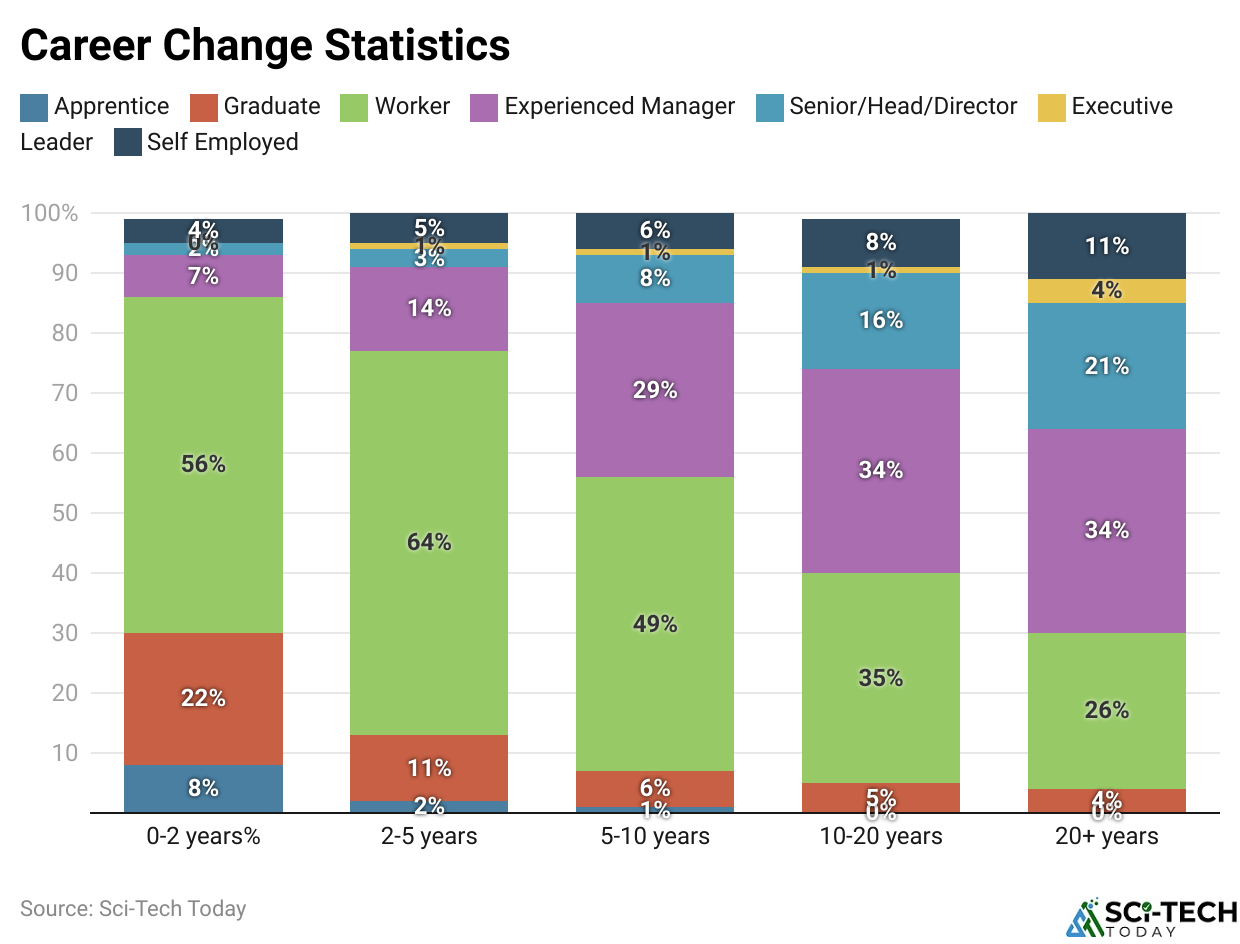
(Reference: tribeandseek.com)
- People who change careers are twice as likely to be senior leaders with over ten years of experience compared to those with 5-10 years in their current industry.
- As people move up in their careers, they feel their responsibilities grow. About 31% of workers feel this way, compared to 47% of experienced managers.
- The desire for autonomy increases with seniority. While only 9% of workers prioritize autonomy, 20% of senior managers do.
- The need for support decreases as people gain seniority. 34% of workers rank support as their top priority, but only 20% of executives do.
- Career Change Statistics stated that experienced managers are more likely to prioritize having a vision for their work, with 19% of them focusing on this, compared to 28% of executives.
- Among senior managers, 53% are parents, while 50% of executives are parents.
- Senior manager parents are 2.1 times more likely to have already found flexibility in their careers compared to worker parents.
- The less senior someone is, the more they value work-life balance: 80% of workers prioritize it, compared to 74% of senior managers and 68% of executives.
Career Change Income Insights Statistics
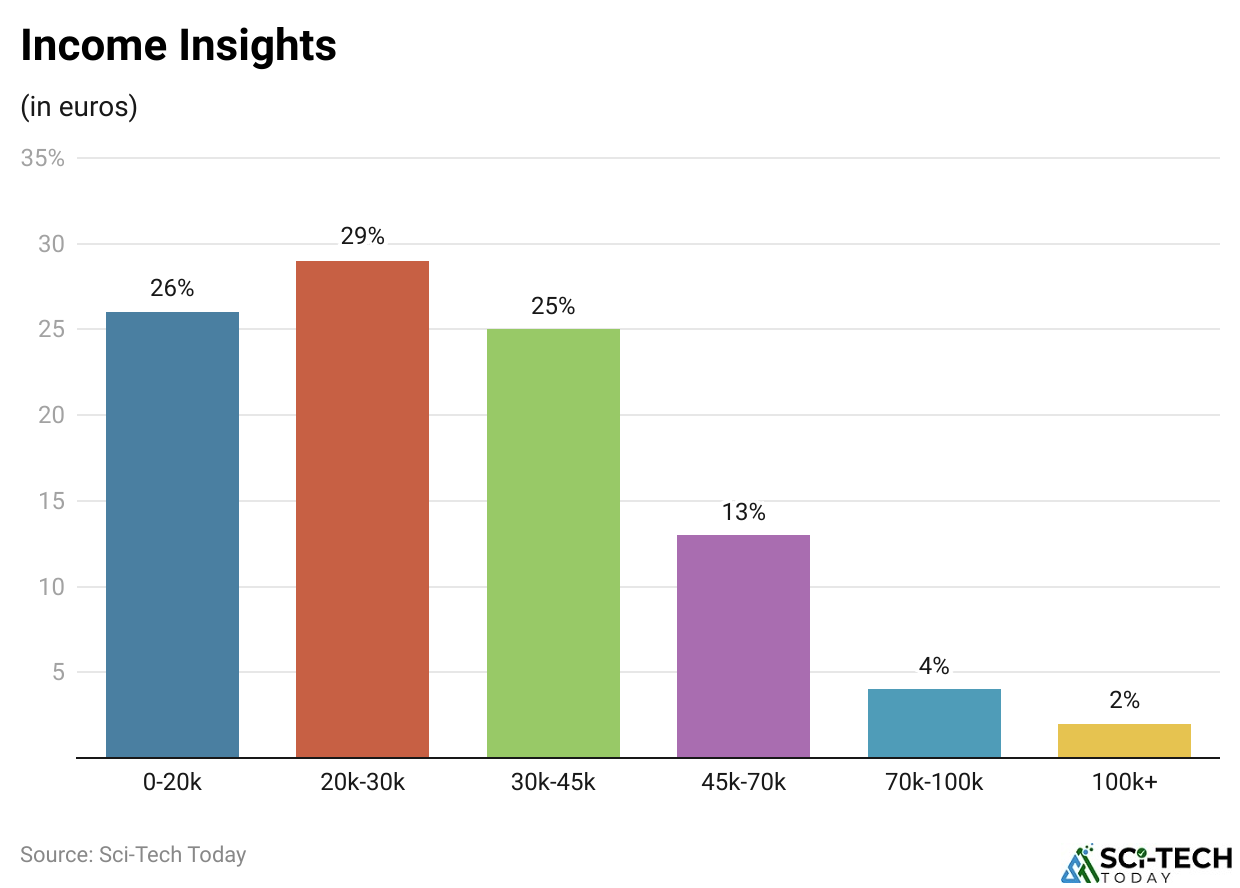
(Reference: tribeandseek.com)
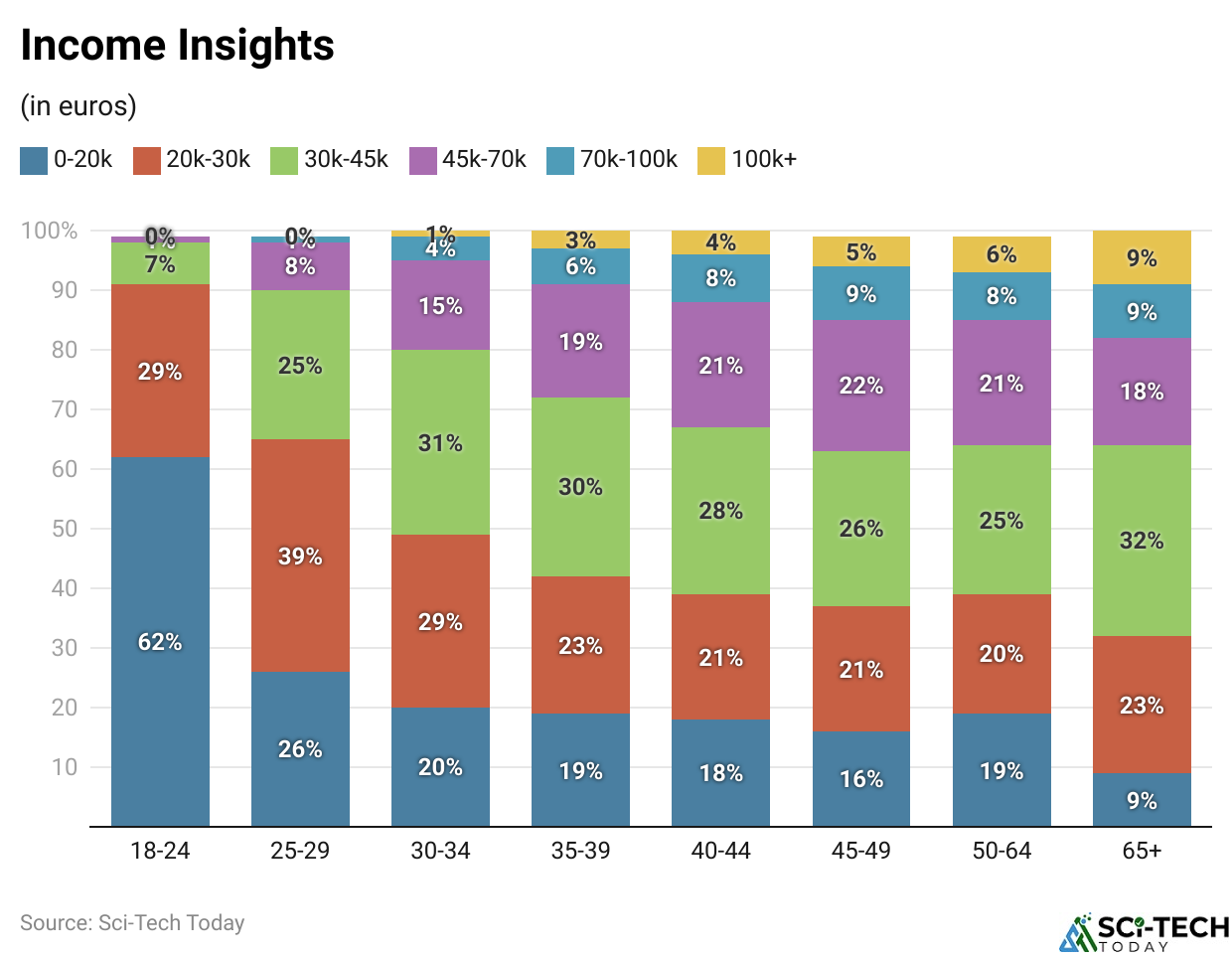
- In the above chart, we can see the income insights as a percentage.
Income Levels:
- 62% of 18-24-year-olds earning less than USD 25,000 per year are likely exploring different career options.
- 65% of people aged 25-29 earn less than USD 37,000 per year.
- Earnings generally increase with age and experience, but even at age 44, 67% of people are still earning under USD 45,000 per year, according to Career Change Statistics.
Experience and Earnings:
- People with 5-10 years of experience are 2.1 times more likely to earn over USD 45,000 compared to those with 2-5 years of experience.
- Among those with over 20 years of experience, 32% still earn less than USD 37,000.
(Reference: tribeandseek.com)
- In the above chart, we can study the income and age statistics in career change statistics.
Managerial Roles and Income:
- Experienced managers see a significant income boost, with 34% earning more than USD 45,000.
- Career Change Statistics stated that earning more than USD 70,000 is common only in senior roles, with 33% of senior managers earning above this amount.
Income and Job Priorities:
- 26% of people earning USD 0-25,000 prioritize job security, compared to 19% of those earning over USD 100,000.
- The desire to have an impact at work increases as the need for job security decreases, with 22% of those earning USD 100,000+ valuing impact compared to 14% of those earning less, as per Career Change Statistics.
Flexibility and Earnings:
- 35% of parents earning under USD 37,000 have job flexibility, while 46% of parents earning over USD 100,000 have this flexibility.
How Long Employees Stay Retained In A Job
- The length of time people stay in a job can depend on various factors, like the industry, type of job, personal preferences, and market conditions.
- While there isn’t a set amount of time people stay in one job, data can show trends and typical lengths of employment.
- As of January 2022, the Bureau of Labor Statistics (BLS) reported that the median tenure for workers in the US was 4.1 years.
- This means that, on average, people stay with one company for about four years before moving on.
(Source: zippia.com)
- In the above chart, we can see the median years of tenure with current employers by industry.
- BLS data show that job tenure usually increases with age.
- People aged 55-64 had the longest median job tenure at 10.3 years, while younger workers aged 25-34 changed jobs more frequently as they explored careers, gained experience, and sought better opportunities.
- Career Change Statistics show that Caucasians change jobs more often than any other racial or ethnic group.
- For those aged 18-24, Caucasians held an average of 5.9 jobs, with 30% working at one company for more than ten years.
- Career Change Statistics stated that workers under 45 typically held an average of two jobs. For those aged 34-44, this average drops to 1.95 jobs.
- Job duration varies widely by industry. BLS data shows that workers in leisure and hospitality have a median job tenure of just 2.3 years, while those in management, professional, and related occupations average 6.7 years. Seasonal or part-time work often leads to shorter job tenures.
- Generational differences also affect how long people stay in jobs.
- Millennials and Generation Z tend to change jobs more frequently than previous generations, according to Career Change Statistics.
- According to LinkedIn, they often switch jobs four times in the first decade after college.
- Several factors influence how long people stay at their jobs, including job security, pay, work-life balance, wage potential, and company culture.
- People may stay longer in jobs that align with their long-term goals or provide high satisfaction.
- Shorter job tenures are common in non-traditional work arrangements and the gig economy.
- Freelancers, independent contractors, and gig workers often move between clients or projects, leading to frequent job changes.
- Career Change Statistics stated that economic conditions can also impact job tenure. During economic uncertainty or recessions, people tend to seek stability and stay in their jobs longer.
- Conversely, during economic growth, people switch jobs more often to seek better opportunities.
Statistics On A Good Workplace Environment
- Lower worker engagement costs the worldwide economy USD 8.8 trillion, which is 9% of worldwide GDP.
- 23% of worldwide workers are engaged at work, 59% are not busy and are quietly quitting, and 18% are disengaged very actively.
- In 2022, 23% of employees worldwide were busy at work, the highest level Gallup has measured worldwide engagement in 2009.
(Reference: jobera.com)
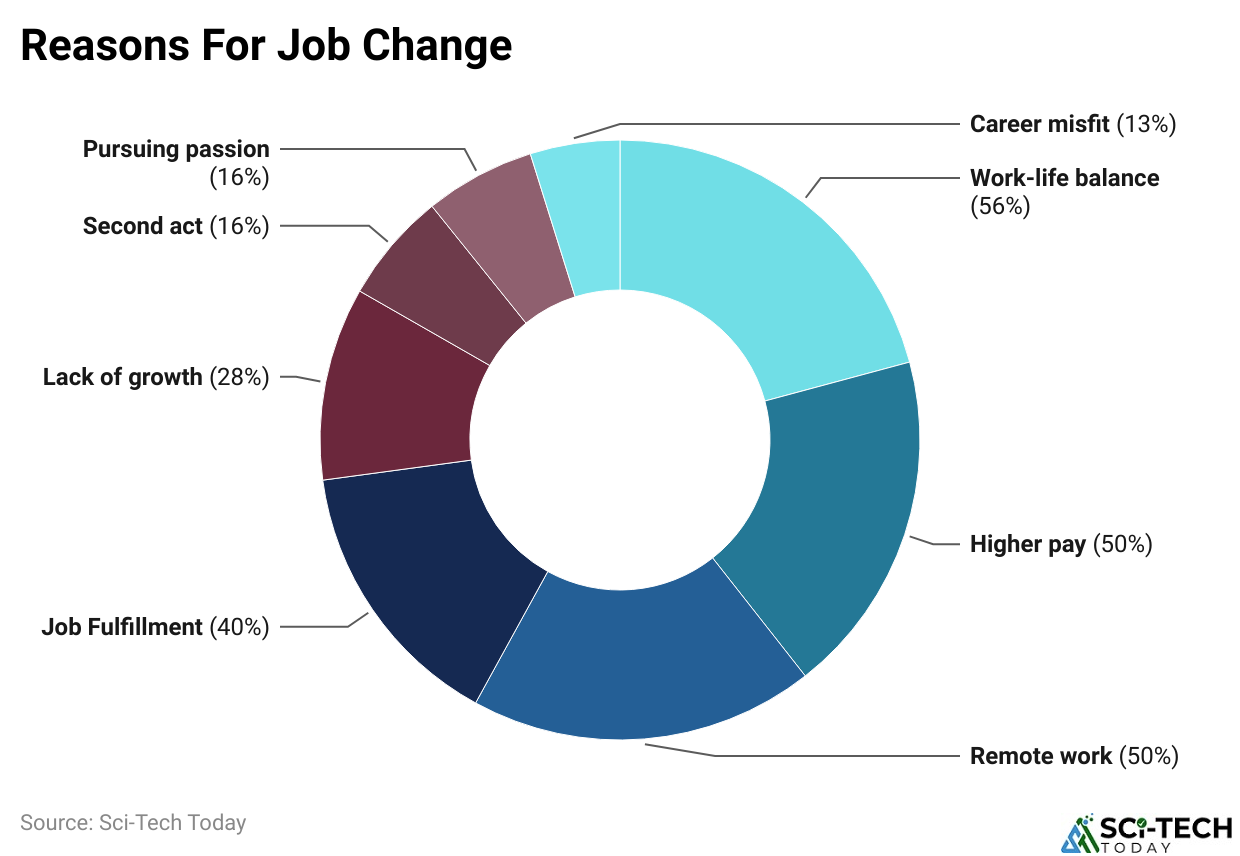
- In the above chart, we can see the Reasons for Career Change.
| Work-life balance | 56% |
| Higher pay | 50% |
| Remote Work | 50% |
| Job Fulfilment | 40% |
| Lack of Growth | 28% |
| Second Act | 16% |
| Pursuing passion | 16% |
| Career misfit | 16% |
- Day-by-day engagement has a 3.9 times greater impact on workers’ stress than work location.
- About 85% of quiet quitters cite issues related to culture, pay, work-life balance, or benefits.
- 41% of workers consider that quiet quitting will improve engagement, 28% will change pay and benefits, and 16% will improve workplace well-being.
- Just 13% of European workers are related to their work, while 73% are not related and are quietly quitting.
- Being Valued: 82% of workers think that it is essential for their company to see them as individuals, but just 45% feel their organization does.
- Pay Equity Perceptions: Negative views on pay equity can show in a 15% lowering in intent to stay, a 14% growth in job searching, and a 13% drop in engagement, as per Career Change Statistics.
- Mental Health Responsibility: 69% of remote workers and 61% of office workers believe that mental health is a shared responsibility between employees and employers.
- Purpose-Driven Companies: Job seekers rate the essentials of a company being purpose-driven as 8.5 out of 10.
- Career Purpose: 89% of people want a job with a clear purpose.
- Inclusivity and Accessibility: 53% of employees felt their company had a renewed focus on accessibility and inclusivity in 2022.
- Resilience and Adaptability: 58% said their work in 2021 required new levels of resilience and adaptability.
- Flexible Work Culture: In 2021, 70% of employees adjusted their work schedules or took flexible time off.
- Remote Work: Almost 90% of employees were either fully remote or hybrid in 2021, and 40% of Americans will only consider hybrid or remote jobs.
- Young Workers and Flexibility: Over half (53%) of 18-34-year-olds won’t join organizations that are not flexible about how employees work.
- Key motivators for teams are ownership (20%), purpose (39%), other factors (17%), respect (9%), money (6%), and promotion (9%).
- Beliefs and Values: 61% of people choose their manager based on shared beliefs and values.
- Commitment to Issues: Employees are 8 to 9.5 times more likely to want to work for a company that takes a stand on economic inequality, gender equality, healthcare access, human rights, or climate change.
- One-third have left their jobs because the company didn’t talk about important issues (Edelman, August 2021).
- Stress in the UK: 35% of United Kingdom employees have thought about quitting due to stress, and 59% said work has impacted their mental health at some point (Investors in People, April 2021).
- Support for Mental Well-being: 36% of United Kingdom workers say their workplace supports mental well-being.
- Causes of Stress: Workplace stress in the UK is caused by workload (40%), poor management (21%), or challenging targets (12%).
- Industry-Specific Stress: 41% of social security workers have thought about quitting due to stress, while 77% of law enforcement employees have never observed it.
A Career That Will Have Maximum Jobs In The Future?
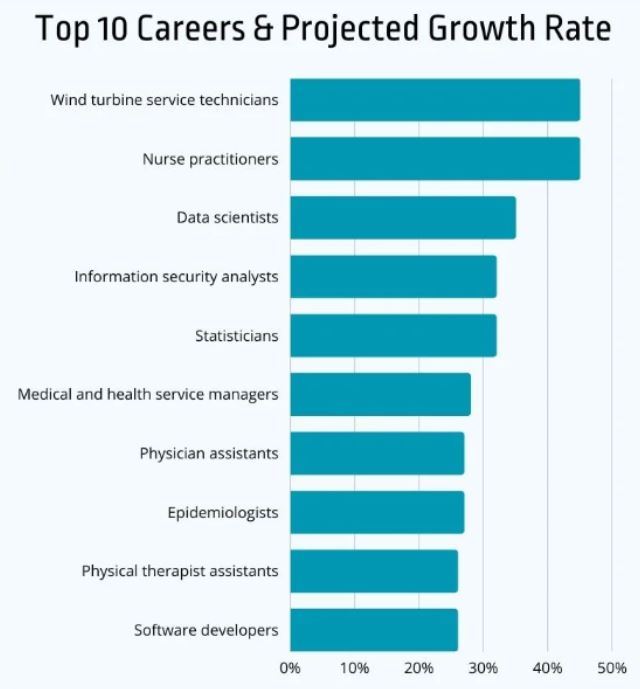
(Source: jobera.com)
| Careers | Growth rate |
| Veterinary assistants and laboratory animal caretakers | 20% |
| Personal care and service workers | 21% |
| Taxi drivers | 21% |
| Veterinary technologists and technicians | 21% |
| Solar photovoltaic installers | 22% |
| Home health and personal care aides | 22% |
| Operational research analysts | 23% |
| Actuaries | 23% |
| Computer and information research scientists | 23% |
| Occupational therapist assistants | 24% |
| Software developers | 24% |
| Physical therapist assistants | 26% |
| Epidemiologists | 26% |
| Physician assistants | 27% |
| Medical and health service managers | 28% |
| Statisticians | 32% |
| Information security analysts | 32% |
| Data scientists | 35% |
| Nurse practitioners | 45% |
| Wind turbine service technicians | 45% |
Over 50% of U.S. workers Thought About Changing Careers in 2020.
- Even though the COVID-19 pandemic disrupted the job market, 52% of US workers considered changing careers in 2020, and 44% planned to switch jobs.
- Among middle-income workers making between USD 50,000 and USD 75,000 a year, 59% were likely to change careers.
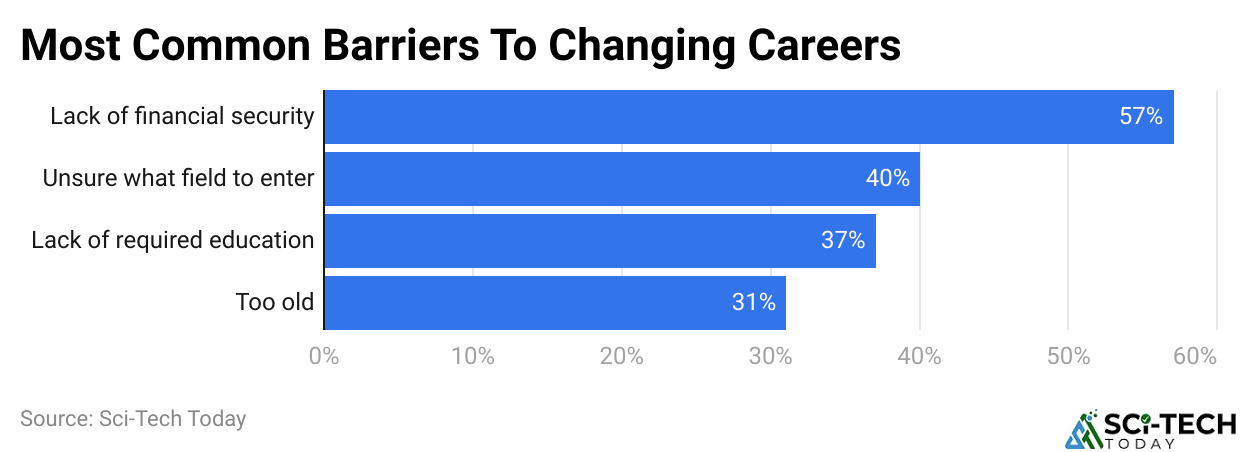
57% of Workers Say Financial Security is the Main Reason They Don’t Change Careers.
- Despite the rise in career changes, many people hesitate due to concerns about finances, uncertainty, and a lack of skills.
- 40% are still deciding what field to move into, 37% lack the necessary education for a new job, and 31% feel too old to switch careers.
Only 7% of Employees Think Their Job is Excellent.
- 93% of US workers are unhappy with their jobs.
- Before the pandemic, many workers were already considering leaving due to dissatisfaction.
- A positive work environment can boost productivity.
52% of Workers Prefer Job Flexibility Over Higher Pay
- Many employees value flexible work hours more than a higher salary. While increasing pay is important, offering flexible schedules can help retain employees.
62% of Workers Want More Job Stability.
- More than 60% of job seekers prefer working for large companies over startups, showing a desire for stability after the COVID-19 pandemic.
- Startups with stable products and good employee benefits can attract and keep top talent.
80% of Workers Want to Work Remotely at Least Twice a Week
- Allowing employees to work from home a few days each week helps build trust and loyalty, which reduces the chances of them leaving for other jobs.
15% of Employees Change Careers for Better Advancement Opportunities.
- Some workers switch careers to find better promotion opportunities. Job satisfaction is important for mental health, so many invest in training to advance their careers.
15% of Employees Change Jobs Due to Poor Management.
- Poor management is a reason 15% of workers switch jobs. Good management practices help keep employees loyal.
Job Satisfaction Post Career Change Statistics
(Reference: zippia.com)
In the above chart, we can see the most common barriers to changing careers:
| Lack of financial security | 57% |
| Unsure what field to enter | 40% |
| Lack of required education | 37% |
| Too old | 31% |
How Many Times Do People Change Careers During Their Lifetime?
- Measuring career changes is difficult because people define a “career change” in different ways.
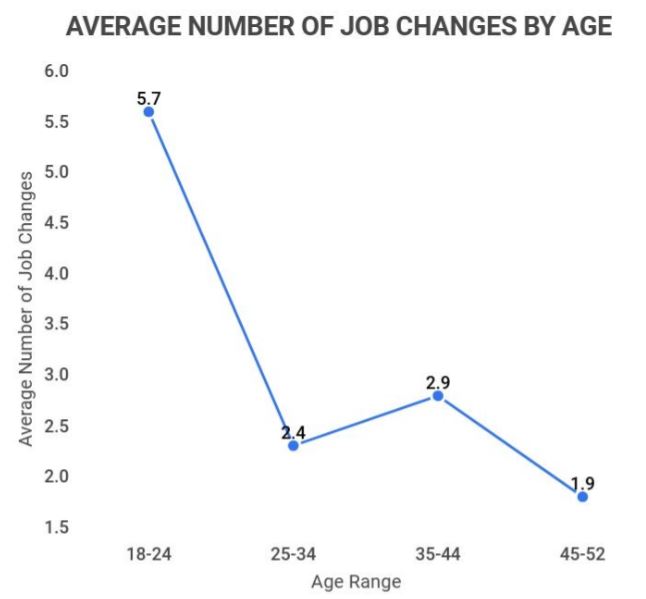
- Research commonly uses job changes to estimate career movement across different age groups.
- Data covering people born between 1957 and 1964, tracked until age 52, shows that job changes become less frequent with age.
- Professionals aged 18-24 changed jobs an average of 5.7 times, while those aged 25-34 averaged 2.4 job changes.
- Workers aged 35-44 changed jobs about 2.9 times, compared with 1.9 times for those aged 45-52.
Career Change Insights – Most Professionals Already Know Their Desired Career
(Source: maketheleap.co)
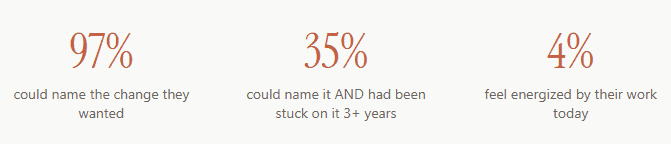
- 97% of people can clearly describe the career or life change they want.
- About 35% know their ideal career but have delayed taking action for 3+ years, while 11% say they have always wanted the same change.
- Only 4% feel truly energized by their current work.
Job Satisfaction Remains Low
- According to maketheleap.co, 42% feel burned out, 21% are simply going through the motions, 16% are in transition, and another 16% feel something is missing.
- Separate findings show 50% report burnout, 44% feel underpaid, 35% dislike their workplace culture, and 34% believe they are not using their strengths or doing meaningful work.
Common Barriers to Career Change
(Source: maketheleap.co)
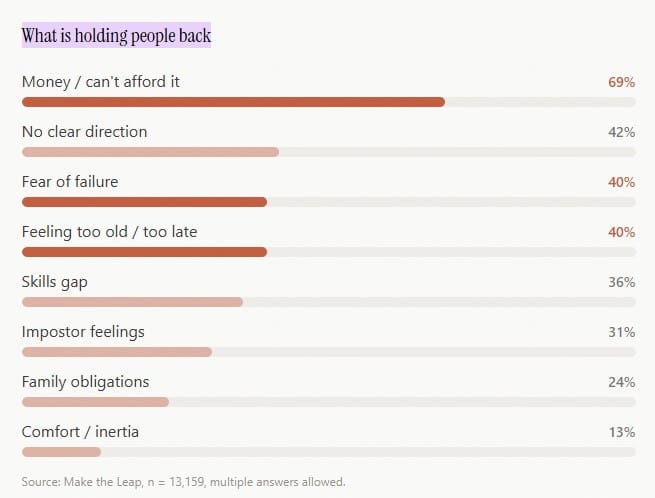
- Financial concerns are the biggest obstacle, with 69% saying they cannot afford a career change.
- Other major barriers include unclear direction (42%), fear of failure (40%), feeling too old or too late (40%), skills gaps (36%), impostor feelings (31%), family responsibilities (24%), and comfort with the current situation (13%).
- On average, each person faces 2.9 barriers, while 76% experience 3 or more challenges at the same time.
Fastest-Growing Career Industries in 2026 – Technology and Software
- Technology and software development remains one of the world’s fastest-growing employment sectors in 2026.
- Common roles include software developer, full-stack developer, cloud architect, and DevOps engineer.
- A 2026 global industry analysis ranks technology and software development as the No. 1 fastest-growing industry.
- According to geetauniversity.edu.in, in India, professionals typically earn ₹4.5 lakh to ₹27.9 lakh per year.
- The field is ideal for career changers because people can enter through bootcamps, online courses, and certification programs before progressing into senior engineering and architecture roles.
Artificial Intelligence and Data Science
- AI and data science continue to create strong demand for skilled professionals worldwide.
- Popular careers include data scientist, data analyst, machine learning engineer, AI engineer, and NLP engineer.
- A 2026 Indian career guide lists AI and data science among the country’s top career options.
- Average salaries in India range from ₹6.8 lakh to ₹15.3 lakh for data science and analytics, while AI and machine learning roles offer ₹4.8 lakh to ₹18 lakh annually.
- Professionals with analytics experience can transition into AI-driven research, analytics engineering, and business intelligence roles.
Cybersecurity and Information Security
- Cybersecurity demand continues to rise because organizations face increasing cyber threats.
- According to a report from the U.S. Bureau of Labor Statistics, the U.S. Bureau of Labor Statistics projects 29% job growth for information security analysts between 2024 and 2034.
- The occupation offers a 2024 median salary of USD 124,910 per year.
- In India, cybersecurity professionals typically earn ₹6.4 lakh to ₹10.5 lakh+ annually.
- Common positions include ethical hacker, security engineer, and cyber consultant.
Healthcare and Biotechnology
- Healthcare and biotechnology continue to expand due to aging populations and medical innovation.
- The BLS projects 40% growth for nurse practitioners and 23% growth for medical and health services managers between 2024 and 2034.
- Their 2024 median salaries are approximately USD 129,210 and USD 117,960 per year, respectively.
- In India, healthcare salaries generally range from ₹3 lakh to ₹10.5 lakh+ annually.
- Non-clinical opportunities include healthcare administration, health IT, public health, and clinical analytics.
Renewable Energy and Sustainability
- Renewable energy remains one of the fastest-growing global industries.
- The BLS projects 50% growth for wind turbine service technicians and 42% growth for solar photovoltaic installers between 2024 and 2034.
- Their 2024 median salaries are approximately USD 62,580 and USD 51,860 per year.
- In India, renewable energy and sustainability professionals typically earn ₹5 lakh to ₹11 lakh+ annually.
- Career opportunities include solar engineer, sustainability consultant, energy analyst, and policy advisor.
Cloud Computing and DevOps
- Cloud computing supports digital transformation across nearly every industry.
- Common careers include cloud architect, cloud engineer, DevOps engineer, and site reliability engineer.
- In India, salaries typically range from ₹8.1 lakh to ₹27.9 lakh per year.
- Cloud certifications and practical projects provide a strong entry path for career changers.
Digital Marketing and E-Commerce
- Digital marketing and e-commerce continue to grow as businesses expand online.
- Popular careers include digital marketing manager, SEO specialist, and e-commerce manager.
- Indian professionals generally earn ₹3 lakh to ₹10 lakh annually.
- Practical experience, freelancing, and digital portfolios help candidates enter this field.
ESG, Green Consulting, Blockchain, and Occupational Safety
- Sustainability, ESG consulting, blockchain, fintech, and occupational safety continue to create specialized career opportunities.
- Sustainability consultants in India typically earn ₹5 lakh to ₹11 lakh+ annually.
- Blockchain developers and consultants earn approximately ₹11 lakh to ₹25 lakh per year.
- Occupational safety and compliance roles are also becoming attractive career options, particularly in manufacturing, construction, renewable energy, and logistics.
Top Careers with the Highest Projected Job Growth from 2026 to 2034
| Career | Sector | Projected Growth / Jobs Added | Median Pay (Estimate) |
| Home Health & Personal Care Aides | Healthcare | +730,000+ jobs by 2034 | USD 33,000 |
| Nurse Practitioners | Healthcare | +35% (2024-2034) | USD 132,000 |
| Delivery Drivers | Logistics | +118,700 jobs by 2034 | USD 40,000 |
| Software Developers & Data Scientists | Technology | 2× average growth rate | USD 130,000+ |
| Cybersecurity Analysts (Infosec) | Technology | Among fastest-growing (29% to 2034) | USD 109,000-162,000 |
| Wind Turbine Technicians | Clean Energy | +50% (2024-2034) | USD 60,000+ |
| Medical & Health Services Managers | Healthcare | High growth (23% to 2034) | USD 110,000 |
| Construction Managers & Skilled Trades | Infrastructure | Steady high demand (millions of jobs) | USD 107,000 (construction managers) |
| Accountants & Auditors | Finance | +72,000 jobs by 2034 | USD 79,000-83,680 |
| Customer Service Representatives | Business Services | High openings: 380,000/year | USD 38,000 |
Employee Satisfaction and Well-Being
- 73% of career changers said their job negatively affects their overall life satisfaction.
- 33% of employees worldwide said they are thriving in life in 2024, down from 35% in 2022.
- Global employee engagement fell to 21% in 2024, causing an estimated USD 438 billion in lost productivity.
- Low employee engagement contributed to an estimated USD 8.9 trillion loss in global GDP.
Career Decisions and Work Priorities
- 28% of employees would leave their current job within the next 12 months if they found a better opportunity, while 14% said they do not feel fulfilled at work.
- 10% of British workers planned to resign during the “January Quit” period.
- Younger employees remain the most optimistic about their careers but are also the most likely to seek new jobs if career goals are not achieved.
- 66% of workers reported career regrets, including staying too long in unsuitable jobs, not asking for raises, and ignoring work-life balance.
- For the first time in 22 years, work-life balance ranked above salary as employees’ top work priority.
- 48% of UK employees said they do not want to become managers.
Workplace Culture and Flexible Work
- 83% of employers have diversity, equity, and inclusion initiatives, up from 67% in 2023, while 47% are expanding diverse talent pools compared with 10% two years earlier.
- 64% of employers identified employee health and well-being as a key strategy for attracting talent.
- 66% of knowledge workers said strong mental health support improves both productivity and happiness, while 46% said work positively affects their mental health.
- Employees reported the highest fulfillment when given flexibility to work remotely, in the office, or in a hybrid model. 39% of remote workers and 34% of office workers wanted more remote work options.
Generational and Global Trends
- 48% of American workers said they are very happy at work.
- Millennials reported the highest workplace happiness (57%) and the greatest sense of purpose (60%), while 22% of Gen Z workers said they were unhappy or disliked their jobs.
- Workplace happiness increased from 64% before the pandemic to 72% after lockdowns.
- In comparison, employee happiness rose from 60% to 67%, and the share of employees who felt their employer cared about their well-being increased from 60% to 72%.
- Switzerland recorded the highest workplace happiness score (75.2%), followed by India (73.05%) and the UK (69.29%).
Wrap-up
Changing your career can help you find better opportunities, higher pay, and greater job satisfaction. Although the process may take time and effort, learning new skills, gaining experience, and staying open to change can make the transition easier.
Set clear goals, keep improving yourself, and build strong professional connections. With the right plan and a positive mindset, you can successfully move into a new career and create a brighter future.
FAQ
The right time is when your job no longer matches your goals, interests, or growth aspirations
Changing careers often means learning new skills, gaining experience, managing financial uncertainty, and adapting to a different work environment.
A career change can take a few months to two years, depending on your goals.

Sources