









Introduction
Product Marketing Statistics: In 2026, Product marketing has changed becomes more than just product launches, sales materials, and messaging: product marketing now plays an important part in growth strategy and in making connections between customer insight, product strategy, positioning, execution, sales effectiveness, and revenues. New research suggests that product marketers are expected to show some commercial benefits even with limited resources and quickly changing buyer behaviour.
AI helps, as 80% of marketers employ AI now, and revenue-related metrics such as win ratios, upselling, and new income are becoming more important. Meanwhile, 67% of B2B buyers says, want to have no communication with salespeople, which makes product positioning, online experience, and buyer facilitation more important than ever.
In this article, we will discuss the product marketing statistics, including product launch, marketer KPI and responsibilities, and salary.
Featured Selection
- 80% of marketers are using AI regularly to increase productivity without hiring new employees.
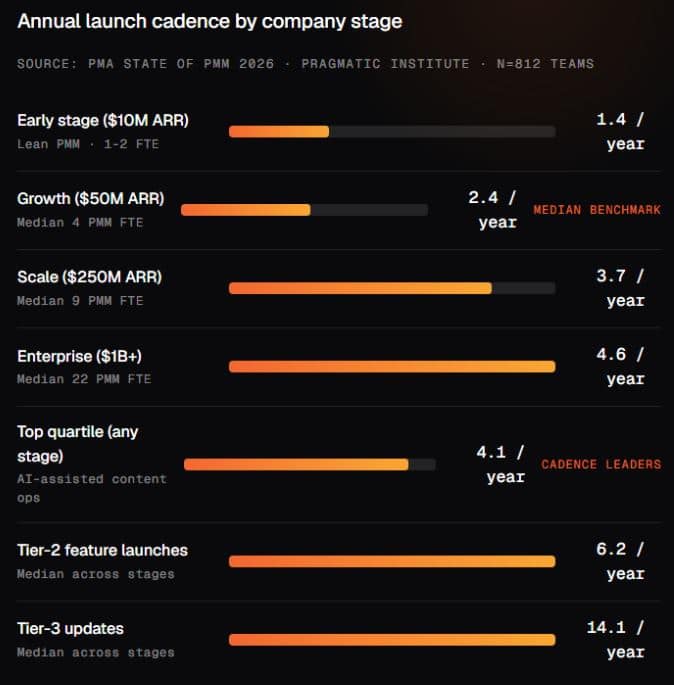
- The average number of Tier-1 launches increases from 1.4 at $10M ARR to 4.6 at $1B+ companies.
- The average number of Tier-2 launches is 6.2 per year, while Tier-3 updates reach 14.1 launches per year.
- Tier-1 launches lead to a 38% average increase in pipeline during Q0, and later drops to only 5% in Q+3 without continued support.
- A 19% advantage in click-to-demo rate is provided by using category-frames to test positioning.
- 67% of B2B customers prefer to buy without a representative, making self-service product information critical.
- 45% of B2B buyers made use of AI in their last purchase, underlining the necessity for AI-ready product information.
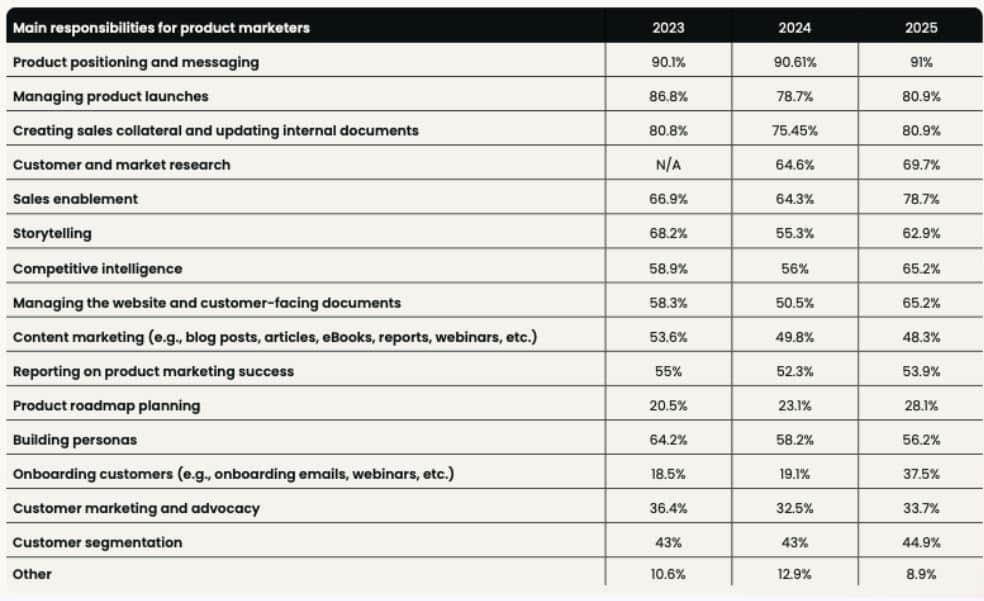
- 91% of PMMs are responsible for positioning and messaging, and 80.9% for launches and sales collateral production.
- Sales enablement responsibility increased from 64.3% in 2024 to 78.7% in 2025, while onboarding increased from 19.1% to 37.5%.
- The global median PMM salary is $119,000, while total average pay is $144,681.
- AI-related jobs get a 28% salary premium, which showcases the importance of AI in product marketing.
- 53.91% of PMM leaders monitor both their go-to-market strategies and new revenue generation, while 13.28% do not have any defined KPIs.
Product Launch Cadence by Company Stage in 2026
(Source: digitalapplied.com)
- The above data results show that product marketing teams are improving launch effectiveness and growth, and companies are also getting pickier about which launches deserve full support.
- According to the PMA State of PMM 2026 report covering 812 teams, median Tier-1 launches grow from 1.4 per year at $10 million ARR companies to 4.6 at companies with ARR exceeding $1 billion.
- Furthermore, growth-stage companies with an average of $50 million ARR see 2.4 Tier-1 launches, while at $250 million ARR companies there are 3.7 launches.
- The noteworthy benchmark to aim for remains that of top-quartile companies that make 4.1 Tier-1 launches annually.
- The data indicates that now a company with $50 million ARR can achieve this with a PMM team of 4 FTEs, while in 2023 it took 8, which includes possibilities such as drafting documents with the use of AI, creation of FAQ, and partially automating updates related to battlecards.
- The Tier-2 launches are made with a frequency of 6.2 per year, while Tier-3 launches occur with a frequency of 14.1.
- The 41% increase in the number of Tier-2 launches proves that businesses achieve better allocation of their launch resources depending on the quality of products they sell and do not treat every new update as a major campaign.
Product Impact and Launch Decay in 2026
- Tier-1 product launches have their largest effect on the pipeline right away, but results drop off considerably without continued marketing investment.
- According to Forrester, LaunchNotes, and the Product Marketing Alliance (PMA), 614 launches created an average 38% increase in pipeline during Q0, falling to 24% during Q+1, 12% during Q+2, and 5% during Q+3.
- The 38% increase experienced in Q0 has been consistent across all companies with an ARR of $50 million to $1 billion, while startups experience an even greater increase of 52%.
- One of the best opportunities appears immediately after the launch when Q+1 is still strong, and companies can share customer stories, partner campaigns, or analyst briefings, with top performers maintaining a lift of 30%.
- By Q+2, reused materials, like case studies and industry reports, become increasingly important as the impact of a launch diminishes.
- According to the PMA State of PMM 2026, successful tests at framing positioning led to a lift of 19 percentage points in click-to-demo activities, hence indicating that positioning testing has good value. Meanwhile, demo show rates improved 22% during Q0, suggesting stronger buyer intent around launch activity.
- Practically thinking says maximize Q0, investing deliberately in Q+1, and gradually shifting resources toward the next launch by Q+3.
Product Marketing Implications of the Shift Toward Rep-Free B2B Buying
- According to a Gartner research study in March 2026 involving 646 B2B buyers, the research findings suggest a significant shift in the way product marketing needs to deal with modern purchasers.
- Around 67% of B2B buyers would prefer to purchase without being in contact with a sales representative, while more than 45% used AI technologies during the recently completed purchase. All in all, the jump in buyers preferring to do their own research regarding certain products without relying on sales reps.
- The importance of the use of product information, comparison content, use cases, pricing context, FAQs, demos, and other self-service content has increased tremendously.
- Furthermore, according to the survey, highly confident decision-makers report their deals are of high quality twice as often as less confident ones.
- From the point of view of product marketing, the key opportunity is to facilitate the understanding of product offerings without having a salesperson involved at each stage of the purchase.
- Gartner recommends using modular content that is AI-enabled, which can be rearranged as per all the buyer’s needs.
Product Marketing Responsibilities
(Source: userpilot.com)
- PMMs are identified as responsible for positioning, creating demand, and ensuring adoption of the products.
- The Product Marketing Alliance’s report entitled State of Product Marketing 2025 found that 91% of PMMs own the positioning and messaging of their companies’ products, while 80.9% of PMMs deal with product launches and 80.9% are responsible for sales collateral design and internal documentation.
- From 64.3% of PMMs in 2024 to 78.7% of PMMs in 2025, the share of PMMs engaged in sales enablement rose significantly.
- The customer onboarding share of PMMs increased significantly, from 19.1% to 37.5%. 69.7% of PMMs carry out customer and market research, 65.2% deal with competitive intelligence, website and customer-facing documents, and only 28.1% are involved in roadmap planning.
- Out of 15 responsibilities given to PMMs, 12 responsibilities are regarded as increased, which points to increased expectations with regard to the responsibilities of PMMs, and even the role of AI in the execution of different activities increased as well.
- In the realm of PLG businesses, PMMs have engaged in analytics, experimentation, UX writing, activation, behavioral research, and lifecycle marketing. However, the shift has come in terms of expectations.
- PMMs need to play their role beyond just launching and marketing products to directing the entire customer journey.
- The advancement of AI has enabled PMMs to achieve more while expecting them to make a strategic impact as well.
Salary Information and Compensation of Product Marketing Professionals
- The Product Marketing Alliance (PMA) Product Marketing Salary Report 2025/26 reveals important trends in terms of salary expectations for product marketers going into 2026.
- The median salary has risen from $61,637 to $90,250 for PMMs, $131,000 for Senior PMMs, and $178,500 for Directors.
- According to the PMA, the median salary for all titles is reported to be $119,000, while the average total compensation is $144,681.
- As per the geographical factors, the PMA found median salaries of $147,000 in North America, $100,000 in the Middle East, $90,130 in Australasia, $87,000 in Europe, and $38,000 in Asia and South/Central America.
- The internet sector PMMs collected $144,800 versus $129,500 in computer software and $84,000 in marketing and advertising sectors.
- The Lightcast report states that positions requiring AI skills earn 28% more, but AI Marketing job offerings for Manager positions seem to exceed the standard salary by $33,000.
- PwC provides an average 62% additional salary for AI positions without immediate application of the broader information to PMM salaries specifically.
- The salary remuneration is more and more related to influence, specifics, and impact of the job rather than titles or experience.
Top Product Marketing KPIs and Metrics
- Measurement of product marketing is transitioning from merely tracking certain activities to measuring profit from that.
- As indicated by PMA, there are 16 measures that PMM leaders mentioned in their evaluation process. Notably, however, 13.28% of PMMs lack defined KPIs.
- PMA has identified that, among the methods, the go-to-market strategy and new-revenue generation are the most common (53.91%), and also widely used are win-rate improvement (38.28%), customer retention (32.03%), and sales confidence (25.39%).
- 3 metrics, among many measures, seem to be the most important for the creation of practical PMM scorecards.
- Competitive Win Rate shows how successful PMM positioning, battlecards, pricing, and enablement are in helping sales teams win sales opportunities.
- According to PMA, Sales Confidence Score reflects the level of enabling efficiency being tracked by only 25.39% of PMM teams.
- Feature Adoption Rate is the link between marketing activities and whether customers make use of vital product functionalities.
- The information received from the survey conducted by the experts of Gartner Peer Community proves that 46% of product managers rely on product metrics to assess launches and updates of features.
- Time-to-Market added an operational perspective by quantifying the efficiency of moving products from an agreed-upon starting point to the market-ready position.
- A McKinsey report reflects that more than 75% of the firms included in its product development research commonly apply time-to-market KPI metrics.
- The success of PMM measurement depends upon an effective methodology that incorporates commercial results, the readiness of the seller, the customer’s readiness to adopt, and execution speed while remaining consistent with definitions, benchmarks, ownership, and measuring parameters.
Conclusion
Marketing products in 2026 will become better at reporting on their commercial performance, adopting artificial intelligence technology, and establishing connections with every step of the consumer journey. The marketing launch remains notable but loses its impact fast due to little post-launch support.
At the same time, research done by AI makes consumers want self-service products even more. The responsibilities of PMM increase and go far beyond the usual marketing launch into product positioning, enabling, onboarding, researching product adoption, and defining how to keep the product. Compensation is a function of the rising strategic demands and specialized skills in AI.
From an analyst’s point of view, the most effective measurement system should include revenue, win rates, confidence among sellers, product acceptance, and time to market instead of figures based on product launch volume or production.
FAQ
80% of marketers use AI constantly.
Tier-1 product launches contribute to 38% of the median pipeline increase in the first quarter.
67% of B2B customers prefer such an arrangement.
The average PMM salary worldwide is $119,000.
The go-to-market strategy and new revenue generation mean that 53.91% of PMM leaders monitor these indicators.