









Opening
Skype Statistics: In today’s digital age, communication tools are integral to personal and professional interactions. As a pioneering platform for Voice over Internet Protocol (VoIP), Skype has led this revolution since its establishment in 2003. Within a short time after it was introduced as one of the pioneering platforms for free voice and video calls over the Internet, Skype had millions of users around the world. Its functionality has grown to allow file sharing, instant messaging, and even conference calling, making it a one-stop shop for both individuals and organizations.
Skype has played an undeniable role in global communication. Whether it be linking up families who live far apart or enabling international business meetings, Skype has changed how we connect. The fact of the matter is that the platform serves as a facilitator for professional interaction and collaboration. The changing nature of Skype statistics has important messages for both business and private individuals as we make our way through the rapid movement of electronic communication.
This article aims to provide statistics about Skype, investigating who uses this software, when they use it most often, and its place within the larger context of digital communication.
Best of the Best
- Among young people, 29% aged 18 to 29 use Skype on mobile phones, and 27% of individuals between 30 and 59 use the same platform.
- In America, Skype has 32 million users monthly; this is about 49% of the total population.
- By early 2025, Zoom’s share has risen to around 29% of the video‑conferencing market, while Skype’s presence has shrunk to roughly 1% before its announced retirement.
- As per Skype statistics, it has an active user base of about 36 million daily users globally in 2023–2024, declining further into 2025 as Microsoft transitions people to Teams, including around 8.6 million people in the software sector.
- Furthermore, approximately 2.7 million school administrators still use Skype into 2024 to early 2025 to communicate with their students and colleagues.
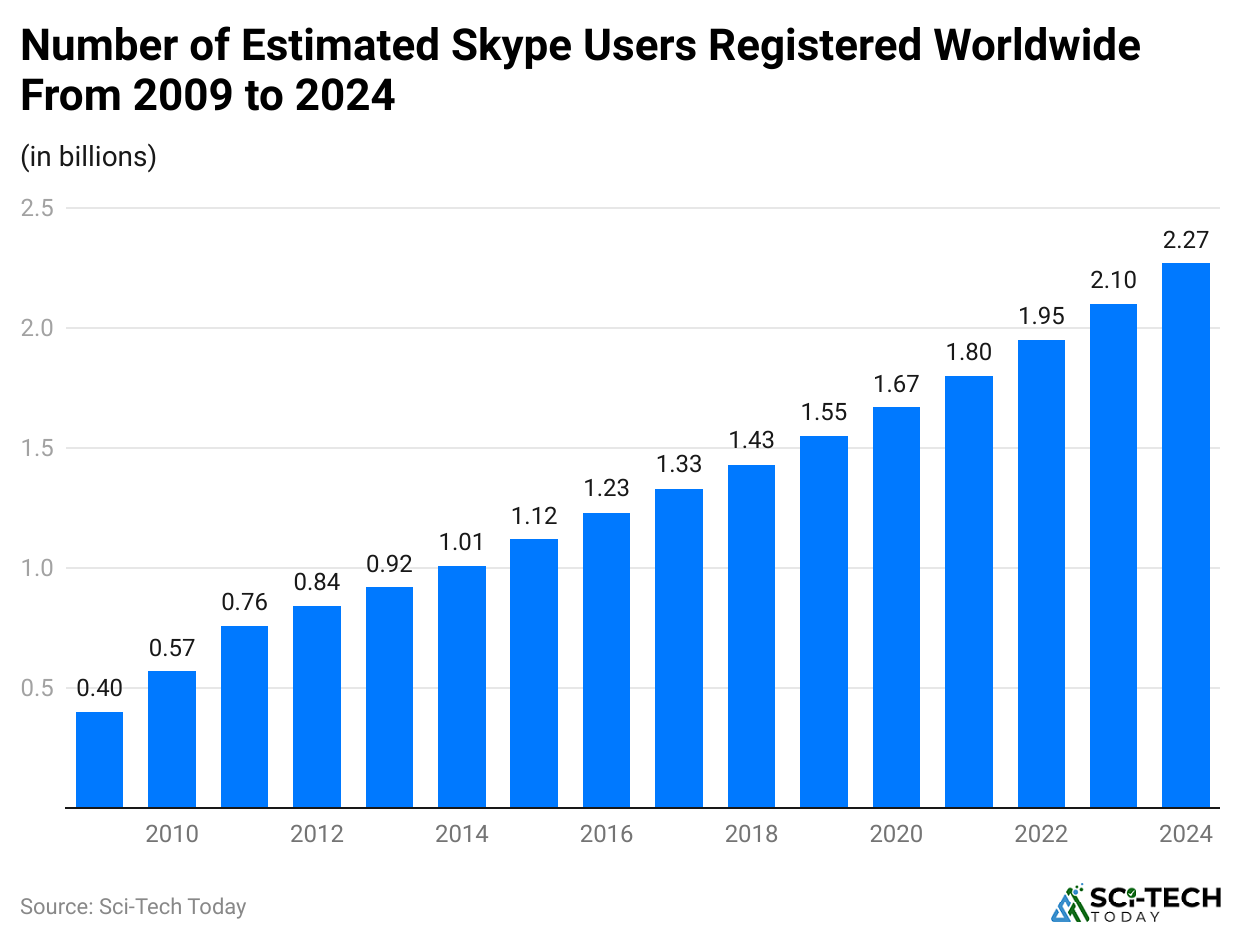
- It is expected that there will be about 2.27 billion registered Skype accounts globally by the end of 2024, with no significant growth in 2025 as the service is officially retired and new sign‑ups are discouraged.
- However, between September 2023 and early 2025, over 3 million users left the platform, as Microsoft shifted focus to Teams and announced Skype’s retirement.
- Video calls consume an average time per week of about three hours and twelve minutes for professionals.
- As accumulated, people spend three billion minutes daily on Skype video calls.
- As of January 2025, the number of monthly active users worldwide on Skype exceeds 100 million, with over 16 million logging in daily.
- The video conferencing market will surpass USD 75 billion by 2027.
- 89% of remote workers think that Skype or similar platforms are necessary to maintain contact with their colleagues.
- Only 13% of traffic towards skpe.com originated from us alone.
- 51% plus Skype users earn at least 100,000 dollars per year.
- Within the computer software industry, Skype boasts an active customer base comprising 8.6 million people.
Fun Facts About Skype Statistics
- Skype is among the best digital communication platforms, and it was introduced in 2003.
- In 2011, Microsoft purchased Skype for about USD 8.5 billion.
- At present, Skype provides various services such as video calls, voice calls, messaging, and file sharing.
- Skype allows group video calls with a maximum of 100 participants.
- Users can also call landlines and mobile phones for a fee.
- Moreover, it offers real-time translation in more than 35 languages at no cost.
- Messaging on Skype is protected by end-to-end encryption, allowing privacy and security to be guaranteed.
- Also, it is accessible on several devices, such as computers, smartphones, tablets, and smartwatches.
- Remote work and virtual communication have become more popular due to the increased need for them during the COVID-19 pandemic.
- The word “Skype” comes from the words “sky peer to peer.”
- Additionally, you can make emergency calls to 911 and reveal your location through Skype.
- In 2014, it was listed in the Oxford English Dictionary as a verb.
- Skype was the pioneer of VoIP services that offered free calls.
Skype Users Statistics
(Reference: statista.com)
- The Skype statistics show the number of Skype users registering worldwide from 2009 to 2017, along with a future projection for 2024/2025. Approximately 1.33 million people were registered on Skype by 2017.
- There are 32 million active Skype users in the United States alone.
- On the opposite end of the spectrum, China and France have relatively fewer active users, at just 3 million and 1.4 million, respectively.
- Additionally, Skype statistics from other countries indicate that 6.7 million UK-based users, 3.1 million people in India, 2.8 million Canadians, and 1.6 million Australians use this service.
Skype Website Traffic by Country
(Source: semrush.com)
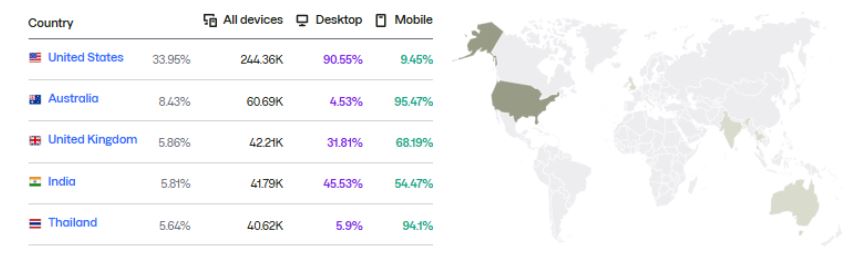
- As of April 2025, the United States leads Skype’s global traffic with a 33.95% share, generating 244.36K visits, with desktop usage overwhelmingly dominant at 90.55% compared to just 9.45% on mobile.
- Australia ranks second with 8.43% of total traffic and 60.69K visits, showing an almost complete reliance on mobile devices at 95.47%.
- The United Kingdom holds the third position with 5.86% of traffic and 42.21K visits, displaying a mobile-leaning split with 68.19% on mobile compared to 31.81% on desktop.
- India contributes 5.81% of total traffic with 41.79K visits, showing a relatively balanced device usage pattern, with 54.47% on mobile and 45.53% on desktop.
- Thailand rounds out the top five with 5.64% of traffic and 40.62K visits, recording one of the highest mobile usage rates among all countries at 94.1%.
Companies Using Skype by Country Statistics
(Reference: enterpriseappstoday.com)
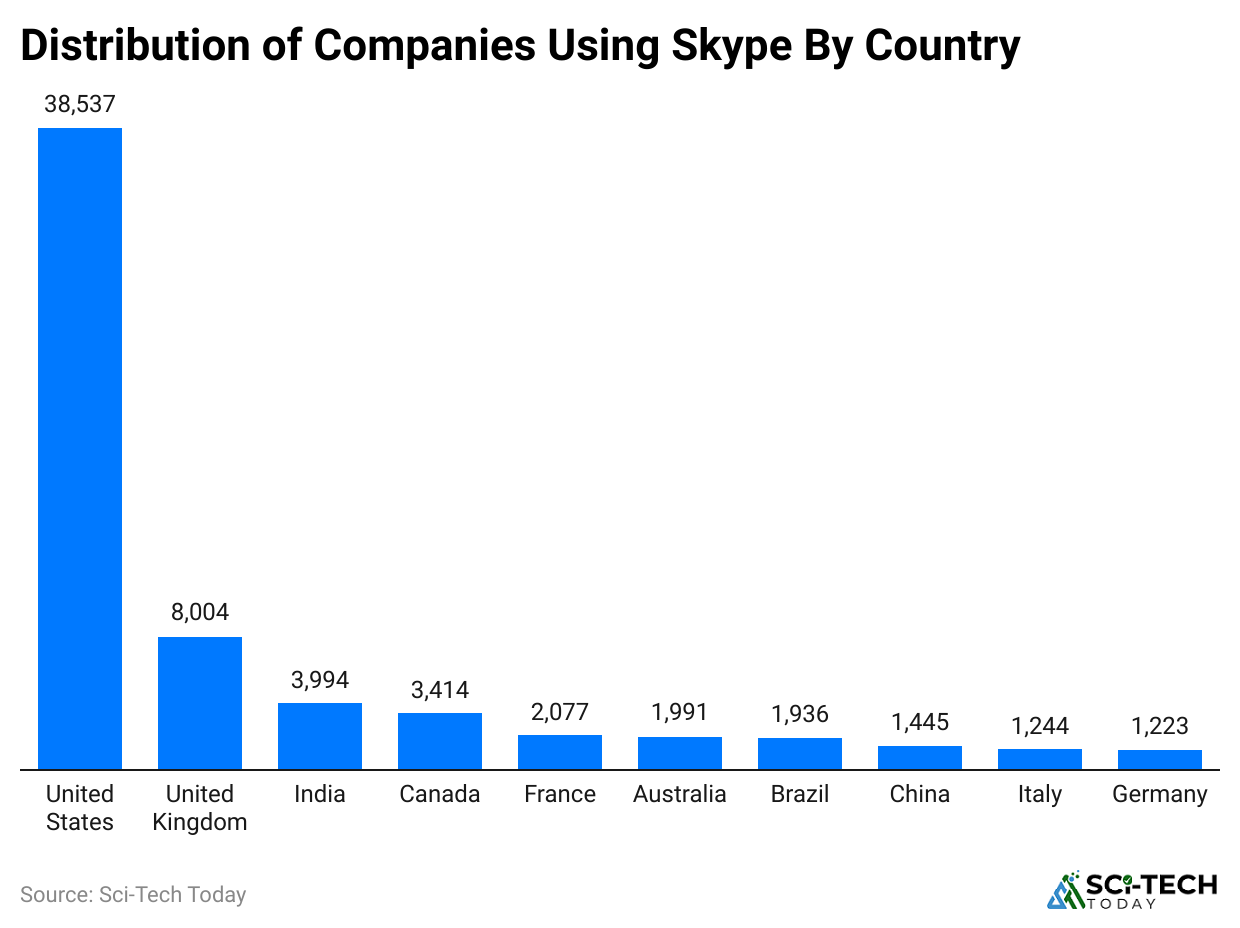
- The recent Skype statistics state that the largest users of Skype by number of enterprises are the United States (38,537), the United Kingdom (8,004), and India (3,994). Subsequently, Canada (3,414), France (2,077), Australia (1,991), and Brazil (1,936) come next.
- Other nations with fewer than 1,500 companies utilizing this platform include China (1,445), Italy (1,244), and Germany (1,223).
Skype Source Website Traffic Statistics
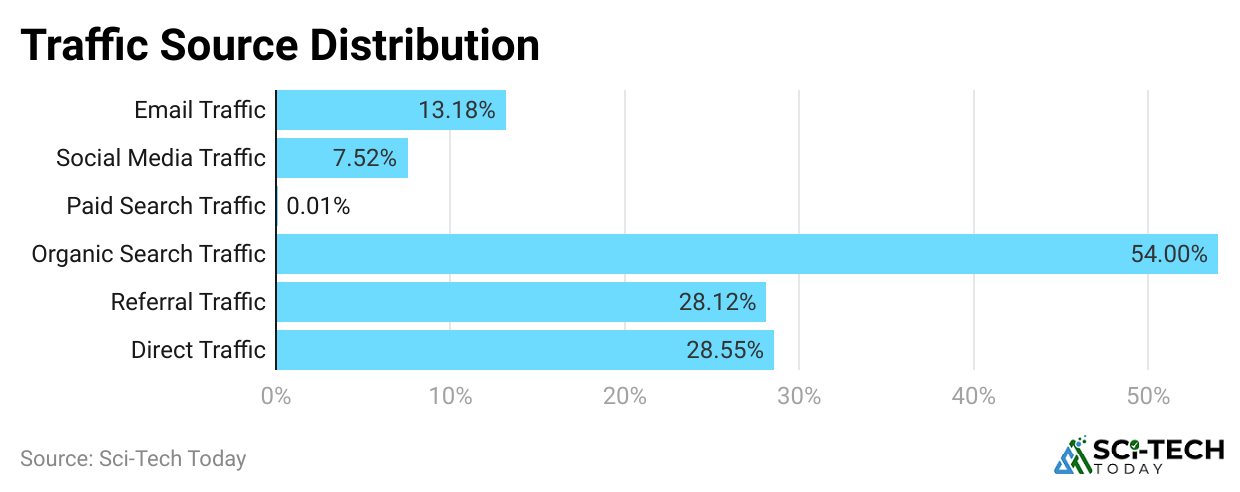
- Direct Traffic (28.55%): Many visitors go to Skype.com by typing its URL in their browser or using a bookmark directly, demonstrating that users are highly familiar with the platform and that it has great brand recognition.
- Referral Traffic (28.12%): Almost as much traffic comes from referrals, which means that users click on links from other websites that direct them to Skype.com. This shows how widely Skype is linked and mentioned across the internet.
- Organic Search Traffic (54%): It has been observed that most of the online traffic directed towards Skype.com originates from organic search engines like Google, where users find the site through these engines. Therefore, this implies that many people come across or even access Skype by searching for it or related terms on online platforms without relying on ads.
- Paid Search Traffic (0.01%): Only a minute portion of the traffic comes from paid search ads; hence, Skype invests very little in paid search engine advertising, relying more on organic visibility.
- Social Media Traffic (7.52%): A small but considerable fraction of visitors comes via social media channels. Indeed, this also reflects just how well Skype has engaged even with these social networking sites.
- Email Traffic (13.18%): Fairly speaking, email campaigns generate quite a lot of visits. In this way, users click links within emails to get to Skype.com. It could be an updated newsletter or advertisement promo letter type that directed them there.
Skype User Demographics Statistics
(Reference: enterpriseappstoday.com)
- Recent Skype statistics data reveal that the 18 to 29-year-old age bracket makes up the majority of individuals who use Skype on mobile devices, accounting for 29% of the total number of users.
- The users’ chart shows that people between 30 and 59 years old account for 27% of the population, together with people aged 60 and above, who form 12%.
- The female population using Skype is 40.69%, while the male population is 59.31%.
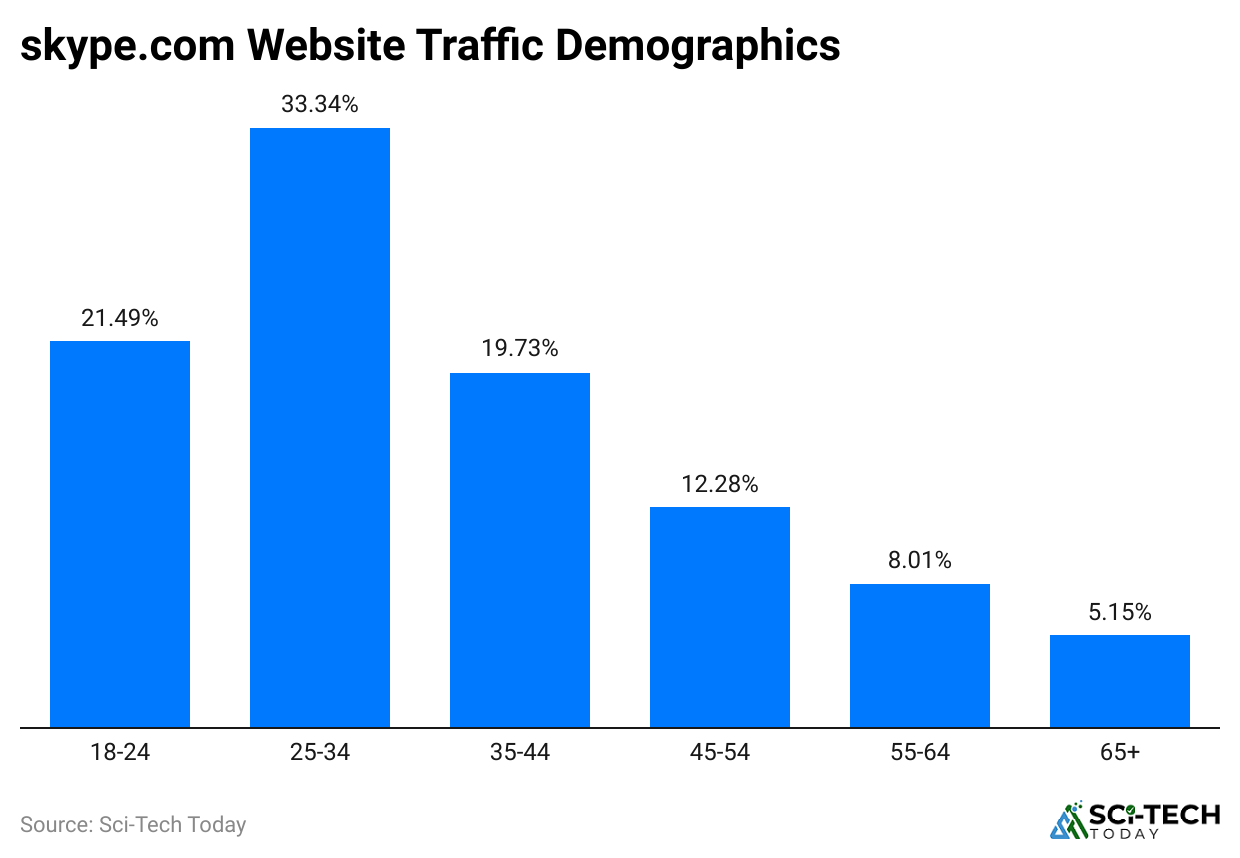
- About one-third comes from the age group of between 25 and 34 years, which includes 33.34%.
- These include those aged between 18-24 years who make up 21.49% of all Skype’s contacts.
- This category has 19.73%, followed by another group that falls between 35 and 44 years old, and following it closely is one whose members range from 45 to 54 years old, which stands at 12.28%.
- Last but not least, there are individuals between the ages of 55 and 64 forming about 8%, for instance, while 5% plus belong at the level of being old enough to have done 65 more orbits around the sun or so ago, minimum, if not more, like a few useful contacts.
Skype Business Statistics
- There are 8.6 million active users of Skype working in the field of computer software.
- Also, 6.3 million active users belong to information technology.
- Interestingly, 1.62 million active users belong to the retail industry.
- Also, about 2.7 million active users belong to the education management area.
- From the hospitality sector, about 2.6 million users of Skype have been identified.
- Additionally, Skype gains 2.1 million users from higher education.
- There are 1.7 million marketing and advertising staffs who use the communication software.
- Also, 1.67 million active users belong to the financial services industry.
- Non-Government Organization (NGO) management contributes 1.5 million active users.
Skype Market Share
(Source- SEMrush)
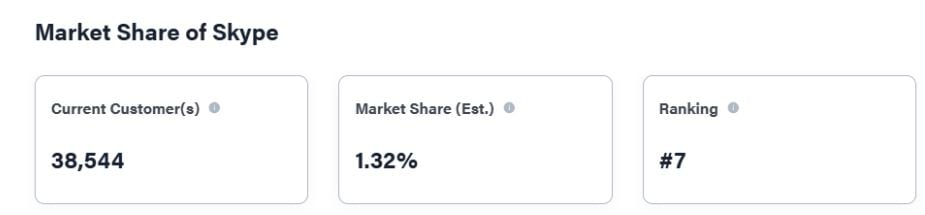
- Skype currently serves a total of 38,544 customers, reflecting its continued presence in the global communication and collaboration tools market.
- The platform holds an estimated market share of 1.32%, indicating a relatively modest but stable position within the highly competitive communication software industry.
- Skype ranks #7 among competitors in its market segment, showing that while it remains relevant, several other platforms have surpassed it in overall market presence.
Skype Brand Awareness Statistics
Awareness: Skype is known to 83% of Americans.
User Preferences:
- 23% of these users are fond of Skype.
- 14% utilize its services daily.
- 67% are loyal customers who are likely to keep using it in the future.
Popularity Rankings:
- Facebook Messenger at 90%
- Snapchat, with 84% shares
- Zoom stands at 81%
- Skype lies in the fourth position, representing only 80% of the total.
Other Messenger Services:
Here are some alternatives to messenger services:
- FaceTime 78%
- WhatsApp 76%
- iMessage 67%
- Google Hangouts 60%
- Discord 46%
- Kik Messenger 41%
- Microsoft Teams 41%
- Telegram 40%
- WeChat 37%
- LINE 26%
- Viber 24%
- Signal 20%
- Threema 10%
Skype Customers by Products and Services
(Reference: 6sense.com)
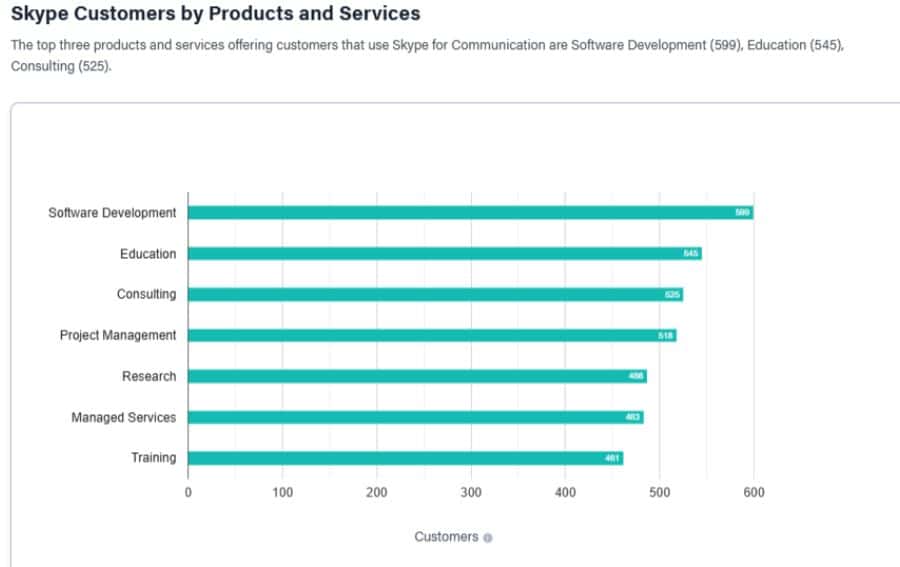
- Software Development leads as the top sector using Skype for communication with 599 customers.
- Education ranks second with 545 customers, reflecting Skype’s continued relevance in virtual classrooms, tutoring sessions, and academic communication.
- Consulting comes in third with 525 customers, showcasing how consulting firms rely on Skype for client meetings, remote advisory sessions, and business discussions.
- Project Management follows closely with 518 customers, demonstrating the platform’s role in facilitating team coordination and cross-functional communication.
- Research accounts for 486 customers, indicating that academic and corporate research teams continue to use Skype for collaborative discussions and knowledge sharing.
- Managed Services has 483 customers, reflecting steady adoption among IT and service-based businesses for client communication and support.
- Training rounds out the list with 461 customers, highlighting Skype’s use in conducting remote training sessions and professional development programs.
Skype Customers by Geography
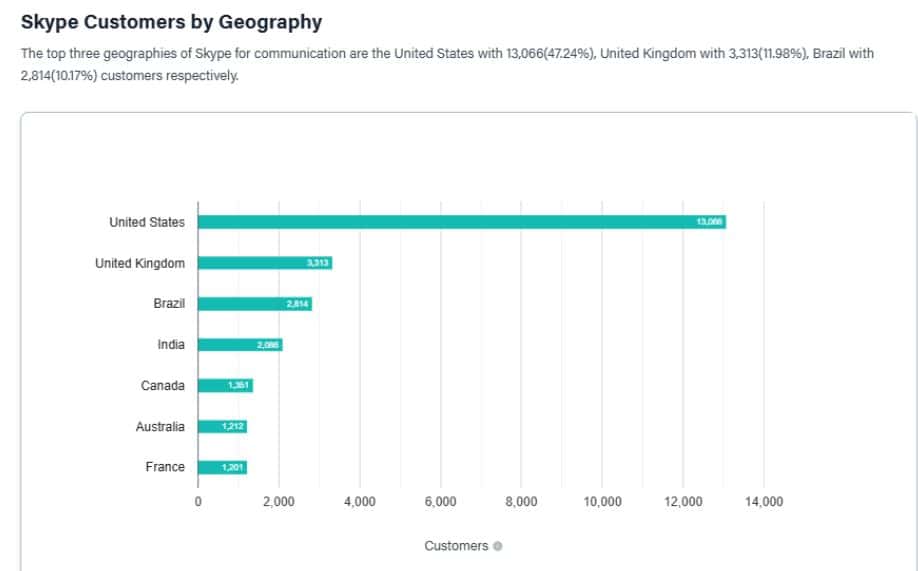
- The United States leads Skype’s customer base by a massive margin, accounting for 13,066 customers, or 47.24% of the total.
- The United Kingdom ranks second with 3,313 customers, representing 11.98% of the total.
- Brazil holds the third position with 2,814 customers, making up 10.17% of the customer base.
- India follows with 2,086 customers, reflecting steady adoption of Skype for both personal and professional communication in the region.
- Canada accounts for 1,351 customers, representing a notable share of Skype’s presence in North America outside the U.S.
- Australia contributes 1,212 customers, indicating consistent usage across the Asia-Pacific region.
- France rounds out the top seven with 1,201 customers, showing moderate but steady adoption within the European market.
Skype Top Industry Active Users Demographics
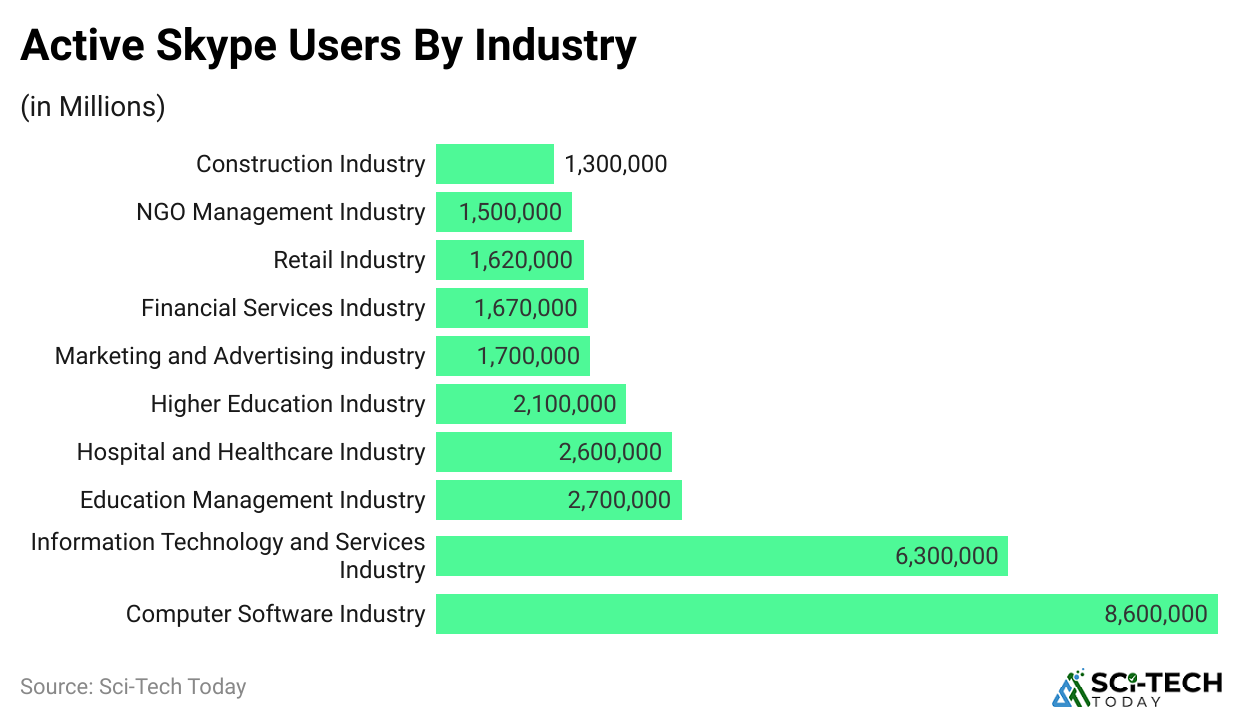
The graph of active Skype users by industry has been provided before. A very small paragraph is as follows:
- According to reported Skype statistics, it has 8.6 million active users; the highest number belongs to the Computer Software Industry.
- In this case, the number of active users is equal to 6.3 million for the Information Technology and Services Industry, respectively.
- In other sectors, like Education Management and Hospitals or Health Care, 2.7 million and 2.6 million, respectively, use Skype as their mode of communication.
- The least amount of these is found in the Construction Sector, with only 1.3 million people using it at all.
Skype Revenue Statistics
- Skype statistics show that it held about 2.5% of the global video‑call market by 2024 to early 2025. However, the increased demand for distance working made it less popular as competition grew for Zoom, Slack, Teams, and Google Meet.
- By 2025, Zoom firmly dominated video conferencing with around 55% market share, while Skype’s share had fallen to roughly 1.8% before its retirement. For video conferencing, Zoom can still accommodate up to about 1,000 participants for up to 40 minutes on its free tier, while Skype’s legacy offering allowed meetings of up to 30 hours with about 230 participants, depending on the plan.
- USD 85 million was lost due to Zoombombing and Skype bombing, whereby meetings are disrupted by unwanted members who barge in during calls. Complaints were also sent against Skype and Zoom regarding rude pictures and sexual harassment on their respective platforms, amidst the broader issue of security.
- According to reported Skype statistics, it boasts 8.6 million active users across the software industry because it is known for its easy-to-use interface and dependable communication elements.
- Precisely 6.3 million active users spend time using this software related to computer science since it provides services like conference calling alongside screen sharing capabilities that enable teamwork on any project, making it stand out in that regard across other applications available online today.
- There are 1.62 million active Skype users in the retail sector who use the platform for real-time communication and coordination in different areas.
- Approximately 2.7 million school administrators are using Skype to communicate with colleagues and students, particularly for virtual meetings and support.
- Also, the hospitality industry has around 2.6 million employees who use Skype to communicate with remote staff members, customers, and suppliers.
- The higher education sector has 2.1 million Skype users who communicate with students and faculty and engage in virtual meetings.
- Marketing and advertising professionals collaborate through Skype, which is considered an important tool for assisting them in working together and communicating from different locations; it has about 1.7 million active users.
Future Outlook and Challenges
- Gazing ahead, Skype finds itself in the predicament of keeping competitive within an industry increasingly ruled by systems with the newest attributes and integrations.
- Skype’s fundamental qualities, like trustworthy calling and Microsoft product combinational capacity, will still support its users; nevertheless, this platform must accept change to capture the interest of individuals from younger generations while following changing consumer inclinations.
Closure
In summary, Skype was one of the key players in international communications, featuring an impressive client base as well as reliable revenue sources. Despite the challenges posed by new services on the market, Skype retains its importance due to its reliability, integration with Microsoft software, and high level of localization in Europe and North America.
Before May 2025, more than 10 million people used it every day for professional interactions, hence underlining its usefulness, while 89% of remote workers assert they find it effective in meeting their colleagues virtually. Furthermore, Skype also plays a significant role in such projections since video conferencing revenue is expected to reach over USD 75 billion by
2027.
FAQ
No, people do not use Skype anymore because Microsoft officially shut down and retired the consumer version of Skype on May 5, 2025.
Skype is a communication tool used for video calls, voice calls, and text messaging over the internet. People use it to connect with friends, family, and coworkers globally for free or low cost.
Skype was officially replaced by Microsoft Teams, which took over after Microsoft retired Skype on May 5, 2025. Other popular apps people use instead for video calls and chats include WhatsApp and Zoom.