









Introduction
Social Media Algorithm Impact Statistics: The algorithms used by social media platforms are the invisible rulers who not only control how we get our information, but also how we buy, what we talk about, and even think. These intricate systems—mainly driven by artificial intelligence (AI)—are going to affect not only what we get to see through our feeds, but also the economic aspects of whole industries in 2025. The algorithms are so powerful that they are influencing global ad spending of USD 276 billion, affecting political discourse, and making their impact on mental health recognized.
This extensive study presents the most convincing social media algorithm impact statistics, economic metrics, and research insights that are forming the story in 2026.
What Is A Social Media Algorithm?
A social media algorithm refers to a sophisticated, data-centric system that is built to determine which posts are presented to the users in the feeds and in which order. It takes into consideration a variety of factors such as the number of likes, comments, shares, content relevance, time of posting, and a user’s past conduct on the platform to estimate the content that will have the highest engagement. These algorithms, from this viewpoint, are developed to draw attention optimally and provide a personalized experience for the user at a very large scale.
Even though they are very effective, it can be quite difficult for brands to cope with and keep up with visibility determined by algorithms. However, employing intelligent social media management tools makes the work of marketers dealing with these situations easier; they can also create and distribute their content and reach their targeted audiences much more effectively.
Editor’s Choice
- The global digital ad spend of 2025 will be largely dictated by the social media algorithms, which will influence over USD276 billion, thus playing a direct role in the marketing economics.
- Throughout history, false or controversial content had a tendency to spread at rates of up to 20× faster, thus indicating amplification bias in engagement-driven systems.
- Influencer marketing is subject to continuous changes, with a 50% drop in reach every year due to influencer campaigns facing algorithmic recalibrations.
- TikTok and Douyin, the short-form video platforms, can convert attention into scale through their very adaptive, outlying discovery algorithms.
- Instagram’s organic reach for campaigns dropped by 23% in Q1 2025; this was a direct consequence of the reduced ROI of the campaigns.
- The number of 3.07 billion users on Facebook is a reflection of the algorithmic prioritization of groups, video, and community content.
- The competition among the platforms is now more along the lines of being driven by algorithmic curation rather than just feature innovation alone.
- According to 73% of the brands, the organic reach has been declining because of the tighter algorithmic thresholds.
- A decrease of 12–18% in the payments to TikTok creators was observed in 2024 as a result of the algorithm changes.
- Constantly, Instagram Reels take over static posts, thus confirming the format-based algorithm preference.
- 30% of marketers are upset with Facebook, making it the most difficult platform in terms of algorithms to navigate.
Top Social Media Platforms
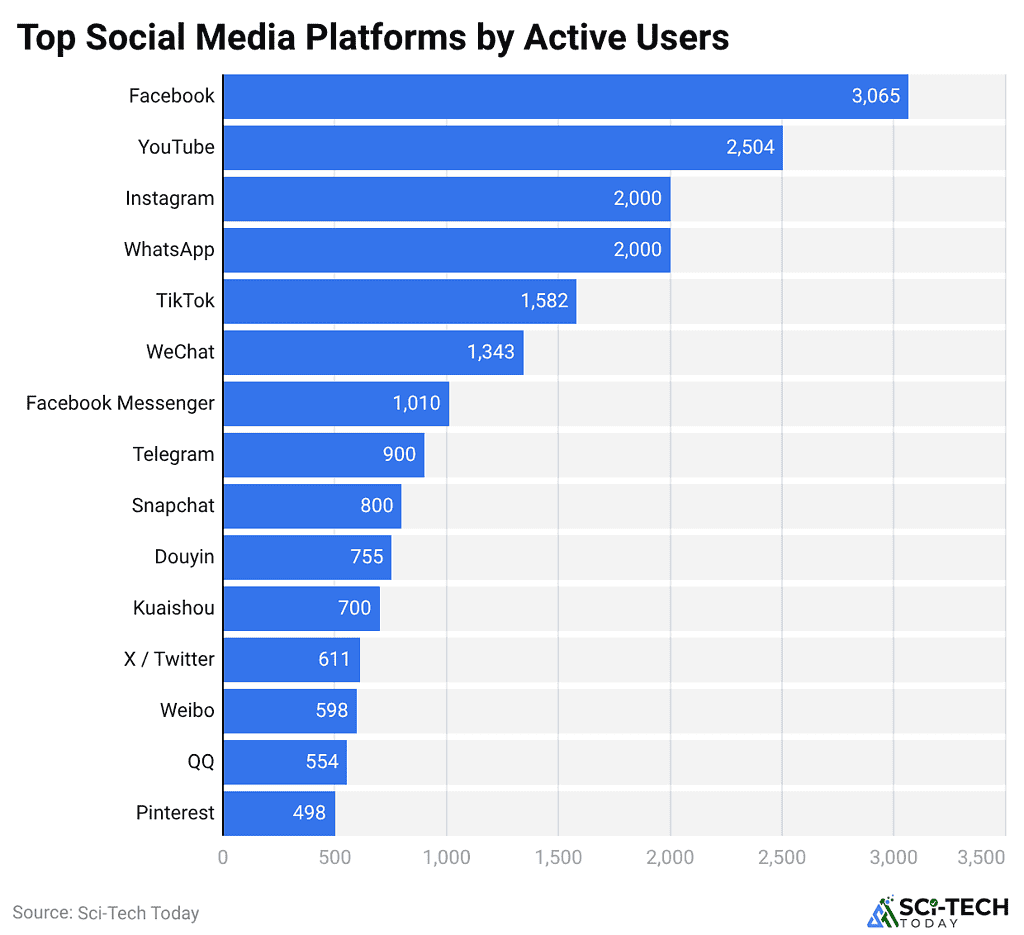
(Reference: sqmagazine.co.uk)
- According to Sqmaginue, the ranking above depicts the collective influence of scale, ecosystem strength, and social media algorithm in the shaping of platform supremacy in 2025.
- The 3.07 billion users of Facebook correspond to the prioritization of groups, video, and community-driven feeds that retention-maximizing algorithmic work.
- The continuous rise of YouTube signifies in a clear way how recommendation engines and monetization incentives draw out more output from the creators—another clear case of the effect of social media algorithms on engagement sustaining.
- The power of Meta’s ecosystem, such as Instagram and WhatsApp are already boasting 2 billion users that are all through cross-platform data and content optimization.
- The same applies to TikTok and Douyin; while their content was very much addictive, they, with the help of their ever-evolving algorithms, managed to change the user base positively, and thus, their impact on discovery through social media algorithms was highlighted.
- Platforms like Telegram and Snapchat, however, are still indicating that privacy, niche positioning, and demographic targeting can be scaled whenever the algorithms synchronize with user intent.
Effects On User Engagement Metrics
- The described trends uncover the degree of social media algorithm impact on modern engagement economics.
- The platforms of today give a lot more value to interaction intensity—likes, comments, shares, and watch time—than to raw reach, thus creators will have to optimize their outputs for reactions and not only for visibility.
- The observation that the dissemination of false or controversial content once took up to 20 times longer on Twitter illustrates one of the unintended consequences of algorithmic amplification, namely, where emotional triggers overshadow accuracy.
- The algorithmic nudges have now turned into the most powerful gatekeeping mechanism, able to quickly amplify or decrease the reach of influencers and political figures, thus strengthening the strategic significance of social media algorithm impact.
- Video-first strategies, particularly those using Reels and short-form formats, always get the highest interaction rates, which proves that the format bias affects the engagement outcomes in a very powerful way.
The Impact Of Platform Algorithms On Influencer Marketing In 2025
- Social media algorithm impact has been, over the years, the unspoken power broker that controls influencer marketing in 2025.
- The platforms don’t just distribute the content in a neutral way anymore; they act as active editors that select which influencer content will be visible.
- The prioritizing of video formats, completion of watch time, and quality of engagement means that the performance is evaluated by the depth of the interaction, not by the surface-level metrics.
- Thus, the tactics that were used to artificially inflate the reach, such as engagement pods or coordinated likes, are now being actively penalized, resulting in the overnight reduction of the effectiveness of the campaign.
- A campaign that had reached 500,000 users in 2024 without any trouble may not be able to reach even that number in 2025 solely because of algorithm changes. This unpredictability affects both creators and brands in terms of their revenue.
- Social media algorithms are reshaping influencer ROI directly, as 73% of brands experiencing a decrease in organic reach attribute this to the social media algorithm’s impact.
- Now the sure-footedness of influencers is based on the adaptability of their teams, the constant monitoring of data, and the making of genuine connections with the audience, thus proving that the social media algorithm impact is no longer a background factor but the core driver of influencer marketing outcomes.
Impact On Content Visibility
- Content visibility in 2025 is determined more by the behavior of users than by the timing of the posts, which is a clear reflection of Social Media Algorithm Impact.
- The Social Media Platforms are now analyzing how users interact with the posts- whether it be slowing down during a video, watching the entire video, or commenting, saving, and sharing—rather than the simple like.
- Instagram’s clear format hierarchy, where Reels are the winners followed by carousels, Stories, and static images, shows that video-first strategies are the ones that dominate the feeds.
- The constant A/B testing of visibility makes the reach increasingly volatile, and the creators have to move fast to adapt.
- The stronger spam and clickbait filters also cut down the visibility of the low-quality posts significantly.
- In the end, the platforms give priority to user intent rather than raw popularity, thus emphasizing how Social Media Algorithm Impact rewards depth, relevance, and sustained engagement rather than instant exposure.
Most Utilized Social Media Platforms By Marketers
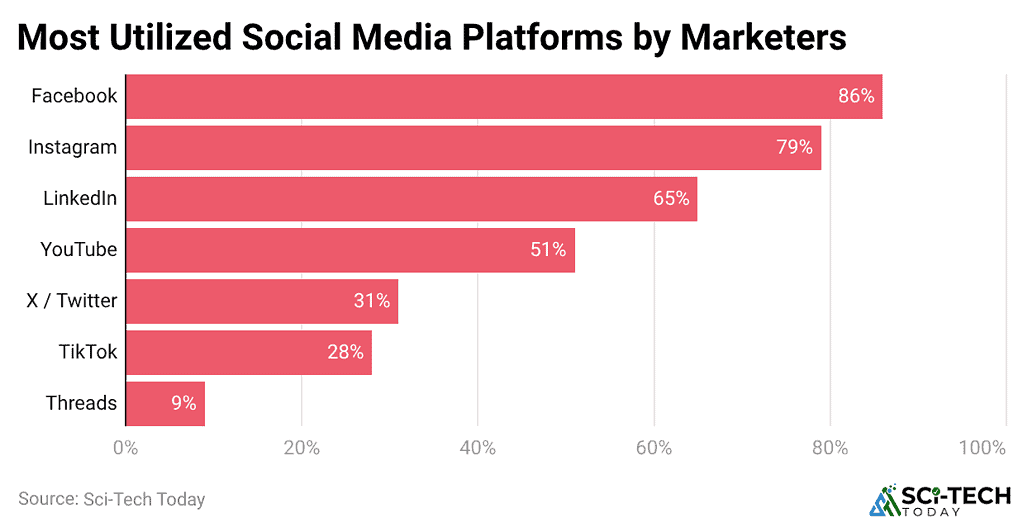
(Reference: sqmagazine.co.uk)
- The patterns of marketer adoption clearly mirror the social media algorithm impact across platforms.
- Facebook’s usage of 86% indicates that the mature targeting tools and algorithms still deliver consistent returns on investments.
- Instagram’s adoption of 79% is evidence for the social media algorithm impact of visual-first and influencer-driven discovery.
- LinkedIn’s substantial share of 65% indicates the accuracy of the algorithm in B2B targeting and the professional relevance.
- YouTube’s usage of 51% reflects the preference of the algorithm for watch time and storytelling depth.
- On the other hand, the lower adoption of X, TikTok, and Threads indicates uncertainty with respect to the evolving ranking systems.
Social Media Algorithms Marketers Find Most Challenging In 2025
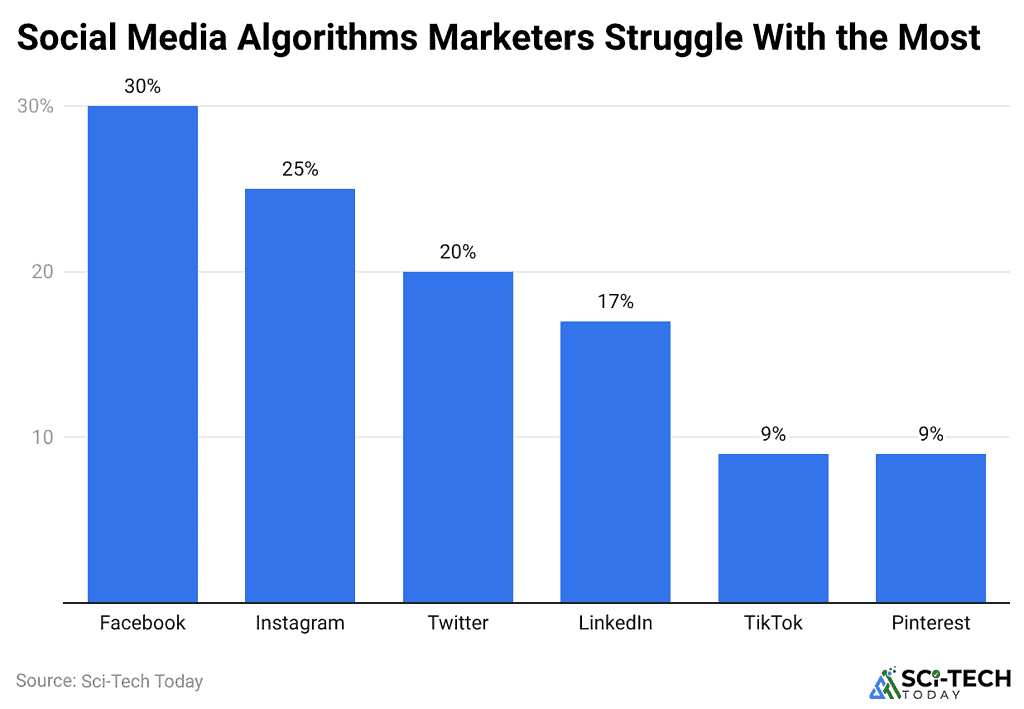
(Reference: sqmagazine.co.uk)
- The above figures vividly illustrate how the social media algorithm impact has been disproportionate across platforms.
- Facebook is the most marked by the frustration of the marketers, with 30% of them unable to keep their visibility due to the rise in engagement thresholds and the tightening of organic reach.
- Instagram is not far behind at 25%, where regular updates are making the social media algorithm impact on discovery even stronger, and the brands are being forced to innovate new formats.
- X is a struggle for 20% of marketers as the prioritization of content is changing, and so are the impressions.
- LinkedIn’s situation with its 17% share is indicative of the professional relevance of its content, but still reflects shorter lifespans of content.
- In contrast, TikTok and Pinterest are showing less friction, signalling that their social media algorithm impact still favours creativity over the complexity of legacy.
How Algorithms Are Reshaping Creator Income Streams
- Gains and losses on social media platforms are no longer just a function of audience size but are greatly conditioned by the reach of the algorithms.
- The 2024–2025 TikTok’s reported 12–18% payouts decline illustrates how even one algorithm change can very quickly erase the income of creators.
- The drop in visibility leads to a drop in monetization, thus making dependency revenue on the platform increasingly fragile.
- Sponsorships, affiliate links, and digital products are no longer mere optional strategies; they have rather turned into the main tactics for fighting against the unpredictable impact of social media algorithms.
- The change in the social media landscape is big. Micro-influencers come to dominate the algorithm’s favour, providing the company with stronger interactions for less money.
- Furthermore, social media is usually easier and more cost-effective to engage several smaller creators together than one big influencer due to the social media algorithms’ impact that favours flexibility over size.
Decoding The Real ROI Effects of Algorithm Shifts
- The ROI numbers have spoken and made clear the marketing efficiency impact that social media algorithms have in enlarging the marketing budget.
- The 23% decline of Instagram organic reach in the first quarter of 2025 is a metric that represents lost visibility, lost conversions, and lost revenue.
- If a USD 10,000 influencer campaign quietly delivers USD 2,300 less value without any mistake on the strategy side, the algorithm has practically rewritten the ROI math—conclusively deciding the value of the campaign.
- The algorithms are progressively giving higher ranks to engagement density than to the size of the audience.
- Nano and micro-influencers are gaining ground because their interaction with the audience is so natural that it gives a quality signal to the ranking system.
- On the other hand, macro and mega influencers are becoming less and less visible, as their organic reach is reduced to a mere single-digit percentage of their total audience.
- TikTok’s income distribution effects are inconsistent and only serve to strengthen the hierarchy—top creators gain while mid-tier creators lose.
- With the shift of budgets toward micro-influencers, they are gaining the social media algorithm impact, achieving higher engagement, stronger reach efficiency, and better returns.
- Algorithm literacy in 2025 is not an option anymore—it is a competitive advantage propelled by social media algorithm impact itself.
Algorithm-First Growth Playbooks – Winning Attention In The 2025 Feed Economy
- According to the InufluenceFlow report, which shows how social media algorithm impact has grown to such a degree that it now dictates success across different platforms.
- In 2025, algorithms are not just passive distribution tools anymore—they are active gatekeepers that grant access based on depth of engagement, rather than superficial involvement.
- Instagram’s focus on Reels, TikTok’s preoccupation with completion rate, and YouTube’s preference for watch time are all indications of the same transition: social media platforms are now optimizing for retention rather than reach.
- Micro-niche hashtags, rapid hooks within the first two seconds, and trending audio are not merely tactics—they are algorithmic signals. These signals assist platforms in quickly classifying content and pairing it with users who have high intent, hence increasing its exposure.
- Conversely, tools that measure saves, shares, and completion rates have now become early-warning systems, exposing creators to what the algorithm really values.
- Risk management is also equally important. Shadow banning has surfaced as a covert punishment, which is set off by engagement pods, bots, or overly using hashtags.
- The system today swiftly sanctions untrue growth, making it clear that authenticity is not an option—it is algorithmic protection.
- The partnership between LinkedIn’s video and employee sharing promotion emphasizes yet another theme—there are still some platform-specific advantages, but only if creators quickly adopt the changes. These approaches, in general, bring forth a new reality: the mixing of human creativity with machine logic is what leads to sustainable growth.
- In 2025, the mastery of social media algorithm impact won’t be about gaming the platforms anymore, but rather about comprehending how attention through social media algorithm impact itself is measured, rewarded, and preserved.
Conclusion
Social Media Algorithm Impact Statistics: The year 2025 marks the time when social media algorithms have completely taken over the economic decision-makers’ roles. The granting of visibility, income, and brand growth is no longer based solely on size but on the alignment with the logic of the algorithms. The data presents a shift that is quite clear: the depth of engagement beats reach, the adaptability wins over the traditional influence, and the authenticity serves as a performance signal that can be measured.
As organic reach gets tighter and volatility rises, those who have an understanding of social media algorithm impact will have the upper hand. Creators and brands are the ones that will be the winners in this environment, provided they treat the algorithms not as barriers, but as systems that can be studied, respected, and strategically leveraged.
FAQ
Rather than just relying on likes, Algorithms prioritize the content based on various factors such as the amount of time watched, saved, shared, commented on, and the relevance, along with the user’s behavior history and the quality of engagement.
Facebook, Instagram, YouTube, and TikTok will be the ones most affected by social media algorithms because of the frequent updates, prioritization of videos, and the setting of engagement thresholds.
The algorithm directly dictates the reach an influencer can achieve, resulting in highly unpredictable visibility and decreasing organic reach.
The amount of money a creator is able to make is heavily dependent upon the reach granted through algorithm updates, which can render a return income to null, as has been witnessed with TikTok, seeing eroding profits of 12%–18% once mix ranking changes are superimposed on it.
Brands need to focus on improving engagement quality, adopting a video-centric approach, strictly monitoring nuanced data, diversifying to creators in terms of class, and forging authentic interactions based on the nitty-gritty of the present situation with content.