








Preface
Customer Relationship Management Statistics: Customers are at the heart of every successful business. That is why companies need more than just good products; they need strong relationships with the people who buy from them. Customer Relationship Management helps businesses do exactly that. It brings customer details, sales activities, messages, and service records together in one place. As a result, teams can understand what customers want, respond faster, and offer more personal experiences.
CRM also helps businesses track leads, improve sales, solve customer problems, and build long-term loyalty. In today’s competitive market, a good CRM system can turn customer data into better decisions, stronger relationships, and steady business growth.
Highly Recommended
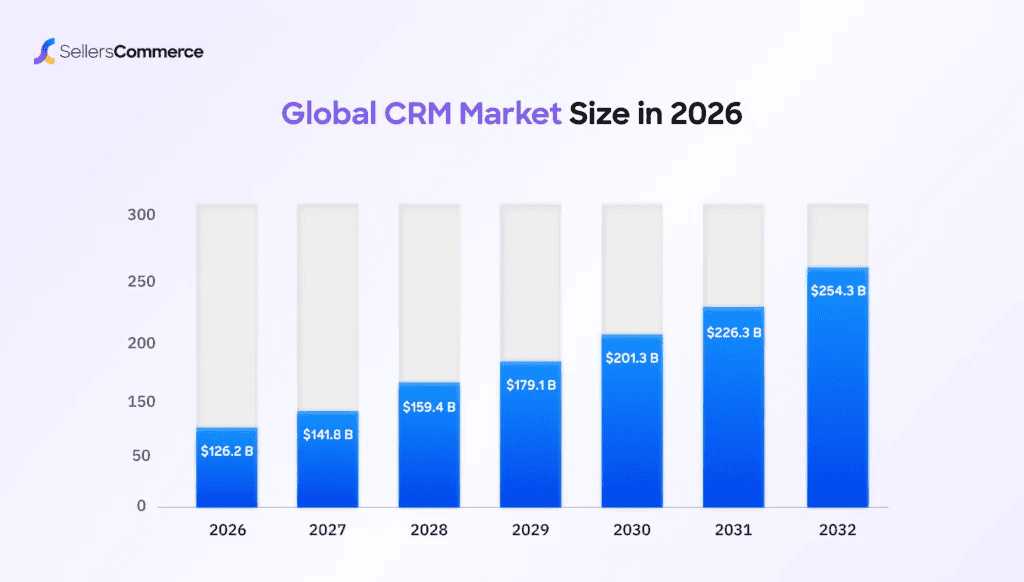
- The global CRM market is projected to grow from USD 126.2 billion in 2026 to USD 254.3 billion by 2032.
- North America leads the market at USD 39.15 billion (30.0%), followed by Asia Pacific at USD 34.02 billion (26.1%).
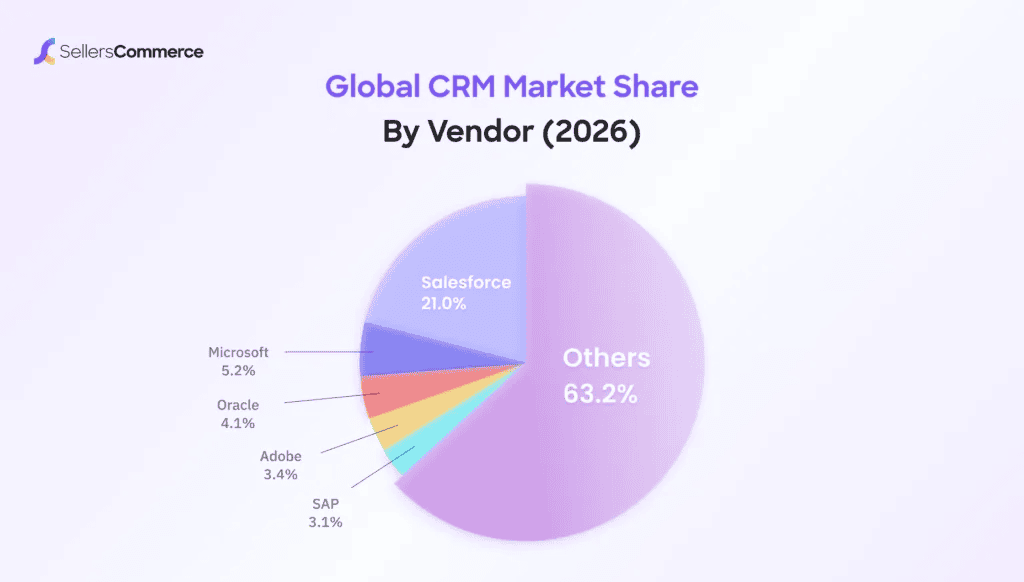
- Salesforce leads vendor share at 21.0%, ahead of Microsoft (5.2%) and Oracle (4.1%).
- 91% of companies with more than 11 employees use CRM software.
- Cloud CRM adoption has risen from 12% in 2008 to 87% today.
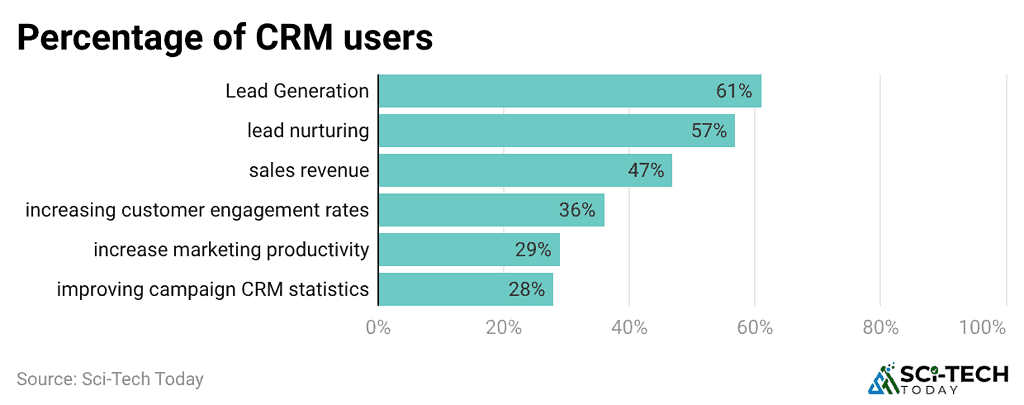
- CRM is used chiefly for lead generation (61%), lead nurturing (57%), and revenue growth (47%).
- CRM investment generates an average return of USD 8.71 per USD 1 spent.
- Companies report up to a 300% improvement in lead-conversion rates after CRM implementation.
- Mobile CRM users are 150% more likely to exceed targets: 65% meet quota, compared with 22% of non-users.
- Data readiness is pivotal: 45% of CRM leaders say their data cannot support advanced AI use cases.
Global Customer Relationship Management Market Outlook
(Source: sellerscommerce.com)
- The global CRM market is valued at USD 126.2 billion in 2026 and is expected to reach USD 254.3 billion by 2032.
- This growth reflects a rise of over 100% from 2026 to 2032.
By Region
- A report published by LinkedIn stated that North America leads with USD 39.15 billion and a 30.0% share, supported by early adoption of AI-powered CRM and major vendors.
- Fortune Business Insights further noted that Asia Pacific follows at USD 34.02 billion, accounting for 26.1%, driven by digital growth in China, India, and Japan.
- Europe reaches USD 31.55 billion, with a 24.2% share, led by Germany, the UK, and France.
- Middle East & Africa accounts for USD 16.53 billion and 12.7%, supported by digital transformation.
- Latin America holds USD 9.28 billion, representing 7.1%, with steady CRM adoption growth.
Market Share by Vendor
(Source: sellerscommerce.com)
- Salesforce leads the global CRM market with a 21.0% share in 2026.
- Microsoft holds 5.2% of the market, followed by Oracle at 4.1%.
- Adobe accounts for a 3.4% share, while SAP holds 3.1%.
- All remaining vendors together capture 63.2% of the market.
Main Objectives of CRM Use
(Reference: demandsage.com)
- 61% of CRM users rely on CRM systems for lead generation.
- 57% use CRM to nurture leads and move prospects toward purchase.
- 47% use CRM to support sales revenue growth.
- 36% focus on increasing customer engagement through CRM.
- 29% use CRM to improve marketing productivity.
- 28% use CRM to improve and track campaign performance.
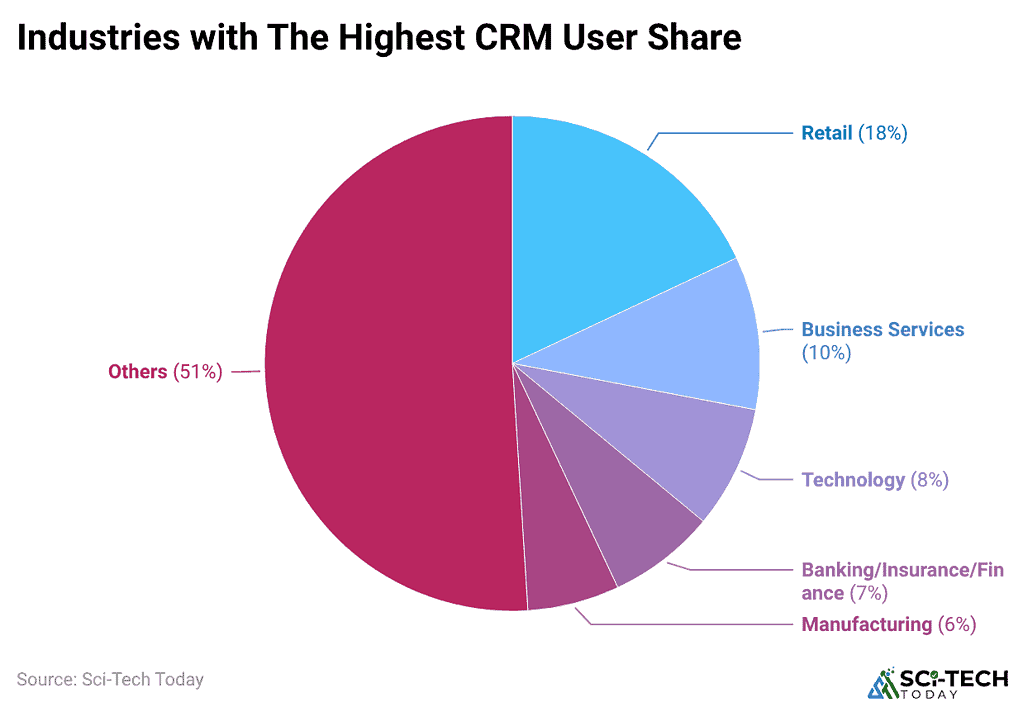
Industries with the Highest CRM User Share
(Reference: demandsage.com)
- Retail leads CRM adoption with an 18% user share, reflecting strong demand for customer engagement and sales management tools.
- Business services account for 10%, followed by technology at 8%.
- Banking, insurance, and finance account for 7%, while manufacturing accounts for 6%.
- Other industries collectively account for the remaining 51% share.
CMR Usage Statistics
- According to Sellers Commerce, 70% of businesses use CRM systems mainly to improve customer service and support.
- About 65% of businesses adopt CRM within their first five years, highlighting its role in early growth and customer management.
- 87% of businesses now use cloud-based CRM platforms, compared with just 12% in 2008, showing the strong shift toward cloud solutions.
- 70% of businesses use mobile CRM to strengthen their sales strategies, while users are 150% more likely to exceed sales targets.
- 92% of businesses consider CRM software essential for achieving their revenue goals.
Customer Relationship Management Statistics by Sales Cycle and Revenue Impact
- Officeclip reported that companies that successfully implement CRM can achieve a 29% improvement in sales performance.
- A CRM system can increase a sales representative’s earning potential by 41%.
- 94% of businesses report higher sales productivity after adopting CRM.
- Active CRM use can potentially boost conversion rates by 300%.
- CRM adoption can increase sales revenue by 45%.
Customer Relationship Management Software Market Trends
- The global CRM software market is expected to reach USD 103.51 billion in 2026, according to Statista.
- The market is projected to grow at a 6.16% annual rate from 2026 to 2031, reaching USD 139.56 billion by 2031.
- The average CRM spending per employee is expected to reach USD 27.66 in 2026.
- The United States is forecast to generate the highest revenue, reaching USD 50.14 billion in 2026.
Key Benefits
- CRM software stores customer data, leads, sales activities, and interaction history in one place.
- 93% of businesses reported higher customer retention after adopting CRM.
- 94% saw improved sales productivity, with 44% gaining a 10%-29% increase.
- 34% reduced their sales cycle by 8-14 days using CRM automation.
Remote Work and Mobile CRM Impact
- 70% of businesses use mobile CRM to manage operations across distributed teams and locations.
- Employees using mobile CRM are 150% more likely to exceed sales goals.
- Mobile access and social features can increase sales productivity by 26.4%.
- 82% of employees say mobile CRM improves data quality and accessibility.
- 65% of mobile CRM users meet their quotas, compared with 22% without it.
- Mobile CRM demand is expected to grow by 11%, representing about USD 15 billion in earnings.
Enhancing Customer Experience and Retention

(Source: keywordseverywhere.com)
- Today, more than two-thirds of companies, over 68%, report that they now compete primarily based on customer experience. This is a dramatic increase from just 36% a decade ago.
- A CRM system can increase customer retention by up to 27%. It achieves this by unifying data from every touchpoint.
- 47% of CRM users say that a CRM system has a significant impact on customer satisfaction, with 75% of organizations using CRM reporting overall improvements.
- 79% of customers expect a consistent, seamless experience across all channels: web, social, email, phone.
- 80% of consumers are more likely to purchase from a company that delivers a personalized experience.
- 74% of CRM users say their system has given them improved access to customer data, allowing them to solve problems faster and without asking for information the customer has already provided.
Customer Relationship Management Adoption Statistics and ROI
- According to SuperOffice, 91% of companies with more than 11 employees use CRM software.
- 65% of sales reps who use a mobile CRM meet their sales quotas, compared with 22% of non-users.
- 74% of CRM users say the system improves access to customer data, but data quality remains a major concern.
- 47% of CRM users say poor data quality significantly affects their satisfaction with the system.
How Have Businesses Adopted CRMs?
- Around 91% of companies with 10+ employees use CRM systems to manage leads and customer interactions.
- Nearly half of businesses with fewer than 10 employees still avoid CRMs due to cost and limited expertise.
- Tech leads CRM adoption at 94%, followed by Manufacturing (86%), Education (85%), Healthcare (82%), and Human Resources (81%).
Customer Relationship Management ROI Statistics
(Source: salesmate.io)
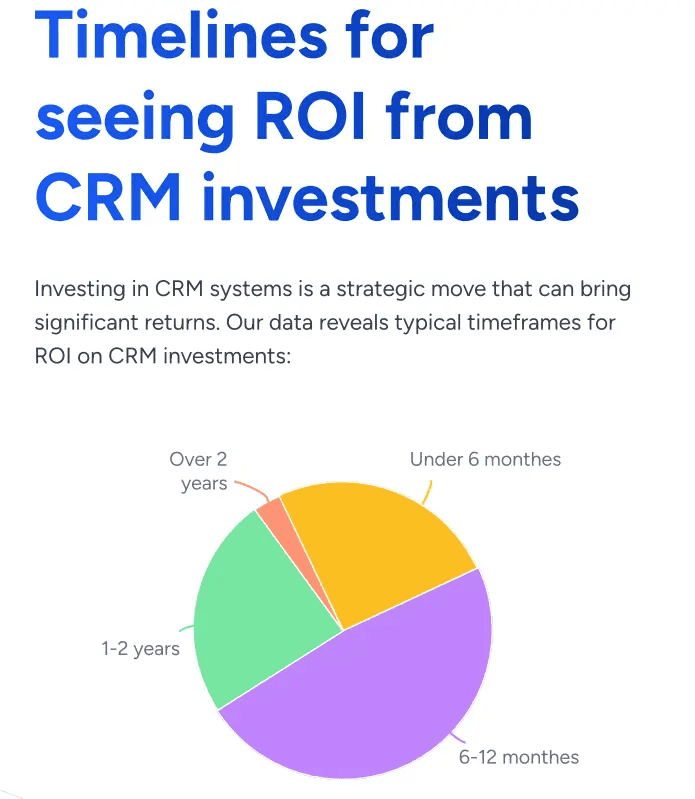
- Most companies (the largest share) see ROI within 6-12 months.
- About 25% see results in 1-2 years, 25% in under 6 months, and only a small share takes over 2 years.
- Businesses earn an average of USD 8.71 for every USD 1 invested in CRM.
- Most businesses report a 21%- 30% increase in sales revenue after implementing a CRM.
- 91% of businesses say CRM helps reduce customer acquisition costs, with 49% reporting an 11%- 20% decline.
- CRM can increase conversion rates by up to 300%.
- Moreover, it also increases cross-sell and upsell revenue by 39%.
Key CRM Productivity Statistics
- According to salesmate.io, most businesses report that CRM software saves employees 5-10 hours each week.
- 94% of businesses see higher sales productivity after adopting CRM, while 44% report gains of 10%-29%.
- 34% say CRM shortens their sales cycle by 8-14 days.
- CRM can improve sales forecasting accuracy by up to 42%.
- 50% credit for automating repetitive tasks to save time.
- 46% benefit from centralized customer data, while 41% report smoother communication with customers and prospects.
How Does CRM Help With Customer Retention?
- Businesses using CRM systems achieve about 27% higher customer retention by organizing customer data and enabling personalized interactions.
- Around 47% of CRM users report major improvements in customer satisfaction, while 75% say their retention strategies have become stronger.
- 79% of customers expect consistent service across all channels, making CRM important for delivering a unified experience.
- Industries with strong retention rates include Commercial Insurance at 86%, Business Consulting at 85%, and IT & Managed Services at 83%.
Customer Experience Impact
(Source: superoffice.com)
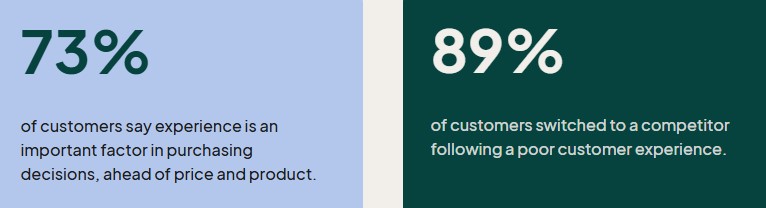
- 73% of customers consider experience an important purchasing factor, ahead of price and product.
- 89% of customers have switched to competitors after a poor experience.
- 86% of buyers are willing to pay more for a better customer experience.
- Acquiring a new customer costs 5 times as much as retaining an existing customer.
- Improving customer retention by 5% can increase profits by 95%.
- 60% of customers share bad experiences with friends and family.
- 70% of buying experiences depend on how customers feel they are treated.
- Businesses can lose an average of 14% in revenue when customers stop buying.
- Only 8% of customers rate companies as delivering an excellent customer experience, while 80% of businesses believe they deliver excellent experiences.
Most Common Business Benefits of Customer Relationship Management Systems
- CRM gives teams better access to customer data, helping them make faster and smarter decisions.
- It supports personalized customer communication across sales and marketing activities.
- CRM improves teamwork by keeping sales, marketing, and support teams on the same customer records.
- 49% of businesses report better customer service and support after adopting CRM.
- 53% report higher customer satisfaction and stronger customer retention.
- 57% of businesses see increased sales revenue from using CRM.
- CRM also improves analytics and visibility into sales pipelines, customer activity, and forecasts.
Customer Relationship Management Implementation Challenges
- 25% of CRM implementations face training and user adoption issues, making it harder for teams to adjust to new workflows.
- 48% of sales leaders say their CRM does not fully meet their business needs because of poor setup or missing features.
- Nearly one-third of sales leaders report that customer data is incomplete or outdated, reducing trust in the system.
- 32% of sales reps spend more than 1 hour per day entering data manually, which can reduce CRM usage.
- 63% of companies face at least one CRM-related challenge after implementation.
- Only 28% of organizations say their CRM provides a fully unified customer view.
How AI Is Reshaping the CRM Market
- Salesforce Agentforce uses AI to automate lead qualification and customer support, achieving 83% accuracy with near real-time processing.
- Microsoft Dynamics 365 uses Copilot across Outlook, Teams, and Excel to automate sales research, follow-ups, and customer routing, while CRM revenue grew 23% in fiscal 2025.
- About 81% of organizations are expected to adopt AI-powered CRM, improving sales forecast accuracy by over 40% and increasing retention and repeat sales by 15%.
- AI chatbots can cut customer service response times by 40% while providing 24/7 support.
- Customer Data Platforms accounted for 69% of new CRM deployments in 2024-2025, while AI-native CRM systems reduced administrative work by 73% and improved forecast accuracy by 3-5 times.
Summary
Customer Relationship Management helps businesses build better and stronger relationships with their customers. It brings customer information, sales, communication, and support into one place, making daily work easier. With CRM, businesses can understand customer needs, respond faster, and offer more personalized service.
As a result, CRM can improve customer satisfaction, increase loyalty, and support sales growth. In today’s competitive market, a simple and effective CRM system can help businesses keep customers and grow steadily. Know in the comments section. Thanks for staying until the end. We appreciate your effort.
FAQ
Benefits include better customer service, improved sales management, organized customer data, stronger customer retention, and increased productivity.
The main types are operational CRM, analytical CRM, and collaborative CRM.
CRM helps sales teams track leads, follow up with prospects, manage sales pipelines, and identify opportunities, thereby improving conversion rates.

Sources