









Beginning
AI In Edtech Statistics: EdTech refers to the use of digital tools, software, and platforms to support teaching and learning. This includes everything from basic tools like learning management systems (Google Classroom, Canvas) and video conferencing for online classes, to more advanced applications like AI-powered tutoring, adaptive learning platforms, language-learning apps, and virtual/augmented reality for immersive lessons. It spans K-12 schools, universities, and corporate training alike.
As for recent data’s funding for EdTech companies is slowing down, investors are still putting a lot of money into artificial intelligence tools. In the first half of 2026, global EdTech venture capital funding totaled around USD 1 billion. This is a 26% drop compared to the same time last year. However, money is still flowing into AI-based platforms that solve specific classroom problems. In this article, we explore at key statistics behind AI’s growing role in EdTech, recent funding trends, and much more.
Top Editorial Pick
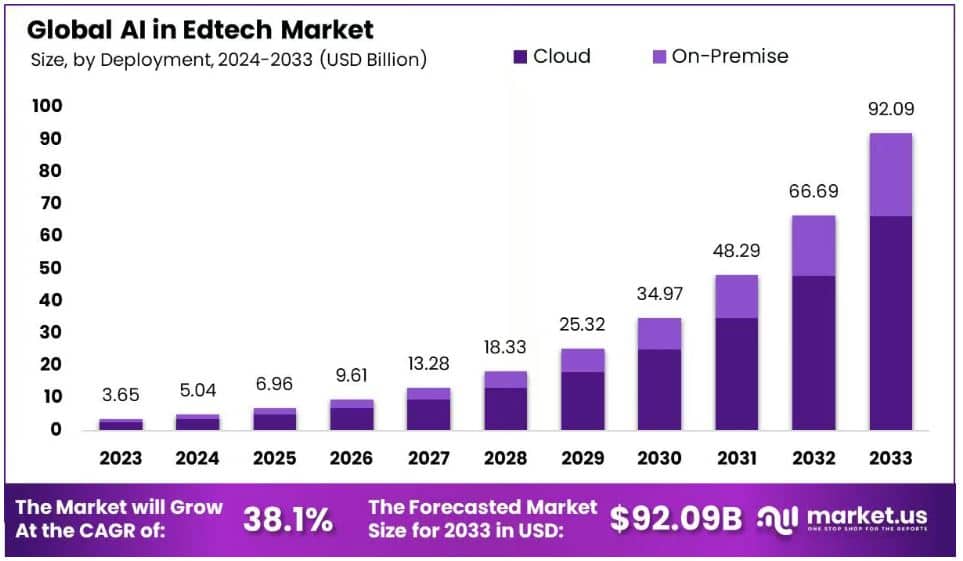
- The global AI in EdTech market is projected to reach USD 92.09 billion by 2033, expanding at a CAGR of 38.1% from 2024 to 2033.
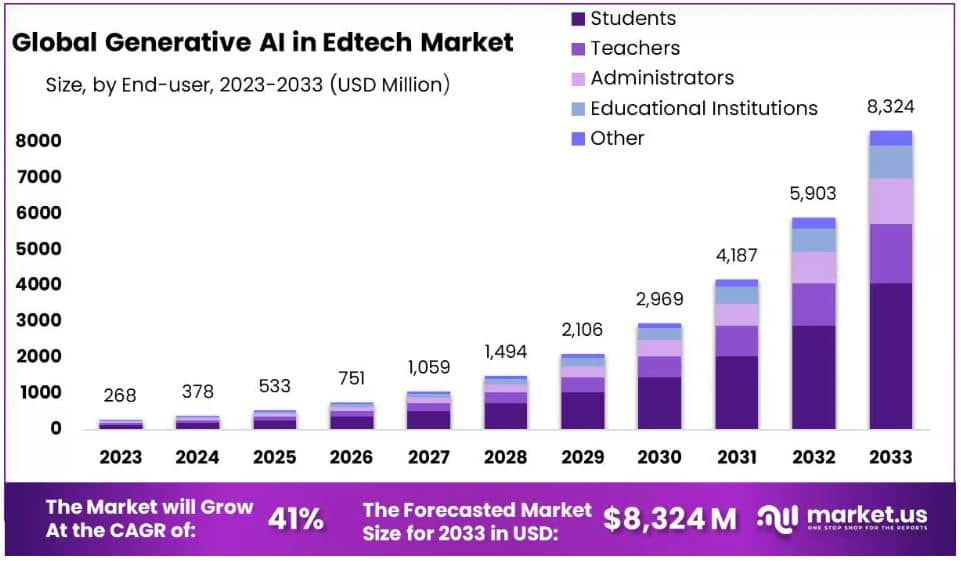
- The global Generative AI in EdTech market is expected to reach USD 8.32 billion by 2033, growing at a strong CAGR of approximately 41%.
- Around 95% of UK undergraduate students used Generative AI in 2026, compared with 92% in 2025 and just 66% in 2024.
- Approximately 94% of UK undergraduate students used Generative AI for assessed academic work in 2026, highlighting its rapid integration into higher education.
- Around 95% or more of higher education students and faculty now use AI in an educational context, indicating that AI adoption has become nearly universal across universities.
- Approximately 81% of teachers are using AI, with the technology increasingly applied to lesson preparation, content development, classroom activities, and professional learning.
- Teacher use of AI for lesson planning increased from 25% to 53% within one year, showing how quickly AI is becoming part of everyday teaching workflows.
- Teachers who use AI at least weekly reported saving an average of 5.9 hours per week, equivalent to approximately six working weeks over an academic year.
- AI-powered grading tools such as EssayGrader and AutoMark report approximately 97% agreement with human grading while reducing essay-grading time by as much as 80%.
- MagicSchool AI surpassed 6 million educator users by October 2025, demonstrating strong demand for AI-powered teacher productivity and classroom-support tools.
- Khan Academy’s AI tutor Khanmigo expanded from 45 to more than 380 school district partners between the 2023–24 and 2024–25 school years.
- Duolingo reached 47.7 million daily active users in Q2 2025, representing a 40% year-over-year increase, while its AI-powered Duolingo Max service was used by 15% of daily active users.
- Global EdTech investment reached approximately USD 2.6 billion in 2025, increasing by about 11% from 2024, with significant funding directed toward AI-enabled learning and workforce-training platforms.
- Despite broader funding pressure, EdTech companies still raised approximately USD 1 billion during the first half of 2026, while AI education startups attracted USD 232.07 million across 32 disclosed funding rounds between August 2025 and September 2026.
- Asia-Pacific is projected to be the fastest-growing AI in education market, with a CAGR of 44.20%, while North America accounted for approximately 38.80% of global AI-in-education revenue in 2024.
Global AI in Edtech Market Statistics
According to Market.us, the AI in EdTech market is experiencing rapid expansion as educational institutions, corporate training providers, and digital learning platforms increasingly adopt artificial intelligence for personalized learning, content development, assessment, and administrative automation.
(Source: market.us)
- Global Market Growth: The global AI in EdTech market was valued at approximately USD 3.65 billion in 2023 and is projected to reach around USD 92.09 billion by 2033, expanding at a strong CAGR of 38.1% from 2024 to 2033.
- Cloud Deployment Leadership: In 2023, the cloud deployment segment accounted for more than 72% of the global AI in EdTech market. Growth has been supported by scalability, lower infrastructure requirements, remote accessibility, and easier integration of AI-powered educational applications.
- Personalized Learning Dominance: The personalized learning segment captured more than 43% of the market in 2023. AI-based adaptive learning platforms are increasingly being used to adjust educational content, learning speed, recommendations, and assessments according to individual student requirements.
- Corporate Training Adoption: Corporate training centers represented more than 45% of the AI in EdTech market in 2023, making them the leading end-user segment. AI is increasingly being deployed to identify workforce skill gaps, personalize employee training, and improve learning and development efficiency.
- North America Leads the Market: North America accounted for more than 37% of global AI in EdTech revenue in 2023, representing approximately USD 1.35 billion. The region’s leadership has been supported by strong digital infrastructure, AI investment, established technology companies, and early adoption of advanced learning technologies.
- AI for Education Administration: More than 50% of schools and universities are reported to use AI for administrative activities, highlighting the increasing adoption of automation for routine institutional processes and education management.
- AI Education Market Expansion: Growing participation in digital courses and technology-supported learning is contributing to wider adoption of AI across education. The broader AI education market has been projected to reach approximately USD 22 billion by 2029.
- Generative AI Opportunity: The global Generative AI in EdTech market is projected to increase from approximately USD 268 million in 2023 to USD 8.32 billion by 2033, representing a CAGR of about 41%. Content generation, automated grading, personalized tutoring, adaptive learning, and virtual simulations are expected to support this expansion.
- AR and VR Adoption in Education: The global AR and VR in Education market is projected to reach approximately USD 75 billion by 2033, expanding at a CAGR of around 20.26% from 2024 to 2033. These technologies are increasingly being integrated with digital learning platforms to create interactive and immersive educational experiences.
- Large Digital Transformation Opportunity: The education industry represents an estimated USD 6.6 trillion market, while less than 4% has historically been digitized, indicating considerable long-term potential for EdTech platforms, artificial intelligence, digital classrooms, and adaptive learning solutions.
- 57% of U.S. College Students Use AI Weekly: According to the 2026 Lumina Foundation-Gallup State of Higher Education study, 57% of U.S. college students use AI for coursework at least weekly, including around one-fifth who use it every day. Only 13% reported never using AI for their coursework.
- AI Policies Are Still Catching Up With Usage: The same 2026 Gallup study found that 53% of U.S. college students said their institution discourages or prohibits AI use in coursework, while 52% reported that at least some classes lack clear guidance regarding AI use. This indicates a considerable gap between student adoption and institutional governance.
- 51% of Gen Z Uses Generative AI Regularly: In 2026, 51% of U.S. Gen Z respondents reported using generative AI either daily or weekly. Among Gen Z K-12 students, the weekly-or-more usage rate reached 56%, demonstrating that AI tools are becoming increasingly integrated into younger learners’ digital activities.
- School AI Policies Are Expanding Rapidly: The share of U.S. Gen Z K-12 students reporting that their school has rules governing AI use increased sharply from 51% in 2025 to 74% in 2026. Meanwhile, access to AI through school computers increased from 36% to 49%.
- 78% of Students See a Role for AI in Classrooms: A 2026 Gallup/Walton Family Foundation survey found that approximately 78% of students believe AI should have a place in the classroom, while 51% reported using AI daily or weekly.
- Higher Education AI Integration Remains Uneven: The Digital Education Council’s 2026 global survey covering 45,398 respondents across 35 countries found that only 15% of students said AI was integrated into many of their courses, while 43% reported integration in only a few courses and another 43% had experienced no AI integration in their courses.
- Faculty AI Readiness Remains a Key Gap: Only 29% of students globally surveyed by the Digital Education Council in 2026 believed their instructors were well equipped to guide them in using AI. Among students in the U.S. and Canada, the proportion fell to 17%.
- AI-Related Academic Integrity Concerns Are Increasing: Approximately 60% of students globally expressed concern that classmates could misuse AI to gain an unfair academic advantage. The proportion increased to 73% among students in the U.S. and Canada, highlighting the growing requirement for clear AI policies and assessment frameworks.
- AI Is Generating Significant Teacher Productivity Gains: A 2025 Gallup-Walton Family Foundation study found that 32% of U.S. K-12 teachers used AI tools at least weekly. Teachers using AI weekly reported saving an average of 5.9 hours per week, equivalent to approximately six weeks of working time over a school year.
- AI Is Supporting Teaching Quality: Among teachers using AI, 61% reported better-quality insights from student learning and achievement data, while 57% reported improvements in grading and student feedback, demonstrating that AI adoption is increasingly moving beyond basic automation toward instructional support.
AI Usage in Academic Activities
- A high 95.6% of users use AI tools in their academic activities, showing widespread adoption among students.
- Among AI types, 88.2% use virtual assistants, 42.4% use AI-based educational platforms, 17.6% use automatic content generation tools, 8.2% use data processing tools, and 3.5% use other AI types.
- Regarding frequency, 57.6% use AI tools weekly, 18.8% use them daily, 11.8% use them monthly, and 11.8% use them rarely.
- Only 1.2% reported not using AI tools at all.
- A strong 80% of students believe AI positively impacts their learning experience by saving time and offering personalized resources.
- However, 17.6% expressed limited familiarity with AI tools, and 2.4% felt AI offers no real benefit.
- On academic performance, 82.4% believe AI improves their results, while 15.3% think it only limits knowledge, and 3.5% feel it could lower performance over time.
Generative AI in Edtech Growth
According to Market.us, the Generative AI in EdTech market is entering a high-growth phase as educational institutions, students, teachers, and digital learning platforms increasingly integrate AI into learning, assessment, content development, and academic support.
(Source: market.us)
- The global Generative AI in EdTech market was valued at approximately USD 268 million in 2023 and is projected to reach around USD 8,324 million by 2033.
- The market is forecast to expand at a strong CAGR of 41% from 2024 to 2033, supported by growing demand for personalized learning, AI tutoring, automated assessment, and intelligent content-generation solutions.
- Adaptive Learning accounted for more than 39% of the market in 2023, making it the leading technology segment. Growth has been supported by the ability of AI-based platforms to adjust learning materials, difficulty levels, feedback, and study paths according to individual student performance.
- Students represented more than 49% of the Generative AI in EdTech market in 2023. The large share can be attributed to increasing student adoption of AI for personalized tutoring, research assistance, content summarization, language learning, and academic support.
- North America’s Generative AI in EdTech market generated approximately USD 39.1 million in 2023. Strong technology infrastructure, substantial EdTech investment, and early adoption of artificial intelligence across educational institutions have supported regional market development.
- Around 50% of organizations surveyed increased their investment in generative AI technologies, indicating that AI adoption is increasingly moving beyond experimental applications toward broader organizational deployment.
- The overall global Generative AI market is projected to increase from USD 13.5 billion in 2023 to approximately USD 255.8 billion by 2033, representing a CAGR of around 34.2%.
- The use of Generative AI for personalized learning and adaptive tutoring increased by approximately 32% in 2023, highlighting the growing importance of customized educational experiences.
- Educational organizations using Generative AI for course development and content creation reported an estimated 25% reduction in content-development time and cost during 2023. This efficiency advantage is strengthening the business case for AI-powered educational content platforms.
- Generative AI applications for language learning and translation increased by approximately 18% in 2023, as AI-powered conversational learning, translation, pronunciation support, and multilingual content became more widely adopted.
- The integration of Generative AI with virtual reality and augmented reality increased by around 22% in 2023. This development is supporting more immersive simulations, interactive classrooms, and experiential learning environments.
- The adoption of Generative AI for student grading and assessment increased by approximately 15% in 2023, helping educational institutions automate routine evaluation activities and reduce administrative workloads.
- Generative AI applications for personalized career guidance and skill development were expected to expand by approximately 28% by the end of 2024, reflecting increasing interest in AI-driven career pathways and skills recommendations.
- The use of Generative AI for gamified and interactive learning increased by approximately 20% during 2023. AI-based gamification is increasingly being used to improve participation, engagement, and learner motivation.
- Around 45% of educational institutions were exploring Generative AI for administrative activities in 2023, including scheduling, resource management, communication, and operational support.
- More than 60% of large EdTech companies were expected to incorporate Generative AI into their product offerings by the end of 2024, indicating a wider shift toward AI-enabled learning platforms.
- The adoption of Generative AI for language translation and accessibility applications increased by around 18% in 2023, improving access to digital education for multilingual learners and students requiring additional accessibility support.
Recent Generative AI in Education Statistics
- Generative AI use among university students has become nearly universal. The HEPI Student Generative AI Survey 2026 found that 95% of surveyed UK undergraduate students use AI in at least one way, compared with 92% in 2025 and 66% in 2024.
- Around 94% of UK undergraduate students reported using Generative AI to support assessed work in 2026, increasing from 88% in 2025. This trend shows how quickly AI tools have become integrated into mainstream academic workflows.
- Approximately 49% of students surveyed by HEPI in 2026 stated that AI had improved their overall student experience, particularly through time savings, improved understanding, and immediate academic support.
- Around 65% of students reported that university assessment practices had changed significantly in response to AI by 2026, showing that institutions are increasingly redesigning evaluation approaches around widespread GenAI adoption.
- According to OECD PISA 2025 results, approximately 46% of students across OECD countries use AI chatbots at least weekly to support learning. Around one in five students reported almost-daily AI use for school-related activities.
- Approximately 60% of students across OECD countries reported being asked at school to evaluate the quality of AI-generated information, suggesting that AI literacy and verification skills are increasingly becoming part of education.
- The OECD Digital Education Outlook 2026 reported that 37% of lower-secondary teachers used AI for their work in 2024, demonstrating increasing adoption of AI on the educator side of the market.
- Around 57% of lower-secondary teachers agreed that AI can help them write or improve lesson plans, highlighting the growing use of Generative AI as a teaching and content-development assistant.
- At the same time, 72% of lower-secondary teachers expressed concern that AI could negatively affect academic integrity by allowing students to present AI-generated work as their own. This indicates that adoption is being accompanied by increased demand for AI governance, assessment redesign, and responsible-use frameworks.
- A 2026 QS survey found that 67% of academics and 62% of students use Generative AI at least weekly for activities including teaching, research, study, and administration.
- The same QS research found that 48% of academics and 53% of students described themselves as very or extremely familiar with Generative AI, demonstrating a significant improvement in AI awareness and practical experience across higher education.
- In India, the FICCI–EY-Parthenon AI Adoption Survey 2025 found that approximately 57% of higher education institutions already had an institutional AI policy, while another 40% were developing one.
- Among surveyed Indian higher education institutions, 53% were using Generative AI for teaching and learning materials, while 40% were using AI-powered tutoring or chatbots, 39% adaptive learning platforms, and 38% automated grading solutions.
AI Use Cases in EdTech
- An Intelligent Tutoring System (ITS) is a modern learning tool that uses AI to give personalized teaching to students. It can automatically adjust the content, speed, and feedback based on each student’s understanding in real time.
- A 2025 study by RAND, which was the first national survey on AI use in K-12 schools, found a big jump in teacher AI use. The number of teachers using AI for planning lessons doubled from 25% to 53% in just one year.
- AI grading tools like EssayGrader and AutoMark are also becoming popular. These platforms report a 97% match with human grading results. They also claim to reduce the time needed for grading essays by 80%.
| AI EdTech solution type | Purpose | Key AI technology | Examples |
| Intelligent Tutoring Systems (ITS) | Personalized instruction adapted to student’s pace | ML, NLP, Reinforcement Learning | Korbit, Carnegie Learning |
| Adaptive Learning Platforms | Real-time content adjustment based on performance | Predictive analytics | Squirrel AI, DreamBox |
| Automated Assessment Tools | Grading essays, tests, and assignments at scale | NLP, Computer Vision (OCR) | Gradescope, IntelliMetric |
| Student Analytics Platforms | Tracking performance, predicting at-risk students | ML classification, clustering | Schoolytics, Brightspace |
| AI-Powered Enrollment Tools | Automating admissions, reducing summer melt | Chatbots, predictive modeling | Pounce (Georgia State), Aible |
| Generative Content Creation | Auto-generating courses, quizzes, video lectures | LLMs, generative AI | Nolej, Prof Jim, GoSkills Genie |
| Conversational AI for Language Tutoring | Voice-based language practice with real-time feedback | Speech-to-text, NLP, deep learning | Loora, Speak |
Equity in AI Education
- AI has the power to change education for the better, but only if all students can access it.
- According to the Pew Research Center, internet access in the US has grown from 85% to 96% over the past ten years.
- However, internet access remains much lower in many parts of the world, creating a gap in opportunities.
- If AI learning tools are only available to some students and not others, existing educational inequalities could become even worse.
- Public-private partnerships are important in solving this problem. AWS is working with nonprofit groups and governments to bring AI tools to more students worldwide.
- One example is Amazon’s Project Kuiper, which aims to provide satellite internet access globally, helping connect remote and underserved areas.
- Additionally, AWS announced the Education Equity Initiative last December, investing USD 100 million to support technology for underserved students and markets around the world.
AI Tutoring & Learning Stats
- The AI tutors’ market was valued at USD 3.55 billion in 2025 and is expected to grow to USD 6.45 billion by 2030.
- The global adaptive learning market was worth USD 4.84 billion in 2024 and is projected to reach USD 18.9 billion by 2034.
- Khan Academy’s AI tool, Khanmigo, grew quickly, expanding from 45 school district partners to over 380 partners between the 2023-24 and 2024-25 school years.
- MagicSchool AI reached more than 6 million educator users by October 2025. This number is even higher than the total number of K-12 teachers in the entire United States.
- Duolingo reported 47.7 million daily active users in the second quarter of 2025, marking a 40% increase compared to the previous year.
- Duolingo Max, the company’s premium AI tool powered by GPT-4, is now used by 15% of all daily active users.
EdTech Investment & Funding Stats
- Global EdTech investment reached USD 2.6 billion in 2025, up about 11% from 2024. Funding mainly supported AI-enabled learning, workforce training, and platforms with proven user demand.
- In the first half of 2026, EdTech companies raised USD 1 billion, down 26% from USD 1.35 billion in the first half of 2025. Deal volume remained stable, but average investment sizes declined.
- AI education startups completed 32 disclosed funding deals worth USD 232.07 million between August 2025 and September 2026. The average round was USD 7.25 million, while the median was USD 5.20 million.
- Preply raised USD 150 million in January 2026, increasing its valuation to USD 1.2 billion and total funding to more than USD 299 million.
- Subject secured USD 28 million in February 2026 to expand its AI-powered K–12 curriculum platform. Gizmo raised USD 22 million in April 2026 after reaching more than 13 million users.
Student and Teacher AI Adoption
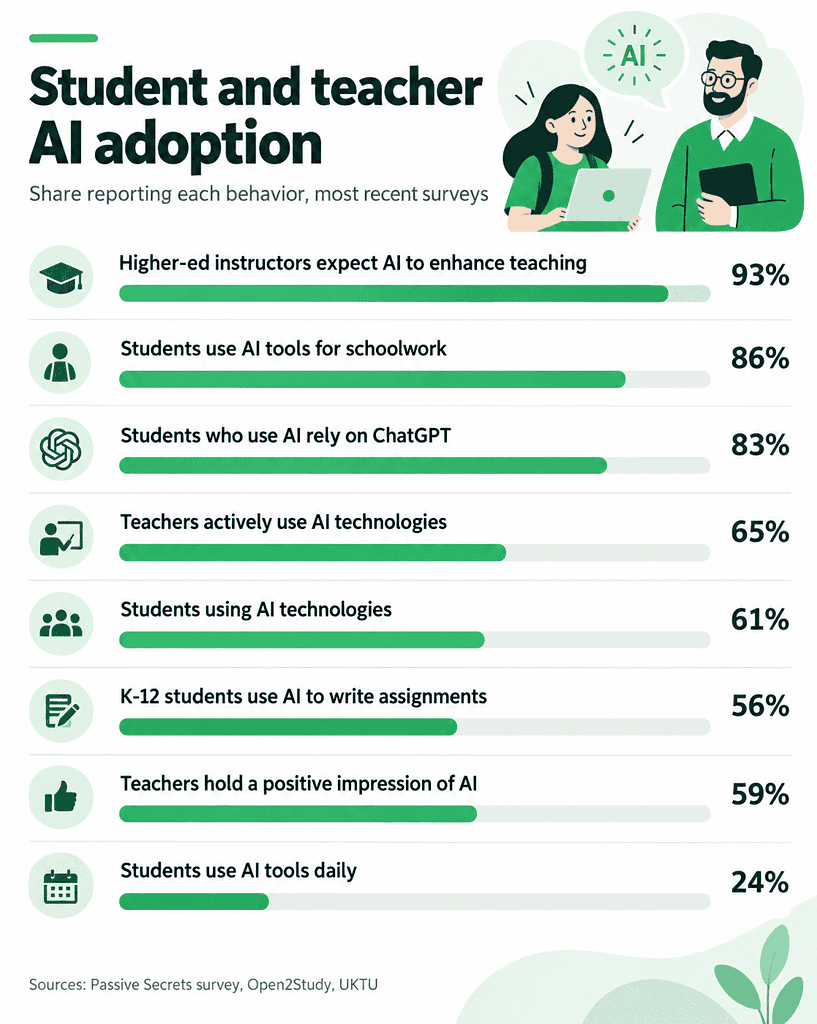
- 93% of higher education staff expect to increase their use of AI for work. An Ellucian survey of 445 faculty members and administrators across more than 330 institutions in the U.S. and Canada found that 93% expected their professional use of AI to expand over the following two years.
- 95%+ of higher education students and faculty now use AI in an educational context. Coursera’s 2026 Higher Education Report, based on more than 4,200 university students and faculty across five countries, found that AI use has become nearly universal across higher education.
- 86% of students reported using AI in their studies in the Digital Education Council’s 2024 global survey. The same research found that 54% used AI at least weekly and 24% used AI every day, highlighting the rapid integration of AI into students’ academic routines.
- 83% of adult students use AI specifically to help with schoolwork. Google’s 2025 “Our Life with AI” survey, conducted with Ipsos across 21 countries and approximately 21,000 respondents, found that 85% of students aged 18 and above were using AI, while 83% used the technology to support schoolwork.
- ChatGPT remains one of the most widely used AI platforms among students. An ACT study found that among high-school students who had used AI tools, 83% had used ChatGPT, considerably ahead of other AI applications measured in the survey.
- 81% of teachers are now using AI, according to Google’s latest global survey. Teachers are increasingly applying AI to learn new concepts, save time, prepare instructional content, and support classroom activities.
- Around 80% of UK school teachers have used Generative AI professionally. The UK Department for Education’s December 2025 survey found that 82% of primary teachers and 78% of secondary teachers had used Generative AI tools in their teaching roles.
- 65% of educators reported actively using AI in a 2026 EdTech survey. Among those using AI, 48% applied the technology to both student-learning activities and administrative tasks. However, this Jotform study covered only 50 K-12 and higher-education professionals, so the percentage should be interpreted with caution.
- 61% of higher education students now use AI at least weekly. Tyton Partners’ Time for Class 2026 research, based on more than 3,000 U.S. higher education administrators, instructors, and students, found weekly AI usage among 61% of students, 52% of instructors, and 71% of administrators.
- 61% of students were also found to use AI at least weekly in Tyton Partners’ September 2026 research, up sharply from 42% a year earlier. Writing and editing assignments, tutoring, and lecture summarization were among the leading applications.
- 56% of K-12 students reported using AI chatbots to write essays and other assignments. A nationwide 2024 Impact Research survey of more than 1,000 U.S. K-12 students found that writing assignments represented their most common reported educational AI use case.
- 59% of teachers held a favorable view of AI chatbots in the same national research. The findings indicated that teacher sentiment toward AI was generally positive, although views differed considerably depending on educators’ experience with the technology.
- 59% of Georgia teachers reported using AI for teaching-related activities in 2026. The state survey covered more than 13,000 teachers, providing evidence that AI has moved into regular lesson preparation and instructional workflows.
- 76% of middle-school educators and 73% of high-school educators report AI being used in their classrooms at least weekly. IBM’s September 2026 U.S. research, conducted by Morning Consult among more than 2,000 K-12 educators and parents, shows that classroom AI adoption has become particularly strong at the secondary-school level.
- 90% of college students report using AI in class at least occasionally. A 2026 Instructure survey also found that 61% of higher education instructors used AI in class, although only 11% of instructors reported receiving comprehensive AI training.
- AI adoption among students is increasingly being driven by academic assistance rather than experimentation. OECD PISA 2025 data show that AI chatbots such as ChatGPT are now used for schoolwork by a majority of students across most participating countries and economies.
Regional AI in Education Adoption
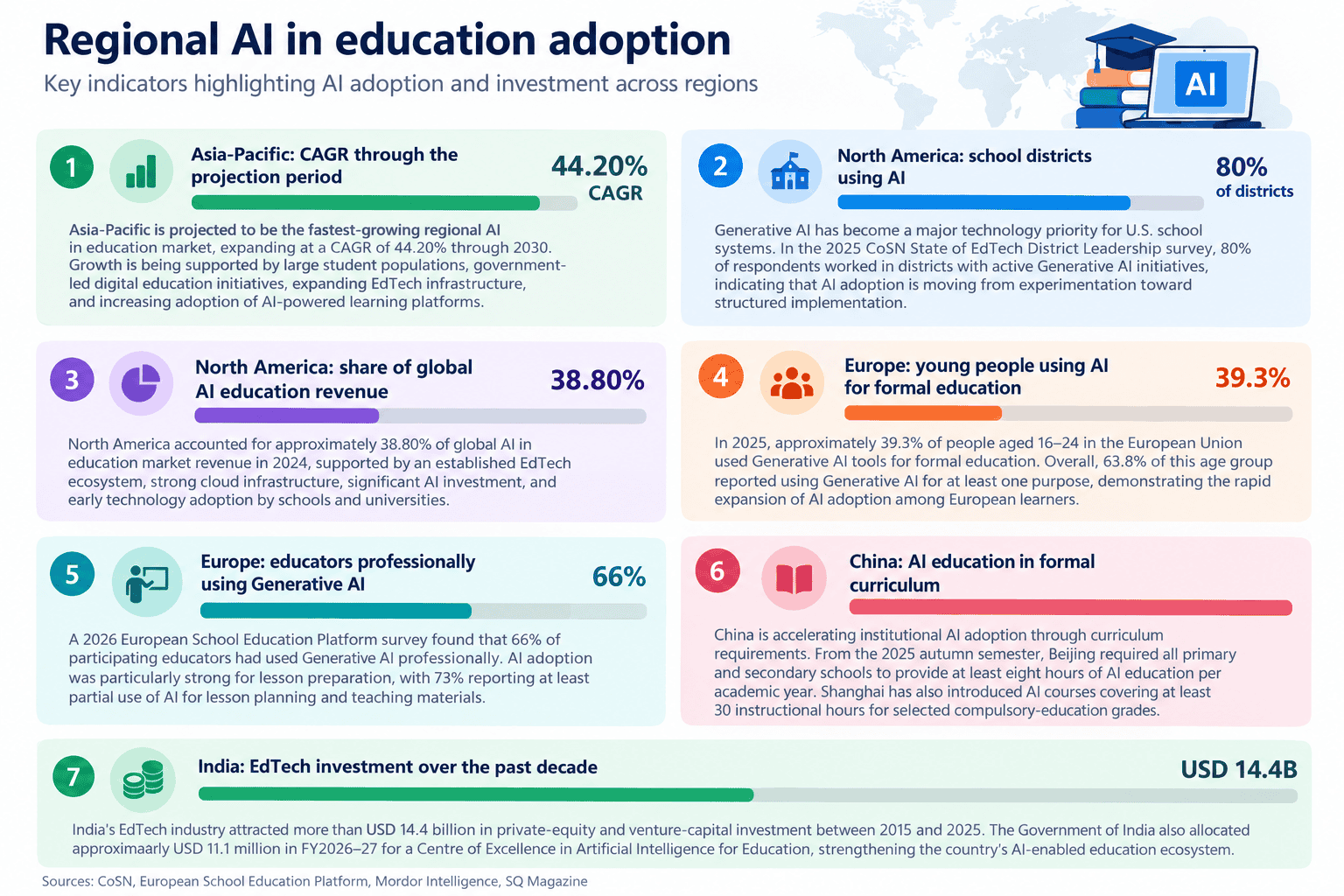
- Asia-Pacific: 44.20% CAGR
- Asia-Pacific is projected to be the fastest-growing regional AI in education market, expanding at a CAGR of 44.20% through 2030. Growth is being supported by large student populations, government-led digital education initiatives, expanding EdTech infrastructure, and increasing adoption of AI-powered learning platforms.
- North America: 80% of surveyed districts have GenAI initiatives
- Generative AI has become a major technology priority for U.S. school systems. In the 2025 CoSN State of EdTech District Leadership survey, 80% of respondents worked in districts with active Generative AI initiatives, indicating that AI adoption is moving from experimentation toward structured implementation.
- North America has 38.80% of global AI-in-education revenue.
- North America accounted for approximately 38.80% of global AI in education market revenue in 2024, supported by an established EdTech ecosystem, strong cloud infrastructure, significant AI investment, and early technology adoption by schools and universities.
- Europe: 39.3% of young people use GenAI for formal education
- In 2025, approximately 39.3% of people aged 16–24 in the European Union used Generative AI tools for formal education. Overall, 63.8% of this age group reported using Generative AI for at least one purpose, demonstrating the rapid expansion of AI adoption among European learners.
- 66% of surveyed educators have professionally used Generative AI
- A 2026 European School Education Platform survey found that 66% of participating educators had used Generative AI professionally. AI adoption was particularly strong for lesson preparation, with 73% reporting at least partial use of AI for lesson planning and teaching materials.
- China: AI education is becoming part of the formal school curriculum
- China is accelerating institutional AI adoption through curriculum requirements. From the 2025 autumn semester, Beijing required all primary and secondary schools to provide at least eight hours of AI education per academic year. Shanghai has also introduced AI courses covering at least 30 instructional hours for selected compulsory-education grades.
- India: USD 14.4 billion invested in EdTech over the past decade
- India’s EdTech industry attracted more than USD 14.4 billion in private-equity and venture-capital investment between 2015 and 2025. The Government of India also allocated approximately USD 11.1 million in FY2026–27 for a Centre of Excellence in Artificial Intelligence for Education, strengthening the country’s AI-enabled education ecosystem.
Top AI in Education Growth Drivers
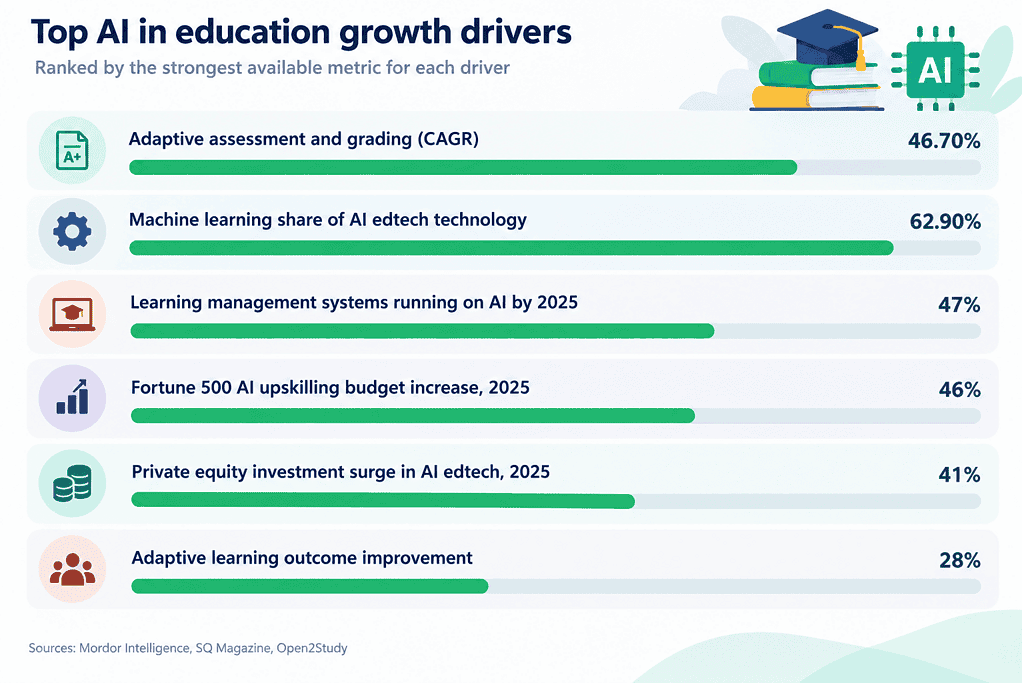
- Adaptive Assessment and Grading: 46.70% CAGR
- AI-powered adaptive assessment and automated grading solutions are projected to expand at a 46.70% CAGR, supported by rising demand for faster evaluation, personalized feedback, and reduced administrative workloads for educators.
- Machine Learning Technology: 62.90% Market Share
- Machine learning accounted for approximately 62.90% of AI-powered EdTech technology adoption, reflecting its extensive application in personalized learning, predictive analytics, student-performance monitoring, and automated recommendations.
- AI-Enabled Learning Management Systems: 47% Adoption
- Approximately 47% of learning management systems were expected to incorporate AI capabilities by 2025, highlighting the increasing integration of intelligent automation, personalized content delivery, and learner analytics within digital education platforms.
- Fortune 500 AI Upskilling Budgets: 46% Increase
- AI-related employee training and upskilling budgets among Fortune 500 companies increased by approximately 46% in 2025, demonstrating growing corporate demand for AI education, professional learning, and workforce development solutions.
- Private Equity Investment in AI EdTech: 41% Increase
- Private equity investment in AI-focused EdTech companies increased by approximately 41% in 2025, indicating stronger investor interest in scalable AI learning platforms, intelligent tutoring systems, and education automation technologies.
- Adaptive Learning Outcomes: 28% Improvement
- AI-powered adaptive learning solutions have been associated with an approximately 28% improvement in learning outcomes, strengthening demand for platforms capable of adjusting educational content according to individual learner performance, pace, and requirements.
Recent AI in Edtech Developments
- On August 19, 2026, Saudi edtech startup AILA raised USD 3 million in pre-Series A funding, led by Rua Growth Fund, to expand its AI-personalized learning and exam-preparation platform into regional and international markets.
- On August 19, 2026, UK-based Medly AI secured USD 8 million in seed funding, led by Felix Capital, to expand its AI exam-preparation tutor in the UK and international markets.
- On July 23, 2026, AI-literacy platform imagi raised a USD 4.5 million seed round after reaching 700,000 students and operating across more than 100 U.S. school districts.
- On July 16, 2026, DeweyLearn closed an oversubscribed USD 5 million Series A, led by SJF Ventures, to scale its multimodal AI platform for assessing real-world skills using audio, video, and learning data.
- On April 15, 2026, AI-powered learning platform Gizmo secured USD 22 million in Series A funding after attracting more than 13 million users, with Shine Capital leading the round.
- On March 19, 2026, AI lesson-planning platform Chalkie closed a USD 4 million funding round from TriplePoint Ventures; the platform was used by more than 500,000 teachers, who reported saving an average of five hours weekly.
- On February 24, 2026, Subject secured a USD 28 million investment led by Vistara Growth to expand its AI-powered, accredited K–12 curriculum and automation tools for educators and administrators.
- On January 21, 2026, Preply raised USD 150 million in a WestCap-led Series D, reaching a USD 1.2 billion valuation+n and approximately USD 299 million in total funding for its human-led, AI-enhanced language-learning platform.
The End
AI is quickly becoming a normal part of how students learn and how teachers teach. Almost everyone using EdTech tools now uses AI in some way, and the market keeps growing fast every year. At the same time, money from investors is still flowing into AI tools even though overall EdTech funding has slowed down a bit. The biggest challenge going forward is making sure all students get equal access to these AI tools, no matter where they live or how much money their school has. If that gap can be closed, AI has a real chance to make learning better and easier for everyone.
FAQ
Khan Academy’s AI tutor Khanmigo expanded from 68,000 users to 1.4 million users within a single academic year. This growth reflects rapid classroom adoption of AI tutoring tools nationwide.
K-12 teacher AI adoption doubled from 25% to 53% within one academic year. This places more than half of K-12 teachers using AI tools in their classrooms today.
Education organizations lead all industries in generative AI adoption, with 86% already using it, according to Microsoft’s 2025 report. This is the highest adoption rate recorded across any sector studied.
There are 14 EdTech unicorns holding a combined valuation of USD 33.84 billion as of February 2026. This reflects continued investor confidence despite a broader funding slowdown across the sector.
Global edtech venture funding reached USD 2.6 billion in 2025, up about 11% from 2024, but fell to USD 512 million across 63 deals in the first quarter of 2026. Preply’s USD 150 million round was the largest deal of that quarter.