








Introduction
Email Automation Statistics: Email automation is now a major win for digital marketing in 2026. Instead of sending every email manually, set up behavioral triggers, use customer details, and apply AI so messages land at the right time. These sequences can welcome subscribers, recover abandoned carts, recommend products, confirm purchases, nurture leads, and re-engage inactive customers. Recent benchmark results suggest automated emails represent a small share of all messages, but generate a large share of revenue disproportionately.
Below are the trending email automation statistics, performance benchmarks, AI direction, compliance notes, and the main priorities marketers should understand before building their 2026 automation strategy effectively.
Top Selection
- Based on Omnisend’s analysis of 23 billion emails, automated emails drove 37% of email sales in 2024, even though they were only 2% of total sends.
- Automated emails showed 52% higher opens, 332% higher clicks, and 2,361% higher conversions compared with scheduled campaigns.
- Klaviyo reports that automated flows brought in close to 41% of email revenue on 5.3% of sends, versus one-time campaigns accounting for 94.7% of sends.
- Across benchmarks, automated flows averaged a 48.57% open rate and a 4.67% CTR, compared with standard campaigns averaging 37.93% opens and 1.29% CTR.
- The best automated flows reached 65.74% opens and 12.21% CTR, and the spread between top and average performance is clearly large.
- On conversion rate, automated flows averaged 1.42%, compared with standard campaigns at 0.08%, and the top 10% sat at 4.93%.
- Abandoned cart sequences revenue was $3.65 per recipient versus $0.11 for standard campaigns.
- The Digital Bloom found that B2B nurture programs created 50% more sales-ready leads at 33% lower cost.
- Leads routed by intent reportedly improved lead-to-opportunity conversion by 4×, reaching 30 to 40%, compared to 10 to 15% traditionally.
- Users of marketing automation also reported 80% more leads, conversion up by 77%, and 76% positive ROI in one year.
- CRM integrated automation raised sales productivity by 14.5%, compared with an overall automation increase of 12.2%.
- Enflow Digital claims AI audience modeling and predictive personalization can lift CTR by 40%. Litmus research reports that with AI-personalized email copy, CTR reportedly rose by more than 13% in automated email work.
- Global daily email volume hit 418 billion messages in 2026, compared to 380 billion in 2025.
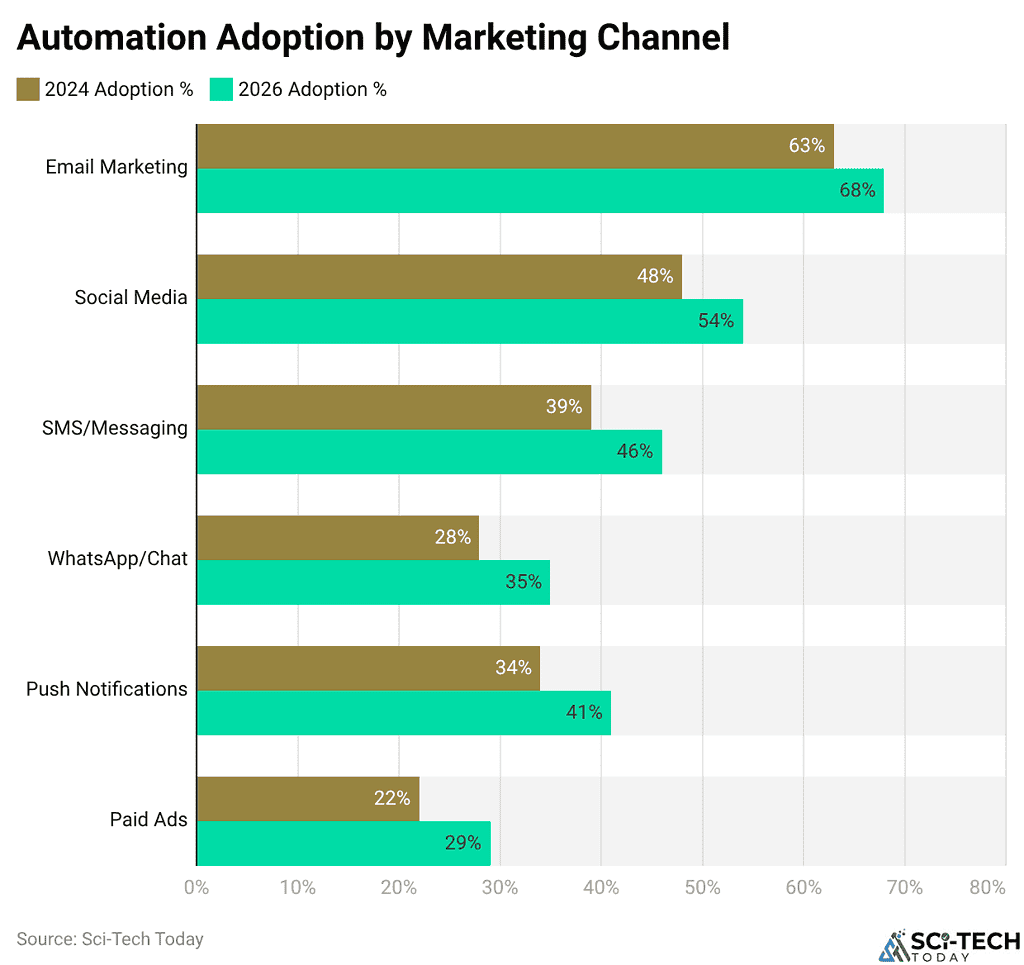
- Automation adoption rose from 2024 to 2026 across each channel named, with email going from 63% to 68%. SMS or messaging went from 39% to 46%.
Automation Adoption by Marketing Channel
(Reference: amraandelma.com)
- The chart tracks automation use in marketing across every marketing channel from 2024 to 2026. Email stays in the lead, rising from 63% in 2024 to 68% in 2026, an increase of 5%, indicating email still looks like the main place for automated messages.
- Social media also moves higher, rising from 48% to 54%, while SMS and messaging increase too, from 39% to 46%. Together, these changes suggest automation is reaching more quick and back-and-forth platforms, not only email.
- WhatsApp or chat climbs from 28% to 35%, while push notifications rise from 34% to 41%. Each one gains 7%, showing among the bigger jumps on the chart.
- Paid advertising grows as well, moving from 22% in 2024 to 29% in 2026. Even so, it remains the smallest share of adoption; the trend shows that more automation is being used in ad-related tasks.
- The chart attributes its data to HubSpot, Omnisend, and Mailchimp. HubSpot’s 2026 research also highlights the broader role of automation and AI in modern marketing workflows.
- On the whole, the results show that each channel rises by about 5 to 7%, pointing to wider use of automation across the full marketing set.
B2B Lead Nurturing Automation Statistics
- B2B teams are using lead nurturing automation more often, and it helps move people through deals that take longer and require more steps from the buyer.
- The Digital Bloom says that nurtured leads can turn into sales-ready chances 50% more often, and the cost drops by 33%.
- The same study for 2025 says nurturing emails can pull in response rates that are 4–10× higher than plain broadcast mail, with average open rates in the 36.7% to 42.35% range and an estimated CTR of about 8%, compared with a 3% CTR for standard emails.
- Digital Bloom notes that intent-based routing can increase lead-to-opportunity conversion by 4x, with qualified leads converting at 30% to 40%, compared with 10% to 15% from older methods.
- For B2B deals with more complexity, Landbase research says nurturing steps may run for 10 or more emails spanning several months, while welcome sequences are usually shorter, around 3 to 5 emails.
- A Mailmodo case study says a welcome series grew qualified leads by 278% after a welcome sequence was segmented by industry and role.
- Another report, from Annuitas and quoted by Marketing LTB, points to a 451% jump in qualified leads, which came from nurtured campaigns run with full-funnel automation.
- Data from the Content Marketing Institute, cited by SalesSOSO, says 71% of B2B marketers use email newsletters to share content and move prospects along, and also lists email as 32% of B2B lead-source effectiveness, ranking second in the cited benchmark.
- Strong B2B automation combines steady follow-up, relevant content, behavior signals, audience splits, and handoffs to sales at the right time, rather than depending only on single email blasts.
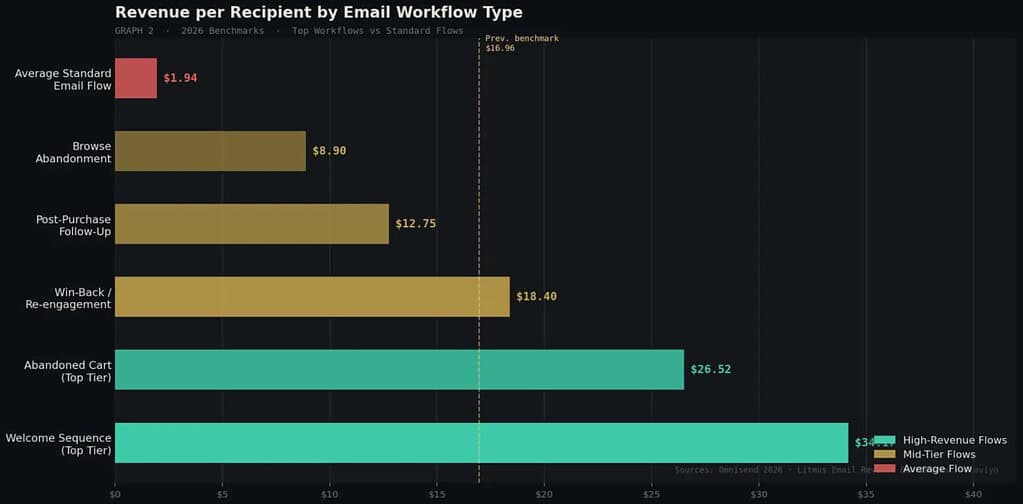
Workflow Revenue per Recipient: 2026 Email Automation Insights
(Source: amraandelma.com)
- Litmus reports in its Email Revenue Benchmarks that automated email workflows can bring very different revenue amounts per person.
- In a separate note, Klaviyo’s 2026 Benchmark Report says the best email flows, the top 10%, land near an RPR of $7.79.
- The same benchmark makes the spread easy to see, as Strong flows bring in $16.96 per recipient on average, while Standard flows land at $1.94 per recipient, showing the large gap.
- Browse Abandonment comes to $8.90 per recipient, while Post-Purchase Follow-Up reaches $12.75.
- Win-Back and Re-engagement sits at $18.40, and Abandoned Cart, top tier, reaches $26.52 per recipient.
- The Litmus results also treat automation as a revenue channel you can measure, and the results change a lot depending on the workflow and how well it is run.
Marketing Automation Adoption and ROI Statistics
- Marketing automation is becoming a practical part of modern marketing programs, rather than an optional efficiency tool.
- According to Ascend2 data, 48% of marketers planned to add email automation to their email plans in 2024.
- CodeCrew report found that 50% of firms already use email marketing automation tools for drip campaigns, which can get click rates that are about 3 times better than one-time emails.
- Marketing LTB reports that 80% of marketers who use automation see more leads, and also says 77% report better conversion.
- Marketing LTB states that 76% of companies reach positive ROI within one year.
- Oracle and Apsis data, cited by Marketing LTB, point to a 12.2% rise in sales productivity and a 12.2% drop in marketing overhead.
- With CRM tools in place, sales productivity climbs further, up to 14.5%.
- Marketing LTB says 63% of companies do better than their rivals with marketing automation.
- For timing, among those that adopt it, 63% expect results in about six months. In the same window, 44% report returns they can measure.
- Mailmodo, citing Litmus data, says 67% of marketers focus on drip campaigns to drive sales. Marketing LTB data reviewed by Mailmodo suggests 36% of marketers have cut repeat tasks, and 50% expect easy integration with CRM, CMS, or ERP as an important need.
- Marketing LTB identifies a lack of expertise and internal skills as the most frequently reported barrier, particularly among SMBs, which generally trail larger enterprises in both adoption and implementation sophistication.
AI in Email Automation Statistics
- AI is changing how email automation works. Instead of one set path for everyone, campaigns can shift based on what each person does. Enflow Digital says AI modeling of audiences and predicted personalization can lift click-through rates by as much as 40%. It uses engagement signals to guess what someone is likely to do next.
- The Digital Bloom reports that AI and automation can bring in up to 320% more revenue than teams get from manual sends, and behavioral triggers can reach 42% open rates, while behavioral triggers are said to deliver about 10× the ROI of broadcast campaigns.
- Landbase adds that AI platforms can change both the number of emails and the actual content, and the changes depend on whether a person keeps engaging or starts to fade.
- Powered by Search points to Litmus 2025 research suggesting that AI used to tailor email copy can raise CTR by over 13% in automated email programs.
- For B2B teams, the Digital Bloom says AI intent routing can make a lead 21× more likely to qualify if contact happens within five minutes after a behavioral signal.
- BytePlus research cited by InboxAlly expects generative AI to support over 60% of digital content creation by 2027, including email subject lines, copy, and different CTA options.
- Enflow Digital also points to loop-based automation, where future messages change according to whether someone clicks or ignores the previous email. This suggests that AI turns automation from a fixed sequence into something closer to a moving customer journey.
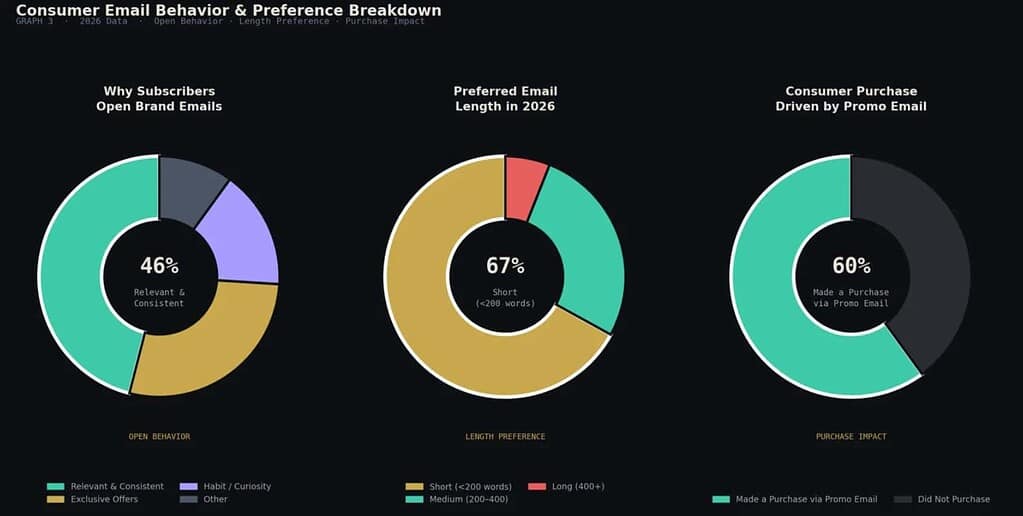
Consumer Email Behavior Statistics
(Source: amraandelma.com)
- Email is still a key channel for both communication and sales, but the inboxes are filling fast, and clarity is increasingly important.
- Statista’s Digital Communication Outlook 2026 reports that global daily email volume reached 418 billion messages in 2026, increased from 380 billion in 2025.
- Automated and AI-made emails are now 54% of commercial sends, compared with estimate 40% two years earlier.
- Klaviyo’s 2026 benchmark study looked at more than 183,000 customers and showed that automated flows made up nearly 41% of email revenue from only 5.3% of sends, despite one-time campaigns still driving 94.7% of the volume.
- The study also reports a strong preference for short emails: about 67% of consumers favor emails under 200 words, while only 6% like emails that are 400 words or longer.
- Nielsen reports that 73% of subscribers delete emails that run past 200 words without opening the content.
- Nielsen also says emails under 125 words with one clear call-to-action produced 41% higher click-to-conversion rates than longer messages.
- Email automation should be more specific, and the copy should be tighter and more useful.
- With inbox volume rising and more automated mail being sent, there is less space for extra text.
- Relevance, shorter copy, and clear calls-to-action now show up in email engagement and buying behavior.
General Email Automation Statistics
- Auto emails do well when email performance is often driven more by timing and relevance than by sending volume.
- In Omnisend’s 2025 Ecommerce Marketing Statistics Report, automated messages made up 37% of email-driven sales in 2024.
- At the same time, they were only 2% of all emails sent, based on a review of more than 23 billion marketing emails.
- Omnisend also reports Automated emails have open rates that are 52% higher, Click rates that are 332% higher, and Conversion rates that are 2,361% higher than for regular scheduled campaigns, showing a wide revenue gap.
- Klaviyo looked at more than 325 billion emails and found automated flows can bring up to 30 times more revenue per person, with standard campaigns averaging $0.11 per recipient versus $3.65 for abandoned-cart flows.
- Klaviyo’s 2025 Benchmark Report shows that Automated flows average a 48.57% open rate, compared with 37.93% for standard campaigns, while the best group, the top 10%, reaches 65.74%. The click-through rate for automated flows averages 4.67%, compared with standard campaigns’ average of 1.29%, with Top performers reaching 12.21%.
- Conversion is 1.42% on average for automated flows, jumping to 4.93% for the top 10% as compared to standard campaigns’ average of 0.08%.
- Omnisend says 1 in 2 people who click an automated welcome or abandoned cart email end up buying; compared to standard campaigns, the rate is 1 in 20 clickers.
- Omnisend reported 250 million more automated emails year over year, with back-in-stock flows growing 4x, welcome flows growing 2.5x, and Browse abandonment flows nearly 2x higher.
- Finally, Campaign Monitor’s 2024 data, cited by CodeCrew, reported that automated emails generate 320% more revenue than non-automated emails.
- Together, these findings show why automated journeys have become a central revenue channel rather than simply a time-saving marketing tool.
Top Challenges and Barriers to Automation Adoption
- In Ascend2’s 2024 State of Marketing Automation study, 52% of people pointed to getting clean, useful data as the top pain, and 47% said they struggled to shape one clear automation plan.
- The report also showed that 64% felt their automation was only partly connected or not connected at all to the tools they already use.
- Demand Gen Report’s 2026 report found that around 70% keep information in CRM systems, about 62% rely on web analytics, roughly 59% use marketing automation tools for records, and 57% still use spreadsheets. Only 50% reported that sales and marketing data comes from one shared source.
- Ascend2 found 39% lacked enough training and support to use automation to its full extent, and another 32% said they did not have enough resources to run and manage the tools day-to-day, while 31% said they did not have a budget for upkeep.
- Demand Gen Report added that 68% of sales and marketing staff use AI at work, but only 17% said they got solid, job-based training, and another 32% said they received no formal AI training.
- It also noted that 99% of marketers do not use important martech features, with 17% blaming not having the right skills.
- The 2025 Act On and Ascend2 B2B study found 51% named building an overall automation strategy as their main challenge, while 44% said they focused on improving data quality.
- Salesforce said 88% of small business leaders feel swamped by how many business tools exist, and 54% think six to 12 months is a fair window to see results from an automation setup.
- Taken together, the results suggest SMBs benefit most from clean data, reliable CRM integration, focused training, clear strategy, and measurable use cases before expanding automation.
Conclusion
In 2026, email automation gets judged more by money made, sign-ups, and day-to-day workflow speed. Marketers are not just looking at how many emails go out. In one set of results, automated journeys produced 37% of email-based sales from only 2% of the total send volume. Newer AI tools help with predicting who is most likely to act, tailoring messages, and adjusting the flow as behavior changes.
However, adoption remains constrained by data quality, integration, skills, strategy, and budget. For marketers, the practical priority is not simply adding more automation, but building reliable data foundations, focused journeys, timely triggers, concise content, and measurable use cases that connect automation directly to business outcomes.
FAQ
Automated emails made up 37% of email-driven sales using 2% of total email volume in 2024.
Automated emails saw 52% higher opens, 332% higher clicks, and 2,361% higher conversions.
The average automated flow CTR was 4.67%. Standard campaigns were at 1.29%.
The biggest blockers are data quality, strategy, integrations, skills, resources, and budget.
AI-based audience modeling and predictive personalization can raise CTR by up to 40%. In cited work, AI-personalized copy lifted CTR by more than 13%.