








Introduction
AI In Space Exploration Statistics: Space exploration has always pushed the limits of human knowledge. Today, AI is helping take that effort a step further. Space agencies and private companies are using AI to handle complex tasks, analyze massive datasets, and support spacecraft and robots during missions. AI can help extract useful information from satellite images, improve navigation, and enable machines to respond to changing conditions with less human intervention.
These capabilities are especially valuable for missions far from Earth, where communication delays can make real-time control difficult. As missions to the Moon, Mars, and deeper space gain momentum, AI could play a bigger role in making exploration safer, faster, and more efficient.
Editor’s Choice
- The global AI in space exploration market is projected to reach USD 4 billion in 2025 and USD 5 billion in 2026.
- Software led the AI in space exploration market with 46.80%, followed by mission planning with 24.70%.
- North America led the AI in space exploration market with 43.70% in 2025.
- The AI in space operations market is projected to rise from USD 2.89 billion in 2026 to USD 15.05 billion by 2034.
- AI could automate 30% of astronaut tasks and has helped map 90% of Mars.
- NASA also planned the 2026 CADRE mission to test autonomous lunar exploration using 3 robots.
- Released September 10, 2026, NASA and IBM’s model analyzes 2 million lunar image tiles from 17 years of LRO observations.
- SpaceX is expected to generate USD 14-16 billion from AI this year.
- SpaceX launched Google’s AI chips into orbit on October 1, 2026, using a Falcon 9 rocket during the Transporter-18 mission.
- About 117 million MAUs used Grok AI features as of March 31, 2026.
Global AI in Space Exploration Market Size
(Source: market.us)
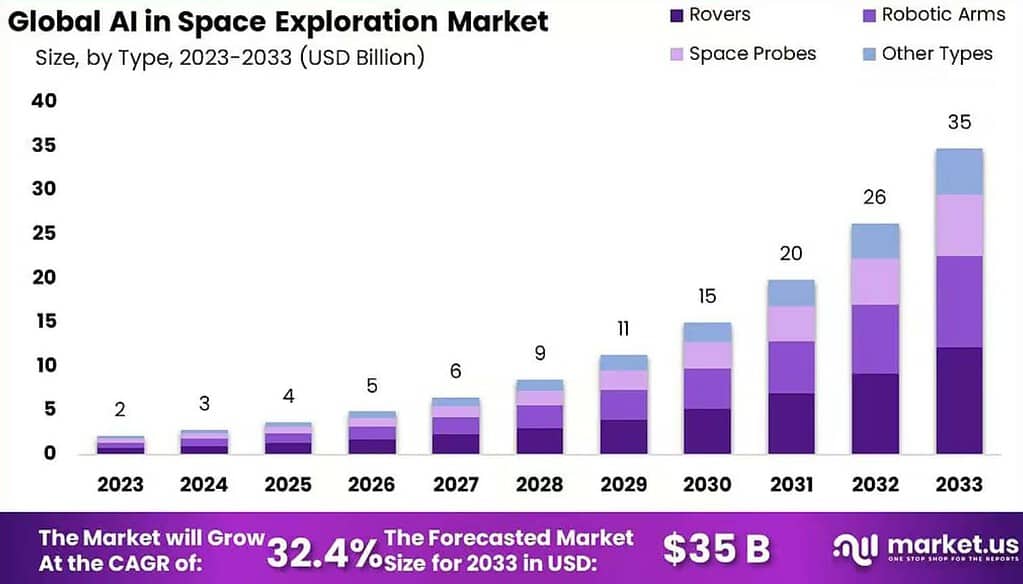
- The global AI in space exploration market is projected to reach USD 4 billion in 2025 and USD 5 billion in 2026.
- The market is forecast to reach USD 35.5 billion by 2033, growing at a CAGR of 32.4%.
Key Market Insights
(Reference: precedenceresearch.com)
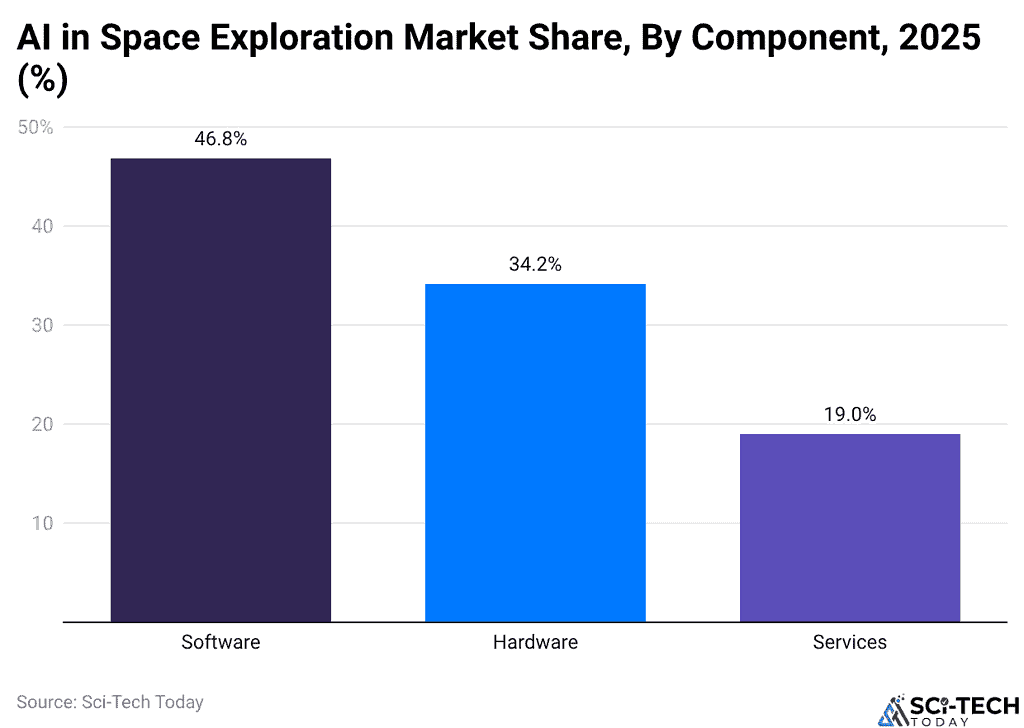
- Software led the AI in space exploration market with 46.80%, followed by hardware at 34.20% and services at 19%.
(Reference: precedenceresearch.com)
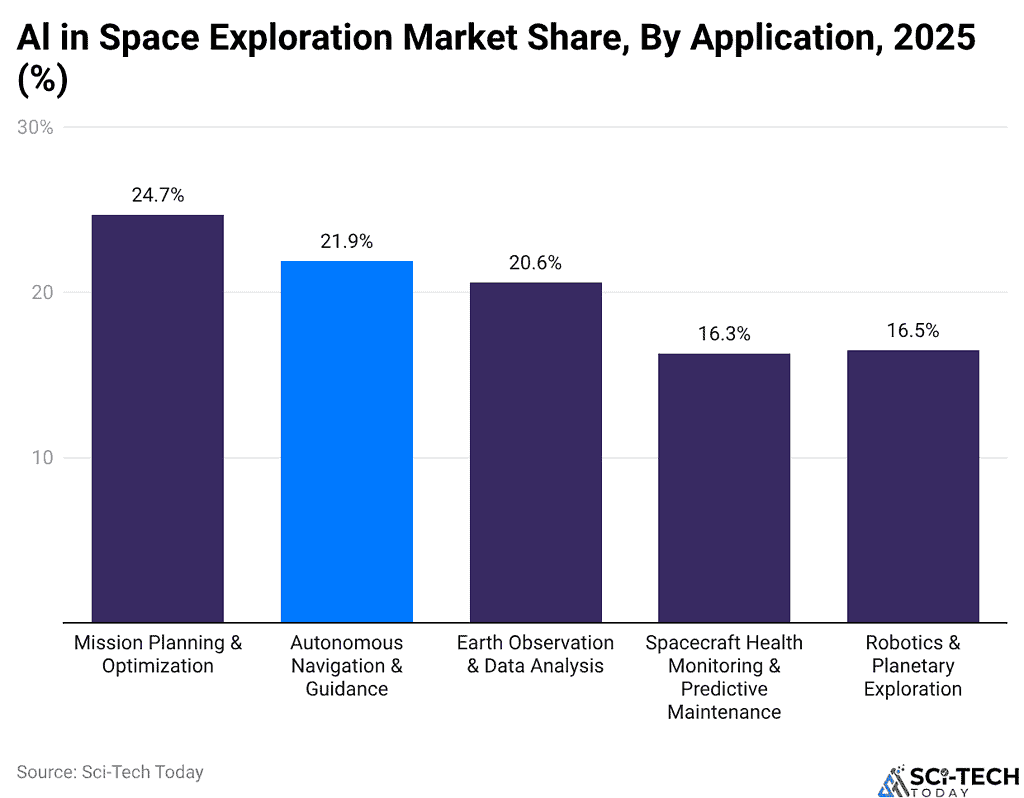
- Mission planning led with 24.70%, followed by navigation at 21.90%.
- Earth observation held 20.60%, followed by robotics (16.50%) and spacecraft monitoring (16.30%).
- Precedence Research stated that government space agencies led with 44.90%, followed by commercial space companies at 29.30%.
- Defense organizations held 15.80%, while research and academic institutions accounted for 10%.
(Reference: precedenceresearch.com)
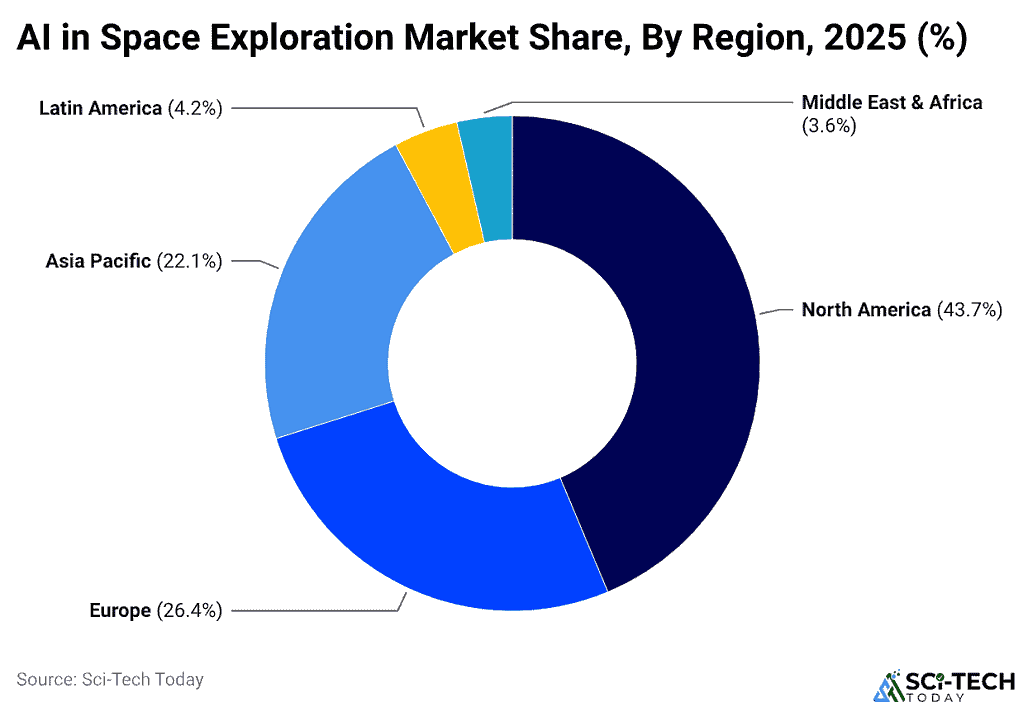
- North America led the AI in space exploration market with 43.70% in 2025.
- Europe accounted for 26.40%, followed by Asia Pacific at 22.10%.
- Latin America accounted for 4.20%, while the Middle East and Africa accounted for 3.60%.
AI in Space Operations Market Outlook
(Source: fortunebusinessinsights.com)
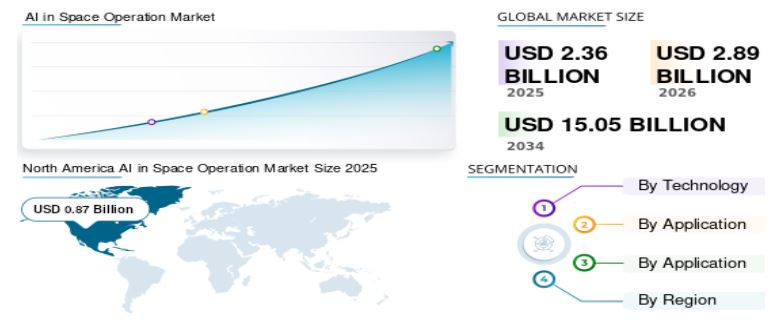
- The AI in space operations market is projected to rise from USD 2.89 billion in 2026 to USD 15.05 billion by 2034.
- North America led the market with a 36.85% share in 2025, generating USD 0.87 billion. Revenue is projected to reach USD 1.07 billion in 2026.
- Computer vision and image recognition are expected to lead with a 42.92% share in 2026.
- The government segment is projected to hold 71.67% of the market.
- Earth observation and data analysis will account for 34.62%.
- In May 2025, the U.S. allocated USD 7 billion for lunar exploration and USD 1 billion for Mars programs.
- NASA proposed a USD 15 billion budget for 2026.
- India allocated USD 1.53 billion to its Department of Space under the 2025-26 Union Budget.
AI and Satellite Industry Insights
- The U.S. Government Accountability Office reported 5,500 operational satellites in 2022, with about 58,000 new satellites expected by 2030.
- AI is becoming critical for autonomous spacecraft, helping missions make decisions when real-time human control is difficult to achieve.
- According to market.us, AI adoption in space increased by 29,300% over 5 years.
- The space-tech AI market reached USD 342 billion in 2025.
- AI could automate 30% of astronaut tasks and has helped map 90% of Mars.
- AI has improved asteroid detection by 10% and satellite data efficiency by 10%-15%.
- AI can identify maritime vessels with over 95% accuracy.
- Moreover, 70% of professionals expect major impacts on space exploration within 10 years.
AI Advances in Space Exploration
- In February 2026, Chinese scientists developed an AI model that uses 3D spatiotemporal analysis to separate faint deep-space signals from background noise.
- Diplomatic Courier said researchers also used AI to identify a possible landing site for Luna 9, the first spacecraft to land on the Moon.
- A second proposed site is about 15 miles away, with Chandrayaan-2 expected to provide clearer images in March.
- NASA’s Perseverance rover completed its first fully AI-planned drive across rough Martian terrain.
- In August 2025, IBM and NASA released an AI model that predicts solar flares with 16% higher accuracy.
- In December 2025, an AI-operated ISS robot worked 50%-60% faster than humans.
- NASA also planned the 2026 CADRE mission to test autonomous lunar exploration using 3 robots.
Top 10 AI Tools for Space Exploration
| Tool | Numerical Data |
| NASA–IBM Lunar Foundation Model | Released on September 10, 2026, the model uses 2 million image tiles from 17 years of LRO observations, according to a NASA announcement.It includes 1 million+ high-resolution images at 1-meter resolution and 964,000 multispectral images at 100-meter resolution.The dataset combines more than 30 layers from 9 instruments across 4 missions. |
| AutoNav | Perseverance completed 88% of its driving autonomously, according to NASA. NASA updated this figure on September 10, 2026. |
| AEGIS | JPL project statistics show AEGIS selected 596 targets for Curiosity and 293 for Perseverance. Targeting took 150-450 seconds, with 95 seconds for pointing refinement. It operated on a 133 MHz processor with 16 MB RAM and was deployed in 2010, 2016, and 2022. |
| Claude-based rover route-planning workflow | The workflow was announced on January 30, 2026, following demonstrations on December 8 and 10, 2025.Perseverance drove 210 meters and 246 meters, for a total of 456 meters.Engineers reviewed more than 500,000 telemetry variables before sending commands, as per the NASA/JPL demonstration. |
| ExoMiner++ | On January 22, 2026, ExoMiner++ identified about 7,000 TESS exoplanet candidates, according to the NASA 2026 update. Earlier, ExoMiner validated 370 Kepler exoplanets. |
| AnomalyMatch | ESA/Hubble announcement stated that on January 27, 2026, AnomalyMatch analyzed nearly 100 million Hubble images in 2.5 days.It identified nearly 1,400 anomalies, of which 1,300 were confirmed, and more than 800 were previously undocumented. |
| Surya | Surya was updated on August 12, 2026, using 9 years of SDO observations. It supports 24-hour flare forecasting and 4-day solar-wind predictions across 1,343 EUV channels. The model has 366 million parameters, 13 input channels, 4096 × 4096 pixels, and a 12-minute cadence. |
| INDUS-SDE | Based on the NASA 2026 model report, on September 2, 2026, INDUS-SDE achieved 78.1% accuracy, compared with 50.3% for INDUS and 65.0% for ModernBERT.It achieved an MRR of 0.791 across 3,240 labels and an F1 score over 0.98. |
| AstroFetch | On October 1, 2026, the archive listed 6,375 confirmed planets and 939 TESS-confirmed planets.On September 25, 8,148 TESS candidates were recorded, according to the NASA Exoplanet Archive and AstroFetch. |
| DAGGER | DAGGER provides 30-minute warnings. It generates predictions in <1 second and updates results every 1 minute. It was tested against 2 storms from August 2011 and March 2015 and published in 2023. |
Rising Costs Could Shape Space-Based AI Expansion
- The United States’ AI data-center investment could reach USD 2.8 trillion by 2030 and USD 10.3 trillion by 2032, with at least USD 1.3 trillion already debt-financed.
- Forbes reported that data-center bonds can carry rates as high as 9.75%.
- Anthropic reported USD 4.6 billion in revenue last year but recorded operating losses above USD 8 billion.
- Anthropic later reported a USD 65 billion annualized revenue run rate in July 2026.
- SpaceX is expected to generate USD 14-16 billion from AI this year.
Google Moves AI Computing Toward Space
- Google is preparing its first AI satellite, marking a major step toward space-based data centers.
- A SpaceX Falcon 9 launch will carry a Planet Labs satellite equipped with Google’s AI chips, according to a report published by Morningstar.
- The satellite will test AI workloads for about 1 year and may remain in orbit for up to 5 years.
- Starcloud, valued at USD 2.3 billion, already placed an Nvidia H100 chip in orbit in November 2025.
- SpaceX plans its first AI satellite by Q4 2027, targeting up to 1 million satellites.
- Blue Origin has proposed 51,600 data-center satellites, while Starcloud seeks approval for up to 88,000.
SpaceX and Google Test AI Computing in Orbit
- CNBC reports that SpaceX launched Google’s AI chips into orbit on October 1, 2026, using a Falcon 9 rocket during the Transporter-18 mission.
- The mission began the first in-orbit test of Google’s Project Suncatcher, which aims to build solar-powered AI computing infrastructure in space.
- Satellites in low Earth orbit can receive up to 8 times as much solar power as on Earth, according to Alphabet.
- Alphabet’s investment in SpaceX is valued at more than USD 82 billion.
- SpaceX plans to deploy orbital supercomputing infrastructure in 2027.
- Analysts see major challenges, including launch costs, cooling, radiation, extreme temperatures, and orbital debris.
Space, Connectivity and AI Drive SpaceX Growth
- SpaceX has reduced launch costs from billions to tens of millions and successfully landed its first Falcon 9 booster in 2015.
- By March 31, 2026, Starlink operated about 9,600 satellites and served 10.3 million subscribers across 164 markets.
- Starlink’s mobile network had about 650 V1 satellites and served 7.4 million devices across 30 countries.
- X and Grok reached 1.3 billion supported accounts, 550 million MAUs, and 350 million daily posts.
- About 117 million MAUs used Grok AI features as of March 31, 2026, based on Space Exploration Technologies Corp.’s filing.
AI and the Next Phase of U.S. Space Exploration
- Future missions will build on discoveries from Europa Clipper and Dragonfly, while PExT communications technology could support more missions.
- Artemis II is expected to lead to Artemis III in 2028 and future lunar landings beyond 2028.
- Higher launch activity in 2026 could accelerate space exploration, science, commerce, and national security.
AI and Space Data Centers
- AI can help analyze vast volumes of Earth, Mars, and Moon data faster than humans can.
- In-space data centers could emerge within 5-10 years, using solar power and the cold space environment.
- Commercial companies are likely to lead networked AI computing in orbit.
2026 Outlook
- According to a January 2026 report from Johns Hopkins University, Artemis II and Dragonfly are major developments to watch.
- Starlink already has more than 8,000 spacecraft, while China and Europe are developing similar networks.
Conclusion
AI is becoming a key tool in space exploration. It helps teams study complex data, monitor spacecraft, plan missions, and make faster decisions. AI can also support autonomous operations when communication with Earth is slow or limited. As missions become more ambitious, their role will continue to grow.
Still, human knowledge and judgment will remain important. Together, people, AI, and robotics can make future space missions safer, smarter, and more efficient.
FAQ
AI helps spacecraft navigate, detect hazards, manage systems, analyze data, and make decisions without constant human control.
Yes, AI can control space robots, helping them navigate, inspect equipment, and perform tasks autonomously.
AI improves satellite operations through smarter navigation, monitoring, communication, and predictive maintenance.