









Starter
AI In Virtual Reality Statistics: Artificial intelligence is changing how virtual reality (VR) is made and used. Developers add AI tools like machine learning, computer vision, and language processing, so virtual worlds can react to each user in real time. Characters can talk in a natural way, and environments change based on what the user does. Eye and hand tracking also become more accurate. AI can also create 3D content faster, which saves time and money.
The market shows this growth. The global AI in virtual reality market is worth USD 41.5 billion in 2026 and is expected to grow at a CAGR of 25.0%. More people are using it in gaming, healthcare, education, retail, and workplace training. These tools help people learn faster, practice safely, and make better choices. Better headsets, faster networks, and cloud computing are also making VR easier to access.
This report shares the key statistics that show where the market stands now and where it is going.
Best of the Best
- Market value is set to rise from USD 41.5 billion in 2026 to USD 198.5 billion by 2033.
- 90.3% of respondents named AI the main force enhancing extended reality.
- AI-adaptive VR rehabilitation improved stroke upper-limb recovery by 7.47 points versus controls, above the 5.25 clinical threshold.
- Qualcomm Snapdragon Reality Elite delivers up to 48 TOPS, running large language and vision models on-device.
- VR eye movement data identified users with 96.61% accuracy after about 38 seconds of video viewing in one study.
- Meta body tracking builds an 84-joint full-body skeleton, estimated rather than directly measured, across four Quest headsets.
- World Labs raised USD 1 billion in February 2026 to build AI-generated, persistent 3D environments.
- 52% of GDC respondents viewed generative AI negatively, while only 7% viewed it positively.
- NVIDIA’s October 2026 character model runs locally on GeForce RTX, with a 64k-token context window and 35 languages.
AI in Virtual Reality Market Size
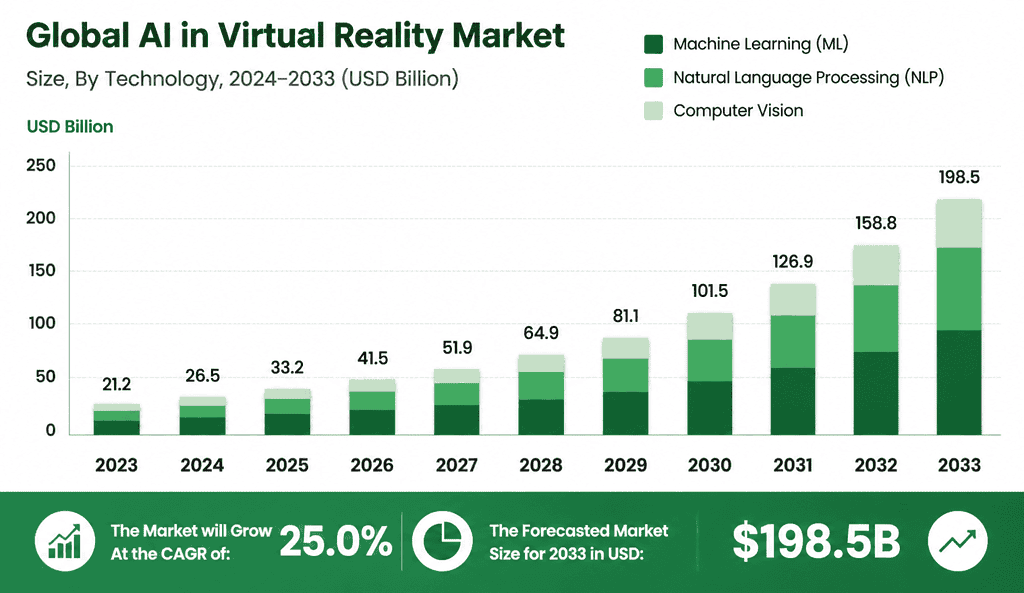
- The global AI in virtual reality market is projected to grow at a compound annual growth rate (CAGR) of 25.0%, reaching USD 198.5 billion by 2033.
- In 2025, the market size was USD 33.2 billion.
- In 2026, the market size is estimated at USD 41.5 billion.
- In 2033, the market size is projected to reach USD 198.5 billion, with all three technology segments expanding over the period shown.
- The market is divided into three technology segments: machine learning (ML), natural language processing (NLP), and computer vision. Machine learning represents the largest segment throughout the period shown, followed by NLP and computer vision.
AI in Virtual Reality Adoption Rate
- YORD’s February 2026 publication reports 74.2% viewed AR, VR, and AI together as the most impactful technology combination.
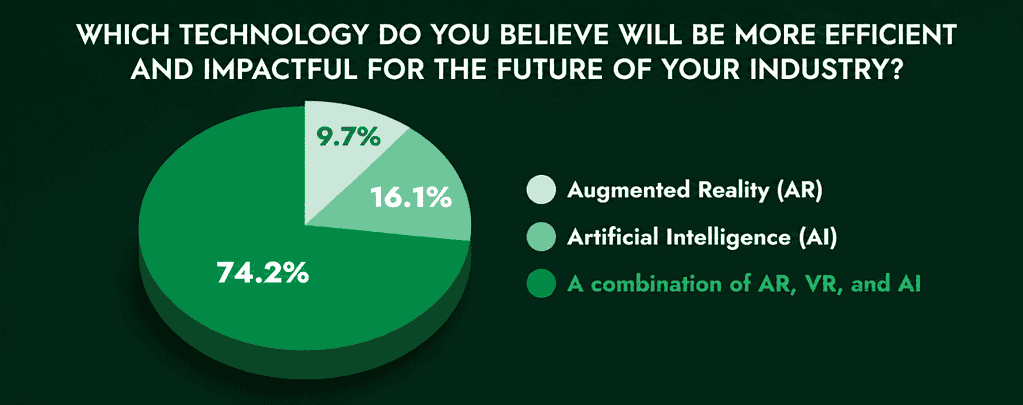
- The same 2026 publication reports 90.3% considered AI the main force enhancing XR.
- YORD reports 54.8% planned to expand XR across more teams within 12–24 months; this indicates deployment intentions.
- YORD reports 19.4% were preparing company-wide XR deployment.
- McKinsey’s 2026 survey reports 44% were scaling AI enterprise-wide, versus 38% previously; these figures cover general AI, not VR-specific adoption.
- McKinsey reports 56% used AI across at least 3 business functions, versus 51% previously; its 2026 survey included 1,719 participants across 97 nations.
- The UK government’s October 2026 survey reports 32% business AI adoption, versus 16% in 2025.
AI in Virtual Reality Gaming Statistics
- GDC’s 2026 survey of over 2,300 industry professionals found 36% used generative AI at work; this measures gaming broadly.
- In GDC’s 2026 survey, 30% of game-studio respondents used AI tools, compared with 58% at publishers, support teams, and marketing/PR firms.
- GDC’s 2026 findings identified research and brainstorming at 81%, daily tasks and coding assistance at 47% each, and prototyping at 35%.
- GDC’s 2026 findings listed ChatGPT usage at 74%, Google Gemini at 37%, and Microsoft Copilot at 22% among gaming professionals using AI tools.
- In 2026, 52% of GDC respondents viewed generative AI negatively, while 7% viewed it positively.
- Valve’s September 2026 survey found 1.35% of surveyed Steam users had VR headsets.
- In September 2026, Meta Quest 3 represented 26.90% of surveyed Steam VR headsets, followed by Quest 2 at 25.80%.
- Valve’s September 2026 VR headset shares included Quest 3S at 11.07%, Valve Index at 10.83%, Pico 4 at 4.76%, and PS VR2 at 2.31%.
AI in Virtual Reality Healthcare Statistics
| Healthcare application | Numeric information reported in 2026 |
| AI-adaptive VR rehabilitation evidence | A review published June 16, 2026, included 25 studies involving 687 stroke survivors, with 12 studies contributing to its meta-analysis. |
| Upper-limb recovery after stroke | The review reported a 7.47-point improvement versus controls on the Fugl-Meyer upper-extremity assessment, with a 95% confidence interval of 5.38–9.57 and p < 0.001, exceeding the cited clinically important difference of 5.25 points. |
| Reliability of the pooled clinical result | Between-study heterogeneity was 58%. Excluding a high-risk study produced a 7.21-point improvement, with a 95% confidence interval of 4.98–9.44 and p < 0.001. |
| Real-time treatment personalization | Approximately 80% of the included studies used real-time, closed-loop adaptation to adjust rehabilitation according to patient performance. |
| AI methods used in VR rehabilitation | The review identified reinforcement learning in 8 studies, deep learning in 7, supervised learning in 5, clustering in 4, and iterative user modelling in 3. Counts totalled 27 because 2 of the 25 studies used multiple algorithm types. |
| Patient usability | The review reported a System Usability Scale score of 72.5 out of 100 for machine-learning-adaptive VR rehabilitation. |
| Planned AI-driven VR stroke trial | A registry entry posted March 6, 2026, planned 50 adults aged 18 or older, with 25 participants per group and 1:1 randomization. Estimated study dates were March 1–August 1, 2026. |
| Evidence in lung cancer rehabilitation | A 2026 review identified 19 completed reports and 1 protocol, including 5 basic immersive/display interventions, 14 deterministic connected systems, and 0 completed advanced AI-digital-human trials. |
AI-Powered Avatars and Virtual Characters
- On January 26, 2026, Synthesia announced USD 200 million in Series E funding at a USD 4 billion valuation.
- Synthesia’s January 2026 announcement reported that over 90% of Fortune 100 companies used its AI video platform, indicating substantial enterprise penetration.
- Synthesia’s announcement page lists over 240 AI avatars supporting more than 140 languages.
- On October 27, 2026, NVIDIA announced Nemotron 3.5 Bolt E4B 4GB for locally powered, conversational game characters on GeForce RTX and RTX Spark.
- NVIDIA reported approximately 40% higher average benchmark quality for its October 2026 character model compared with its previous model.
- NVIDIA reported its October 2026 character model generated up to approximately 80% fewer tokens than peers, supporting more concise character interactions.
- NVIDIA’s October 2026 model provided a 64k-token context window for conversation history, instructions, tools, retrieved information, and game-state data.
- NVIDIA’s October 2026 character model supported 35 languages, building on a base model pretrained across more than 140 languages.
AI in Virtual Reality Investment and Funding
- On June 15, 2026, AutoVRse announced USD 2.4 million in funding to expand AI-powered industrial training and VR solutions internationally.
- AutoVRse’s 2026 round followed USD 2 million raised in February 2024; Singularity AMC and existing investor Lumikai co-led the new investment.
- On October 26, 2026, Springfield Memorial Foundation and SIU School of Medicine announced USD 2 million for AI and extended-reality medical education.
- Springfield Memorial Foundation contributed USD 1 million toward the October 2026 initiative supporting virtual patient encounters and immersive surgical simulations.
- SIU School of Medicine matched the foundation’s grant with USD 1 million, completing the combined USD 2 million medical-education investment.
- On February 18, 2026, World Labs announced USD 1 billion in funding for spatial intelligence and AI-generated, persistent 3D environments.
- Autodesk announced a USD 200 million World Labs investment on February 18, 2026, supporting spatial AI research rather than exclusively VR applications.
- World Labs’ USD 1 billion announcement named AMD, Autodesk, NVIDIA, Fidelity, Emerson Collective, and Sea among investors, without disclosing every individual contribution.
AI Hand, Body, and Facial Tracking in Virtual Reality
- Meta’s April 14, 2026, documentation defines 70 upper-body joints for reconstructing user movements and animating VR avatars.
- Meta’s 2026 body-tracking documentation adds 14 lower-body joints, producing an 84-joint full-body skeleton rather than directly measuring every joint.
- Meta’s tracking skeleton comprises 18 core-body joints and 52 hand joints, combining estimated positions and orientations for avatar movement.
- Meta’s April 2026 documentation lists body-tracking support across 4 headsets: Quest 2, Quest 3, Quest 3S, and Quest Pro.
- Meta’s hand-tracking documentation specifies 60 Hz Fast Motion Mode for tracking rapid movements commonly encountered in fitness and rhythm applications.
- Meta’s September 30, 2026, facial-tracking documentation describes 70 facial muscle expressions used to animate avatar faces through its facial-action representation.
| Feature | Specification |
| Upper-body joints | 70 joints |
| Lower-body joints (added) | 14 joints |
| Full-body skeleton (combined) | 84 joints (estimated, not directly measured) |
| Core-body joints | 18 joints |
| Hand joints | 52 joints |
| Supported headsets (body-tracking) | Quest 2, Quest 3, Quest 3S, Quest Pro (4 headsets) |
| Fast Motion Mode (hand-tracking) | 60 Hz, for rapid movements (fitness/rhythm apps) |
| Facial muscle expressions | 70 expressions (facial-action representation) |
On-Device AI vs Cloud-Based AI Inference in VR Headsets
- At AWE 2026, Qualcomm introduced Snapdragon Reality Elite with up to 48 TOPS, enabling large language and vision models to run on-device.
- Qualcomm’s 2026 chipset claims up to 160% higher NPU performance, 60% higher GPU performance, and 30% higher CPU performance than XR2+ Gen 2.
- Qualcomm demonstrated offline image generation in approximately 1.7 seconds at AWE 2026, alongside an on-device conversational avatar requiring no cloud connection.
- NVIDIA’s 2026 CloudXR 6.0 documentation recommends 200 Mbps downstream bandwidth, with 100 Mbps minimum, illustrating connectivity requirements for remotely processed XR experiences.
- CloudXR 6.0 specifies 20–50 milliseconds pose-to-frame latency, 100 milliseconds maximum, jitter below 10 milliseconds, and packet loss below 1%.
- NVIDIA’s 2026 CloudXR documentation specifies 4K maximum resolution and default streaming bandwidth of 50 Mbps per eye, totalling 100 Mbps.
Security Risks in AI-Enabled VR
- An April 2026 study achieved 96.61% identification accuracy using VR eye movements, demonstrating that AI can compromise anonymity during passive video viewing.
- The same study used 407 participants’ gaze data recorded at 250 Hz; approximately 38 seconds of video viewing enabled identification under experimental conditions.
- Identification accuracy varied by activity: 72.11% for random saccades, 68.33% for smooth pursuit, 57.37% for reading, and 43.82% for vergence.
- A March 2026 study evaluated 2 identification models using 49 users across 5 XR applications; limited cross-application generalization constrained demonstrated tracking risks.
- An NDSS 2026 study interviewed 23 XR developers; recognized sensitive-data categories increased from 2.1 to 4.8 after explanations, revealing substantial awareness gaps.
- A September 2026 research preprint reviewed 134 papers on XR motion privacy, mapping identity inference, profiling risks, attack methods, and protective approaches.
Recent AI in Virtual Reality Developments
- On February 20, 2025, Meta announced a USD 50 million creator fund and early-access Horizon editor featuring generative AI tools for virtual-world creation.
- On March 31, 2025, Apple released visionOS 2.4, bringing AI-powered writing, image generation, and ChatGPT integration to Vision Pro.
- On April 14, 2025, Meta expanded Horizon’s generative AI tools into the UK and Canada, adding 3D mesh and texture generation.
- In September 2025, Meta introduced Horizon Studio’s AI creation tools and announced another USD 2.5 million competition, reporting in-world purchases increased 280% that year.
- In September 2025, Meta launched Hyperscape Capture early access, enabling Quest 3 and 3S users to convert physical rooms into photorealistic virtual environments.
- On October 15, 2025, Apple announced M5 Vision Pro, starting at USD 3,499, with AI features running up to 50% faster than its predecessor.
- On October 22, 2025, Samsung unveiled Galaxy XR, an AI-native immersive headset integrating Google Gemini, with availability beginning October 21 in the USA.
- In March 2026, NVIDIA introduced CloudXR 6.0, enabling high-fidelity XR streaming across headsets and browsers to support increasingly demanding AI-enhanced spatial computing.
What It All Comes Down To
AI is making virtual reality more responsive, personal, and useful. Growth is strong across gaming, healthcare, training, and education, supported by smarter characters, better body and face tracking, and faster on-device processing. Heavy investment in spatial AI and content creation is speeding up development.
However, many game professionals remain skeptical, and eye and motion data raise serious privacy risks. Lasting success will depend on harmonizing innovation with strong data protection and user trust.
FAQ
AI powers many of VR’s core features. It drives realistic non-player characters, tracks hand, eye, and body movement, generates and adapts virtual environments, and personalizes experiences based on how a user behaves. In short, AI makes VR worlds more responsive and lifelike.
VR creates an immersive, computer-generated environment you experience through a headset. AI is software that learns from data to make decisions or generate content. They are separate technologies, but AI is often built into VR to make it smarter and more interactive.
AI makes opponents and companions react more naturally, adjusts difficulty to your skill level, and generates dynamic quests or environments. It also supports voice interaction with characters and can reduce development time by helping create 3D assets and worlds.
Yes. Generative AI tools can produce 3D models, textures, and entire environments from text prompts or images, which speeds up development. Results still usually need human refinement for quality, performance, and design consistency.
Key challenges include the high computing power needed for real-time processing, the cost of hardware and development, data privacy concerns (VR can capture eye, motion, and biometric data), and the risk of biased or unrealistic AI-generated content.
Expect more natural interaction through voice, gesture, and eye tracking, more AI-generated content, and smarter virtual assistants and characters. Most forecasts point to growing adoption in training, healthcare, and entertainment, though the exact pace depends on hardware costs and consumer uptake.