








Introduction
GigE Cameras Statistics: GigE cameras help industries capture clear images and inspect products with greater accuracy. They use Gigabit Ethernet technology to send image data quickly over long distances, making them a practical choice for industrial applications. These cameras also work with standard Ethernet networks, which makes installation simple and affordable. From checking product quality on factory floors to guiding robots and inspecting electronic parts, GigE cameras support a wide range of tasks.
They also help businesses spot defects early, reduce manual work, and improve production speed. As more companies adopt automation, GigE cameras are gaining importance as a reliable imaging solution for faster inspections and smoother industrial operations.
Editor’s Choice
- The GigE camera market is projected to grow from USD 4.5 billion in 2025 to USD 5.0 billion in 2026.
- Area Scan Cameras captured 52% of the market, valued at USD 650 million in 2025.
- CMOS dominated the GigE Camera market with a 78% share, worth USD 975 million.
- Industrial Inspection led demand at 42%, or USD 525 million, with a projected 10.2% CAGR from 2026 to 2032.
- Manufacturing remained the largest end-user segment at 48%, valued at USD 600 million, with projected growth of 10%.
- Allied Vision unveiled its Camtastic G1 platform at VISION Stuttgart 2026, featuring three global-shutter models with resolutions ranging from 5.01 to 12.28 MP and 1GigE connectivity.
- In 2025, Asia-Pacific generated USD 512.5 million, accounting for 41% of market revenue.
- The GigE Vision Network Components market is expected to reach USD 1.94 billion in 2026.
- The Teledyne DALSA BFS-PGE-04S2 GigE camera delivers 291 fps at a resolution of 720 × 540 pixels.
- The Association for Advancing Automation (A3) approved GigE Vision 3.0 on April 17, 2026.
GigE Camera Market Size
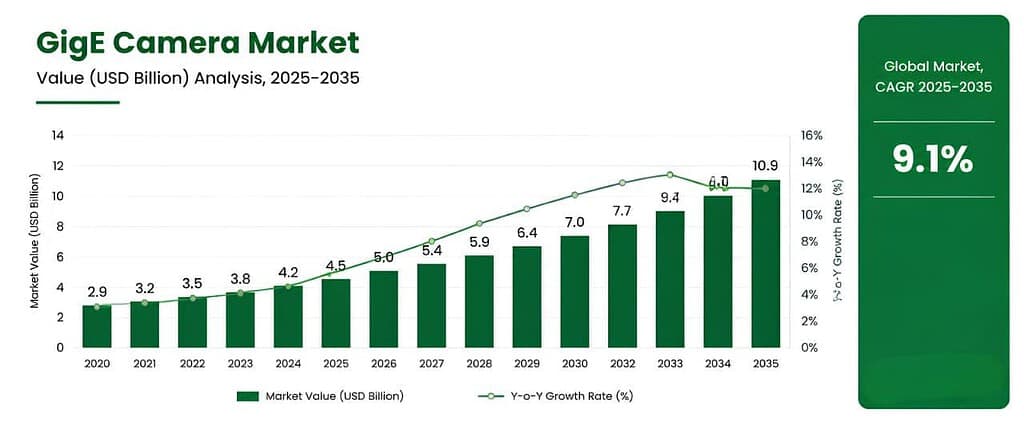
- The GigE camera market is estimated at USD 4.5 billion in 2025.
- Market value is projected to reach USD 5.0 billion in 2026, reflecting approximately 11.1% annual growth.
- By 2035, the market is forecast to reach USD 10.9 billion.
Market Segmentation by Product Type
- Area Scan Cameras captured 52% of the market, valued at USD 650 million in 2025, according to Strategic Market Research.
- Line Scan Cameras generated USD 350 million, representing 28.0% of the market, and are forecast to record a 9.8% CAGR from 2026 to 2032.
- 3D Cameras contributed USD 250 million, representing 20% of the market, with growth expected at a 10.6% CAGR.
By Technology
- CMOS dominated the GigE Camera market with a 78% share, worth USD 975 million in 2025, and is projected to expand at a 10.1% CAGR.
- CCD maintained a 22.0% share, valued at USD 275 million, with anticipated growth of 7.5%.
By Application
- Industrial Inspection led demand at 42%, or USD 525 million, with a projected 10.2% CAGR from 2026 to 2032.
- Surveillance reached USD 225 million, capturing 18% and growing at 8.7%.
- Transportation recorded USD 187.5 million, holding a 15% share and a 9.4% CAGR in the forecast period.
- Medical secured 14%, worth USD 175 million, and is expected to grow at 10%.
- Logistics accounted for USD 137.5 million (11%) and grew at a 9.1% CAGR.
By End User
- Manufacturing remained the largest end-user segment at 48%, valued at USD 600 million, with projected growth of 10%.
- Healthcare reached USD 225 million, representing 18% and a 9.8% CAGR during 2026-2032.
- Government & Defense recorded USD 212.5 million, equivalent to 17%, with an 8.9% CAGR.
- Transportation also accounted for 17%, valued at USD 212.5 million, and is forecast to grow by 9.3%.
Regional Market Insights
| Region | Market Revenue (Share), 2025 |
| Asia-Pacific | USD 512.5 million (41%) |
| North America | USD 362.5 million (29%) |
| Europe | USD 287.5 million (23%) |
| Latin America | USD 50 million (4%) |
| Middle East and Africa | USD 37.5 million (3%) |
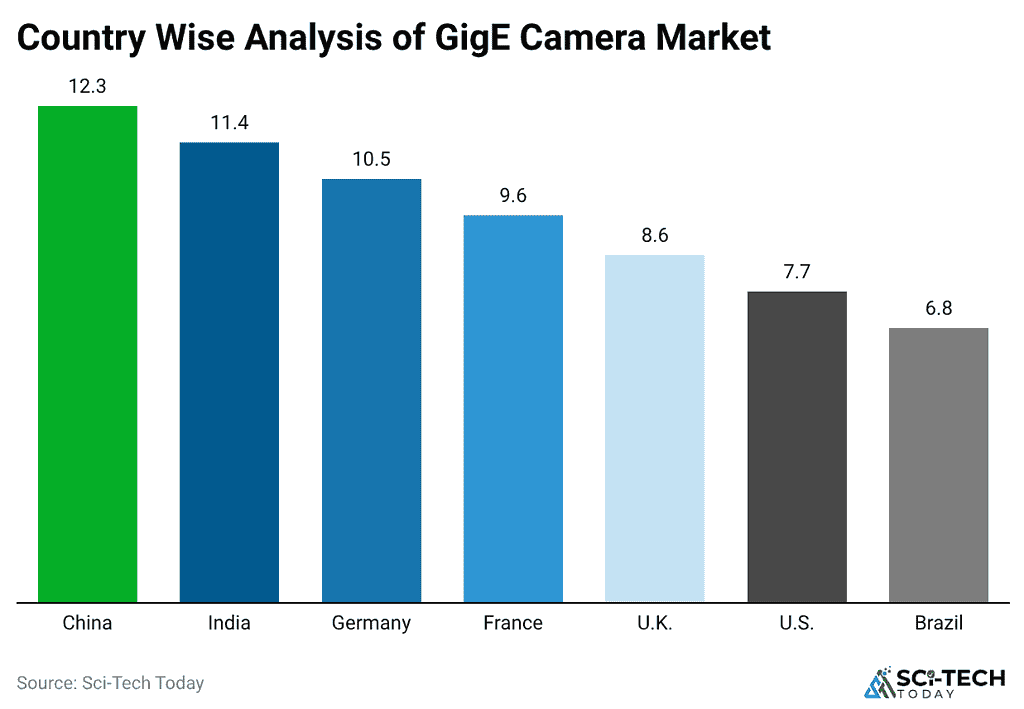
- From 2025 to 2035, projected compound annual growth rates are China’s 12.3%, India’s 11.4%, Germany’s 10.5%, France’s 9.6%, the U.K.’s 8.6%, the U.S.’s 7.7%, and Brazil’s 6.8%.
GigE Camera Market: Key Companies and Developments
| Company | Specifications |
| Allied Vision | Introduced the Camtastic G1 platform at VISION Stuttgart 2026. Its three models offer 5.01-12.28 MP resolution, 9-023 fps, global shutters, and 1GigE connectivity. |
| Basler AG | Its ace 2 10GigE cameras offer resolutions from 5 to 24.4 MP and speeds up to 234 fps across different models. In H1 2026, revenue reached EUR 152.4 million, up 36%, while EBITDA rose to EUR 37.9 million. Full-year 2026 revenue guidance was EUR 270-290 million. |
| Teledyne FLIR | The Forge 5GigE series offers multiple resolution configurations with frame rates ranging from 25 to 122.9 fps. |
| IDS Imaging | The uEye Warp10 range supports 5 MP at 247 fps and 45 MP at 27.7 fps. |
| JAI | Its Sweep+ cameras provide 4,096- and 8,192-pixel line resolutions, with maximum RGB line rates of 97 kHz and 49 kHz, respectively. |
| Sony | In Q1 2026, Imaging & Sensing Solutions sales increased 26% to JPY 512.7 billion. |
| Teledyne DALSA | Genie Nano cameras cover 0.3-25 MP, while the Kaleido SWIR hyperspectral system exceeds 2,300 lines per second. |
GigE Vision Network Components Market Highlights
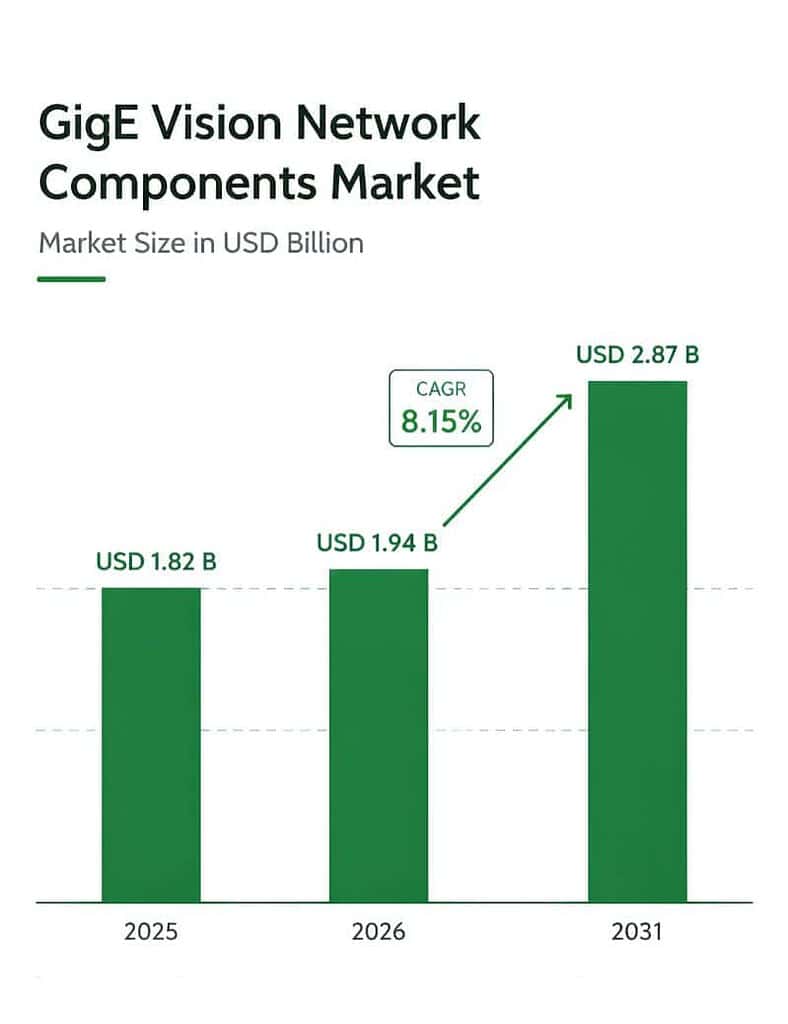
- The GigE Vision Network Components market is expected to reach USD 1.94 billion in 2026 and USD 2.87 billion by 2031, growing at an 8.15% CAGR.
- Cameras held a 57.83% share in 2025, while software and SDKs.
- Moreover, drivers are forecast to grow at a 10.47% CAGR through 2031.
Key Segmental Report
- Area-scan cameras held 48.67% of revenue in 2025, while 3D and stereo vision cameras are forecast to grow at an 11.38% CAGR through 2031.
- 1 GigE captured 46.27% in 2025, while 10 GigE and 25 GigE are projected to grow at an 11.16% CAGR.
- Manufacturing accounted for 27.43% in 2025. Meanwhile, electronics and semiconductors are expected to grow at a 10.76% CAGR.
- Asia-Pacific led with a 38.71% share in 2025 and is projected to expand at an 11.28% CAGR through 2031.
Industrial GigE Camera Market Growth
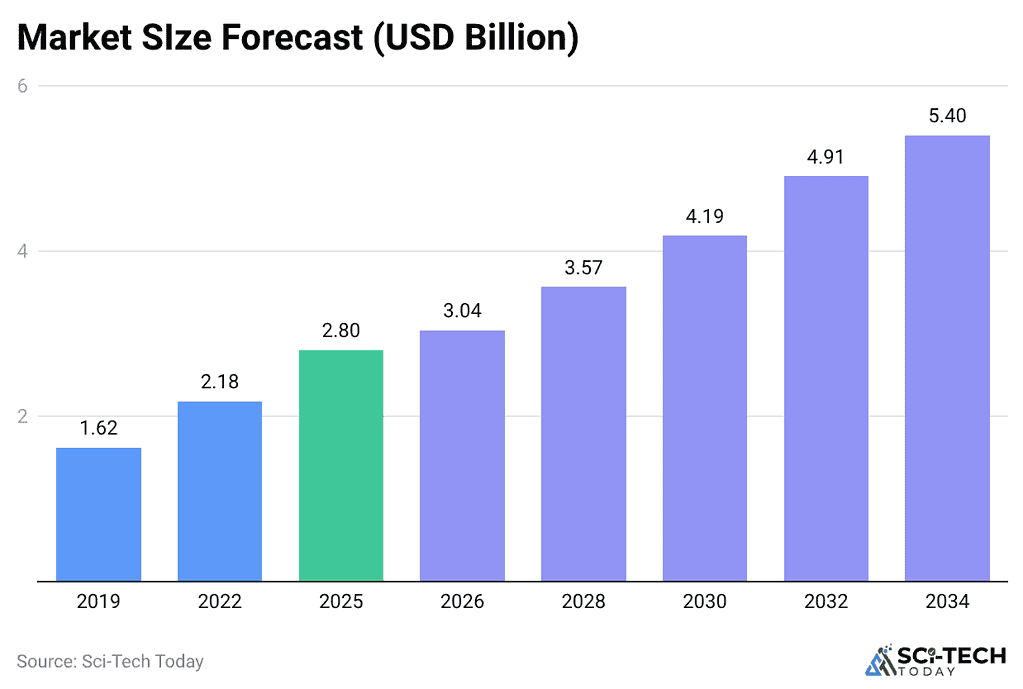
- The industrial GigE camera market is projected to reach USD 3.04 billion in 2026.
- Asia Pacific led the regional market in 2025, generating USD 1.19 billion and accounting for 42.5% of global revenue.
- Area Scan Cameras held the largest product share at 58.2%, reaching USD 1.63 billion in 2025.
- Cameras below 2 MP served the entry-level market, contributing 22.4%, or approximately USD 627 million.
- Inspection-led applications accounted for 38.3% of the total, valued at approximately USD 1.07 billion.
- Automotive was the largest end-user, generating approximately USD 750 million and holding 26.8%.
- Monochrome cameras accounted for 52.1% of revenue, reaching around USD 1.46 billion in 2025.
GigE Cameras for Traffic and High-Impact Applications
| Manufacturer | Camera Type | Frame rate / Line Rate | Resolution | Imaging Modes / Key Features |
| Baumer | Progressive scan; board level | Progressive scan: 16-160 fps; board level: 27-160 fps | Progressive scan: <1-8 MP; board level: <1-4 MP | Digital monochrome and color |
| Dalsa | Area scan; line scan | Area scan: 12-300 fps; line scan: 9-68 kHz | Area scan: <1-12.5 MP; line scan: 1K-4K | Monochrome and color |
| JAI | Area scan | 15-200 fps | <1-16 MP | Monochrome/color, digital color, NIR, RGB |
| PixeLINK | Area scan | 7-150 fps | <1-6 MP | Monochrome and color |
| Sony | Area scan | 15-90 fps | <1-5 MP | Monochrome and color |
| Illunis | Area scan | 1.7-2.4 fps | 50-71 MP | High-speed, high-resolution |
Real-World GigE Camera Resolution and Frame-Rate Specifications
| Camera Model | Interface | Resolution (pixels) | Listed Frame Rate |
| Teledyne DALSA BFS-PGE-04S2 | GigE | 720 × 540 | 291 fps |
| Teledyne DALSA BFS-PGE-120S4 | GigE | 4,000 × 3,000 | 10 fps |
| Teledyne DALSA BFS-PGE-16S2 | GigE | 1,440 × 1,080 | 78 fps |
| JAI AP-3200T-10GE | 10GigE | 2,064 × 1,544 | 106 fps |
| JAI AP-5100T-5GE | 5GigE | 2,472 × 2,064 | 32 fps |
| JAI FS-1600D-10GE | 10GigE | 1,440 × 1,080 | 226 fps |
| JAI FS-3200D-10GE | 10GigE | 2,048 × 1,536 | 123 fps |
GigE Vision Standards and Ethernet Performance
- The Association for Advancing Automation (A3) approved GigE Vision 3.0 on April 17, 2026.
- According to A3, the standard supports data streaming at 400 Gbps and beyond. This is a standard-level capability, not the speed of a typical 1 GigE camera.
- Conventional GigE cameras use a nominal 1 Gbps Ethernet link, while faster models support 5GigE and 10GigE interfaces.
- Compatible copper Ethernet connections can reach up to 100 meters using suitable cabling, such as Cat5e or Cat6.
- Before GigE Vision 3.0, version 2.2 was updated in June 2022, and version 2.1 in August 2018.
GigE Performance Report
| Tier | Nominal Link Rate | Typical Connector/Media | 2026 Role |
| 1 GigE | 1 Gbps | RJ45 copper | Broad industrial baseline; supports cable runs up to 100 m. |
| 2.5 GigE | 2.5 Gbps | Copper | Incremental upgrade when 1 GigE bandwidth is insufficient. |
| 5 GigE | 5 Gbps | Copper / Cat6a | Cost-effective mid-band upgrade while retaining familiar Ethernet infrastructure. |
| 10 GigE | 10 Gbps | Copper or SFP+ fiber | High-resolution and high-frame-rate imaging is a common choice for demanding machine-vision systems. |
| 25 GigE | 25 Gbps | SFP28 | High-end inspection, very high sensor data rates, and multi-camera aggregation. |
| 50-100 GigE | 50-100 Gbps | QSFP28 and fiber | Camera aggregation, sports/volumetric capture, and advanced automated optical inspection. |
| 200-400G+ | 200-400+ Gbps | RoCEv2 / NIC-based fabric | Future scalable vision infrastructure enabled by GigE Vision 3.0 and RDMA-based streaming. |
Comparison Between GigE and USB Cameras
| Feature | GigE | USB 3.0 |
| Max Speed | 1 Gbps (1 GigE) | Up to 5 Gbps |
| Cable Length | Up to 100m | ~5m without extenders |
| Power Delivery | PoE (Power over Ethernet) | Bus powered |
| Infrastructure | Standard Ethernet | Typically direct connection to PC |
| Cost | Lower Overall System Cost | Lower camera cost, higher cable/connecttion limitations |
- 1GigE offers a data rate of 1 Gbps, while USB 3.0 supports speeds of up to 5 Gbps.
- GigE supports cable runs of up to 100 meters, while USB typically supports around 5 meters without extenders.
- GigE cameras can receive power through Power over Ethernet (PoE), while USB cameras typically draw power directly from the connected device.
- GigE uses standard Ethernet networks, while USB cameras usually connect directly to a computer.
- GigE can be more cost-effective for multi-camera and long-distance setups, while USB cameras generally cost less upfront but may require additional equipment for longer connections.
Conclusion
GigE cameras are a useful choice for industries that need fast and reliable image capture. They support tasks such as product inspection, defect detection, and automated production. Their easy connectivity and flexible setup also make them suitable for different machine vision systems. As more factories adopt smart technologies, GigE cameras will continue to support industrial automation.
Before choosing a camera, businesses should consider image quality, capture speed, lighting, network requirements, and system compatibility.
FAQ
GigE cameras are widely used in industrial automation, machine vision, quality inspection, robotics, medical imaging, traffic monitoring, and scientific research.
A GigE camera typically transmits data up to 100 meters over standard Cat5e or Cat6 Ethernet cables.
GigE cameras use Ethernet for longer cable runs and networking, while USB3 cameras offer plug-and-play connectivity and shorter cables.

Sources