








Introduction
HR SaaS Statistics: The HR SaaS market in 2026 enters a more challenging phase, where businesses are demanding that cloud solutions unify payroll, talent, workforce planning, and employee services while providing evidence of profits.
The Information Services Group’s 2025 enterprise survey shows that 69% of businesses implement SaaS or hybrid-cloud strategies in their HR activities, but only 52% of businesses can determine the returns yielded by their HR technology investment. HR SaaS also should be distinguished from other HR technologies because the delivery format, type of product, and surveyed audiences of different studies vary.
The figures mentioned in this article show how 2026 spending plans and projections for the next year differ in basis from former analyses.
Key Highlights
- The global HR SaaS industry will be worth US$462.26 billion by 2026 and US$833.38 billion by 2031 at a CAGR of 12.51%.
- In 2025, cloud deployment accounted for 73.41% of the HR SaaS market, which is a sign of the industry moving toward employing cloud-based workforce management solutions.
- By the year 2025, North America accounted for 39.83% of the total revenue around the world for HR SaaS, projecting a CAGR of 13.57% for the Asian Pacific region through the year 2031.
- HR SaaS spending ranges between US$185,000 and US$465,000 for companies with around 1,000 employees, as opposed to US$4,000 and US$8,000 for businesses employing between 25 and 50 employees.
- A company would incur costs of US$20,000 to US$100,000 for implementation of HRIS and data migration.
- The research by Zylo shows that 54% of enterprise SaaS licenses are utilized while the other 46% remain unused or underutilized.
- 79% of interviewed IT executives stated that they met with price increases for SaaS, while 78% faced unforeseen expenses stemming from consumption-based pricing or AI-related features.
- HR SaaS spending will probably grow by 15% to 20% in 2027 given the tendency for favorable adoption of more advanced AI technologies.
HR SaaS Market Size Statistics
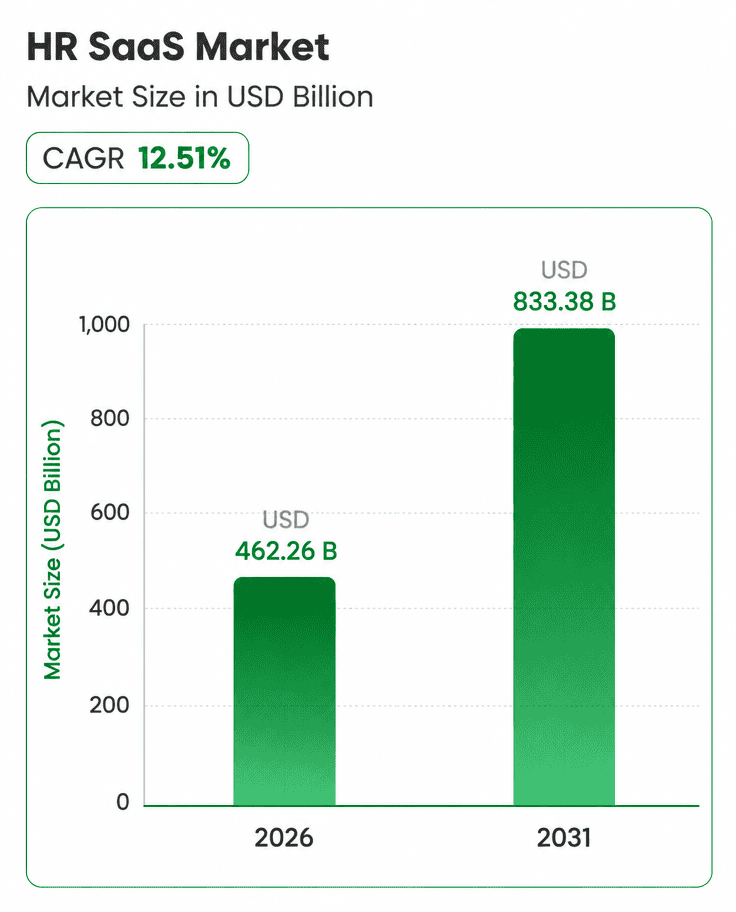
- The global HR Software-as-a-Service (SaaS) market is set to expand over the next few years. In the forecast by Mordor Intelligence, the global HR SaaS market is set to be valued at USD 833.38 billion by 2031, up from its valuation in 2026 at USD 462.26 billion.
- The expansion is attributed to the adoption of HR processes by companies through automation and the increased use of AI in HR processes, as well as the transition of HR systems to the cloud.
- Increased need for HR solutions in various countries across the globe for multi-country hiring and payroll, compliance, and employee management is also supporting this market expansion.
- Cloud deployments are forecasted to dominate the market by holding a 73.41% market share in 2025 and an expected 12.89% compound annual growth rate (CAGR) from 2025 to 2031.
- Core HR applications held the largest market share in 2025 at 32.67%, whereas workforce analytics are predicted to grow at a CAGR of 13.73%.
- Large enterprises held a 52.38% market share. However, mid-sized enterprises will grow at the highest CAGR of 13.11% from 2025 to 2031.
- Different industries have different market responses. For example, IT and telecommunications in 2025 contributed 27.72% to HR SaaS revenue.
- Healthcare, however, will see the highest growth at a 13.84% CAGR to 2031, and North America led with 39.83% of the global market revenue in 2025.
- Asia Pacific, meanwhile, is expected to experience the fastest market growth at a 13.57% CAGR in the forecast period of 2026 to 2031.
- Emerging markets are forecast to support HR SaaS growth, and cloud technology and workforce analytics are also factors that will support the market growth in the coming years.
HR SaaS Spending Statistics by Company Size
| Company Size | Annual HR SaaS Spend | Per Employee (Monthly) |
| 25-50 employees | US$4,000-US$8,000 | US$7-US$13 |
| 50-100 employees | US$8,000-US$14,000 | US$7-US$14 |
| 100-250 employees | US$14,000-US$42,000 | US$10-US$18 |
| 250-500 employees | US$42,000-US$85,000 | US$12-US$20 |
| 500-1000 employees | US$85,000-US$185,000 | US$14-US$31 |
| 1000+ employees | US$185,000-US$465,000 | US$15-US$39 |
- Companies have different budgets for HR SaaS, and this depends on how many functions they have in their HR and the level of sophistication they require.
- Smaller companies will typically require only a core HR system, an applicant tracking system, and a payroll system, while large companies need an entire HR suite that encompasses advanced analytics and global payroll and compensation planning.
- The range of annual budgets for smaller businesses with 25-50 employees is US$4,000 – US$8,000 and increases for companies with 50-100 employees to US$8,000 – US$14,000, US$14,000 – US$42,000 for 100-250 employees, US$42,000 – US$85,000 for 250-500 employees, and US$85,000 – US$185,000 for 500-1,000 employees.
- The budget for businesses with 1,000 employees is US$185,000 – US$465,000.
- Companies with fewer than 1,000 employees will pay US$7- US$13 monthly per employee. Large businesses (more than 1,000 employees) pay more, at US$15 – US$39 monthly per employee.
- Software requirements, systems integration, and service sophistication levels are the primary reasons behind the price ranges, in addition to headcount.
- For companies and businesses above the early mid-market and even mid-market level, the annual price range begins to escalate because of the needs associated with international expansion, as global payroll will be a major expense at approximately US$15 – US$50 annually per employee.
- Also, with international expansion comes complex compliance laws (e.g., GDPR), and in many instances, individual company and state laws.
- While having a larger workforce means a business can save on labor costs through economies of scale, these benefits can be offset by a business’s global presence and more stringent regulations.
- The complexities of a business’s workforce should drive HR software selection as much as, or perhaps even more than, the size of the business.
Hidden Costs of HR SaaS: Beyond Subscription Fees
- There are more costs to HR software than a monthly subscription. Although an average business spends roughly US$6,300 per year and incurs an additional average cost of roughly US$260 for transactions, these software costs represent only the beginning.
- Additional costs such as implementation, integration, the use of other software that could be considered duplicative, under-utilized licenses, and compliance costs need to be accounted for in determining the software’s total cost of ownership.
- For HRIS transitions, companies can pay from US$20,000 to US$100,000 for consulting and implementation.
- In the first year of using a new system, many companies choose to add 15–20% of the cost of the system to their budget to cover costs associated with implementation.
- Companies have to properly plan and account for operational and compliance issues associated with data migration, system transition, and data and records management.
- Integration is costly. If you have to build your own system connectors to HR software to interface with systems like payroll, accounting, recruitment, benefits, and learning, that could cost between US$5,000 and US$30,000 to build and maintain.
- The costs for duplicate software are about 15–25% of overall spend for a company and are particularly egregious when companies buy software with similar features like performance, recruiting, engagement, and surveys.
- Underutilized licenses, including those used by former employees and test users, all increase costs.
- Vendor lock-in means companies pay an additional cost when they switch services.
- For instance, when it’s time to sign a new contract with a service provider, businesses end up paying more because of the extra cost to migrate from one service to another, even when both services offer comparable subscription prices.
- Another reason costs go up is compliance requirements such as GDPR, CCPA, HIPAA, and SOC 2.
- There are businesses in a position where they must use an already certified service in order to maintain a safe working environment and ensure company employees aren’t subject to any penalties or issues.
- Before choosing an HR SaaS service, companies should take into account all costs, including subscription services and additional compliance costs, which come with service license audits and tool audits, to ensure the right service is chosen to serve the company best.
B2B HR Tech SaaS benchmarks
| Segment | Average CPC | Average CPL | Conversion rate | Sales cycle |
| ATS / Recruiting | US$8-US$15 | US$200-US$400 | 2-3.5% | 60-120 days |
| HRIS | US$10-US$18 | US$300-US$600 | 1.5-3% | 90-180 days |
| Payroll | US$9-US$16 | US$250-US$500 | 2-3% | 60-120 days |
| Performance Management | US$7-US$12 | US$200-US$400 | 2-3.5% | 60-90 days |
| Employee Engagement / Survey | US$5-US$10 | US$150-US$300 | 2.5-4% | 45-90 days |
| LMS / Learning | US$6-US$11 | US$200-US$400 | 2-3.5% | 60-120 days |
| Time and Attendance | US$5-US$9 | US$150-US$300 | 2.5-4% | 45-90 days |
| Benefits Admin | US$10-US$18 | US$300-US$600 | 1.5-3% | 90-180 days |
| Compensation Management | US$10-US$20 | US$400-US$800 | 1-2.5% | 120-180 days |
Number of HR SaaS Companies Formation Statistics
| Year | No. of companies |
| 2026 | 1,550 |
| 2025 | 1,371 |
| 2024 | 1,427 |
| 2023 | 1,342 |
| 2022 | 1,114 |
| 2021 | 1,513 |
| 2020 | 2,089 |
| 2019 | 1,717 |
| 2018 | 1,432 |
| 2017 | 1,308 |
- Businesses have the potential to disrupt the HR space, with more and more new businesses entering the HR SaaS space, especially with the advancement of HR solutions.
- The data in 2026 reports show that 1,550 new HR SaaS startups have entered the space. That is an improvement over the 2,089 new startups in 2020.
- However, the data for new startups has shown that the trend for HR SaaS startups is still at an all-time low. This shows that interest is present, but it has not reached the peak interest level seen in 2020.
HR SaaS Startup Funding Statistics
| Year | Total Funding |
| 2026 | US$2.89B |
| 2025 | US$4.17B |
| 2024 | US$2.69B |
| 2023 | US$3.77B |
| 2022 | US$8.84B |
| 2021 | US$19.2B |
| 2020 | US$5.22B |
| 2019 | US$7.54B |
| 2018 | US$11.6B |
| 2017 | US$2.81B |
- HR software platforms have attracted a total of US$68.7 billion over the past 10 years, which reflects the ongoing interest from investors in software related to HR.
- Based on reports on HR related software funding, the peak annual investment was over US$19.2 billion, occurring in 2021. So far this year, HR software funding has reached US$2.89 billion.
- Looking at the investment figures as an analyst, investment is still significant, but it will take time to grow to 2021 levels.
HR SaaS License Utilization and Shelfware Statistics
- SaaS sprawl and the resulting underutilization have become a significant problem for many organizations.
- Zylo’s 2026 SaaS Index states that on average only 54% of licenses purchased by an enterprise are utilized.
- The Index is based on more than 40 million licenses worth US$75 billion, along with data from over 200 IT executives.
- Another one of their statistics shows 36% utilization across all sectors. These numbers should not be used as HR benchmarks and shouldn’t be compared as identical numbers.
- Waste in licensing is a major issue, but IT leaders also need to understand the difference between assigned and purchased seats as well as assess how much each application is used for its intended purpose.
- Recruiting software has different goals and should have a different frequency of usage than software designed to help employees understand compensation.
- One of the issues associated with the software lifecycle is rising costs of software renewal.
- IT leaders reported that 79% experienced software cost increases during renewal within the past year.
- In that same survey, 78% stated that they saw surprise costs related to the utilization of new features (AI features) or costs related to the consumption of services.
- In its pricing guides, Vendr said that some of the proposed cost increases for SAP were 3-8%, while for UKG, it recommended pricing caps between 3 and 5%.
- The ability to successfully negotiate contracts, both before and after renewal, is another skill of IT leadership.
- Preparation should occur approximately 90-120 days before a contract’s renewal, with 30-90 days for major contracts and notice for cancellation.
- The best way to save money with software purchasing is for HR procurement to audit software for duplication.
- The best way to evaluate savings is to look at how much software was actually used and how much money was actually saved as opposed to estimating how much software will be wasted.
The Impact of Future HR SaaS Spending Trends (2027 and Beyond)
- As organizations consolidate their tech stacks, prioritize AI and workforce solutions, and deepen the integration of their HR software, the spending landscape for HR SaaS is expected to shift.
- The upcoming trend for HR software is for companies to invest in unified HR software that integrates all of the necessary HR tools rather than having separate applications for separate functions.
- Companies will still need separate, specialized tools to support specific needs such as recruiting and training.
- We also expect the number of standalone HR software vendors to decrease, especially with a trend of companies merging with others to dominate the market.
- Solutions for HR functions, such as tools that are capable of predicting employee turnover, solutions that automate recruiting and the generation of job descriptions, will command a premium price, and businesses should anticipate having to budget for an increase in HR SaaS expenditures.
- Big players in the payroll software industry are creating solutions to manage the workforce globally by offering bundled packages that reduce pricing to encourage customers to unify vendors.
- Being a top choice for mid-to-large customers will come down to integrating different solutions, such as connecting HR, payroll, accounting, recruiting, and training applications.
- While AI becomes more standard in software solutions, businesses can anticipate their HR SaaS spending of US$6,280 to grow incrementally.
- Consolidating vendors and managing duplicate subscriptions is the best approach to control spending.
- Organizations will increasingly seek the most value for money through connected platforms, as opposed to the purchase of software in an attempt to cover more areas of HR.
Conclusion
The HR SaaS industry is growing steadily as companies adopt cloud-based systems for workforce management, streamlining activities, and AI usage in operations. However, higher subscription fees, installation costs, and unused licenses are placing more importance on cost control. The expansion of the industry is providing positive conditions for startups, even though funding and the creation of new companies from one year to another vary.
By 2027, the development of AI technologies, international payroll systems, and concentration of platforms will determine the purchasing decisions and budgets for software solutions. Companies should determine if HR SaaS platforms meet criteria for total cost of ownership, ability to integrate with different systems, actual license use, and business impact.
FAQ
By 2026, Mordor Intelligence projects the HR SaaS Market to be valued at US$462.26B and US$833.38B by 2031.
Companies with 25 to 50 employees spend between US$4k and US$8k annually. Larger companies with over 1k employees spend between US$185k and US$465k.
Some of the primary hidden costs include implementation, data migration, system integration, duplicate subscriptions, unused licenses, vendor switching, and compliance with regulations.
Zylo’s research shows that only 54% of enterprises are able to maximize their SaaS license usage, which indicates that 46% of licenses remain underused or not utilized at all.
The most important trends include the use of AI in recruiting, predictive analytics in workforce management, global payroll integration, SaaS consolidation, and increased attention to connected HR technologies.