








Introduction
Email Engagement Statistics: In 2026, email is one of the most productive marketing channels for building relationships, nurturing leads, and driving sales. In today’s landscape, open rates alone don’t capture an email marketing campaign’s success. Other measures such as click-through rate, conversion rate, and unsubscribe rate capture the overall email marketing engagement metrics.
For example, as privacy standards evolve, inbox competition intensifies, and email marketing technologies leverage AI for personalization, it is crucial to understand what engagement metrics actually capture in order to execute successful email marketing.
Key Highlights
- In terms of email marketing engagement, media ranks the lowest in terms of unsubscribe rate at 0.10%, while consulting comes in the highest at 0.23%.
- In the nonprofit industry, email open rates are at their highest at 52.38%, while email open rates are lowest at 32.67% for the ecommerce industry.
- Media industry click-through rates of 4.10% lead the way in email marketing.
- Ecommerce rates come in lower at 1.07%.
- With regard to re-engagement emails, email marketing has one of the highest returns at 28% for revenue generated per email sent, and it comes in even higher at 45% for the retail and ecommerce industries.
- The average return on email marketing investment is US$36 per US$1, but this jumps to US$45 in the retail and ecommerce industries.
- Personalized email marketing drives 6x more transactions compared to other email marketing techniques.
- The email open rate is monitored by 95% of marketers, followed by 88% of marketers who monitor the email click-through rate.
- McKinsey predicted email marketing revenue would increase by 5–8% using AI technology for personalization.
- According to Litmus, 61.9% of emails are opened on a mobile device, so email designers must incorporate mobile-friendly design.
Email Engagement Statistics by Industry
| Industry | Recorded open rate | Click-through rate | Unsubscribe rate |
| Marketing and advertising | 37.23% | 1.30% | 0.15% |
| Media | 42.97% | 4.10% | 0.10% |
| Bloggers | 43.03% | 3.00% | 0.16% |
| Business and finance | 43.34% | 2.37% | 0.16% |
| Consulting | 45.96% | 2.41% | 0.23% |
| Ecommerce | 32.67% | 1.07% | 0.18% |
| Retail | 37.47% | 1.27% | 0.22% |
| Software and web apps | 39.31% | 1.15% | 0.20% |
| Nonprofits | 52.38% | 2.90% | 0.19% |
- The industry email open rate can give you context for how your email is performing. For example, open rates for the nonprofit sector are the highest at 52.38%. This is followed by consulting at 45.96% and business and finance at 43.34%.
- Bloggers follow at 43.03% and media at 42.97%, while Software and web applications come in at 39.31%, with retail at 37.47%, marketing and advertising at 37.23%, and the lowest open rate for this industry dataset is e-commerce at 32.67%.
- A similar trend can be seen in click-through rates for these sectors. Media is the highest at 4.10%. Bloggers are at 3.00%, and nonprofits are at 2.90%.
- Consulting comes in at 2.41%, Business and finance is at 2.37%, Marketing and advertising is at 1.30%, while retail is at 1.27%.
- Software and web applications are at 1.15%, and e-commerce is the lowest at 1.07%.
- Consulting had the highest at 0.23%, followed by retail at 0.22%, then software and web apps at 0.20%. Nonprofits are at 0.19%.
- Ecommerce was 0.18%, bloggers and business and finance were both 0.16%, and marketing and advertising was at 0.15%. Media had the lowest unsubscribe rate at 0.10%.
- Based on this data, higher open rates don’t result in higher click-through rates, and industry-specific benchmarks for performance and improvement to emails, and not rely solely on open rates to improve engagement and retention of subscribers.
Email Revenue By Type
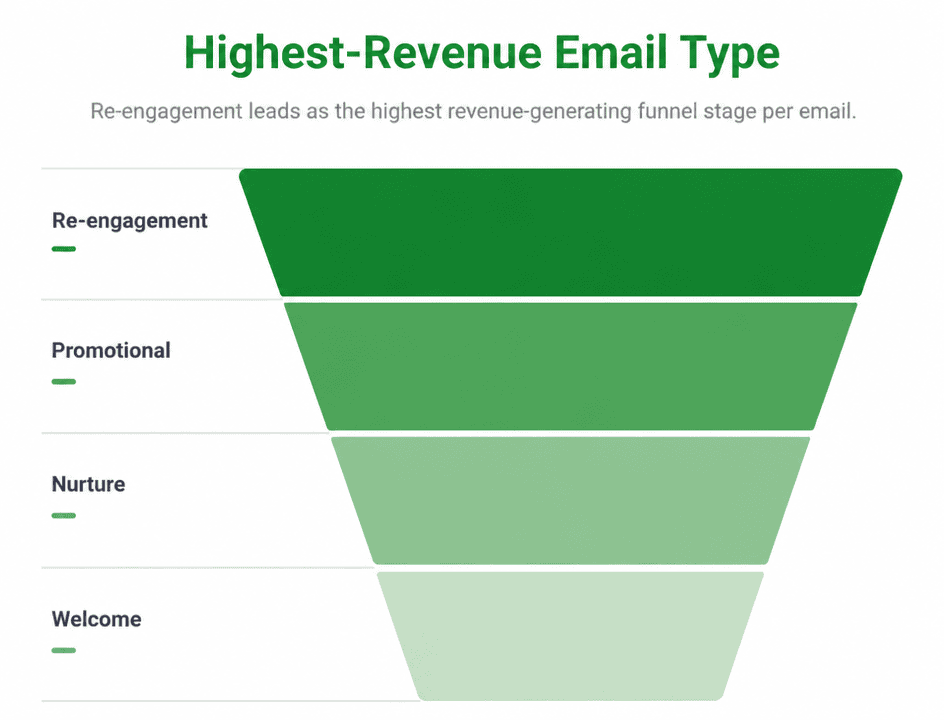
- The data reveals the opportunity re-engagement emails present to get great returns for each email sent.
- A maximum of 28% of people stated re-engagement emails bring the most revenue per email at any funnel stage.
- This was closely followed by promotional emails (25%), then nurture emails (24%), and lastly welcome emails (22%).
- Many marketers focus on larger marketing and promotional campaigns at the expense of inactive customers who have at least some awareness of the brand.
- Win-back emails and sequences offer a marketing strategy for this segment rather than just getting rid of them from the email list.
- An evaluation of email marketing must include more than total gross revenue, but should also consider the revenue that comes in per email that is sent.
- More effective re-engagement strategies can help customers extract value from existing segments of inactive subscribers, while at the same time supporting and supplementing ongoing marketing initiatives.
Email Marketing ROI
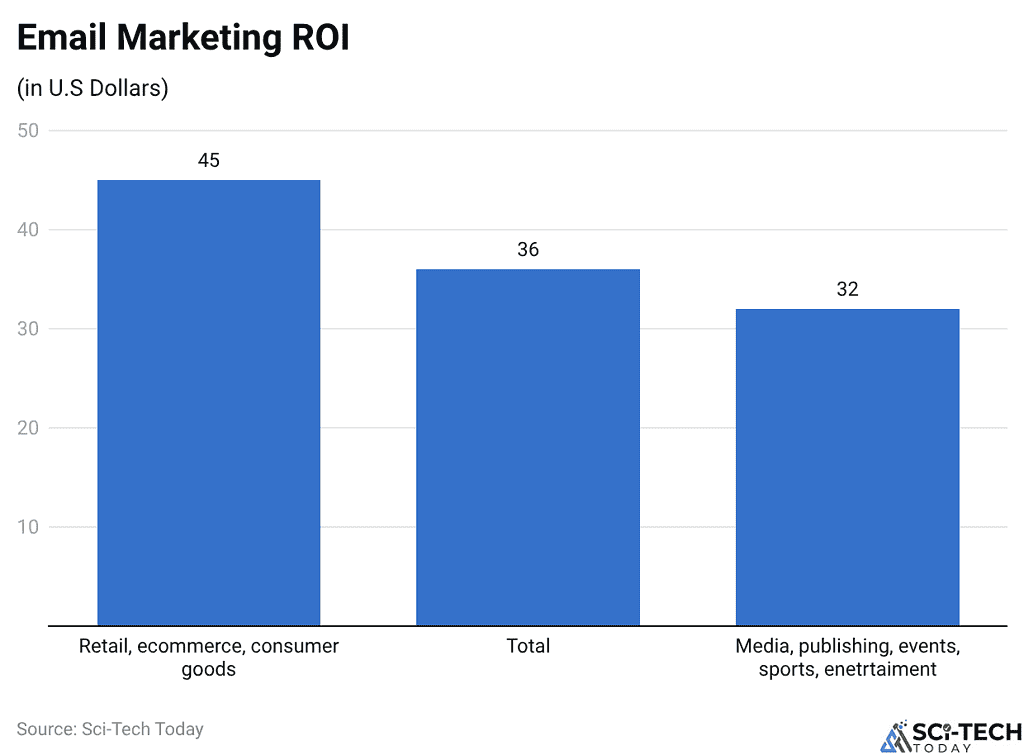
- According to industry research, email marketing offers a great way to maximize a company’s return on investment with a return of 36 to 1 on every dollar.
- Email marketing returns vary from industry to industry. The retail/e-commerce industry has the highest return at 45 to 1, while media, publishing, entertainment, sports, and events industries have the lowest at 32 to 1.
- A number of studies suggest email marketing results in better engagement when personalization is added.
- Research indicates that personalizing email campaigns results in a return that is six times better than regular email marketing campaigns.
- Google ads bring in about 8 dollars for every dollar spent. Email marketing is still more cost-effective when compared to other digital advertising channels like SEO, which bring in about US$12.
- Companies should think about the strategy behind email marketing and utilize multiple marketing techniques as opposed to just relying on a single one.
- When done in the correct way, email marketing will improve a company’s relationship with its customers, sales, and influence buying behavior.
- In general, email marketing offers a higher ROI for organizations.
Email Marketing Metrics
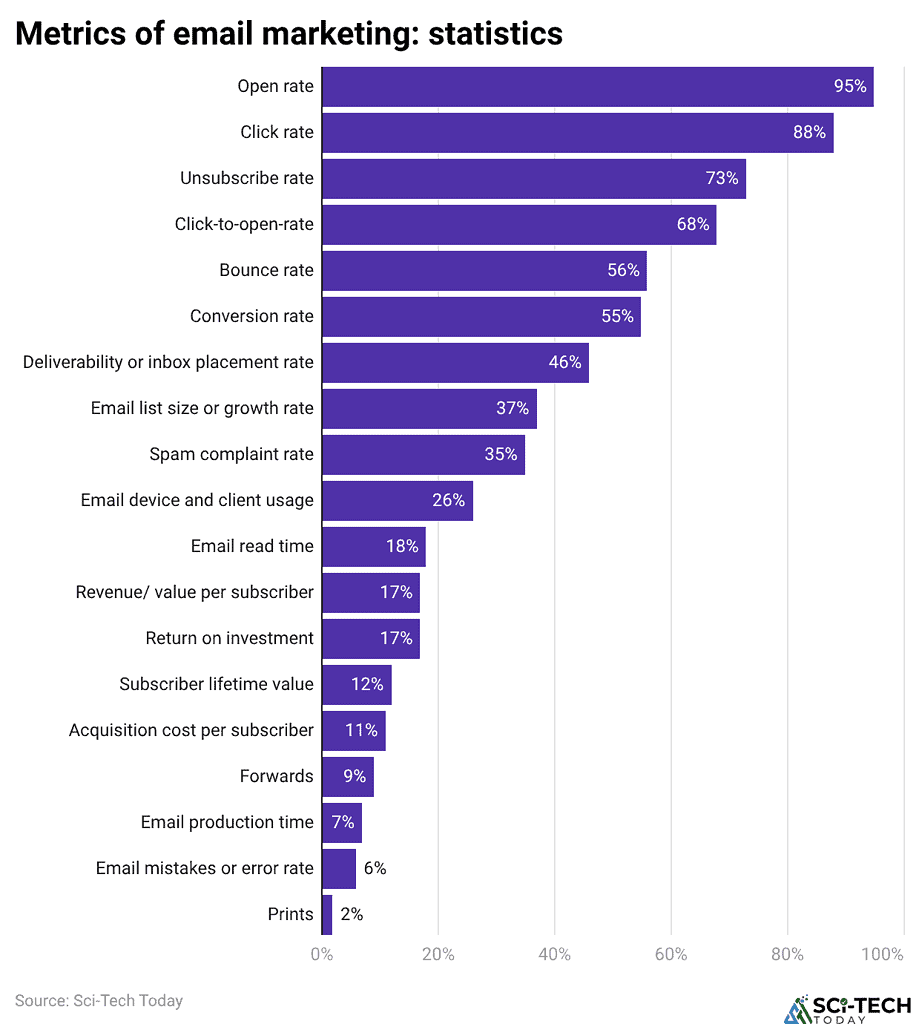
- Performance metrics are varied and more insightful than using one singular number. For example, 95% of marketers monitor email open rates.
- Click-through rates, unsubscribe rates, click-to-open rates, soft bounce rates, and conversion rates follow open rates at 88%, 73%, 68%, 56%, and 55%, respectively.
- Research demonstrates that email marketers are not solely interested in email visibility but also care if their emails spur substantive actions.
- Open and click-through rates help marketers learn the audience’s engagement, while bounce and unsubscribe rates provide insights into issues regarding content delivery and quality.
- An interesting finding from the research is that 18% of content marketers track the time email readers take to read emails, while 37% measure the subscriber list’s growth.
- Both metrics provide a better picture of the content’s effectiveness, especially with regard to the audience’s level of engagement and list growth, and when combined with delivery and conversion metrics, marketers gain better insights into what content pays the bills.
- Collecting the data is one thing; using it to improve the efficacy of marketing efforts is another.
AI Personalization and Dynamic Content Impact in 2026
- AI personalization will go beyond email names by 2026. The real value is in combining audience selection, content creation, and product recommendations to improve customers’ experiences.
- Personalization at this level will improve revenue by 5-8%, according to McKinsey, and is beneficial across all operations in businesses.
- Marketing professionals will use generative AI to write numerous variations of marketing messages.
- Simultaneously, AI will forecast customer engagement and focus messaging efforts accordingly.
- Salesforce Einstein can write five subject line or marketing message variations and leave them for further analysis.
- A study conducted by Braze with Uswitch showed an open rate of nearly 10% in a study subject line, and a 43% increase in engagement through a reactivation message.
- However, a study conducted by Defau and Zauner in Marketing Letters showed that first-name personalization had almost no impact on customer engagement in the student experiment.
- Braze used Intelligent Timing to report a 26% decrease in customer unsubscribes through a study of Foodora.
- Through a study on 8fit in 2021, high-probability purchase audiences had 3.75x higher engagement compared to random audience selections.
- Mailchimp, in a 2026 study of 44 billion emails and 83 million texts, linked generative AI marketing messages to higher order and conversion rates.
- Segmented emails performed 11% better than their unsegmented counterparts, with average order values of US$166.16 and US$149.54, respectively.
- Klaviyo’s 2026 benchmarks for automated emails compared to their email campaigns were 2.11% to 0.16% placed-order rates.
- AI product recommendation emails achieved an average click-through rate of 3.75% with a high of 8.79%.
- While encouraging, the data should be viewed in a larger context, as most email marketers need to run tests for revenue, purchases, and unsubscribes.
- In line with the guidelines laid out by NIST, all personalization must balance privacy with AI recommendation and bias monitoring, accuracy, and human oversight.
Best Email Design Statistics of 2026
- The top trend in 2026 email design is making sure emails are easy to read and use on different devices and clients. It should have responsive email layouts and buttons, as well as an easy-to-read font and light and dark modes.
- Litmus noted in its March 2026 article that 61.9% of email users read email on a mobile device. While this statistic describes mobile readership of email, it is not the %age of total email readership.
- Litmus notes it is possible to read email on desktop devices, such as tablet computers, without opening the email on a mobile device.
- Further, as email open tracking becomes more complicated due to Apple’s Privacy Protection feature, device readership tracking becomes more problematic.
- Litmus says to design emails with single-column layouts and a 600px width.
- In addition, Litmus says CTA buttons should have a minimum of a 44x44px touch area, while email body text should have a minimum of 18px and email secondary text should have a minimum of 14px.
- Readers will be able to navigate emails easily and not be forced to zoom or scroll horizontally or click the incorrect link.
- With more email clients being able to completely or partially invert the colors, ensuring your design is compatible with dark mode is a major consideration.
- Litmus suggests that you should design for all color combinations by using background and foreground colors that ensure contrast, as well as flexible images.
- One new development in interactive email experiences is the AMP for Email framework.
- With the support of the AMP Project, email designers can incorporate different features such as carousels of products, lists, forms, and preferences.
- With these different features, email recipients can engage with products and different calls to action, and complete a form without having to leave the email.
- Some email clients, like AOL Mail, FairEmail, Gmail, Mail.ru, and Yahoo Mail, now have some limited support; Apple Mail and Outlook do not support this new framework.
- Google has different requirements that include email senders completing the registration process and having different email authentication protocols and policies in place, such as DKIM, SPF, TLS, and DMARC.
- Additionally, to avoid issues with different email inboxes, it is also highly suggested that the email sender provide an alternative version of their emails in plain text.
Conclusion
Email engagement levels by 2026 will not be just about getting your clients to open emails. According to industry benchmarks, open rates, click-through rates, and the number of clients unsubscribing from emails can vary a lot, while re-engagement emails present one more way to earn extra cash from inactive audiences. An average email ROI of US$36 per spent dollar only proves its commercial value.
AI-driven personalization, segmentation, and automation help reach audiences, but those effects should still be proven in real-life experiments and studies. At the same time, mobile-first design solutions, accessible CTA and suitable interactive features help create a better customer experience. To ensure sustainable profitability, one should strike a balance between relevance, usability, privacy, and profit.
FAQ
There are some variations between sectors. According to research provided by MailerLite, the figure varies from 32.67 % in ecommerce to 52.38 % in non-profit organizations.
The media industry boasts a 4.10% click-through rate, while bloggers come in second at 3.00%.
The average reported number is US$36 per dollar spent, but the results differ between industries.
Artificial intelligence helps to categorize audiences, predict the target audience, recommend personalized offers, and define the time of delivery.
Litmus data states that 61.9% of emails are opened on mobile devices. In general, responsive design, readable text, and buttons that are easy to tap increase usability.