









Industry at a Glance
Metaverse In Medical Training Statistics: Medical training is moving beyond textbooks, classrooms, and traditional practice methods. The metaverse is bringing a new approach to learning by creating virtual spaces where medical students and doctors can gain practical experience. Using virtual reality, augmented reality, and 3D technology, they can study the human body, practice surgical procedures, and experience real-life medical situations.
This approach makes learning more engaging while allowing healthcare professionals to improve their skills without risking patient safety. It also gives learners the freedom to repeat procedures and learn at their own pace.
As this technology develops, the metaverse could play an important role in making medical education more interactive, practical, and effective.
Best Overall
- The Medical Training Metaverse market is projected to grow from USD 9.8 million in 2025 to USD 12.9 million in 2026.
- Hardware led the component segment with a 68% share in 2025, while software is projected to grow at a 26.3% CAGR from 2026 to 2035.
- In 2025, North America led the medical training metaverse market, accounting for 42%.
- In Japan, healthcare professionals’ confidence scores rose from 2.9 to 4.3 on a 5-point scale in 2025.
- Microsoft reported 2026 revenue of USD 331.84 billion, up by 18% from last year.
- Medical education accounted for 15.22% of the research focus on the Metaverse.
- Virtual worlds dominated healthcare applications, accounting for 50% of the market.
- On August 13, 2026, at Seoul’s Samsung Medical Center, AR training was compared between 21 nurses with printed manuals and 21 others.
- A BJS Open review covered 14 VR and 11 AR studies, finding 80% focused on metaverse training, 67% on operations, and 53% on education.
- A 2025 systematic review analyzed VR, AR, and MR in medical education, covering 1,560 participants across 30 randomized controlled studies.
- The healthcare metaverse market is projected to reach USD 16.11 billion in 2026.
Medical Training Metaverse Market Size
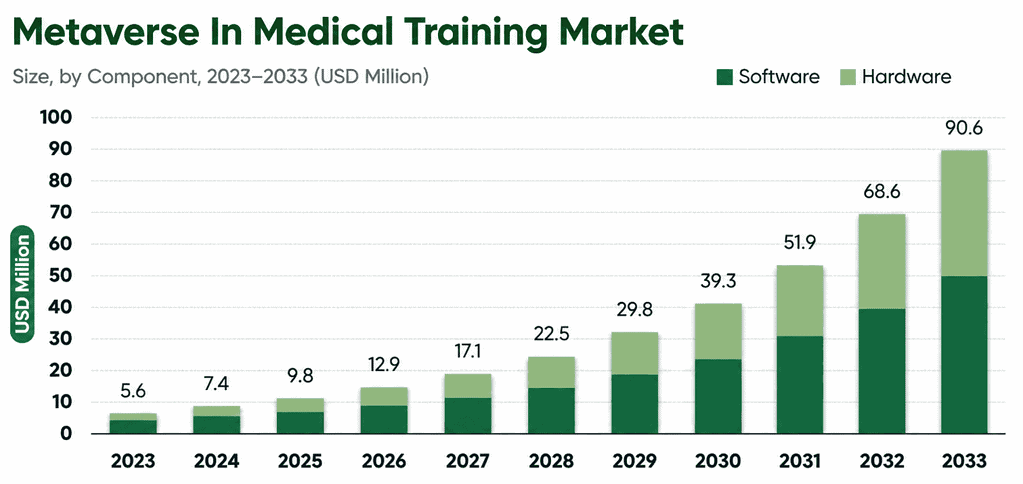
- The Medical Training Metaverse market is projected to grow from USD 9.8 million in 2025 to USD 12.9 million in 2026.
- The market is forecast to grow at a CAGR of 32.1% from 2023 to 2033, reaching USD 90.6 million by 2033.
Market Segmentation Analysis
- Hardware led the component segment with a 68% share in 2025, while software is projected to grow at a 26.3% CAGR from 2026 to 2035.
- VR technology and headsets accounted for over 48% and 46% of revenue, respectively, in 2025.
- Medical schools and universities led end-users with a 41% share.
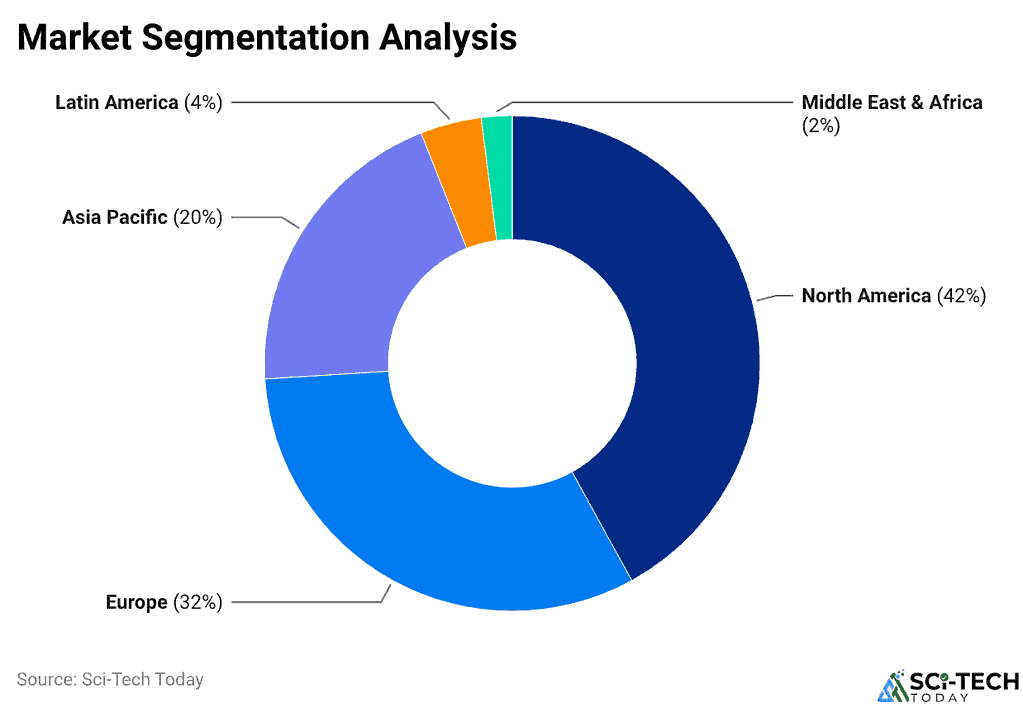
- In 2025, North America led the medical training metaverse market, accounting for 42%.
- It is followed by Europe (32%), Asia Pacific (20%), Latin America (4%), and the Middle East & Africa (2%).
Countries Using the Metaverse in Medical Training
| Country | Publication Year | Key Findings |
| Japan | 2025 | Healthcare professionals’ confidence increased from 2.9 to 4.3 on a 5-point scale. |
| China | 2025 | Participants’ confidence increased from 3.0 to 4.2 after immersive healthcare training. |
| United States | 2025 | Confidence increased from 2.8 to 4.4 following immersive technology workshops. |
| Saudi Arabia and Egypt | 2025 | Al Faisal University and Cairo University participated in metaverse-based clinical collaboration and surgical training. |
| Turkey | 2026 | Surveyed 718 medical students and physicians. |
| United Kingdom and Ireland | 2026 | Remote anatomy study involved 24 students from 11 medical schools, with 100% completion. |
Key Research Findings of the Metaverse in Medical Education and Training
- According to the International Journal of Technology Assessment, medical education accounted for 15.22% of the research focus.
- It is followed by surgery and dentistry at 6.52% each, and nursing at 4.35%.
- Education represented 21.74% of the identified application areas.
- Medical students accounted for 23.53% of the target groups, while healthcare providers represented 15.69%.
Technologies Supporting Medical Training
- Virtual worlds dominated healthcare applications, accounting for 50% of the market, followed by augmented reality at 17.39%.
- Mirror worlds and multiple metaverse technologies each captured 8.70%.
- Meanwhile, 15.22% did not specify the technology type.
AR for Emergency Medical Device Training
- A randomized controlled trial published in JMIR Medical Education on August 13, 2026, at Seoul’s Samsung Medical Center compared AR training in 21 nurses with printed manuals in 21 others.
- AR learners completed device setup in 3.67 minutes, compared with 9.85 minutes for manual learners, a 62% reduction in setup time.
- Total performance time was 5.83 minutes with AR, compared to 13.63 minutes with printed manuals.
- The AR group achieved a median competency score of 90/100, compared with 70/100.
- Self-efficacy scores were 20/30 versus 16.5/30, while satisfaction scores reached 18/20 versus 12/20.
AR and Gamification for Surgical Training
- A study published in the Archives of Academic Emergency Medicine on August 15, 2026, included 164 operating-room students divided into 4 groups of 41.
- Training lasted 3 weeks, with one 30-minute session each week.
- The AR and gamification group achieved a knowledge score of 84.4 ± 2.7 after 1 week and 71.6 ± 1.9 after 3 months, compared with 56.7 ± 6.8 and 48.6 ± 6.7 under traditional instruction.
- Practical examination scores reached 86.5 ± 4.3 versus 62.7 ± 6.2 out of 97.
AR for Obstetric Training
- According to a 2026 study published in Medical Teacher, a multicenter trial included 401 medical and midwifery students from Chile and Colombia, of whom 389 were included in the final analysis.
- AR learners achieved a procedural score of 11.9 versus 10.6 and a critical-task score of 3.6 versus 3.3.
- The competency threshold was reached by 12.8% of AR learners, compared with 6.2% using conventional preparation.
AR for Congenital Heart Disease Education
- A 2026 pilot randomized trial in JMIR Medical Education evaluated teaching methods among 26 first-year medical students.
- Participants included 8 slide-based learners, 9 using 3D-printed models, and 9 receiving AR instruction.
- Perfect immediate test scores were achieved by 67% of AR learners, compared with 13% of lecture learners and 11% of physical-model learners.
- Only 17 of 26 participants (65%) completed the delayed assessment.
VR for Physical Therapy Education
- Published on August 14, 2026, the trial compared immersive 180° videos with conventional 2D videos.
- It involved 52 physical therapy students, including 28 VR learners and 24 conventional-video learners.
- VR achieved higher adjusted satisfaction scores of 107.04 versus 93.28 (P=.001) and technology acceptance scores of 74.44 versus 68.03 (P=.04).
- However, quiz scores of 5.94 versus 5.11 showed no statistically significant difference.
Metaverse Applications in Surgical Education and Healthcare
- A scoping review published in BJS Open examined 14 VR studies and 11 AR studies related to surgical metaverse technologies.
- The findings showed that 80% focused on surgical training, 67% on operations, and 53% on education.
- Additionally, 53% of applications focused on surgical care, highlighting the technology’s growing role in medical practice.
People Involved in Metaverse Medical Training
- A 2025 systematic review covered 1,560 participants across 30 randomized controlled studies, examining VR, AR, and MR in medical education.
- A 2025 study published in Frontiers in Digital Health stated that 350 healthcare professionals enrolled in international immersive healthcare workshops covering VR, metaverse platforms, and 3D displays.
- A 2026 Turkish study surveyed 718 medical students and physicians about metaverse adoption, according to a Springer Nature report.
- A 2026 anatomy pilot involved 24 medical students from 11 medical schools in the UK and Ireland.
- Another 2026 study evaluated metaverse-based anatomy teaching among 64 fifth- and sixth-year medical students.
- A gastrointestinal surgery education study published in August 2026 involved 20 medical students.
Healthcare Metaverse Market Outlook
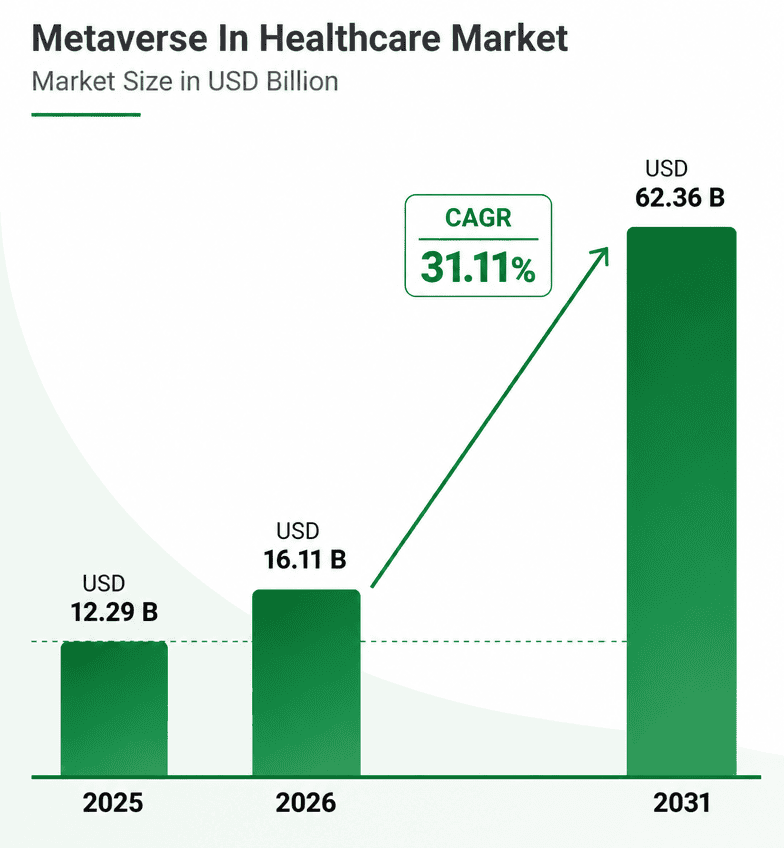
- The healthcare metaverse market stood at USD 12.29 billion in 2025.
- It is projected to reach USD 16.11 billion in 2026.
- By 2031, it is forecast to reach USD 62.36 billion, with a compound annual growth rate of 31.11%.
- Hardware accounted for the largest market share, at 57.62%, in 2025.
- However, services are projected to grow at a 34.20% CAGR from 2026 to 2031.
- Patient care management held the leading share at 33.42%, while mental-health VR therapy is expected to grow at a 33.90% CAGR.
- North America dominated with 42.05% of revenue in 2025.
- Asia-Pacific is projected to be the fastest-growing region, with a 32.90% CAGR through 2031.
Metaverse Healthcare Development Costs
- MVP platforms cost USD 80,000-150,000 for basic features.
- Mid-scale platforms cost USD 150,000-350,000 for added capabilities.
- Enterprise platforms cost USD 350,000-1 million+ for advanced features.
Estimated Development Budget Breakdown
| Development Activity | Budget Share |
| Research and planning | 5%-10% |
| Interface and user experience design | 10%-15% |
| 3D modeling and XR development | 15%-25% |
| Backend and API development | 20%-30% |
| AI, digital twins, and analytics | 10%-20% |
| System connections | 10%-15% |
| Security and compliance | 5%-10% |
| Testing and quality checks | 10%-15% |
Key Players in the Global Metaverse in the Medical Training Market
- Microsoft reported 2026 revenue of USD 331.84 billion, up 18%, with Azure revenue above USD 100 billion and 30 million paid Copilot seats.
- NVIDIA generated USD 215.94 billion in revenue in 2026, a 65% year-over-year increase.
- Siemens Healthineers recorded approximately EUR 23.6 billion in revenue, with 4% comparable growth and a 16.2% adjusted EBIT margin.
- GE HealthCare generated USD 5.5 billion in Q3 2026 revenue, up 7.2%, with a USD 23.7 billion order backlog.
- CAE reported approximately CAD 4.9 billion in revenue for 2026. It sold its healthcare business for CAD 311 million in 2024.
- 3D Systems recorded USD 99.3 million in Q3 2026 revenue, while healthcare revenue reached USD 49.0 million.
- Brainlab operates in 23 locations, serves approximately 120 countries, and employs engineers representing 83 nationalities.
- Surgical Science reported SEK 750.2 million in nine-month 2026 sales, up 4%, and SEK 228.4 million in license revenue.
- EON Reality introduced Genesis 2.0 with 95 environments and 475 interactive 3D objects in March 2026. Its platform reports 80+ countries, 1,000+ institutions, and 136 million+ downloads.
- CMR Surgical accounted for more than 45,000 patients treated using Versius by March 2026. Its Versius Plus system received US FDA clearance in December 2025.
Metaverse in Medical Training: Virtual Care Spending Potential
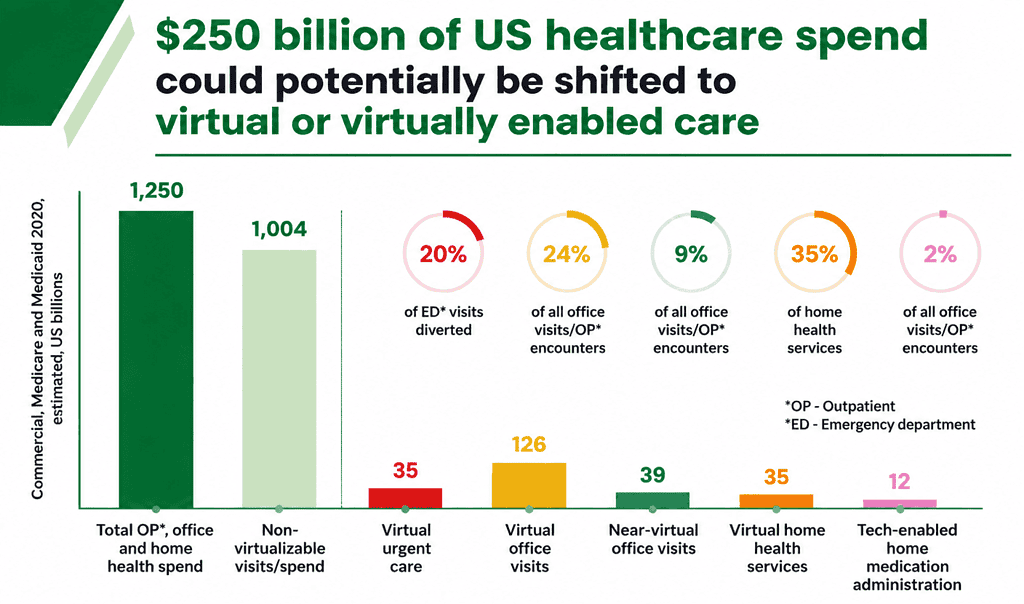
- The chart estimates that USD 250 billion in U.S. healthcare spending could shift to virtual or virtually supported care.
- Commercial, Medicare, and Medicaid spending on outpatient, office, and home healthcare totaled USD 1,250 billion.
- Non-virtualizable visits and services accounted for USD 1,004 billion.
- Virtual urgent care represented USD 35 billion, potentially redirecting 20% of emergency department visits.
- Virtual office visits generated USD 126 billion, accounting for 24% of office and outpatient encounters.
- Near-virtual office visits contributed USD 39 billion, representing 9% of total office and outpatient encounters.
- Virtual home healthcare reached USD 35 billion, covering 35% of home health services.
- Technology-enabled home medication administration accounted for USD 12 billion, representing 2% of office and outpatient encounters.
How is the Metaverse Reshaping Medical Visualization and Training?
- According to a research article published in the National Library of Medicine’s PubMed database, a 2026 anatomy trial involved 24 students from 11 medical schools, with 100% completion.
- Each teaching method lasted 10 minutes and included a brief comparison.
- VR-based learning achieved a depth-perception score of 3.75, compared with 2.58 for animation-based learning.
- Students using VR scored 4.25 in understanding different anatomical views, while the animation group scored 2.33.
- Mental reconstruction performance was higher with VR (3.83) than with animation (2.08).
- Learner confidence increased by 1.58 points with VR, whereas animation-based learning produced a 0.50-point improvement.
- Knowledge improved by 1.75 points with VR versus 2.83 points with animation.
Final Verdict
The metaverse is opening new ways to train future healthcare professionals. With virtual simulations, medical students can explore the human body, practice procedures, and gain hands-on experience without putting patients at risk. It also gives doctors a chance to improve their skills through repeated practice.
While costs and technical limits remain challenges, the technology could make medical learning more practical, accessible, and effective in the coming years.
FAQ
The metaverse offers immersive, interactive 3D simulations, allowing medical students to practice procedures and explore anatomy through realistic experiences rather than passive reading.
Virtual reality, augmented reality, artificial intelligence, 3D simulation, haptic feedback, and digital twins.
High costs, technical limitations, data privacy concerns, motion sickness, accessibility issues, and limited clinical realism hinder adoption.

Sources