









Beginning
Job Growth Statistics: Job growth shows how many new jobs are being created in an economy over time. It is an important sign of how strong and active a country’s economy is. When job growth is high, it means more companies are expanding, and more people are getting work opportunities.
Today, job growth is changing rapidly due to technology, globalization, and emerging industries. Fields like IT, healthcare, renewable energy, and online services are creating many new jobs, while machines and automation are changing old ones. Because of this, workers need new skills to stay up to date. Understanding job growth helps people, businesses, and governments make better choices for the future and prepare for upcoming changes in the job market.
Premium Pick
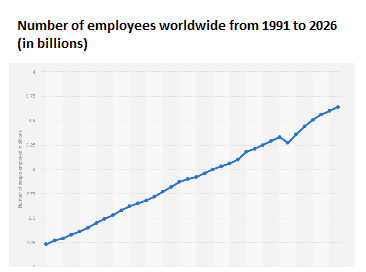
- By 2026, the number of employed people worldwide is estimated to reach approximately 3.65 billion.
- The U.S. economy added 172,000 nonfarm payroll jobs in May 2026.
- Meanwhile, the labor force participation rate remained unchanged at 61.8%.
- Economists had expected nonfarm payrolls to show that the 172,000 actual jobs would massively outperform the forecast of 85,000.
- The Leisure and Hospitality sector added 70,000 jobs, significantly above its previous 12-month average monthly gain of 14,000 jobs.
- Average hourly earnings for all private-sector employees increased by USD 0.12 (0.3%), reaching USD 37.53.
- Besides, the unemployment rate stayed at 4.3% in May 2026.
- The number of people unemployed for less than 5 weeks declined by 286,000 to 2.2 million.
- Productivity growth is 40% higher at companies with the greatest AI exposure than at those with the least exposure.
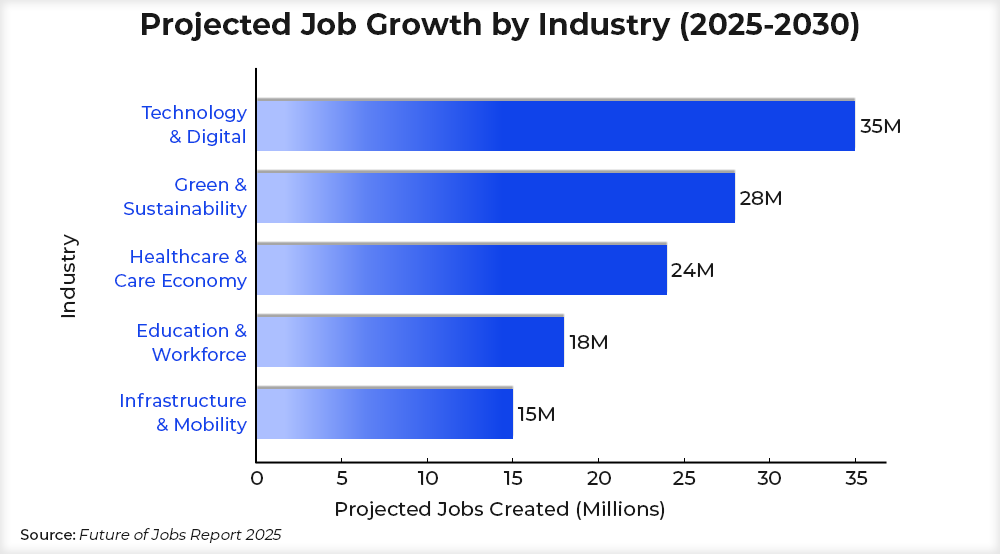
- Technology & digital roles are expected to add about 35 million jobs globally.
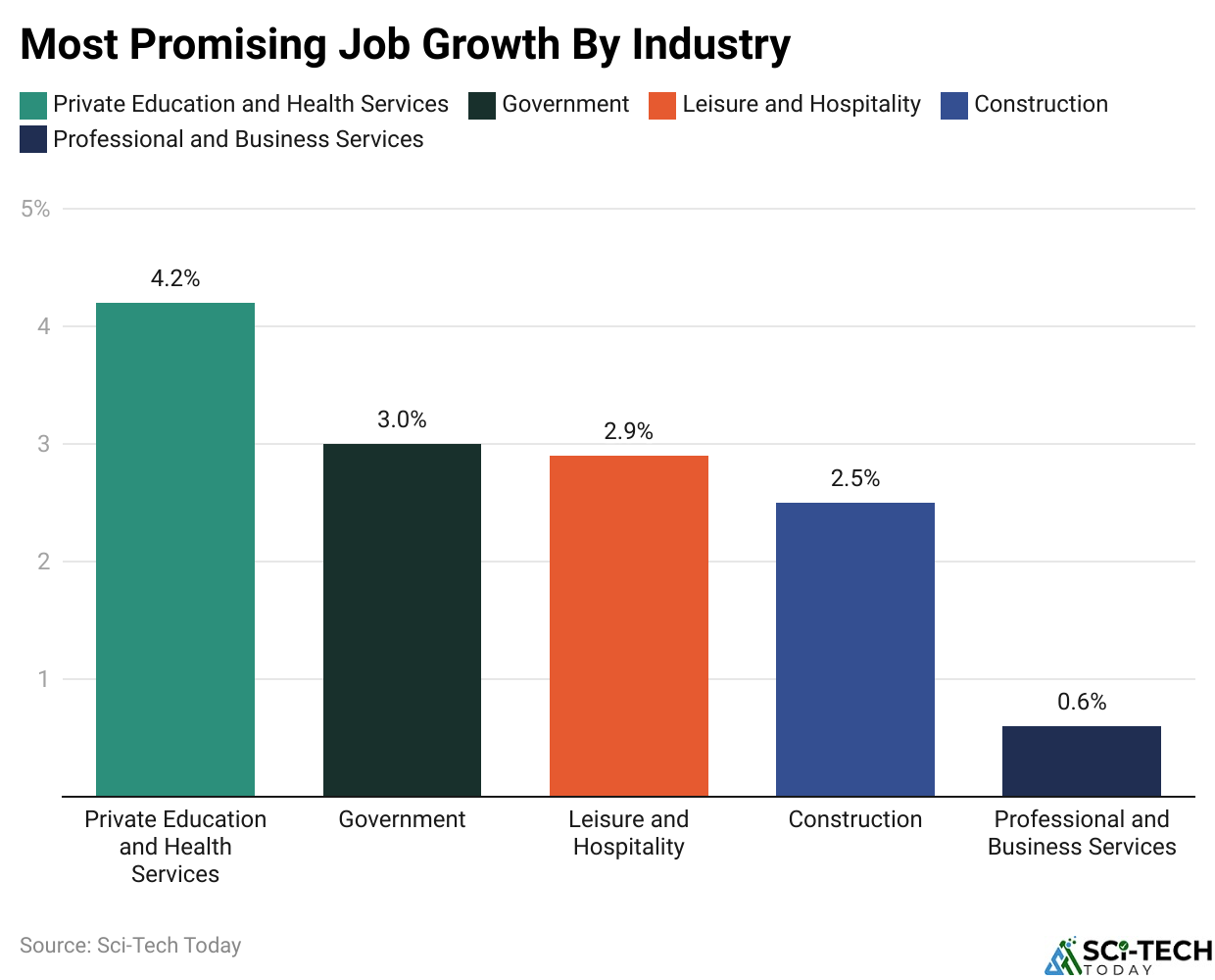
- Private Education and Health Services, at 4.2%, with a net change of 1.05 million newly employed among more than 25.87 million.
- Total global hours worked increased by approximately 0.8% from 2025 to 2026.
Global Workforce Expansion
(Source: statista.com)
- By 2026, the number of employed people worldwide is estimated to reach approximately 3.65 billion, reflecting an increase of about 1.43 billion workers since 1991.
- In 2025, the global workforce comprised approximately 3.58 billion employees across industries and regions.
United States Employment Situation, May 2026
- The U.S. economy added 172,000 nonfarm payroll jobs in May 2026, showing that the labor market continued to grow at a steady pace.
- This performance was similar to the revised 179,000 jobs added in April 2026.
- The unemployment rate remained unchanged at 4.3% for the third consecutive month.
- Workers employed part-time for economic reasons declined by 137,000, while short-term unemployment (less than 5 weeks) fell by 286,000.
- However, long-term unemployment (jobless for 27 weeks or more) increased by 155,000 to nearly 2 million.
The Labor Market Remained Stable
- The unemployment rate stayed at 4.3% in May 2026.
- The unemployment rate has remained within a narrow range of 4.3% to 4.5% since July 2025.
- The total number of unemployed people was 7.3 million.
Short-Term and Long-Term Unemployment
- The number of people unemployed for less than 5 weeks declined by 286,000 to 2.2 million.
- The number of long-term unemployed people (those unemployed for 27 weeks or longer) remained nearly unchanged at 2.0 million.
- Compared with one year earlier, long-term unemployment increased by 524,000 people.
- Long-term unemployed workers represented 27.5% of all unemployed individuals in May.
Unemployment by Demographic Group
- Adult men: 4.0%
- Adult women: 3.8%
- Teenagers: 14.7%
- White workers: 3.8%
- Black workers: 6.6%
- Asian workers: 3.8%
- Hispanic workers: 5.0%
Labor Force Participation
- The labor force participation rate remained unchanged at 61.8%.
- The employment-population ratio also remained stable at 59.2%.
- Both indicators have shown little movement over the past year after adjusting for annual population updates.
Part-Time Employment
- Approximately 4.8 million people worked part-time for economic reasons.
- These workers preferred full-time employment but either experienced reduced working hours or were unable to secure full-time jobs.
People Outside the Labor Force
- There were 6.2 million people not in the labor force who wanted a job, little changed from the previous month.
- These individuals were not classified as unemployed because they had not actively searched for work during the previous 4 weeks or were unavailable to start work.
Marginally Attached and Discouraged Workers
- The number of marginally attached workers remained nearly unchanged at 1.7 million.
- These individuals wanted employment, were available to work, and had searched for a job within the past 12 months.
- Among them, 486,000 discouraged workers believed no jobs were available to them, with little change from April.
Global AI Jobs Barometer, 2026
- According to PwC, AI is creating a two-track labor market in which skills such as judgment and leadership are becoming more valuable.
- Productivity growth is 40% higher at companies with the greatest AI exposure than at those with the least exposure.
- Skills required for the most AI-exposed jobs are changing 2x faster.
- AI-professionalized jobs have recorded 42% faster wage growth since 2021.
- The most AI-exposed junior roles are 7x more likely to require senior-level leadership skills.
United States Job Market Outlook and Economic Expectations
- According to Reuters, economists had expected nonfarm payrolls to show that the 172,000 actual jobs would massively outperform the 85,000 forecast.
- Forecasts range between 50,000 and 125,000 jobs, while the 2026 monthly average stands at 76,000 jobs.
- The economy is estimated to need 0-50,000 new jobs per month to keep pace with growth in the working-age population.
- The unemployment rate is expected to remain at 4.3% for a third consecutive month, although some economists expect it to be 4.4%.
- The labor force has declined by about 500,000 people since February.
- Financial markets expect the benchmark interest rate to remain between 3.50% and 3.75% into next year.
- Corporate profits increased by USD 40.4 billion in the first quarter and have continued rising since the second quarter of 2025.
Job Growth Surpassed Expectations
- According to shrm.org, U.S. employers added 172,000 jobs in May 2026, exceeding market expectations, while the unemployment rate remained stable at 4.3%.
- Employment data were revised upward, with March job gains increasing by 29,000 to 214,000, and April gains rising by 64,000 to 179,000.
- Job openings increased in April, although voluntary resignations fell to their lowest level since August 2020.
- Private-sector payroll growth averaged 87,000 jobs through May 2026, compared with only 17,000 jobs during the previous 6 months.
U.S. Industry Employment Performance Report
Leisure and Hospitality
- The sector added 70,000 jobs, significantly above its previous 12-month average monthly gain of 14,000 jobs.
- Food services and drinking places contributed 48,000 new jobs, accounting for most of the sector’s growth.
Local Government
- Local government employment increased by 55,000 jobs.
- Besides, excluding education, added 44,000 jobs.
Health Care
- Health care employment increased by 35,000 jobs, closely matching the previous 12-month average monthly gain of 38,000 jobs.
- Ambulatory health care services added 26,000 jobs, including 11,000 in home health care.
- Hospitals added another 6,000 jobs during the month.
Social Assistance
- Employment increased by 12,000 jobs.
- Individual and family services accounted for 10,000 new jobs.
- During the previous 12 months, the sector averaged 17,000 new jobs per month.
Mining, Quarrying, and Oil and Gas Extraction
- Employment increased by 5,000 jobs in May.
- Since February 2026, the industry has added a total of 10,000 jobs.
Financial Activities
- Employment declined by 22,000 jobs in May.
- Since reaching its recent peak in May 2025, the industry has lost 107,000 jobs.
- Job losses included: Insurance carriers and related activities (11,000 jobs), and Commercial banking (3,000 jobs).
Transportation and Warehousing
- Employment remained essentially unchanged, increasing by only 1,000 jobs.
- Since its peak in February 2025, the industry has lost 92,000 jobs.
- Industry performance included Transit and ground passenger transportation (+9,000 jobs), Warehousing and storage (+6,000 jobs), and Air transportation (+9,000 jobs).
Wages and Earnings Statistics by Average Hourly Earnings
- Average hourly earnings for all private-sector employees increased by USD 0.12 (0.3%), reaching USD 37.53.
- Over the past 12 months, average hourly earnings increased by 3.4%.
- Average hourly earnings for production and nonsupervisory employees increased by USD 0.08 (0.2%) to USD 32.31.
By Average Weekly Working Hours
- The average workweek for all private-sector employees remained unchanged at 34.3 hours.
- In manufacturing, the average workweek stayed at 40.4 hours.
- Manufacturing overtime increased slightly to 3.1 hours.
- Production and nonsupervisory employees continued to work an average of 33.8 hours per week.
By Payroll Revisions
- March 2026 employment growth was revised from 185,000 to 214,000, an increase of 29,000 jobs.
- April 2026 employment growth was revised from 115,000 to 179,000, an increase of 64,000 jobs.
- Combined, employment for March and April 2026 was revised upward by 93,000 jobs.
Sector-wise Job Growth
(Source: cloudfront.net)
- Technology & digital roles are expected to add about 35 million jobs globally.
- Green & sustainability industries are projected to create around 28 million new positions.
- Healthcare & care economy could generate roughly 24 million additional jobs.
- The education and workforce sectors may contribute about 18 million new roles.
- Infrastructure & mobility are likely to add nearly 15 million jobs worldwide.
Most Promising Job Growth By Industry
(Reference: skillademia.com)
- Employment varies by industry, and the BLS data has shown in white segments observed most keenly for the increase on the job front from December 2022 to December 2023, and those sectors are noted down in the context of more sectors that will improve in the coming times in 2024.
- Job growth statistics state that the most pronounced growth sector is Private Education and Health Services, at 4.2% or a net change of 1.05 million newly employed among more than 25.87 million.
- Within this sector, healthcare managed to record 3.9% growth in more than 654,000 jobs, comprising more than 17.24 million employed.
- The next category was government, with an increase of 3%, netting 672,000 jobs with more than 23 million workers. The local government sector was seen to have the largest increase, with 342,000 new hires, in contrast to the state and federal levels.
- The leisure and hospitality sector grew by 2.9%, a net change of 466,000 jobs, employing more than 16.7 million. Accommodation and food services contributed significantly to this increase, with a 2.5% increase, representing close to 14.3 million employees.
- Construction also experienced significant growth at a rate of 2.5% and added over 197,000 jobs, employing more than 8 million workers.
- Specialty trade contractors experienced an increase of 2%, most covering the nonresidential specialties, totaling more than 2.7 million.
- Professional and business services scaled the lowest among these, with a modest growth of 0.6%, resulting in a net change of 132,000 jobs and a workforce of over 22.9 million.
- Within this industry, however, professional, scientific, and technical services were notable, with a 2.5% growth rate and almost 11 million jobs in their payrolls.
Projected Job Growth by Income Group
- Employment growth is expected to be strongest in low-income countries at approximately 3.1% in 2026, according to Nextias.
- Lower-middle-income economies are projected to record employment growth of around 1.8%. In comparison, upper-middle-income countries are expected to grow by only 0.5%, mainly due to slower labor force expansion in aging economies.
By Gender and Youth Employment
- Women account for only about two-fifths of global employment and are approximately 24% less likely than men to participate in the labor force.
- Global youth unemployment is estimated at 12–13%, with around 260 million young people not in education, employment, or training.
- NEET rates are close to 28% in low-income countries.
By Regional Employment Trends
- In Latin America and the Caribbean, employment increased by 4.4 million between 2024 and 2025, while the employment-to-population ratio rose from 59.1% to 59.3%.
- According to news.un.org, informal employment still represents just over half of all jobs, and youth unemployment remains close to 12%.
- In Asia and the Pacific, the unemployment rate declined to 4.1% in 2025 from 5.1% a decade earlier.
- However, urban youth unemployment in China remained high at nearly 18% in mid-2025.
By Occupation
(Reference: skillademia.com)
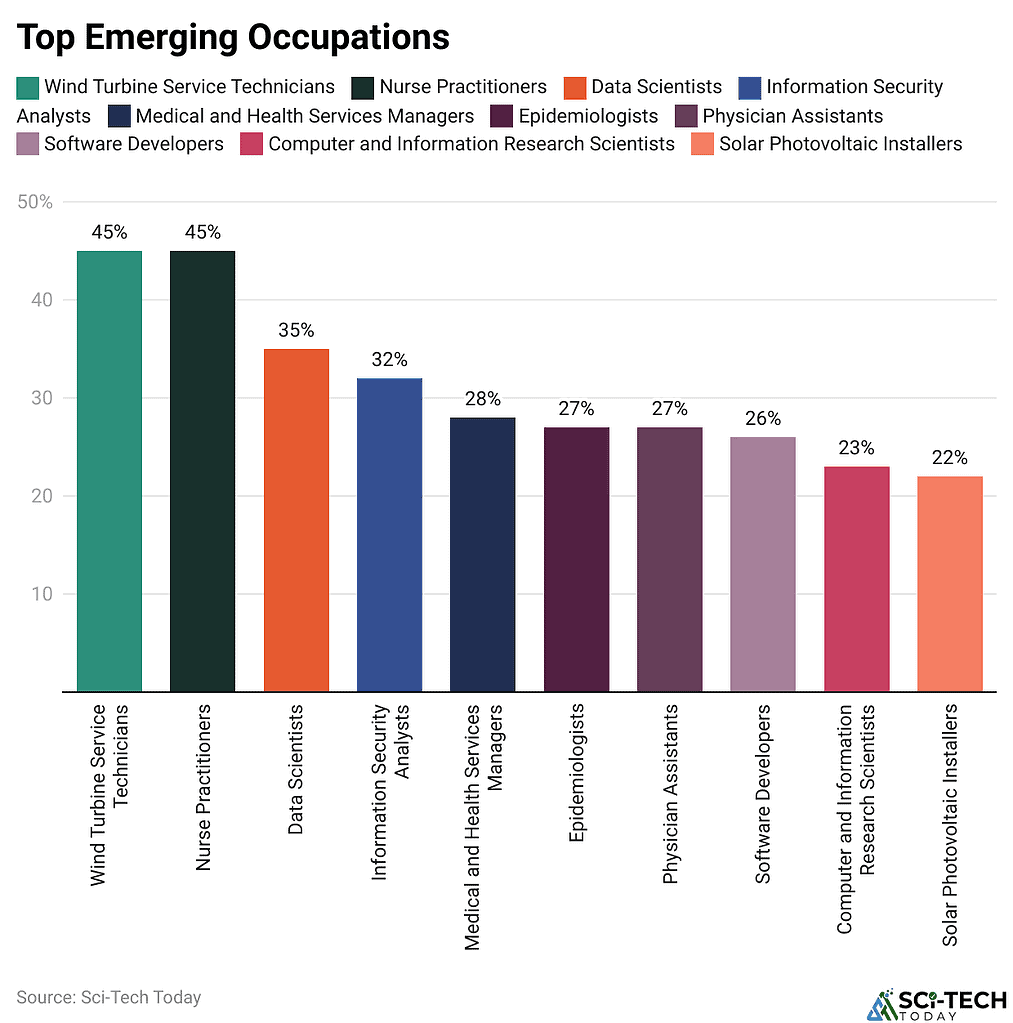
- Wind turbine service technicians are projected to earn a 45% wage premium over their current wages because of the significant shift toward renewable energy in the U.S. and the increasing emphasis on sustainable energy sources.
- With the same growth rate, nurse practitioners play an equally important role in bridging gaps in primary and specialty services in an ever-increasing healthcare industry.
- Data scientists are expected to grow by 35% because industries increasingly prefer data-driven decision-making.
- Information security analysts are projected to grow 32% as these professionals are in high demand in the fight against increasingly sophisticated cyber threats and are driving demand for robust security measures.
- Medical and health services managers are predicted to see demand rise by about 28% due to the ever-increasing number of healthcare facilities and the need to streamline healthcare provision.
- Epidemiologists are projected to grow by 27% as they are increasingly called upon in today’s global health arena by international health disasters such as the COVID-19 pandemic, which has highlighted the need for expertise in understanding and controlling disease patterns.
- Also projected to increase by 27% are physician assistants, who play an important role in expanding access to healthcare services by providing access to physicians and extending their medical services.
- Even with a consistent 26% growth rate over the last decade, software developers remain in high demand as firms continue to digitize and undergo digital transformations.
- Computer and information research scientists are also among the fastest-growing occupations, with about a 23% growth rate.
- Solar photovoltaic installers are projected to see a sharp rise of 22%, as they are more closely tied to the fast-growing solar branch of the energy sector, given overall renewable energy take-up around the globe
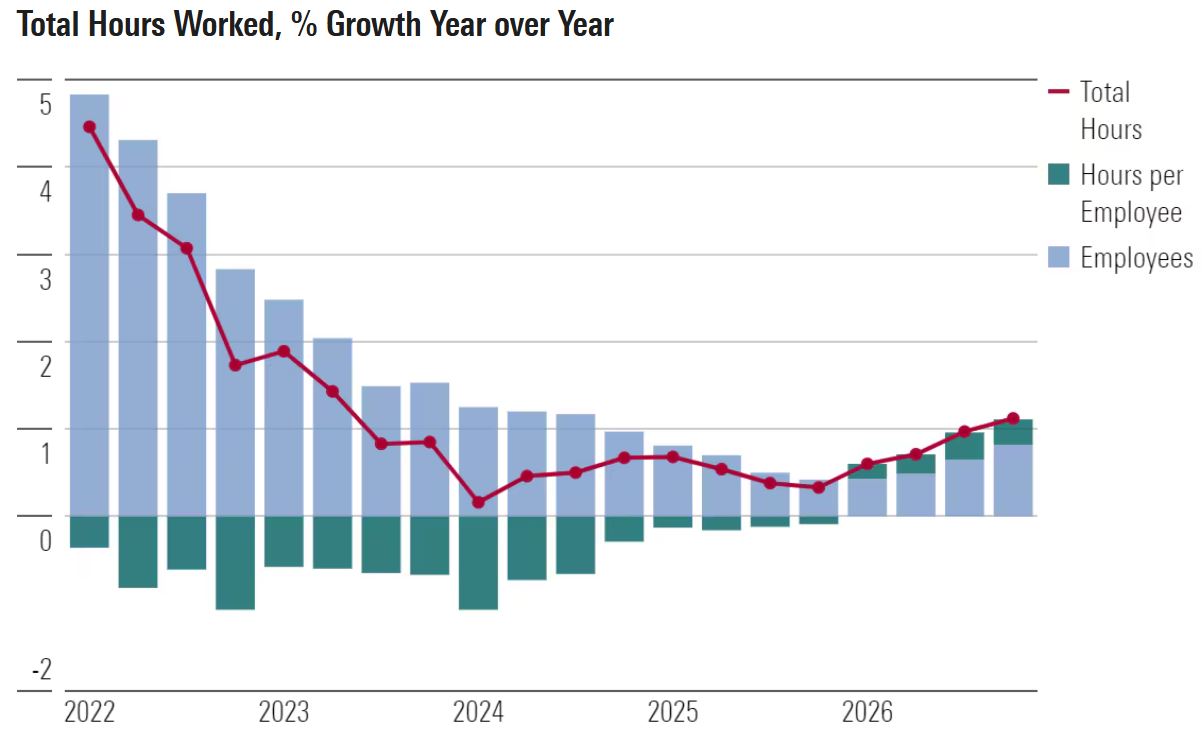
Annual Growth in Total Hours Worked
(Source: morningstar.com)
- Total global hours worked increased by approximately 0.8% from 2025 to 2026.
- While employment increased by 1.8% annually, average weekly hours per employee decreased by 1%. However, as they are already close to maximum reductions, it may be time for businesses to begin slowing the pace of hiring.
- A deeper slice of the organization will be added to controlling labor cost increases, as slower GDP growth is projected.
- Employment growth slowed to 0.5% year over year in the fourth quarter of 2024.
- The unemployment rate rose from 3.6% in 2023 to 4.4% in 2025, and is projected to reach 4.5% by the end of 2026.
Conclusion
Job growth shows how many new jobs are created in a country. It is important because it helps people earn money and improve their lives. Various sectors, such as technology, healthcare, and services, create many jobs.
However, a lack of skills and automation can reduce job chances. Good education and training help solve this problem. Overall, steady job growth supports a strong economy and better living standards for everyone in the long run.
FAQ
Strong job growth reflects a healthy economy by increasing employment, raising household income, supporting consumer spending, encouraging business investment, and generating higher tax revenues
In mature economies, creating around 100,000-150,000 jobs each month is generally enough to meet workforce growth.
Automation and AI reduce some routine jobs but also create new opportunities in technology, data, and maintenance, especially when supported by reskilling and investment.