









Initial Discussion
AI in Food Processing Statistics: The food industry is entering a smarter phase, and AI is playing a key role in that shift. Food processors are turning to AI to check product quality, reduce waste, improve safety, and keep production running smoothly. Instead of relying only on manual checks, companies can now use smart systems to detect defects, monitor equipment, and spot production issues early.
AI also helps manufacturers make sense of large amounts of data and respond quickly to changing demand. From inspecting raw ingredients to sorting, packaging, and managing supplies, AI is finding a place across the food processing industry. This shift is making food production more efficient, consistent, and technology-driven.
Top-Rated Pick
- The global AI in food processing market is valued at USD 13.2 billion in 2025 and is projected to reach USD 14.4 billion in 2026.
- Quality control and safety compliance accounted for 35.9%, while machine learning and deep learning accounted for 43.1%.
- North America led the AI market in food processing with a 45.5% share.
- Higher AI spending is the leading adoption indicator at 83%.
- Cost is the main barrier to adopting digital AI systems, cited by 69% of food-processing companies.
- Predictive maintenance can achieve 92% accuracy and reduce unplanned downtime by 40%.
- Continuous IoT monitoring can replace routine technician inspections, saving 10-15 labor hours weekly.
- AI-driven predictive analytics can help food plants achieve full ROI within 6-9 months after implementation.
- A food and beverage company earning USD 10 billion could create USD 810 million in AI value from selected operations.
- 34% of respondents expect AI and machine learning to have the greatest positive impact on food manufacturing.
- Rockwell Automation and Actemium achieved a 20% higher coefficient of performance through AI-based refrigeration optimization.
- Robot chefs can lower restaurant labor costs by 30%.
- The global AI in food and beverages market is expected to rise to USD 18.34 billion in 2026.
Global AI in Food Processing Market Insights
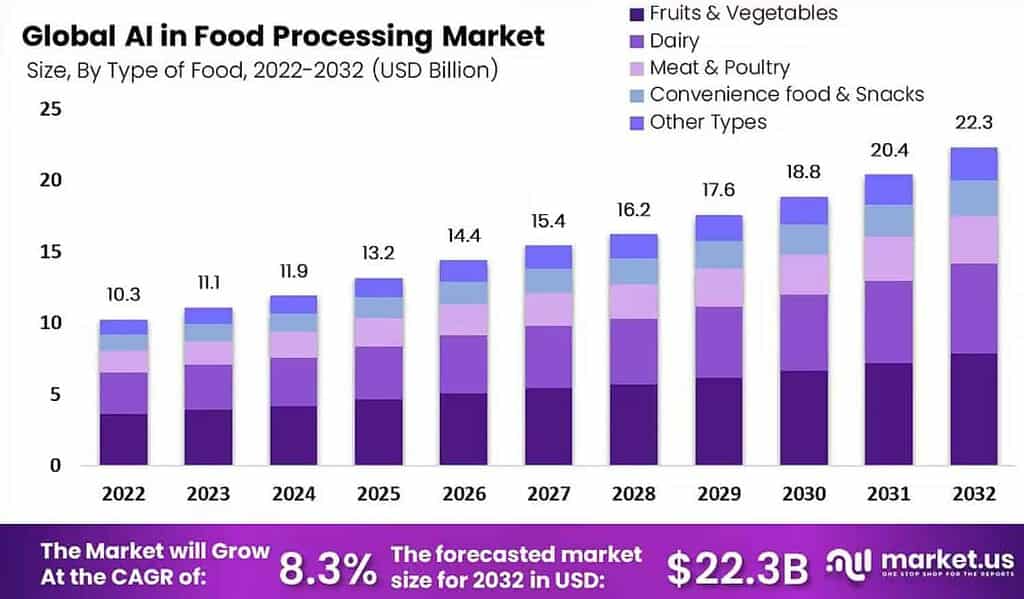
(Source: market.us)
- The global AI in food processing market is valued at USD 13.2 billion in 2025 and is projected to reach USD 14.4 billion in 2026.
- By 2032, the market size is forecast to reach USD 22.3 billion.
- As of 2026, convenience food and snacks led by food type, with a 33.5% share, according to Globe Market Research.
- Quality control and safety compliance accounted for 35.9%, while machine learning and deep learning accounted for 43.1%.
- Software accounted for 50.5%, cloud deployment for 59.9%, and food manufacturers for 63.8%.
Regional Share, 2025
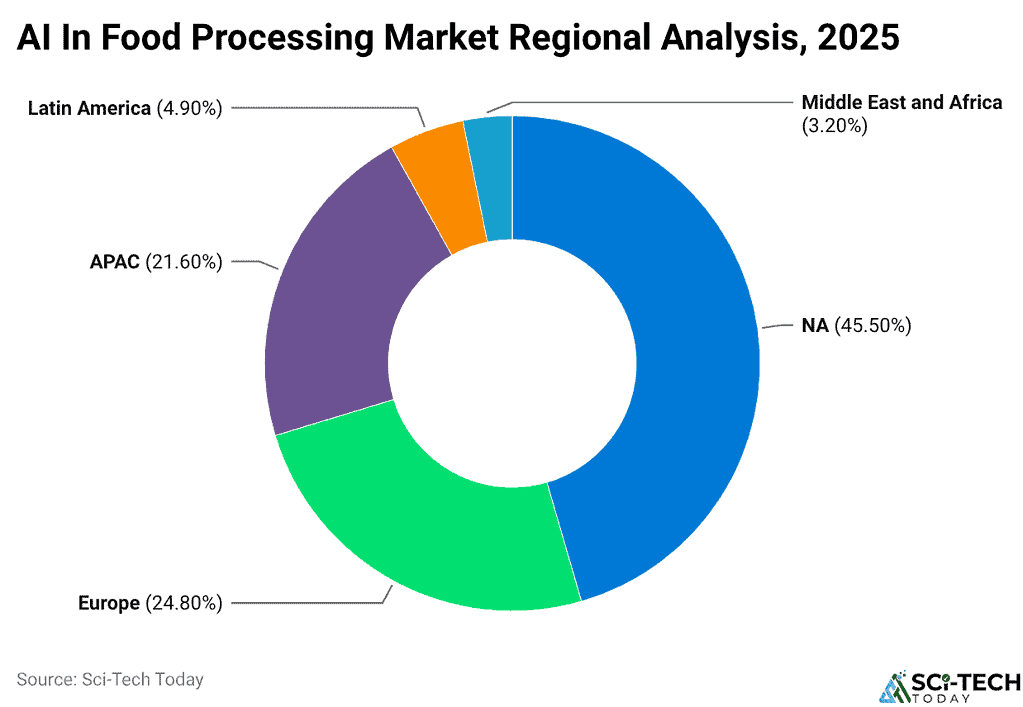
(Reference: globemarketresearch.com)
- North America led the AI market in food processing with a 45.5% share.
- Europe accounted for 24.8%, followed by Asia Pacific at 21.6%, reflecting significant adoption across these regions.
- Latin America accounted for 4.9%, while the Middle East and Africa had the smallest share at 3.2%.
Key AI Food Industry Trends and Regulatory Changes
- AI and clean-label transparency are increasingly working together to reshape the food industry in 2026.
- According to a report published by Journey Foods, 64% of Gen Z consumers actively look for clean-label products.
- 58% of global consumers value honesty and transparency when purchasing.
- AI fraud detection achieves 81%-100% accuracy across categories.
- The clean-label market is projected to grow at a 6.8% CAGR through 2028.
- FSMA 204 takes effect in January 2026.
- Red 3 reformulation deadlines are January 2027 for food and January 2028 for drugs.
- Six additional dyes are expected to be phased out before 2027.
AI Adoption Trends in Food Processing
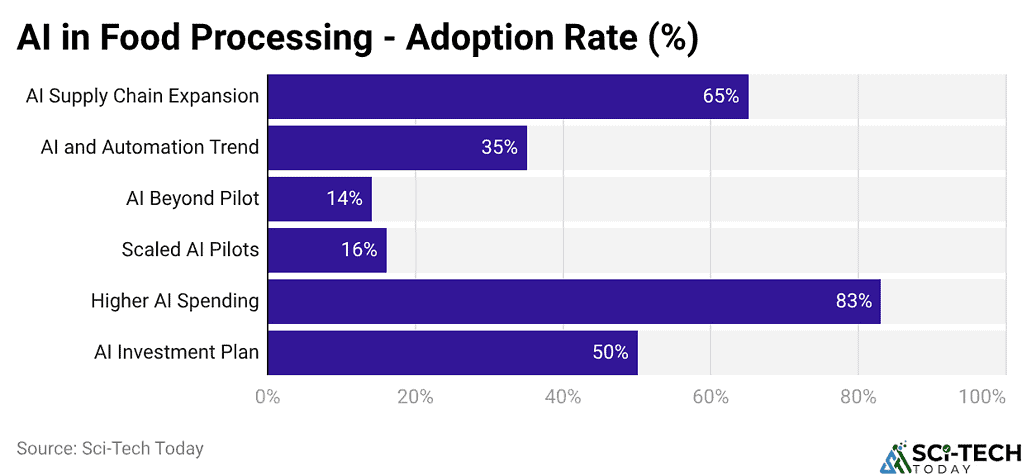
(Reference: globemarketresearch.com)
- Higher AI spending is the leading adoption indicator at 83%.
- AI supply chain expansion follows at 65%, while 50% of companies report plans to invest in AI solutions.
- AI and automation trends account for 35%, while scaled AI pilots and AI initiatives beyond the pilot stage account for 16% and 14%, respectively.
AI Adoption Barriers in Food Processing
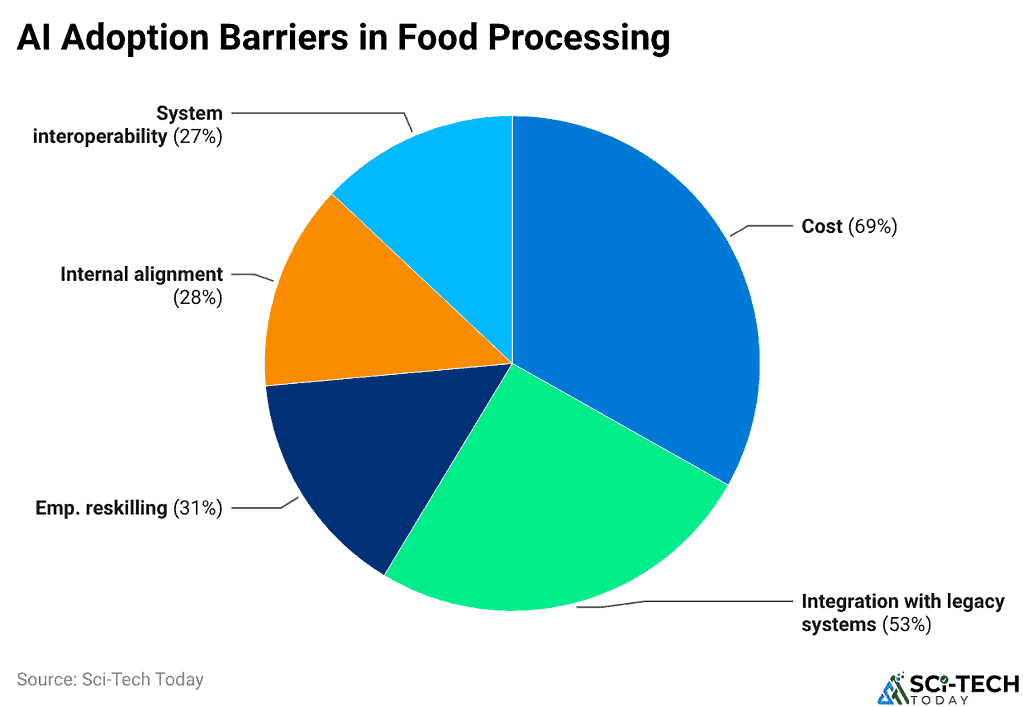
(Reference: globemarketresearch.com)
- Cost is the main barrier to adopting digital AI systems, cited by 69% of food-processing companies.
- Integration with legacy systems affects 53%, while employee reskilling remains a challenge for 31%.
- Internal alignment and system interoperability are further constraints, reported by 28% and 27% of respondents, respectively.
AI-Driven Process Optimization in Food Engineering
- AI is making food processing more efficient through real-time control, improved quality, and reduced energy consumption.
- AI models can predict extrusion quality with R² above 0.95.
- Optimized systems can also lower energy consumption by 20%.
- According to MDPI, predictive maintenance can achieve 92% accuracy and reduce unplanned downtime by 40%.
- AI-based spray drying can reach 96% prediction accuracy and reduce operating costs by 25%.
- AI can improve moisture uniformity in drum drying by 15% and reduce burn-on incidents by 50%.
- Precision fermentation can increase efficiency by 25% to 35%.
- Digital twins may cut R&D timelines from months to weeks.
AI in the Food and Beverages Market Trend
(Source: mordorintelligence.com)
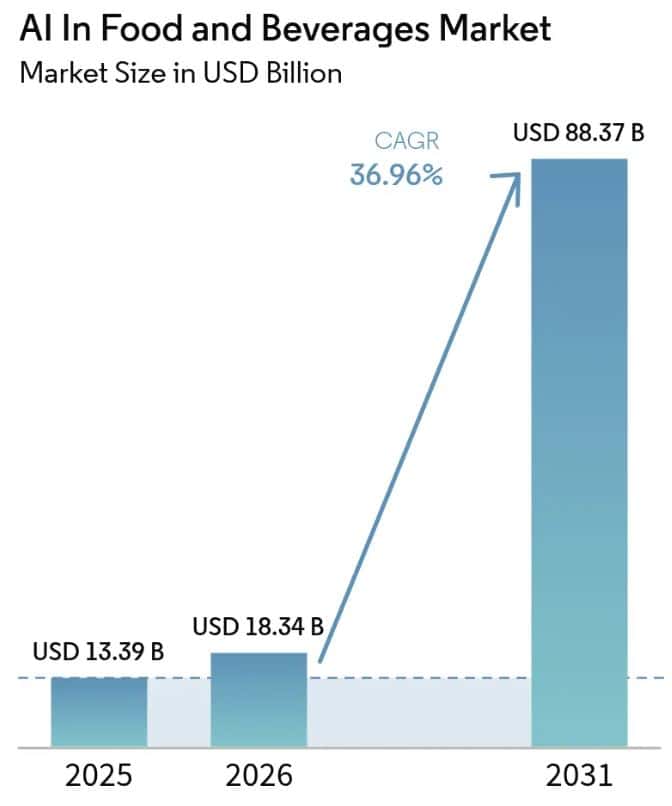
- The global AI in food and beverages market is valued at USD 13.39 billion in 2025 and is expected to rise to USD 18.34 billion in 2026.
- It is projected to expand strongly to USD 88.37 billion by 2031.
- This growth reflects a robust CAGR of 36.96% between 2026 and 2031.
Market Segmentation
| Segment | Leading Segment | Share, 2025 | Fastest-Growing Segment | CAGR(2025 to 2031) |
| Component | Software solutions | 47.35% | Services | 40.8% |
| Technology | Computer vision | 41.95% | Robotics and automation | 41.15% |
| Application | Food sorting and grading | 29.75% | Predictive maintenance | 41.05% |
| End User | Food-processing manufacturers | 37.10% | Quick-service and cloud kitchens | 38.95% |
| Geography | Asia Pacific | 33.70% | Asia Pacific | 40.25% |
AI Benefits in Food Manufacturing Operations
- iFactory AI reports that continuous IoT monitoring can replace routine technician inspections, saving 10-15 labor hours weekly.
- AI fault detection can spot anomalies 3-14 days before failure.
- It may also cut unexpected equipment breakdowns by 60%-80%.
- Automated work-order creation recovers over 5 hours per lead per week.
- Meanwhile, AI repair guidance can reduce mean time to repair by 35%.
- Digital compliance logging saves 20+ hours weekly.
- One-click audit tools save 80-100 hours per audit cycle.
- AI-guided onboarding can reduce employee time-to-competency by 50%.
ROI Benefits of AI Analytics in Food Processing
- AI-driven predictive analytics can help food plants achieve full ROI within 6-9 months after implementation.
- Unplanned downtime costs about USD 17,000-25,000 per hour, while predictive alerts can reduce incident costs by 70%-85%.
- Reactive maintenance can consume 20%-35% of labor hours through overtime and contractor work.
- AI-supported technicians can manage about 2 times more assets, increasing wrench time from 35%-45% to 65%-75%.
- FDA, USDA, and FSMA violations can lead to fines of USD 15,000 or even facility shutdowns.
- Predictive analytics can also reduce spare parts spending by 15% to 25% through better planning.
AI Use Cases in Food Processing, 2026
- Rockwell Automation and Actemium achieved a 20% higher coefficient of performance through AI-based refrigeration optimization.
- The solution also cut energy use by about 17%, with projected annual savings of approximately USD 130,000 per facility.
- TOMRA Food’s deep-learning systems detected 99%+ of citrus defects, improving quality and yield.
- AI inspection detected more than 97% of defects and foreign materials, while the system maintained a false-reject rate of just 1%.
- Business Wire reported that FPT’s AI program targets a 20% reduction in operating costs and 100% food-safety traceability.
- The rollout includes 6 initiatives delivered through a 2-phase roadmap.
- JBT Marel’s systems handle 75%+ of global citrus juice processing, supporting future AI adoption.
- Midera secured a 5-year, USD 1 billion credit agreement.
- It includes USD 750 million and USD 250 million revolving facilities.
AI Value Creation Across the Food Value Chain
(Source: appinventiv.com)
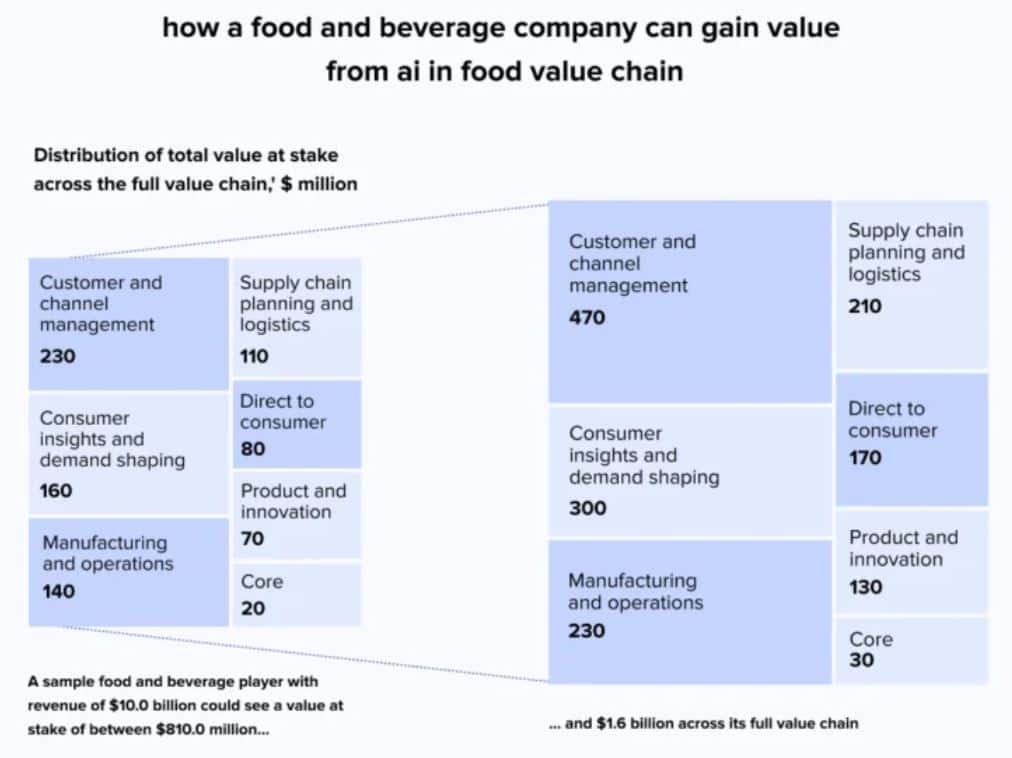
- A food and beverage company earning USD 10 billion could create USD 810 million in AI value from selected operations.
- Across its full value chain, the potential could reach USD 1.6 billion.
- Customer and channel management has the highest potential value at USD 470 million.
- Consumer insights and demand shaping follow with USD 300 million.
- Manufacturing and operations could contribute USD 230 million, while supply-chain planning and logistics may create USD 210 million in value.
- Direct-to-consumer activities, product innovation, and core functions represent USD 170 million, USD 130 million, and USD 30 million, respectively.
United States Food and Beverage AI Visibility Leaders, July 2026
(Source: globemarketresearch.com)
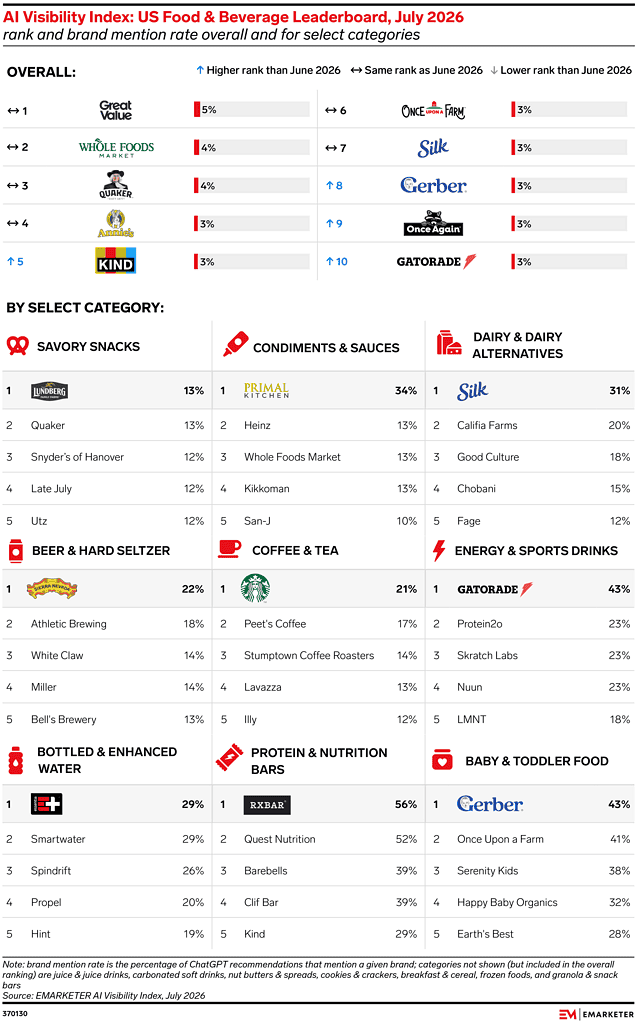
- Great Value ranked first overall with a 5% brand mention rate, followed by Whole Foods Market and Quaker at 4% each.
- KIND improved to fifth position, while Gerber, Once Again, and Gatorade moved up to ranks 8, 9, and 10, respectively; each recorded 3%.
- Primal Kitchen led condiments at 34%, while Silk reached 31% in dairy alternatives.
- Gatorade topped energy drinks at 43%, followed by RXBAR at 56% in protein bars and Gerber at 43% in baby food.
- Sierra Nevada led beer and hard seltzer at 22%, Starbucks led coffee and tea at 21%, and Essentia and Smartwater jointly led bottled water at 29%.
Most Impactful Technologies in Food Manufacturing
(Reference: foodindustryexecutive.com)
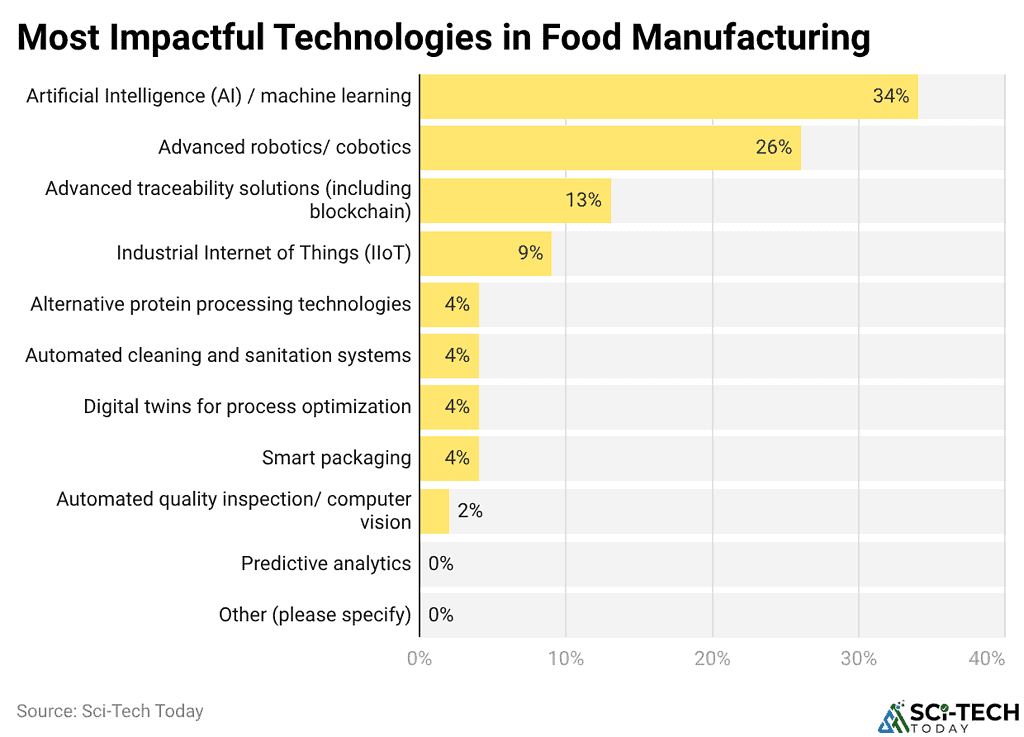
- According to 34% of respondents, Artificial Intelligence and machine learning will have the most positive impact on food manufacturing over the next three years.
- Advanced robotics and collaborative robots (cobots) rank second, cited by 26% of respondents.
- 13% consider advanced traceability solutions, such as blockchain.
- The Industrial Internet of Things follows closely, with 9% rating it as most impactful.
- Alternative proteins, automated sanitation, digital twins, and smart packaging each received 4% of selections.
- Automated quality inspection and computer vision account for 2%.
AI’s Growing Impact on Food Industry Operations
- Wifitalents reported that 40% of food plants use AI for quality control, while predictive maintenance cuts downtime by 15%.
- 25% of large farms use AI soil analysis, and machine learning predicts harvest times with 90% precision.
- Computer vision detects 99% of foreign bodies, while egg-crack inspection reaches 99.7% accuracy.
- AI sensors reduce energy use by 18%, while thermal imaging detects bacterial contamination with 95% accuracy.
- AI cameras can monitor 100% of production lines, compared to 1% manual sampling.
- Acoustic sensors detect 88% of bearing failures, while vibration AI prevents 90% of motor failures.
- AI wheat grading achieves 98% consistency, compared with 80% for humans.
- Optical sorting cuts nut-processing labor by 50%, while smart ovens reduce cafeteria waste by 10%.
- AI moisture control can save USD 200K per plant annually.
Robotics and Automation Trends
- Robot chefs can lower restaurant labor costs by 30%.
- Automated kiosks can also increase average order value by 15% to 20%.
- Food-packaging cobots are growing 22% annually, while delivery drones could handle 10% of last-mile deliveries by 2030.
- Warehouse robots can reduce picking errors by 60%, and robotic harvesting can increase fruit yields by 10%.
- Autonomous burger robots can make 200 burgers per hour, while poultry robots can increase speed by 15%.
- AGVs can improve warehouse efficiency by 40%, while smart packing robots can increase throughput by 25%.
- AI robots can reduce bakery injuries by 25%, herbicide use by 90%, and dough-mixer electricity use by 12%.
- Robotic fruit pickers can work 3 times faster, while robotic baristas can serve 100 cups per hour.
Final Thoughts
AI is changing the way food is processed by helping businesses work faster and reduce waste. It can check food quality, spot equipment issues, improve production, and support better decisions. While using AI requires good data, skilled workers, and the right technology, its benefits are clear.
As technology advances, more food companies are likely to use AI to improve food safety, reduce costs, and build a more efficient and sustainable food processing industry.
FAQ
Voice AI can quickly handle complaints, understand customer concerns, and route issues to the right teams.
AI helps food processors predict demand, monitor suppliers, automate communication, manage inventory, and quickly address supply chain disruptions.
AI detects defects, monitors batches, and tracks products from processing to delivery.