








Opening
AI In Recruitment Statistics: Artificial intelligence is becoming an essential part of recruitment, helping employers create job descriptions, screen resumes, schedule interviews, assess skills, and match candidates with suitable roles. Organizations are increasingly using AI to reduce repetitive work, improve hiring efficiency, and support recruiters throughout the talent-acquisition process.
AI adoption is also responding to rising hiring volumes; applications per job increased from 28 in 2021 to 95 in 2025. In 2026, AI can also reduce repetitive work and improve structured screening; human oversight remains essential.
In this article, you will find how AI is impacting the recruitment market and how recruiters and employees are moving forward with this in 2026.
Important Facts Selected by the Editor
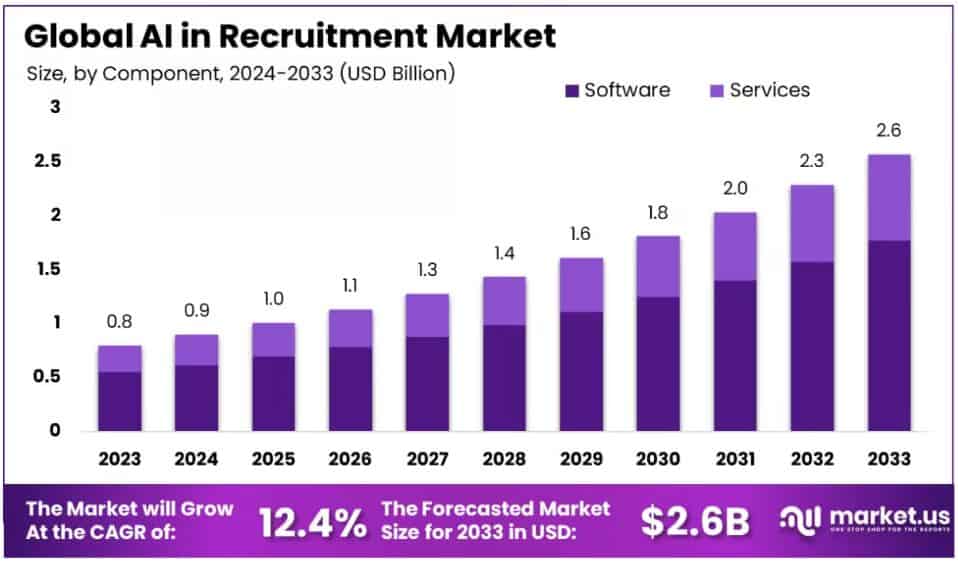
- Global AI in the recruitment market is projected to grow from USD 0.9 billion in 2024 to USD 2.6 billion by 2033, a 12.4% CAGR.
- 99% of surveyed respondents said they use AI in some part of the hiring process, and 98% reported major efficiency improvements.
- AI recruitment tools can reduce cost per hire by as much as 30%.
- Recruitment teams using generative AI can save around 20% of a standard workweek.
- AI-powered payroll systems already cut payroll-processing time by 70% and are expected to reduce payroll errors by 90% by the end of 2026.
- 66% of US adults said they would not apply for a job if AI were used to make hiring decisions.
- Almost 90% of job seekers want employers to be transparent about their use of AI in hiring.
Global AI in Recruitment Market Growth
(Source: market.us)
- The global AI in recruitment market is projected to grow at a compound annual growth rate of 12.4% between 2024 and 2033.
- The market was valued at USD 0.9 billion in 2024 and is expected to reach USD 1.0 billion in 2025.
- By 2031, the global AI in recruitment market is forecast to reach USD 2.0 billion.
- The market is expected to grow further to USD 2.3 billion in 2032 and USD 2.6 billion by 2033.
AI’s Role in Recruitment and Retention
- Between 35% and 45% of organizations have adopted AI in their hiring processes.
- Around 38% of HR leaders have explored or implemented AI tools to improve efficiency in their organizations.
- AI helps recruiters manage large applicant pools by screening candidates, identifying people whose skills match open roles, and supporting more personalized candidate communication.
- AI recruitment tools can reduce the cost per hire by as much as 30%, allowing recruiters to spend more time building relationships with shortlisted candidates.
- About 85% of employers using automation or AI say these tools save time and improve efficiency.
- Among recruiters who use AI, 86.1% say it speeds up the hiring process.
- AI can support fairer hiring decisions by assessing candidates based on skills rather than personal characteristics that may lead to human bias.
AI Candidate Screening Time per Job
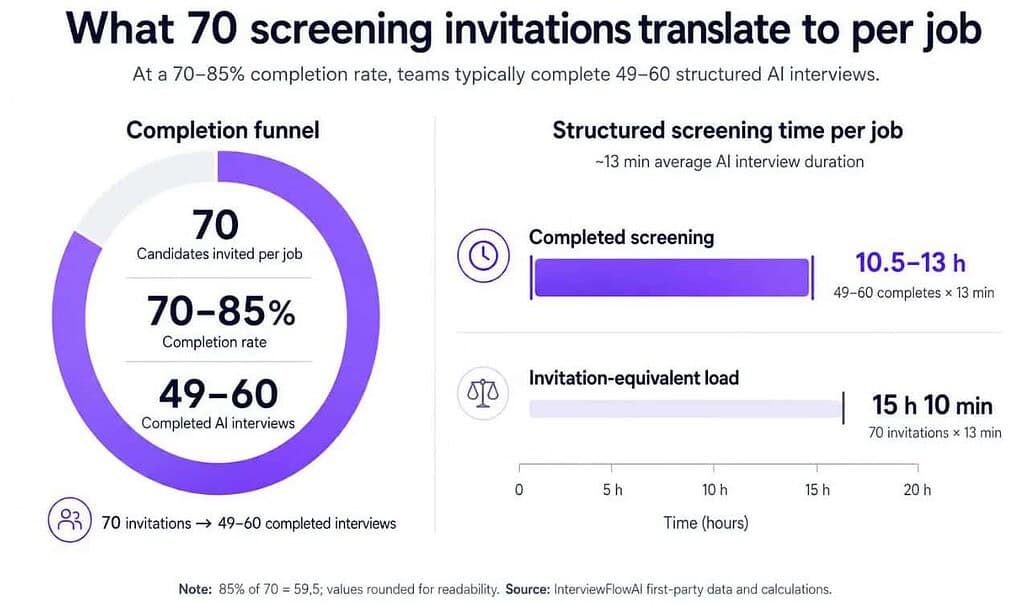
- According to InterviewFlowAI’s screening invitations to 70 candidates, with a typical completion rate of 70% to 85%, around 49 to 60 candidates are expected to complete the AI interview.
- The average AI interview takes about 13 minutes per candidate.
- Completing 49 to 60 AI interviews requires approximately 10.5 to 13 hours of structured screening time per job.
- If all 70 invited candidates were included in the calculation, the total invitation-equivalent screening workload would be about 15 hours and 10 minutes.
- At an 85% completion rate, 70 invitations would result in about 59.5 completed interviews, rounded to approximately 60 interviews.
(Source: interviewflowai.com)
How AI Increases Recruiter Capacity
- AI helps recruitment teams create faster and more organized hiring workflows.
- 89% of organizations use AI in recruitment to save time and improve efficiency.
- 36% of organizations use AI recruitment tools to reduce hiring costs.
- 24% of organizations use AI to identify top candidates more effectively.
- Recruitment teams using generative AI can save around 20% of a standard workweek.
- Among organizations that are using or testing generative AI, 73% expect it to change their hiring processes.
AI in Hiring: Key Survey Findings
- 99% of surveyed respondents said they use AI in some part of the hiring process.
- 98% of respondents reported major improvements in hiring efficiency from using AI for tasks such as interview scheduling, résumé screening, and skills assessment.
- 93% of hiring managers said human involvement remains important in the hiring process, even with widespread AI adoption.
- 74% of respondents believe AI can support recruiters and hiring managers by assessing how well an applicant’s skills fit a role.
- 88% of respondents said they can identify when candidates use AI to prepare applications, cover letters, or resumes.
- 54% of hiring managers said they would care if applicants used AI to create or improve their application materials.
AI in Payroll, Compensation, and Benefits
- AI-powered payroll systems already reduce payroll-processing time by 70% and are expected to reduce payroll errors by 90% by the end of 2026.
- AI-driven compensation models can improve pay equity by 30%.
- Salary-benchmarking tools are expected to improve pay competitiveness by 25% in 2026.
- Around 60% of employees are expected to use salary-benchmarking tools, while compensation tools could reduce pay gaps by 30%.
- AI-based benefit personalization can increase employee satisfaction by 40%.
- Predictive analytics can improve employee use of benefits by 22%.
- AI can automate up to 90% of benefits-administration tasks.
- By 2026, 70% of organizations are expected to personalize employee benefits using AI.
Job Seeker Views on AI in Recruitment
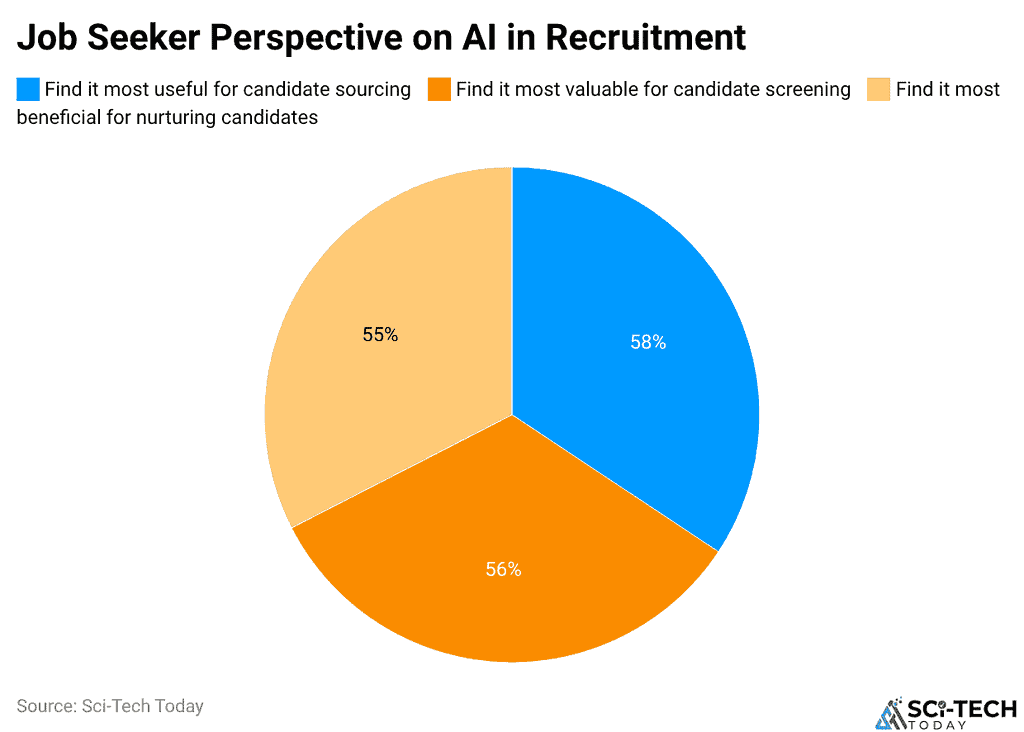
- 66% of U.S. adults said they would not apply for a job if AI were used to make hiring decisions.
- 79% of candidates said employers should tell them when AI is used in the recruitment process.
- 70% of job seekers believe AI can improve response times and create a better candidate experience.
- 75% of candidates said they prefer AI-driven recruitment tools when the tools provide faster feedback and a more personalized experience.
- 44% of job seekers said they have faced discrimination during recruitment and believe AI tools could help reduce this bias.
- 67% of job seekers said they feel uncomfortable when employers use AI to review résumés and make hiring decisions.
- Almost 90% of job seekers want employers to be transparent about their use of AI in hiring.
(Reference: resourcera.com)
Chatbots and Candidate Experience Statistics
- In 2024, 20% of audited large employers used intelligent chatbots on their career websites.
- In 2024, 29% of employers used AI personalization to improve the candidate experience.
- As of June 2025, 87% of Fortune 500 companies were not using AI to create highly personalized career websites.
- AI-powered job recommendations on career sites can increase application-conversion rates by 10% to 20%.
- Automated question-and-answer tools can handle 30% to 50% of common recruiter questions, reducing the number of routine inquiries reaching recruiter inboxes.
| AI recruitment trend | Statistic |
| Chatbots on career sites | 20% |
| AI personalization | 29% |
| Fortune 500 without personalized AI sites | 87% |
| Application conversion increase | 10% to 20% |
| FAQs handled automatically | 30% to 50% |
AI Recruitment Rules and Risks Stats
- The EU AI Act classifies AI systems used for employment and worker management as high-risk.
- In 2024, the UK Information Commissioner’s Office issued 296 recommendations and 14 advisory notes to audited AI HR tool providers.
- The U.S. Equal Employment Opportunity Commission published technical-assistance documents on AI and employment between 2022 and 2023 and released updated guidance in April 2026.
- In June 2026, a federal judge in the US dismissed a proposed class-action lawsuit that alleged Workday’s AI screening tools discriminated based on race, age, and disability.
- Workday stated that more than 1.1 billion rejected job applications were processed through the challenged tools.
- The EU AI Act introduces complaint rights and lifecycle conformity assessments for high-risk AI systems.
- The Federal Trade Commission and academics have warned employers against using unproven emotion-detection tools in interviews.
- In December 2025, New York City’s comptroller found that Local Law 144 bias-audit enforcement was ineffective; 75% of test calls reported violations, 15 potential violations were identified, and the city regulator found only 1.
- In February 2026, Illinois strengthened its AI Video Interview Act by replacing implied consent with explicit written consent and requiring 5 business days’ notice before an AI-analyzed interview.
Recent AI in Recruitment Developments
- On February 24, 2026, AI recruitment startup HireBound raised USD 2 million in seed funding led by Kalaari Capital to develop its product and support international expansion over the next 12–24 months.
- On April 28, 2026, AI-powered recruiting startup Dex announced a USD 5.3 million seed round, bringing its total funding to USD 8.4 million; the company had reached an annualized revenue run rate of about USD 1.8 million.
- On September 15, 2026, Eightfold AI’s AI Interviewer was named 1 of 14 Top HR Products of 2026; the platform uses data from 1.6 billion career trajectories and 1.6 million skills.
- On September 16, 2026, Amazon Web Services made Amazon Connect Talent generally available, offering AI-led voice interviews, candidate assessments and scoring while supporting the simultaneous evaluation of hundreds of candidates.
- On September 22, 2026, recruitment technology company Spott raised USD 21 million in Series A funding, bringing its total funding to USD 24.2 million and supporting plans to expand its workforce from 44 to more than 60 employees.
- On September 22, 2026, Pete & Gabi launched instant access to Rebecca AI, its autonomous candidate-screening platform, with a free trial offering 5 interview credits and a Scout plan providing 30 interviews for USD 199 per month.
- On September 23, 2026, Paychex launched WISE Hire, an AI-native recruiting solution that can help businesses find and hire qualified candidates 4 times faster on average.
- On September 24, 2026, Velric launched an AI-based hiring platform that uses role-specific work simulations and a standardized candidate score to help employers evaluate applicants beyond their resumes.
Closing
AI is now part of recruitment at every stage, from screening resumes and running interviews to handling payroll and pay decisions. Companies say it helps them hire faster, spend less, and work more efficiently. Job seekers want to know when AI is being used and are still unsure about letting it make hiring decisions alone.
Regulators in the EU, UK, US, and Illinois are adding stricter rules for AI hiring tools. As more companies adopt AI and more money flows into AI recruitment startups, human judgment still plays a key role alongside AI-based screening and evaluation.
FAQ
AI in recruitment refers to the use of machine learning, natural language processing, and automation to help companies source candidates, screen resumes, conduct initial interviews, and make hiring decisions faster and with less manual effort.
AI resume screening tools scan applications for keywords, skills, experience, and qualifications that match a job description, then rank or shortlist candidates so recruiters can focus their time on the strongest applicants.
Yes, some companies use AI-powered video or chatbot interviews that ask candidates standard questions and analyze responses, speech patterns, or facial expressions, though these are often used alongside human interviewers rather than replacing them entirely.
AI has the potential to reduce human bias by focusing on skills and qualifications rather than personal characteristics, but poorly trained models can also inherit bias from historical hiring data, making fairness audits and diverse training data essential.
Key risks include algorithmic bias, lack of transparency in how decisions are made, over reliance on automated screening that may filter out qualified candidates, data privacy concerns, and legal or regulatory compliance issues.
AI can automate onboarding tasks such as paperwork processing, training schedules, answering new hire questions through chatbots, and personalizing onboarding content based on a new employee’s role and background.