








Introduction
Venmo Vs. Cash App Statistics: Venmo and Cash App are two of the most used money-sending apps on phones, but they’re growing at different rates and attracting different users. Venmo is primarily for social payments between friends, while Cash App adds features like a debit card, investing, direct deposit, and transfers.
This article covered comparison between the two application gathering several current data points, and information from different insights that examines how people use Venmo and Cash App, including who uses them, how they pay, the fees they face, and the features they choose, and shows which app leads for daily payments and helps them choose a better option based on their needs and criteria.
Editor’s Choice
- In 2025, Cash App revenue totalled USD 10.8 billion, and Venmo reported USD 4.3 billion, as tools and debit card use grew.
- Cash App is the strongest overall with Gen Z: 45% of users are 18 to 29, while Venmo attracts millennials, who make up 54% of its active users.
- In 2025, Venmo had more than 3.8 million Business Profiles, up 22% year over year, and CahApp secured a larger Business user base of around 5.3 million active accounts.
- Venmo and Cash App both offer free standard transfers, usually taking 1-3 days.
- Venmo users can send USD 299.99 before ID checks, while verified Cash App users send about USD 7,500 over a rolling 7-day period.
- Cash App secured more than 420 million lifetime downloads globally and added 14 million new installs in 2025, while Venmo has about 380 million lifetime downloads and 11 million installs in the first half of 2025.
- Usage depth is higher on Cash App, with an average session time of 6.7 minutes, as compared to Venmo with 4.9 minutes.
- Venmo debit-card satisfaction is 87%, while Cash App’s debit card satisfaction is 91%.
- Both Venmo and Cash App encrypt user financial data and support multi-factor authentication for stronger account protection.
Key Features
| App | Features |
| Venmo | Venmo includes a social feed where users can share payments with friends. It offers a Venmo Debit Card for ATM cash, online shopping, and in-store purchases. Users can pay or request money quickly using a phone number or username. Venmo also supports crypto trading (e.g., Bitcoin) inside the app. For safety, it uses encryption, PIN or fingerprint login, plus privacy controls to manage who can see transaction activity. |
| Cash App | Cash App provides a Cash Card for ATM withdrawals and everyday purchases. It supports direct deposit, so paychecks can go straight into the app. Users can split bills and collect money from friends. Cash App also allows investing in stocks and Bitcoin. Security includes two-factor authentication, real-time fraud monitoring, encrypted payments, and alerts when suspicious activity is detected. |
Venmo Vs. Cash App Statistics By Financial Insights
- According to coinlaw.io, in 2025, Cash App revenue totalled USD 10.8 billion, and Venmo reported USD 4.3 billion, as tools and debit card use grew.
- In the same period, Cash App’s profit reached around USD 3.5 billion, increased by 16% from last year, and Venmo’s profit increased by 12% from 2024 to 2025.
- Venmo earned USD 0.92 per user monthly from financial products and merchant payments.
- Cash App subscriptions bring over USD 1.2 billion yearly, and Venmo merchant fees hit USD 700 million in 2025, up 11%.
- Meanwhile, Cash App for Business added USD 900 million.
- Meanwhile, Venmo is nearly 16% of its revenue mix.
By Transaction Volume and Frequency
- In 2025, Venmo’s payment volume increased to USD 325 billion and has continued to grow since then.
- Cash App processed USD 248 billion in transactions, driven by business flows and Bitcoin use.
- Venmo users average 6.5 payments a month, while Cash App users average 8.1.
- Venmo Business Profiles moved over USD 42 billion, and Cash App’s recurring payments now run above USD 4.1 billion a year.
- Together, instant-transfer fees brought in more than USD 500 million.
- Venmo’s bank transfers are complete within 30 minutes.
- Cash App Instant Deposit earns 95% satisfaction ratings, and 80% of its payments complete within 5 seconds.
Venmo Vs. Cash App User Statistics
- As of 2025, Cash App is the strongest overall with Gen Z: 45% of users are 18 to 29.
- Venmo attracted millennials, who make up 54% of its active users.
- Cash App reaches diverse communities, with African American and Hispanic users at over 48%.
- Venmo’s gender mix is even, with 51% female and 49% male.
- Cash App leans toward lower income, with 39% earning under USD 50,000/year.
- Students make up over 14% of Venmo users.
- Cash App was used in Southern and Midwestern states, with 21 million users.
- Venmo is strongest in coastal cities like San Francisco, New York, and Boston.
- Users over 40 make up 28% of Venmo users, and Cash App has 7 million teens.
By Monthly Analysis
- According to Q4 Capital, in Q3 2025, Venmo reached nearly 66 million monthly active accounts, up 7% year over year.
- At the same time, Block reported Cash App had 58 million monthly transacting active users.
Venmo Vs. Cash App Comparison – Business Adoption And
Acceptance
Venmo:
- In 2025, Venmo had more than 3.8 million Business Profiles, up 22% year over year.
- The merchant QR codes are accepted at 1.1 million retail stores across the U.S.
- Pricing remained competitive at 1.9% + USD 0.10 per transaction.
- Venmo Checkout works with 60+ major brands, including Uber, Amazon, and Chipotle.
- It also reported 17% YoY growth in food-and-beverage payments, led by quick-service outlets.
Cash App:
- CahApp secured a larger Business user base of around 5.3 million active accounts, powered by creators, small vendors, social sellers, and freelancers.
- About 34% of small-business sellers use it as their main tool.
- Cash App Pay integrates with Square POS for a smooth checkout experience at 2.2 million SMB locations.
- Partnerships with Shopify and Etsy contribute 13% of monthly business transaction volume.
- Its invoicing tool supports 400K+ freelancers, mainly in design and creative work.
Product Analysis
- Venmo expanded crypto trading to four major coins, including Ethereum and Litecoin.
- Its debit card cashback program has 3.5 million active users.
- Teen Accounts reached 1.9 million sign-ups, with parental controls and budgeting.
- 5 million households used split rent and recurring requests.
- Cash App lets users buy stocks of USD 1, and it had over 12 million active users in 2025.
- Cash App Taxes logged 6 million filings in 2025, up by 30% from last year.
- Meanwhile, 16 million users now receive paychecks with early access.
- Cash App Card works with Apple Pay and Google Wallet.
- Boosts stay strong, with 40% of users redeeming at least one offer each month.
Social Engagement
- Venmo’s social feed accounted for 65% of users who were active weekly, and 70% of payments included emoji notes, as mentioned in a report shared by sqmagazine.co.uk.
- In 2025, Venmo Groups reached 5 million households, while its charity tool raised USD 9.7 million in donations.
- Venmo’s social-payments approach delivered a 25% higher conversion rate.
- Cash App increased its growth rate on Fridays, attracting over 1.4 million users each week.
- Live-event tipping increased by 28% YoY, and under-25s shared referral codes 3 times as often as over-40s users.
Fee Structure Comparison
- Standard bank transfer: According to Cash Prior, Venmo and Cash App both offer free standard transfers, which usually take 1-3 days.
- Instant transfer: Venmo charges 1.75% with a minimum of USD 0.25 and a maximum of USD 25, while Cash App typically charges 0.5%-1.75% depending on the transfer.
- Credit card payments: Both apps charge a 3% fee.
- Business transactions: Venmo charges 1.9% + USD 0.10 per goods-and-services payment, while Cash App charges 2.75%.
- ATM withdrawals: Venmo is free at MoneyPass locations; otherwise, it costs USD 2.50; Cash App charges USD 2.50, but it can be free with a USD 300+ direct deposit.
Payment Limits
| Venmo | Cash App |
| Before ID checks, the total sending limit is USD 299.99 until verification is complete. After verification, users can usually send up to USD 4,999 per rolling 7-day window. Payments for goods/services are capped at USD 2,999.99 per transaction. Instant bank transfers incur a fee, capped at USD 25 per transfer. | Verified users can typically send about USD 7,500 per rolling 7-day window. Direct-deposit users may receive more, often up to USD 300,000 per year.ATM withdrawals are often about USD 1,000 per day, and cards spend about USD 2,000 per day. |
Mobile App Downloads And Engagement
- A report published by sqmagazine.co.uk found that Cash App secured more than 420 million lifetime downloads globally and added 14 million new installs in 2025, while Venmo has about 380 million lifetime downloads and 11 million installs in the first half of 2025.
- Usage remained higher on Cash App, with an average session time of 6.7 minutes, as compared to Venmo with 4.9 minutes.
- Cash App retains about 68% of users for 30 days, outpacing Venmo’s 62%.
- Engagement with Venmo remains strong, with around 65% of users active weekly in 2025.
- Cash App’s Cash Card usage increased by 34% from last year, and it ranks as one of the top 10 free Finance apps on both iOS and Android.
- Overall, app downloads are projected to reach 299 billion globally in 2025.
User Satisfaction
- Venmo rates 4.6/5 from 1.8 million reviews (2025); debit-card satisfaction reached 87%, and 68% of users reported trusting its security features.
- Venmo for Business has a 7.7/10 score and 92% positive sentiment.
- Cash App debit card satisfaction is 91%, and it closes about 94% of support cases within 72 hours.
- Both are easy to use, but complaints cite slow support and fraud.
Security Features
| Venmo | CashApp |
| On Venmo, a user’s financial data is encrypted, and multi-factor authentication can add extra protection. They can also enable PIN or fingerprint login. However, because Venmo has a social feed, some users may reveal more than they expect if they forget to set payments to private. | On Cash App, data is also encrypted and protected with multi-factor authentication. If a Cash Card is lost or stolen, the user can turn it off in the app. It also supports app lock with a PIN or fingerprint, helping prevent unauthorised access to funds. |
U.S. Footprint And Adoption – Venmo Vs.Cash App
- Texas and California together accounted for about 15% of Cash App’s U.S. users in 2025, making them the largest combined user base.
- Florida contributes about 10%, while New York adds about 9% of users.
- Moreover, Georgia, Illinois, and New Jersey are around 5%-7% each, and Pennsylvania, Michigan, and Ohio are around 3%-4% each.
- In California, New York, and Texas, Venmo accounted for 37% of market share, but fewer than 60% of small U.S. businesses accept digital wallets today.
- Despite limited merchant acceptance, around 70% of U.S. adults used mobile payments in 2025.
Methods of Transferring Cash Between Venmo And CashApp
Method 1:
- Use a bank account in the middle.
- The user sends money from one app to their linked bank account, then adds it to the other app from the bank.
- This usually takes 1-3 business days, unless an instant-transfer fee is paid.
Method 2:
- Pay a self-request.
- In the receiving app, the user creates a payment request for themselves; then, in the other app, they pay that request using a linked card or bank account.
- This works best when each app is set up with a different email or phone number.
Method 3:
- In-person transfer.
- If moving funds between their Cash App and another person’s Venmo (or the reverse).
- The sender pays the recipient in the chosen app, and the recipient receives it there.
Venmo Business Impacts
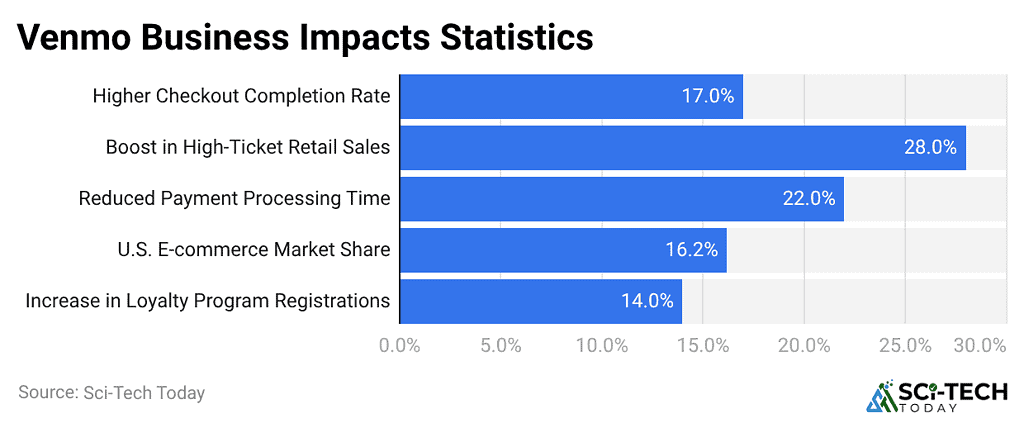
(Reference: coinlaw.io)
- From the above graph, Venmo accounted for 28% lift in high-ticket retail sales, a 22% reduction in payment processing time, and a 17.0% increase in checkout completion rate.
- It also reported around 16.2% U.S. e-commerce market share and a 14% increase in loyalty program registrations.
Consumer Spending On CashApp
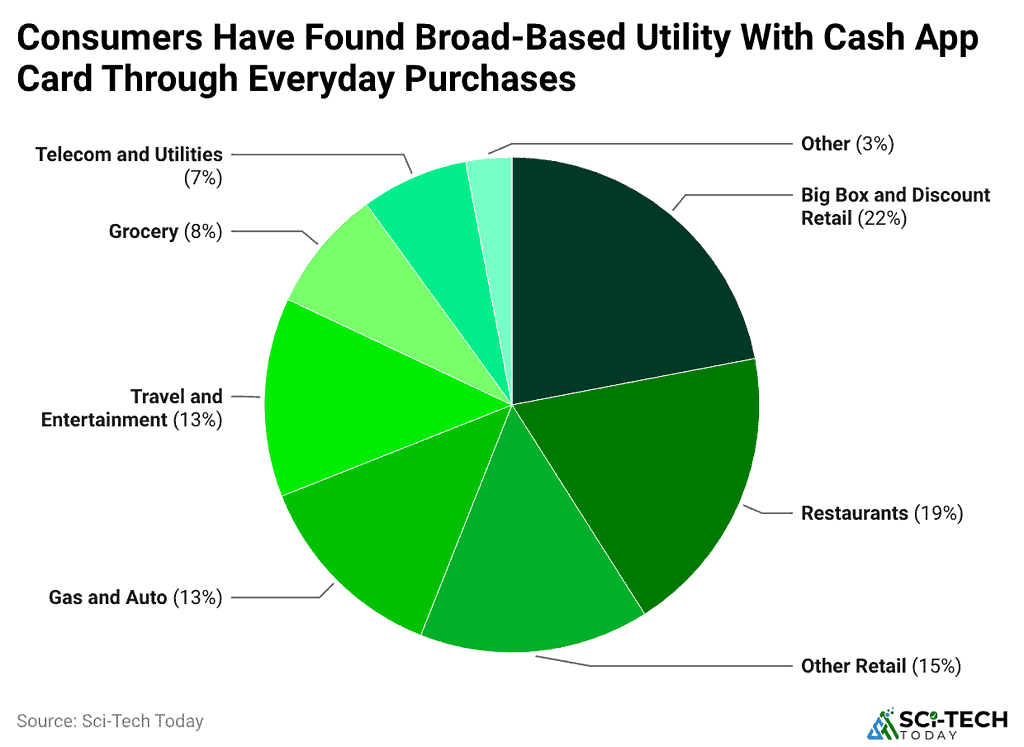
(Reference: sqmagazine.co.uk)
- Cash App Card spending has spread across Big Box & Discount Retail (22%), Restaurants (19%), and Other Retail (15%).
- Besides, the other spending share of the application includes Travel & Entertainment (13%, Gas & Auto (13%). Grocery (8%), Telecom & Utilities (7%), and Other (3%).
Pros And Cons of Venmo Vs. Cash App
| Platforms | Pros | Cons |
| Venmo | Interactive social feed creates engagement. Easy payment splitting for group expenses.Backed by PayPal’s established infrastructure.Strong merchant acceptance. Cryptocurrency trading options.User-friendly interface with social elements. | 3% fee for credit card transactions.Higher instant transfer fee (1.75%).Potential privacy concerns with the public transaction feed.Limited customer support options (no phone support).Fewer additional financial services than Cash App. |
| CashApp | Clean, function-focused interface.Comprehensive financial ecosystem (banking, investing, Bitcoin).Cash Card for direct spending from account balance.Lower instant transfer fee (1.5%).Stock and Bitcoin investment capabilities.Tax filing service integration. | Limited social features.Fewer cashback rewards compared to some competitors. Not everyone needs or wants investment features. Available only in the U.S. and UK. |
Conclusion
After completing the article, it is clear that both Venmo and Cash App allow for easy transactions (sending and receiving money), but each serves different purposes and use cases. Venmo is best for users who make regular online payments, split bills, or share group costs. Cash App is a full-fledged money app that offers Cash Card and direct deposit, making it better for users who want more than just basic transfers.
Hopefully, the overall analyses will effectively guide the right choice, depending on what the user needs most: fast payments between people or a broader personal finance setup. Many users keep both apps to cover different situations.
FAQ
Venmo is mostly for paying friends and splitting bills, with a social feed. Cash App is more of a money tool: quick transfers, a card, direct deposit, investing, and Bitcoin.
Yes, Venmo offers the Venmo Debit Card for spending your Venmo balance, and Cash App offers the Cash App Card for spending your Cash App balance.
Neither one is always safer. But both use security features like alerts and sign-in protection. Most problems occur when users share passwords, fall for scams, or send money to strangers.
Cash App works well for simple payments, while Venmo can be better when users need a clearer “personal vs. selling” setup and want purchase-related protections for eligible sales.
Cash App focuses on Bitcoin, while Venmo supports multiple coins; both show fees upfront, and withdrawals usually require ID verification.

Sources