








Context
AI Receptionist Statistics: AI receptionists are changing the way businesses manage calls and customers. Instead of waiting for a human receptionist, callers can now speak with an AI that answers questions, books appointments, takes messages, and handles routine requests. More importantly, these virtual assistants can work 24/7 without taking breaks, helping businesses respond faster and avoid missed calls.
From small businesses to large companies, AI receptionists are becoming a practical way to save time and reduce daily workloads. As AI technology improves, its role is moving beyond simple call answering to delivering faster and more personalized customer service.
In this article, we explore how AI receptionists work, their benefits, costs, use cases, and growing impact on businesses.
Recommended Choice
- The global AI receptionist market is estimated at USD 2.7 billion in 2025 and is forecast to reach USD 31.4 billion by 2035, at a 27.8% CAGR.
- 24/7 receptionist services dominate adoption, accounting for more than 62% of the market in 2025.
- Cloud deployments lead with a 70.1% share, and SMEs account for over 61% of demand.
- Voice AI is the leading technology segment, supported by mobile-first customer interaction and appointment-led workflows.
- AI receptionists can lift call-answer rates from 71% to 99.7% and respond in under one second.
- Healthcare, legal, dental, hospitality, and home services are early high-potential verticals.
- 78% of consumers value seamless AI-to-human handoffs, yet only 15% report experiencing one.
- AI will increasingly handle routine calls, while human teams focus on complex, sensitive, and high-value customer interactions.
- About 28% of business calls go unanswered, creating lost-lead risk and demand for always-on AI reception.
Key Trends in AI Reception and Customer Support
- Around 28% of business calls go unanswered, prompting companies to use AI receptionists to capture leads, reduce missed calls, and provide after-hours support.
- Globe Market Research further stated that Intercom reports that 82% of senior customer-service leaders invested in AI during the past 12 months, while 87% plan to invest in 2026.
- Only 10% of support teams have achieved mature AI deployment, indicating that most businesses remain in the early or mid-stage of adoption.
- Among mature AI teams, 87% reported improved performance metrics, compared with 62% of all teams.
- Twilio found that 78% of consumers consider an easy transfer from an AI agent to a human agent important; however, only 15% have experienced a smooth handoff.
- While 69% of consumers prefer human support, 72% would select an AI agent if it could resolve issues faster.
Global AI Receptionist Market Outlook
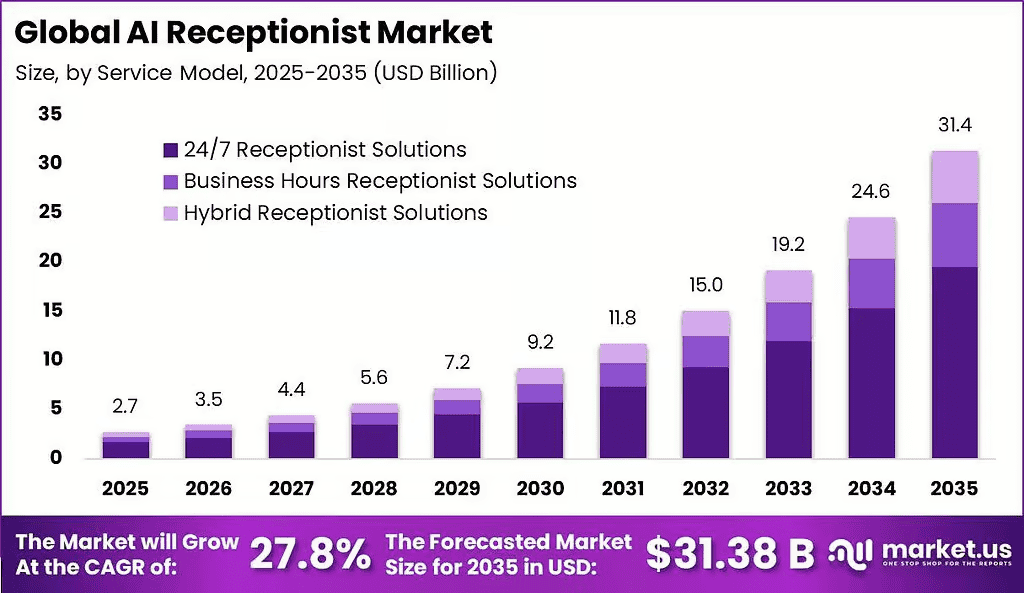
(Source: market.us)
- The global AI receptionist market was valued at USD 2.7 billion in 2025 and is projected to reach USD 3.5 billion in 2026.
- Supported by rising adoption of 24/7 receptionist, business-hours, and hybrid solutions, the market is expected to grow at a 27.8% CAGR.
- By 2035, the market is forecast to reach USD 31.4 billion.
Segment Analysis of AI Receptionist: By Component
- In 2025, Solutions led the market with a share of over 76%.
- U.S. businesses using AI increased to 17%-20% between December 2025 and May 2026, while 20%-23% planned adoption within 6 months.
- Among companies with at least 250 employees, 37% were already using AI.
By Deployment
- Cloud-based solutions held over 70.1% of the market share in 2025, as they reduce the need for on-site servers and simplify software updates and multi-location management.
- In 2025, 52.7% of EU enterprises purchased cloud services, up by 7.4 percentage points from 2023.
- Adoption reached 84.7% among large enterprises.
By Service Model
- 24/7 Receptionist solutions captured over 62.3% share in 2025, according to a report published by market.us.
- The United States airlines carried 92.2 million passengers in July 2025, including 13.3 million international passengers.
- Hotel-related traveler spending was projected at USD 777.2 billion, with occupancy at 63.3%.
By Enterprise Size
- SMEs accounted for over 61% of the market in 2025.
- The U.S. had 36.2 million small businesses, representing 99.9% of all businesses and employing 62.3 million people, or 45.9% of the private-sector workforce.
- SME AI adoption increased from 26% in 2024 to 39% in 2025.
By Technology
- Voice AI Integration led with a share of over 56.1%.
- About 197 million U.S. adults lived in wireless-only households in the second half of 2023.
- Telemedicine use among office-based physicians reached 80.5% in 2021, up from 16.0% in 2019.
By Service Type
- Voice Reception Services held over a 54.5% share in 2025.
- The U.S. had 135,665 dental establishments, supporting 2.5 million jobs and generating around USD 487 billion annually.
By End Use
- IT and Telecom led with a share of over 19%.
- In 2025, 6.0 billion people, or 74% of the global population, used the internet, while mobile-cellular subscriptions reached 9.2 billion and mobile-broadband subscriptions reached 99 per 100 people.
- Automotive was the fastest-growing segment, with vehicle production rising from 92.7 million units in 2024 to 96.4 million in 2025.
AI Receptionist Adoption by Industry
(Source: ainora.lt)
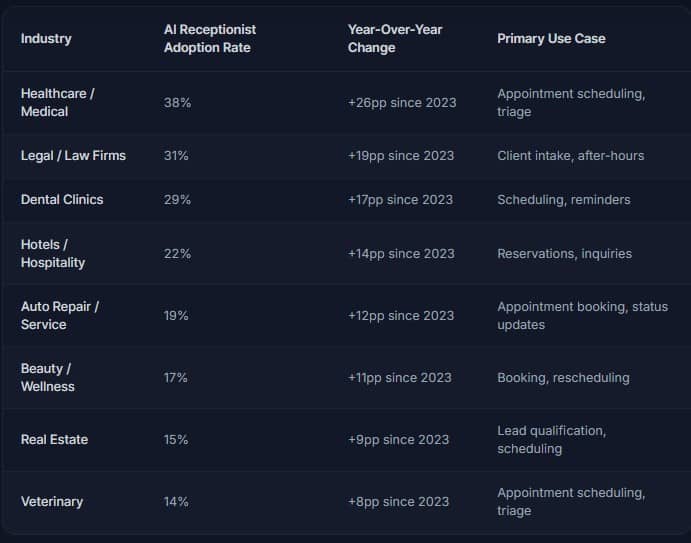
- In 2025, 38% of healthcare practices in the U.S. and EU used AI to answer calls, schedule appointments, or triage patients, up from 12% in 2023.
- 31% of law firms used AI for client intake, conflict checks, or after-hours calls. Adoption reached 36% among firms with 2-10 attorneys.
- 29% of dental clinics in Western Europe used AI phone systems, rising to 34% in the Nordic countries.
- 22% of hotels with 50+ rooms used AI for reservation and inquiry calls, with budget and mid-scale hotels adopting it faster.
- 19% of independent repair shops used AI phone answering, while shops with 5+ bays adopted it at 2× the rate of single-bay shops.
- AI receptionist adoption reached 17% in beauty and wellness, while real estate and veterinary stood at 15% and 14%, respectively.
By Region
| Region | AI Receptionist Adoption Rate | YoY Growth |
| United States | 32% | 52% |
| Nordic Countries | 28% | 71% |
| United Kingdom | 24% | 58% |
| DACH Region | 21% | 63% |
| France | 18% | 55% |
| Baltic States | 16% | 94% |
| Southern Europe | 13% | 47% |
AI Receptionist Service Comparison
| Service | Price | Best For | Key Strength | Key Limitation |
| NextPhone | USD 199/mo unlimited | Home services (plumbing, HVAC, electrical, roofing) with 50+ calls/mo. | Flat rate regardless of volume; emergency call routing; 28 voice options at no extra cost. | U.S./Canada only; industry-specific focus. |
| Smith.ai (AI-only) | USD 255/mo for 30 calls; USD 510/mo for 60 calls; USD 8.50/call overage | Growing SMBs want room to scale into enterprise features. | Strong CRM integrations, lead qualification, 24/7 availability. | Complex pricing can get costly at volume. |
| Smith.ai AI + Live | USD 300/mo for 30 calls (USD 11.50/call overage); USD 810/mo for 90 calls (USD 10.50 overage); USD 2,100/mo for 300 calls (USD 8.50 overage). Legacy tiers: USD 255/30 calls, USD 510/60 calls, USD 2,100/300 calls | Legal intake, high-end professional services, complex B2B sales. | Human receptionists handle complex calls with premium accuracy and quality. | Expensive at scale; overages add up fast; not cost-effective for routine SMB use. |
| Abby Connect | Starts at approximately USD 99/mo; custom/per-minute or package pricing | Businesses want a human-first touch with AI assistance. | Dedicated receptionist team; highly customizable; extended hours. | Not purely AI; pricing can be variable and complex. |
AI Receptionist Monthly Cost by Industry
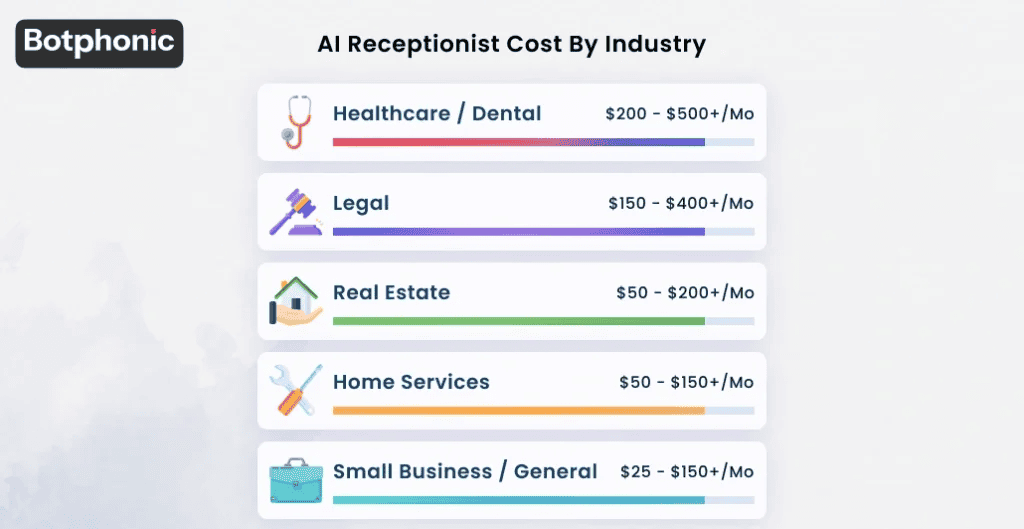
(Source: botphonic.ai)
- Healthcare and dental practices typically spend USD 200-500+/month, while legal firms generally pay USD 150-400+/month for AI receptionist services.
- Real-estate businesses commonly incur costs of USD 50-200+/month, depending on call volume, integrations, and scheduling needs.
- Home-service providers and small/general businesses usually pay USD 50-150+/month and USD 25-150+/month, respectively. Costs can vary by up to 100%+ based on required features.
AI Receptionist Statistics by Missed Calls, Timing, and Cost Statistics
- According to magicline.ai, 62% of inbound small-business calls go unanswered during peak periods, creating opportunities for competitors.
- About 85% of callers who reach voicemail do not leave a message, and most do not call back.
- Approximately 30%-40% of local service business calls arrive after standard business hours.
- Leads contacted within 5 minutes convert about 9 times more often than those contacted after 30 minutes.
- AI receptionist plans can start at around USD 29/month with unlimited calls, while part-time receptionists cost USD 1,500-2,500/month plus overhead.
- Traditional answering services typically cost USD 100-500/month, often based on call minutes.
- Overall, AI receptionists can provide a more affordable option for 24/7 call coverage.
AI Receptionist Performance Highlights
- According to Globe Market Research, AI-enabled customer service teams resolve tickets in about 32 minutes, compared with up to 36 hours for less advanced teams.
- Around 64% of consumers expect AI to improve the quality and speed of customer service, while 42% of CX leaders prioritize greater AI adoption.
- AI receptionists can achieve 85%-95% accuracy on routine calls and answer in under 1 second, compared with 15-45 seconds for human answering services.
- AI can reduce missed calls by 87% and appointment no-shows by 40%-60%.
Call Handling Statistics
- According to ainora.lt, AI receptionists handle an average of 147 calls per day, compared with 50-70 for human receptionists.
- Meanwhile, the average call duration is 2.4 minutes, compared with 3.8 minutes.
- AI can increase call answer rates from 71% to 99.7%, helping businesses capture more potential revenue.
- Appointment scheduling accuracy reaches 96.4% with AI, compared with 91.2% for humans.
- After-hours calls represent 34% of daily call volume, giving AI receptionists an important role in handling missed calls outside regular business hours.
Lead Response Time and Conversion Statistics
(Source: callsetter.ai)
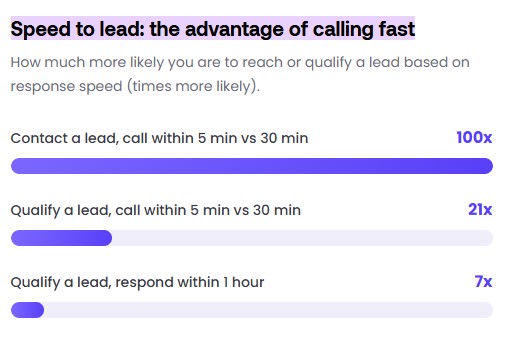
- Responding to a lead within 5 minutes makes businesses 100 times more likely to make contact than if they wait 30 minutes.
- Calling within 5 minutes makes qualification 21 times more likely, while responding within 1 hour makes qualification 7 times more likely.
- The average response time was 42 hours, and 23% of 2,241 U.S. companies never responded to an inbound lead.
- Calling within 1 minute can increase conversion rates by 391% compared with waiting 30 minutes.
- Only 7% of 433 B2B companies responded within 5 minutes, and 55% did not respond within 5 business days.
Customer Satisfaction Report
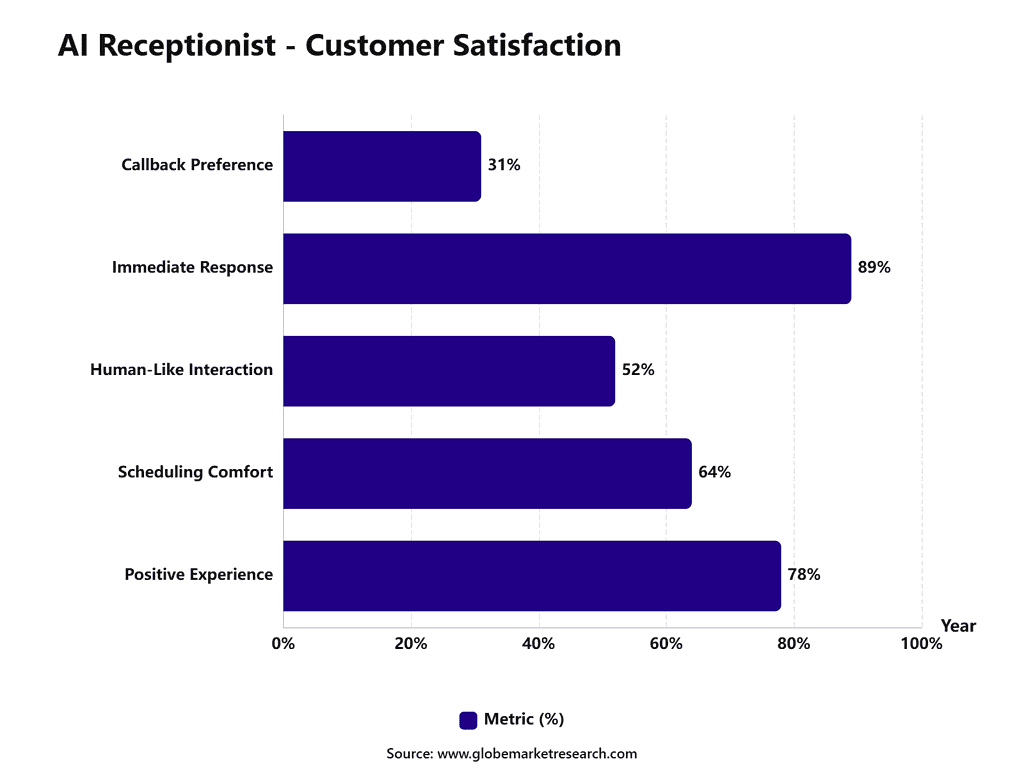
- Immediate response is the most valued feature, with 89% customer satisfaction, showing that users expect quick support from AI receptionists.
- Positive experience ranks second at 78%, while 64% of users feel comfortable scheduling appointments through the AI system.
- Human-like interaction receives 52% satisfaction, whereas only 31% prefer callbacks.
AI Receptionist Market Growth Drivers
- According to Market.us, U.S. business AI adoption ranged from 17% to 20% between December 2025 and May 2026, with 20% to 23% expecting to adopt within six months. Adoption reached 37% among firms with 250+ employees.
- In May 2026, AI adoption reached 39.7% in Information and 33.9% in Finance and Insurance, versus 19.8% nationally.
- About 18% of U.S. firms used AI by the end of 2025, while 41% of workers used generative AI and 78% worked at firms that adopted AI.
- Zoom launched AI receptionist pricing from USD 29.99/month for 100 minutes, supporting 24/7 calls and 10+ additional languages.
- EU cloud adoption reached 52.74% in 2025, supporting CRM and AI integration.
- Twilio surveyed 7,640 consumers and 637 business leaders across 18 countries; 88% preferred personalized engagement.
- Salesforce found that 39% of consumers were comfortable with AI appointment scheduling, while AI agent use in customer service rose from 39% in 2025 to 66% in 2026.
- The U.S. had 2.814 million customer service jobs in 2024, projected to decline by 5% by 2034, with 341,700 annual replacement openings and a median pay of USD 20.59/hour.
- Globally, 6.0 billion people, or 74%, used the internet in 2025, while mobile subscriptions reached 9.2 billion, or 112 per 100 inhabitants.
Future Market Predictions
- By 2028, around 60% of small service businesses are expected to use AI phone handling, up from about 25% today.
- By 2030, AI could handle 75% of routine business calls, while humans manage more complex issues.
- AI receptionist accuracy for routine tasks is projected to exceed 99% by 2027, up from 97%.
- Service costs could fall by 40% between 2025 and 2028, with monthly prices declining from USD 150-300 to USD 90-180.
Quick Comparison Between AI and Human Receptionists
| Factor | AI Receptionist | Human Receptionist |
| Annual cost | USD 828-2,388 | USD 35,000-55,000 |
| Availability | 24/7/365 coverage | Typically 40 hours/week |
| Simultaneous calls | Handles unlimited concurrent calls | Usually 1 call at a time |
| Consistency | Delivers standardized responses | It can vary by workload and experience |
| Sick days | No sick leave required | About 5-10 days/year |
| Training period | Can be configured in 15 minutes. | Around 2-4 weeks |
| Empathy | Improving conversational capability. | Strong human connection. |
| Complex issues | Resolves routine needs; escalates complex cases. | Excellent judgment and resolution. |
Final Perspective
AI receptionists are making customer service faster, easier, and more efficient. They can answer calls, book appointments, handle common questions, and support customers 24/7. This helps businesses save time and reduce routine work. However, human staff are still important for complex issues and personal support.
As AI technology improves, more businesses are likely to use AI receptionists alongside their teams to deliver better customer service while keeping operations simple and cost-effective.
FAQ
An AI receptionist uses artificial intelligence to answer calls, understand questions, provide information, schedule appointments, and transfer calls when needed.
Yes, an AI receptionist can answer calls 24/7, including weekends and holidays.
Yes, many AI receptionists understand different accents and languages, though accuracy varies by provider and language.