









First Glance
AI In Media And Entertainment Statistics: AI is changing how movies, music, games, news, and online videos are made and enjoyed, helping media companies create content faster, understand audiences better, and deliver personalized experiences across streaming, social media, and gaming. Using data and generative AI models, it can recommend movies based on viewing habits, generate subtitles, improve visual effects, write ad copy, and help editors sort through footage. Audiences now expect relevant, personalized content delivered quickly, and AI helps media businesses support creators, improve workflows, and unlock new opportunities in virtual production, interactive gaming, and automated dubbing.
In this article, you get to explore the trending AI in media and entertainment statistics, market growth, key use cases, regional trends, major companies, recent developments, and the future outlook for this industry.
Stats that Matter the Most
- The AI in the media and entertainment market is set to grow from USD 27.8 billion in 2025 to USD 195.7 billion by 2033, growing about 27.6% every single year.
- 80% of everything people watch on Netflix comes from its AI recommendation system.
- AI can cut video editing time by up to 30%, giving creative teams more time to focus on the story instead of the technical grind.
- By 2026, tailoring content to each viewer is expected to be the single biggest AI use case, bringing in 27.4% of all related revenue.
- AI dubbing tools like Netflix’s DeepSpeak, which match a voice to lip movement and rhythm, have helped push dubbed-content viewership up by 120%.
- By 2025, nearly 30% of big brands’ marketing messages will be AI-written, up from less than 2% in 2022.
- People now watch almost 7 hours of video a day, but traditional TV and film make up only half of that, down from 61% in 2019, showing how much room AI-shaped content has taken over.
Global AI in Media and Entertainment Market Statistics
- AI in the Media and Entertainment Market is expected to reach USD 27.8 billion in 2025 and USD 195.7 billion by 2033, at a spectacular CAGR of 27.6% over the period.
- In 2023, the Solution segment accounted for the largest market share, accounting for over 70.4%. The reason for this dominance can be traced back to the significance of AI technologies in changing different aspects of the industry.
- The Machine Learning (ML) technology segment has been observed as a leader in 2023 with over 45.2% market share. ML enables advanced data analytics and pattern recognition necessary for personalized recommendations and audience analytics.
- The Personalized Recommendations segment held the top spot in 2023 with over 32.9% share. It highlights the growing need for personalized media among consumers due to excess content availability.
- North America was the leading region in 2023 with over 39.5% share on account of factors such as advanced digital infrastructure and the presence of major technology players.
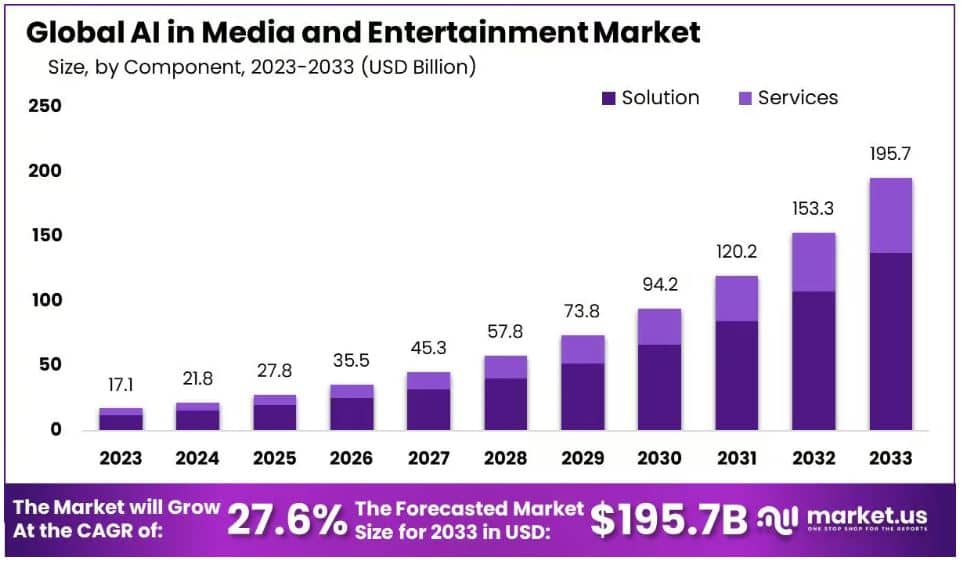
(Source: market.us)
AI Use Cases in Media and Entertainment
- Content personalization is the most mature AI use case in media, projected to generate 27.4% of total application revenue by 2026 as streaming platforms tailor viewing experiences to individual users.
- Netflix shows this at scale by using AI to study viewing habits and personalize how shows are presented, which has lifted engagement globally.
- AI dubbing is growing fast as well, with Netflix’s DeepSpeak matching original actors’ voices by analyzing lip movement, pitch, and rhythm.
- That effort paid off, as Clearly Loc reports a 120% rise in dubbed content viewership, though preferences for dubbing versus subtitles still vary by region.
- Generative creation tools are now central to production, and Grand View Research finds entertainment and gaming held the largest end-user share at nearly 32% in 2025.
- For media and entertainment specifically, Precedence Research says advertising and marketing content led generative AI uses in 2025 with a 21.10% share.
- One of AI’s most common uses in media and entertainment is recommendation engines, with Netflix, Spotify, and YouTube using AI to study user behavior and deliver personalized suggestions.
- AI-powered editing software can automatically improve video quality, fix lighting, apply filters, and even create VFX or deepfake effects, which greatly cuts post-production time and costs.
Generative AI in the Media Industry
- McKinsey’s November 2025 analysis of the film and TV industry found that the average U.S. adult now spends nearly 7 hours a day watching video, yet traditional television and film account for only half of that time, down sharply from 61% in 2019, which is exactly the gap generative AI production tools are being built to close.
- Gartner has forecast that by 2025, nearly 30% of outbound marketing messages from large organizations will be synthetically generated, a sharp rise from less than 2% in 2022, showing how fast generative AI has become the default engine behind advertising copy.
- Data from Gartner also points to traditional search engine volume falling by roughly 25% by 2026 as more consumers turn to AI chatbots for answers, a shift that is pushing media publishers to rethink how their content gets discovered.
- Forrester’s Q3 2025 CMO Pulse Survey reports that 86% of U.S. B2C marketing executives plan to experiment with new channels in 2026, while 83% intend to diversify their media spend beyond the dominant walled-garden platforms.
- Forrester further predicts that display advertising budgets will shrink by 30% in 2026 as brands shift spending toward entertainment formats like connected TV and short-form video, many of which now rely on generative tools for personalization.
- A recent comprehensive Forrester study cautions that this momentum isn’t without risk, projecting that one in three brands will damage customer trust in 2026 by rushing out generative AI-powered self-service tools before they’re truly ready.
- Taken together, the World Economic Forum’s 2025 whitepaper on AI in media, entertainment, and sport, built on McKinsey’s broader research into AI and gen AI across tech, media, and telecom, frames generative AI as a lasting structural force reshaping how content is made, distributed, and monetized.
| Finding | Percentage |
| Share of daily video time held by traditional TV & film in 2025 (down from 61% in 2019) | 50% |
| Traditional TV & film’s share of daily video time in 2019, for comparison | 61% |
| Outbound marketing messages projected to be synthetically generated by 2025 | 30% |
| Outbound marketing messages that were synthetically generated in 2022 | <2% |
| Projected decline in traditional search engine volume by 2026 | 25% |
| U.S. B2C marketing executives planning to experiment with new channels in 2026 | 86% |
| U.S. B2C marketing executives diversifying media spend beyond walled-garden platforms | 83% |
| Projected shrinkage in display advertising budgets in 2026 | 30% |
| Brands expected to damage customer trust via rushed AI rollouts in 2026 | 33% (1 in 3) |
Benefits of AI in Media and Entertainment
- According to Deloitte, AI has the potential to cut down on video editing time by up to 30%. Teams can use their time for creating new stories, experimenting, and innovating.
- AI-assisted creativity, according to McKinsey, adds variety and effectiveness to content testing by up to 25%. These systems help tell stories without taking away the human component.
- AI can help make media delivery efficient by up to 40%. AI dashboards also increase collaboration and project tracking in real time.
- Netflix’s AI system helps generate recommendations that comprise 80% of the total watch time. AI can change content formats according to genres or stories.
Cost of AI in Media and Entertainment
- Typical investment ranges for employing AI in media and entertainment are from USD 150,000 to USD 500,000+.
| Component | Estimated Cost |
| Data Infrastructure & Preparation | USD 30K – USD 100K |
| AI Model Development | USD 50K – USD 200K |
| Integration & Deployment | USD 30K – USD 100K |
| Ongoing Maintenance & Optimization | USD 5K – USD 20K/month |
Recent AI in Media and Entertainment Statistics
- On June 4, 2025, AMC Networks signed a deal with Runway to use its AI tech for marketing images and pre-visualizing upcoming shows, becoming the first cable company to do so.
- On September 29, 2025, Electronic Arts was taken private in a USD 55 billion deal led by Silver Lake, Saudi Arabia’s Public Investment Fund, and Affinity Partners, reshaping AI-driven game development funding.
- On November 12, 2025, AlixPartners predicted media and entertainment M&A would exceed USD 80 billion in 2026, driven largely by the AI race and rising tech investment demands.
- On November 21, 2025, A year into their partnership, Lionsgate and Runway faced copyright concerns and technical limits, showing that turning studio libraries into usable AI models is harder than expected.
- In December 2025, Disney closed out 2025 with a landmark USD 1 billion investment in OpenAI, the parent company of Sora, marking a major bet on generative AI for content creation.
- On December 5, 2025, Netflix struck a USD 82 billion deal for Warner Bros. studio and streaming assets, one of the biggest media acquisitions fueling AI-driven content strategy shifts across the industry.
- On February 10, 2026, Mattel acquired full ownership of its Mattel163 mobile games studio for USD 159 million, buying out NetEase’s 50% stake in the AI-and-gaming venture.
- On March 11, 2026, Venture capital deals in media fell to USD 165 million in the first two months of 2026, down sharply as investors shifted toward an “AI-first” approach.
- In June 11, 2026, Lionsgate expanded its 2024 partnership with Runway by taking an equity stake in the AI video company and announced plans for an AI-generated short-form series using its own IP.
- In June 2026, OpenAI reached roughly 20 verified news publisher partnerships covering more than 160 outlets, anchored by a reported USD 250 million deal with News Corp.
Concluding the Story
AI is becoming the backbone of how content gets made, found, and sold. From explosive market growth to Netflix’s recommendation engine driving most of what people watch, the pattern is clear: audiences want fast, personalized content, and studios are racing to build the tools that deliver it. Big players like Disney, Netflix, and Electronic Arts are backing this shift with massive investments and acquisitions, and by 2026, AI-driven mergers alone are expected to top USD 80 billion.
But this rapid growth comes with real risks too: copyright disputes over AI training data, concerns about job security for creative professionals, and the danger of rushing out half-ready AI tools that damage audience trust. The companies that come out ahead will likely be the ones that use AI to support human creativity rather than replace it, while staying careful about the risks that come with moving fast.
FAQ
AI in media and entertainment refers to the use of artificial intelligence tools, like machine learning and generative AI, to create, edit, and personalize content such as movies, music, games, and news across streaming platforms and studios.
AI is used for tasks like video editing, script writing, visual effects, content recommendations, dubbing and translation, and even generating fully AI-created characters or scenes.
Major players include Netflix, Disney, Warner Bros. Discovery, Spotify, and tech companies like Google, OpenAI, and Runway, all investing in AI tools for content creation and personalization.
AI is automating some repetitive tasks like editing and captioning, but most of the industry still relies on humans for creative direction, storytelling, and final decision-making, with AI acting as a supporting tool.
Streaming platforms use AI algorithms to study viewing habits and preferences, then suggest movies, shows, or music that match what a user is most likely to enjoy.
Key challenges include copyright issues, job security concerns for creative professionals, maintaining originality, and making sure AI-generated content doesn’t spread misinformation or deepfakes.

Sources