









Beginning
Mobile AI Statistics: Artificial intelligence is no longer limited to computers and cloud platforms. It is now becoming a major part of everyday mobile devices. Smartphones can use AI to improve photos, understand voice commands, translate languages, personalize apps, and even create content. Much of this work can happen directly on the device, helping users get faster results without always relying on cloud services.
This shift is also pushing smartphone makers and chip companies to build more powerful AI features into their devices. As Mobile AI continues to grow, it is changing both the smartphone experience and the wider mobile technology market.
This article looks at key Mobile AI trends, applications, growth, and statistics.
Editor’s Selection
- The mobile AI market is projected to rise from USD 31.67 billion in 2025 to USD 40.26 billion in 2026, reflecting 27.1% growth.
- In 2026, North America leads with 36%, while the U.S. mobile artificial intelligence market size is estimated to reach USD 8.74 billion.
- As of 2026, 20-28nm leads with approximately 30%, while 10nm holds nearly 25% of the Mobile AI Market.
- ChatGPT led AI mobile apps with 592 million monthly active users worldwide.
- Qualcomm, a U.S. company, had a USD 208.9 billion valuation as of September 2026 and reported USD 9.9 billion in Q3 2026 revenue.
- The global AI mobile app development market is projected to reach USD 56.7 billion in 2026.
- Approximately 70% of mobile apps use AI to improve the user experience.
- 5G carries nearly 50% of global mobile data traffic, with over 3.1 billion subscriptions in H1 2026.
- GenAI-capable phones are forecast to account for 45% of global smartphone shipments in 2026, up from 35% in 2025.
Mobile AI Market Size
(Source: precedenceresearch.com)
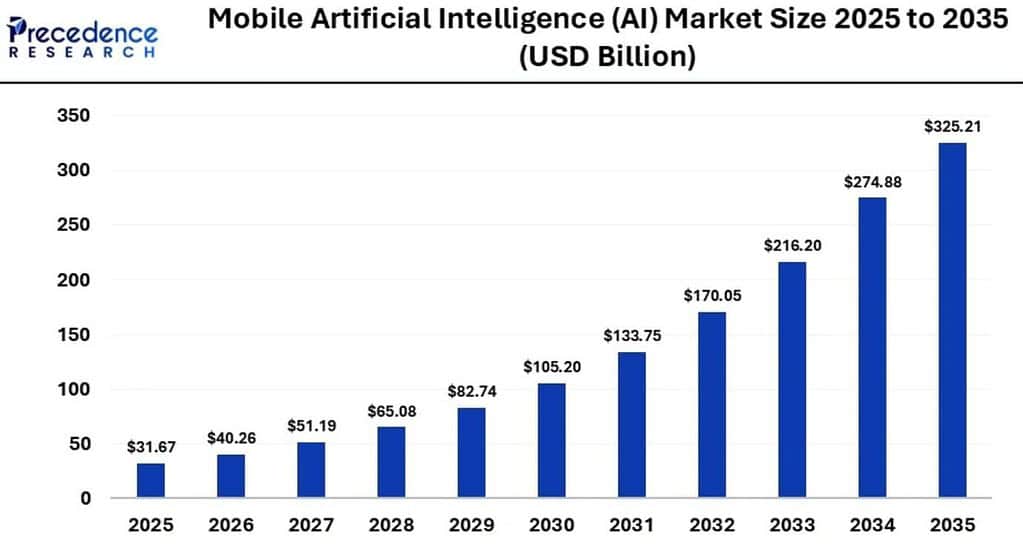
- The mobile AI market is projected to rise from USD 31.67 billion in 2025 to USD 40.26 billion in 2026, reflecting 27.1% growth.
- By 2035, the market is expected to reach USD 325.21 billion, growing at a CAGR of 26.2% from 2025.
- The U.S. mobile artificial intelligence (AI) market size is estimated to reach USD 8.74 billion in 2026.
Mobile AI Market by Technology Node
- As of 2026, 20-28nm leads with approximately 30%, while 10nm holds nearly 25% of the Mobile AI Market.
- 7nm represents approximately 20%, while other nodes, including 12nm and 14nm, account for approximately 25%.
By Application
- Fortune Business Insights further stated that smartphones lead with approximately 35%, while automotive holds 15%.
- Cameras and AR/VR each account for around 12%, while drones represent 10%.
- Robotics contributes 8%, with other applications, including smart boards and PCs, also at 8%.
Regional Share
- In 2026, North America leads with 36%.
- Meanwhile, Europe accounts for 28%, with Germany at 12% and the UK at 8%.
- Asia-Pacific accounted for 32%, followed by China (15%) and Japan (10%).
- The rest of the world accounts for 5%, indicating a smaller market share.
Leading Mobile AI Companies and 2026 Financial Highlights
- Qualcomm, a U.S. company, had a USD 208.9 billion valuation as of September 2026 and reported USD 9.9 billion in Q3 2026 revenue, according to Yahoo Finance. In Q1, revenue was USD 12.3 billion, including USD 10.6 billion from QCT.
- NVIDIA’s valuation reached USD 5.54 trillion, while in 2026 revenue was USD 215.9 billion, up 65%. Gross margin was 71.1%, with USD 41.1 billion returned to shareholders.
- Intel, valued at USD 574.1 billion, reported USD 16.1 billion in Q2 2026 revenue, up 25%. Client Computing and Physical AI generated USD 8.9 billion, while Data Center and AI generated USD 6.3 billion.
- According to Capital.com, IBM’s valuation was USD 215.2 billion, with Q2 2026 revenue of USD 17.162 billion. H1 revenue reached USD 33.079 billion.
- Microsoft, valued at USD 3.69 trillion, generated USD 331.8 billion in revenue in 2026, up 18%. Net income reached USD 133.7 billion, up 31%.
- Apple’s valuation was USD 4.95 trillion, while Q3 2026 revenue reached USD 109.4 billion, up 16%. Its installed base exceeded 2.5 billion active devices.
- In H1 2026, Huawei’s revenue was CNY 467.82 billion, up 9.6%, while net profit was CNY 23.81 billion, down 36%.
- Google’s parent company, Alphabet, was valued at USD 4.31 trillion and reported USD 119.796 billion in Q2 2026 revenue, up 24%. Google Cloud revenue reached USD 24.8 billion, up 82%.
- MediaTek had a USD 251.8 billion valuation and Q2 2026 revenue of TWD 152.2 billion, up 1.2%. Q2 EPS was TWD 15.28.
- Companies Market Cap stated that Samsung Electronics’ valuation reached USD 1.35 trillion. Meanwhile, in Q1 2026, revenue was KRW 133.9 trillion and operating profit was KRW 57.2 trillion.
AI Mobile App Development Statistics
(Source: cmarix.com)
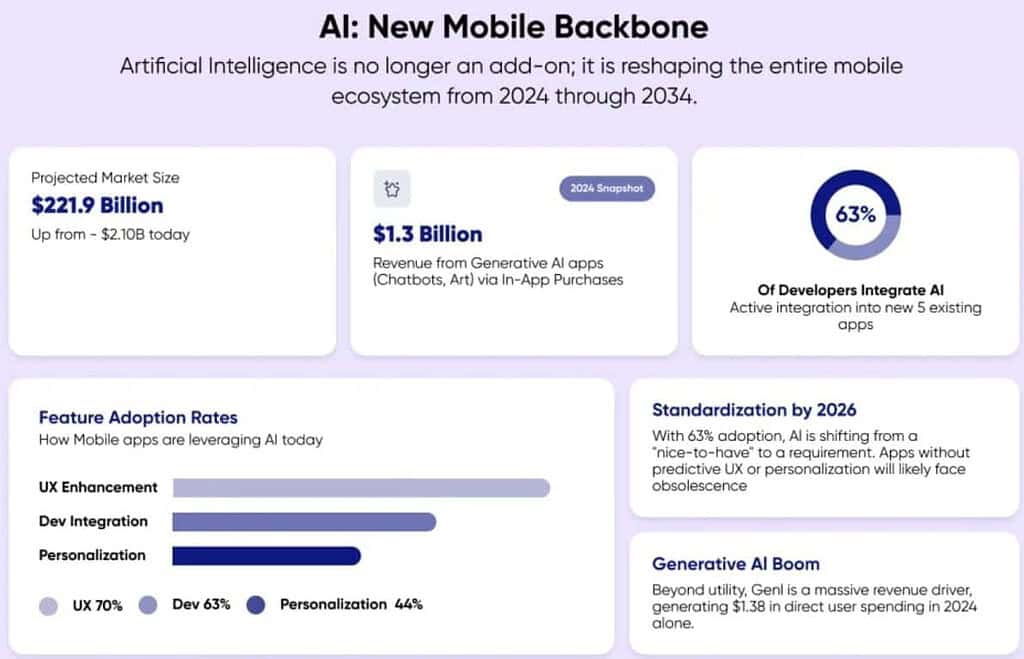
- The global AI mobile app development market is projected to reach USD 56.7 billion in 2026 and USD 221.9 billion by 2034.
- About 63% of mobile app developers integrate AI features into their apps.
- Around 44% of mobile apps use AI personalization to provide tailored content.
- Approximately 70% of mobile apps use AI to improve the user experience.
- The AI app industry is valued at around USD 210 billion.
- Generative AI app downloads are projected to reach 7.5 billion in 2026, representing about 108% year-over-year growth.
- ChatGPT held 45% of the U.S. market in Q3 2024, while Gemini exceeded 50% in India.
- By December 2025, mobile-only generative AI usage reached 50% in the U.S., up from 25% in 2024.
- All 10 top generative AI apps by global downloads in 2025 were AI assistants.
Mobile App Developer and Technology Statistics 2026
- A blog post by Cmarix reports that Kotlin is the primary language for new Android projects, with over 95% of the top 1,000 Android apps using native Kotlin.
- On iOS, 57% of developers use SwiftUI, while 22% use hybrid frameworks for app development.
- Flutter leads cross-platform development with a 46% share.
- React Native remains popular, with its open-source package reaching 10.3 million downloads per week in mid-2026.
- Kotlin Multiplatform is growing rapidly, recording 120% year-over-year growth in enterprise adoption.
- The global low-code development market is projected to reach USD 66.2 billion by 2026.
- 5G supports AR/VR, gaming, IoT, and streaming through lower latency.
- 5G carries nearly 50% of global mobile data traffic, with over 3.1 billion subscriptions in H1 2026.
- Network slicing configurations increased from 65 to 84.
AI Mobile App User Reach in February 2026
(Reference: statista.com)
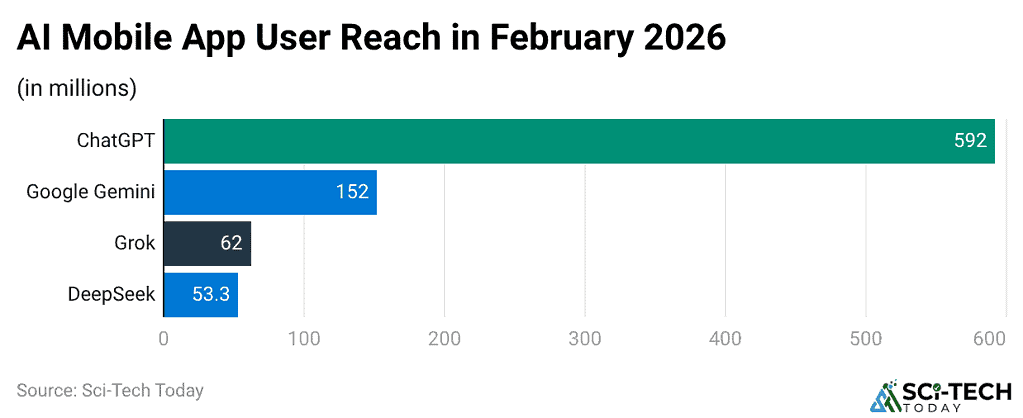
- According to Statista, ChatGPT led AI mobile apps with 592 million monthly active users worldwide.
- Google Gemini followed with 152 million users.
- Grok reached nearly 62 million monthly active users.
- DeepSeek recorded 53.3 million users.
AI App User Statistics
(Source: sensortower.com)
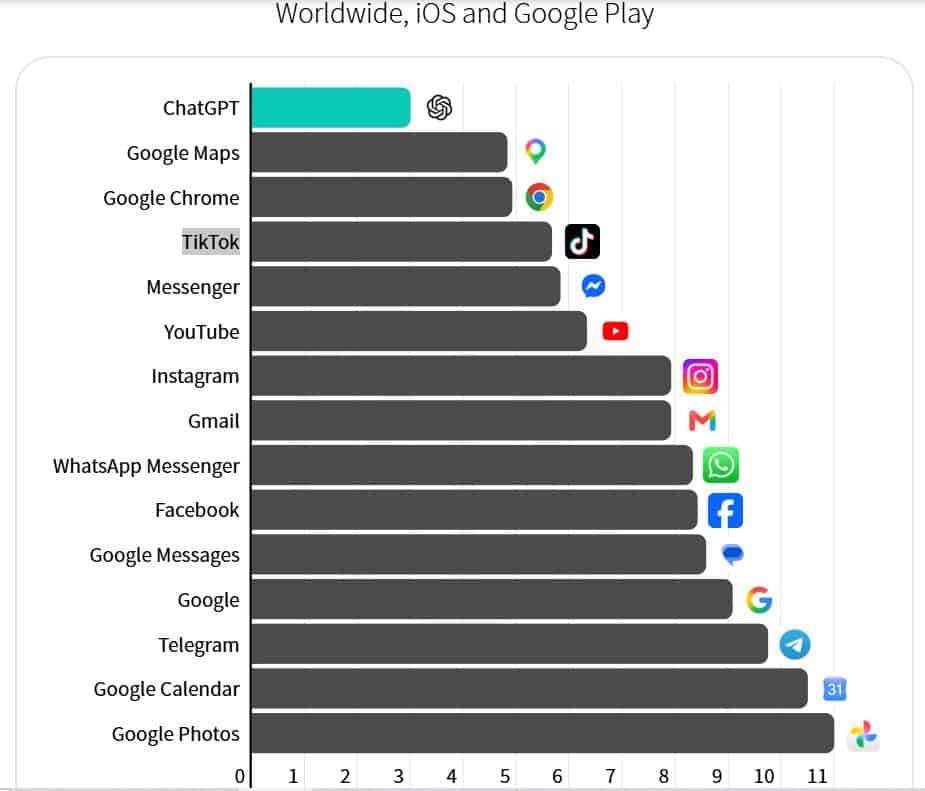
- ChatGPT reached 1 billion monthly active users in May 2026, while Gemini had about 716 million.
- Meanwhile, Google reported 900 million monthly users across 230 countries and 70 languages.
- According to a blog. Google, by August 2026, Gemini exceeded 1 billion monthly users, including more than 100 million active iOS users.
- ChatGPT surpassed 1 billion weekly active users in August-September 2026.
- Data Reportal’s report further stated that the global AI-app users exceeded 1.1 billion, while broader consumer-AI usage reached 2 billion, or about 24% of the global population.
- The mobile addressable base reached 5.78 billion users, representing 70.1% of the world population.
Generative AI Smartphone Market Statistics
(Source: counterpointresearch.com)
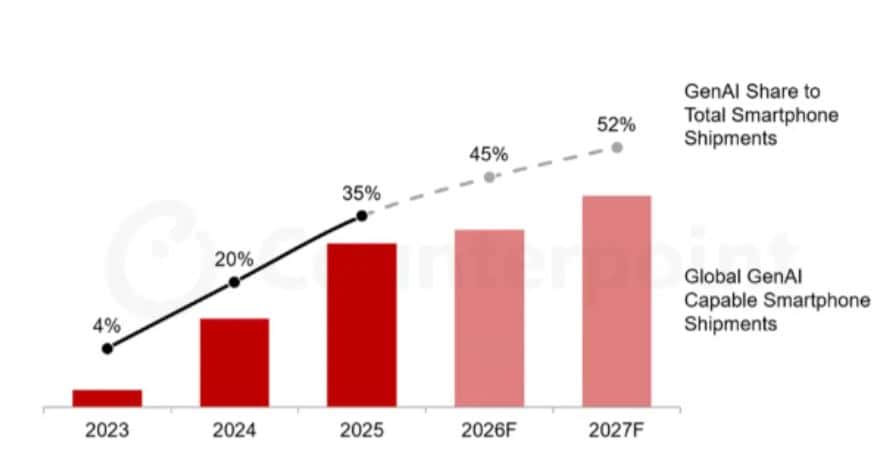
- GenAI-capable phones are forecast to account for 45% of global smartphone shipments in 2026, up from 35% in 2025 and potentially reaching 52% in 2027.
- With 1.08 billion total smartphone shipments forecast for 2026, this equals approximately 486 million GenAI phones.
- TechInsights expects shipments to exceed 500 million units, with Asia-Pacific contributing more than half.
- Apple, Samsung, and Xiaomi are expected to be the top 3 vendors.
Global Best AI Phones 2026 at a Glance
| Phone | Launch / List Price | Display | Memory and Storage | Cameras |
| iPhone 18 Pro Max | USD 1,199 / USD 1,299, 256 GB | 6.9-inch, 2,868 × 1,320, 460 ppi | 256 GB, 512 GB, 1 TB, 2 TB | 48 MP main + 48 MP ultrawide; 8x optical-quality zoom-in, 16x optical-quality range |
| Pixel 11 Pro XL | USD 1,099 / USD 1,299, 256 GB | 6.8-inch, up to 3,600 nits | Up to 16 GB RAM; 256 GB, 512 GB, 1 TB | 50 + 48 + 48 MP rear; 42 MP front; 120x Pro Zoom; 8K video |
| Galaxy S26 Ultra | USD 1,299.99, 12 GB/256 GB; up to USD 1,799.99, 16 GB/1 TB | 6.9-inch, up to 120 Hz | 12/256 GB, 12/512 GB, 16 GB/1 TB | 200 MP wide + 50 MP telephoto among the headline sensors |
| OnePlus 15 | USD 899, 12/256 GB; USD 999, 16/512 GB | 6.78-inch, 2,772 × 1,272, 450 ppi; 1-120 Hz, up to 165 Hz gaming | 12/256 GB or 16/512 GB; UFS 4.1 | Triple 50 MP; 4K/120 fps Dolby Vision listed for the model |
| Xiaomi 17 Ultra | EUR 1,499, 16/512 GB; EUR 1,699, 16 GB/1 TB | 6.9-inch | 16/512 GB or 16 GB/1 TB | 50 MP 1-inch main; 200 MP 75-100 mm continuous optical zoom; 14 mm ultrawide |
| OPPO Find X9 Pro | GBP 1,099 RRP; EUR 1,299 / INR 109,999 in cited markets | 6.78-inch, 2,772 × 1,272, 120 Hz | 16/512 GB; LPDDR5X/UFS 4.1 in cited official configuration | 50 MP main + 200 MP telephoto + 50 MP ultrawide; 50 MP front |
| HONOR Magic8 Pro | From GBP 899.99 in the cited UK offer; China launch from RMB 5,699 | 6.8-inch, up to 5,000 nits in cited global model | 12/512 GB in cited UK model | 50 MP main + 200 MP, 3.7x telephoto + 50 MP ultrawide + 50 MP front |
| vivo X300 Pro | INR 119,999, 16/512 GB; cited European list price EUR 1,399 | 6.78-inch, 2,800 × 1,260, 1-120 Hz, 4,500 nits | 16/512 GB in the cited India model | 50 MP front; 50 + 50 + 200 MP rear |
| Galaxy Z Fold8 Ultra | USD 2,099.99 / EUR 2,199 / GBP 1,899, 256 GB | 8.0-inch inner + 6.5-inch cover, both 120 Hz | 12/256 GB, 12/512 GB, 16 GB/1 TB | 200 MP main + 50 MP ultrawide + 10 MP 3x telephoto |
Bottom Line
Mobile AI is becoming a regular part of modern smartphones. It helps users with tasks such as taking better photos, managing information, improving security, and personalizing their experience. With stronger chips and better software, phones can now handle many AI tasks more smoothly.
At the same time, concerns about privacy, battery use, and device prices remain. As AI technology develops, mobile devices are expected to become more helpful, responsive, and practical for everyday use.
FAQ
An AI phone uses artificial intelligence to enhance features, performance, and the everyday smartphone experience.
Mobile AI is commonly used for voice assistants, camera enhancements, personalized recommendations, translation, security, and predictive text.
Yes, some Mobile AI features work offline, but cloud-based AI tools require an internet connection to process requests.