








Overview
AI In Art Statistics: AI in art refers to tools that can generate images, music, writing, and other creative work from text prompts or reference material, trained on vast datasets that often include existing human-made art without consent. These tools are reshaping creative marketplaces, expanding the volume and variety of available work and giving buyers more choice, even as human creators face more competition and reduced demand for their own output.
Most artists are not abandoning their craft for AI; instead, they are folding it into parts of their process, such as idea exploration or asset creation, while treating hands-on creation as the heart of their practice. Galleries report similar caution, using AI mainly for administrative work rather than artistic production. Surveys consistently find that audiences want a human behind the work, valuing effort, intention, and emotional connection over output alone.
This article looks at how AI is changing art today, how the market is growing, and how artists are moving forward with AI.
Key Takeaways Marked by the Editor
- The global AI in art market was valued at USD 4.1 billion in 2024 and USD 5.3 billion in 2025, projected to reach USD 40.4 billion by 2033, a 28.9% CAGR.
- Only 13% of surveyed artists said they use AI in parts of their creative process rather than to generate final artwork.
- 91% of respondents reported a negative reaction to discovering that an artwork they liked had been created by AI, including 73% who said they would view it very negatively.
- Markets that allowed generative-AI images received 78% more images per month and had 88% more active firms per month than markets without AI-generated images.
- Realistic AI-generated images were detected with about 100% accuracy by the Hive Moderation model, compared with just 67% accuracy for the Illuminarty model.
- Among artists using text-to-image tools, 35.10% use them to explore new creative ideas, and 30.30% create image assets for later use in other projects.
- Canva accounted for an estimated 64.4% of visits among selected AI image-generation websites in August 2026, with about 870.4 million visits, far ahead of Midjourney’s 7.8%.
- 86% of surveyed creators already used creative generative AI in 2025, and 85% said they would consider an AI agent that learns their individual creative style.
Recent AI in Art Developments
- On October 1, 2026, Dataland raised USD 1.2 million in pre-seed funding for a text-to-animation platform that converts prompts into editable 2D and 3D motion graphics.
- In September 2026, U.S. venture-capital investment in generative-AI creative platforms reached approximately USD 813 million across three companies, led by an estimated USD 500 million funding round for Fal AI.
- On September 22, 2026, Getty Images and Perplexity expanded their visual-content partnership, integrating Getty’s licensed image library into Perplexity’s Comet browser for instant access to high-quality creative assets.
- On August 17, 2026, AI video startup Higgsfield acquired Diffuse and announced USD 130 million in new funding at a valuation exceeding USD 1.3 billion; the platform had more than 15 million creators.
- On July 24, 2026, Adobe reported that creators had generated more than 29 billion assets with Firefly since its 2023 launch, while monthly paid subscribers had grown more than 30% quarter over quarter.
- On July 13, 2026, Google invested USD 300 million in voice-AI company ElevenLabs at an estimated USD 30 billion valuation, following the company’s prior USD 11 billion valuation in February 2026.
- On June 8, 2026, VAST Data acquired visual generative-AI startup Luma AI in a deal valued at approximately USD 7 billion; Luma had previously raised more than USD 1 billion and reached around 30 million users.
- On March 11, 2026, RPLY raised USD 5 million for an AI design assistant that works within Figma and supports workflow automation for user-interface and user-experience teams.
- On February 19, 2026, Adobe completed its acquisition of Semrush in a transaction valued at approximately USD 1.9 billion, adding generative-engine optimization capabilities to its digital experience platform.
Global AI in Art Market Stats
(Source: market.us)
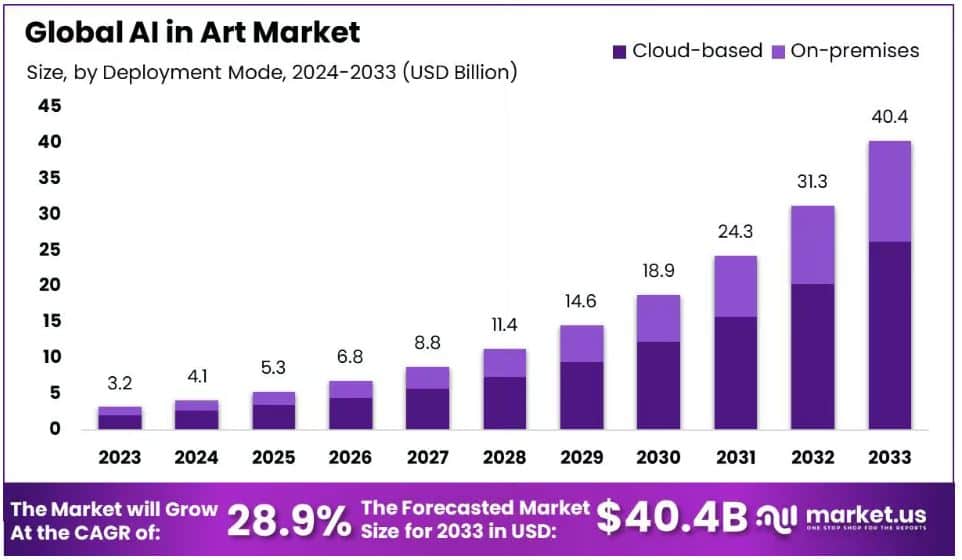
- The global AI in art market was valued at USD 4.1 billion in 2024 and USD 5.3 billion in 2025.
- The market could grow further to USD 24.3 billion in 2031, USD 31.3 billion in 2032, and USD 40.4 billion by 2033.
- Overall, the market is expected to grow at a compound annual growth rate of 28.9%.
- Cloud-based deployment is forecast to remain larger than on-premises deployment throughout the period.
Generative AI in Art Stats
(Source: market.us)
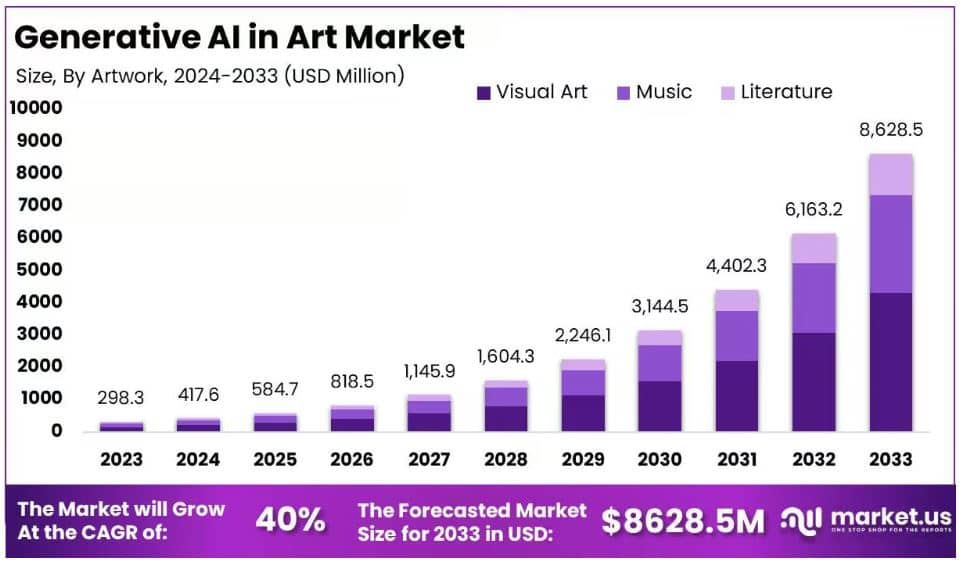
- The market was valued at USD 298.3 million in 2023 and USD 417.6 million in 2024.
- It could increase further to USD 4,402.3 million in 2031, USD 6,163.2 million in 2032, and USD 8,628.5 million by 2033.
- Overall, the market is expected to expand at a compound annual growth rate of 40%.
- Visual art is forecast to remain the largest segment, followed by music and literature.
Use of AI in the Creative Process
- Among surveyed artists, 13% said they use AI in parts of their creative process, rather than using AI to generate the final artwork.
- The survey suggests that many creative professionals view AI mainly as a support tool for selected tasks, not as the primary medium for making art.
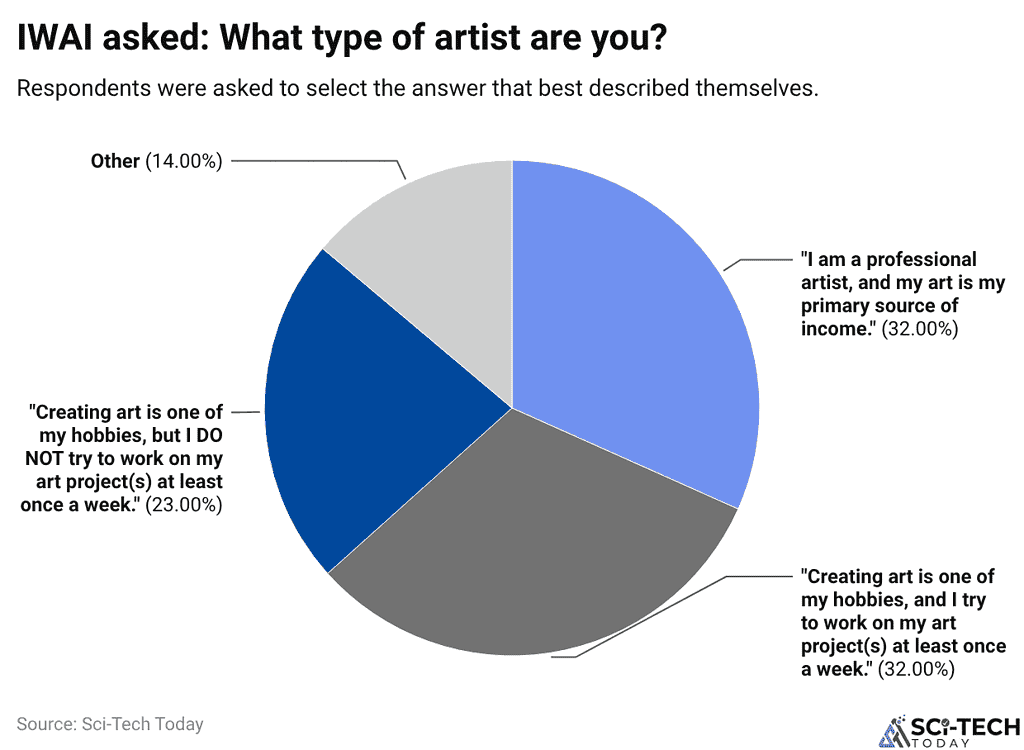
- 32% of respondents were professional artists whose art was their main source of income.
- Another 32% created art as a hobby and worked on art projects at least once a week.
- 23% created art as a hobby but did not work on art projects at least once a week.
- The remaining 14% selected another description of their artistic activity.
(Reference: innovatingwithai.com)
Public Response to AI-Generated Art
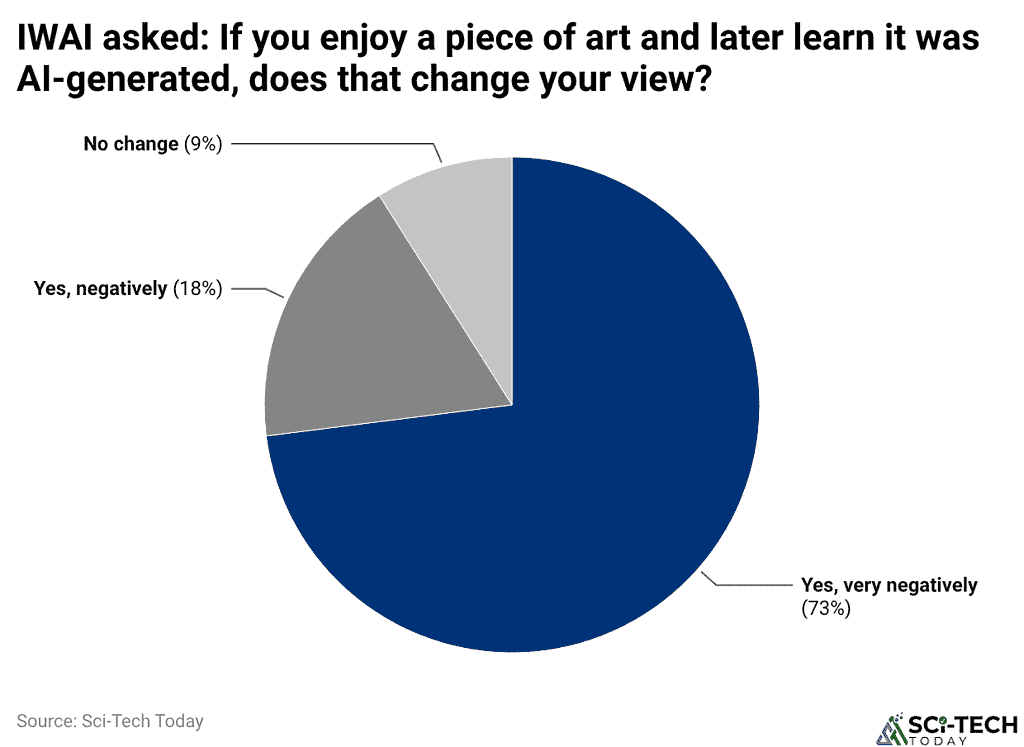
- A poll of IWA’s audience found that 73% of respondents would view an artwork very negatively if they enjoyed it first and later discovered it was AI-generated.
- Another 18% said learning that the artwork was AI-generated would change their opinion negatively.
- Only 9% said the disclosure would cause no change in their view.
- Overall, 91% of respondents reported a negative reaction to discovering that an artwork they liked had been created by AI.
(Reference: innovatingwithai.com)
Public Views on How AI Could Shape Art Discovery
- 31% of respondents viewed AI recommendations as a complementary tool that could support existing art-discovery methods.
- 29% considered AI-powered discovery a concern for the art-market ecosystem.
- 19% believed AI discovery tools could help attract new buyers to the art market.
- 16% expected AI to have only a limited role, with collectors continuing to depend on galleries and curators.
Benefits of Using AI in Art
- Markets that allowed generative-AI images received 78% more images per month than markets where AI-generated images were not allowed, with the growth driven almost entirely by generative-AI content production.
- Markets with generative-AI images had 88% more active firms per month than markets without those images, with the rise driven primarily by sellers using generative AI.
- Total image sales increased by 39% after generative-AI images entered the marketplace, as consumers purchased more images thanks to a wider selection and improved overall quality.
- Overall image quality improved after generative AI entered the platform, and quality also improved among non-AI images, likely because competitive pressure pushed lower-quality human creators to exit while stronger creators remained.
- AI-generated images added variety to the marketplace rather than simply replicating existing human-created content.
Accuracy of AI-Generated Art Detection
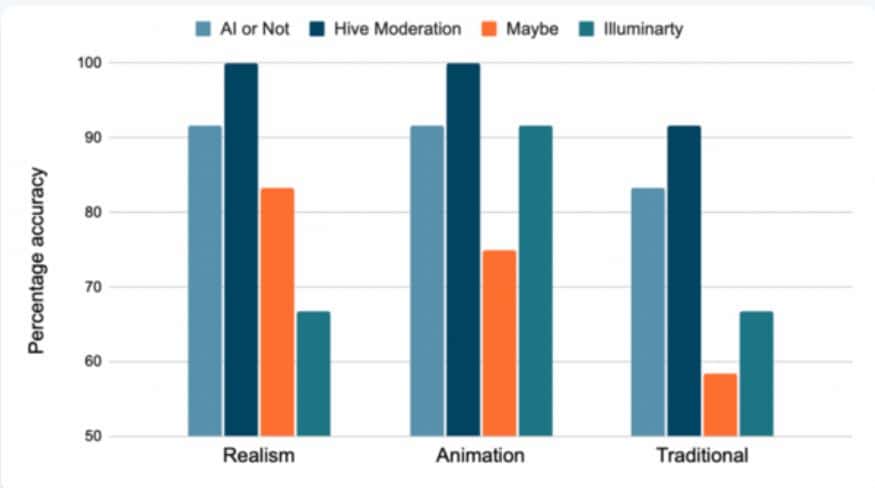
- Emerging investigators stated that machine-learning models could distinguish AI-generated images from human-created images across realism, animation, and traditional-art styles.
- Models achieved slightly higher accuracy for environmental images at 84.7% than for images featuring human characters at 81.9%.
- Realistic images produced the strongest results: approximately 100% accuracy for the “Hive Moderation” model, 92% for “AI or Not,” 84% for “Maybe,” and 67% for “Illuminarty.”
- For animation-style images, the corresponding accuracy rates were about 100%, 92%, 75%, and 92%.
- For traditional-art images, accuracy was approximately 92% for Hive Moderation, 83% for AI or Not, 58% for Maybe, and 67% for Illuminarty.
(Source: innovatingwithai.com)
How Artists Use Text-to-Image AI Tools
- Among surveyed artists who use text-to-image technology, 35.10% use it to explore new creative ideas.
- 30.30% create image assets that are later used in other projects.
- 14.20% use text-to-image tools mainly for fun.
- 11.20% use the technology to create almost complete digital artworks.
- The remaining 9.20% reported other forms of use.
Generative AI Image Tools’ Global Market Share in 2026
- Canva accounted for an estimated 64.4% of visits among selected AI image-generation websites in August 2026, with approximately 870.4 million visits.
- Midjourney represented around 7.8% of traffic within the same selected platform set, based on approximately 105.2 million visits.
- Leonardo AI captured an estimated 1.3% of traffic, with approximately 18.2 million visits.
- Ideogram accounted for about 0.95%, based on approximately 12.9 million visits.
- Adobe Firefly represented roughly 0.57% of traffic, with approximately 7.7 million visits. This excludes Firefly use embedded inside Adobe applications.
- DreamStudio accounted for around 0.22%, with approximately 3.0 million visits. This excludes Stable Diffusion use through third-party services and local installations.
- Other selected tools collectively represented approximately 24.8% of traffic.
| AI image tool | Estimated traffic share | Approximate monthly visits |
| Canva | 64.4% | 870.4 million |
| Midjourney | 7.8% | 105.2 million |
| Leonardo AI | 1.3% | 18.2 million |
| Ideogram | 0.95% | 12.9 million |
| Adobe Firefly | 0.57% | 7.7 million |
| DreamStudio | 0.22% | 3.0 million |
| Other selected tools | 24.8% | Not specified |
What is the Future of AI in Art?
- AI is likely to become a standard creative assistant, as 86% of surveyed creators already used creative generative AI in 2025. In the same survey, 55% used it for editing and enhancement, 52% for generating images and videos, and 48% for developing ideas.
- Future creative systems are expected to become more personalized, with 85% of surveyed creators saying they would consider using an AI agent that learns their individual creative style. Moreover, 60% had used more than one generative AI tool during the previous 3 months.
- AI could play a larger role in art discovery because 20% of high-net-worth collectors reported using AI recommendations or applications in 2025.
- However, industry opinion remains divided: 31% viewed AI recommendations as a complementary aid, 29% considered them a concern, 19% believed they could attract new buyers, and 16% expected AI to have only a limited role.
Summary
AI in art is expanding fast, boosting supply, sales, and quality in creative marketplaces, while most artists still use it only as a supporting tool rather than a replacement. Public opinion remains sharply negative toward undisclosed AI-generated art, even as creators increasingly adopt generative tools for editing, ideation, and exploration.
Canva dominates AI image-tool traffic, and detection accuracy still varies widely across styles. Rising market value and collector interest point to an expanding role for AI in art discovery.
FAQ
AI art generators are trained on large datasets of images to learn patterns, styles, and visual elements, then use that knowledge to create new images based on text descriptions, reference images, or other creative inputs from users.
AI-generated art is created by identifying patterns and styles from training data rather than directly copying specific images, though debates continue about originality, inspiration, and how closely AI outputs can resemble existing artists’ work.
Copyright rules for AI generated art vary by country and are still evolving, with some jurisdictions requiring significant human creative input for copyright protection, while fully AI generated images may not qualify for copyright in certain regions.
Artists have mixed reactions, with some embracing AI as a creative tool to enhance their work and others raising concerns about job displacement, unauthorized use of their art in training data, and the devaluation of human-made art.
Popular AI art tools include platforms that generate images from text prompts, tools that transform photos into different artistic styles, and software that assists with digital painting, concept art, and animation.
Yes, AI-generated art is increasingly used in advertising, marketing materials, book covers, video game assets, and social media content, though commercial use raises ongoing legal and ethical questions around copyright and consent.