









Initial Assessment
AI In BPO Statistics: Artificial Intelligence is reshaping the BPO industry by making everyday business operations faster and easier. Today, companies use AI tools to handle customer queries, process data, manage workflows, and automate routine tasks. Solutions such as chatbots, virtual assistants, and robotic process automation help businesses save time, lower costs, and improve service quality. AI also enables BPO companies to handle more customer requests, reduce manual errors, and provide 24/7 support.
As demand for faster, more efficient services grows, AI is becoming an integral part of BPO operations. However, companies must also address data security, employee training, and the impact of automation on jobs.
Editor-Approved
- The global AI market in business process outsourcing is projected to reach USD 4.7 billion in 2025 and USD 6.3 billion in 2026.
- In 2026, 43% of surveyed enterprises primarily use AI in BPO to improve operational efficiency, while only 14% have achieved AI-first outcome delivery.
- AI replacement plans are most concentrated in customer experience, which accounts for 41% of planned adoption.
- 78% of businesses planned to increase investment in AI-powered BPO automation by 2025 to improve efficiency.
- Pure-play BPO providers improved profitability by 9%, despite a -6.6% ISG AI Index score. Besides, revenue and revenue per employee grew 1% and 2%, respectively.
- Customer experience leads adoption, with 29% manual, 49% using AI for efficiency, and 22% focused on AI-first outcomes.
- Innovation is expected to gain momentum, with 70% of buyers anticipating improvements and only 8% expecting a decline.
- In April 2026, voice AI is transforming contact center operations by reducing the cost of a routine call from USD 7-12 to just USD 0.40-1.30.
- Hiring for BPO and IT-enabled services increased by 21% YoY in early 2026.
- Vsynergize AI, founded in 2001, has 1,200+ employees and has delivered 500+ AI BPO projects.
- AI chatbots handle 70% of customer interactions without human assistance.
Global AI in BPO Market Size
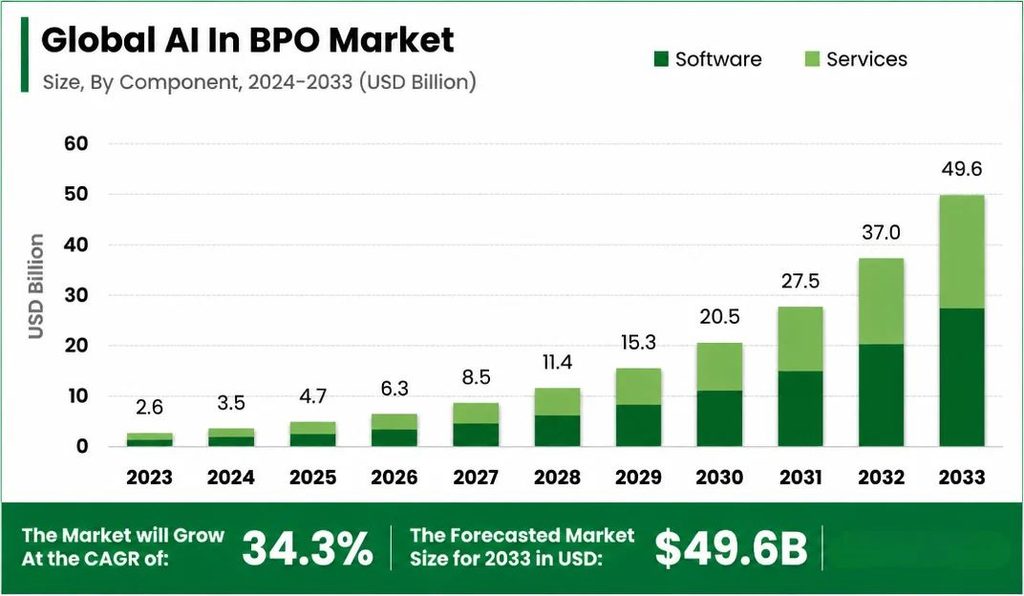
- The global AI market in business process outsourcing is projected to reach USD 4.7 billion in 2025 and USD 6.3 billion in 2026.
- By 2033, the market is forecast to reach USD 49.6 billion, with a compound annual growth rate of 34.3%.
BPO Industry Size and Leading Companies
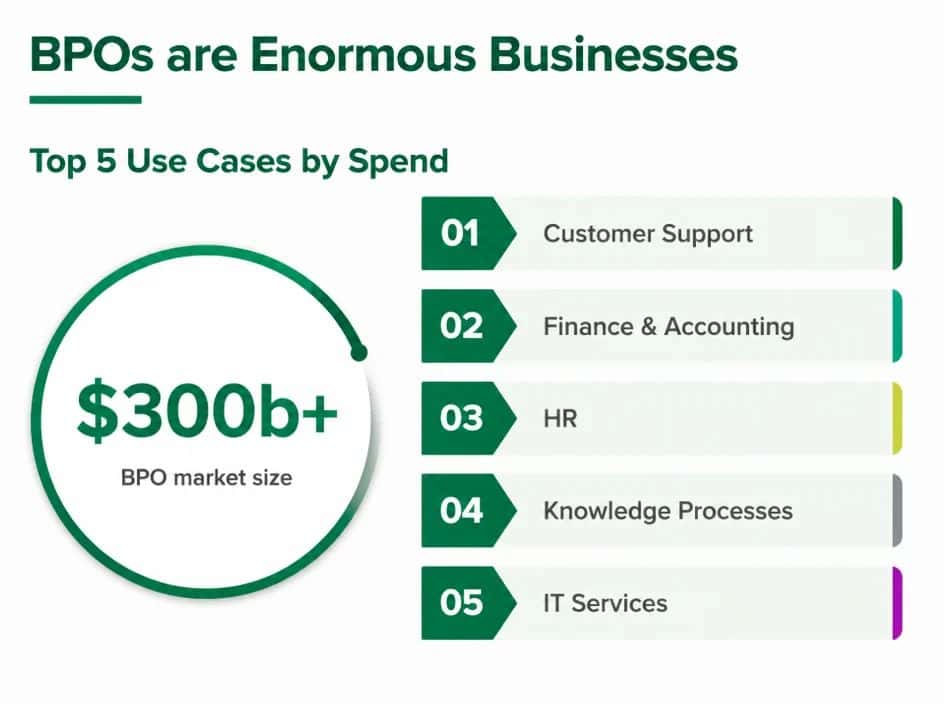
- The global BPO market is valued at more than USD 300 billion in 2025.
- Among major industry players, Accenture leads with USD 64.9 billion in revenue, followed by TCS at USD 29.1 billion, Cognizant at USD 19.3 billion, Infosys at USD 18.6 billion, and Wipro at USD 10.7 billion.
Key AI Adoption and Transformation Statistics in the BPO Industry
- In 2026, 43% of surveyed enterprises primarily use AI in BPO to improve operational efficiency, while only 14% have achieved AI-first outcome delivery.
- 67% of enterprises expect their BPO providers to lead AI adoption, according to a 2026 ISG study.
- 65% are willing to redesign existing business processes if AI can significantly improve results.
- 56% of enterprises lack the internal skills required to govern AI-enabled BPO operations effectively.
- 66% measure BPO return on investment using cost and financial metrics.
- 58% of industry-specific BPO operations remain manual or labor-led, while only 6% have achieved AI-first outcomes.
- A report published by Andreessen Horowitz stated that Wipro reported a 140% increase in AI adoption across existing projects, while Infosys deployed 100+ generative AI agents.
- Accenture secured USD 1.2 billion in generative AI bookings.
AI Adoption Priorities Across BPO-Relevant Services
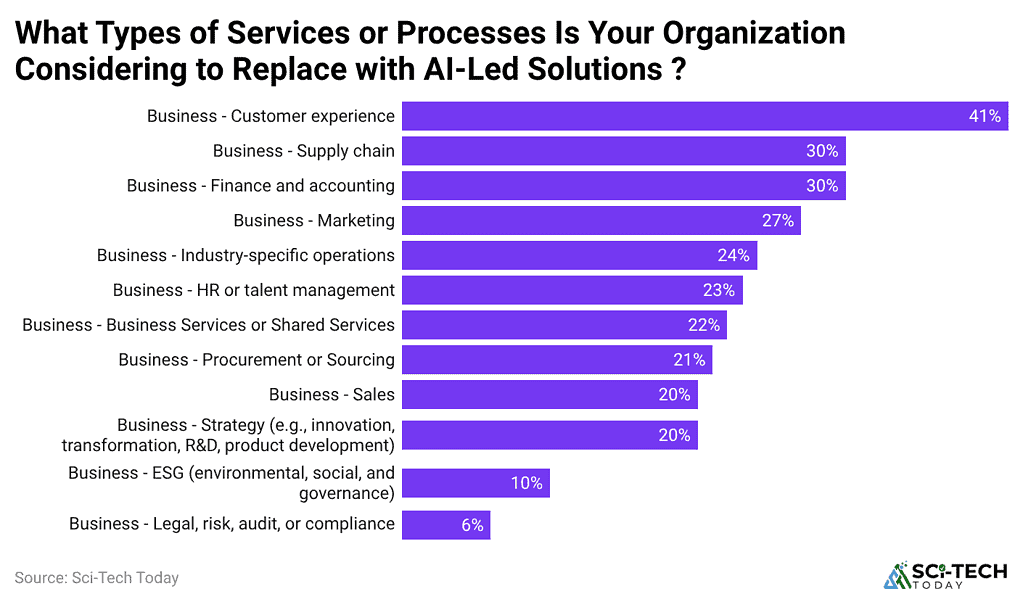
- AI replacement plans are most concentrated in customer experience, which accounts for 41% of planned adoption.
- Moreover, supply chain, finance, and accounting follow at 30% each.
- Marketing represents 27%, while industry-specific operations account for 24%.
- AI adoption plans cover HR and talent management at 23% and business or shared services at 22%.
- Procurement and sourcing account for 21%, while sales, strategy, innovation, transformation, R&D, and product development each represent 20%.
- ESG services account for 10%, whereas legal, risk, audit, and compliance have the lowest share at 6%.
Real-World Impact of AI Adoption in BPO
- A report published by Staple AI stated that 78% of businesses planned to increase investment in AI-powered BPO automation by 2025 to improve efficiency.
- AI customer support agents achieve 80% resolution rates and help improve customer satisfaction.
- AI assistants increase leadership team productivity by 30% by automating repetitive tasks.
- The business process automation market is projected to reach USD 38 billion by 2032.
- Microsoft 365 Copilot users save 2 hours per employee per month on operational tasks, freeing up time for innovation.
AI Creates Uneven Growth Across BPO and Technology Providers
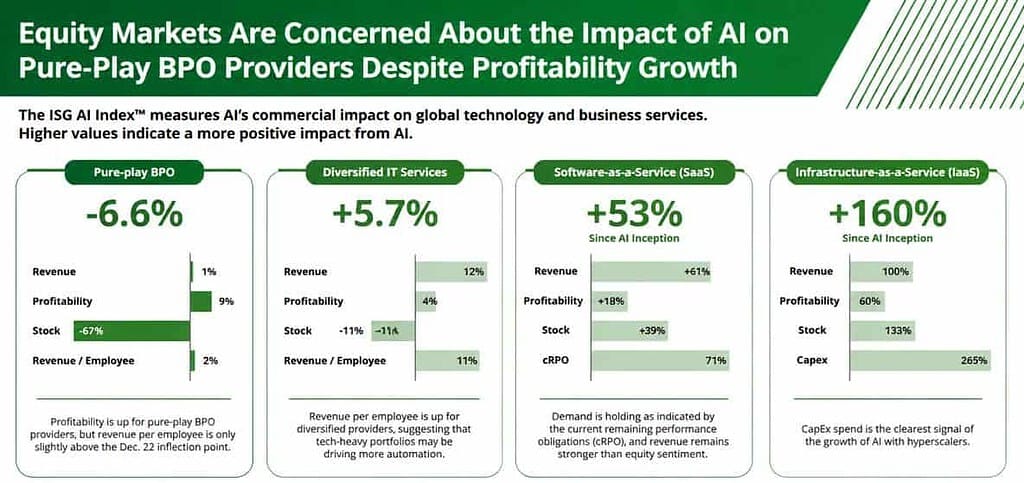
Pure-play BPO providers
- Despite a 9% increase in profitability, BPO companies recorded a -6.6% score on the ISG AI Index.
- Revenue grew just 1%, while revenue per employee improved by 2%.
- However, their stock price fell by 67%, and productivity remained only slightly above the December 2022 level.
Diversified IT services
- These companies delivered stronger operational growth, with revenue up 12%, profitability up 4%, and revenue per employee up 11%.
- However, their stocks declined 11%, resulting in an AI Index score of +5.7%.
SaaS providers
- It recorded 61% revenue growth and 18% higher profitability.
- Additionally, stocks increased by 39%, while remaining performance obligations increased by 71%.
IaaS providers
- Infrastructure providers recorded the strongest gains, with revenue up 100%, profitability up 60%, and stock prices up 133%.
- Capital expenditure also surged 265%, reflecting heavy investment in AI infrastructure.
BPO Transformation Progress Varies Across Segments
- According to ISG’s State of BPO Report 2026, overall, 43% of respondents remain manual or labor-led.
- Customer experience leads adoption, with 29% manual, 49% using AI for efficiency, and 22% focused on AI-first outcomes.
- Industry-specific services lag, with 58% manual, 36% using AI for efficiency, and 6% focused on AI-first outcomes.
- Back-office operations remain varied, with 44% relying on manual processes, 42% adopting AI to improve efficiency, and 14% prioritizing AI-first outcomes.
- InfineneTech’s report on June 26, 2026, says AI-powered document processing can reduce insurance claim turnaround times from 3 days to 6 hours and lower error rates from 8% to below 1%.
- In accounts payable, intelligent document processing can reduce manual invoice reviews from 100% to just 5%.
- Intelligent process automation can reduce insurance renewal processing time by 70% and error rates by 85%.
- AI customer support agents can achieve 80% resolution rates.
- Meanwhile, healthcare AI solutions have reduced claim denials by 80% and processing time by 50%.
Expected Changes in BPO Operations by 2027
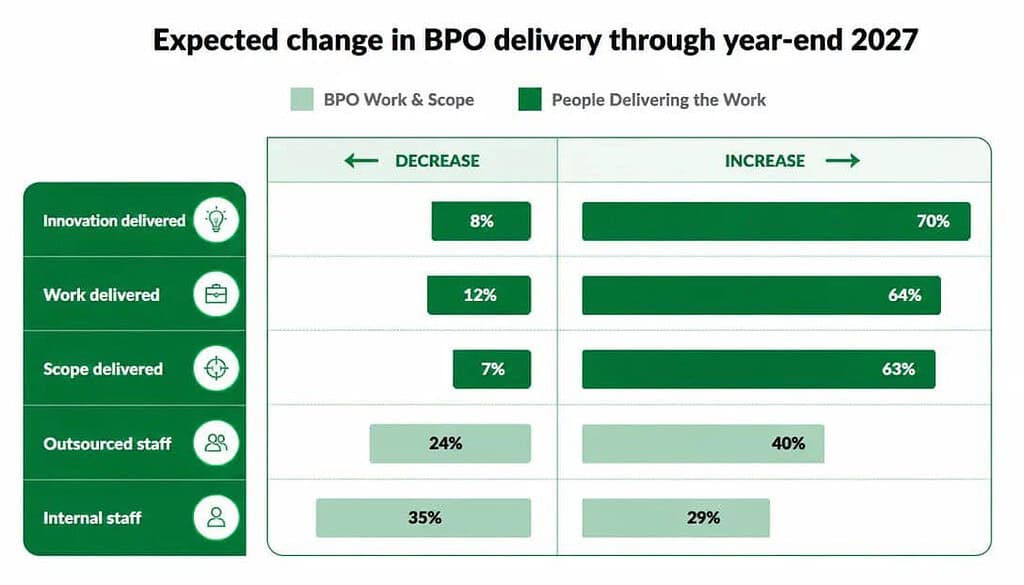
- Innovation is expected to gain momentum, with 70% of buyers anticipating improvements and only 8% expecting a decline.
- BPO providers may handle more work as 64% of buyers expect higher output, while 12% foresee a decrease.
- Around 63% of buyers plan to expand outsourced services, while 7% expect to reduce them.
- Staffing demand is likely to increase for 40% of buyers, although 24% expect fewer outsourced employees.
- Meanwhile, 29% anticipate hiring more employees, and 35% expect their internal workforce to shrink.
Voice AI Drives Major Cost Savings in BPO Operations
- According to a report published by LYRIQ AI in April 2026, voice AI is transforming contact center operations by reducing the cost of a routine call from USD 7-12 to just USD 0.40-1.30.
- Around 67% of Fortune 500 companies are reportedly running production voice AI systems.
- Gartner forecasts that voice AI could eliminate USD 80 billion in contact center labor costs.
- According to a Forrester Consulting study, enterprise voice AI solutions can deliver a 391% ROI over three years.
- The BFSI sector leads adoption with a 32.9% market share, while 78% of the top 50 banks have deployed production voice agents, compared with 34% two years earlier.
- North America accounts for 40.2% of the global voice AI market.
- The global market is valued at USD 22.5 billion in 2026 and is projected to reach USD 47.5 billion by 2034, growing at a 34.8% CAGR.
AI-Augmented BPO: Illustrative Cost of Ownership
| BPO Pricing Tier | Resolutions Per Month | Cost Per Resolution (USD) | Monthly Cost (USD) | Annual Cost (USD) | Coverage |
| Low end | 100,000 | 1.25 | 125,000 | 1,500,000 | AI automation with human backup |
| Mid-range | 100,000 | 2.00 | 200,000 | 2,400,000 | |
| High end | 100,000 | 3.00+ | 300,000+ | 3,600,000+ |
How AI Improves BPO Speed and Accuracy
- According to ARDEM Incorporated, AI can improve BPO processing speed and accuracy by up to 10 times.
- Deloitte reports that 70% of BPO companies use AI and robotic process automation, completing tasks 3 times faster with 50% fewer errors.
- McKinsey reports that AI can process 1,000+ invoices in minutes and reduce human errors by up to 90%.
- In healthcare, AI-powered claims processing can achieve 98% data accuracy.
- In logistics, AI reduces manual bill-of-lading processing by 65%.
BPO Hiring Growth and AI’s Impact on Employment
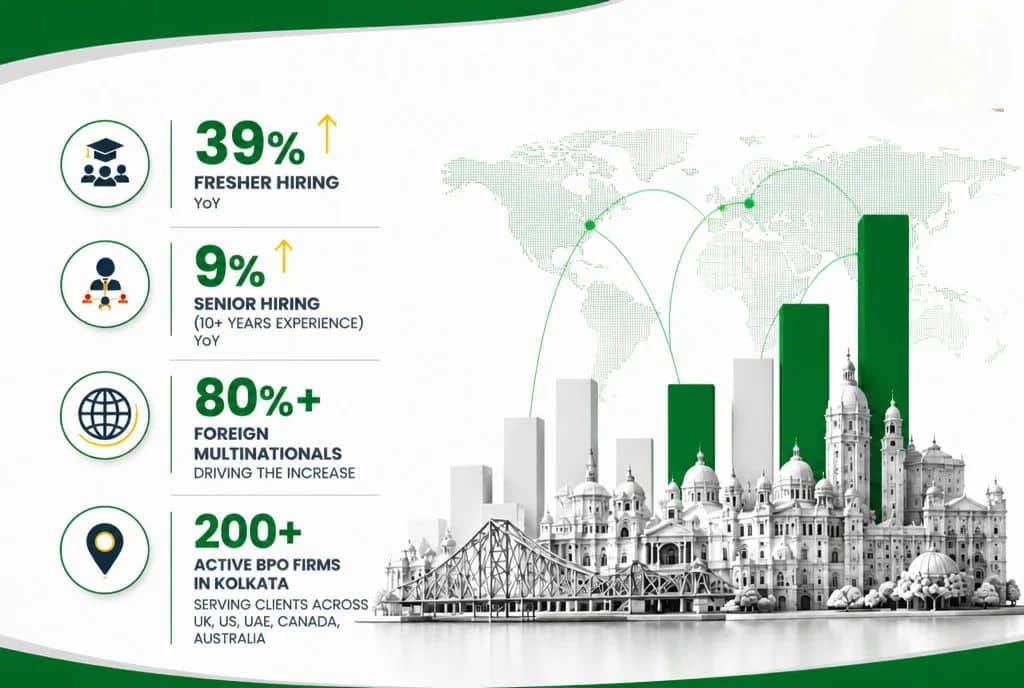
- Hiring for BPO and IT-enabled services increased by 21% YoY in early 2026.
- Fresher recruitment surged 39% YoY, indicating continued demand for entry-level employees despite AI adoption.
- Hiring for experienced professionals with 10+ years of experience grew 9% YoY.
- Foreign multinational companies accounted for more than 80% of the increase in hiring.
- Kolkata has more than 200 active BPO companies serving clients across the U.S., UK, UAE, Canada, and Australia.
BPO Operational Performance Comparison: Pure AI, Hybrid AI-Human, and Traditional Human Agents
| Operational Vector | Pure AI Agent Tier | Hybrid Co-Pilot Tier (MasCallNet) | Pure Human Tier (Legacy) |
| Target Scope | Structured L1 Transactions | Complex L2 Escalations | High-Value VIP Exceptions |
| Average Handle Time | <15 seconds | 110-160 seconds | 480+ seconds |
| First Contact Resolution | 72% | 91% | 64% |
| Scalability Limit | Infinite (API Elasticity) | Linear-Elastic (Augmented) | Rigid (WFM Constrained) |
| Context Retention | 100% Machine Logging | 100% AI-Summarized Handoff | 45% Manual Agent Tagging |
How AI Is Making BPO Operations Faster and More Cost-Effective
- According to ARDEM Incorporated, 83% of organizations consider AI and automation essential to staying competitive over the next 5 years.
- Businesses using AI-driven BPO report operational cost reductions of up to 50% and processing speed increases of up to 60%.
- AI and robotic process automation can reduce errors by up to 80%.
- The AI outsourcing market will exceed USD 31 billion by 2027.
Top AI BPO Companies in 2026
Vsynergize AI:
- According to Vsynergize’s Top AI BPO Companies in 2026, Vsynergize AI, founded in 2001, has 1,200+ employees and has delivered 500+ AI BPO projects.
- Its Angel AI assistant reportedly reduces response time by 50%, increases customer satisfaction by 30%, cuts support costs by 20%, and improves customer retention by 40%.
Accenture:
- Founded in 1989, Accenture employs 774,000+ people across 49 countries and serves 9,000+ clients.
- It has delivered over 700 generative AI projects and generates over USD 64 billion in annual revenue.
Cognizant:
- Founded in 1994, Cognizant employs approximately 349,800 people across 40 countries.
- Its AI solutions have generated USD 900 million in client savings, up to 8 times ROI, and 600% faster claim processing.
- Q3 2025 bookings reached USD 27.5 billion, with 5.9% YoY growth.
Teleperformance:
- Founded in 1978, Teleperformance employs approximately 410,000 people across 91 countries and serves 170 markets.
- It manages 3 billion+ customer interactions annually and maintains an average client tenure of 13 years.
Concentrix:
- Founded in 1983, Concentrix employs 300,000+ people across 70 countries and serves 2,000 clients.
- It has received 176 industry awards and ranked No. 426 on the 2025 Fortune 500.
- Its AI tools support 150 languages, combining automation and human expertise to improve customer experience.
Popular AI Uses in Customer Service Statistics
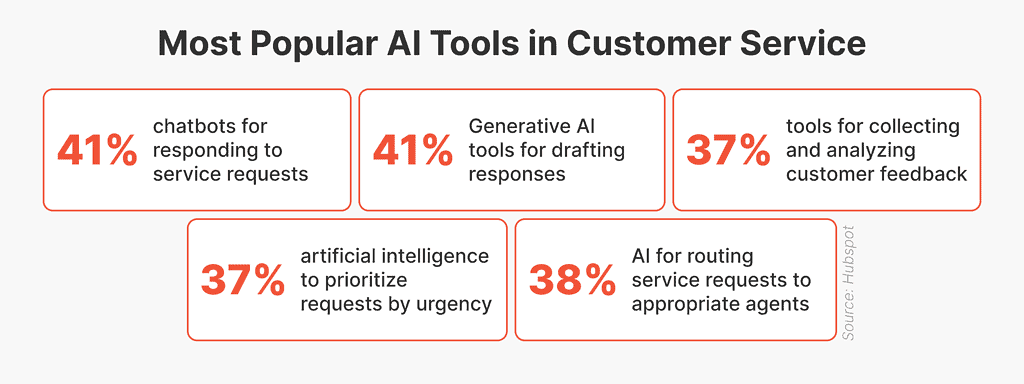
- Chatbots that answer service requests and generative AI tools that draft responses both lead adoption at 41%.
- AI tools that direct requests to suitable agents follow at 38%.
- Tools that collect and analyze customer feedback and those that give priority to urgent requests each account for 37%.
AI Chatbot Statistics Highlighting ROI in the BPO Industry
- HoduSoft reported that AI chatbots handle 70% of customer interactions without human assistance.
- Businesses reported a 67% increase in sales after adopting AI chatbots.
- Around 90% of businesses experienced faster complaint resolution through chatbot services.
- Chatbots can improve customer retention by up to 30% through faster support.
- Business leaders reported up to a 24% improvement in customer support satisfaction scores after implementing AI chatbots.
Final Overview
AI is reshaping the BPO industry by helping companies save time, lower costs, and serve customers better. From handling routine tasks to supporting business decisions, AI tools are making daily operations simpler and faster. However, companies still need to address data security, adoption costs, and employee training.
In the coming years, BPO providers that balance AI technology with human expertise will have better opportunities to improve services and remain competitive.
FAQ
AI is transforming traditional BPOs through automation, faster service delivery, lower costs, and smarter customer support.
AI automates customer support, chatbots, data processing, invoice management, fraud detection, quality monitoring, and workflow optimization in BPO operations.
Traditional automation follows fixed rules, while AI learns, adapts, and makes decisions independently.

Sources