









Introduction
Interactive Learning Statistics: Interactive learning has turned into one of the fastest-growing segments of the global education technology (EdTech) industry in 2026. Schools, universities, corporate training providers, and online education platforms are more and more picking up AI powered tutoring, gamification, virtual classrooms, augmented reality (AR), virtual reality (VR), adaptive learning systems, and collaborative learning tools, all aimed at improving engagement and learning results.
And the quick rise of cloud computing, artificial intelligence, and personalized education is basically pushing investments in interactive learning technologies forward around the world. Reports from UNESCO, Coursera, Fortune Business Insights, and other market research firms suggest that interactive learning is reshaping both academic education and workplace learning, while also building a multibillion-dollar global market.
Editor’s Choice
- The global interactive learning market is expected to move from USD 24.68 billion in 2026 to USD 37.88 billion by 2033, with a 7.4% CAGR.
- In 2026, software solutions will make up 47.3% of the interactive learning market.
- North America holds 41.6% of the market, while Asia Pacific (23.8%) is expected to grow more quickly.
- 74% of teachers now use digital game-based learning, and still, 93% of classroom time remains focused on learning activities when these methods are used.
- 79% of faculty already weave AI into teaching, and 76% think AI will change education in a major way over the next few years.
- Active learning improves academic performance too, with students reaching 54% higher test scores and becoming 1.5 times less prone to fail compared to learners inside lecture-based classrooms.
- Pearson 2026 study kinda suggested that if students use an AI-powered study tool one time, they’re around 23x more likely to become active readers, or at least that’s what the numbers imply.
- The game-based corporate training space is growing roughly 53.4% CAGR, and then microlearning boosts performance by 17%, plus there’s this engagement lift of 50% as well.
- 82% of organizations rolling out AR and VR training say the outcomes meet, or even go beyond.
- 94% of internet usage shows up in high-income countries versus only 23% in low-income countries, and that mismatch clearly limits global access to interactive learning for many people.
Interactive Learning Market Size
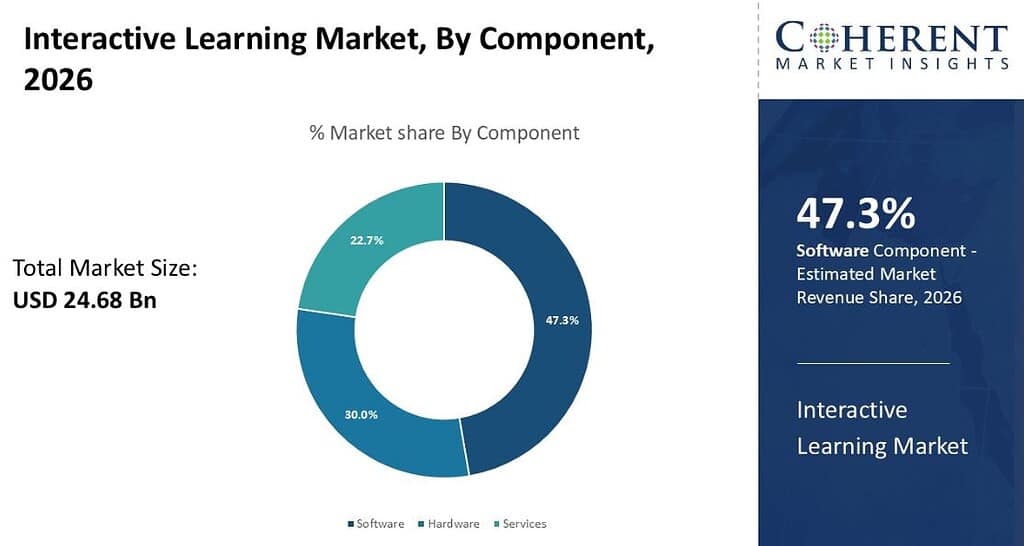
(Source: coherentmarketinsights.com)
- The interactive learning market looks like it is moving into a pretty steady expansion phase, mostly because more and more schools, universities, and companies are asking for digital education technologies.
- Based on the data you shared, the global market should grow from USD 24.68 billion in 2026 up to USD 37.88 billion by 2033, which suggests a solid compound annual growth rate of 7.4%. This kind of sustained rise implies that organizations are still putting money into immersive learning experiences, and those tend to support better knowledge retention and keep learners more involved.
- Software is projected to stay the market leader; it is expected to represent 47.3% of the market share in 2026, so learning platforms, assessment tools, and interactive content solutions are becoming more central than before.
- In the education space, the K-12 segment is expected to dominate, with about 33.4% of total market share in 2026, showing that primary and secondary schools are increasingly adopting technology-enabled learning.
- By geography, North America should keep leading with 41.6% of the global market share in 2026, largely because the digital infrastructure is strong there and EdTech adoption is widespread.
- Asia Pacific, with 23.8% of the market share in 2026, is also expected to be the fastest- growing region, as governments and education institutions continue to expand investment into digital learning ecosystems.
- Taken together, these signals suggest that interactive learning will stay a meaningful growth area inside the broader education technology industry.
Evolution Of Interactive Learning
- Interactive learning really moved education away from a stiff, teacher-directed structure into something more flexible and student-centered. In the early days, classrooms tended to follow a straight-line teaching method.
- Teachers controlled the pace of knowledge, while students were basically expected to move through lessons in a set sequence.
- Learning leaned heavily on lectures, recitations, homework, and projects, which meant there was not much space for customization or real active involvement.
- As technology advanced, education kind of shifted, with hypermedia learning showing up, where lessons started using visual plus audio resources to make things more engaging.
- Even though those digital tools really helped the classroom atmosphere, teachers still were basically the main source of knowledge.
- The big change happened when educational philosophy moved toward learner-centered teaching, and it became clear that students learn better when they actively join in the process, not just watching quietly.
- Modern interactive learning leans on collaboration, talk, working through problems, and even tailored learning, instead of just feeding students content in a passive way.
- Nowadays, educators often act more like facilitators; they help steer discovery, they push critical thinking, and they back each person’s learning route, instead of simply handing out facts.
- The change seems to create more engaging classrooms, boosts learner involvement, and sets up the technology-enabled education patterns that keep shaping schools, universities, and training programs across the world.
Game-Based Learning And AI Are Reshaping Modern Classrooms
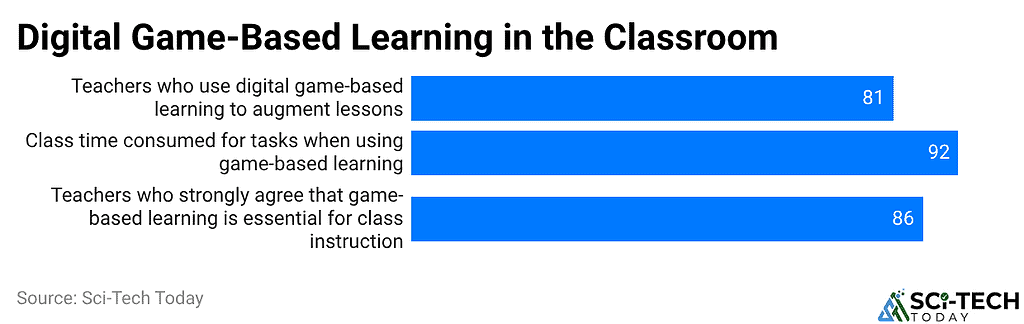
(Reference: research.com)
- Interactive learning is kinda becoming a core piece of modern education, with game -based learning and artificial intelligence kinda nudging teachers toward better student engagement and more solid classroom outcomes.
- Market Research Future (2025), 74% of teachers now use digital game-based learning to strengthen their lessons, which shows that it is spreading across schools.
- According to García-González et al. (2024), 93% of classroom time still stays on learning tasks when game-based approaches are used. So, students seem more attentive and more involved, not just “playing around”.
- About 91% of younger learners have played educational games, while 95% of school -age children actively play video games. This gives educators a pretty ready base to blend interactive learning into lessons.
- Only 46% of households have access to the technology needed for video game-based learning, and that keeps showing the digital divide as a real obstacle for wider use (UNICEF, 2024).
- According to Pew Research Center (2025), about 86% of teachers say game-based and digital learning tools are essential for better engagement and learning results, and around 65% of U.S. teachers back the idea of keeping these tools inside classrooms.
- Digital Education Council, 2026, AI is moving fast through day-to-day teaching, with 79% of faculty already using AI in instruction and 76% expecting meaningful, maybe even transformative shifts for education soon.
- Put together, these numbers suggest interactive technologies are turning into a kind of long-term base for the future classroom.
Active learning Statistics
- The newest active learning figures show that how much students take part is becoming one of the clearest signals for academic success.
- Freeman et al. (2014) and the University of Washington (2025) meta-analysis indicate learners in active learning settings earn 54% higher test scores than students in standard lecture-centered courses, which sort of reinforces that interactive teaching supports deeper retention and understanding. Students in lecture-based courses are 1.5 times more likely to fail compared with students in active learning environments.
- University of Washington (2025) reported an average exam score lift of 0.519 standard deviations across STEM areas, and it said the effects stayed steady even when class size changes, course level shifts, or the discipline differs.
- Also, longer-running studies point out that learners who are exposed to active learning tend to do better in later courses, so it looks like the payoff goes way past a single semester.
- A February 2026 Pearson study, looking at nearly 80 million learning interactions from close to 400,000 higher education students, found that using an AI-powered study tool one time increased the odds of becoming an active reader by 23 times.
- In other words, blending interactive instruction with AI-enabled learning tools seems to be reshaping education, boosting participation, cutting down on failure rates, and creating stronger academic outcomes over time.
Interactive Learning Statistics By Industry Sector
Education Sector
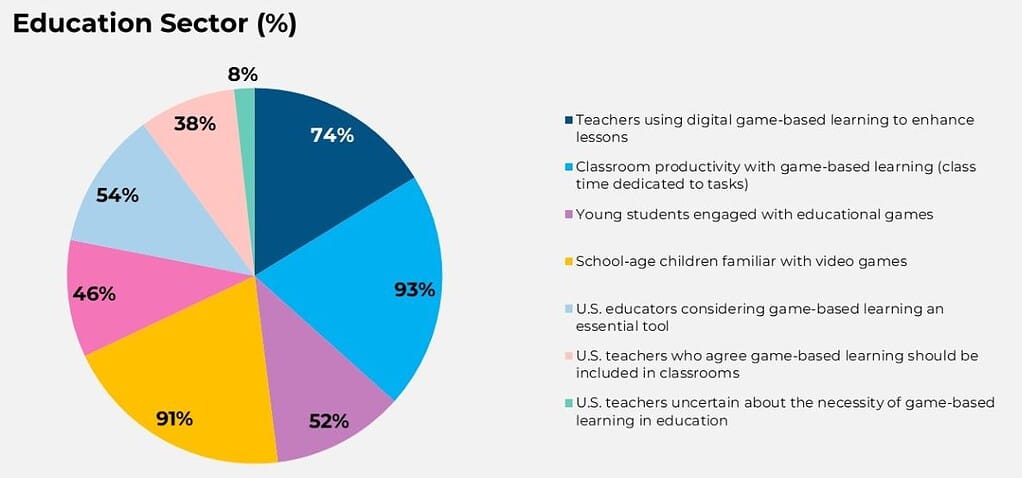
(Source: market.biz)
- Interactive learning is kind of turning into a cornerstone of modern education because schools increasingly blend digital tools with teaching that feels more lively, you know.
- Juraschka and Murray, around 74% of teachers say they already use digital game-based learning to polish classroom instruction, and it seems to help students stay attentive, with 93% of class time actually going to learning tasks.
- Also, students are getting comfortable with educational technology faster these days; for example, according to Deloitte, 52% of young learners are already interacting with educational games, while 91% of school-age children report being familiar with video games.
- According to Namuddu & Watts, though, there are adoption issues, mostly around accessibility, because only 46% of children have the kind of access or tech needed for game-based learning.
- Deloitte, with 54% of U.S. educators describing game-based learning as a necessary classroom tool, and only 8% remaining unsure about where it fits in education.
Workplace Sector
- Interactive learning is also kinda reshaping employee training, with organizations pushing for more immersive yet flexible learning experiences, you know, the kind that feel less like slides and more like real practice.
- The workplace game-based learning market is growing really fast; it’s reporting a strong 53.4% CAGR, which signals solid enterprise investment (Deloitte).
- Murray, Microlearning keeps showing tangible results too; it boosts learner performance by 17% and at the same time lifts engagement by 50%, so it’s often viewed as one of the better corporate training methods.
- On top of that, according to Deloitte, government funding adds even more weight to the shift, with the U.S. Pentagon handing Microsoft a USD 479 million contract to weave VR, AR, and AI into military training programs.
- Deloitte: 82% of organizations that deploy AR and VR say the outcomes either met or went beyond expectations, so it shows people are getting more confident in these immersive training solutions.
Device Usage In Education
- About 56% of U.S. students use laptops at least weekly, and 54% regularly depend on desktop computers during lessons.
- According to Fowler, Interactive content matters just as much; educational videos are used 67% of the time, and educational apps show up in 65% of classroom activities, which signals how multimedia learning resources are being integrated more and more.
Tablet Usage
- Tablets keep gaining attention, mainly due to portability, and they’re also easier to handle.
- 65% of students say they prefer tablets over laptops and desktops when they’re first introduced to devices, while 51% of U.S. students regularly use tablets in school.
- Plus, 52% of classrooms include educational video games every week, meaning tablet-friendly learning apps are becoming a normal part of instruction now.
Smartphone Usage
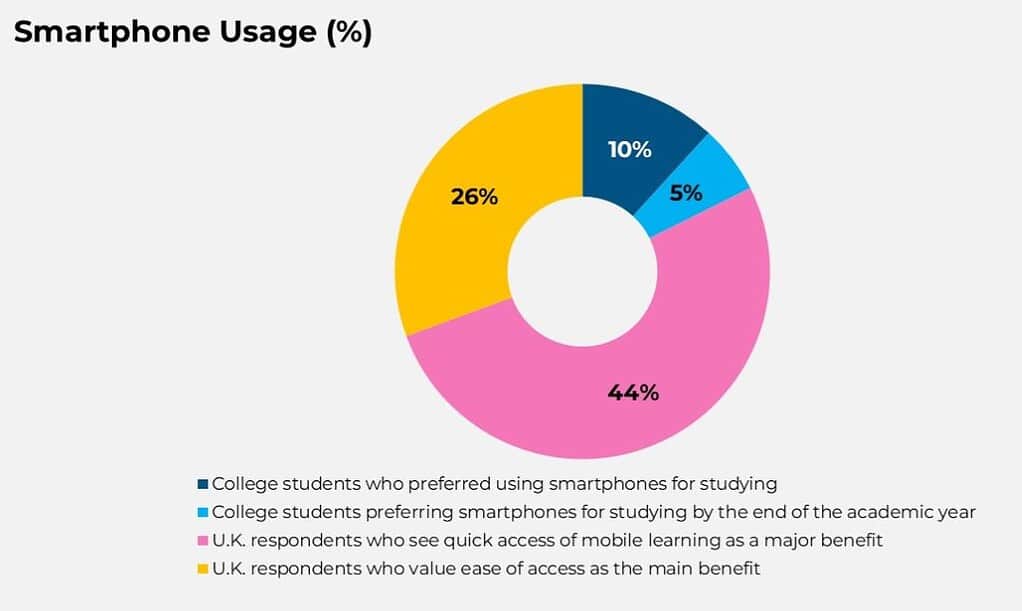
(Source: market.biz)
- Even though smartphones are pretty much everywhere, their educational use is still more specialized and a bit limited, like not fully the main tool.
- Student preference for using a smartphone as the main study device dropped from 10% at the start of the academic year to 5% by the end (Irwin). But still, specific mobile learning programs and targeted applications keep showing solid academic benefits.
- For example, in the Czech Republic, students who used an English-learning application reached an average score of 43.9 out of 60, while students who did not use it scored 31.8.
- At the same time, 44% of UK respondents say fast mobile access is the biggest advantage of mobile learning, and 26% point to convenience, plus easy access.
K-12 Education Statistics
- Interactive learning seems to bring real, measurable benefits across K-12 classrooms.
- Juraschka studies indicate that preschool children involved in gesture-based, interactive learning activities show stronger motor skills development and better learning outcomes.
- Similar positive academic results have also been seen with fourth-grade and eighth-grade students when interactive teaching approaches were used.
- In the 2015–2016 academic year, around 5 million K-12 students took part in online or virtual learning programs, and that points to an early scale-up of digital education.
Higher Education Statistics
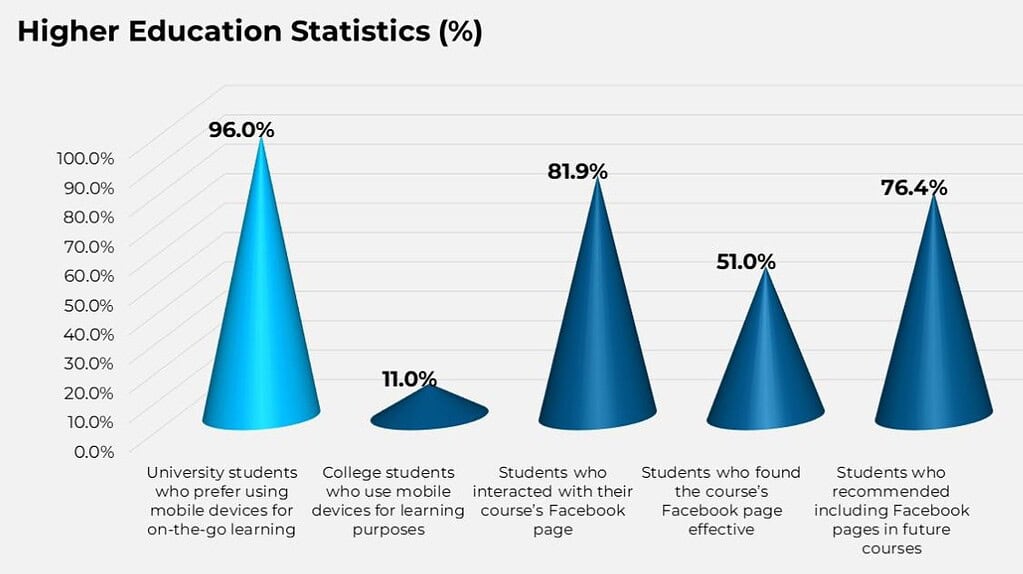
(Source: market.biz)
Higher education institutions are, yeah, increasingly embracing mobile and social learning, and it is kinda obvious why.
- About 96% of university students say they prefer mobile devices for learning while moving around, though only 11% of college students actually report using mobile devices as their primary learning tool.
- Social media then kinda fits in too, since it supports student engagement, with 81.9% of students interacting with course Facebook pages.
- Around 51% describe those pages as effective, and 76.4% recommend they be included in future courses, so it still shows the ongoing value of collaborative digital learning environments.
Interactive Learning Statistics: Overcoming The Digital Divide (Accessibility and Infrastructure)
- Interactive learning has major potential; however, its global success is still shaped by unequal digital access, in practice.
- The International Telecommunication Union (ITU) notes that internet usage is around 94% in high-income countries but drops to just 23% in low-income countries.
- At the same time, 96% of the world’s offline population lives in low- and middle-income nations.
- The connectivity gap isn’t only economic either; it is also geographical, where 85% of urban residents are online versus 58% of rural populations.
- It also varies by age, because 82% of people aged 15–24 are connected compared to 72% of older users, which underlines persistent inequalities in access quality.
- UNICEF says about 2.2 billion children and young people, almost two-thirds of the world’s youth group, do not have a stable internet connection at home.
- In the least developed countries, 4G actually reaches just 40% of people, but globally it’s around 85%, and that reduces access to interactive learning.
- When schools were closed because of the pandemic, more than two-thirds of kids everywhere could not join online education.
- At the same time, the World Bank notes that over one-quarter of the global population stays offline and 53% still do not have high-speed broadband, so the real issue of building useful digital connectivity is still there.
- In India, 97% of internet users get online via mobile phones. Also, rural smartphone ownership went from 36.5% in 2018 to 61.8% in 2020, and since 2015 rural internet access has basically tripled, rising about 35% each year.
- Mobile-first Education Report (2025): Rural internet penetration is 41% while urban areas reach 71%, so lightweight mobile-first learning becomes crucial, like not optional.
- Smartphone ownership rose by 18 percentage points in South Africa. Ghana moved from 15% up to 35% and Senegal from 13% to 34% across five years.
- Findings from the World Bank, ITU, and UNICEF indicate that although advanced interactive learning thrives in well-connected regions, smartphones and affordable mobile broadband remain the primary gateway to digital education for millions of learners worldwide.
Conclusion
Interactive learning has kind of turned into this cornerstone for modern education and workforce development, powered by artificial intelligence, gamification, adaptive learning, and immersive technologies. You can see strong market growth, more and more adoption of digital learning tools, and also measurable improvements in academic performance, which basically shows that interactive learning does a better job with engagement, helps people retain knowledge, and supports better learner outcomes.
At the same time, AI-powered education is speeding up more personalized learning experiences across schools, universities, and businesses. Still, though, dealing with the global digital divide is essential, so everyone gets equal access to these new things. And as tech keeps moving forward, interactive learning is expected to take a bigger and bigger role in forming the future of education worldwide.
FAQ
The global interactive learning market is valued at USD 24.68 billion in 2026, and it’s projected to climb to USD 37.88 billion by 2033.
In active learning settings, students reach 54% higher test scores, and they’re 1.5 times less likely to fail compared to traditional lecture-based classrooms.
About 79% of faculty already use AI in teaching, and 76% expect it will significantly reshape education.
It’s adopted by 74% of teachers, and it supports engagement, plus 93% of classroom time gets spent on learning activities.
The digital divide remains the primary challenge, with 94% internet adoption in high income countries compared to only 23% in low-income countries, limiting access to digital education.


