









Introduction
Voice Search Statistics: Voice search has rapidly become a core method of digital interaction, driven by the ubiquitous presence of smart devices like smartphones, smart speakers, and integrated virtual assistants.
As consumers increasingly opt for spoken commands over manual typing, understanding the latest voice search statistics is essential for any business aiming to maintain digital relevance.
So, this comprehensive report dives deep into the most current voice search statistics for 2026 and future outlook, providing the insights needed to adapt content strategies and adopt the immense commercial potential of the voice-first revolution. So, let’s get started.
Editor’s Top Picks
- The global penetration of voice search has solidified, with approximately 5% of the total worldwide internet-using population now actively engaging with voice commands to initiate online searches.
- The total number of digital voice assistant devices, including smart speakers, smartphones, and in-car systems, is projected to reach a colossal 4 billion units in use globally by the end of 2024.
- In the substantial United States market, the user base for voice assistants is forecast to reach 5 million by 2025.
- The overall search volume generated by this technology is immense, with more than 1 billion voice searches conducted each month.
- The technology’s reliability is high, as voice search assistants achieve an impressive accuracy rate, correctly answering an average of 7% of all user queries.
- Local intent overwhelmingly drives usage, with a massive 76% of all voice searches focusing on local or near me information.
- The speed of result delivery is a key competitive advantage, as the average page load time for a top voice search result is an exceptionally fast 6 seconds.
- The commercial impact is profound, with the projected global spending in voice-driven shopping, or v-commerce, expected to skyrocket to approximately USD 82 billion by the year 2025.
- For search engine optimization SEO, achieving Featured Snippet placement is vital, as 7% of the answers delivered by voice assistants are sourced directly from this Position Zero block.
- Consumer preference is shifting definitively toward ease of use, with 71% of users reporting they prefer the convenience and speed of voice search queries over manually typing their requests.
- Voice shopping is already generating significant value, with global voice-assistant-driven purchases on smart devices totalling USD 164 billion in transaction value.
- The number of people issuing voice commands is substantial, as roughly 25 billion people worldwide currently use some form of voice-activated assistant or search capability regularly.
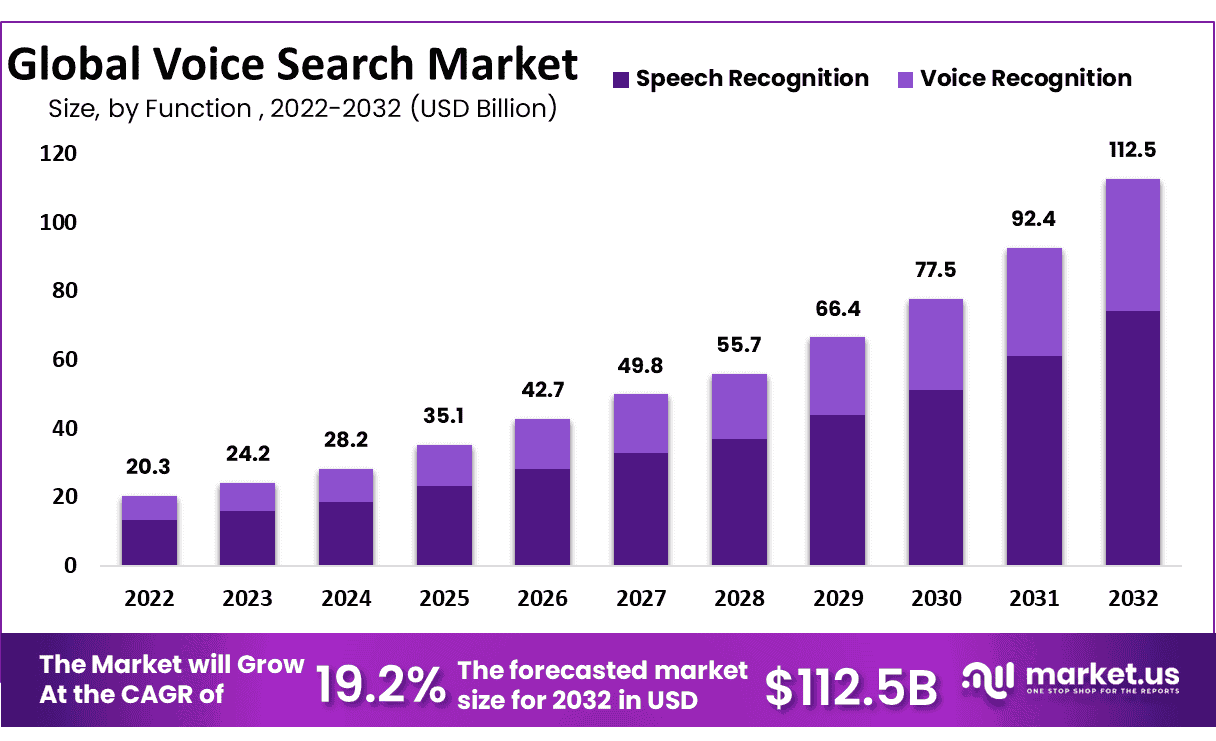
Global Voice Search Market Size In USD Billion
(Source: market.us)
- The global market for voice search is predicted to grow substantially, expanding from an estimated USD 35.1 billion in 2025 to around USD 112.5 billion by 2032, a massive compounding annual growth rate of 19.2%.
- The number of digital voice assistants in use worldwide reached an extraordinary 8.4 billion by the end of 2024.
- In the U.S. market, Google Assistant is the leader with approximately 88.8 million active users, closely followed by Apple’s Siri, which commands a strong user base of 86.5 million individuals.
- Amazon’s Alexa remains a dominant force in the smart speaker segment, with 67% of U.S. smart speaker owners reporting that they use an Amazon Echo device.
- Consumer satisfaction with voice assistants is exceptionally high, with 93% of users reporting overall satisfaction.
- The average accuracy rate for correctly answering search queries across all major voice assistants is impressive, standing at 93.7%.
- Google Assistant often leads in accuracy tests, having demonstrated a capability to correctly answer around 92.9% of the questions posed to it in recent controlled digital assistant IQ tests.
| Voice Search Market | The market is expected to hit USD 112.5 billion by 2032. |
| Speech Recognition Value | The market is expected to hit USD 83 billion by 2032. |
| Global Device Count | 8.4 billion voice assistants in use globally. |
| US Market Leader | Google Assistant leads with 88.8 million US users. |
| Smart Speaker Share | 67% of US owners use an Amazon Echo Alexa. |
| User Satisfaction | 93% of consumers are satisfied with voice assistants. |
| Average Accuracy | Voice assistants answer 93.7% of queries correctly. |
| Growth Rate | Market growth rate is 28.7% CAGR. |
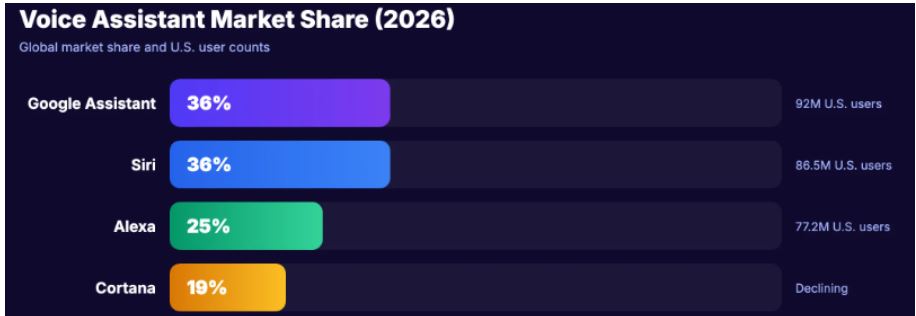
Voice Assistant Market Share
(Source: theStaoo)
- Market share held by Google Assistant and Siri is 36%, while Alexa holds 25%.
- 92 million projected users of Google Assistant in the U.S.
- 86.5 million users of Siri in the U.S.
- 77.2 million users of Alexa in the U.S.
- 500 million users globally using Google Assistant monthly.
- Google Assistant can speak 119 languages.
- 5.1% of smartphone users who use voice assistants use Siri.
Voice Search Usage And Adoption Insights
(Reference: demandsage.com)
- Globally, approximately 20.5% of people who use the internet now actively engage with voice search.
- The overall volume of queries is, with over 1 billion voice searches being executed every single month.
- In the United States, the number of individuals using voice assistants is expected to reach 153.5 million in 2025, which represents a stable year-over-year increase of about 2.5%.
- A significant portion of the adult population in the U.S., specifically 41%, reports using voice search daily.
- Younger demographics are particularly heavy users, with 65% of people aged 25 to 49 utilizing their voice assistants at least once a day.
- Smartphones remain the dominant platform, with 56% of users relying on their mobile device for voice search to find information about brands or conduct quick.
- Cultural adoption varies, with China showing the highest weekly usage, as 39.3% of its internet users engage with voice assistants weekly, compared to roughly 30% globally.
- About 21% of the general population has made weekly voice search a regular, entrenched habit in their daily lives.
- Over 70% of internet users express a preference for voice search due to its speed and hands-free convenience.
- The average response given by a voice assistant is notably concise, containing only about 29 words.
| Category | Usage |
| Global Penetration | 20.5% of internet users employ voice search. |
| U.S. User Base 2025 | 153.5 million voice assistant users in the US. |
| Daily Use | 41% of US adults use voice search daily. |
| High-Frequency Users | 65% of 25 to 49-year-olds use a voice assistant at least once daily. |
| Mobile Dominance | 56% of voice search is conducted on smartphones. |
| Weekly Habit | 21% of users perform voice searches weekly. |
| Average Answer Length | Voice search results average 29 words in length. |
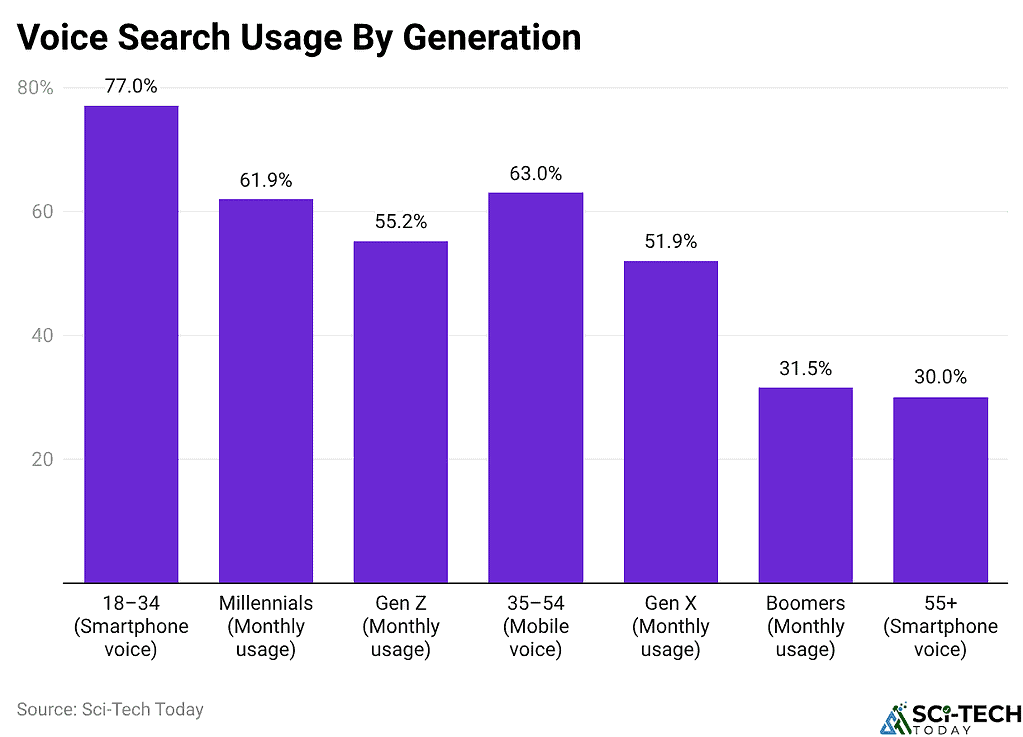
Voice Search Demographics
(Reference: theStaoo)
- 77% of 18-34 year old adults use voice search on smart phones.
- 63% of 35-54 year old adults use voice search on mobiles.
- 30% of 55+ year old adults use voice search on smart phones.
- 55% of teenagers in America use voice search daily.
- Millennials have highest monthly voice search usage of 61.9%, followed by Gen Z 55.2%, Gen X 51.9% and Boomers 31.5%.
- 61% of 25-64 year olds adults plan to boost their voice assistant usage.
Voice Shopping
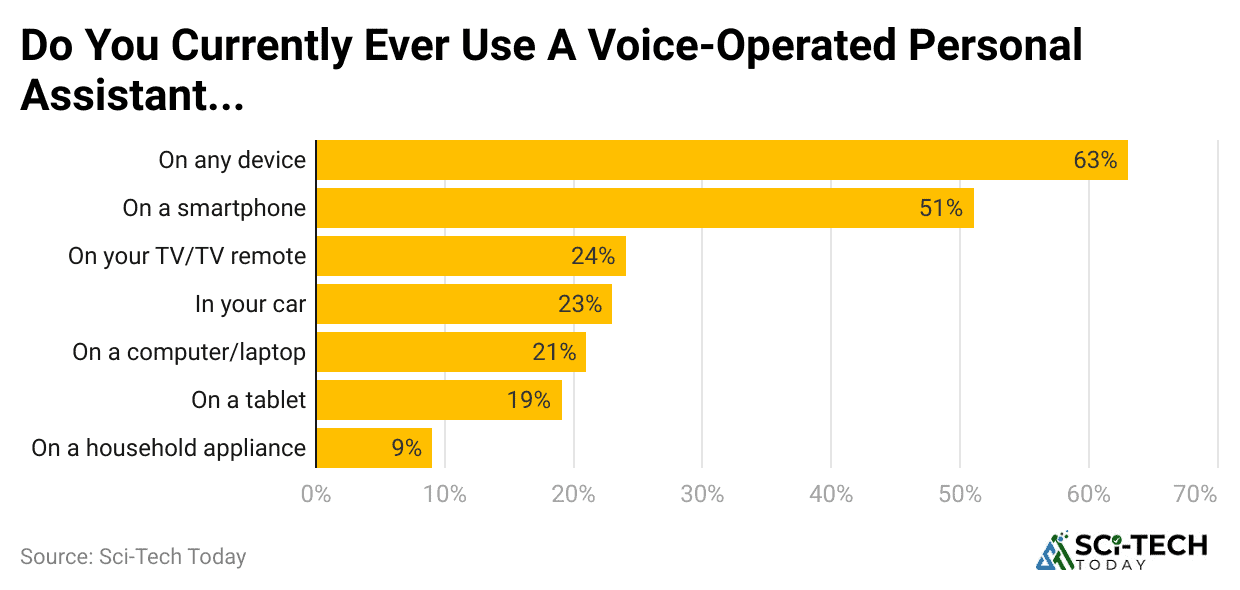
(Reference: siteefy.com)
- Global voice-driven commerce is projected to reach an eye-watering USD 82 billion by 2025, highlighting a rapid.
- A significant 35% of U.S. adults are not yet making purchases via voice but have expressed a clear interest in trying voice shopping.
- The initial point of entry for v-commerce is research, with 51% of individuals who use voice for shopping primarily using it to look up product information before committing to a purchase.
- For services, convenience reigns supreme: 54% of voice search users have successfully used the feature to secure a restaurant reservation.
- Takeout and quick-service purchases are highly popular, as 34% of consumers have utilized voice search to place food orders.
- The total transaction value for purchases driven by voice assistants on smart devices globally has already climbed to USD 164 billion.
- Among smart speaker owners, 22% in the U.S. have already completed at least one purchase using their device.
- Brands should recognize the desire for deals, as 52% of voice-activated speaker owners are interested in receiving tailored promotions and sales information directly from brands.
- For local businesses, voice search is already a conversion powerhouse, with 18% of local voice searches made on a smartphone leading directly to a purchase on the same day.
| Category | V-Commerce |
| 2025 Projected Value | Global voice shopping spend to hit $82 billion. |
| Latent Interest | 35% of US adults are interested in voice shopping adoption. |
| Primary Use | 51% of voice buyers use it for initial product research. |
| Restaurant Reservations | 54% of users employ voice search to book a table. |
| Food Orders | 34% of consumers have placed food orders using voice. |
| Voice Buyers | 22% of U.S. smart speaker owners have made a purchase. |
| Conversion Rate | 18% of local mobile voice searches lead to same-day purchase. |
Booming Growth Of Voice Devices
- In the previous year alone, the number of voice assistants in use exceeded 8.4 billion. It seems you heard me well, as right now there are more devices than people on this planet.
- More than half (58.6%) of the US population have tried out voice search at least once in their life. This is a developing trend that marketers should think about when they are planning their digital marketing strategy.
- Almost 1 in every 4 individuals (21%) perform voice search on a regular basis, as they include it into their weekly routines.
- More than 1 billion of voice searches are made every month. The number keeps increasing as customers get used to this channel.
- About 27% of the people make use of voice search in their mobile phones. Voice search proves convenient for users that are on the go and want to keep their hands free.
- 75% of households will possess smart speakers by 2025. Marketers should prepare themselves for the future where voice commerce will be more popular among buyers.
- As much as 34% of those who don’t have voice assistants want to buy one. Late adopters are going to help the smart speaker industry grow.
Voice Search Trends For Businesses

(Reference: invoca.com)
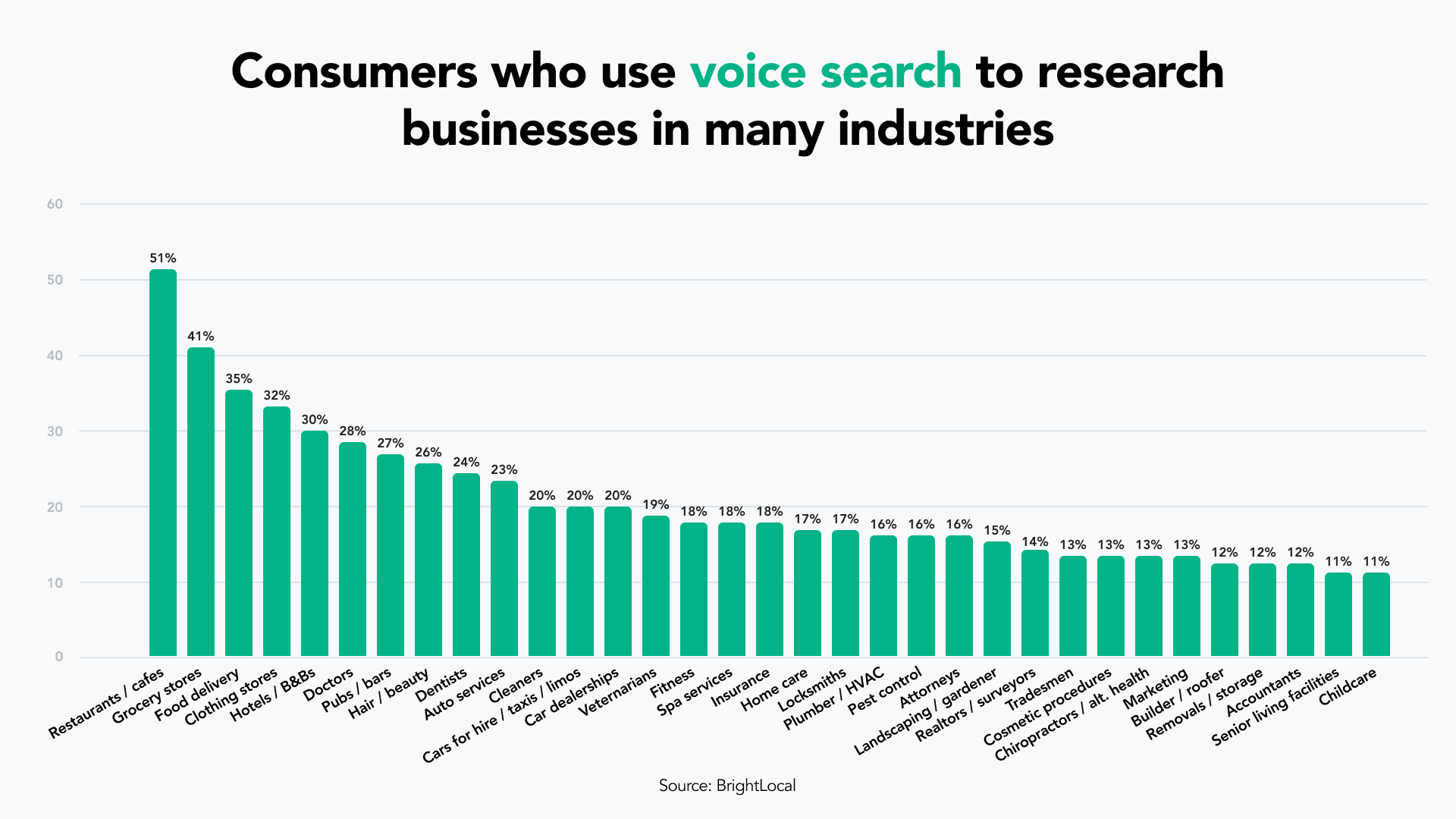
- An overwhelming 76% of all voice searches possess local intent, meaning the user is looking for a nearby business, product, or service.
- Mobile voice searches are intrinsically local, being approximately three times more likely to target local information compared to traditional text-based queries on a mobile device.
- The convenience of voice drives instant action: 58% of consumers utilize voice search to discover and find information on local businesses.
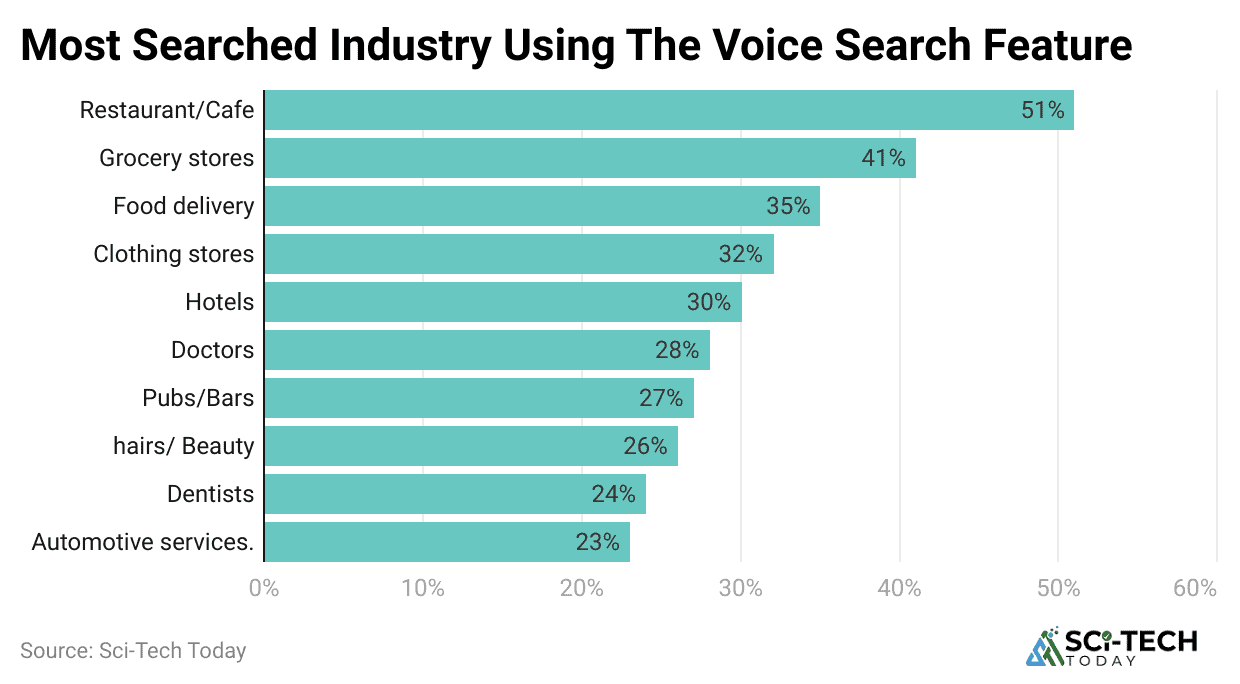
- In the restaurant sector, the adoption is highest, with 51% of voice search users specifically researching restaurants and cafes.
- A stunning 88% of individuals who perform a local search on their phone will either visit or call the related store within just 24 hours.
- The loyalty of smart speaker owners to local search is high: 76% of smart speaker users conduct voice searches for local information at least once a week.
- Positive online reviews are directly tied to voice conversion; 27% of users visit a local business’s website immediately after completing a voice search.
- For drivers, in-car voice systems are essential, as 62% of people use voice search to find local businesses or services while they are behind the wheel.
- Due to the high local intent, local content is a substantial category, making up 22% of all voice search queries.
- Beyond restaurants, popular local business searches include grocery stores at 41% and food delivery services at 35% of all local voice queries.
| Category | Local Search |
| Local Intent Share | 76% of all voice searches are location-based. |
| Mobile Local Search Multiplier | Mobile voice searches are 3x more likely to be local than text searches. |
| High-Intent Follow-Up | 88% of local searchers visit or call a store within a day. |
| Top Industry | 51% of users research restaurants using voice search. |
| Smart Speaker Local Use | 76% of smart speaker owners search for local info weekly. |
| In-Car Use | 62% of people use voice search for local information while driving. |
| Conversion Catalyst | 27% of users visit a website after a local voice search. |
Voice Search For Optimization
(Source: invoca.com)
- The average page load time for a top voice search result is incredibly fast, clocking in at only 4.6 seconds, which is an average of 52% faster than a standard search result page load time.
- A significant 40.7% of all answers delivered by voice assistants are sourced directly from the Featured Snippet box.
- 80% of the content that Google’s voice assistant reads aloud is sourced from one of the top three organic search results.
- The content favored by voice search is typically long-form, with the average voice search result page containing a substantial 2,312 words.
- To appeal to the natural language processing of assistants, the content is generally written at an accessible, conversational level, specifically a 9th-grade reading level.
- The average voice query is notably longer and more conversational than a traditional text query, measuring approximately 29 words in length.
- Websites that rank well in voice search are overwhelmingly secured, with 70.4% of voice search result URLs utilizing the HTTPS protocol, compared to only about 50% of traditional desktop results.
- Social popularity remains a strong indicator of trust, with the average voice search result page boasting a high social share count, including 1,199 Facebook shares and 44 X formerly Twitter shares.
- Domain Authority is a major factor, with the average domain rating for a page that surfaces in a voice search result being a high 76.8 out of 100.
| Category | SEO |
| Load Speed | Average load time is 4.6 seconds 52% faster. |
| Featured Snippet Share | 40.7% of answers come from the Featured Snippet. |
| Top Ranking Reliance | 80% of answers come from the top 3 organic results. |
| Content Length | Average content length for a voice result is 2,312 words. |
| Reading Level | Content is typically written at a 9th-grade reading level. |
| Query Length | The average voice search query is 29 words long. |
| Security Factor | 70.4% of voice results use HTTPS. |
| Domain Authority | Average Domain Rating is 76.8. |
Summary
Overall, these data confirm that voice search has become a significant change in the digital ecosystem. From over 1 billion monthly searches to a projected USD 82 billion in voice-driven commerce by 2025, the numbers give us a clear picture of a market that is rapidly maturing and integrating into daily life.
So, the clear alignment between voice search and high-intent, local queries means that businesses must move beyond simple SEO measures. So, I hope you like this piece of content. I have analysed the most up-to-date data and information to present you with this article. If you have any questions, kindly let us know. Thanks for staying up till the end.
FAQ
Voice search is a feature that allows users to perform internet searches, ask questions, or complete tasks by speaking into a device rather than typing. Powered by Automatic Speech Recognition (ASR) and Natural Language Processing (NLP), it converts spoken words into text, understands the user’s intent, and delivers a relevant response.
Over 111 million people in the US use voice search features, with about 27% of the global online population regularly using mobile voice search. Adoption is widespread, with over 8.4 billion active digital voice assistants in use worldwide today.
Identifying a person by voice involves Voice Biometrics (speaker recognition), which analyzes the unique physiological size of a person’s vocal tract (larynx, throat, and nasal cavities) and their behavioral speech patterns (pitch, cadence, and accent) to create a distinctive “voiceprint”.

Sources