









The Start
mHealth Statistics: mHealth, or mobile health, refers to the delivery of health and public health services through smartphones and wearable devices, covering everything from wellness apps and remote patient monitoring to easy mobile access to health information. The global mHealth industry continues to grow steadily, backed by strong consumer demand and widespread availability across multiple platforms.
In 2024, health and fitness apps crossed an impressive 3.6 billion downloads worldwide, showing a mid-single-digit increase compared to the previous year and confirming that people around the world remain deeply engaged with mobile health tools. In 2025, the global mHealth market continued its ongoing growth trajectory, surpassing hundreds of billions of dollars in value as adoption accelerated across hospitals, clinics, and everyday consumer devices worldwide.
In this article, you will explore the mHealth market trends, app download insights, and future developments of mobile healthcare in 2026 and beyond.
Spotlighted by the Editor
- The Global mHealth Market Size is expected to be valued at approximately USD 187.7 billion by 2033.
- mHealth apps had an impressive market share of about 76.7% in 2025.
- The mobile operators were identified as the prominent players in the mHealth market and accounted for about 47.2% of the market share.
- North America was leading the global mHealth market in 2025 by earning about 37.45% of the revenue.
- There were more than 350,000 health and wellness apps in 2025 in the major app stores.
- The downloads of health and fitness apps amounted to about 25.15 million in January 2025.
- According to a survey by Pew Research Center, 62% of smartphone users have searched for health information on their smartphones.
- The mHealth market size in Latin America is estimated to be valued at USD 12.2 billion in 2025, growing from USD 9 billion in 2024.
Interesting Facts about mHealth
| Market Value in 2025 | 78.6 billion |
| Projected Market Value in 2033 | 187.7 billion |
| CAGR (2023-2033) | 11.5% |
| Regional Head | North America |
| Market Key Players | AT&T, Telefonica S.A., SoftServe, Google Inc., Airstrip Technologies Inc., Samsung Electronics Co Ltd., Allscripts Healthcare Solutions, Apple Inc. |
| Apple Health Dominance | Apple’s Health app has been used by over 400 million iPhone users worldwide. |
| FDA Digital Approvals | The U.S. FDA approved over 200 new digital health tools in the first half of 2025 alone. |
Global mHealth Market Statistics
- The Global mHealth Market size is expected to be worth around USD 187.7 billion by 2033, from USD 63.2 billion in 2023, growing at a CAGR of 11.5% during the forecast period from 2024 to 2033.
- In 2026, the Global mHealth Apps Market is projected to reach USD 87.6 billion, with both wearables and mHealth apps contributing to steady growth as consumer adoption of digital health tools accelerates across global markets.
- By 2031, the market is forecasted to hit USD 151.0 billion, reflecting the compounding impact of an 11.5% CAGR as AI-powered health apps, remote patient monitoring, and wearable health devices become deeply integrated into everyday healthcare routines.
- The market is expected to reach USD 168.3 billion by 2032, with wearables continuing to capture a growing share of total market value alongside mHealth apps, driven by increasing demand for real-time health monitoring and personalized digital health experiences.
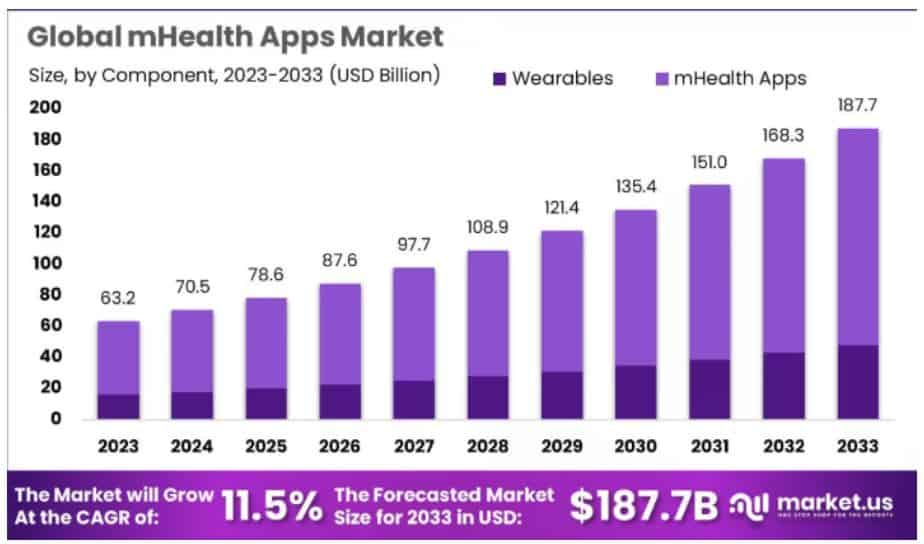
(Source: market.us)
Dominating Factors of mHealth Market
- mHealth apps dominated the market with a substantial 76.7% share in 2025, playing a central role in driving healthcare innovation through mobile platforms.
- Monitoring services led the way in terms of service type, accounting for over 65.8% of the total market share by offering real-time health tracking capabilities to patients and healthcare providers alike.
- Mobile operators emerged as the key players in the mHealth ecosystem, holding a 47.2% market share, followed by device vendors, content players, and healthcare providers rounding out the competitive landscape.
- The widespread adoption of smartphones around the world has been a major driver of mHealth growth, making healthcare more accessible and convenient for millions of people across both developed and developing markets.
- Despite its rapid growth, data security concerns and the challenges of meeting regulatory compliance requirements remain significant barriers to broader mHealth adoption.
Regional Market Dominance of mHealth
- North America continued to lead the global mHealth market in 2025, accounting for an estimated 37.45% of revenue, supported by high healthcare spending, widespread smartphone and connected-device adoption, a substantial chronic-disease burden, an ageing population, and well-developed digital-health infrastructure.
- The region’s rapid smartphone adoption has further fueled this growth, creating significant opportunities for mobile health solutions across all age groups and healthcare segments.
- In Asia Pacific, the market is also experiencing strong momentum, with the number of unique mobile subscribers expected to surpass 3 billion by 2025, up from 2.8 billion in 2019, according to GSMA’s Mobile Economy report, opening up enormous potential for mHealth expansion across the region.
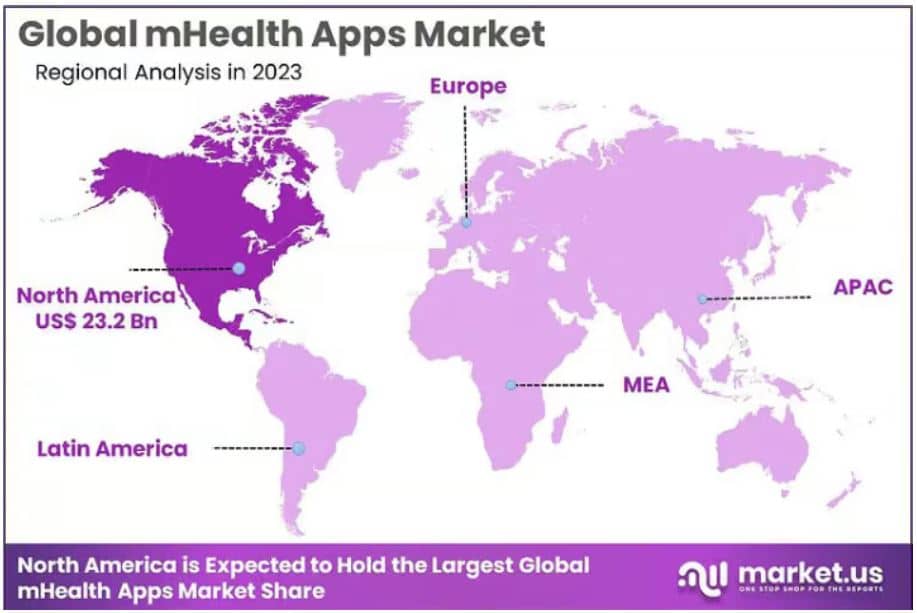
(Source: market.us)
mHealth Apps Users Statistics
- As of 2025, the number of health and wellness apps available across major app stores remains above 350,000; however, older adults are not the primary users.
- Among adults aged 50 and above, 71% use smartphones or tablets, while health-and-wellness app use is strongest for fitness and physical-activity tracking.
- 28% currently use at least one health app, 44% have ever used one, and 56% had never used one.
- For older adults who use health-related apps, the most common purpose is now reported as fitness and physical-activity tracking (55%), followed by health monitoring (29%) and personal goal setting (29%).
- Only 20% of older adults with a chronic condition use an app to help manage it, despite 63% reporting at least one chronic condition.
- A significant 22% of users downloaded health apps primarily to gain better insights about their nutrition and dietary habits.
- Weight management is another major driver of health app adoption, with 20% of users downloading these apps specifically to track their weight loss progress, reflecting the growing global concern around obesity.
- Sleep tracking is also a popular use case, with 17% of users relying on health apps to monitor and improve their sleep patterns and overall sleep quality.
- Meditation and mindfulness features attract 9% of health app users, highlighting the growing interest in mental wellness and stress relief through digital tools.
- A smaller but important 5% of users turn to health apps for managing chronic mental health conditions or everyday stress.
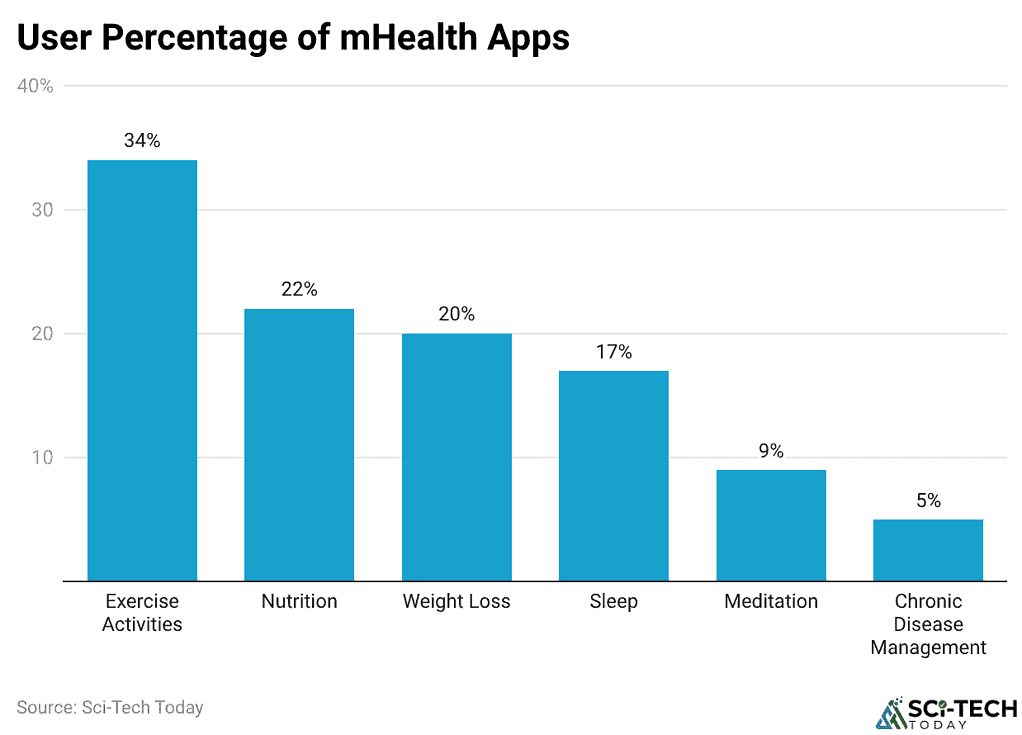
(Reference: scoop.market.us)
Insights on Usage of mHealth
- Recent studies show that more than 85% of resident physicians use smartphones in clinical practice.
- Health and fitness apps alone recorded approximately 25.15 million downloads globally in January 2025.
- Remote patient monitoring is now widely used to track patients’ blood pressure, blood glucose, weight, pulse oximetry, and other vital signs from home; an estimated 71 million Americans used such services in 2025
- Recent telemedicine studies report high satisfaction among patients who use virtual consultations, including one study in which 98% of participants reported satisfaction with the virtual consultation method.
How Smartphones Are Transforming Healthcare
- A Pew Research Center study found that 62% of smartphone users have used their device to search for health-related information, making mHealth one of the most common smartphone activities among adults worldwide.
- Searching for health information on smartphones is actually more popular than online banking (57%), job searching (42%), and accessing educational content (30%).
- Smartphones are increasingly being used as valuable clinical tools in healthcare settings, with new apps and services freeing up valuable time for doctors to focus on direct patient care rather than administrative tasks.
- An impressive 90% of physicians already use smartphones in their daily work, primarily to access electronic health records, communicate with their medical teams, and reference clinical information quickly and efficiently.
- 2/3 of the largest hospitals in the United States currently offer mobile health apps to their patients.
- However, despite this widespread availability, Accenture research finds that many hospital apps are falling short due to poor user experience and limited functionality.
mHealth Revenue Share of Latin America
- In 2025, the mHealth market in Latin America is expected to reach USD 12.2 billion, growing strongly from USD 9 billion in 2024.
- In 2026, the market is projected to grow to USD 16.7 billion, an increase of about USD 4.5 billion in one year.
- The market is forecasted to hit USD 22.8 billion by 2027, nearly five times its 2022 value of USD 4.8 billion, making Latin America one of the fastest-growing regions for mobile health solutions in the world.
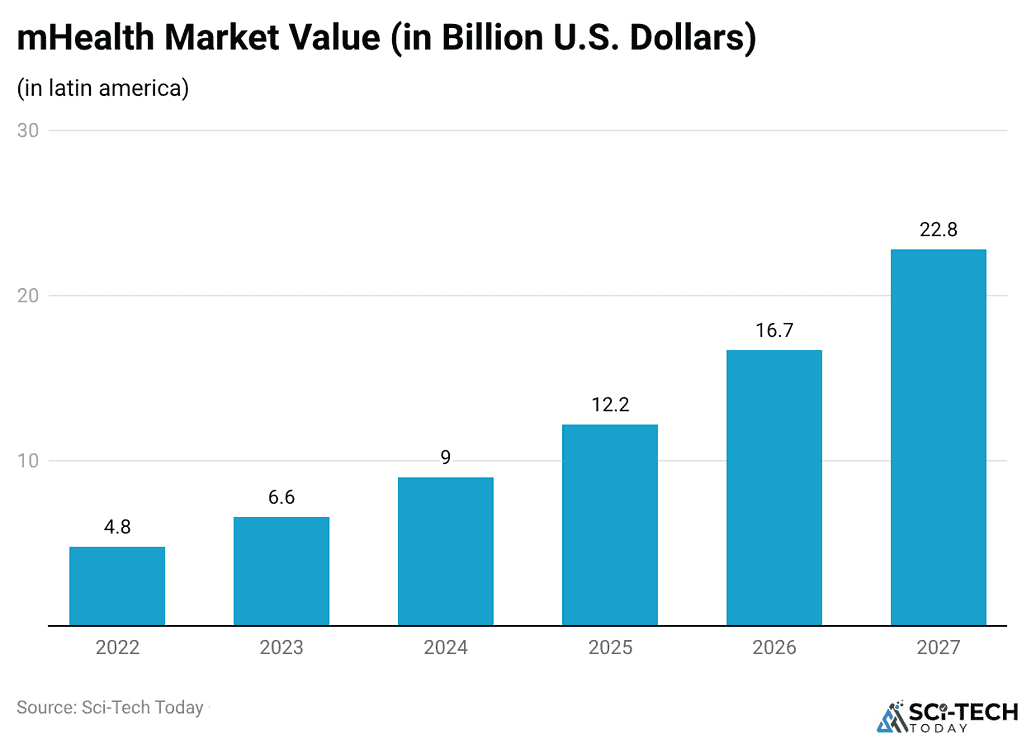
(Reference: scoop.market.us)
Top mHealth Apps in 2026
| App/platform | User metric | Reported user count |
| Samsung Health | Monthly active users | 95+ million MAUs |
| Strava | Registered users | 100+ million users |
| MyFitnessPal | Registered users | 200+ million users |
| Flo | Android download | 100+ million downloads |
| Google Fit | Android download | 100+ million downloads |
| Strava | Active-user reference | 95 million active users |
| MyFitnessPal | Monthly active users | 85 million MAUs |
| Fitbit | Active users | 30+ million active users |
| Headspace | Subscribers | 2+ million subscribers |
| HealthifyMe | Android download | 50+ million downloads |
Recent mHealth Statistics
- In March 2024, the global mHealth market was valued at approximately USD 70.5 billion, with mobile health apps generating over 50,000 new app releases on the Apple App Store and Google Play Store combined.
- In June 2024, Apple reported that its Health app had been used by over 400 million iPhone users worldwide, with heart rate monitoring, sleep tracking, and medication reminders ranking as the three most frequently used health features across its device ecosystem.
- In January 2025, the World Health Organization (WHO) reported that over 350,000 health and wellness apps were available across major app stores globally, with mental health and fitness apps accounting for the largest share of downloads at 35% and 28%, respectively.
- In March 2025, Fitbit and Google Health announced the integration of AI-powered health coaching features into their wearable devices, reaching over 120 million active users worldwide and offering personalized recommendations based on real-time biometric data.
- In May 2025, Samsung Health reported surpassing 500 million registered users globally, with its Galaxy Watch series driving a 42% year-over-year increase in health monitoring feature engagement across blood oxygen, ECG, and stress tracking capabilities.
- In August 2025, the U.S. FDA approved over 200 new digital health tools and mHealth applications in the first half of 2025 alone, a 35% increase compared to the same period in 2024.
- In 2026, the global mHealth market surpassed USD 87.6 billion in value, growing at a CAGR of 11.5%, with AI-powered diagnostic apps, remote patient monitoring platforms, and mental health applications driving the majority of market expansion.
- In April 2026, Teladoc Health reported that virtual care visits conducted through its mobile platform exceeded 15 million consultations in 2025, a 28% increase from the previous year, with chronic disease management and mental health services accounting for over 60% of total consultations.
The End
mHealth is quickly becoming a core part of everyday healthcare, with smartphones, wearable devices, remote monitoring, and AI-powered apps making health services easier to access and personalize. In 2026 and beyond, continued smartphone adoption, demand for virtual care, and the need to manage chronic conditions will support further market growth.
While privacy, data security, and app quality remain key challenges, mHealth has a promising future in connecting patients with faster, smarter, and more convenient care.
FAQ
mHealth, short for mobile health, is the use of mobile and wireless devices, like smartphones, tablets, and wearable sensors, to deliver health care services, information, and support.
Mobile health (mHealth) relies on a wide array of wireless and portable hardware to track data, run medical apps, and connect with providers. Core categories include smartphones, tablets, smartwatches, fitness bands, and specialized home medical monitors.
mHealth (mobile health) is the use of mobile phones, tablets, and wearable devices to deliver health services, track medical data, and share health information.
The most popular health and fitness apps include MyFitnessPal for calorie counting, Strava for workout tracking, and Flo for cycle tracking.
Epic Systems is the most popular and widely used medical software globally, dominating the electronic health record (EHR) market for large hospitals and acute care systems.