








Brief Overview
AI in Military Statistics: AI is no longer a futuristic idea in defense. From autonomous drones to smart surveillance systems, AI is quietly becoming the backbone of modern warfare strategies worldwide. 2025 turned out to be a remarkable year for military AI. World military expenditure climbed to a record USD 2.887 trillion in 2025, marking the 11th consecutive year of growth, with AI-focused defense stocks and contracts surging alongside it. According to market.us, the global AI in military market itself grew at a CAGR of 11.37%, rising from USD 3.14 billion in 2024 to a projected USD 5.99 billion by 2030, showing just how fast nations are pouring money into smarter defense tech.
Why does all this matter? Because AI is fundamentally changing the rules of national security, giving militaries faster decision-making, sharper threat detection, and reduced human risk on the battlefield.
In this article, we will discuss how AI transformed military operations in 2025, what’s coming in 2026, and why this shift matters for global security as a whole.
Key Choices that Matter the Most
- As reported by WorldMetrics, 33% of defense companies will spend USD 50 million or more per year on AI.
- Only 33% of US citizens believe AI will enhance the safety and efficiency of using weapons in the military.
- The US retained the leading position in military spending despite reducing its expenditures by 7.5% to USD 954 billion in 2025.
- One of the most intensive defense burdens among developed countries was shouldered by Saudi Arabia; it spent USD 83.2 billion in 2025.
- Russia continued increasing its military budget, growing by 5.9% to reach USD 190 billion in 2025.
Global AI In Military Market Share
- The Global AI in Military Market is estimated to grow and have a total value of approximately USD 8.29 billion by 2033, having a value of USD 2.82 billion in 2023, with a CAGR of 11.37% during the forecast period of 2024-2033.
- According to WorldMetrics, 33% of defense firms are going to spend USD 50 million or more on AI each year.
- Moreover, 62% of defense leaders state that AI is going to be crucial for their country’s security in the upcoming year.
- Besides, 60% of defense firms believe that AI is essential for maintaining or improving competitive military advantage.
- Also, around 80% of defense firms agree that every human being will experience the consequences of an AI-driven decision in the upcoming five years.
- In 2024, the usage of AI tools in cybersecurity in the defense sector exceeded USD 4 billion. At the moment, 45% of defense firms are investing in AI.
- Moreover, the global market for military drones, which often use AI, is estimated to reach USD 40 billion in 2027.
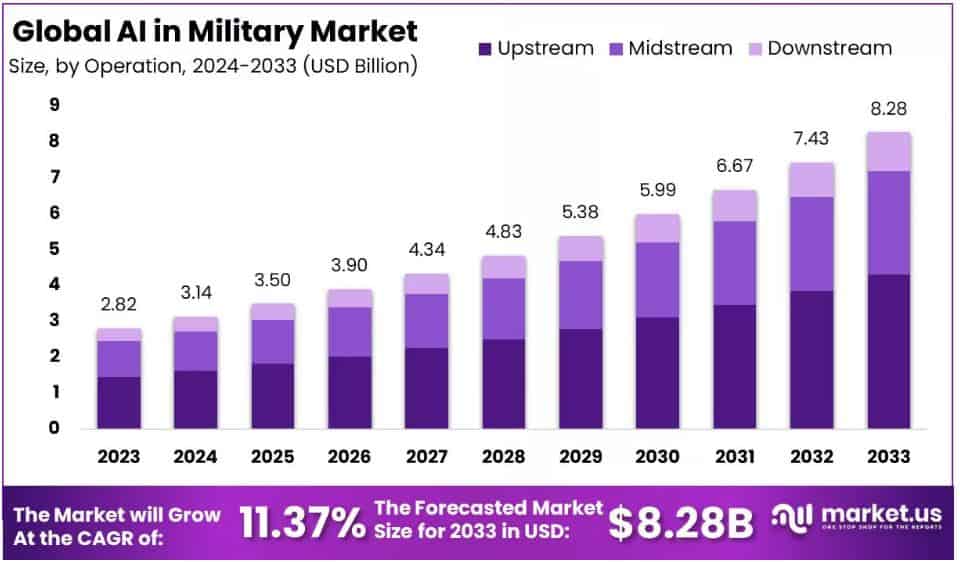
(Source: market.us)
AI in Warfare
- 41% of U.S. respondents believe AI will mostly improve the ability to detect military threats, making it the area where Americans feel most optimistic about AI’s impact on national defense capabilities.
- 38% of respondents think AI will enhance the quality of intelligence analyses, while 20% believe it could actually reduce accuracy, reflecting a divided but generally positive outlook on AI-driven intelligence gathering.
- Only 33% of Americans feel confident that AI will improve the safe and efficient use of military weapons, with 21% expressing concern that it could reduce safety, highlighting hesitancy around AI’s role in weapons systems.
- Just 28% of respondents believe AI will improve overall U.S. military strategy, while another 25% think it could actually make strategic decision-making worse, showing significant uncertainty in this area.
- Confidence drops the lowest when it comes to military personnel selection, with only 20% believing AI will improve this process, while 25% fear it could reduce quality, and a notable 32% remain unsure, reflecting the deepest skepticism among all categories surveyed.
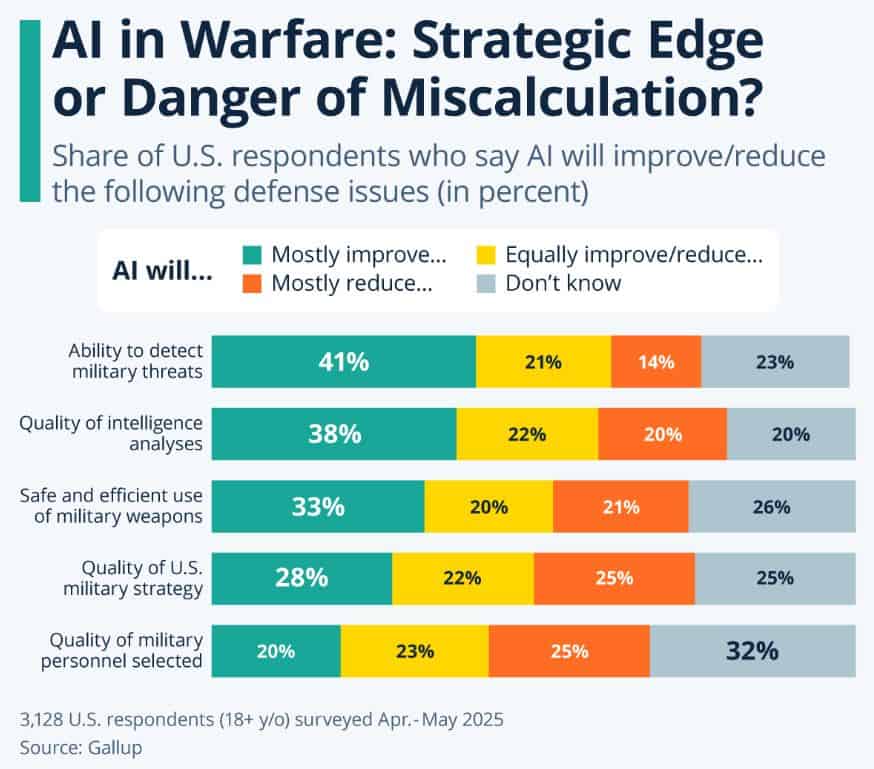
(Source: statista.com)
AI in Military by Platform Statistics
- The space platform has the largest share in the industry with 33% because of the growing dependence and investment in satellite technology, space surveillance, and other extraterrestrial uses of artificial intelligence.
- Next comes the land platform, which accounts for 29% of the market because of the growing use of artificial intelligence in land warfare, such as the use of autonomous vehicles, robotics, and surveillance systems.
- The airborne platform has 21% of the market share because of the growing dependence on artificial intelligence in fighter jet support systems and other drone uses.
- Lastly, the naval platform accounts for 17% of the market share because of the good investment in AI for unmanned underwater vehicles, shipboard systems, and maritime surveillance.
Military Spending by Countries
- Global military expenditure climbed to a record USD 2.887 trillion in 2025, according to the Stockholm International Peace Research Institute.
- The United States remained the world’s largest military spender by a wide margin, though its budget actually fell by 7.5% to USD 954 billion in 2025.
- China retained its position as the second-largest spender globally, with SIPRI estimating the country allocated USD 336 billion to its military in 2025, representing a 7.4% increase and marking its 31st consecutive year of rising defense expenditure.
- India made history by entering the exclusive club of the world’s top five defense spenders for the first time, increasing its budget by 8.9% to reach USD 92.1 billion in 2025.
- Russia continued its wartime spending trajectory, increasing its military budget by 5.9% to an estimated USD 190 billion in 2025.
- Germany posted one of the most dramatic percentage increases among major economies, raising its defense budget by 24% to USD 114 billion in 2025 as Europe pursued its largest rearmament drive since the end of the Cold War.
- Ukraine, despite its comparatively modest population and economy, ranked as the world’s seventh-largest military spender in 2025, increasing its budget by 20% to an estimated USD 84.1 billion, an amount equal to a staggering 40% of the entire country’s GDP.
- NATO’s 32 member states collectively spent USD 1.581 trillion on defense in 2025, representing 55% of worldwide military expenditure and underscoring the alliance’s continued dominance of global security spending.
- Saudi Arabia carried one of the heaviest relative defense burdens among major economies, spending USD 83.2 billion in 2025, equivalent to 6.48% of its entire GDP.
- Israel similarly maintained an outsized military commitment relative to its economic size, with defense spending reaching approximately 7.8% to 8.8% of GDP in 2025.
- Poland continued its position as one of Europe’s fastest-militarizing economies, dedicating approximately 4.5% of its GDP to defense in 2025.
| Country | 2025 Spending (USD) |
| United States | USD 954 billion |
| China | USD 336 billion |
| Russia | USD 190 billion |
| Germany | USD 114 billion |
| India | USD 92.1 billion |
| United Kingdom | USD 89 billion |
| Ukraine | USD 84.1 billion |
| Saudi Arabia | USD 83.2 billion |
| France | USD 68 billion |
| Japan | USD 62.2 billion |
AI Applications in Military
- Automatic target recognition systems have advanced considerably in recent battlefield deployments, with research from the Center for Strategic and International Studies documenting that AI has extended effective target recognition ranges from roughly 300 meters up to an average of 1 kilometer in combat conditions, and as far as 2 kilometers under optimal circumstances.
- India’s military has demonstrated a particularly sophisticated integration of AI during real combat operations, as the Indian Army’s AI-enabled Meteorological Reporting System, known as Project Anumaan, was used during the 2025 India-Pakistan conflict to predict wind speed and meteorological conditions up to 200 kilometers inside Pakistani territory, 48 to 72 hours in advance, to support accurate long-range artillery targeting.
- Israel has expanded its military AI infrastructure considerably beyond its initial deployments in Gaza, developing an army-wide “Operational Data and AI Factory” by 2026 that has since supported drone strikes, targeting operations, and defensive measures during conflicts extending into Lebanon and Iran.
- Logistics and predictive maintenance applications have quietly become one of the most operationally valuable uses of military AI, as forecasting algorithms now optimize equipment readiness, anticipate part failures before they occur, and streamline route planning for supply convoys.
Recent AI In Military Developments
- In July 2025, the Pentagon’s CDAO awarded up to USD 200 million each to Google, OpenAI, Anthropic, and xAI to build AI agents for national-security missions.
- Between October 2025 and August 2026, Reuters and Jamestown Foundation reporting traced DeepSeek’s open-weight models into PLA hospitals, defense-mobilization offices, and procurement tenders for battlefield-intelligence and planning use.
- On January 29, 2026, the US House Select Committee on China sent a letter alleging Nvidia gave DeepSeek technical support that helped its AI reach PLA systems, intensifying export-control scrutiny.
- Between January–June 2026, India backed a USD 90 million Shield AI–JSW Defence manufacturing tie-up (January 2026) and a USD 53 million AI-drone R&D hub at IIT Kanpur (June 2026) to build indigenous AI-guided UAVs.
- In February 2026, Anthropic’s USD 200 million DoD contract was cancelled, and the company was designated a “supply chain risk” after disputes over autonomous weapons and surveillance use; OpenAI stepped in with a matching USD 200 million deal within days.
- In March 2026, the Army signed a 10-year, up to USD 20 billion enterprise deal with Anduril, folding over 120 earlier contracts into one platform built around its Lattice AI battle-management software.
- In September 2026, the Army awarded USD 127 million to Palantir and USD 65 million to Anduril for 8 AI-powered TITAN targeting trucks, moving the system from prototype to production.
Final Thoughts
AI has become a core part of how militaries operate in 2025 and 2026, from faster decision-making to smarter targeting and surveillance. Countries are spending record amounts on defense, and much of that money is now going toward AI-driven tools and systems. At the same time, people remain cautious about AI’s role in weapons and strategy, showing that trust in this technology is still growing.
As more nations invest in military AI, the coming years will likely bring even bigger changes to how wars are fought and defended against.
FAQ
Artificial intelligence is used in the military to process data quickly, enhance surveillance, and automate tactical decision-making.
Artificial intelligence is used in modern warfare to quickly process massive amounts of battlefield data, track enemy movements, and recommend targets for military strikes.
Using artificial intelligence in the military creates serious risks, including unintended escalation, civilian harm, and accountability gaps.
Artificial intelligence will transform the military by dramatically accelerating decision-making speeds, automating routine staff work, and introducing lethal autonomous systems to the battlefield.
Yes, China actively uses artificial intelligence in its military operations and development.


