









Outline
AI in Video Surveillance Statistics: Video surveillance is moving beyond simple recording as AI makes security systems smarter and more responsive. Instead of relying on people to watch hours of footage, AI can scan live video, spot unusual activity, identify objects, follow movements, and raise alerts within seconds. This allows security teams to act quickly and focus on events that need attention. From retail stores and airports to factories, hospitals, and public areas, businesses are using AI-powered cameras to strengthen security and improve daily operations.
However, the technology also brings concerns around privacy, data protection, accuracy, and cost. As AI continues to advance, its role in video surveillance is expected to grow across industries.
Featured Pick
- The global AI in video surveillance market accounted for USD 8.2 billion in 2025 and is expected to rise to USD 9.8 billion in 2026.
- The hardware segment held 56.15% of the market in 2025.
- In 2026, Asia Pacific leads the market with 37.4%, followed by North America at 29.8%.
- The United States market is expected to reach USD 2.05 billion in 2026.
- Hikvision reported USD 12.95 billion in revenue in 2025 and had a USD 45.83 billion market cap in September 2026.
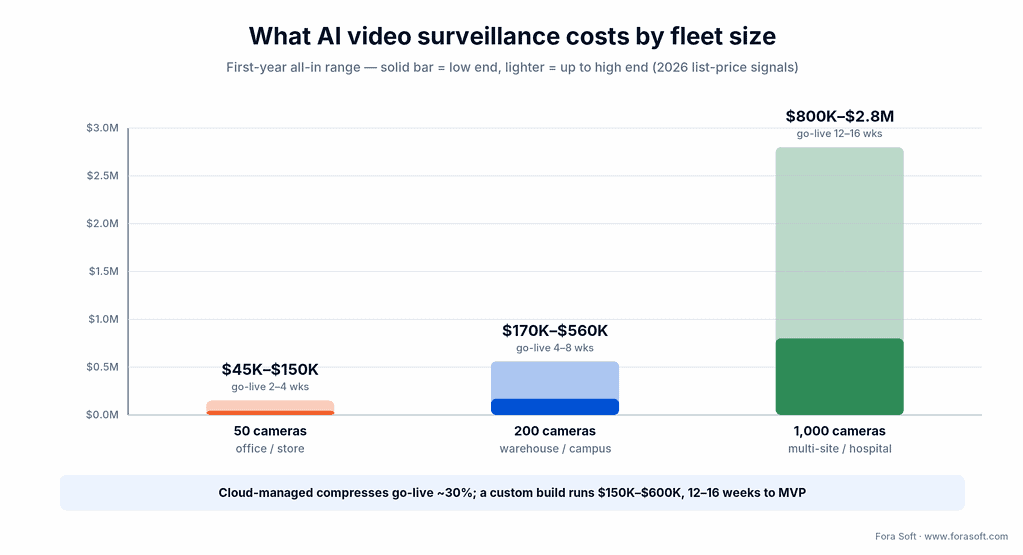
- A 50-camera site may require USD 45,000-150,000 in total first-year spending.
- 66% of organizations use AI for workplace safety and compliance.
- AI surveillance can reduce false alarms by 95%.
- Cloud-based AI now plays a central role in video surveillance, as 65% of webinar attendees consider it essential.
- AI-powered video surveillance ranked highly, with 45% of CSOs citing it as crucial over the next 2 years.
- AI video systems can reduce investigations from 20 hours to about 90 seconds.
- Verkada pricing ranges from USD 200-1,500 per camera, plus USD 35-90 per camera/month.
- Global smart city spending on AI surveillance reached about USD 560 billion in 2025, with growth expected at a CAGR above 22% through 2030.
AI in Video Surveillance Market Size
(Source: market.us)
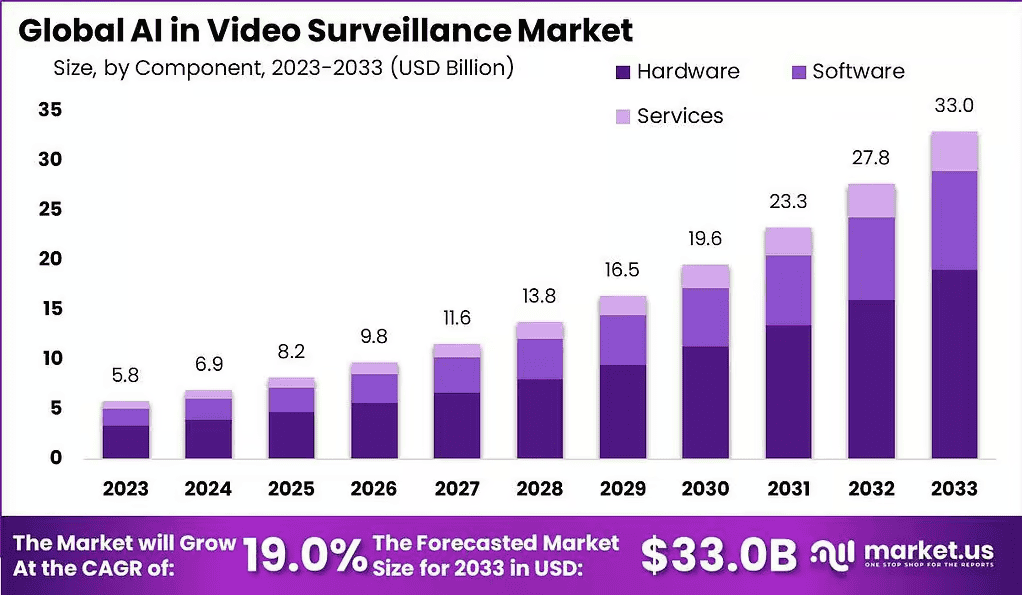
- The global AI in video surveillance market is projected to reach USD 33 billion by 2033.
- The market accounted for USD 8.2 billion in 2025 and is expected to rise to USD 9.8 billion in 2026.
- It is forecast to grow at a 19% CAGR from 2024 to 2033.
Market Segmentation
- Mordor Intelligence further stated that hardware held 56.15% of the market in 2025, while software is projected to grow at a 17.85% CAGR through 2031.
- On-premises systems led with a 64.35% revenue share in 2025. Cloud solutions are expected to grow at a 22.1% CAGR.
- Commercial facilities accounted for 43.05% in 2025, while residential demand is projected to grow at a 15.05% CAGR from 2025 to 2031.
- Dome cameras held 32.25% in 2025. Panoramic/fisheye cameras are forecast to grow at a 15.85% CAGR in the same forecast period.
- Perimeter security led with 27.95% in 2025, while facial recognition and biometrics are projected to grow at a 23.85% CAGR.
Regional Market Breakdown
(Reference: dataintelo.com)
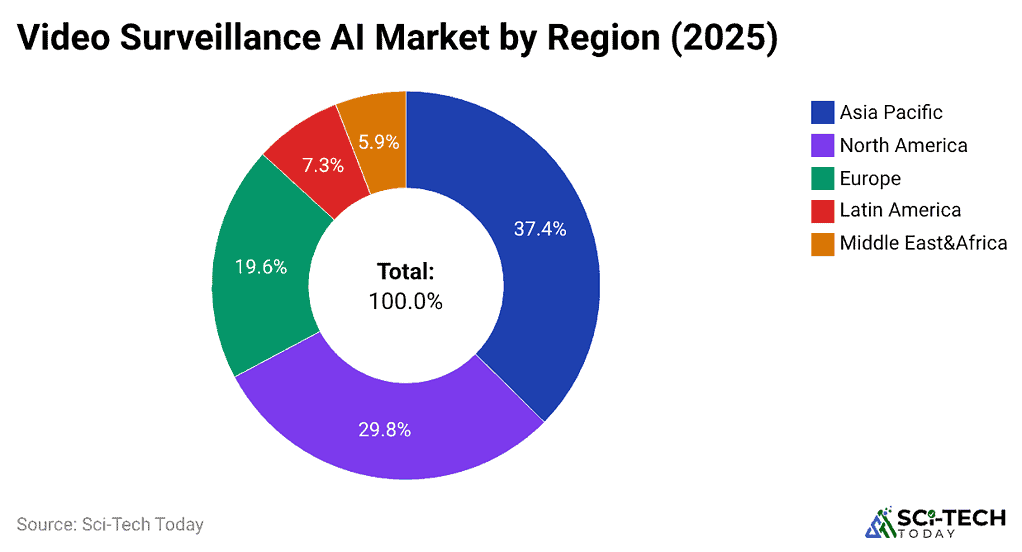
- In 2026, Asia Pacific leads the market with 37.4%, followed by North America at 29.8%.
- Europe accounts for 19.6%, Latin America for 7.3%, and the Middle East & Africa for 5.9%.
- Together, these regions make up 100% of the market.
Geographical Market Valuation
- According to Fortune Business Insights, North America led the market in 2024, reaching USD 2.08 billion. Its value increased to USD 2.33 billion in 2025.
| Region / Country | Market Value, 2026 (USD billion) |
| United States | 2.05 |
| Europe | 1.22 |
| United Kingdom | 0.16 |
| Germany | 0.20 |
| Asia Pacific | 2.32 |
| China | 0.95 |
| Japan | 0.25 |
| India | 0.34 |
| South America | 0.32 |
| Brazil | 0.17 |
| Middle East & Africa | 0.54 |
| GCC | 0.22 |
Top Companies in the AI in Video Surveillance Market
- Hikvision reported USD 12.95 billion in revenue in 2025 and had a USD 45.83 billion market cap in September 2026. It serves more than 180 countries and regions.
- Dahua Technology recorded about USD 4.8 billion in trailing revenue and had a USD 7.40B market cap in September 2026.
- Axis Communications generated SEK 20.8 billion in revenue in 2025, with sales up 17% and an operating margin of 11%. It had 5,273 employees.
- Motorola Solutions secured USD 11.68 billion in revenue in 2025, up 8%. Software and Services sales rose 13%, and backlog reached USD 15.7 billion.
- Hanwha Vision reported USD 362 million in sales and USD 1.082 billion in assets after September 1, 2024.
- NEC captured JPY 3.69 trillion in revenue and a JPY 6.08 trillion market cap in September 2026.
- SenseTime generated RMB 2.91 billion in revenue in 1H 2026, up 23.4%. The generative AI revenue reached RMB 2.33 billion, and net profit was RMB 620 million.
AI Video Surveillance Deployment Costs
(Source: cdn.prod.website-files.com)
50-camera (Office, retail store, and small facility)
- Hardware costs range from USD 12,500 to 60,000, with installation adding USD 15,000 to 30,000.
- Cloud VMS costs USD 12,000-36,000/year, while analytics cost USD 6,000-18,000/year.
- First-year spending ranges from USD 45,000 to 150,000, ongoing costs range from USD 18,000 to 54,000, and deployment takes 2-4 weeks.
200-Camera (Warehouse, campus, and large retail)
- Hardware costs USD 50,000 to 240,000, while installation requires USD 50,000 to 100,000.
- Cloud VMS costs USD 48,000-144,000/year, and analytics costs USD 24,000-72,000/year.
- First-year investment ranges from USD 170,000 to 560,000, with deployment completed in 4-8 weeks.
1,000-Camera (Multi-site retail, hospital system, and airport)
- Hardware costs USD 250,000 to 1.2 million, while installation costs USD 200,000 to 500,000.
- Cloud VMS costs USD 240,000 to 720,000/year, while on-premises licensing costs USD 200,000 to 500,000/year, plus USD 50,000/year in maintenance.
- Analytics costs USD 120,000 to 360,000/year, bringing first-year costs to USD 800,000 to 2.8 million, with deployment in 12-16 weeks.
How Organizations Use AI in Video Security
- According to Verkada, 66% of organizations use AI for workplace safety and compliance.
- Around 58% focus on improving operational efficiency.
- Space utilization and insurance documentation each account for 40%, and retail analytics represents 37%.
- AI governance is reported by 68% of active users, 28% of pilots, and 11% of organizations yet to begin AI adoption.
- Overall, 41% have comprehensive AI governance, while 38% formally measure AI ROI.
Why Businesses Need AI-Powered Video Surveillance in 2026
- Sirix Monitoring reported that AI surveillance can reduce false alarms by 95% and detect people or vehicles with 90%-95% accuracy.
- AI can identify incidents in under 30 seconds, compared with about 20 minutes for manual monitoring.
- Automated detection can reduce dependence on constant human guarding and improve theft prevention.
- AI helps businesses scale security across multiple locations while reducing insurance risk.
- Faster alerts can improve response times by 80% to 90%.
Cloud AI and Video Surveillance Trends
- Cloud-based AI now plays a central role in video surveillance, as 65% of webinar attendees consider it essential.
- Brivo forecasts public cloud spending will reach USD 723.4 billion in 2025, up from USD 595.7 billion in 2024.
- AI is shifting surveillance from reactive monitoring to proactive security through real-time analytics and agentic tools.
- AI-powered gun detection is gaining importance, with some industry leaders expecting possible mandates within 5 to 10 years.
AI Video Analytics Improves Real-Time Security
- A blog published by Closely.dev shows that mid-sized security operations in the U.S. and Latin America typically use 50-500 cameras. But only 5%-15% of camera activity is understood in real time.
- AI video analytics converts camera footage into useful intelligence through object detection, classification, behavior analysis, and event correlation.
- The 2026 World Security Report surveyed 2,352 CSOs across 31 countries on emerging security technologies.
- AI-powered video surveillance ranked highly, with 45% of CSOs citing it as crucial over the next 2 years.
- Moreover, 46% in Latin America and the U.S., while pharmaceuticals and real estate recorded 56% adoption.
AI Video Surveillance Delivers Faster Security ROI
- Fora Soft noted that most AI surveillance deployments can achieve positive ROI within 12 months.
- AI detectors can reduce false alarms by 70%-90%. Traditional motion sensors produce false alarms more than 97% of the time.
- Retail shrink exceeds USD 90 billion, with shoplifting incidents rising 18% year over year.
- AI analytics can reduce theft by 10%-40% in targeted retail areas.
- AI video systems can reduce investigations from 20 hours to about 90 seconds.
- Cloud-managed systems can deploy 50 cameras in 2-4 weeks and 200 cameras in 4-8 weeks.
- Moreover, Integrations may save 30%-40% of implementation time.
AI Video Surveillance Vendor Pricing Comparison
| Vendor | Model | Pricing signal | Best for |
| Verkada | Proprietary cloud platform with vendor cameras | USD 200-1,500 per camera; USD 35-90 per camera/month | Mid-market multi-site organizations with limited IT resources. |
| Rhombus | Cloud platform with branded cameras | USD 250-1,200 per camera; USD 20-60 per camera/month | Hospitality, education, and multi-unit retail sites. |
| Milestone XProtect | On-premises VMS with plug-in ecosystem | Approximately USD 75-250 per camera, plus analytics costs | Enterprises with stringent compliance requirements and customized analytics needs. |
| Genetec Security Center | Unified VMS, access control, and license-plate-recognition platform | Enterprise license: approximately USD 50 per camera/year | Airports, critical infrastructure, and municipalities. |
| Eagle Eye Networks | Cloud VMS supporting third-party cameras | USD 20-50 per camera/month | Distributed camera fleets and managed-service-provider deployments. |
| BriefCam | Video analytics add-on for existing VMS | USD 100,000-999,999+ deployment range | Forensic video search, transit systems, and large campuses. |
| Fora Soft custom / MindBox pattern | Custom on-premises or hybrid, open-model solution | USD 150,000-600,000 build cost; approximately USD 5,000/month infrastructure | Highly tailored deployments requiring custom models, workflows, or integrations. |
Key Growth Drivers of the Video Surveillance AI Market
- Global smart city spending reached about USD 560 billion in 2025, with growth expected at a CAGR above 22% through 2030.
- China plans more than 600 million AI cameras.
- India’s initiative covers over 100 cities, and AI can cut response times by 30%-40%, according to a report shared by Data Intelo.
- AI systems exceed 98.5% detection accuracy.
- Edge AI can cut bandwidth use by 70%.
- NVIDIA Jetson Orin delivers 275 TOPS, while AI camera costs fell 35% from 2021 to 2025.
- More than 58 countries experienced major terrorism incidents in 2024.
- Insurance incentives can lower premiums by 15%–25% for eligible security deployments.
- Global security technology spending surpassed USD 220 billion in 2025.
- VSaaS adoption is expected to expand at a CAGR exceeding 22.5% through 2034.
Final Observations
AI is reshaping video surveillance by helping systems spot threats, detect unusual behavior, and support quicker security responses. Its use is growing across public spaces, businesses, transport, and industrial facilities. However, concerns about privacy, data protection, accuracy, and human control cannot be ignored.
As the technology develops, organizations will need to use AI carefully and responsibly. This balance will be key to making AI-based video surveillance more effective and trusted.
FAQ
No, AI surveillance can often upgrade existing cameras using compatible software and hardware.
AI in video surveillance enables facial recognition, object detection, behavior analysis, intrusion detection, and real-time alerts.
Retail, transportation, banking, healthcare, manufacturing, government, and public safety industries use AI surveillance.

Sources