








Introduction
SEO ROI Statistics: SEO campaigns can yield quite a different financial outcome even in a period of three years. For example, one campaign has made a return of 748%, whereas another campaign made a return of 16%. This illustrates the need for businesses to assess their SEO plans by the type of work they will perform as opposed to viewing SEO as one marketing investment. Many marketing departments see SEO as one big expense and have one budget for it with the assumption that it would yield similar returns regardless of what particular activity was performed.
In this article, SEO ROI statistics, trends, payback period, and comparison with paid advertising are analyzed to show which activities give higher returns.
ROI Statistics
- The variation in SEO ROI spans from 317% in the e-commerce sector to 1,183% in the medical device sector.
- A general cross-industry study reported the median SEO ROI to be about 748% with a break-even point between 6 and 12 months.
- Leadership position reports an ROI of 748% with a return on ad spend (ROAS) of 9.1. An ROI of 16% for content marketing was also reported.
- An SEO focus on technical aspects (technical SEO) reports an estimated break-even period of six months with a 117% ROI.
- SEO campaigns that attract leads (e.g., SEO lead attraction campaigns) attract a conversion rate (closing) of 14.6%.
- Lead-attracting campaigns through PPC and outbound marketing report conversion rates of 3.75% and 1.7%, respectively.
- A lead that comes to a company through organic search costs US$31, and conversely, PPC lead generation reports an estimated US$181.
- Legal services see the highest conversion rate from organic searches at 7.5%.
- Across industries, organic search results convert at a rate of 4.9% vs. 5.4% for paid search.
- SEO typically takes 9–12 months to overtake PPC in ROI, although paid campaigns can deliver faster results within the first 3–6 months.
- Email marketing generates an estimated US$36–US$42 per dollar invested, compared with the article’s reported US$22 return for SEO.
SEO ROI Statistics by Industry
| Industry | Average SEO ROI | Break-Even Timeline |
| B2B SaaS | ~702% | ~7 months |
| Financial Services | ~1,031% | 12–18 months |
| Medical Device | ~1,183% | 12–24 months |
| Higher Education | ~994% | 12–24 months |
| Biotech | ~788% | 12–24 months |
| Legal Services | ~526% | 9–12 months |
| E-commerce | ~317% | 12 months+ |
| Cross-Industry Median | ~748% | 6–12 months |
- SEO outcomes depend on your industry and vary from case to case, based on how much you have to spend, your customer lifetime value, and how long your sales cycle is.
- According to recent research in various industries and agency research, high-value industries receive higher ROI from SEO.
- Medical devices come out on top at an estimated 1183% SEO ROI.
- Financial services are next at 1031%, then higher education at 994%, and then both biotech and B2B SaaS at 702%.
- Legal services come in at a decent 526%, while e-commerce receives 317%.
- SEO investment recovery time is also different for different industries. B2B SaaS breaks even after about 7 months. It takes legal services around 9 to 12 months. It takes financial services around 12 to 18 months.
- Biotech, higher education, and medical devices take about 12 to 24 months to break even. It usually takes at least a year for an e-commerce business to break even on SEO.
- In general, across all industries, the median ROI on SEO is about 748%.
- The break-even period for most industries is between 6 and 12 months. This data points towards the conclusion that SEO can have an exceptionally high ROI for businesses whose customers spend money frequently over a longer period of time.
- However, for e-commerce, rankings and traffic can take some time to grow before you start to see ROI.
- Businesses focus on industry benchmarks rather than the average return to gauge the feasibility of an SEO investment.
- Customer lifetime value, coupled with an estimated recovery time, will give a better picture of whether or not to invest.
SEO ROI Statistics by Service Type
| SEO Service | Return on Advertising Spend (ROAS) | ROI | Time to Break-Even |
| Technical SEO (Technical fixes, keyword research, title tag rewrites) | 1.35 | 117% | 6 months |
| Basic Content Marketing (Average quality keyword research & blog articles ~4x/mo) | 1.05 | 16% | 15 months |
| Thought Leadership & SEO (Strategic planning that includes generative engine optimization, high-end content ~8x/mo, focus on marketing KPIs) | 9.10 | 748% | 9 months |
- The type of investment, the industry, the quality, and the focus all determine the ROI of an SEO campaign. Routine optimizations return less value than more sophisticated SEO.
- Technical SEO can return 1.35x and 117% with an estimated 6 months to break even for improvements like performance, security, mobile, keywords, and title tags.
- Routine content marketing with approximately 4 blog articles and keywords can only achieve a return of 1.05x and 16% for a 15-month break-even.
- Thought leadership SEO significantly outperforms routine SEO, including routine content marketing, and routine technical SEO.
- Strategic content planning with keyword planning and research can provide stronger results with an estimated 9.10x return and 748% return in 9 months.
- With generative engine optimization (GEO), it also leverages the increasing use of search technologies.
- Strong SEO outcomes are based on strategic planning and quality content. Technical optimizations are necessary, but the only value they provide is the baseline.
- High-value, commercial outcomes result from more sophisticated thought leadership SEO, which considers your audience, content, and AI.
PPC vs. SEO ROI Statistics
- Although SEO and PPC have different marketing functions, available metrics generally support the case for PPC providing quick returns, with a longer return on investment for SEO.
- For instance, Adcore and various industry reports estimate that SEO conversion rates are around 14.6%, versus 10% for PPC.
- NP Digital’s LinkedIn survey also estimates a 6x return for SEO versus 4x for PPC.
- More significant variations can be observed in customer acquisition costs. HubSpot estimates that SEO typically costs US$31 per lead, while PPC costs US$181 per lead. As a result, one dollar invested in SEO provides 5.8 times the leads.
- FirstPageSage reports that SEO also performs better in terms of conversions: 7.3 times better for the financial industry, and 3.4 times better for the legal industry.
- There are cases where PPC is needed in the immediate term to create visibility and achieve predictable results.
- Adcore reports that PPC can return up to 200%, with US$2 of returns for every US$1 invested, in well-executed campaigns. As a result, PPC is a good option to support product launches and time-bound marketing.
- It is estimated that for businesses without a search engine optimization strategy, the cost of advertising can be up to 400% higher.
- Research conducted by Shapes & Pages (2025) suggests that organic visitors engage more with content and build trust with a company.
- Research by Hallam (2026) highlights the long-term ROI potential of organic search.
- In terms of providing a good return on investment over the long term, SEO wins.
- Overall, PPC builds traffic with instant but temporary visibility, whereas SEO creates a foundation for sustained traffic. As such, the ideal strategy is to incorporate a hybrid model.
SEO Conversion and Close Rate Benchmarks
- Measuring ROI in isolation doesn’t reveal the full picture of an SEO program. Conversion rates of organic traffic from site visit to lead and then to paying customer also matter.
- Across the board, conversion rates for SEO are 2.4% for organic leads, and for B2B SaaS, 2.1%.
- However, local service businesses (e.g., HVAC companies) tend to see 3.3% due to higher buying intent, and legal services see 7.5%, the highest conversion rate.
- More important is the quality of the lead, and organic search leads tend to have the highest close rate of 14.6%, whereas paid search leads have a 3.75% close rate.
- Cold calling/email lead generation tends to have an even lower close rate of 1.7%, meaning people actively searching for a product/service are more likely to buy than prospects who are marketed to.
- Organic traffic and search intent play a significant role in conversions, and B2B websites continue to struggle with an overall 2-3% conversion rate, especially as searchers ignore the top-most paid search results.
- SEO brings qualified and valuable commercial leads. However, results are very dependent on an organization’s industry and intent, as well as how effective the landing page is.
SEO vs PPC Conversion Rate By Industry
| Industry | Average SEO Conversion Rate | Average PPC Conversion Rate |
| Addiction Treatment | 2.10% | 1.10% |
| Biotech | 1.80% | 0.70% |
| B2B SaaS | 2.10% | 1.00% |
| Commercial Insurance | 1.70% | 0.90% |
| Construction | 1.90% | 1.90% |
| E-commerce / Retail | 1.60% | 1.30% |
| Financial Services | 2.20% | 0.30% |
| Higher Education & College | 1.40% | 1.70% |
| HVAC Services | 3.30% | 1.80% |
| Industrial IoT | 2.20% | 0.90% |
| Legal Services | 7.50% | 2.20% |
| Manufacturing & Distribution | 3.00% | 1.00% |
| Medical Device | 3.10% | 0.90% |
| Oil & Gas | 1.70% | 1.50% |
| PCB Design & Manufacturing | 2.30% | 1.40% |
| Pharmaceutical | 2.00% | 1.40% |
| Real Estate | 2.80% | 0.80% |
| Solar Energy | 2.70% | 1.90% |
| Transportation & Logistics | 1.40% | 1.10% |
SEO ROI vs. Paid Advertising
- SEO has a better ROI than paid ads, especially for companies that want to reduce the cost to acquire new customers and build a presence with organic traffic.
- When calculated, the average cost of SEO to generate leads is US$31, whereas paid channels come to US$198.
- With an 84% cost saving, organic channels beat paid advertising on ROI too by around 25%.
- As time passes and competition builds, the costs of advertising also build up, and that is the only metric that grows. While other channels decrease in value, organic SEO increases in value.
- But of course, we need to consider the timeline. For most channels, we expect to see an immediate return in the first 3-6 months.
- For ROI, however, we can usually see a better return with SEO after the first 9-12 months, and this is also how marketers assess it.
- 49% say organic search provides the best ROI and 60% say inbound strategies, such as SEO, provide the best leads.
- For each dollar invested in content marketing, US$3 comes back. That is 67% better than paid advertising. ROI with email marketing is better, too.
- With a dollar invested, we expect to see between US$36 and US$42, and for SEO, we expect US$22. But keep in mind that with email marketing, we rely on a subscriber list we’ve built up.
- Webinars generate a return of 213% for B2B marketers, and email marketing brings a return of 261%. That’s a good return but doesn’t even compare to the 748% ROI reported with SEO.
- The above facts establish SEO as the long-term ROI solution, whereas paid search, webinars, and email provide instant opportunities for marketing and lead generation.
Organic Search ROI Compared With Other Marketing Channels
- Comparing organic search against social media, email, and paid search is not as straightforward as most claim, as verified data that shows a true ROI comparison for all of these methods at once does not exist.
- A good way to gauge the importance of organic search is to look at the metrics that are under its direct influence.
- Organic search typically results in a 4.9% conversion rate. This is close to the 5.4% conversion rate from paid search and slightly less than the 5.13% conversion rate of all marketing methods, but is still considered to be an important driver of website traffic.
- When combined with Ahrefs 2026 data, BrightEdge research demonstrates that search demand will also highlight the importance of organic search.
- BrightEdge also claims that SEO generated over 1,000% more traffic than organic social media.
- The 8.5 billion search queries on Google reported in the AIOSEO 2026 roundup represent roughly 99,000 queries every second, and this only takes into account about 90.83% of all search queries globally.
- The rest are from smaller search engines, and the combined figure likely would be significantly larger.
- 61.5% of queries made using a search engine on a desktop computer do not result in any user engagement or a single click, and it’s slightly lower on a search engine made using a mobile phone at 34.4%.
- With over 110 million user sessions spanning across 13 different industries and 5 million user conversions, Ruler Analytics documented how different industries convert at drastically different rates.
- Automotive and Legal converted at a higher rate of 7.9% compared to the lowest industry in the survey, travel, at only 1.9%. The rest of the industries converted at around the 7% rate.
- Because every industry is so different, using the travel conversion rate of 1.9% will unfairly skew investment for your company’s search strategy.
- It’s always best to make investment decisions based on the performance of measurable traffic and conversion data against your industry.
How to Calculate SEO ROI
- The calculation of SEO return on investment (ROI) is crucial for businesses to determine if their investments in organic search yield sufficient revenue to justify the expenditures.
- Marketers should go beyond measuring success by rankings or traffic and rather focus their energy on determining how much revenue the SEO contributes and then compare that with the total expenses incurred.
- The standard SEO ROI computation makes use of the following formula:
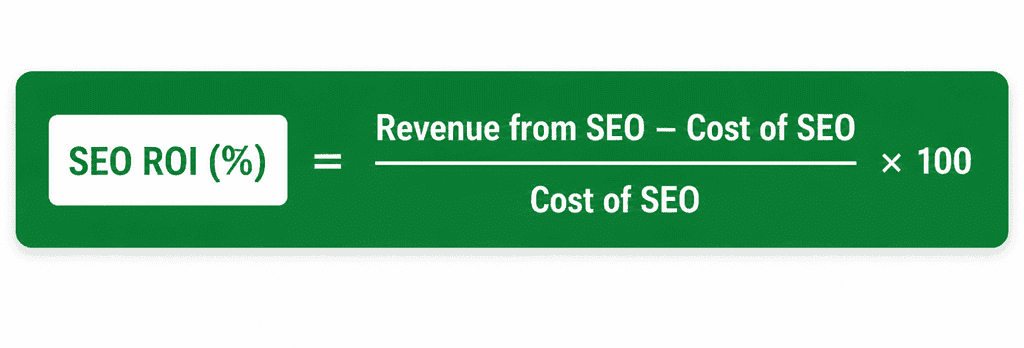
- Revenue from SEO refers to revenue from sales and conversions as a result of organic search traffic.
- Costs related to SEO come from all expenses related to the SEO campaign, including the expense of the SEO tools, content creation, marketing, link building, and labor costs, either agency-related or in-house salaries.
- For instance, in case a campaign related to SEO generates revenues of US$30,000 compared to total expenses of US$10,000, the formula is as follows:
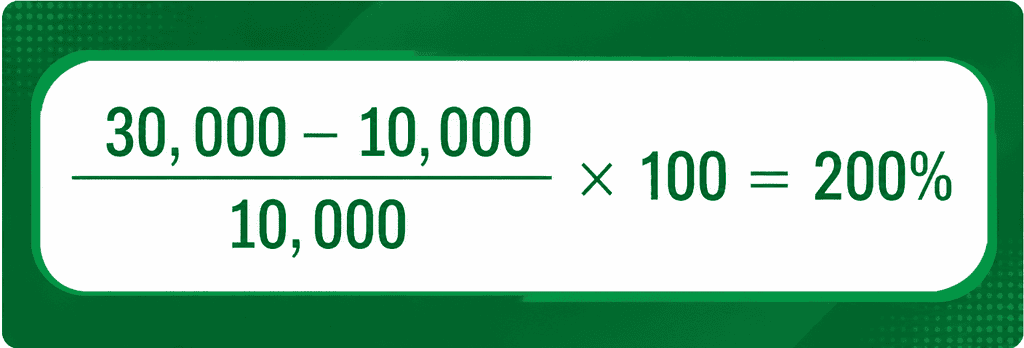
- The above implies that SEO provides the campaign with ROI equal to 200%.
- When it comes to calculating ROI, it is essential to keep track of all the costs and attribute revenues accurately.
- Using some special tools like UpGrowth’s SEO ROI Calculator, it is easy to perform calculations even for inexperienced marketers.
Conclusion
The return on investment (ROI) of search engine optimization (SEO) is dependent on several factors, including the industry of operation, the quality of services offered, as well as the value accorded to clients. Statistics show that the returns on investment brought about by strategic content and technical optimization are different. The cost of leads from organic search is much lower and often produces results that are competitive when compared to other paid or outbound options.
In addition, pay-per-click (PPC) leads to fast results. However, the effectiveness of the ROI in the use of SEO differs depending on the business. As such, it is necessary for businesses to have realistic expectations when setting results and costs associated with SEO.
FAQ
According to reports, the average ROI from SEO across various sectors is 748%.
Most businesses take between 6 and 12 months for SEO to break even.
SEO generates a larger amount of ROI compared to pay-per-click advertisements due to the fact that leads from organic search are cheaper.
Medical devices lead the cited industry benchmarks with an estimated 1,183% SEO ROI, followed by financial services at 1,031%.