









Introduction
Organic Search Statistics: The nature of organic search is changing in 2026. According to Google’s documentation, visits from AI advertising are now included in the organic search figures alongside traditional search results. An analysis conducted in November 2026 using SimilarWeb data showed that organic search visits decreased by 13.2% for a selected group of websites in the U.S. from August 2024 to August 2026, but this does not provide a national picture, nor does it attribute the decrease to AI advertising.
On the other hand, research from HubSpot conducted in 2026 showed that websites (79%), blogs (70%), and SEO (70%) remained the most frequently utilized channels by B2B marketers participating in the survey.
This article will reflect upon the trending organic search statistics and their importance in the digital world.
Key Highlights
- According to SimilarWeb estimates, organic traffic in August 2024 – August 2026 in the U.S. had decreased by 13.2%, while in France it dropped by 23.4%.
- The large U.S. websites experienced a median decrease in organic traffic of 17.6%.
- Retail and marketplace websites in the U.S. showed a growth of 7%, while news and information websites saw a decline of 15.1%.
- Contently reports that Google searches that fell into the category of AI Overview in the first quarter of 2026 accounted for 25.11%. This figure was calculated based on 21.9 million searches.
- The percentage of traditional results clicked in AI summary events was 8% as opposed to 15% in the absence of AI.
- Around 83% of searches that involved AI Overview had no click.
- An increase of 42.8% in the number of people who searched for information via AI in the 2026 period.
- Estimated costs of generating SaaS leads through organic search are around US$ 147, while the same figure in the case of paid search is US$280, thus proving that organic search is superior in terms of its acquisition costs.
- Search advertisements in the US brought around US$114.2 billion in the year 2025, according to IAB and PwC reports, which accounted for 38.8% of total revenues for digital advertising.
Understanding Organic Search Traffic Share
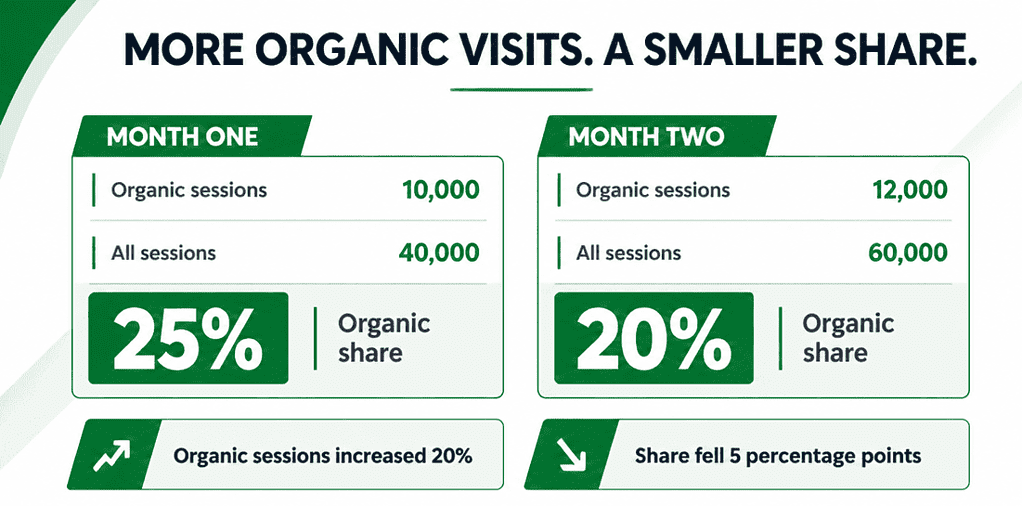
- Measuring organic search performance should include an analysis of actual visitor volume and growth rather than simply examining search’s contribution to total website traffic.
- The distinction is critical and is best shown by an example. 10,000 visits via search in month one resulted in 20% search growth.
- The search volume in month two grew to 12,000 visits, but the 20% search growth was far less impressive because total traffic increased from 40,000 to 60,000.
- Search’s share of traffic decreased by 5 percentage points, going from 25% to 20%.
- With organic share in mind, analysts should look beyond a single number and examine traffic volume, qualified conversions, and total revenue before concluding an organic search strategy is failing.
- The data BrightEdge gathered for their 2019 Channel Share Report showed that search engines delivered 53.3% of the traffic to tracked sites in the set.
- That search traffic share number depends heavily on many factors such as the company’s business, marketing strategy, awareness, and even what was paid for search ads, to name only a few.
- Companies should know and rely on their own benchmarks, along with any outside ones they think relevant, in their marketing.
How to Calculate the Percentage of Traffic from Organic Search
- Determining the proportion of your unpaid search traffic helps businesses assess the impact of their SEO.
- In GA4, go to Session default channel group and the Sessions metric to see Organic Search sessions alongside all sessions in your desired date range.
- Organic share = Organic Search sessions ÷ All sessions × 100
- If your site had 10,000 Organic Search sessions in a month out of 40,000 total sessions, your organic search is 25%. This is just an example.
- If you need a week-over-week or a month-over-month analysis, make sure your periods cover entire weeks and entire months.
- Account for seasonal trends and the timing of your marketing. When looking at your traffic proportions, make sure to use sessions, not first-user metrics.
- You also need to verify that your tracking tags and your tags’ configurations (filters, consent) are working, as well as your referral data, as these all contribute to your traffic metrics.
- For organic traffic analysis, look at other metrics like qualified leads, sales, and revenue to get the whole picture of the business impact of your traffic.
- As stated in the AI Search and Search AI categories, traffic to your site via these tools counts as Organic Search in Google Analytics. However, Paid Search stays in its own category.
Organic Search Traffic Trends and the Channels Gaining Ground
- According to Kevin Indig’s article published in Search Engine Land on November 4, 2026, organic search traffic experienced a decline between August 2024 and August 2026.
- In the U.S., organic traffic dropped by 13%, while in France, it fell by 24%. When compared to websites for which total traffic estimates were available, the U.S. and French data showed traffic declines of 13.2% and 23.4%, respectively.
- Organic search does face challenges, but the impacts vary greatly from one region to another.
- There were many factors, such as the size of the website, that played a major role in the performance of organic search traffic.
- Smaller websites generally retained steady traffic; however, large websites experienced a 17.6% and a 26% decline in organic traffic in the U.S. and France, respectively. There were many differences across industries.
- The organic traffic for retail and marketplace sites in the U.S. saw a 7% increase, whereas traffic for news and information sites decreased by 15.1%, and the same categories saw a decrease of 10.7% in France.
- Each industry has to perform its own analysis and assess the performance of its individual website because trends across industries do not all experience a similar decline.
- Direct traffic, another acquisition channel, also experienced declines, though to a lesser extent than organic search traffic.
- For a set of websites, Direct traffic declined 3.4% and 5.3% in the U.S. and France, respectively, during the period.
- Small websites did, however, show growth of 14.4% in the U.S. and 21.2% in France. Larger websites showed declines of 13% and 7.1%.
- Smaller sites may be experiencing a decline in organic traffic, but larger websites are experiencing declines in traffic for direct visits and for all acquisition channels.
- While Similarweb provides us with information to look at the differences in how much traffic was going to certain websites over a given period of time, it does not confirm the reasons why organic traffic was lost to specific websites.
- It is important for us as analysts to not look at this data in isolation and only consider how organic traffic has decreased and use it as a complete reflection of a website’s overall performance.
- It’s much better to look at all of the traffic sources in their entirety along with their impact on conversions and revenue.
AI’s Effect on Organic Search Traffic in 2026
- Contently reports on AI Overviews and organic traffic, showing that over 20 million search results, and of those, about 25% showed an AI overview, which we expect will be an increasing trend for all search queries, which could lead to users not engaging with the traditional organic search listings, further reducing search traffic for these listings.
- There has already been an observable decline in click-through behavior for users who have had the AI summaries show up on the search results pages compared to when they do not, and in a lot of cases with the latter, a large percentage of searches have had no clicks associated with them.
- A decrease in traffic from organic search, especially via traditional search methods, doesn’t mean a website has lost its search engine value.
- Data from Semrush, for instance, has shown that users brought to a website through AI search are worth roughly 4.4 times more than visitors brought through a standard organic search method.
- A separate study by VereNorth showed that AI search brings users who are 3 times more likely to convert.
- The traffic may be smaller, but that’s okay when they’re of higher value and are potentially better customers, particularly when a potential customer uses AI search as part of the initial stage of their search process and makes the final decision to visit the website through an AI-generated link.
- According to Wix AI Search Lab, AI search visits grew at a rate of 42.8% to 27.4 billion from 15.6 billion from Q1 2025 to Q1 2026. Semrush estimates that AI search visitors will likely overtake traditional search visitors in 2028.
- Based on these numbers, businesses need to think beyond measuring search traffic as only sessions on the website.
- More valuable data comes from metrics such as AI citations, branded search queries, conversion rates, and revenue by traffic source.
Organic Search vs. Paid Acquisition: Cost and Conversion Performance
- With organic search, B2B businesses are able to draw leads for much less than the cost of using paid ads.
- With a cost per lead of US$280 via paid search, organic search is still US$147 in SaaS, but effective SEO reduces it by even more—over 87% in some cases—and this only further improves the case for organic search as a solid ROI for businesses.
- Content marketing supports the ROI of organic search because for every US$1 invested, three times as many leads are created compared to traditional marketing.
- Unlike other methods of marketing, including the use of paid advertisements, search engine optimization continues to bring traffic to a website after the initial investment and, if done well, can create a continuous flow of prospective customers.
- Content marketing will provide the best value proposition in the long run if a business focuses on high-quality content that will improve search engine rankings.
- Organic search traffic has better conversion rates than traffic driven through paid methods, especially given that paid methods only drive a small portion of a website’s overall traffic.
- In the long term, search engine optimization will result in a lower cost of acquisition and higher return on investment than paid methods if analyzed properly and taking into account other variables like the quality and intent of the website’s traffic.
Future-Proofing Your Content Strategy Against Algorithm Volatility
- An essential step in reducing dependence on search engines and building loyal relationships with your audience is creating an effective content strategy that is designed for the future.
- Search engine traffic, which has always been an integral part of the strategy, has now become a source of less traffic.
- The first search engine summaries that reduced clicks in Pew Research were summarized as AI results with an 8% click-through rate, whereas others in the results saw a 15% click-through rate.
- The trend has begun to reduce search engine dependence as publishers began distributing their content through alternate channels.
- Publishers should take note of the forecast made by Gartner in 2018 regarding the reduction of search engine traffic, and diversify their distribution channels.
- As part of this process, the first consideration is the 2025 marketing spend budgets. 61.1% of these budgets are allocated to the digital domain, of which 69% of the budget goes to paid search, and 7.4% goes to email, making email a channel for audience loyalty.
- The data supports the use of several different search and distribution channels rather than the single-channel approach of most companies.
- Gartner recommends the frequent review of marketing channel spend and balancing investments between reliable proven channels and carefully considered experiments.
- According to Google Gmail, newsletters should maintain spam complaints at a low 0.1% and ensure they never reach 0.3%.
- Newsletters also should be in line with authentication practices, including SPF, DKIM, and DMARC. Google stresses the importance of trust, originality, accuracy, and usefulness of the information while not treating E-E-A-T as a ranking criterion.
- The publishers have to work with skilled authors, validate their research results, present their methods, and ensure the correctness of references.
- Besides, good topical coverage, effective internal traffic links, and use of adequate structured data will also positively affect clarity and ranking chances of the content.
- Data collection requires care for privacy, getting permission to collect data, and developing an interesting subscription offer that will turn anonymous visitors into followers.
- Publishers also have to study their returning visitors, subscribers, renewals, and conversions and not just rely on direct traffic.
- Therefore, resilience means conducting a quarterly analysis of channels, technical analysis, and setting measurable objectives.
- The aim is to create a content production business that will stay relevant regardless of ups and downs in search visibility and traffic.
How Much Money Moves Through Search Advertising?
- Search advertising continues to be an integral part of the digital marketplace, even as the contest for digital ad clicks evolves.
- A collaboration between the IAB and PwC on Internet Advertising Revenue has found that search ads in the US amounted to US$114.2 billion in 2025. This was a growth of 11% and accounted for 38.8% of all digital advertising.
- However, social media ad spending surpassed search spending for the first time, as it reached US$117.7 billion with a growth of 32.6%.
- In total, the amounts spent on digital advertising in the US reached US$294.6 billion.
- As for Alphabet’s 2025 Form 10-K, the figure shows that Google Search and other revenues grew to US$224.5 billion compared to US$198.1 billion in 2024 and US$175 billion in 2023, which means 13% growth in annual terms.
- The growth comes along with the reported decline in organic clicks to the open web by 23%, indicating the changing nature of the relationship between earnings from search and web traffic.
- According to Gartner’s 2025 CMO Spend Survey, the percentage of budget allocated for marketing remained 7.7% of revenue, with the share of media costs rising to 31% of this budget, up from approximately 28%.
- Paid search accounted for 13.9% of the digital advertising budget, which is higher than display (12.5%) and social media (12.2%).
- According to GWI data shared by Backlinko, 29.5% of internet users worldwide and 32.5% of Americans occasionally use ad blockers, equating to around 1.77 billion individuals. This data underscores the necessity for marketers to balance paid visibility with alternative acquisition methods.
Conclusion
While organic search continues to be a vital acquisition channel, its effectiveness is evolving due to AI-driven searches, changing user behaviors, and increased competition within platforms that alter how digital information is discovered. Studies show a decrease in traditional organic clicks across various markets, with AI-generated responses impacting how users seek out information.
Nonetheless, organic search still presents viable opportunities for qualified traffic generation, lead development, and cost-effective customer acquisition. Companies should assess their SEO strategies based on conversions, revenue metrics, and audience quality rather than solely focusing on traffic volume alone. Expanding into avenues like email newsletters and partnerships while fostering direct engagement and providing valuable content can help lessen reliance on visibility in search engines.
FAQ
Data collected by Similarweb revealed a decrease of 13.2% in organic searches in the U.S. between August 2024 and August 2026; however, the findings differed depending on the niche and site size.
AI Overviews provide the answer directly in search results that might reduce the count of the clicks made on organic listings. Pew Research discovered that the click rate of traditional results is 8% with AI Overviews.
Organic search brings in SaaS leads for US$147, while paid search costs US$280.
Businesses should create reliable content, engage in email marketing and various partnerships, have strong relationships with their audience, and track conversions and income along with organic traffic.