









First Glance
AI in Computer Vision Statistics: AI in computer vision means teaching computers to understand pictures and videos. It uses smart learning models that can sort images, find objects, outline shapes, read text, recognize faces, and follow movement. This field grows because of three things: large sets of labelled images, strong computer hardware, and better model designs.
Many industries now use this technology, including healthcare, car safety, retail, factories, farming, and public security. Companies use it to improve accuracy, save review time, and handle far more images than people can check. Important points to consider are accuracy, data quality, cost, privacy rules, and fairness in results. This report examines AI in the computer vision industry through these factors.
Must Know Facts by the Editor
- Computer vision AI market: USD 24.7 billion in 2025, projected USD 280.5 billion by 2035 at 27.5% CAGR.
- Hitachi’s 2026 survey found 43% of manufacturing respondents had deployed computer vision inspection in production.
- Edge inference latency is 15–50 milliseconds versus 150–400 milliseconds for cloud in a 2026 security comparison.
- Edge costs USD 7.49 per camera monthly versus USD 27.21 for cloud-only AWS in a modeled 50-camera deployment.
- RF-DETR 2XL exceeds 60 COCO AP; YOLO26n reaches 40.9 mAP at 1.7 ms on T4 TensorRT.
- DINOv3 scales to 7 billion parameters, trained on 1.7 billion images without human supervision.
- SqueezeViT uses 43.2% fewer parameters than baseline MobileViT for chest X-ray classification.
- NVIDIA Jetson Thor developer kit starts at USD 3,499, delivering up to 2,070 FP4 TFLOPS within 130W.
- Lyte raised USD 165 million in September 2026, reaching a USD 1.6 billion valuation.
How Computer Vision Models Work
- Models convert images into numerical arrays; RGB inputs contain 3 colour channels: red, green, and blue.
- Preprocessing standardizes image dimensions; IBM documents 512 × 512 pixels for SSD and 608 × 608 for YOLOv3.
| Model type | Image dimensions | Notes |
| Single shot detector (SSD) | 512 x 512 pixels | |
| YOLO v3 | 608 x 608 pixels | |
| Tiny YOLO v3 | 416 x 416 pixels | |
| Faster R-CNN | 1000 x 600 pixels | The original aspect ratio is maintained. If necessary, black bands are added to the image to make it fit. |
| Detectron2 | 1333 x 800 pixels | The original aspect ratio is maintained. If necessary, black bands are added to the image to make it fit |
| GoogLeNet | 224 x 224 pixels | |
| Structured segment network (SSN) | 224 x 224 pixels | |
| High resolution | 1333 x 800 pixels | Images are scaled down only during training. Images are not scaled down during inference. |
- CNNs slide learned filters, commonly 3 × 3, across pixels to extract patterns such as edges and textures.
- Deeper layers combine extracted features; pooling compresses feature maps, reducing computation and helping control overfitting.
- Vision transformers divide images into patches; 224 × 224 pixels can yield 256 patches measuring 14 × 14 pixels.
- Training uses backpropagation to adjust weights and biases, improving predictions against annotated examples.
- During inference, trained networks process new images; detection heads predict object categories, bounding boxes, and classification scores.
AI in Computer Vision Startup Statistics
- Seedtable’s 2026 directory tracks 916 funded computer vision startups; its top 60 collectively raised USD 4.2 billion cumulatively.
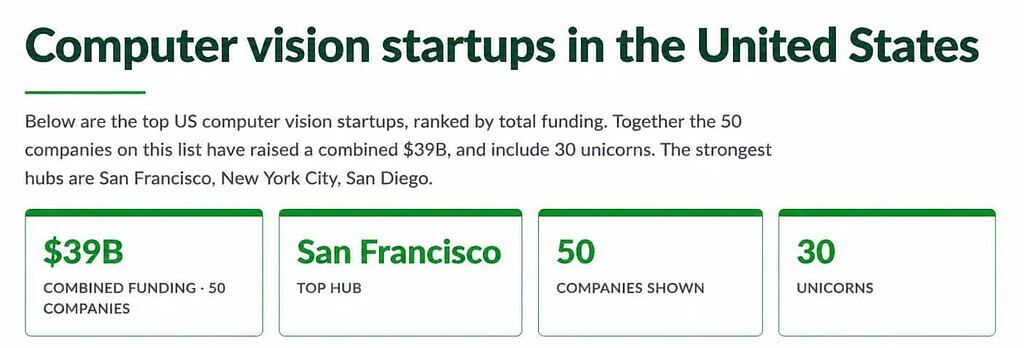
- Dealroom’s October 2026 US computer vision list includes 50 companies, 30 unicorns, and USD 39 billion in combined funding.
- Machine vision startup Lyte raised USD 165 million in September 2026, reaching a USD 1.6 billion valuation.
- Singapore’s Ailytics raised USD 7.4 million in Series A funding in October 2026, led by Tin Men Capital.
- By October 2026, Ailytics reported more than 400 deployments across 15 countries, up from 70 projects across four countries.
- Manufacturing computer vision startup Assembler AI raised USD 4 million in seed funding in October 2026.
- Sports computer vision startup OnSport AI raised USD 2 million in pre-seed funding, reported in November 2026.
- Failory’s 2026 directory lists 10 computer vision unicorn startups, led by Metropolis at a USD 5 billion valuation.
Edge AI vs Cloud AI in Computer Vision
| Comparison factor | Edge AI in computer vision | Cloud AI in computer vision |
| Processing location | Runs inference on cameras, local accelerators, or on-premises appliances. | Runs inference on remote servers after images or video are uploaded. |
| End-to-end latency | A 2026 physical-security comparison reports 15–50 milliseconds for local processing. | The same comparison reports 150–400 milliseconds, including network and processing delays. |
| Illustrative monthly cost | USD 7.49 per camera in a modeled 50-camera deployment. | USD 27.21 per camera for cloud-only AWS; USD 28–33 for subscription alternatives. |
| Cost-model assumptions | Includes cameras and hardware amortized over five years. | Uses the same 50 cameras, 5-megapixel resolution, 30-day retention, and detection at 5 frames per second. |
| Video bandwidth | Can transmit detection metadata instead of continuous footage; individual detection results may occupy only hundreds of bytes. | A 1080p stream at 4 Mbps generates approximately 1.8 GB hourly, or 1,300 GB monthly when streamed continuously. |
| Internet outages | Local detection can continue without internet access, provided local equipment remains operational. | Cloud-dependent detection can stop when connectivity fails. |
| Privacy and data movement | Raw footage can remain on the customer’s network; hybrid systems can upload metadata only. | Frames or video leave the local network for remote analysis, requiring appropriate data-handling controls. |
| Model capacity and management | Model size is constrained by device memory, power, and compute; updates must reach distributed equipment. | Supports larger workloads and centralized model updates, with recurring infrastructure costs. |
Vision Transformers in Computer Vision
- April 2026’s SqueezeViT study reports 43.2% fewer parameters than baseline MobileViT for chest X-ray classification.
- SqueezeViT reports parameter reductions reaching 95.4% against other compared state-of-the-art models in its 2026 evaluation.
- SqueezeViT’s 2026 experiments used 4 × 4 patches, roughly halving transformer-module runtime versus 2 × 2 patches.
- SqueezeViT’s 2026 training configuration used batches of 64, 100 epochs, and an Adam learning rate of 0.0001.
- An April 2026 vegetation-classification preprint evaluated vision transformers across seven design dimensions using two Brazilian Cerrado datasets.
- That 2026 vegetation study reports approximately 10-fold fewer floating-point operations than its CNN baseline, maintaining competitive classification performance.
- May 2026’s MicroViTv2 preprint reports accuracy improvements up to 0.5% over MicroViT, testing efficiency on Jetson AGX Orin.
- September 2026’s VideoMSN paper reports up to 160-fold fewer video-pretraining epochs than compared self-supervised approaches.
- November 2026’s MRI benchmarking preprint reports ViT-L/16 achieved 95.0% accuracy on 1,675 external images.
AI in Computer Vision Market Size
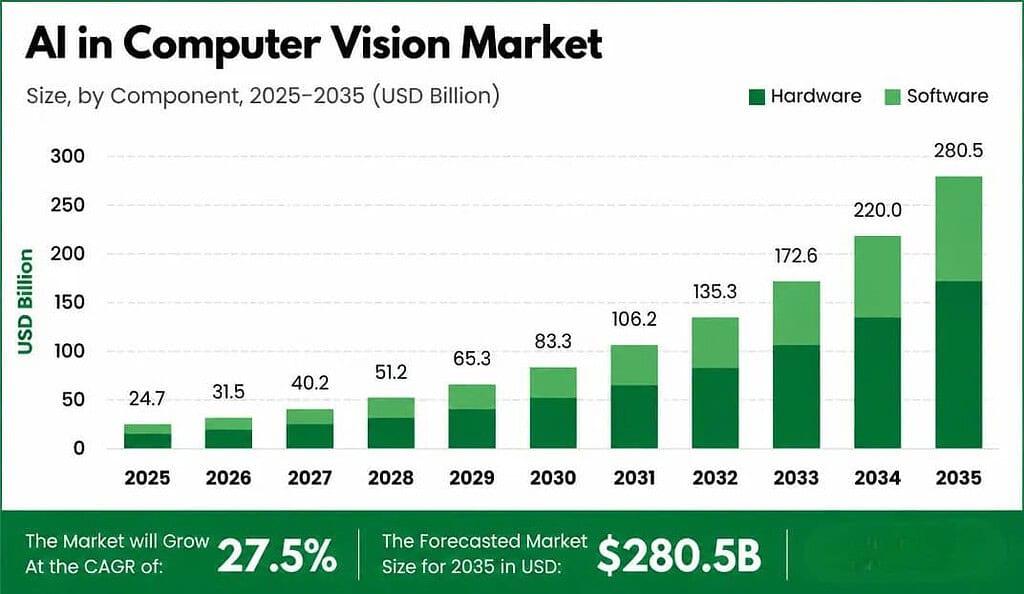
- The global AI in computer vision market includes hardware and software, with its value projected to grow at a compound annual growth rate (CAGR) of 27.5% during 2025–2035.
- The market is valued at USD 24.7 billion in 2025 and is expected to reach USD 31.5 billion in 2026 and USD 40.2 billion in 2027.
- The market is expected to grow to USD 220.0 billion in 2034 and USD 280.5 billion in 2035, with hardware maintaining a larger share than software.
AI in Computer Vision Adoption Statistics
- Hitachi’s 2026 survey found 43% of manufacturing respondents had deployed computer vision inspection in production.
- IHL’s 2026 study found 35% of retail sales winners planned computer vision deployment within 12 months, versus 10% of laggards.
- IHL’s 2026 study found current computer vision deployments among 20% of online/warehouse fulfillment leaders, versus 9% overall.
- IHL’s 2026 study reported computer vision adoption 83% above average among buy-online-pickup-in-store leaders.
- IHL’s 2026 study reported computer vision adoption 77% above average among ship-from-store leaders.
- Ailytics reported over 400 vision AI deployments across 15 countries in October 2026, up from 70 projects across four countries.
- Ailytics reported deploying vision AI across over 1,000 cameras at Changi Airport’s Terminal 5 construction site in October 2026.
Top AI Models in Computer Vision
- RF-DETR 2XL exceeds 60 AP on COCO object detection, making it a strong high-accuracy option.
- YOLO26n delivers 40.9 COCO mAP, 1.7 ms T4 TensorRT latency, and 2.4 million parameters for efficient detection.
| Model | size (pixels) | mAPval50-95 | mAPval50-95 (e2e) | Speed CPU ONNX (ms) | Speed T4 TensorRT10 (ms) | params (M) | FLOPs (B) |
| YOLO26n | 640 | 40.9 | 40.1 | 38.9 ± 0.7 | 1.7 ± 0.0 | 2.4 | 5.5 |
| YOLO26s | 640 | 48.6 | 47.8 | 87.2 ± 0.9 | 2.5 ± 0.0 | 9.5 | 20.9 |
| YOLO26m | 640 | 53.1 | 52.5 | 220.0 ± 1.4 | 4.7 ± 0.1 | 20.4 | 68.4 |
| YOLO26l | 640 | 55 | 54.4 | 286.2 ± 2.0 | 6.2 ± 0.2 | 24.8 | 86.8 |
| YOLO26x | 640 | 57.5 | 56.9 | 525.8 ± 4.0 | 11.8 ± 0.2 | 55.7 | 194.4 |
- RF-DETR Seg-Preview achieves 44.3 COCO mask AP at 5.6 ms on NVIDIA T4, TensorRT FP16, batch-one inference.
- RF-DETR Keypoint achieves 71.8 COCO Keypoint AP at 9.8 ms, using 576×576 inputs and T4 TensorRT FP16.
- SAM 3 supports promptable segmentation and tracking, reporting 2× gains over previous systems on image/video promptable concept segmentation.
- DINOv3 scales visual representation learning to 7 billion parameters, trained on 1.7 billion images without human supervision.
- GLM-OCR combines 0.9 billion parameters with a 94.62 OmniDocBench V1.5 score for complex document understanding.
Recent AI in Computer Vision Developments
- On July 15, 2026, NVIDIA announced Jetson T3000/T2000, offering 865/400 FP4 TFLOPS and 32/16GB memory, respectively, with availability planned for Q1 2027.
- On June 1, 2026, Qualcomm introduced Dragonwing IQ10’s robotics reference design, specifying up to 700 TOPS, 18 CPU cores, and 12 cameras.
- On January 13, 2026, Google released 4-billion-parameter MedGemma 1.5, reporting internal CT/MRI accuracy improving from 58%/51% to 61%/65%, respectively.
- On January 5, 2026, Ambarella launched 4nm CV7, claiming 20% lower power, over 2.5× AI performance, and 2× encoding performance versus CV5.
- On November 19, 2025, Meta introduced SAM 3 and SAM 3D; SAM 3D provides 2 open-source models for reconstructing objects and people from 1 image.
- On August 25, 2025, NVIDIA released the Jetson Thor developer kit, starting at USD 3,499, delivering up to 2,070 FP4 TFLOPS within 130W and 128GB of memory.
- On August 14, 2025, Meta introduced DINOv3, scaling self-supervised computer vision to 7-billion-parameter models and 1.7 billion training images without human annotations.
- In April 2025, Apple introduced FastVLM, reporting 85× faster first-token generation and a 3.4× smaller vision encoder than LLaVA-OneVision using 0.5-billion-parameter language models.
Closing Statement
AI in computer vision has moved from research into everyday commercial use across manufacturing, retail, healthcare, security, and robotics. The market is projected to expand quickly, with hardware holding a larger share than software. Edge processing lowers latency, cost, and bandwidth needs, while efficient models, lightweight vision transformers, and new chips bring more compute to devices.
Strong startup funding and growing deployments reflect demand, though data quality, privacy, and fairness will shape how responsibly the technology scales.
FAQ
Computer vision systems capture an image or video frame, convert it into numerical pixel data, and pass it through a trained neural network. The network extracts features such as edges, shapes, and textures, then combines them to produce an output like a label, a bounding box around an object, or a pixel-level map of the scene.
Core tasks include image classification, object detection, semantic and instance segmentation, facial recognition, optical character recognition, pose estimation, object tracking, and depth estimation. Newer work also covers image generation, video understanding, and visual question answering, where a model answers questions about what an image contains.
Convolutional neural networks scan images with small filters to detect local patterns, making them efficient and effective with limited data. Vision transformers split an image into patches and use attention to relate every patch to every other, capturing global context. Transformers often perform better at scale but typically need more training data and computing power.
Common uses include medical imaging analysis, driver assistance and autonomous vehicles, quality inspection in manufacturing, retail checkout and inventory tracking, crop monitoring in agriculture, security and surveillance, document processing, and smartphone features such as face unlock and photo search.
Key challenges include the cost of collecting and labeling training data, poor performance in unusual lighting, angles, or weather, bias when datasets underrepresent certain groups, and high computing demands. Privacy, consent, and misuse concerns also apply, particularly for facial recognition and surveillance, and rules vary by country.

Sources