









Introduction
Cloud Gaming Statistics: Cloud gaming, or gaming-as-a-service, enables users to play video games over the internet without needing a high-definition gaming console or a gaming personal computer. Here, the use of cloud servers means that processing power is provided off-site, allowing easy gaming on different devices like smartphones, tablets, and smart TVs.
In 2026, cloud gaming statistics will still dominate the gaming sector as a fundamental tool, owing to the state-of-the-art and the availability of the Internet.
The Editor’s Personal Picks
- Recent cloud gaming statistics reveal that the global cloud gaming market is expected to produce revenue of about USD 11.1 billion by 2025.
- This market is predicted to have a healthy compound annual growth rate (CAGR) of 29.64% between 2024 and 2029, increasing the market volume to USD 25.30 billion in 2029.
- Cloud Gaming users metric is forecasted to reach 501.1 million by 2029, growing from a user penetration of 5.1% in 2024 to 6.2% in 2029.
- According to cloud gaming statistics, the average revenue per user (ARPU) is estimated to rise to around USD 22.97 in 2025.
- In revenue generation, the United States and North America remain among the largest contributors, with North America accounting for roughly 38% of global cloud gaming revenues in 2025.
- The rapid increase in cloud gaming services worldwide positively impacts the media sector by enabling different individuals to play games without incurring maintenance costs and making the activity accessible to everyone. This hype is projected to continue through 2025, but USD 2 billion in cloud gaming revenue is expected to come from the U.S. market.
- The share of U.S. gamers using cloud gaming services in 2025 includes console‑based offerings like Xbox Cloud Gaming.
- By 2025, PC has become even more dominant, with about 80% of game developers working on at least one PC title.
- As of March 2025, PlayStation Plus is the biggest cloud gaming service, with 50 million subscribers. The primary game development platforms in the year 2025 are PC (78%), PlayStation 5 (33%), and Xbox X/S (30%).
- Cloud gaming statistics show that the U.S. cloud gaming market is projected to be worth about USD 2.38 billion by 2024 and will likely hit USD 7.39 billion in 2028.
- The number of cloud gaming consumers in the U.S. will be 87.2 million in 2028, increasing considerably between 2024 and 2028. Cloud gaming users, on the other hand, are estimated to number 497 million by the year 2028.
- Within G7 nations, the Cloud Gaming industry is set to generate an approximate revenue of USD 3.64 billion by 2024. From 2024 to 2029, the market is anticipated to expand at a compound annual growth rate (CAGR) of 28.61%, with the total market volume expected to reach USD 12.81 billion by 2029.
- Cloud gaming statistics expect that there will be no camera users in Cloud Gaming across the G7 country populations by 2029, with user penetration and ARPU also forecasted to remain at zero in that time frame.
- On a global scale, the country expected to collect the highest revenue from cloud gaming is the United States, with USD 1.938 billion projected in 2024.
- Cloud Gaming in G7 is disrupting the media market by enabling on-demand gaming services that offer high-quality and smooth game streaming.
Cloud Gaming by Region
Asia
- The Asian cloud gaming market is forecasted to generate USD 3.50 billion in revenue in 2025, with a CAGR of 35.50% over the period, reaching USD 8.60 billion by 2028.
- The region’s user penetration rate is expected to rise from around 5.8% in 2025 to 6.7% by 2028, with an average revenue per user (ARPU) of about USD 11.50 in 2025. By 2025, the number of users in the Asian market is projected to reach around 260 million, before climbing to 311.4 million by 2028.
Americas
- Cloud gaming is expected to create a revenue pool of about USD 3.2 billion in the Americas by 2025, on its way from USD 2.38 billion in 2024 to roughly USD 7.39 billion in 2028, at a strong CAGR in the 33% to 46% range.
- The Average Revenue Per User (ARPU) is expected to be sustainable at 32.74%. By 2028, the user base is expected to grow to 87.2 million, with user penetration growing from 6.8% in 2024 to 8.4% in 2028.
- Within the said period, growth in the above statistics and investment in the market are the key contributors to this growth.
Africa
- As far as the cloud gaming industry in Africa is concerned, revenue generation is projected to reach about USD 14.36 million by the year 2025 and then grow toward around USD 36.17 million by 2028.
- The revenue per user is estimated to be USD 9.60 per user in the year 2025.
- However, the number of users is expected to grow to 1.6 million by the year 2028, and user penetration is expected to grow to 0.7% in the year 2025.
Australia And Oceania
- The Australian and Oceania cloud gaming market is anticipated to earn USD 214 million in 2025.
- The market will expand at a CAGR of 32.39% and will reach USD 491.90 million by 2028.
- The user base is expected to grow to 8.1 million in 2028, with a 17.8% user penetration rate.
- The Average Revenue Per User (ARPU) is likely to be USD 24.99.
Europe
- The revenue of the European cloud gaming market is projected to reach USD 2.37 billion in 2025, and with a growth forecast of 33% CAGR, this market will be worth USD 5.49 billion by 2028.
- The ARPU is predicted to stand at USD 24.77.
- The volume of users in 2024 will approximate 88.8 million, which corresponds to 8.4% penetration. In 2028, user penetration is projected to grow to 10.5%.
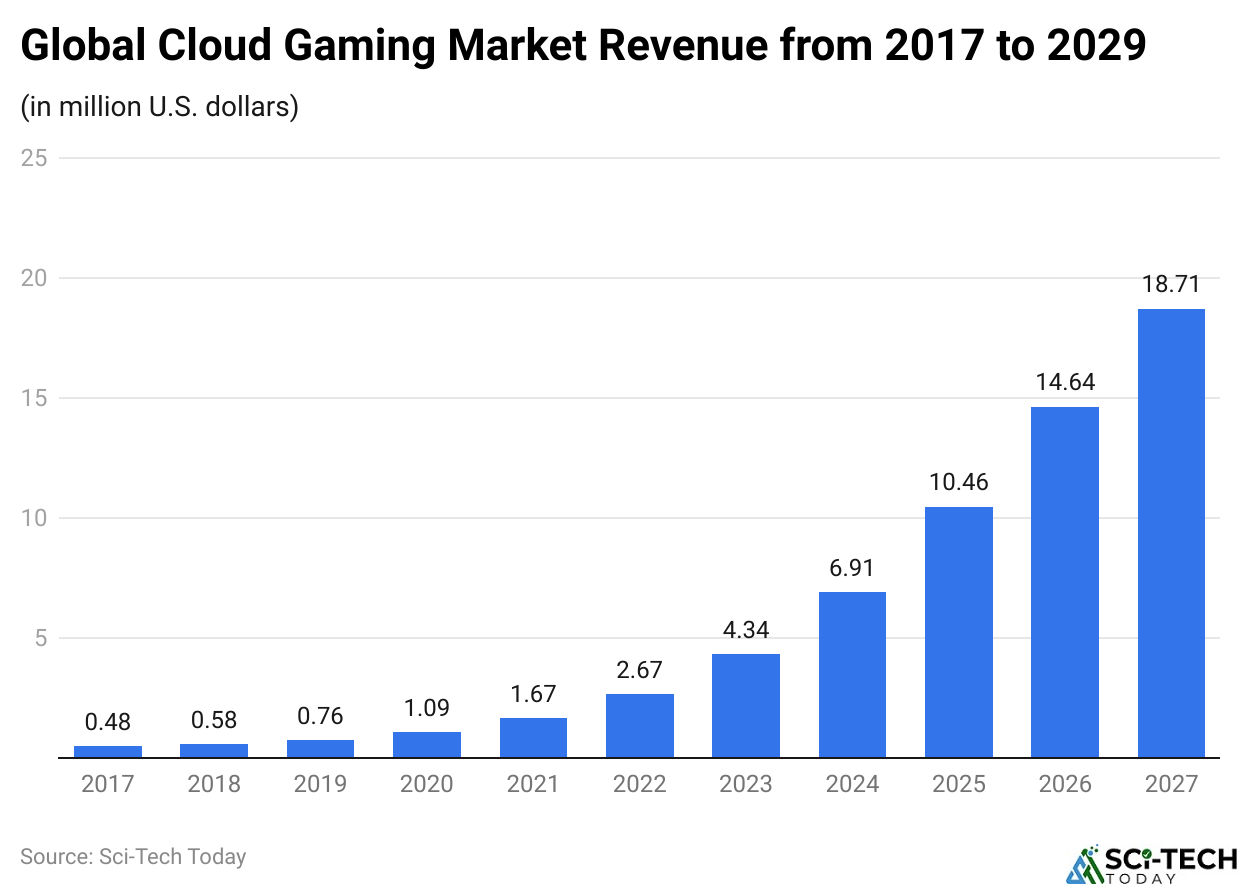
Cloud Gaming Market Revenue
(Reference: statista.com)
- According to cloud gaming statistics, revenue in the digital media market segment of cloud gaming is anticipated to increase steadily between 2024 and 2027, with an increase of USD 11.8 billion (+170.777%), reaching roughly USD 3.3 billion in 2025 on its way toward that total uplift by 2027.
- This will mark the tenth successive year of growth, with revenues forecast to peak once again at USD 18.71 billion in 2027.
- The segment of Cloud Gaming, in particular, has been registering steady growth in the previous years and is still on the rise.
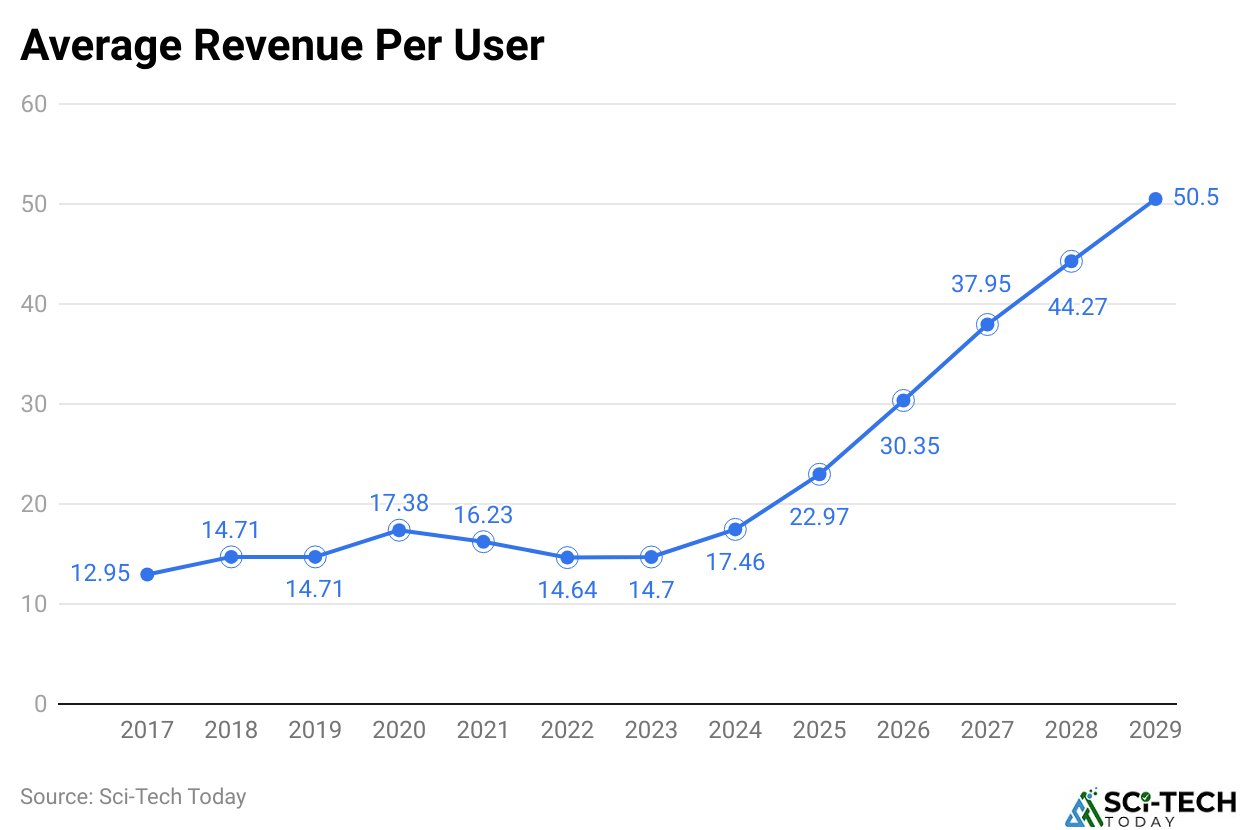
Cloud Gaming Average Revenue Per User
(Reference: statista.com)
- Cloud gaming statistics expect that in 2025, the Average Revenue Per User (ARPU) of cloud gaming will reach about USD 22.97 yearly, continuing the strong growth from USD 17.46 in 2024 and USD 14.70 in the previous year.
- With more premium games and features being introduced on cloud gaming platforms, the cost of subscriptions has increased, thus raising ARPU.
- Players are buying more in-game items, expansions, and skins, which is also contributing to the revenue.
- High-end subscription models with superior services and access to unique games have played a part in the growing ARPU.
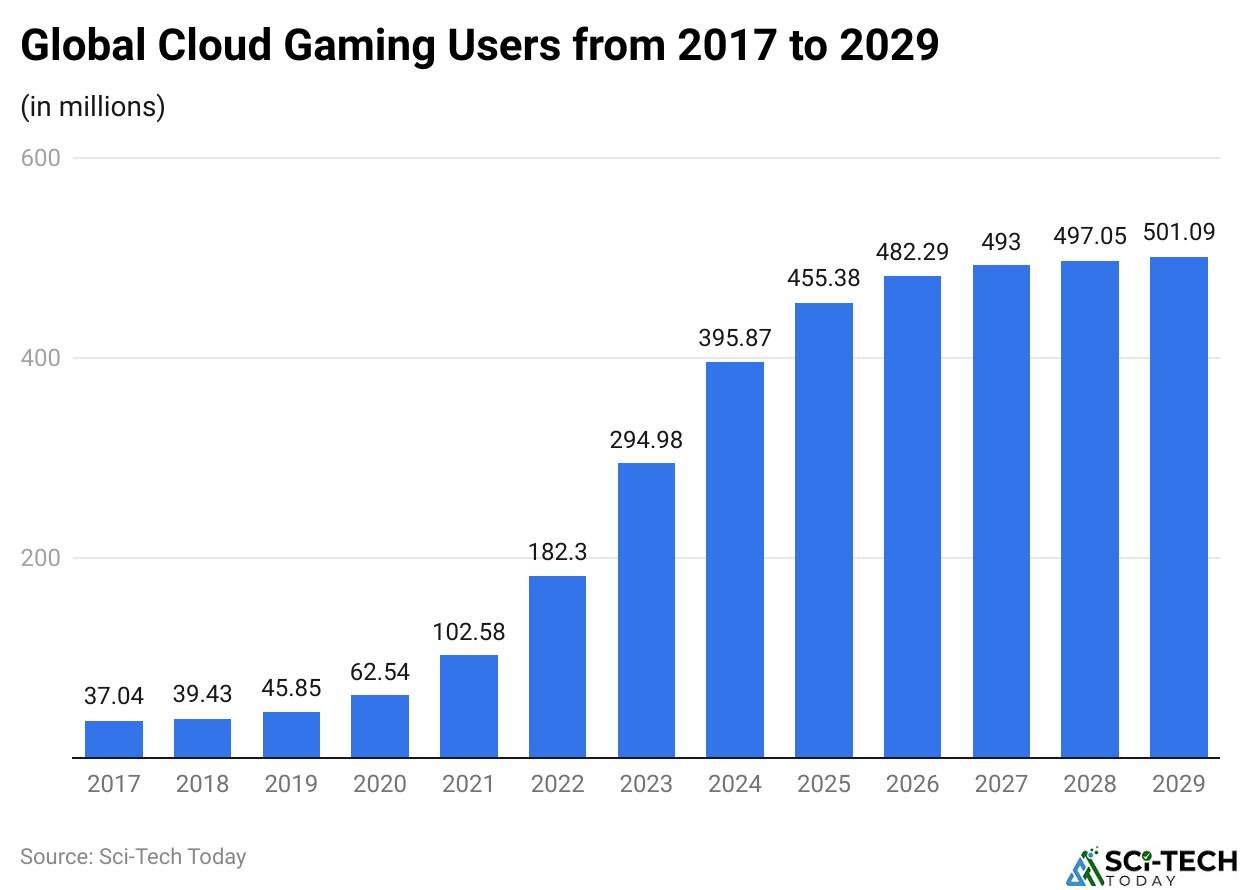
Cloud Gaming Users Global
(Reference: statista.com)
- Recent cloud gaming statistics indicate that the number of users in the digital media market for “Cloud Gaming” has been steadily increasing and is projected to increase by 97.1 million users (+24.53%) between 2024 and 2027.
- This will mark the tenth consecutive year of growth, which will push the total number of users to approximately 493 million by the year 2027, an all-time high.
- Over the past years, the number of users in the ‘Cloud Gaming’ segment has consistently portrayed an upward curve, with several other factors keeping the curve in an upward trajectory.
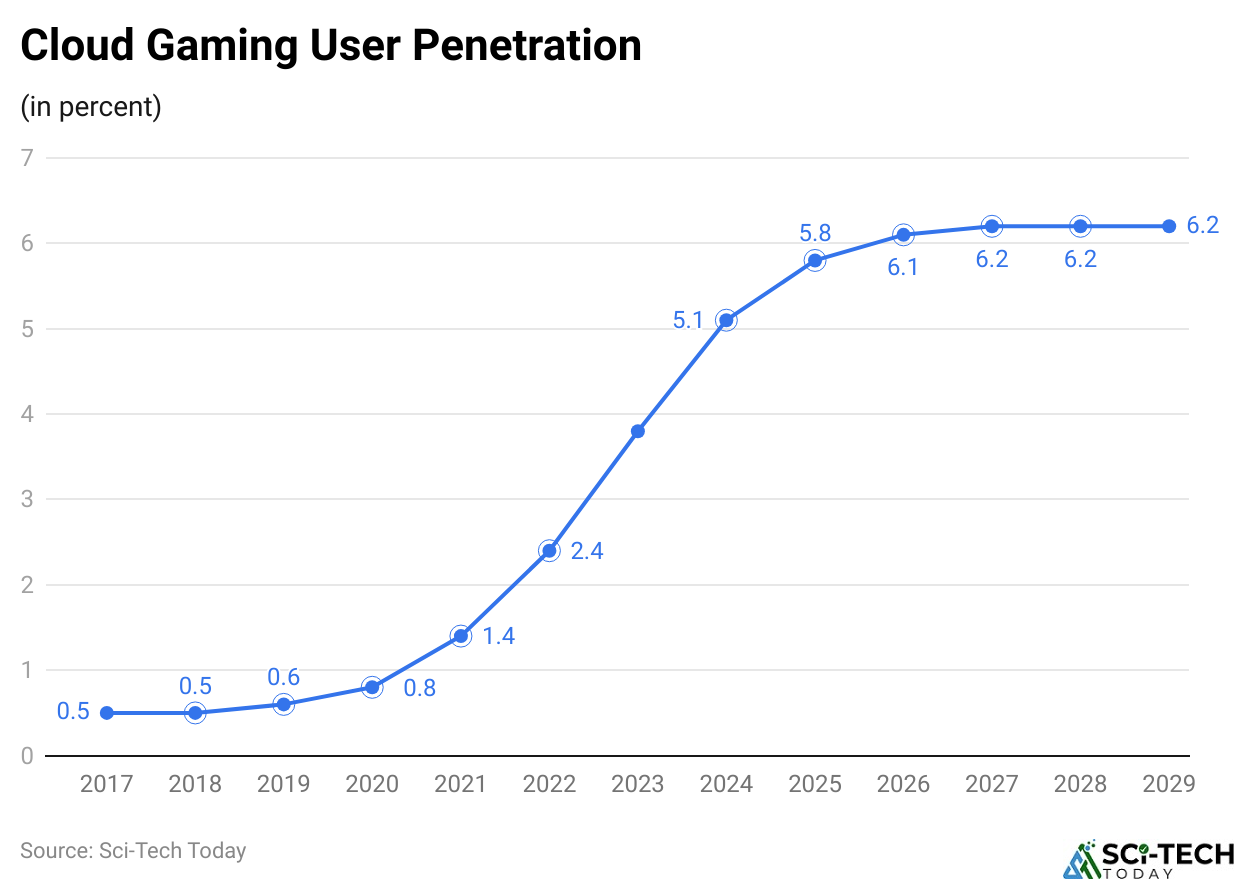
Cloud Gaming User Penetration
(Reference: statista.com)
- Based on the global cloud gaming statistics by user penetration, it is evident what % age of internet users or gamers contribute to cloud gaming services.
- Cloud gaming statistics expect that in 2025, the global penetration of cloud gaming among internet users will reach around 5.9%, up from 5.1% in 2024 and 3.8% in 2023, showing continued warming to the service as connectivity and cloud infrastructure improve.
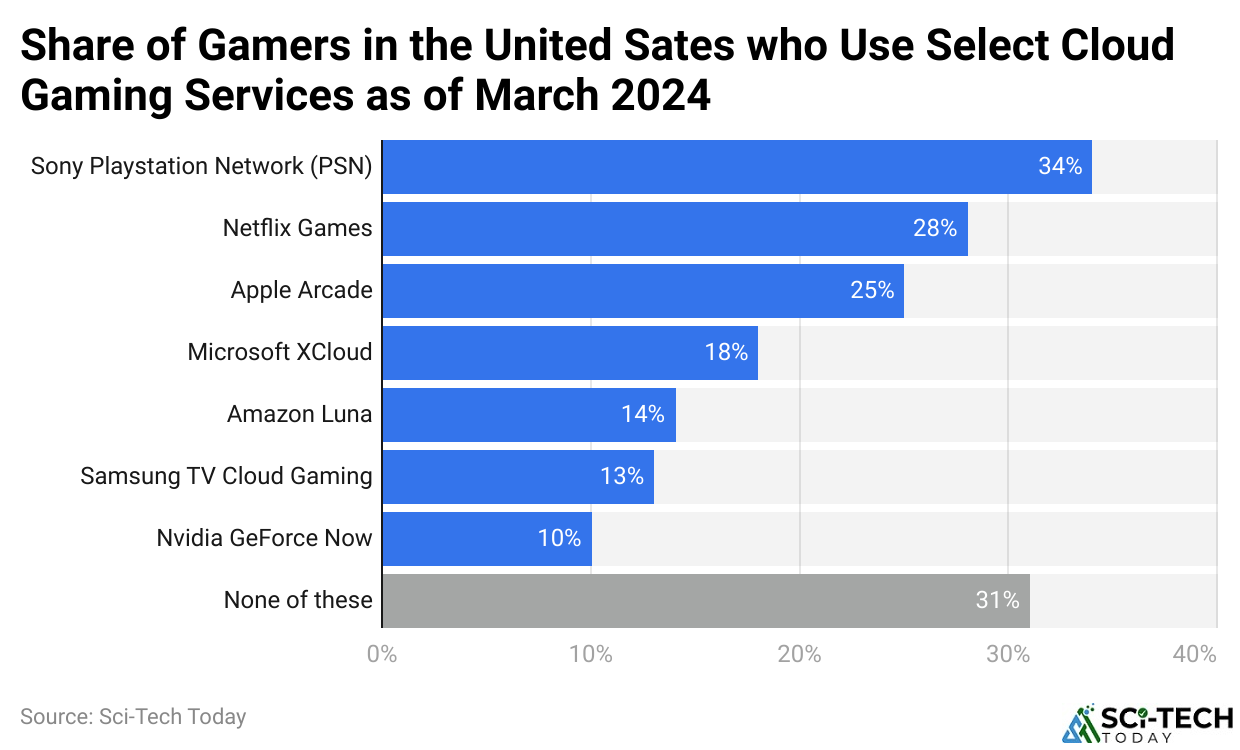
Cloud Gaming by Share of Gamers in the United States
(Reference: statista.com)
- According to cloud gaming statistics conducted in March 2025 among US gamers aware of cloud gaming, about 35.4% of gamers of the highest age reported using the Sony PlayStation Network (PSN), making it the most prevalent platform.
- This means that out of the surveyed gamers who were aware of cloud gaming, well over one‑third were using PSN in 2025.
- The third position was occupied by Netflix Games, with around 30% of the respondents in 2025 reporting using this platform for gaming, as Netflix’s cloud and mobile catalogue continued to expand and gain traction.
- The above data underlines the fact that the cloud gaming market is very competitive. PSN has the largest market share, even though services such as Netflix Games have started becoming popular.
Key Players Of The Cloud Gaming Market
- There are several important contributors in the global cloud gaming market, and they compete to dominate the market.
- NVIDIA Corporation has a 21% market share, followed by Microsoft Corporation, which has 14%, and Google Inc., which has 11%.
- On the other hand, Intel Corporation and IBM Corporation managed to attain reasonable market shares, commanding 16% and 9%, respectively.
- On the other hand, Amazon Inc. and Electronic Arts, Inc. account for 10% and 7%, respectively, and Apple Inc. controls 8% of the market.
- These large corporations dominate the cloud gaming market to an extent, leaving only 4% for other players.
- It can be conclusively stated that cloud gaming will be directed by these players as the market grows competitive, and innovations are bound to arise.
Satisfaction Levels Of Cloud Gaming Gamers
(Reference: scoop.market.us)
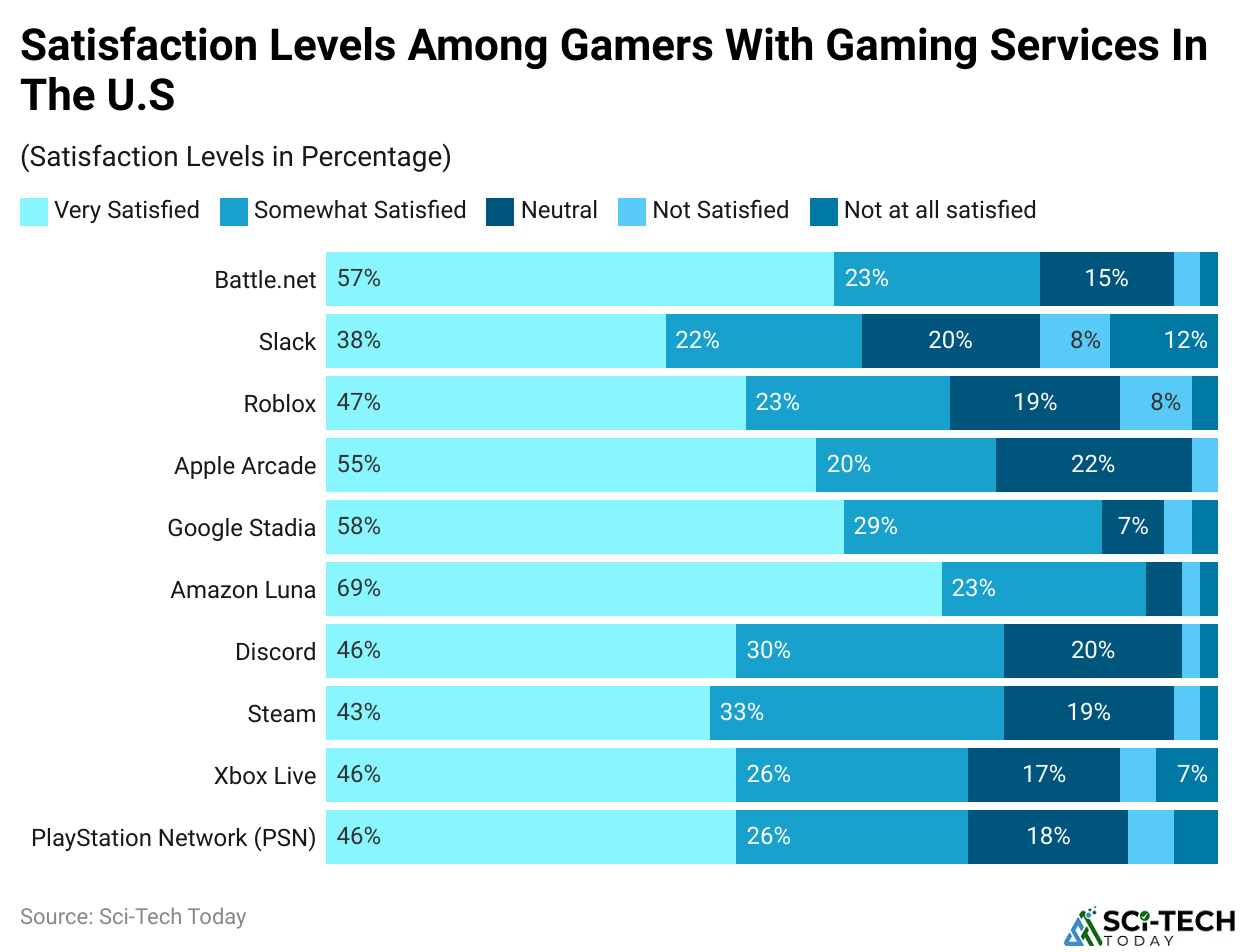
- A cloud gaming statistics survey, carried out in the United States in April 2025 and targeted at gamers, brought about different levels of user satisfaction with different gaming services. For example, PlayStation service provider (PSN) or Xbox Live scored high user satisfaction rates, with 46% of the users rating themselves as “Very Satisfied” while 26% rated themselves as “Somewhat Satisfied.”
- Steam reported similar results, with 43% rating themselves “Very Satisfied” and 33% “Somewhat Satisfied.”
- A similar gratification survey was noted in Discord, where 46% of disgruntled users rated the service as ‘Very Satisfying’ while 30% said it was ‘Moderately Satisfying.’
- The cloud gaming statistics estimates relate to user satisfaction levels between Amazon Luna and Google Stadia services, respectively. Apple Arcade, which has a mobile gaming subscription, experienced warm regards, as 55% of users reported being ‘Delighted’, and 47% of user responses were ‘Very Satisfied’ for the Roblox platform.
- On the negative spectrum, however, Slack, which is a communication tool, offered lower levels of satisfaction: Only 38% of users rated the service as “Very Satisfied.” Blizzard’s Battle.net fared better, with 57% “Very Satisfied” responses recorded.
- The above results show different preferences and experiences in the gaming community in the United States.
Recent Developments in Cloud Gaming
- In May 2025, Microsoft expanded its Xbox Cloud Gaming service by introducing native support for LG Smart TVs, allowing users to stream over 100 games directly without needing a console or PC, further pushing the industry toward a device-agnostic gaming experience.
- In March 2025, NVIDIA announced major upgrades to GeForce NOW, including the rollout of RTX 4080-level cloud gaming servers, offering subscribers significantly improved graphics fidelity, ray tracing support, and reduced latency for a more console-like streaming experience.
- In January 2025, Amazon Luna expanded its cloud gaming service to additional international markets, including new regions across Europe and Asia, as part of its strategy to compete more aggressively with Xbox Cloud Gaming and NVIDIA GeForce NOW in the global streaming space.
- In April 2025, Sony confirmed ongoing development of a next-generation PlayStation Cloud Streaming platform, aimed at enabling PS5-quality game streaming on mobile devices, smart TVs, and low-spec PCs, signaling PlayStation’s stronger push into the cloud gaming market.
- In early 2024, Google included newer features in its sponsored version, Stadia Pro, including more exclusive games, 4K streaming advancements, and other user experience improvements.
- In early 2024, Shadow, a provider of cloud gaming and PC virtualization, received $100 million in funding to develop its technology and grow its audience by making high-end gaming easy to access.
- At the beginning of 2024, the US Federal Trade Commission (FTC) stimulated several cloud gaming consolidations and mergers within the industry to advance progress while ensuring that such activity did not compromise market competition.
Final Thoughts
Cloud gaming will become the most profitable area of the gaming industry by 2026, with many improvements in the market value of the industry, the number of users, and earnings. Thanks to the introduction of 5G and cloud servers, high-quality gaming will be easier and improved. Nevertheless, issues like access to the internet have to be resolved.
FAQ
Cloud gaming is a method of playing video games where the game runs on remote data center servers and streams directly to your local device, like Xbox Cloud Gaming, NVIDIA GeForce NOW, and Amazon Luna. It works similarly to video streaming services, removing the need for high-end local hardware or large game downloads.
No, GTA 5 is not inherently free on cloud gaming platforms. To play it via the cloud, you generally must own a digital copy of the game or have an active subscription to a service that currently includes it.
Cloud gaming is available as both free and paid options, depending on the platform, your subscription tier, and the specific game you want to play. Many major services offer free basic access with restrictions, alongside paid tiers that unlock better performance and larger game libraries.


