








Initial Discussion
Same-Day Delivery Statistics: Waiting days for an online order is becoming a thing of the past. Same-day delivery is changing customer expectations by bringing products to their doorstep within hours. From groceries and medicines to electronics and clothing, shoppers now value speed as much as price and convenience.
This growing demand is also pushing businesses to rethink how they store, pack, and deliver orders. Local fulfillment centers, real-time tracking, smart routing, and improved delivery technology are helping companies deliver faster. As e-commerce continues to expand, same-day delivery is becoming an important part of modern retail.
This article explores the latest statistics, trends, customer preferences, and market growth shaping the industry.
Recommended Choice
- The global same-day delivery market is expected to grow further to nearly USD 17.8 billion by 2026.
- In the global same-day delivery market in 2026, domestic services account for USD 14.70 billion.
- Road transport accounts for 71% of the market share, while over 80% of last-mile deliveries rely on road networks.
- B2B accounts for 33% of the market, with industrial goods representing 41% of deliveries and healthcare 18%.
- As of 2026, North America leads with a 39% global share.
- The U.S. same-day delivery market is valued at USD 10.4 billion in 2026.
- Among the 80% seeking same-day shipping, 76.3% want delivery within 3 hours.
- 74% of online shoppers expect delivery within 2 days.
- 70% are more likely to shop online when same-day delivery is available.
- 44% of consumers are willing to wait up to 2 days for fast-shipping orders.
- Free delivery is the leading reason, influencing 76% of consumers.
Same-Day Delivery Consumer Trends
- Capital One shopping research stated that 41% of U.S. consumers would pay more for same-day delivery.
- Meanwhile, 23% would pay extra for delivery within 3 hours.
- 81% value free shipping, and 80% expect same-day delivery; 30% expect it to be free.
- 70% are more likely to shop online when same-day delivery is available.
- 51% of online retailers offer same-day delivery.
- 86% of consumers define fast delivery as receiving orders within 2 days.
- ClickPost.ai reported that 76% of consumers choose free same-day delivery when available.
- 46% of customers are willing to pay extra for premium same-day delivery options.
- 51% of online retailers now offer same-day delivery despite high last-mile delivery costs.
- 85% of retailers report stronger online market presence after introducing same-day delivery services.
Global Same-Day Delivery Market Size
(Source: market.us)
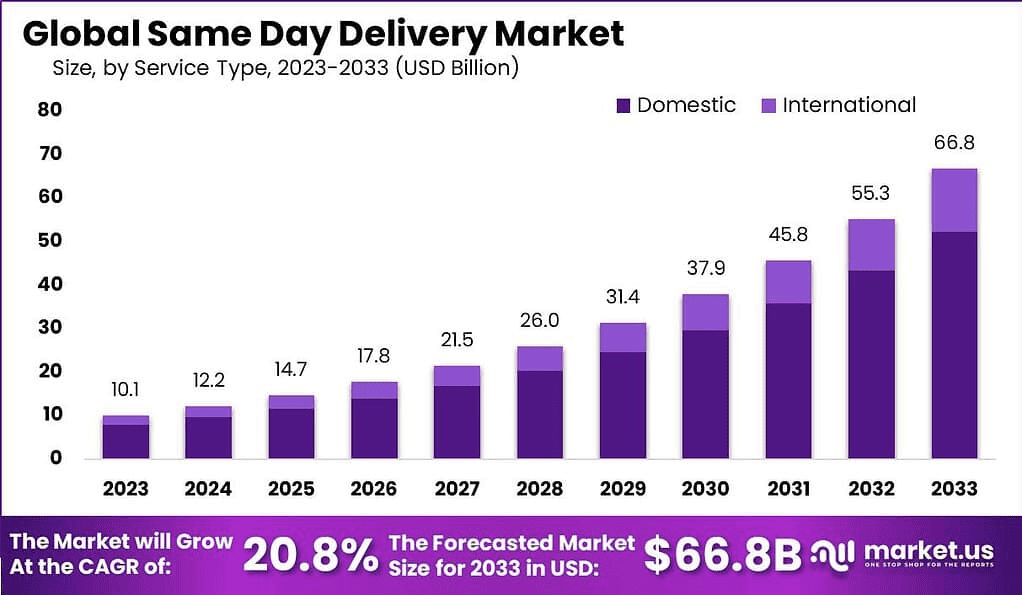
- The global same-day delivery market is valued at around USD 14.7 billion in 2025.
- By 2026, it is expected to grow further to nearly USD 17.8 billion.
- Looking ahead, the market is forecast to reach USD 66.8 billion by 2033, reflecting a CAGR of 20.8% from 2023 to 2033.
By Service Type
- According to Market.us Scoop, in the global same-day delivery market in 2026, domestic services account for USD 14.70 billion.
- Meanwhile, international services account for USD 3.19 billion.
- By 2033, the market segment is estimated at USD 52.30 billion for the domestic type and USD 14.50 billion for the international type.
By Transport Type
- Business Research Insights reported that road transport accounts for 71% of the market share, while over 80% of last-mile deliveries rely on road networks.
- Around 62% of same-day shipments travel under 50 kilometers, and 52% of providers use AI-based route planning.
- Urban fleets complete millions of deliveries daily.
- Air transport holds 21%.
- Air transport supports over 35% of urgent healthcare deliveries and 48% of express-provider shipments.
- About 29% of international same-day deliveries use air travel, covering distances above 500 kilometers.
- Rail transport accounts for 8% and handles 17% of high-volume regional freight.
- It uses nearly 70% less energy per ton-kilometer than road transport and connects 24% of intercity logistics hubs.
By Application
- B2B accounts for 33% of the market, with industrial goods representing 41% of deliveries and healthcare 18%.
- About 55% of manufacturing facilities use fast logistics providers to reduce downtime.
- B2C dominates at 67%, with 78% of consumers valuing delivery speed and 66% preferring same-day or next-day delivery.
- Retail products represent 48% of B2C activity, followed by groceries at 22% and healthcare products at 11%.
- Same-day availability encourages higher spending among 57% of consumers.
Regional Analysis
- As of 2026, North America leads with a 39% global share.
- Over 80% of metropolitan consumers and 75% of urban households can access same-day delivery.
- The U.S. accounts for 85% of regional demand and has over 310 million online shoppers, while Canada accounts for 11%.
- Retail, groceries, and healthcare represent 50%, 20%, and 12%, respectively.
- Around 60% of large Canadian retailers offer same-day services.
- Furthermore, 52% of operators use AI routing, 45% use automated sorting, and electric vehicles form 18% of urban fleets.
- Micro-fulfillment centers are generally located within 15 kilometers of consumers.
- Europe accounts for 28% globally.
- Over 75% of residents live in cities, and 68% of online shoppers value delivery speed.
- Germany accounts for 24% of regional demand, followed by the UK at 20%, France at 16%, and Italy at 11%.
- Road leads with 73%, while air and rail account for 19% and 8%, respectively.
- Meanwhile, 46% of operators use micro-fulfillment centers, 43% use automated sorting, and 37% apply demand forecasting.
- Asia-Pacific accounts for 25%, with over 4.5 billion people and 2.8 billion digital shoppers.
- China contributes 41%, India 18%, Japan 15%, South Korea 8%, and Australia 5%.
- B2C accounts for 72%, while groceries and electronics account for 21% and 16%, respectively.
- 48% of large retailers rely on urban hubs, while 39% use AI-powered routing to improve delivery efficiency.
- Automated warehouses support 33% of metropolitan consumers, as 65% expect deliveries within 24 hours.
- Middle East & Africa represents 5%.
- GCC countries account for 57%, with Saudi Arabia at 25% and the UAE at 22%, while Africa accounts for 17%.
- B2C accounts for 61%; retail, groceries, and healthcare contribute 44%, 19%, and 10%, respectively.
United States Same-Day Delivery Market Outlook
(Source: imagedelivery.net)
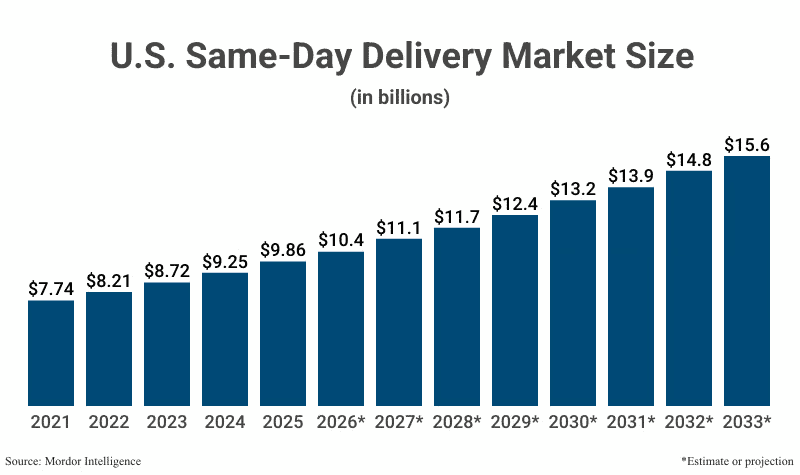
- The U.S. same-day delivery market is valued at USD 10.4 billion in 2026.
- The market is projected to reach USD 13.7 billion by 2031, growing at a 5.62% CAGR from 2026 to 2031.
- In 2025, U.S. same-day deliveries reached 3,879 million, and by 2026, deliveries are projected to rise to 5,818 million.
U.S. Same-Day Delivery Usage
| Product category | Have received | Want |
| Groceries | 19% | 64% |
| Healthcare products | 4% | 46% |
| Specialty snacks | 7% | 42% |
| Alcohol | 5% | 41% |
| Household products | 5% | 28% |
| Pet products | 4% | 28% |
| Beauty products | 4% | 26% |
| Electronics | 4% | 24% |
| Appliances | 2% | 22% |
| Clothing, shoes, and accessories | 2% | 21% |
Same-Day Delivery Market by Key Driver
- Business Research Insights stated that 78% of consumers value fast delivery, while 72% expect their orders within 24 hours.
- 66% of consumers prefer same-day fulfillment, and 61% consider delivery speed before making a purchase.
- 57% of consumers spend more when retailers provide faster delivery options.
Major Market Restraint
- 54% of logistics providers report high operating costs, making profitability a key challenge in same-day delivery.
- 49% face inefficient delivery routes, while 43% experience labor shortages.
- 39% report inventory coordination problems, and 35% struggle to remain profitable when serving low-density areas.
Emerging Trends
- 52% of retailers use AI for route planning, while 47% operate micro-fulfillment centers to speed up orders.
- Moreover, 41% of retailers provide real-time tracking.
- 36% are adopting electric delivery vehicles, while 29% are exploring autonomous delivery technology.
Same-Day Delivery Market: Key Company Performance
- FedEx: In 2026, revenue is expected to be USD 94.72 billion, up 7.73% from 2025. Q3 revenue reached USD 24.0 billion, with net income of USD 1.06 billion and diluted EPS of USD 4.41.
- UPS: 2026 revenue guidance increased to approximately USD 91.2 billion. Q2 revenue was USD 22.8 billion, including USD 14.93 billion from U.S. Domestic and USD 5.044 billion from International operations.
- XPO: In Q2 2026, revenue reached USD 2.36 billion, compared with USD 2.08 billion in Q2 2025. Trailing-twelve-month revenue stood at USD 8.574 billion.
- DHL Group: In the first half of 2026, revenue was approximately USD 49.4 billion, with EBIT of USD 3.85 billion and net profit of USD 2.10 billion. Q2 revenue increased 12.8% to EUR 22.367 billion.
- Aramex: H1 2026 revenue reached approximately USD 934 million, while Q2 revenue was USD 498 million, up 22% year-over-year.
Same-Day Delivery Consumer Preferences
- Capital One Shopping reported that among the 80% seeking same-day shipping, 76.3% want delivery within 3 hours.
- 55% would pay at least the value for same-day delivery.is
- 50% value-free same-day delivery is better than curbside or in-store pickup.
- Consumers are 91.8% more likely to choose Amazon for same-day delivery.
- 39% have used Amazon, 25% have used physical stores, and 15% have used other web-only shops for same-day delivery.
Speed Expectations
- 74% of online shoppers expect delivery within 2 days.
- Almost 56% of 18-34-year-olds expect same-day delivery.
- 80% expect retailers to offer same-day delivery, with 76.3% wanting orders within 3 hours.
- According to Flexe, 57% of U.S. shoppers rank same-day or faster delivery as a key priority for the future.
Willingness to Pay
- 41% of Americans will pay more for same-day delivery.
- Around 55% will pay at least USD 5.
- 23% routinely pay extra for same-day delivery.
Free Delivery vs. Speed
- Based on a report shared by DHL, 90% will wait 2-3 days to avoid shipping costs.
- On the other hand, more than 95% prefer free standard shipping.
- 58% consider free delivery the most important delivery feature, as per McKinsey & Company.
Buying Behavior
- 70% are more likely to shop online when same-day delivery is available.
- Moreover, 63% switch retailers when delivery takes more than 2 days.
- 43% have abandoned their purchases due to slow delivery.
Online Shopping and Delivery Preferences
- Eliteextra further stated that 44% of consumers are willing to wait up to 2 days for fast-shipping orders.
- 56% of Gen Xers and 55% of millennials prefer online shopping over physical stores.
- Convenience drives 77% of consumers to shop online, while 72% value free shipping.
- 41% are willing to pay more for same-day delivery, and 24% would pay extra for 1-2-hour delivery.
- 45% say digital retailers meet their delivery-speed expectations nearly 50% of the time.
Key Reasons for Choosing Same-Day Delivery
(Source: imagedelivery.net)
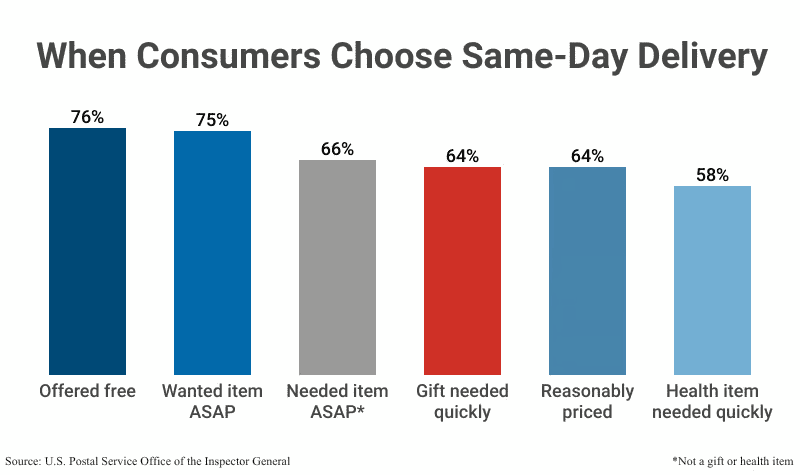
- Free delivery is the leading reason, influencing 76% of consumers.
- About 75% choose this service when they want an item quickly.
- Urgent product needs motivate 66% of consumers.
- Quick gift delivery and reasonable prices each influence 64%.
- Fast delivery of health products attracts 58% of consumers.
Reasons Consumers Reject Same-Day Delivery
| Reason for rejection | Consumers Share |
| Same-day delivery is too expensive. | 81% |
| The item is not needed quickly. | 78% |
| Consumers prefer “click-and-collect.” | 67% |
| Consumers are unavailable to receive the item at home. | 45% |
| The same-day delivery option is unavailable. | 21% |
Key Same-Day Delivery Industry Developments
- In January 2026, Serve Robotics planned to deploy 2,000+ autonomous robots after completing 100,000+ deliveries.
- Its robots use Level 4 autonomous driving technology.
- In April 2026, Walmart expanded same-day delivery to about 95% of households, using more than 4,600 locations for local fulfillment.
- In June 2026, Amazon Pharmacy expanded same-day prescription delivery, aiming to cover nearly 45% of the population.
- In September 2026, Uber expanded real-time dispatch optimization across its delivery network.
- The network supports more than 30 million trips and deliveries on peak operating days.
Closing Remarks
Same-day delivery is becoming a key part of online shopping. Customers now expect their orders to arrive quickly, and businesses are working to meet this demand. However, faster delivery can increase costs and pose challenges for workers, logistics operations, and the environment.
Better technology, local warehouses, and smarter delivery systems can help solve these issues. As e-commerce continues to grow, same-day delivery will remain important for businesses focused on speed and customer convenience.
FAQ
Same-day delivery quickly processes, packs, and transports orders to customers within hours.
Same-day delivery usually arrives within a few hours, depending on location, order time, and delivery availability.
No, same-day delivery is usually available only in selected areas, cities, and postal codes.

Sources