









Introduction
AI Agent Customer Support Statistics: AI agent customer support has kind of moved on from those basic rule-based chatbots into autonomous digital agents that can infer intent, untangle complicated issues, run workflows, and offer tailored help across multiple channels. By 2026, organizations are increasingly rolling out AI agents to cut operational costs, lift customer satisfaction, shorten waiting periods, and deliver 24/7 multilingual service.
With improvements in large language models (LLMs), generative AI, voice AI, and agentic automation, companies can now automate full customer service journeys instead of just isolated chats. And according to findings, AI-powered customer support is turning into one of the highest-return investments in enterprise digital transformation.
The article on AI agent customer support statistics will show the market trends, AI adoption, training, and transparency.
Editor’s Top Picks
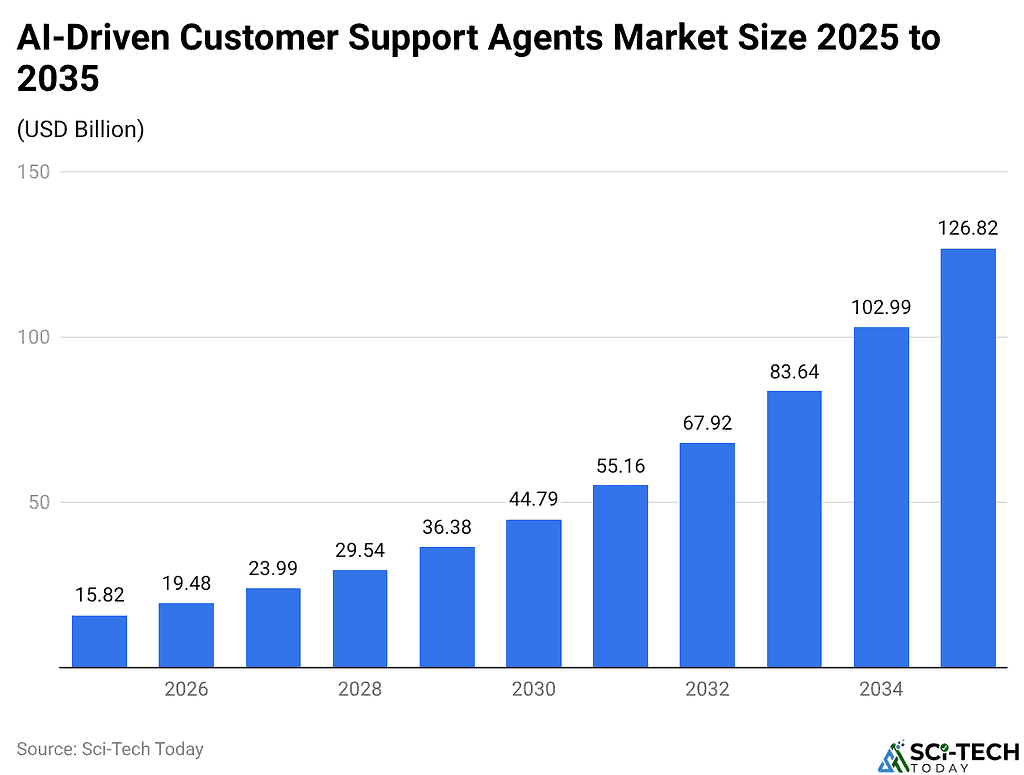
- The AI-driven customer support agent market is projected to grow from USD 19.48 billion in 2026 to USD 126.82 billion by 2035, expanding at a strong 23.14% CAGR.
- North America takes about 38% of the global AI customer support market, while machine learning and deep learning make up 45% of technology adoption.
- Telecommunications (95%) and banking & finance (92%) are leading AI adoption, showing customer support automation as a strategic priority, even when things are messy.
- 80% of routine interactions are expected to be handled by AI, and 80% of companies are already using or planning AI chatbots.
- AI chatbot adoption jumped from 5% in 2020 to more than 80% in 2025, and 92% of organizations say deployment led to higher customer satisfaction.
- 72% of CX leaders provide AI training, but 55% of service agents get no formal AI training.
- Conversational AI is projected to save USD 80 billion in global contact center labor costs by 2026, while also cutting customer support costs by about 30–40%.
- AI-powered customer support can raise productivity roughly 14% overall, and as much as 35% for brand-new agents.
- AI interactions can be around USD 0.50 per conversation, instead of roughly USD 6 when it’s human-assisted support.
- Gartner even forecasts that agentic AI will, on its own, resolve 80% of common customer service issues by 2029.
AI-Driven Customer Support Agent Market Statistics
(Reference: precedenceresearch.com)
- Companies are moving aggressively toward intelligent automation, so they can give quicker answers, more tailored interactions, and basically 24/7 help.
- In the AI-Driven Customer Support Agents Market Size 2025 to 2035 report, the global market was valued at USD 15.82 billion in 2025, and it’s expected to reach about USD 19.48 billion by the close of 2026, then jump to USD 126.82 billion by 2035, which works out to a strong 23.14% CAGR from 2026 to 2035.
- The report also notes that North America held the biggest slice, around 38% in 2025.
- At the same time, the Asia Pacific is expected to grow at the quickest pace across the forecast period.
- On the technology side, machine learning plus deep learning reportedly made up 45% of the market share in 2025.
- By industry, BFSI took the lead in 2025. Retail and e-commerce are predicted to expand the hardest, as businesses lean harder on AI-driven support to improve customer engagement, and also to boost day-to-day operational efficiency.
AI Adoption By Industry Statistics
- Artificial intelligence adoption seems to be picking up speed across basically every industry, and customer support is coming up as one of the most noticeable uses, kind of like where it actually shows value fast.
- As per Master of Code Global, the telecommunications sector is leading with AI adoption at 95%, then banking and finance sit not far behind at 92%, largely because these areas deal with huge amounts of repeatable customer conversations. That repetition is, you know, the perfect spot for automation to step in and help.
- In healthcare, the numbers are also climbing, with AI adoption up by 51.9%, and that’s helping providers sort out non-clinical work like appointment timing, prescription management, and patient messages so operations run smoother overall.
- Capgemini notes that 94% of retail businesses have managed to reduce operational costs after bringing in AI-powered solutions, which makes sense since a lot of routine questions can be handled automatically and at the same time, service quality stays steadier.
- McKinsey states that AI-enabled customer support has led to claims being processed 35% faster, plus fraud detection response times improved by 28%, so customers get a better experience while the whole operation becomes more resilient.
- Zendesk reports that only 33% of companies currently offer integrated AI support across different channels, like chatbots, video calls, WhatsApp, Instagram, and Facebook Messenger, all working together instead of in separate lanes.
- These statistics show that even though AI adoption is already bringing big efficiency gains, the next competitive edge is probably going to belong to orgs that manage to unify AI across all customer engagement touchpoints, so they can deliver quicker, more capable, and more customized support experiences.
AI Adoption In Customer Service Statistics
- Artificial intelligence has quickly shifted customer service from a kind of test project into a core business skill.
- According to CoSupport AI, current 2026 tracking suggests that 80% of routine customer interactions are on pace to be fully handled by AI, including things like ticket triage, order status requests, familiar questions, and basic troubleshooting. This momentum is also backed up by Grand View Research, which says 80% of firms are already using or planning to use AI- powered chatbots, so in practice, AI is now a mainstream customer service option.
- The speed of adoption has been basically exceptional. Gartner points out that AI chatbot use by customer service teams jumped from only 5% in 2020 to over 80% by 2025, a really striking 16x climb within just five years.
- The business effect is there too, with 92% of organizations reporting better customer satisfaction after adopting AI chatbots, according to Dante AI.
- Still, AmplifAI observes that although 88% of contact centers use some sort of AI, only 25% have actually folded automation into their everyday workflows, meaning there’s still a lot of space for deeper AI adoption.
- Customer experience strategies are also moving beyond plain automation. Zendesk CX Trends reports that 69% of organizations think generative AI helps create more human-like digital interactions, while 75% of CX leaders see AI as something that supports and amplifies human intelligence, not a thing that fully replaces it.
- The above numbers kinda suggest the next chapter of customer service will depend on mixing AI efficiency with real human know-how so customers get answers quicker, but also more tailored, and hopefully better overall experiences.
AI Agent Training and Transparency Statistics
- Since AI is becoming part of customer service, companies are learning that just having the technology isn’t enough; it’s also about how the agent side is trained, plus how transparent the systems are.
- Zendesk says 72% of CX leaders say they’ve already given adequate training for generative AI tools, but 55% of customer service agents say they received no training at all.
- Only 45% of agents claim they actually went through AI training, and a mere 21% say they are satisfied with the training quality, which points to a real skills gap.
- 65% of agents feel additional training would help them do their job better, but only 34% say they fully understand their organization’s AI strategy, so there’s a clear need for stronger communication and more workforce development.
- Zendesk reports that 63% of consumers are worried about bias and discrimination in AI-driven decisions, while 74% of CX leaders believe AI transparency is critical for handling the higher customer expectations plus regulatory pressure.
- PwC further reveals that nearly three in four CEOs are concerned about the lack of transparency across the AI market.
- Protecting customer information still stays a top business priority, with 77% of CX leaders taking responsibility for safeguarding customer data and 83% ranking cybersecurity and data protection as central to their customer service strategy.
- This kind of result suggests that successful AI adoption doesn’t only hinge on advanced tech, but also on well-trained employees, clearer AI governance, and solid data protection habits that help generate long-term customer confidence.
AI Agent Customer Support Financial Impact and Contact Center Cost Savings
- Conversational AI has rapidly evolved into one of the most useful investments for current customer service operations, providing tangible wins in both productivity and cost efficiency.
- According to Gartner, conversational AI deployments are expected to reduce global contact center agent labor costs by roughly USD 80 billion by 2026, while early adopters are already seeing 20–30% lower cost per customer contact by automating high-volume, routine questions.
- Juniper Research also estimates that AI-powered customer service is already generating around USD 8 billion in annual business savings, with organizations often cutting overall support expenses by 30–40% in the first year, whereas the top performers manage 30–45% cost reductions when AI is used across multiple customer journeys.
- AI is also reshaping workforce productivity, kinda in a real way. There’s an NBER-backed study with 5,179 customer service agents, and it suggests generative AI made it easier to close things faster, as resolutions per hour went up 14%.
- In the same report, the productivity lift comes closer to around 35% for newly hired people, or agents with lower skill levels.
- A bunch of industry rollouts say the same thing too: for new employees, they’re seeing improvements up to 34%, which means less time spent training and fewer operational hiccups or inefficiencies.
- Klarna says its AI assistant is dealing with about two-thirds of customer service conversations now, and it’s doing work comparable to 700 full-time agents, plus it’s linked to an estimated USD 40 million profit improvement in year one.
- On the other side, NIB Health Insurance reports roughly 60% reductions in customer service costs, along with USD 22 million in savings coming from AI-driven digital assistants.
- Juniper Research notes that chatbot conversations usually average around USD 0.50 per interaction, while human-assisted traditional support lands closer to about USD 6.
- Some industry benchmarks put routine human interactions at USD 20–25 each, whereas chatbot resolutions are often in the USD 0.50–0.70 range, so the self-service route looks way cheaper.
- Freshworks claims a 38% improvement in average resolution time, while Salesforce says customer satisfaction scores climb 10–15 percentage points within the first 90 days of AI rollout.
- MIT Sloan Management Review and Juniper Research, on the other hand, point to AI customer service programs delivering an average 340% first-year ROI, basically returning close to USD 3.5 for every USD 1 put in.
- The above numbers basically confirm that conversational AI is no longer just an automation gadget; it has turned into a strategic business asset. It both lowers operating expenses, lifts customer delight, raises workforce output, and supports long-term profitability
The Shift From Generative AI To Agentic Automation
- Customer service is sliding into a new phase now, where AI moves past simply responding and instead can complete tasks.
- Gartner notes that agentic AI is expected to autonomously resolve 80% of common customer service problems by 2029. That feels like a clear change from older conversational AI approaches, which mostly detect customer intent and then craft replies, not actually run actions.
- Gartner also projects the shift will cut customer service operating costs by roughly 30% by the end of the decade, since autonomous AI agents manage routine requests, speed up resolution, and reduce dependence on oversized Tier 1 support teams.
- Another key Gartner forecast says that by 2028, at least 15% of day-to-day enterprise work decisions will be made autonomously by agentic AI, compared with basically 0% in 2024. It really shows how AI is spreading beyond those customer conversations and moving into operational decision-making, sorta like it’s crossing a line.
- Gartner estimates that more than 40% of agentic AI efforts could be delayed or cancelled by 2028 because of bad planning, weak data governance, or not enough stakeholder alignment.
- So basically, companies will need real governance, dependable data, and thoughtfully designed implementation paths before they roll autonomous AI out at full scale.
- The shift from conversational AI to agentic AI is, arguably, one of the bigger changes in customer experience technology.
- Classic chatbots tend to stick with communication, while agentic AI leans into execution, and that allows businesses to automate entire service journeys instead of isolated exchanges.
- As organizations put money into secure API connections and enterprise automation, the mix is 80% autonomous issue resolution.
- 30% lower operational costs, and 15% autonomous business decisions suggest agentic AI could become the bedrock for next-generation customer service operations. Still, without careful, disciplined execution, these benefits may not fully land (Source: Gartner).
Conclusion
AI agent customer support is changing pretty fast, moving from simple chat-style help into something more “do the work” autonomous service execution, which lets orgs give customers a better experience while also cutting operational costs a lot. Right now, banks, retail shops, healthcare teams, and telcos are using AI agents to take care of repetitive chores, improve day-to-day output, and provide tailored support around the clock, even at 3 a.m.
As generative AI keeps maturing into agentic AI, many enterprises are going to automate entire customer paths, not just single, isolated back-and-forth exchanges. Still, the long haul won’t be automatic. Lasting results will depend on responsible AI governance, training employees properly, keeping things transparent, and securely managing data. Companies that manage to blend AI automation with real human know-how should see a durable edge in customer service.
FAQ
An AI customer support agent is basically an intelligent system that handles customer conversations, fixes problems, and performs service actions using AI along with large language models.
The global market for AI driven customer support agents is forecast to reach USD 19.48 billion in 2026.
Most organizations see a 30–40% reduction in customer support expenses, and Gartner also projects about USD 80 billion in global contact center labor savings by 2026.
Telecommunications sits at 95% and banking & finance at 92%, and then healthcare and retail follow after that.
Agentic AI is more than just answering questions. It can autonomously complete tasks like updating CRM entries, handling refunds, and resolving customer issues end to end.