









Overview
AI in Logistics Statistics: The logistics industry is changing fast, and AI is playing a big role in that change. Companies now use AI to plan delivery routes, track shipments, manage inventory, and improve warehouse operations. Instead of relying solely on manual work, logistics teams can use real-time data to make faster, smarter decisions.
AI can also help predict demand, reduce delays, and control transportation costs. As businesses handle more orders and customers expect quick deliveries, these tools are becoming increasingly useful. From automated warehouses to intelligent fleet management, AI is reshaping how goods are stored, moved, and delivered.
This article explores the key trends, uses, benefits, challenges, and statistics of AI in logistics.
Recommended Choice
- The global AI in logistics market is expected to grow from USD 26 billion in 2025 to USD 38 billion in 2026.
- AI investments deliver an average ROI of 190% within 6-18 months.
- The generative AI market in logistics was valued at USD 2.11 billion in 2026.
- Solutions led the market with USD 27 billion, followed by supply chain planning at USD 11.2 billion.
- In 2026, the top 10 players collectively account for 16.7% of total market revenue.
- North America led the market with USD 14 billion.
- A January 2026 survey of more than 180 logistics experts found that over 40% of shippers consider AI capabilities when choosing logistics providers.
- Demand for supply chain roles requiring AI skills rose 387% from Q1 2023 to Q1 2026, based on 35 million job postings.
- In 2026, 86% of C-suite leaders plan to increase AI investment, making AI central to nearly 9 in 10 strategies.
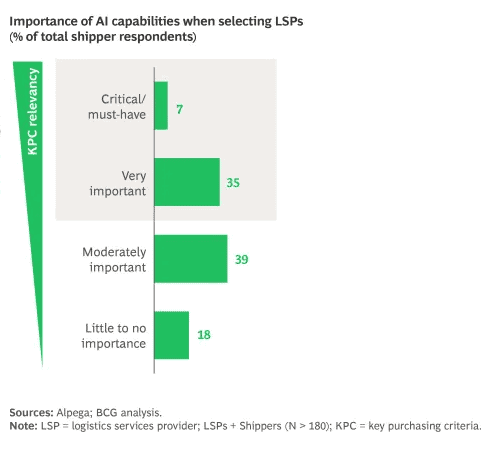
- Around 7% of shippers consider AI capabilities critical when selecting logistics service providers.
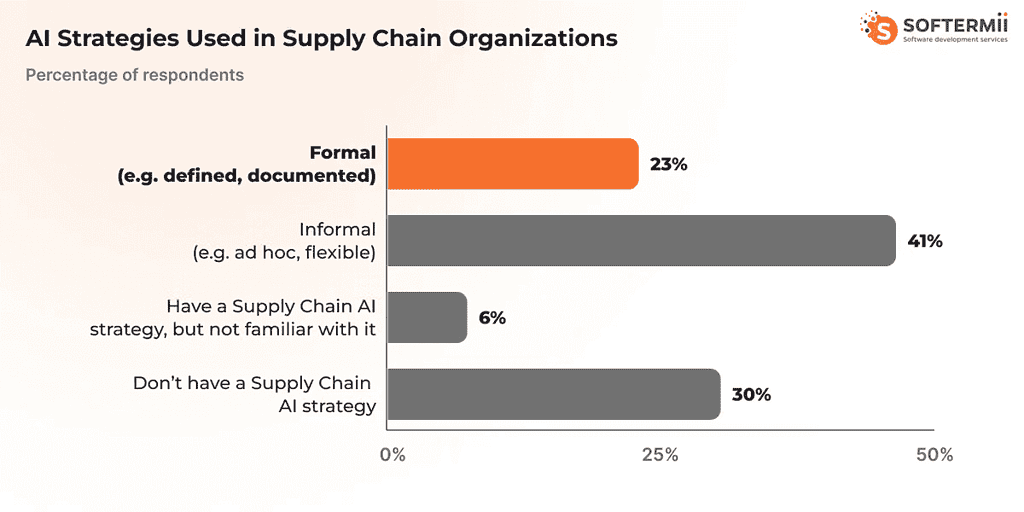
- Informal AI strategies are most common, used by 41% of supply chain organizations.
- Generative AI could reduce supply chain errors by 50% and improve customer response times by 30%-50%.
- About 75% of large enterprises are expected to use smart intralogistics robots in warehouses.
- AI improves efficiency by automating repetitive tasks, reducing errors, and helping warehouse robots work up to 70% faster with 99.5% accuracy.
AI in Logistics Market Trends
(Source: market.us)
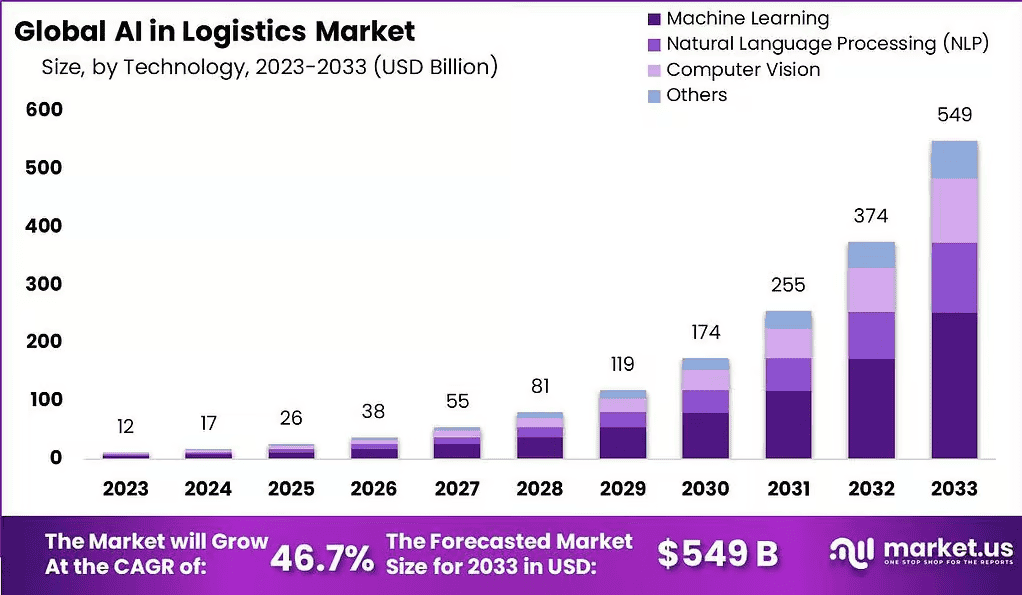
- The global AI in logistics market is expected to grow from USD 26 billion in 2025 to USD 38 billion in 2026.
- By 2033, the market is forecast to reach USD 549 billion, expanding at a CAGR of 46.7%.
- A report shared by MasterOfCode stated that AI investments deliver an average ROI of 190% within 6-18 months.
- Moreover, AI agents raise productivity by 40%.
- Route optimization removes 30 million delivery miles annually.
- However, return fraud causes USD 76.5 billion in losses, and 60% of companies report unmet expectations for AI.
Generative AI in Logistics Market Size
(Source: precedenceresearch.com)
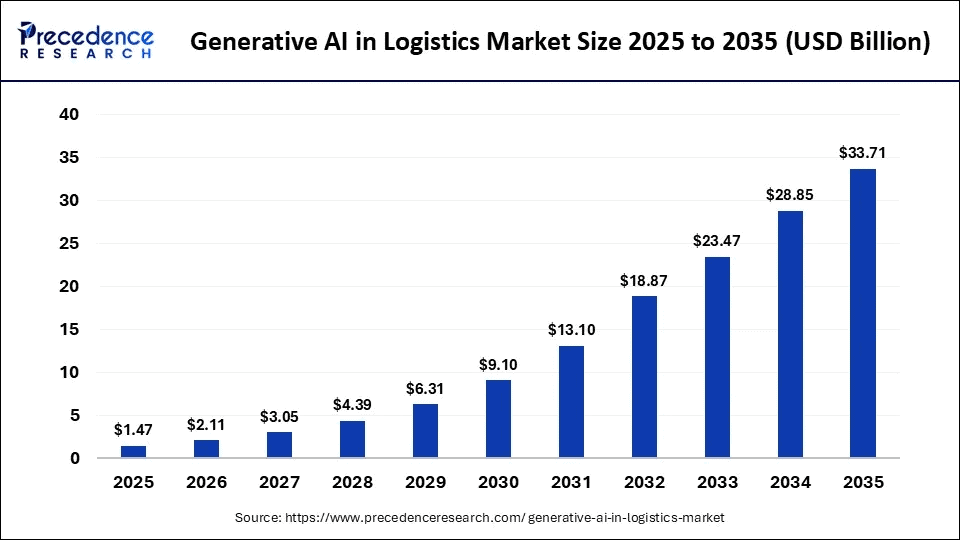
- The generative AI market in logistics was valued at USD 2.11 billion in 2026.
- The market is projected to reach USD 33.71 billion by 2035, with a CAGR of 35.91% from 2026 to 2035.
- In 2025, cloud-based deployment led with 63% market share, while on-premises solutions accounted for the remaining 37%.
- The U.S. generative AI in logistics market size is estimated to reach USD 665.63 million in 2026.
(Source: precedenceresearch.com)
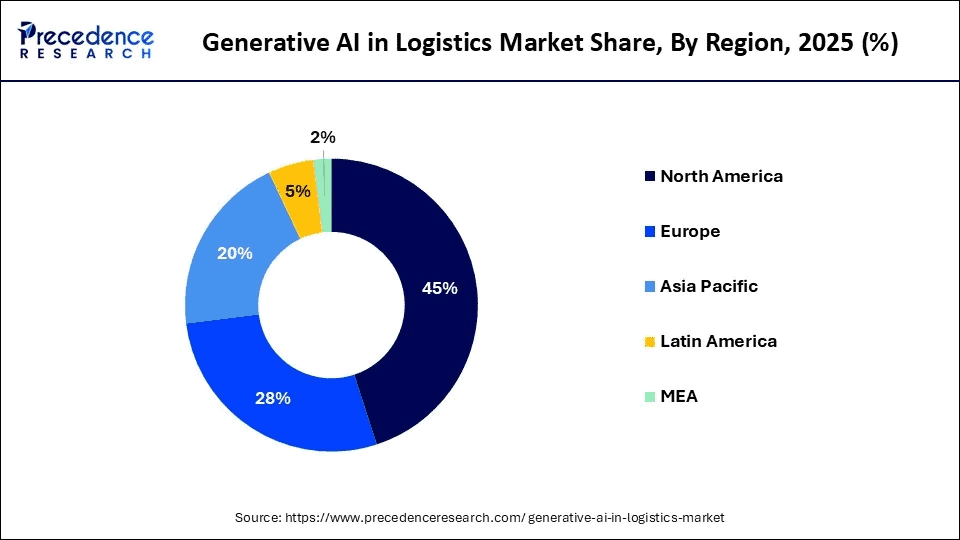
- In 2025, North America led with 45%, followed by Europe at 28% and Asia Pacific at 20%.
- Latin America held 5%, while the Middle East and Africa accounted for 2%.
AI in Logistics and Supply Chain Management Market Insights
(Source: thebusinessresearchcompany.com)
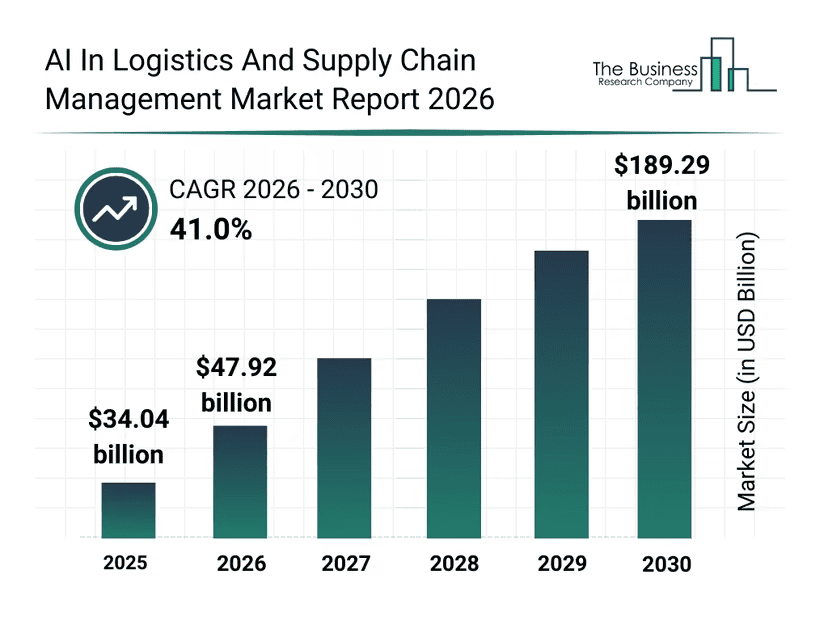
- The market was valued at USD 34.04 billion in 2025. It increased to USD 47.92 billion in 2026.
- The market is forecast to reach USD 189.29 billion by 2030, with a strong CAGR of 41.0% during 2026-2030.
Major Market Segments in 2026
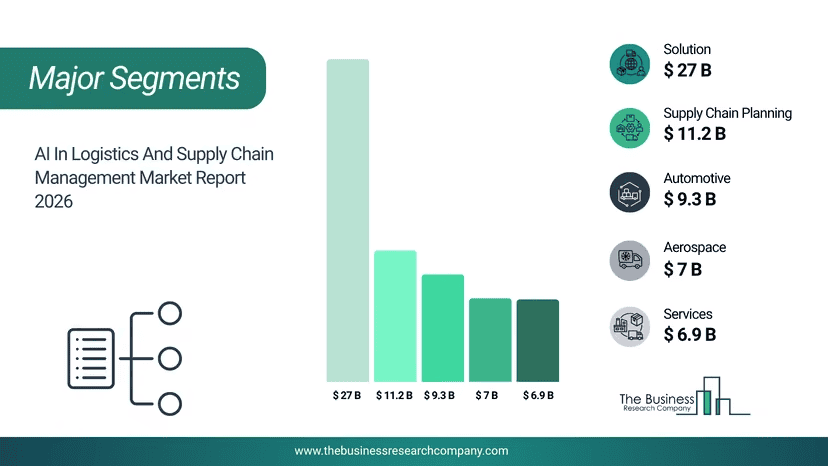
(Source: thebusinessresearchcompany.com)
- Solutions led the market with USD 27 billion, followed by supply chain planning at USD 11.2 billion.
- Automotive reached USD 9.3 billion, while aerospace and services recorded USD 7 billion and USD 6.9 billion, respectively.
Logistics AI Competitor Shares
- According to The Business Research Company, in 2026, the top 10 players collectively account for 16.7% of total market revenue.
- GEP and Blue Yonder each held 5%, while Infor and HAVI each captured 2%.
- Vorto holds 1%, while FourKites and Coupa Software Inc. each have 0.5%.
- AWS has 0.3%, while Shipsy and IBM Corporation each hold 0.2%.
- Moreover, other market participants collectively represented 83.3%.
Regional Market Analysis
- In 2026, North America led the market with USD 14 billion.
- Asia Pacific and Western Europe each generated USD 8 billion.
- South America reached USD 1.3 billion, followed by Eastern Europe at USD 1.2 billion.
- The Middle East recorded USD 1 billion, while Africa accounted for USD 0.7 billion.
Logistics Automation Market Overview
(Reference: grandviewresearch.com)
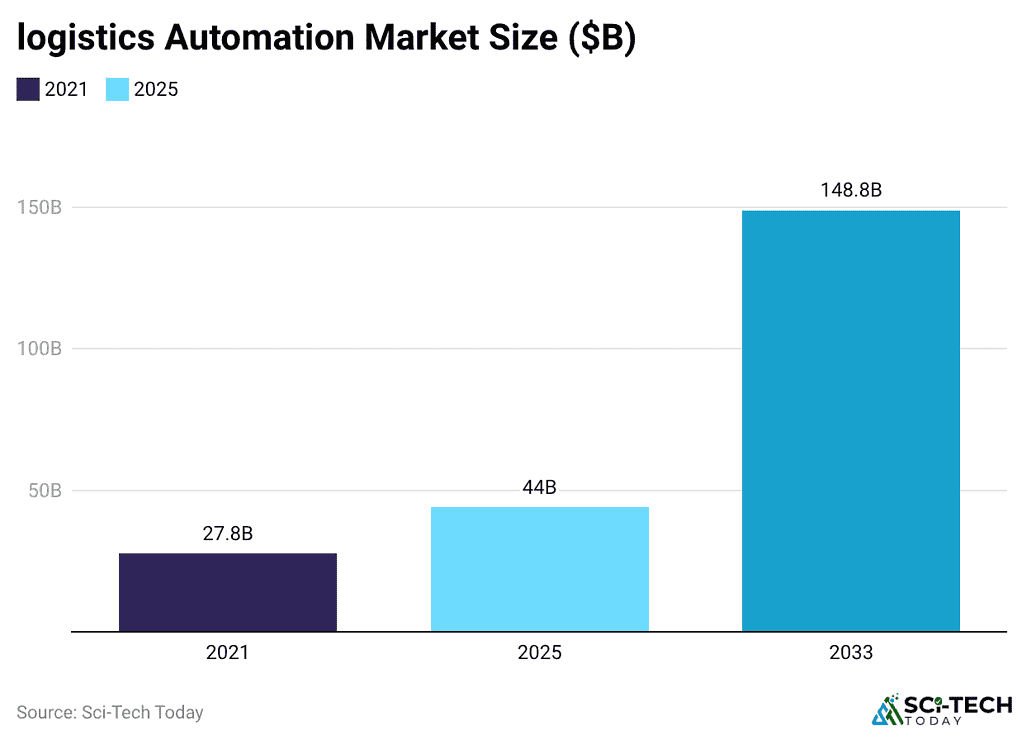
- The global logistics automation market was valued at USD 44 billion in 2025 and is expected to reach USD 148.7 billion by 2033, growing at a 16.8% CAGR from 2026 to 2033.
- North America led the market with a 35.4% share in 2025.
- Hardware was the largest component, holding 66.3% of the market.
- Transportation management led by function with 61.4%.
- Retail & e-commerce-led verticals were at 29.4%, while large enterprises were at 63.0%.
AI Adoption and Implementation
- A January 2026 survey of more than 180 logistics experts found that over 40% of shippers consider AI capabilities when choosing logistics providers.
- Fewer than 10% of shippers consider AI a mandatory requirement.
- Around 40% of logistics providers have deployed AI beyond pilot projects.
- Only 10% have scaled AI across core operations, while 13% report measurable business value.
- Nearly 70% of shippers remain at the exploration or pilot stage.
- Only 7% of shippers report measurable improvements, and 1% have embedded AI into core operations.
- Transport planning and execution lead AI adoption among providers at 64%.
- Tracking and visibility use AI in approximately 50% of logistics operations.
- Nearly 80% identify efficiency and cost reduction as key drivers of adoption.
- About 40% cite unclear returns and capability gaps as major barriers, according to BCG.
Workforce Trends in Supply Chain
- A report published by nShift found that early autonomous supply chain projects delivered 27% shorter order lead times and 25% higher labor productivity.
(Source: nshift.com)
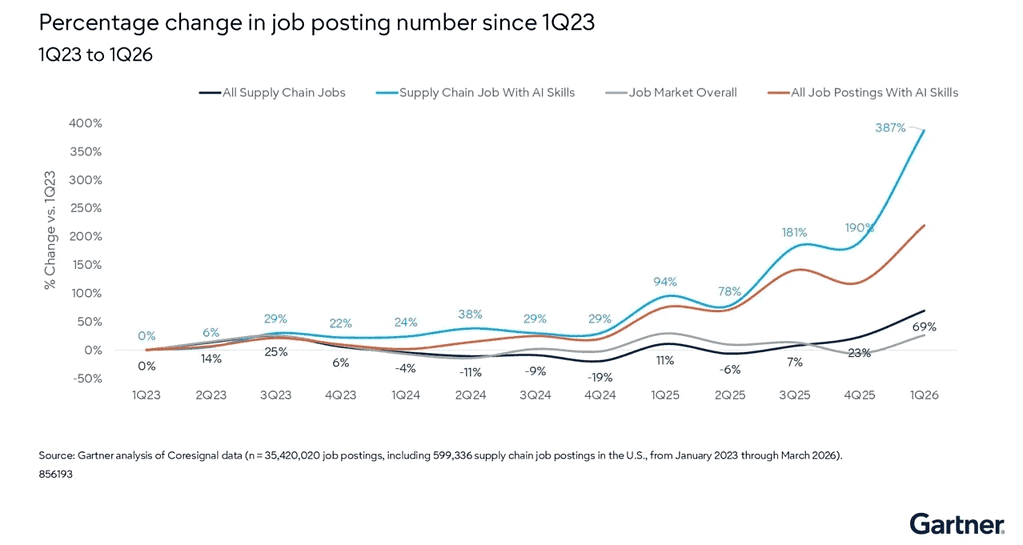
- Demand for supply chain roles requiring AI skills rose 387% from Q1 2023 to Q1 2026, based on 35 million job postings.
- In May 2026, 17% of leaders pursued transformational AI redesign, while 83% preferred incremental adoption.
- By February 2026, 55% expected agentic AI to reduce entry-level hiring, and 51% anticipated overall workforce reductions.
AI Investment Priorities
(Source: nshift.com)
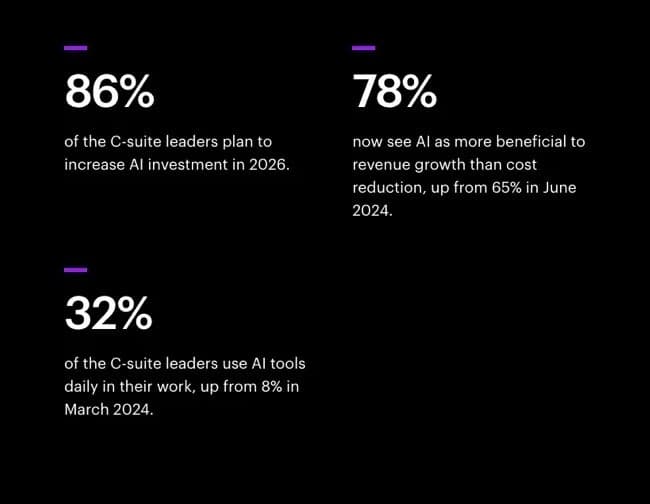
- In 2026, 86% of C-suite leaders plan to increase AI investment, making AI central to nearly 9 in 10 strategies.
- Around 78% prioritize revenue growth over cost reduction, up from 65% in June 2024; supply chain executives reported 75%.
- Daily AI use rose from 8% in March 2024 to 32%.
AI-Enabled Logistics Roles and Salaries, March 2026
AI Priorities in Logistics Services: Importance to Shippers
(Source: web-assets.bcg.com)
- Around 7% of shippers consider AI capabilities critical when selecting logistics service providers, while 35% view them as very important.
- Another 39% consider AI moderately important, whereas 18% attach little or no importance to it.
Investment Priorities
(Source: web-assets.bcg.com)
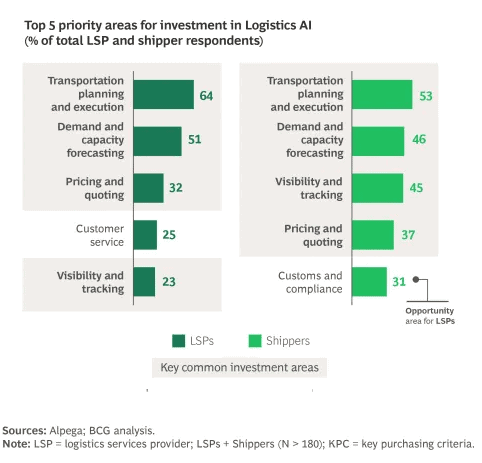
- Among LSPs, the main AI investment areas are transportation planning and execution (64%), demand and capacity forecasting (51%), pricing and quoting (32%), customer service (25%), and visibility and tracking (23%).
- Shippers prioritize transportation planning and execution at 53%, demand and capacity forecasting at 46%, visibility and tracking at 45%, pricing and quoting at 37%, and customs and compliance at 31%.
Top 5 Use Cases of AI in Logistics
(Source: cdn-hjokj.nitrocdn.com)
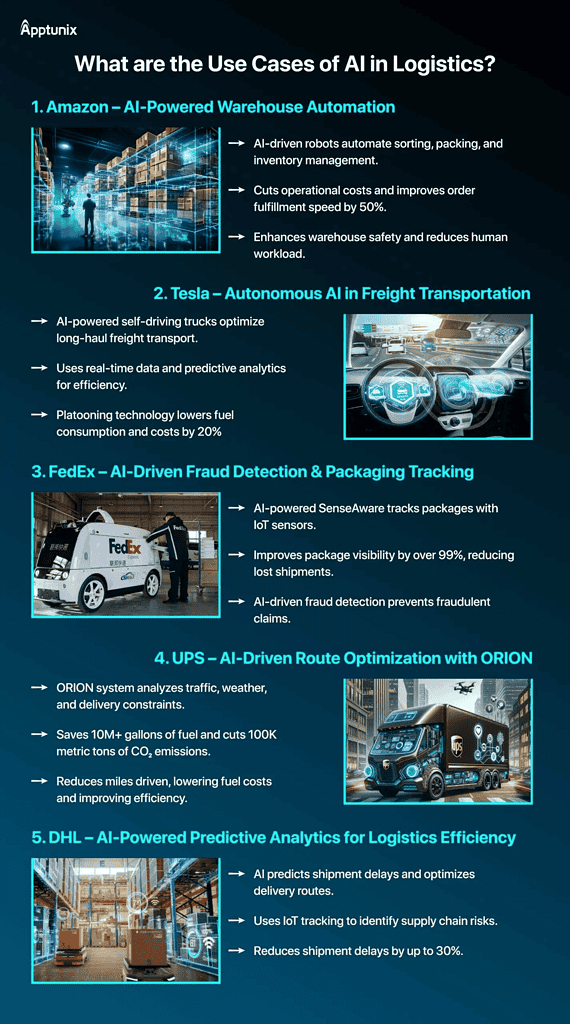
- Amazon: Warehouse robots grew from 350,000 in 2021 to 750,000 in 2023. AI supports sorting, packing, inventory management, and shipping, helping to fulfill orders up to 50% faster.
- Tesla: AI-powered autonomous trucks use real-time data, deep learning, and platooning to improve freight efficiency. The technology aims to reduce fuel costs by 20%.
- FedEx: SenseAware uses IoT sensors and machine learning to track location, temperature, humidity, shock, and pressure. Package visibility has improved by over 99%.
- UPS: ORION analyzes over 250 million address data points daily to optimize routes. It saves 10 million gallons of fuel and reduces CO₂ emissions by 100,000 metric tons annually.
- DHL: AI predicts shipment delays and supply chain risks linked to weather, port congestion, and political instability. It can reduce shipment delays by up to 30% and improve delivery accuracy.
Supply Chain AI Strategies
(Source: cdn.sanity.io)
- Informal AI strategies are most common, used by 41% of supply chain organizations.
- Around 30% have no AI strategy, while 23% follow a formal, documented approach.
- The remaining 6% have an AI strategy but are not familiar with its details.
Emerging AI Trends in Logistics
- According to Apptunix, Generative AI could reduce supply chain errors by 50% and improve customer response times by 30%-50%.
- Advanced analytics may lower costs by 10%-20% and strengthen forecasting accuracy by 20%-50%.
- Personalized experiences can improve customer retention by 30%-40%, while chatbots handle 85% of queries.
- Audio AI may increase warehouse efficiency by 25%-30% and reduce driver distraction by 20%.
- Computer vision could decrease damage claims by 40% and boost warehouse efficiency by 30%.
Development of New Logistics Technologies
- The Mind Studios noted that by 2026, about 75% of large enterprises are expected to use smart intralogistics robots in warehouses.
- Over 75% of supply chain software vendors are expected to offer advanced analytics, AI, and data science features.
- As of 2025, 25% of supply chain decisions are expected to be made using intelligent edge ecosystems that process data near its source.
Key Benefits of AI in Logistics
- AI improves efficiency by automating repetitive tasks, reducing errors, and helping warehouse robots work up to 70% faster with 99.5% accuracy.
- Predictive analytics helps businesses forecast demand, manage inventory, and reduce shortages.
- AI reduces costs by optimizing delivery routes, cutting shipping costs by up to 20%, and lowering stock levels by up to 30%, according to Shiprocket. in.
- Real-time tracking improves delivery speed, accuracy, and issue detection.
- AI strengthens customer service and scalability through chatbots, personalized updates, and flexible operations during demand surges.
Challenges and Limitations of AI Adoption in Logistics and Supply Chain
- AI platforms can cost USD 500,000-USD 2.5 million, with annual maintenance at 15%-20%. Gartner reports that 62% of initiatives exceed budgets by 45%.
- McKinsey reports 3.5 times the median returns over 3 years, but only 28% of mid-sized providers, versus 73% of large enterprises, have comprehensive AI.
- Organizations use only 23% of available data, while 60%-70% of project budgets can go toward data preparation and integration.
- 72% of failed implementations cite workforce resistance, while 68% report difficulty hiring AI specialists.
- Spending 15% of project budgets on training can deliver 2.8 times higher adoption and 3.5 times higher ROI.
- Only 23% of systems provide sufficient explanations, while algorithmic bias can favor larger suppliers by a 3.5:1 ratio.
Outcome
AI is changing how the logistics industry works. It helps businesses plan better routes, manage inventory, track shipments, and reduce delays. AI tools also make daily operations easier by handling repetitive tasks and providing useful insights.
Still, businesses need reliable data, skilled teams, and secure systems for successful AI adoption. As logistics becomes more complex, AI will become an important tool for improving efficiency, reducing costs, and delivering better customer service.
FAQ
Traditional logistics software follows predefined rules, while AI-powered systems learn from data to optimize routes, predict demand, and improve decisions.
AI improves route planning, demand forecasting, warehouse operations, delivery tracking, and overall logistics efficiency.
AI creates opportunities in route optimization, demand forecasting, warehouse automation, predictive maintenance, and delivery efficiency.

Sources