








Introduction
Link Building Statistics: In 2026, link building is much more than a numbers game of having the most backlinks. Digital marketers now look for opportunities that include coverage, mentions of their brand, relevance of the links, and visibility in AI-driven answers. In BuzzStream’s 2026 survey of over 150 digital PR professionals, 85.1% of participants noted the importance of link quality when evaluating the success of their PR campaigns.
However, nearly half of respondents (44.6%) still noted the importance of tracking AI citations. As it turns out, the vast majority of digital PR pros (39.2%) admitted that they don’t know the average cost for one link acquisition. Link building needs to be clearly defined with measurement that can be tracked and expectations that are reasonable.
This article goes through current stats, as well as notable historical studies, to further illustrate the importance of link building.
Top Selection
- The link-building industry will grow by US$7.51 billion in 2 years to reach a projected value of US$30.32 billion in 2026 from US$22.81 billion in 2024.
- Interest in “link building services” on Google has grown by 518% in the two years leading up to August 2026.
- Nearly 60% of digital PRs surveyed chose Ahrefs as their favorite all-in-one SEO software, and BuzzStream won the most votes for digital PR outreach tools at 56.1%.
- 95.9% of digital PRs build links using data, and 89.9% build links with comments from subject matter experts.
- Research by Ahrefs using data for 75,000 brands shows AI Overviews in search are more closely linked to mentions of the brand than the backlink count.
- Backlinko and Pitchbox analyzed 12 million outreach emails and found only 8.5% got a response.
- Follow-up emails improved the response rate, and personalized outreach emails increased the response rate by 32.7%. Reaching out to several people in one company improved the response rate by 93%.
- Nearly four in five SEO specialists (78.1%) claimed their efforts with link building yielded a positive ROI.
- According to a BuzzStream 2026 survey, about one in three (29%) of surveyed link builders considered their link building to be a failure.
- Nearly four in ten (39.2%) digital PR professionals said they didn’t know their cost per link.
Link Building Market Size
| Year | Estimated link building market size |
|---|---|
| 2024 | $22.81B |
| 2025 | $25.97B |
| 2026 | $30.32B |
| 2027 | $35.51B |
| 2028 | $41.58B |
| 2029 | $48.69B |
| 2030 | $57.07B |
- The value of off-page SEO has shifted link-building into a high-growth sector. Market valuations show link building growing from US$22.81 billion in 2024 and US$25.97 billion in 2025 to an estimated US$30.32 billion in 2026.
- Valuations continue to climb in subsequent years, hitting US$35.51 billion in 2027, US$41.58 billion in 2028, US$48.69 billion in 2029, and finally, US$57.07 billion in 2030.
- Google Trends from August 2024 to August 2026 reveals a significant rise in demand for link building.
- Searches for link building services rose by 518%, while link building searches increased by 339%. Link building agency searches grew by 227%.
- Companies seem to be taking a new look at strengthening their off-site presence. Link building interest is growing for several reasons.
- Perhaps the impact of AI search on online discovery has caused companies to think differently about what earns their brand a mention, a citation, or even a backlink.
- Whatever the case may be, growing interest in search queries means increased interest, but it doesn’t mean businesses are ready to sign up for link building services.
- A growing industry, with businesses placing greater attention on link-building as part of their wider search visibility strategies.
Link Building Tools Statistics
- Selecting the best tools for research, competitor analysis, and outreach plays a big role in the effectiveness of link building.
- Editorial. link’s State of Link Building Report states that 59.1% of SEOs have chosen Ahrefs as their top choice for all-in-one SEO.
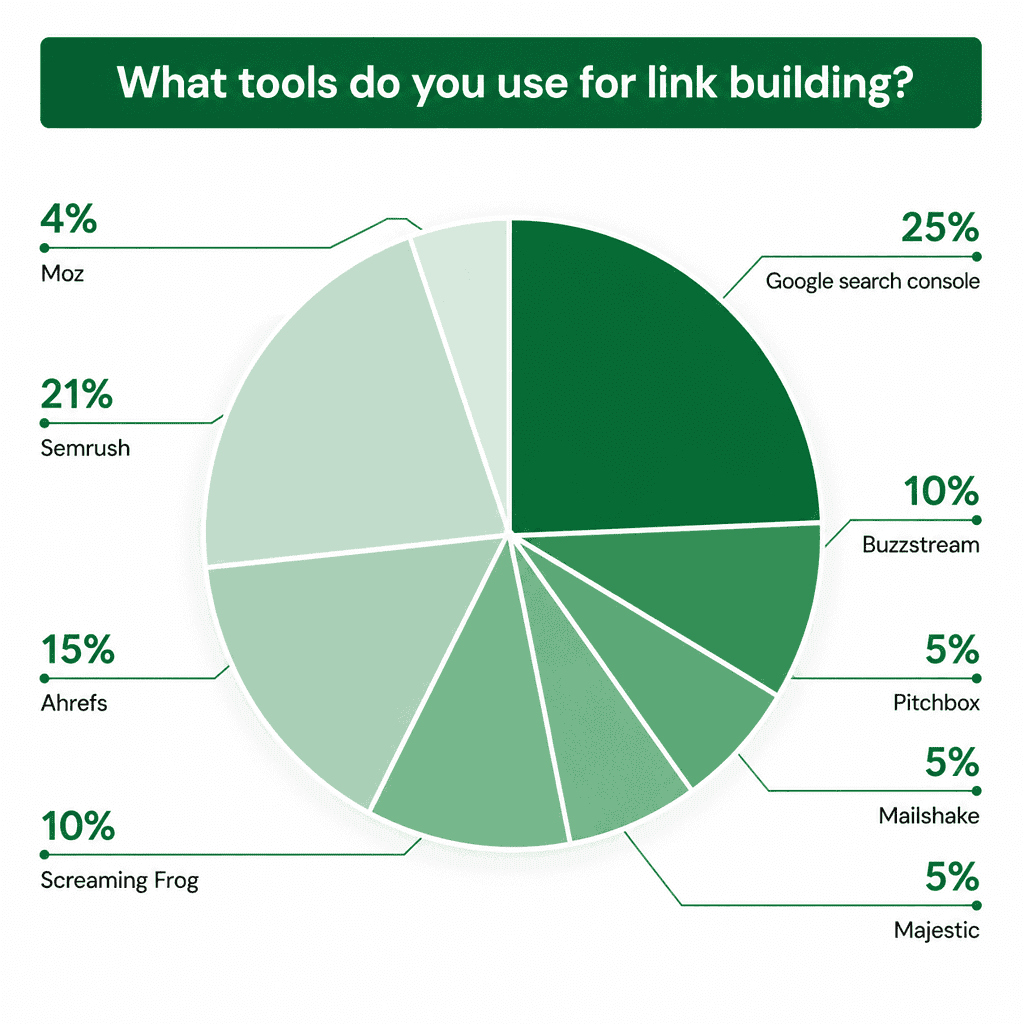
- The tools used by link builders are represented by Google Search Console with 25%, Semrush with 21%, Ahrefs with 15%, Screaming Frog with 10%, BuzzStream with 10%, Pitchbox, Mailshake, and Majestic with 5%, and Moz with 4%.
- Outreach is a big part of the job, and most people like BuzzStream, which is used by 56.1% of people surveyed for digital PR outreach, while 13.9% of people used only Gmail for their outreach.
- Overall, it appears that the majority of link builders like a combination of a couple of tools for all three tasks: research, monitoring, and outreach.
Link Building Tactics and Priorities for 2025
- Link building will increasingly rely on digital PR and content-led outreach. As reported by FatJoe, digital PR was the top link-building method for 2025. This has surpassed guest posting as a link-building technique.
- According to uSERP, digital PR also accounted for the highest number of link-building tactics (20%), closely followed by content marketing.
- According to a BuzzStream survey, almost 96% of respondents attributed the success of their digital PR link-building tactics to content supported by data, while roughly 90% stated they had used expert commentary in their content to drive success for these digital PR tactics.
- According to the results from a study by BuzzStream, less than a third of link-building pros follow a written procedure.
- 84% stated that while they may have core tactics, their outreach is generally iterative and flexible. Only 16% of those link builders surveyed said their process is constant and unchanging.
- These numbers tell us that although link building is most commonly a flexible endeavor, link builders do still need a flexible game plan.
- It also appears that the priorities link builders establish within the various segments of a website can also give us some insight into their thought processes.
- The results from the survey also state that roughly two-thirds of the link builders focus the majority of their time on blog posts.
- 44% said that they devote the majority of their time to a company’s homepage.
- Link builders said they focus their attention on the various pages dedicated to products for approximately 41% of the time, and link builders stated that only 16% of their time is focused on the page or pages of a site that may be dedicated to the selling or demonstration of a product.
- The majority of link builders (45.1%) believed that Travel is the easiest industry for link building.
- A lesser majority of 23.6% believed that the most challenging industry is Finance, followed closely by 20.3% who felt the same about the Health and Wellness sector.
- A good portion of the industry reported that their approach to link building was unchanged due to the most recent Google updates.
- The responses indicate that this sector is increasingly adopting digital PR as well as useful, flexible content and adaptable delivery methods.
Link Building and AI Search Statistics in 2026
- Brands will need to find new ways to gain visibility online and build a stronger presence across the internet.
- An Ahrefs analysis on 75,000 brands found that AI citations correlated with web mentions at 0.664 and backlinks at 0.218.
- Branded mentions correlate more strongly with AI citations than do backlinks by a factor of approximately 3.
- Both high- and low-performing brands with the top 25% for mentions receive more than 10 times the AI citations as those in the bottom 75% for mentions.
- The traditional metrics that we use to evaluate the success of an SEO campaign are starting to diverge from metrics used to evaluate AI citations.
- A little less than a year ago, 76% of citations from AI Overviews originated from the top 10 search results. Now, it’s at 37.1%.
- AI Overviews, however, still contribute to improved organic click-through rates. Brands with an AI overview in their listing get 2.07% more clicks than brands without them.
- The majority of SEO professionals have adapted to the changes, with 73% of survey respondents admitting that they believe mentions influence AI citations.
- Only 30% or so of those survey respondents have changed their strategies to accommodate.
- However, the data points to businesses having the option of either relying on authority or trying to get brand visibility all over the internet.
- Mentions, backlinks, and AI citations are becoming the pillars of a search presence, and they all rely on each other in varying ways.
Link Building Outreach Statistics
- Successful link building emails are not defined by the sheer quantity of outreach emails that are sent.
- A study by Backlinko and Pitchbox analyzed 12 million link building outreach emails.
- Backlinko study showed that, on average, only 8.5% of outreach emails received any kind of response. This response rate increased by approximately double after one follow-up.
- Further analysis showed that automating follow-ups had an impact of 62% on the number of outreach emails received. This is a big improvement from the baseline.
- Outreach emails with personalized email bodies saw a response rate increase of 32.7% over the baseline.
- There were also an additional 30.5% more responses to outreach emails that had personalized subject lines. This is probably due to emails being more engaging and personal, resulting in more people being likely to engage.
- Emails were 93% more likely to be opened if outreach emails were targeted to more than one person at the same company, instead of just one person at the company.
- For instance, LoopEx Digital notes that only 8.5% of link building emails produce links.
- Similar to our findings above, the response rates of cold link building emails can increase with follow-ups, and personalization of these emails can increase response rates by as much as 33%.
- When it comes to the PR world, the routine is slightly different. LoopEx Digital found that 48% of digital PR link builders always personalize their emails, while 32.4% do it most of the time.
- Around 55% of them follow up with the journalists only once, while 33% follow up with them twice.
- The majority of PR professionals tend to use email outreach tools such as Pitchbox, BuzzStream, Muck Rack, Prowly, and Cision.
Link Building ROI, Measurement, and Performance Challenges
- Although SEO professionals often report the effectiveness of their link-building efforts, a significant majority (approx. 70%) struggle to evaluate the success of these activities.
- LoopEx Digital found that 78.1% of SEOs actually find link building a positive ROI investment. It appears as though link building still has a great deal of perceived value despite being difficult to evaluate.
- A backlink is primarily evaluated by its ability to increase organic traffic by 67% of SEO professionals.
- 43% of SEOs rank link building based on the ability to achieve certain search rankings. This figure is slightly higher, 51%, among the most experienced SEOs
- 77.3% of SEOs value rankings for keywords, followed by referral traffic and organic traffic growth.
- As much as people think link building provides good results, very few link builders feel like they’re being successful.
- According to a State of Link Building survey, only 29% of link builders believe their work is successful. Link builders struggle to secure the budget they need for link building, with 29% saying that budget is hard to secure.
- Challenges related to allocating resources for link building include: 42% devote equal time to internal and external link building, and 34% say they devote more time to backlink building.
- Other top link building challenges include the quality of link building (43%), tracking ROI (43%), and disappearing links (42%).
- These results point out the difference between appreciating the benefits of link building and being able to measure the benefits link building provides.
- Better tracking, better assessment, and better budget management can lead to a more successful link building campaign.
How to Vet Link Vendors and Avoid Toxic Backlink Penalties
- Choosing the right link-building agency means looking beyond domain authority and rank guarantees.
- A lot of agencies do that to make you buy, but in reality, that’s not something an agency can legally do, according to Google.
- In the case of Ahrefs, they will even admit to the fact that their Domain Rating (DR) has absolutely no influence on search engine ranking.
- The BuzzStream 2026 State of Digital PR Report surveyed 150 PR professionals. 19.6% of them estimated US$300-US$500 per link.
- Almost 40% admitted they didn’t know the price, so don’t take these figures as Gospel. It’s vital to differentiate the cost of an agency service vs. payments directly to publishers to get a spot for your ranking, something Google prohibits.
- Using tools like Ahrefs Site Explorer and Semrush Organic Rankings can provide a helpful, rough estimation of the potential reach for each publisher over the next 1-2 years.
- While these tools offer a screening estimate, they should not be considered an endorsement or a confirmation of an existing penalty.
- First-party Search Console statistics can provide a useful supplemental resource for contextualizing these estimates.
- Google advises using its disavow tool carefully, mostly in cases when there is a great risk of incurring a manual action because of a large number of artificial links.
- A small pilot and documented checks may prevent any mistakes made by vendors that might cost a lot.
Conclusion
In 2026, link building is transforming from the process of obtaining backlinks into a complex activity that includes search visibility, digital PR, and brand authority. The statistics demonstrate increasing demands from the market, more implemented tools, and the role of data-driven content together with the personalization of outreach. Brand mentions are becoming more significant due to changes in AI search, resulting in the improvement of visibility evaluation methods.
Meanwhile, determining the effectiveness of a campaign is rather difficult because many teams have problems with measurement and budgeting. From the viewpoint of an analyst, companies should base decisions on good editorial coverage, ethical practices of the vendor, and measurable results.
FAQ
The global link-building market is expected to be US$30.32 billion by 2026.
Digital public relations seems to be an effective strategy, supported by data-oriented content and professional commentary.
According to the historical research by Backlinko and Pitchbox, the outreach response rate has been 8.5% on average out of 12 million emails sent.
It has been determined that brand mentions have a higher Index correlation with AI overview visibility than backlink count with visibility.
Measure audience traffic, ranking indicators, referrals and links quality, references for artificial intelligence and campaign spending for a better evaluation of the campaign effectiveness.


