









Introduction
Financial Services Marketing Statistics: Financial services marketing is currently experiencing a major transformation due to artificial intelligence, digitization, changing consumers’ spending habits, and some economic fluctuations. Now, AI search, generative AI, digital marketing, and automated customer service provide new opportunities and, at the same time, create new challenges for the operational framework and regulation.
The latest statistics on financial services marketing show how the market is changing, how customers’ behavior is changing, and what technologies will be important for growth. All these trends help to understand the dynamics of financial services marketing.
Key Highlights
- The Emerging markets and developing economies will grow by 4.4 % in 2027, while developed economies will increase only by 2.1 % in 2026.
- The growth of the global market for financial services, starting from US$33.67 trillion in 2024 to US$47.67 trillion in 2029, is calculated at a 7.20% CAGR.
- North America will have more than 12,500 fintech companies in 2025, taking first place, with Europe and Asia-Pacific in second.
- AI chatbots and virtual assistants will be responsible for 64% of the total number of AI-related applications.
- The value of organic search will be shifted to AI-powered platforms by about 21% in 2 years.
- In the financial services sector, OpenAI is at the forefront of AI foundation model implementation, with 69% of survey respondents affirming its use by the beginning of 2026.
- In 2026, the adoption rate of AI in financial services hit 86% among UK firms.
- Data analytics tops the investment priority list for financial services sector companies, with 68% of companies citing it as a priority.
- 89% of advertising companies in financial services are planning to increase their spending on influencer and creator marketing.
Global Real GDP growth
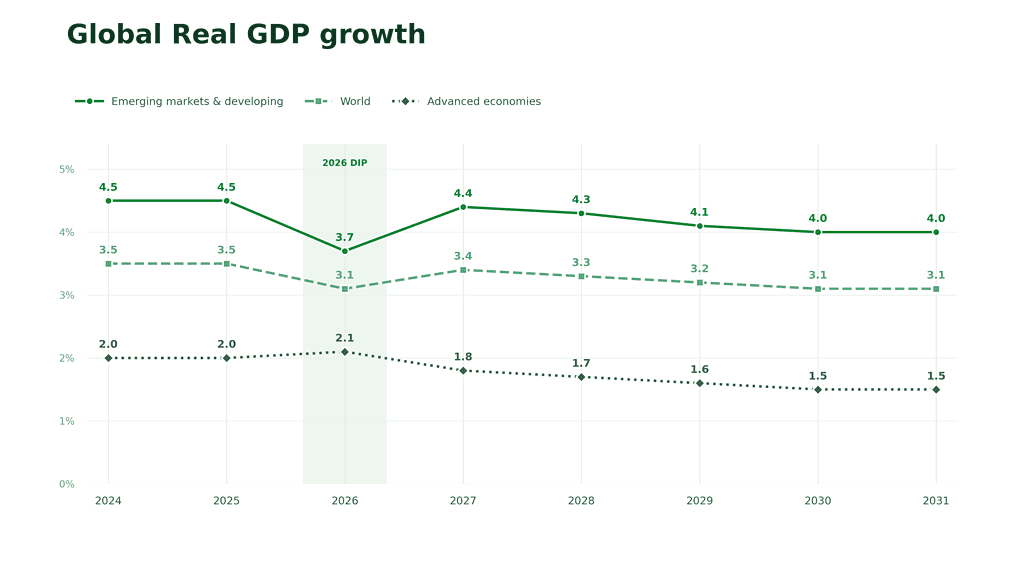
- According to a recent IMF World Economic Outlook report, emerging and developing economies are going to experience more rapid economic growth than advanced economies over the 2024 to 2031 period.
- The growth of emerging and developing economies was recorded at 4.5% for 2024 and 2025 before decreasing to 3.7% in 2026.
- However, 3.7% in 2026 is going to rise back to 4.4% in 2027 before declining slightly to 4.0% in 2030 and 2031.
- World economic growth was 3.5% in both 2024 and 2025 and is going to fall to 3.1% in 2026.
- World economic growth is predicted to be back to 3.4% in 2027 and will decline gradually to 3.1% by 2030 and remain there until 2031.
- Advanced economies will experience the slowest growth of any group of countries in the time period, increasing only slightly from 2.0% in 2024 and 2025 to 2.1% in 2026 before going down to 1.5% in 2030 and 2031.
- The global real GDP growth shows a continued gap in economic growth between emerging and advanced economies, with emerging markets taking a leading role in economic growth globally.
Global Financial Service Market Size
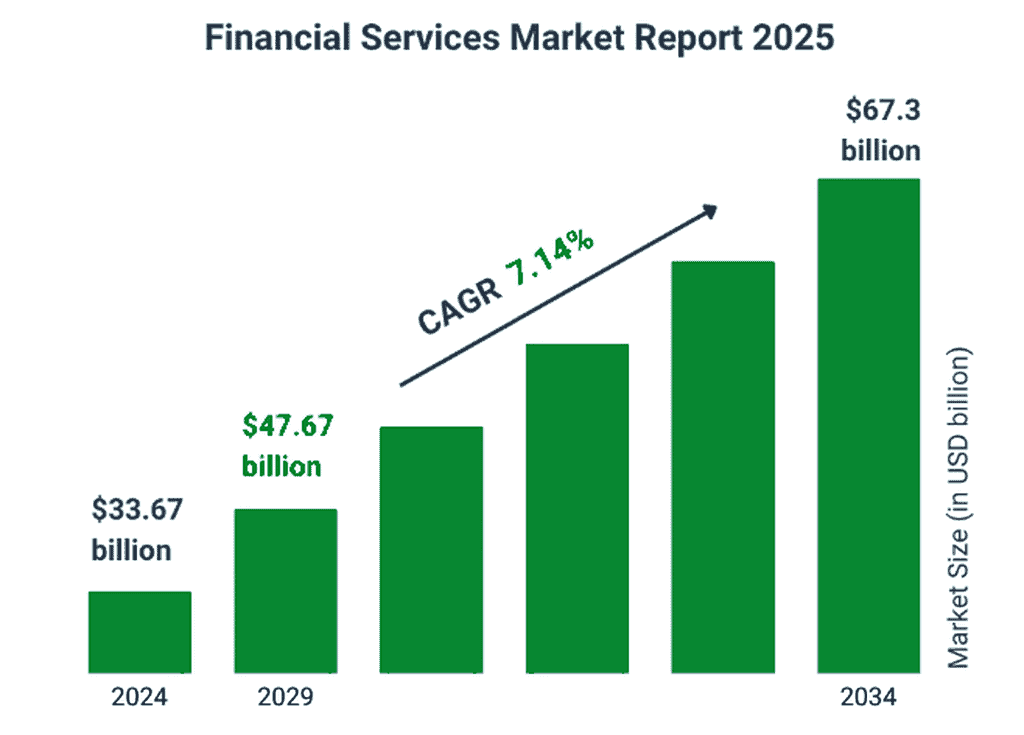
- A report from The Business Research Company shows the financial services market is expected to grow from US$33.67 trillion in 2024 to US$47.67 trillion in 2029 with a CAGR of 7.20%.
- The growth of financial services market is expected to continue growth to US$67.30 trillion by 2034 with a CAGR of 7.14% between 2029 and 2034. .
- The global financial services market growth is constant with the combination of technology, investment, and the demand for financial services on digital platforms.
- In the past, wealth among high-net-worth individuals, EMV technology, different models of business financing, and a bull market led to the market’s growth.
- The market growth catalysts have since changed, as industry participants are hindered by increasingly strict market regulations and the location of data.
- With growing adoption of cryptocurrencies, digital banking, alternative investment strategies, risk management, and increased support by government entities, the market is expected to see even more growth.
- Market expansion is also likely in an environment with higher interest rates, but there is an increased likelihood of cybercrime and stricter capital regulations, which would likely have a constraining impact on the industry’s growth.
Global Financial Services Application Market Size
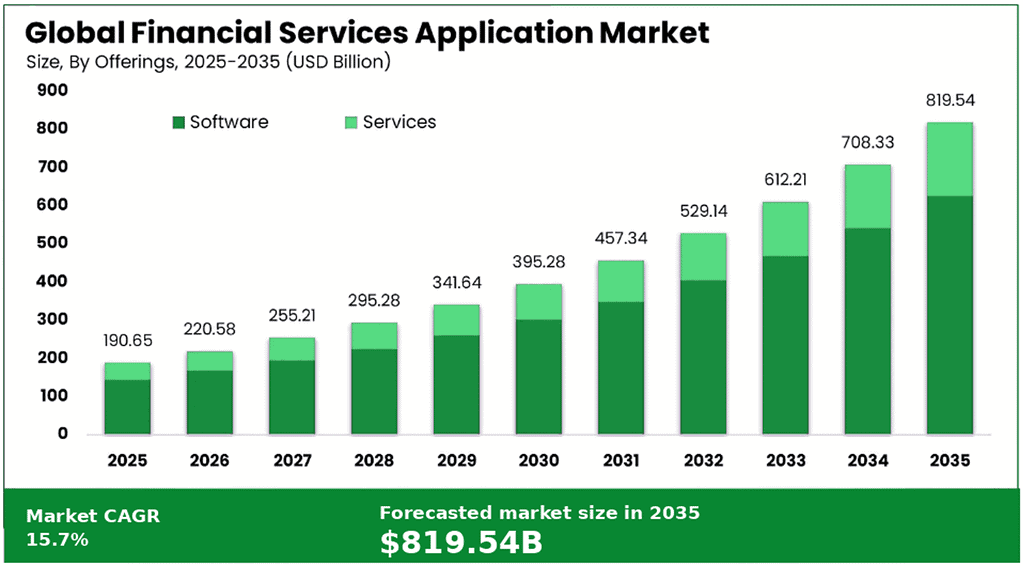
- According to market.us, the global financial services application market continues to grow rapidly, and banks, insurance firms, and fintech businesses are launching their digital transformation projects.
- The projected financial services application market will hit US$819.54 billion by 2035 with a compound annual growth rate of 15.7% because of the increasing demand for advanced financial software, digital platforms, and automated solutions.
- North America is the largest regional market with 34.8% of global revenue (or US$66.34 billion).
- The largest firms are in the lead regarding the number of users, with 72.7% of the total number of consumers, since they spend much more on technology and have more difficult business situations.
- Banking provides about 38.4% of the total financial services application market demand due to significant usage of applications in transactions, risk management, and client services.
- The financial services application market size of the industry in the United States is estimated at US$55.73 billion in 2025, with an expected CAGR of 12.6%.
Global Fintech Landscape By Region
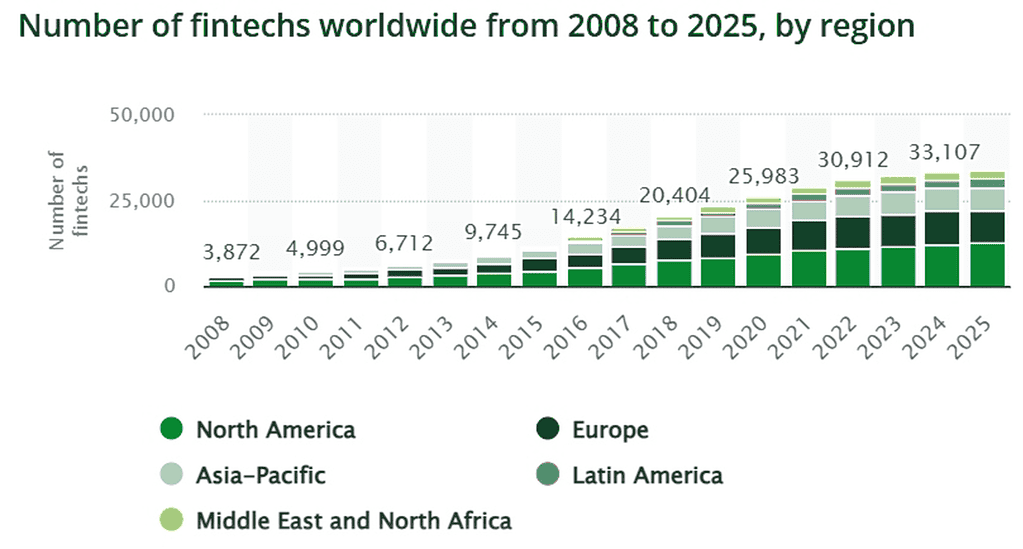
- The global fintech sector is still limited to a few key regions, with North America retaining its lead in 2025.
- Statista estimates that North America is home to more than 12,500 fintech firms, while Europe has around 10,000 and Asia Pacific about 6,795.
- While the fintech sector has seen steady growth from 2008 to 2025, the number of new fintech firms formed shrank sharply after 2021.
- The concentration of the fintech industry is evident in the distribution of unicorns, too.
- In 2025, the US had about five times more unicorns in fintech than the UK, which means that it is firmly established in the global fintech industry.
AI Applications in Emerging Market and Developing Economies
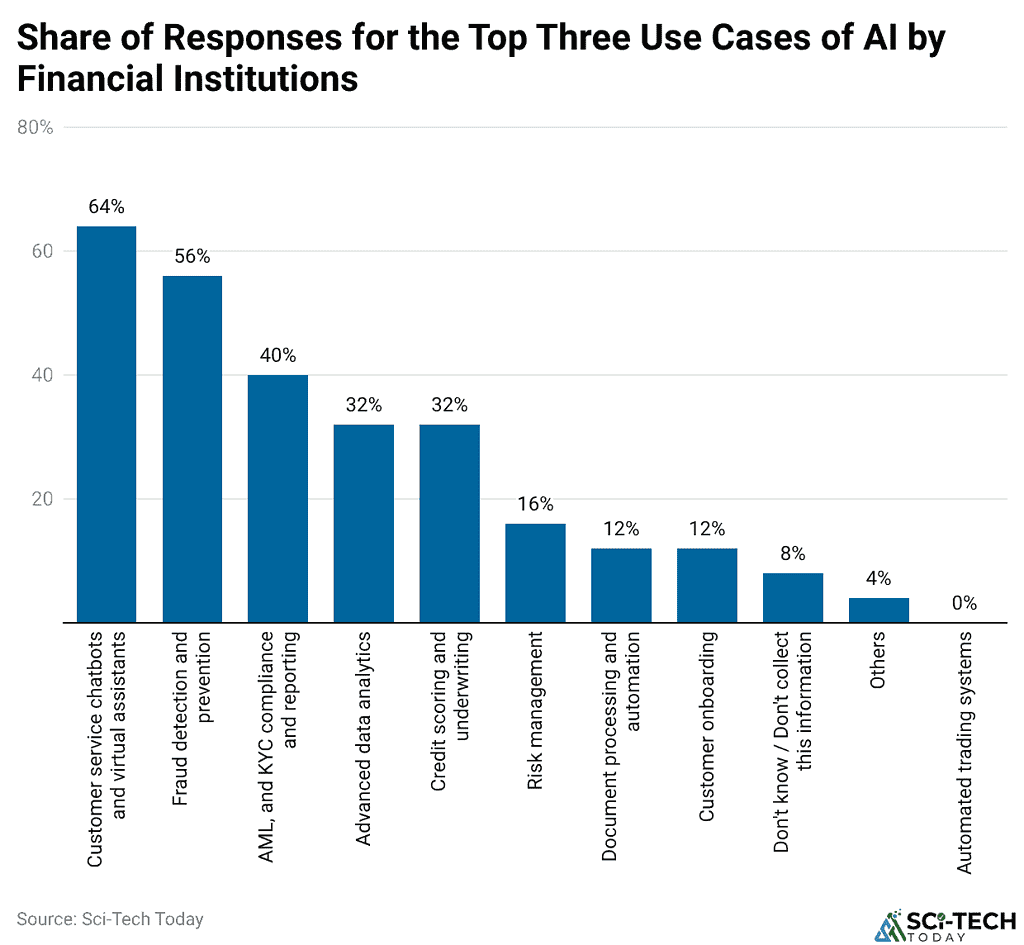
- According to a 2025 World Bank survey, which assesses 27 emerging market and developing economies (EMDEs), the financial sector is focusing on AI for customer service, fraud detection, and regulatory compliance.
- With 64% of the replies, customer service chatbots and virtual agents are the most frequently mentioned application.
- Fraud detection comes in second place, with 56%, followed by other applications such as AML, KYC compliance, or reporting, which account for 40% of the mentions.
- Data analytics and credit scoring/underwriting represent 32% of the mentions, which reflects the growing interest in the use of AI in financial assessment and lending.
- Nevertheless, other applications such as risk management, document processing/automation, and customer onboarding are less often reported.
- The automated trading applications do not figure in the research, with 0% of the replies.
- Meanwhile, 8% of the respondents did not know or did not collect information regarding the applications related to AI technologies, while 4% mentioned some other applications.
- The use of AI technologies within the EMDE financial sector is aimed at practical applications that enhance customer service, fraud detection, and regulatory compliance.
AI Is Transforming Financial Services Product Discovery and Search Strategies
| Strategy | Share (%) |
| Enhancing content authenticity signals | 46 |
| Enhancing content depth and expertise | 42 |
| Focusing on E-E-A-T signals | 41 |
| Creating content that answers specific questions | 39 |
| Building topical authority | 39 |
| Creating more detailed, long-form content | 38 |
| Adjusting keyword strategies | 38 |
| Optimizing content for conversational queries | 35 |
| Optimizing for featured snippets | 33 |
| Structuring data for AI readability | 32 |
| Developing voice search compatibility | 30 |
| Haven’t considered the impact of AI search | 14 |
| Developing AI-specific SEO tactics | 12 |
| Partnering directly with AI companies | 9 |
- According to Adobe’s State of Customer Experience in Financial Services in an AI-Driven World Report, the discoverability of financial products and digital visibility of financial services firms is being disrupted by AI.
- The above table shows that over the next two years, 21% of organic searches will shift to AI search platforms, while 86% of financial services companies are thinking about the impacts AI search will have on their brands.
- For modification in the scenario, financial services firms are shifting their priorities to quality and search optimization.
- Improving content authenticity comes first at 46%, while improving content depth and expertise comes second at 42%. E-E-A-T signals, which stand for Experience, Expertise, Authoritativeness, and Trustworthiness, came third at 41%.
- For 39% of the surveyed firms, their goal is creating content topical authority, while for another 38%, it is about developing high-quality long-form content.
- Some other areas of interest for the firms are voice search and AI search, at 30% and 32%, respectively.
- A few other strategies include optimizing content for featured snippets (33%) and structuring data to improve content readability (32%).
- The other strategy is simply creating content that optimizes for conversational queries (35%).
- Almost 14% have not really thought about AI search, 12% are working on AI-specific SEO, while only 9% have decided to work directly with AI firms.
- The AI transformation is making content credible, with strong informative value still of utmost importance to marketing in the financial services sector, as well as the need for such content to be optimized for search AI.
AI Model Adoption in Financial Services
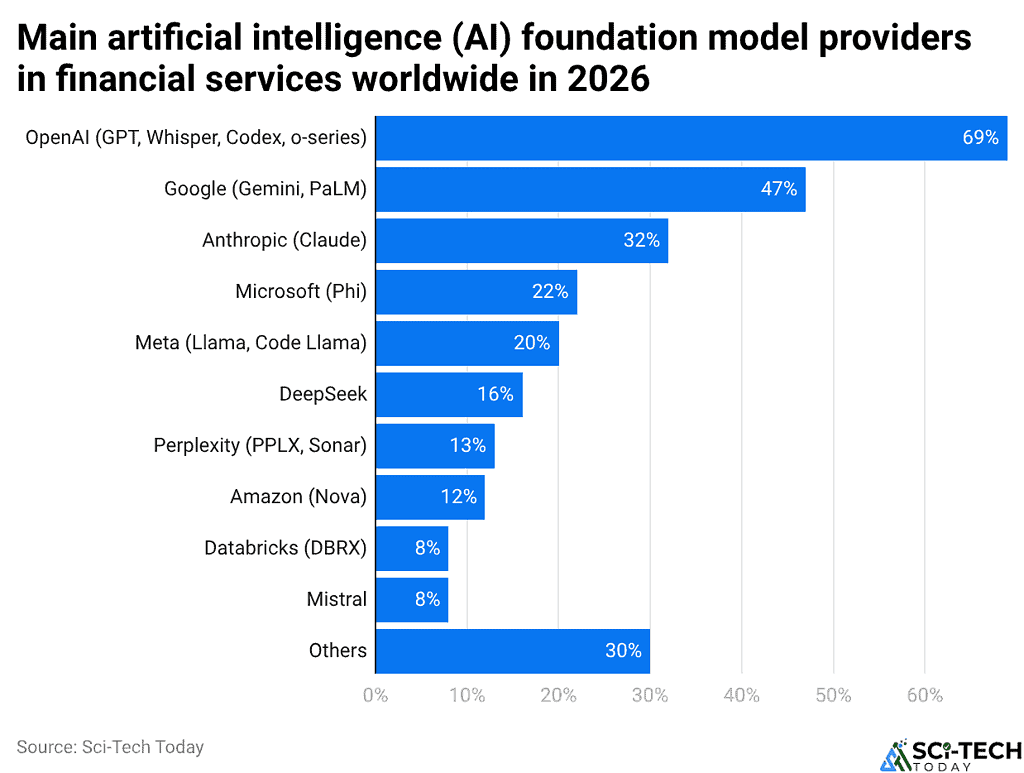
- As of early 2026, financial services providers are increasingly making use of foundational AI models in their operations and services, with OpenAI at the forefront.
- Based on Statista’s analysis, 69% of financial institutions and enterprises are using OpenAI models, making OpenAI the most frequently adopted service provider.
- Google takes second place with 47%, followed by Anthropic with 32%.
- Other companies ranked in the middle tier are Meta and Microsoft.
- The lowest percentages, 16% and 13%, belong to DeepSeek and Perplexity.
- Two companies, Databricks and Mistral, had the same percentage, with 8% each.
- The results show that financial institutions switch to using different AI model providers instead of relying on one only.
AI and Digital Adoption in Financial Services 2026
- AI is starting to take over the financial world, with banking, insurance, and marketing having different levels of AI integration.
- According to the US Census Bureau, 33.9% of financial businesses in the United States have adopted AI, compared to only 19.8% of businesses in all industries.
- 52% of businesses across all industries reported utilizing AI for marketing and sales purposes.
- The Bank of England and Financial Conduct Authority say that 86% of financial services firms in the UK use AI, and this has grown from 75% in 2024, while the adoption among banks in the UK and insurers is 93%.
- The reported usage is only 22% for firms in the UK, and that usage is only to support decision-making, with zero reports of marketing and sales having autonomous agent adoption.
- The European Central Bank reported a jump from 46% to 86% in the proportion of euro area banks adopting generative AI between 2024 and 2025.
- In addition, by September 2025, 55% of EU banks had deployed some form of generative or agent-based AI in client-facing applications.
- AI and Digital Adoption is indicative of AI’s broader implementation in the marketing of financial services, operational excellence, and increased client interaction.
Financial Services: Consumer Spending Patterns
| Category | Spend per transaction (% 2026) | Transactions per household per month (% 2026) | Households transacting (pp change 2026) |
| Furniture | 3.2 | -0.5 | -0.2 |
| Clothing | 4.8 | 0.9 | -0.5 |
| General merchandise | 0.9 | 4.5 | -0.1 |
| Food services | 1.9 | 1.9 | -0.6 |
| Lodging | 3.7 | 0.4 | -0.1 |
| Airlines | 6.4 | 4.1 | -0.2 |
- Data from Bank of America, 11 June 2026, shows how consumers have spent money differently within categories, to what degree households are active, and how many times they make transactions within those categories.
- Air travel spending had a 6.4% increase per transaction and a 4.1% increase in transactions made per household, indicating people continue to spend more money on travelling, supported by more people booking more often.
- Clothing had strong growth as well, with a 4.8% increase in spending per transaction and a 0.9% increase in transactions made per household.
- Similarly, spending on lodging grew by 3.7% per transaction, and the number of transactions per household grew by 0.4%.
- Furniture had a 3.2% increase in spending per transaction, although the number of transactions per household had a 0.5% decrease.
- Spending in food services had a 1.9% increase per transaction and in transaction frequency. General merchandise spending was a bit different.
- Only a 0.9% increase in spending per transaction, but transaction frequency grew by 4.5%, which was the largest growth across the board in this category.
- Food services had the largest decrease of 0.6%, and clothing was next with a decrease of 0.5%.
- Overall, the spending growth in each category has been mainly driven by higher spending per transaction and an increase in transaction frequency rather than an increase in the number of households that spend money.
AI Adoption Priorities Across Financial Services Segments
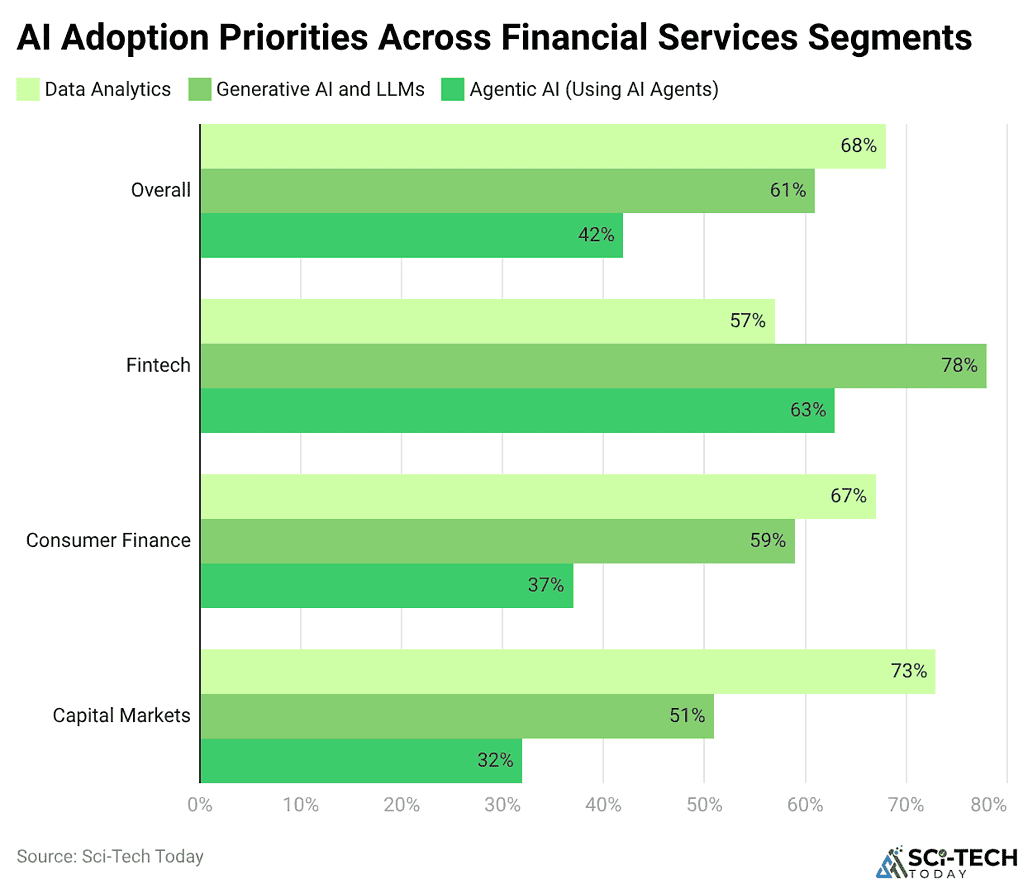
- AI has impacted all segments of financial services in various ways, but all segments seem to have prioritized AI investment in data analytics, generative AI, and agentic AI.
- As stated in NVIDIA’s 2026 Finance State of AI report, the most commonly used form of AI, mentioned by 68% of respondents, is data analytics.
- The data analytics industry is followed by generative AI and Large Language Models, at 61%.
- Finally, Agentic AI, AI that executes AI-based tasks, is mentioned by 42% of survey respondents.
- In general, data analytics has the lowest priority in fintech, at 57%.
- Fintech companies have shown interest in generative AI and Agentic AI at 78% and 63%, respectively.
- The data for Consumer finance differs slightly. 67% of firms prioritized data analytics.
- The next most prioritized form of AI, generative AI, received a priority of 59%, followed by Agentic AI with a priority of 37%.
- Data analytics is most interesting for 73% of Capital markets firms. Generative AI was prioritized by 51%, and Agentic AI was prioritized by 32%.
- AI Adoption priorities show how businesses have different strategies based on their goals and objectives.
- Data analytics is more important to Capital Markets and Consumer Finance companies.
- For fintech companies, data analytics is still important but less so in comparison to their need to grow and the importance placed on generative and agentic AI.
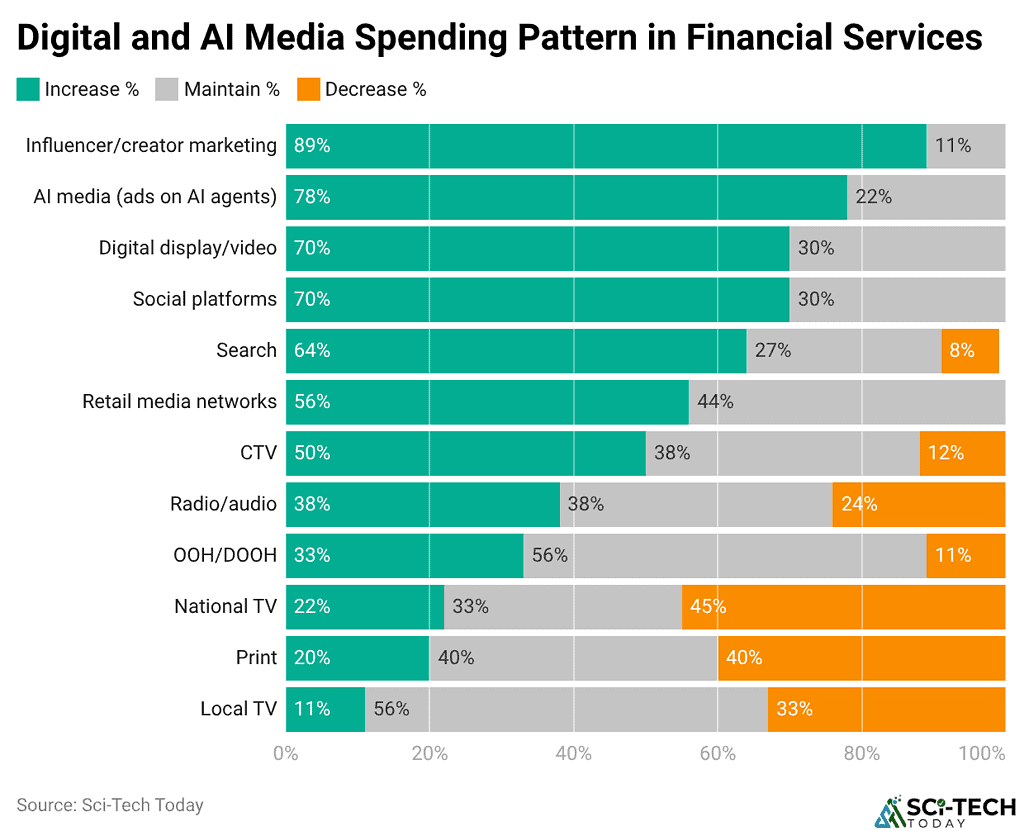
Digital and AI Media Spending Pattern in Financial Services
| Channel | Increase % | Maintain % | Decrease % |
| Influencer/creator marketing | 89 | 11 | 0 |
| AI media (ads on AI agents) | 78 | 22 | 0 |
| Digital display/video | 70 | 30 | 0 |
| Social platforms | 70 | 30 | 0 |
| Search | 64 | 27 | 8 |
| Retail media networks | 56 | 44 | 0 |
| CTV | 50 | 38 | 12 |
| Radio/audio | 38 | 38 | 24 |
| OOH/DOOH | 33 | 56 | 11 |
| National TV | 22 | 33 | 45 |
| 20 | 40 | 40 | |
| Local TV | 11 | 56 | 33 |
Emerging Trends and Future of Financial Services Marketing
- Financial services marketing in 2027 is anticipated to focus more on measurable outcomes, regulatory frameworks, customer trust, and artificial intelligence.
- According to the International Monetary Fund, the economy is expected to grow globally from 3.1% in 2026 to 3.4% in 2027, with the inflation rate expected to decline to 4.1%.
- On the other hand, the projected growth rate of financial services is 2.3% in the U.S. and 1.2% in the Euro area as well as the UK, suggesting that financial institutions will focus on marketing efficiency and return on investments rather than expansive budgets.
- Regulatory actions will also impact financial services marketing approaches, as in the UK, the Financial Conduct Authority is expected to modify Consumer Duty, and evaluate investment promotion risk warnings in the year 2027.
- Although the Financial Conduct Authority does not seek the establishment of separate rules covering artificial intelligence, the current regulations will remain in effect for AI-generated marketing.
- According to the Mills Review, 20% of consumers in the UK surveyed (approximately 11 million adults) are likely to deploy AI agents to achieve desired goals.
- The deployment of AI agents in the financial sector will encourage financial organisations to ensure a higher degree of accessibility to product information for AI systems.
- In parallel, high-risk AI criteria of the EU, deadlines for AI sandboxes, and the development of the digital euro pilot will entail additional compliance priorities and prioritization of innovations.
- In the US, uncertainties regarding open banking regulations will affect the speed of implementation.
- The marketing in the financial services sector in 2027 is likely to be characterized by transparency, responsible AI usage, readiness for regulatory changes, and accessibility to product information.
Conclusion
Financial services marketing is constantly changing to accommodate innovations in technology and changes in economics and customer behaviors. The statistics underscore the increasing necessity of utilizing customer engagement, data analytics, fintech innovations, and digital marketing in the creation of corporate strategies. Also, AI-driven search will revolutionize the means by which consumers find financial products and make the availability of content and visibility of financial products on the Internet more important.
The changing means by which consumers spend money and the means by which the government regulates money and the financial services industry further underline the need for financial marketing to be responsible and measurable. As institutions look to the year 2027, the challenge will be to balance automation with transparency, personalization with the need for customer trust, and the constant demand to be creative with the necessity to remain compliant, in order to best retain customer business and remain competitive.
FAQ
Global Financial Services Market reached approximately US$33.67 trillion in 2024, with an annual growth rate (CAGR) of 7.25% from 2019 to 2024.
AI is enhancing customer service and fraud detection, helping to personalize marketing efforts and clients’ interactions.
Financial services brands build trust through digital marketing by combining transparent communication, regulatory compliance, data privacy, and authentic social proof across search, social, and AI channels.
AI searches are changing the process of discovering financial products.