









At a Glance
Yoga Industry Statistics: Yoga is no longer just a form of exercise. It has become a popular part of everyday wellness, helping people stay fit, manage stress, and improve their overall health. From yoga studios and fitness centers to online classes and mobile apps, the industry is growing in many new ways. More people are also turning to yoga as they look for simple and healthy ways to care for their bodies and minds. As interest continues to rise, businesses are expanding their services and creating new experiences for yoga enthusiasts. This article explores the latest yoga industry statistics and trends, covering market growth, participation, consumer habits, and the key factors shaping the industry’s future.
Best of the Best
- The global yoga market is projected to reach USD 119.69 billion by 2034, growing at a 7.29% CAGR.
- More than 300 million people practice yoga worldwide.
- About 11% of American adults, or nearly 38 million people, practice yoga.
- 67% of practitioners practice yoga at home, making it the most popular location.
- 78% of travelers are interested in joining a yoga retreat within the next 12 months.
- 56% of travelers choose yoga retreats mainly for better mental health and wellbeing.
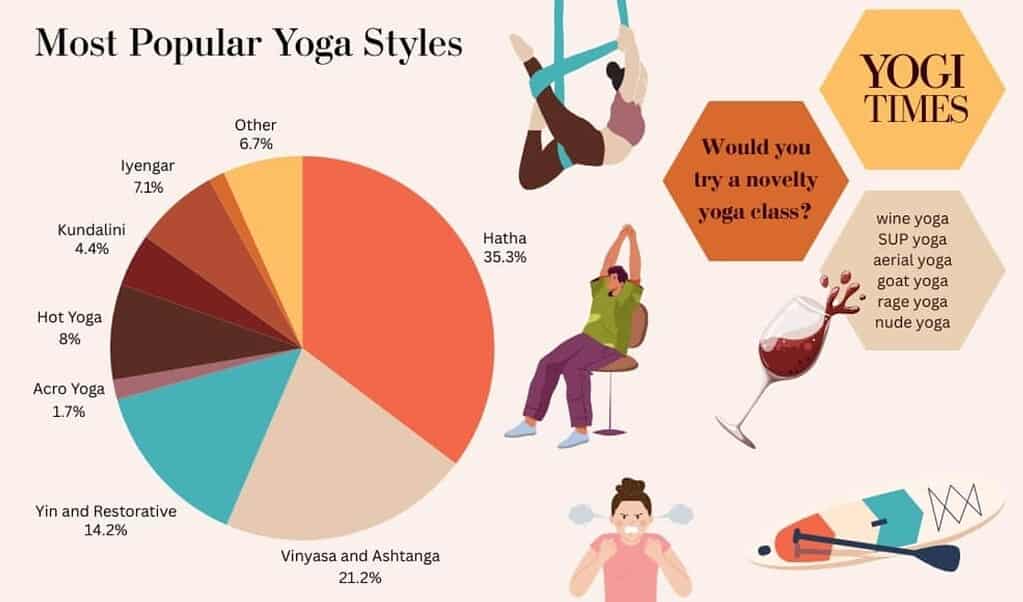
- Hatha yoga remains the most popular style, practiced by 35.3% of practitioners.
- Women make up about 72% of yoga practitioners.
- 86% of practitioners report feeling mentally well after practicing yoga.
- Nearly 40% of yoga classes are now offered in a hybrid format, reflecting the industry’s shift toward digital access.
Global Yoga Market Overview
- The global yoga market was valued at USD 63.82 billion in 2025 and is expected to grow from USD 68.15 billion in 2026 to USD 119.69 billion by 2034, representing a 7.29% CAGR, according to Fortune Business Insights.
- North America led the global market in 2025, accounting for 33.27% of the total market.
- The offline course segment is expected to remain the largest segment in 2026, with a 62.54% market share.
- The female segment is projected to lead by gender, accounting for 68.57%.
- Consumers aged 30 to 50 years are expected to represent the largest age group, with a 41.29% share.
Geographical Market Outlook
- North America generated USD 21.23 billion in 2025, equal to 33.27% of global demand. The regional market is projected to reach USD 22.62 billion in 2026.
- The U.S. yoga market alone is expected to reach USD 18.90 billion by 2026.
- Europe accounted for 29.82% of the global market in 2025, generating USD 19.03 billion. It is projected to reach USD 20.33 billion in 2026.
- Asia Pacific generated USD 17.78 billion in 2025, representing a 27.85% share, and is expected to reach USD 19.1 billion in 2026.
- Middle East & Africa generated USD 2.11 billion in 2025, accounting for 3.31% of the global market, and is expected to reach USD 2.22 billion in 2026.
Yoga Industry Revenue Streams
- According to Indiayogashala, the U.S. yoga studio market is valued at USD 11.8 billion. However, growth remains flat as more practitioners adopt hybrid models that combine in-person and online classes.
- The digital yoga market is expected to exceed USD 30 billion by 2027, with more than 120 million practitioners using virtual classes in 2025.
- The yoga clothing market was valued at USD 28.47 billion in 2025 and is projected to reach USD 42.43 billion by 2030, growing at an 8.31% CAGR.
- The global yoga mat market generates USD 8.9 billion and grows by 6.8% annually. The accessories market could rise from USD 18.9 billion in 2025 to USD 28.4 billion by 2030, at an 8.4% CAGR.
- The market is valued at USD 72 billion in 2025 and could grow at a 10% CAGR through 2032. Wellness tourism is expected to reach USD 1.3 trillion by 2030.
- Programs typically cost USD 2,000 to USD 10,000+ for 200-hour certifications.
Yoga Retreat Industry Outlook for 2026/2027
- According to bookretreats.com, 78% of travelers are interested in joining a yoga retreat within the next 12 months.
- Searches for yoga retreats have increased by 15% year over year, showing growing consumer interest.
- 98% of retreat attendees report at least one lasting benefit, while 51% say retreats improved their mental and emotional wellbeing.
Most Popular Yoga Retreat Types
- With more than 100 yoga styles worldwide, travelers increasingly prefer flexible and personalized retreat options.
- 42% of travelers prefer yoga combined with another activity, while 40% favor mixed-style yoga retreats.
- 33% show interest in Restorative Yoga, about 2x the interest in faster styles such as Vinyasa and Hot Yoga.
- Vinyasa attracts 15%, Hot Yoga 14%, and yoga teacher training 12% of travelers.
- Demand for retreats focused on nervous-system recovery has risen 105% year over year.
World’s Top Yoga Retreat Destinations
| Destination | YoY Growth in Interest |
| Albania | +203% |
| Mexico | +183% |
| Japan | +173% |
| England | +124% |
| Spain | +100% |
| France | +81% |
| Vietnam | +73% |
| Australia | +73% |
| Thailand | +62% |
| Philippines | +58% |
Why People Book a Yoga Retreat
(Source: bookretreats.com)
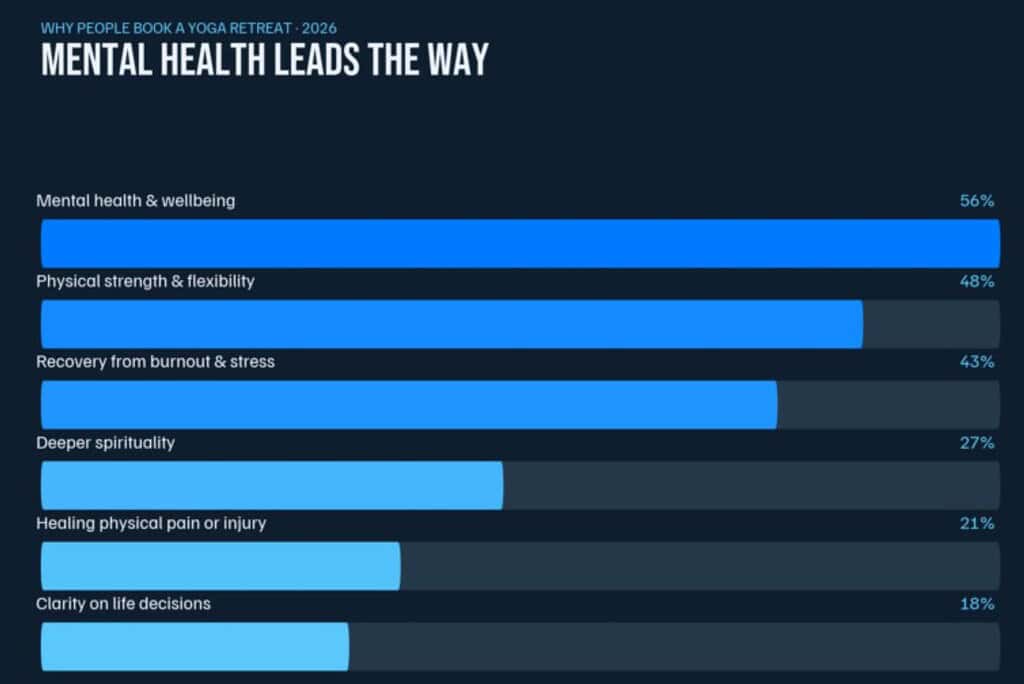
- 56% of travelers choose yoga retreats mainly for better mental health and overall wellbeing, making it the top reason.
- Physical benefits, such as improved strength and flexibility, attract 48%, while 43% seek relief from stress and burnout.
- Other motivations include deeper spirituality (27%), healing pain or injuries (21%), and gaining clarity about important life decisions (18%).
Yoga Practice Continues to Grow
- About 11% of American adults, or nearly 38 million people, practice yoga, according to research from Yoga Alliance and Yoga Journal.
- More than 300 million people practice yoga worldwide, showing its strong global popularity.
- Around 90% of Americans have heard of yoga, according to Harvard Health.
- Nearly 33% of Americans have tried yoga at least once.
- U.S. yoga practitioners spend more than USD 21 billion annually on classes, equipment, and related experiences.
Who Is Practicing Yoga Today?
- A report published by Bookre Treats shows that women make up about 72% of yoga practitioners.
- Male participation has more than doubled, rising from around 4 million to 10 million practitioners.
- Yoga participation among people aged 50+ has tripled in recent years, reaching about 14 million.
- Women also dominate yoga retreats, with women-only retreats outnumbering men’s retreats by nearly 6 to 1.
- Gen X shows the strongest interest in retreats, with 73% planning to attend one in the next 12 months.
- Gen Z follows closely at 68% and is the most likely group to book its first retreat.
Frequency Of Yoga Practice In America
| Frequency of Yoga Practice | % of Practitioners |
| 5 or more times per week | 6% |
| 2 to 4 times per week | 31% |
| Once per week | 22% |
| 5-10 times per month | 14% |
| Once per month | 6% |
| 5-10 times per year | 12% |
| Not applicable | 9% |
(Reference: statista.com)
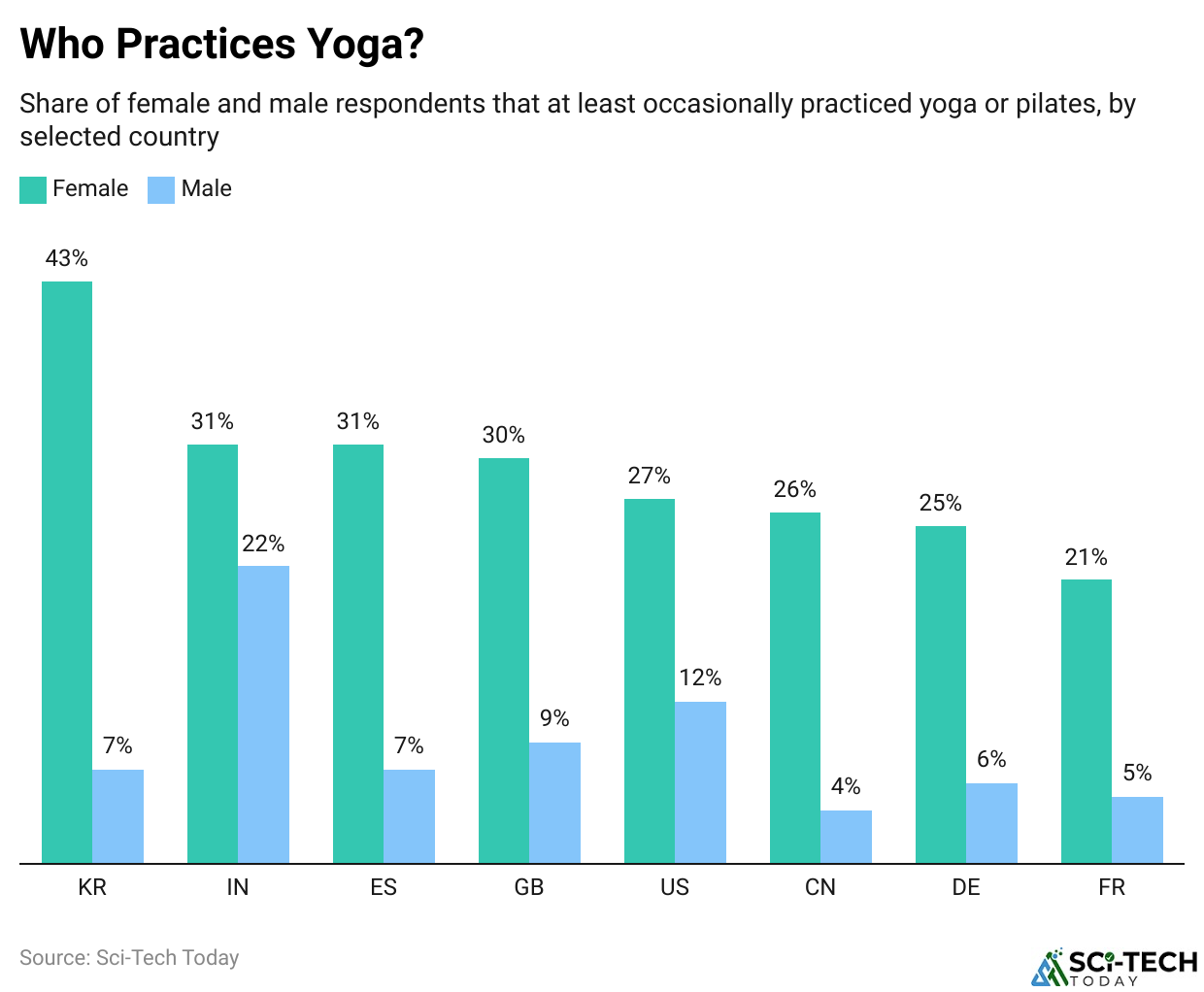
- A Statista poll indicates that women are more likely than men to do yoga, yet country-by-country differences exist in this regard. For instance, in India, compared to 22% of males, 31% of women who play sports report having performed yoga between April 2022 and March 2023.
- 59% of yoga practitioners report better sleep, both in terms of quantity and quality; 86% report feeling more mentally well; and 28% report fewer symptoms of depression.
Yoga Practitioner Demographics by Age Groups
(Source: indiayogashala.com)
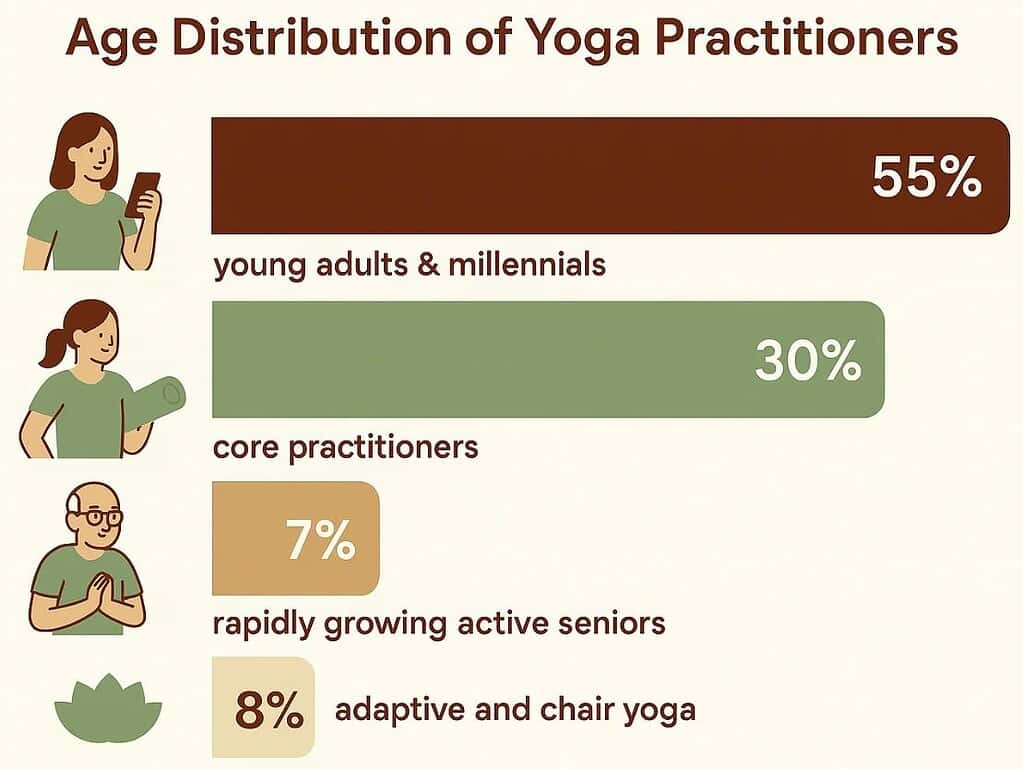
- The 30-49 age group forms the core yoga demographic, with consistent participation and higher spending on classes, equipment, and retreats.
- Millennials and Gen Z account for about 55% of practitioners in 2025, driving demand for online classes, fitness-focused yoga, apps, and social media content.
- Yoga participation among people aged 50+ has tripled over the past four years, mainly for flexibility, joint health, stress relief, and pain management.
- Only 8.0% of adults aged 65+ practiced yoga, supported by adaptive and chair yoga programs.
- Children are also increasingly participating, with 37% of practitioners having children who practice yoga.
Income and Diversity
- Yoga participation rises with income, from 10.4% among adults below 200% FPL to 23.0% among those at 400% FPL or more.
- People of color represent 38% of U.S. practitioners. Asian adults had the highest participation at 22.5%, followed by White (19.3%), other or multiple races (15.7%), Black (12.6%), and Hispanic adults (10.5%).
Where People Practice Yoga
- 67% of practitioners practice yoga at home, making it the most popular location.
- Other locations include gyms (43%), yoga studios (38%), outdoors (32%), yoga or wellness festivals (20%), and special events (20%).
Estimated Yoga Practitioners by Country
| Country | Number of Practitioners | Population Share | Average Age |
| Worldwide estimate | 300+ million | 4%-5% | 30-45 years |
| France | 10.7 million | 20.5% | Not specified |
| Italy | 6 million | 10% | Not specified |
| Germany | 3.21 million | 3.9% | 14 years and older |
| Belgium | 500,000 | 4%-5% | 40 years |
| United Kingdom | 2-3 million | 3%-4.5% | 35-45 years |
| Netherlands | 1-1.5 million | 6%-8% | 35 years |
| Luxembourg | 30,000-50,000 | 5%-8% | 35-40 years |
| United States | 36.7 million | 11% | 38 years |
| Canada | 3-4 million | 10% | 35-45 years |
| Australia | 2.5-3 million | 10% | 35-45 years |
| Brazil | 6–8 million | 3%-4% | 35 years |
| Argentina | 1-1.5 million | 2%-3% | 35-40 years |
| Mexico | 1.3-2.6 million | 1%-2% | 30-40 years |
| China | 10-15 million | 0.7%-1% | 25-35 years |
| Japan | 2-3 million | 2%-3% | 40 years |
| India | Varies widely | 20%-30% | Varies |
| South Africa | 3-4 million | 5%-7% | 30-40 years |
Key Motivations for Practicing Yoga
(Source: zippia.com)
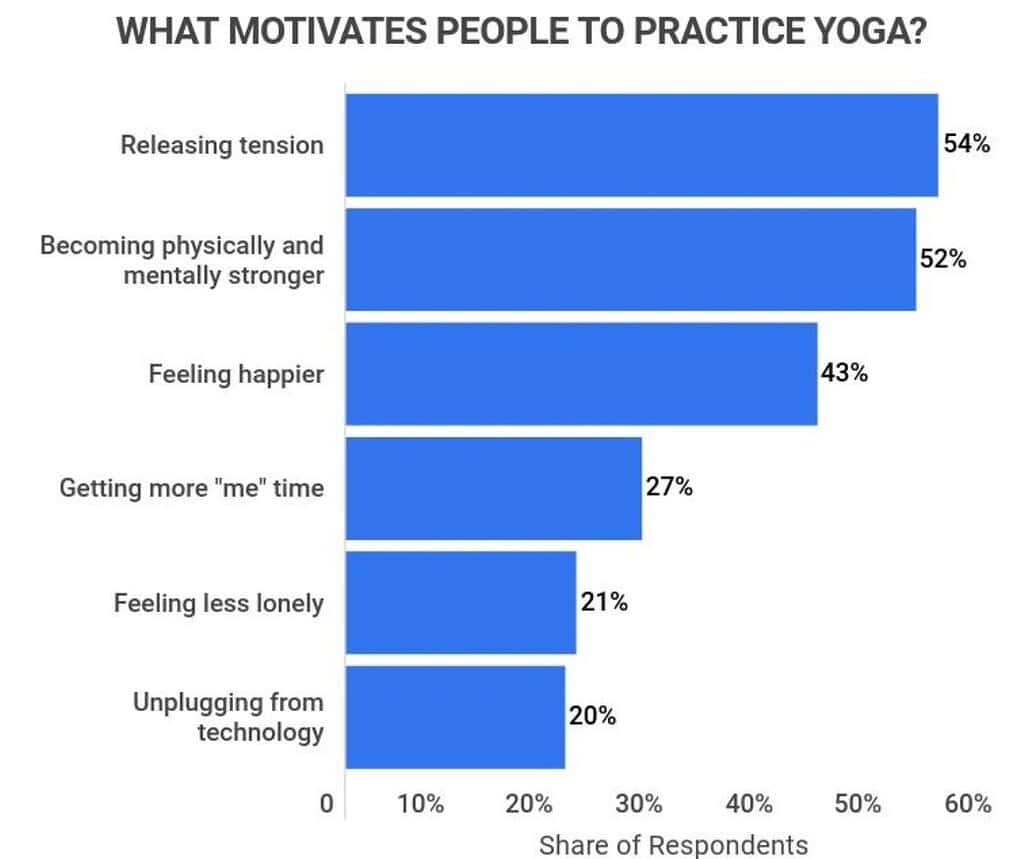
- 54% of respondents practice yoga to release tension.
- 52% use yoga to become physically and mentally stronger.
- 43% practice yoga because it helps them feel happier.
- 27% choose yoga to gain more personal “me” time.
- 21% practice yoga to feel less lonely.
- 20% use yoga to disconnect from technology.
Most Popular Yoga Styles
(Source: yogitimes.com)
- Hatha yoga remains the most popular style, practiced by 35.3% of yoga practitioners.
- Vinyasa and Ashtanga rank second, accounting for 21.2%.
- Yin and restorative yoga represent 14.2%, reflecting demand for slower, recovery-focused practices.
- Hot yoga accounts for 8.4%, while Iyengar yoga represents 7.1%.
- Other styles comprise 6.7%, followed by Kundalini yoga at 4.4% and Acro yoga at 1.7%.
Yoga Teachers and Teacher Training Statistics
- According to a report published by Yogi Times, the average U.S. yoga teacher earns USD 30.46 per hour.
- Female teachers account for 82% of U.S. yoga instructors, while men represent 17%.
- The average yoga instructor is 37 years old; the youngest teachers begin at approximately 6 years old.
- About 30% of yoga teacher training graduates teach full time.
- 35% of graduates pursue further education.
- Average yoga teacher training costs approximately USD 2,000.
Role of Technology and Innovation In The Yoga Industry
- According to Gitnux, almost 40% of yoga classes are now offered in a hybrid format.
- The fitness app market is expected to reach USD 120.37 billion by 2030, with yoga among the leading niches.
- 1 in 5 regular yoga practitioners use a wearable device during practice.
- 45% of yoga teachers offer virtual private sessions.
- Smart yoga accessories are growing at a 15% CAGR.
- VR yoga apps have recorded a 50% quarterly increase in users.
- 80% of yoga studios use booking software.
- 37% of practitioners use online platforms exclusively.
- 70% of yoga influencers earn most of their income from digital products.
- Gamification can improve app retention by 22%.
- Biodegradable TPE mats account for 12% of new yoga mat sales.
- Live classes generate 40% of digital yoga revenue.
- Digital classes cost 60% less than in-person classes.
- 25% of studios offer on-demand video libraries.
- 5G has reduced virtual-class lag by 80%.
- Smart yoga mats can measure pressure and balance with 99% accuracy.
- Biometric tracking during yoga has increased by 18%.
- 60% of consumers prefer 20-minute digital sessions.
- Digital memberships have a 10% higher churn rate than in-person memberships.
- High-fidelity studio audio equipment sales have increased 15%.
Yoga and Its Health Benefits
- Yoga can improve flexibility, balance, cardiovascular fitness, and help reduce stress, anxiety, and pain.
- About 86% of practitioners report strong mental clarity, while regular yoga is also linked to lower cortisol and fewer symptoms of anxiety and depression.
- 75% of practitioners also participate in other exercises, and they are 20% more likely to feel positive about their strength, flexibility, and fitness.
- 40% of people say yoga encourages healthier eating, while research links regular practice with better cardiovascular health.
Summary
The yoga industry is growing as more people focus on fitness, mental health, and overall wellness. Yoga is now popular in gyms, studios, apps, and online classes, making it easier for people to practice anywhere. This wider access is helping the industry reach more users worldwide. As interest in healthy living continues to rise, the yoga market is likely to see steady growth and create more opportunities for businesses, trainers, and wellness brands.
FAQ
An estimated 300 million people practice yoga worldwide, according to industry estimates.
The main segments include yoga studios, online classes, teacher training, retreats, apparel, equipment, and wellness programs.
Major trends include digital yoga classes, wellness integration, personalized programs, yoga retreats, and growing demand for holistic health.

Sources