









Opening
AI In Construction Statistics: AI is changing the construction industry in a big way. This industry has long struggled with slow productivity growth and a shortage of workers. According to McKinsey, construction productivity grew by only 10% between 2000 and 2022, while manufacturing productivity grew by 90% during the same time. McKinsey also found that AI-powered automation could create around USD 228 billion in yearly value in the US and USD 126 billion in Europe by 2030. AI has the potential to automate up to 39% of construction work that does not require physical labor.
According to AGC’s 2026 outlook, 61% of construction firms are already using AI or planning to invest more in it. However, KPMG reports that only 24% of companies worldwide have fully scaled their AI adoption. This shows a growing gap between companies’ plans and what they have actually achieved. A new type of AI, called agentic AI, is also emerging. This technology can manage tasks like cost estimating, scheduling, and compliance checks, making it more advanced than earlier digital tools.
In this article, we explore key statistics about AI’s role in construction, its real business impact, recent industry updates, and answers to common questions.
Editor’s Pick from the Article
- The global AI in construction market was valued at USD 1,211.90 million in 2025 and is projected to reach USD 24,696.92 million by 2035.
- The market is expected to grow at a 32.76% CAGR between 2026 and 2035.
- AI can increase construction productivity by up to 20%, lower costs by up to 15%, and shorten project delivery time by up to 30%.
- Construction productivity grew by only 10% between 2000 and 2022, compared with 90% growth in manufacturing.
- Around 61% of construction firms already use AI or plan to increase AI investment.
- Only 1.5% of construction organizations use AI across multiple business processes, while less than 1% have adopted it organization-wide.
- Office and administrative work is the leading AI use case, used by 45% of construction companies.
Global AI in Construction Market Statistics
- The global AI in the construction market was worth USD 1,211.90 million in 2025.
- This market is expected to grow and reach USD 24,696.92 million by 2035.
- Between 2026 and 2035, the market is expected to grow every year at a rate of 32.76%, known as CAGR.
- In North America, the AI in construction market was worth USD 424.15 million in 2025. It is expected to grow to around USD 7,214.35 million by 2035, growing at the same yearly rate of 32.76% between 2026 and 2035.
- North America led the global market in 2025, holding the largest share at 35%.
- The Asia Pacific region is expected to grow the fastest in the coming years.
- When it comes to offerings, the solution segment was the largest in 2025, making up 62% of the market.
- In terms of deployment, the cloud segment is expected to grow the fastest in the near future.
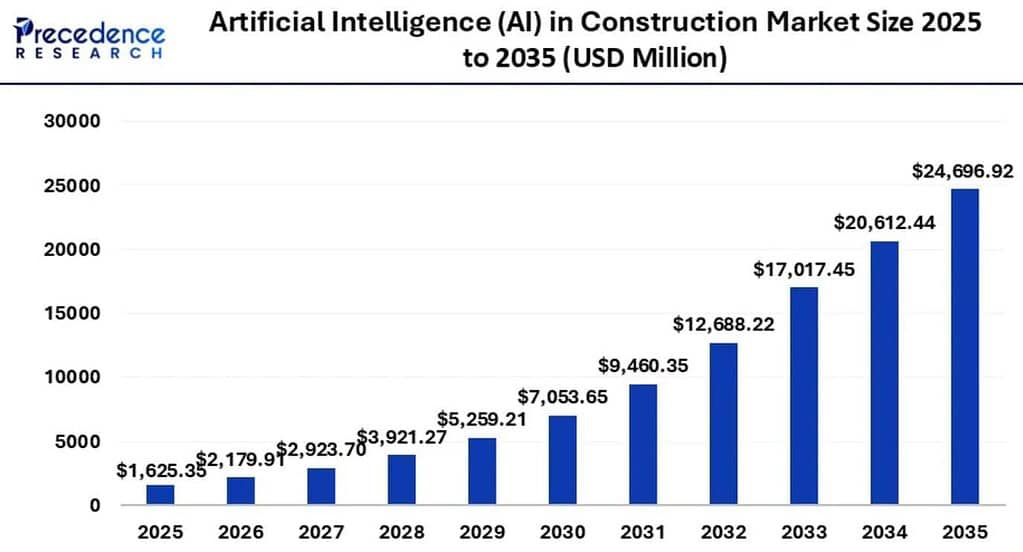
(Source: precedenceresearch.com)
Generative AI in Construction Market Share
- The global Generative AI market grew to USD 191.7 million in 2024 and further increased to USD 258.8 million in 2025.
- By 2026, the market reached USD 349.4 million, followed by USD 471.7 million in 2027 and USD 636.7 million in 2028.
- By 2033, the market is expected to reach USD 2,855.1 million, growing at a strong yearly rate of 35%, known as CAGR.
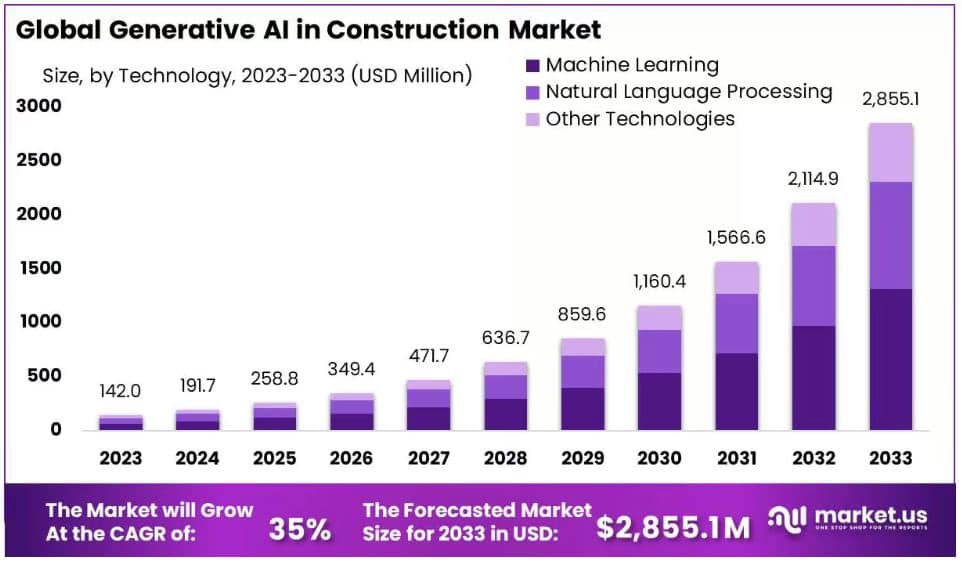
(Source: market.us)
AI Adoption in Construction
- AI is becoming more popular in the construction industry. According to McKinsey, AI can boost productivity by up to 20%, cut costs by up to 15%, and speed up project delivery by up to 30%.
- McKinsey explains that AI-based project management tools help teams spot risks early and use resources more wisely, leading to better efficiency and cost savings.
- The World Economic Forum also shares similar findings. They estimate that using AI can lower project costs by 20% and reduce project time by 15%.
- AI and machine learning are among the fastest-growing technologies in construction today.
- According to the State of Digital Adoption in the Construction Industry report, 37% of businesses are now using AI.
- This is a big jump from 2023, when only 26% of businesses reported using this technology.
- The RICS 2025 AI in Construction Survey gathered responses from more than 2,200 construction professionals worldwide, providing a clear view of current AI adoption across the industry.
- Around 45% of construction organizations have not implemented AI at all.
- About 34% of organizations are still testing AI through early pilot projects.
- Under 12% of organizations regularly use AI for specific business processes.
- Only 1.5% use AI across several processes.
- Less than 1% have adopted AI throughout their entire organization.
- According to Dodge Construction Network, 87% of contractors believe AI will have a meaningful impact on the construction industry.
- However, only 19% have changed their workflows to include AI, showing a wide gap between expectations and actual implementation.
- The Associated General Contractors of America’s annual survey found that 61% of construction companies currently use AI or plan to increase their AI investments.
Architecture, Engineering, and Construction Industry Statistics
- The global construction output was valued at around USD 15 trillion in 2025.
- Demand for construction is projected to grow further, potentially reaching USD 22 trillion by 2040.
- Despite this growth in demand, labor productivity in construction has remained mostly stagnant over the years.
- Between 2000 and 2022, construction productivity improved by only 10%, which works out to a small annual growth rate of 0.4%.
- In comparison, the manufacturing industry saw a much larger productivity improvement of 90% during the same period, growing at a strong annual rate of 3.0%.
- If this slow growth trend continues, construction output could fall short of actual demand by as much as USD 40 trillion cumulatively by 2040.
Construction Functions Using AI
- Around 45% of construction companies use AI for office and administrative tasks, making this the most common area of deployment.
- About 23% use AI for estimating, including activities related to project costs, materials, and labor requirements.
- Around 20% use AI for design and preconstruction activities.
- Approximately 16% use AI for human resources activities.
| Construction function | Companies using AI |
| Office and administrative tasks | 45% |
| Estimating | 23% |
| Design and preconstruction | 20% |
| Human resources | 16% |
AI’s Investment in Construction
- The AGC’s 2025 Outlook found that 44% of construction companies planned to increase their AI investments in 2025.
- AI was the highest-ranked technology investment category in the 2025 outlook, showing that construction companies were giving it greater strategic attention.
- The RICS Q2 2025 Construction Report found that only 15% of construction organizations were actively using AI.
- Around 45% of construction organizations were still exploring AI rather than using it as part of their regular operations.
- Another 29% had no AI capabilities or adoption plans.
Construction Jobsite Safety Statistics
Government Safety Data
- The US Bureau of Labor Statistics (BLS) reported 1,034 fatal workplace injuries in the private construction industry in 2024.
- This was a 3.8% decrease from the 1,075 fatal workplace injuries recorded in 2023.
- The BLS Census of Fatal Occupational Injuries (CFOI) separately reported 1,032 deaths among workers in construction and extraction occupations in 2024.
Fatal Falls
- Construction and extraction workers recorded 370 fatal falls, slips, and trips in 2024.
- Fatalities caused by falls, slips, and trips decreased by 7.5% during the year.
- The Occupational Safety and Health Administration (OSHA) reported 389 fatal falls to a lower level out of 1,034 construction deaths in 2024.
- OSHA also reported that its fall-emphasis program reduced fatal falls by 20%, lowering the number from 234 to 189.
- During the same program period, states operating their own OSHA-approved safety programs recorded a 15% reduction in fatal falls.
Nonfatal Incidents
- The BLS reported 30.0 nonfatal fall, slip, and trip cases per 10,000 full-time equivalent workers in the construction industry.
- These cases required workers to take at least 1 day away from work.
- By comparison, the average across all private industries was 22.6 cases per 10,000 full-time equivalent workers.
Civil Construction Rates
- In 2024, heavy and civil engineering construction recorded a total recordable case rate of 1.8 cases per 100 full-time equivalent workers.
- Highway, street, and bridge construction recorded a higher total recordable case rate of 2.5 cases per 100 full-time equivalent workers.
- Specialty trade contractors recorded a total recordable case rate of 2.3 cases per 100 full-time equivalent workers.
Recent AI in Construction Developments
- On July 22, 2026, Arrakis emerged from stealth with a USD 30 million Series A after raising USD 7.5 million in seed funding, bringing its total funding to around USD 37.5 million for deploying AI agents across construction and other industrial sectors.
- On July 21, 2026, Gritt launched with USD 32.4 million in pre-seed and Series A funding to develop AI-powered robotic systems for large construction sites; the total included a USD 26 million Series A led by Obvious Ventures.
- On July 14, 2026, construction robotics company TerraFirma announced approximately USD 115 million in total funding, including a USD 100 million Series A led by Kleiner Perkins to expand its semi-autonomous heavy-equipment technology.
- On June 17, 2026, construction materials procurement platform SubBase raised USD 7 million in a Series A round led by FINTOP to expand its technology and services for contractors.
- On May 12, 2026, Nemetschek Group India and New Consolidated Construction Company Ltd. signed a 3-year partnership to use BIM and digital construction tools in projects across data centers, healthcare, residential, commercial, and hospitality developments.
- On February 26, 2026, AI-supported jobsite monitoring company Sensera Systems raised USD 27 million in Series B funding, led by 10 Atlantic Group with additional investment from Egis Capital Partners and MUUS Asset Management.
- On February 18, 2026, construction-site intelligence platform FYLD announced a USD 41 million Series B led by Energy Impact Partners to expand its AI-supported reality-capture and field-management technology.
- On February 4, 2026, Bedrock Robotics raised USD 270 million in Series B funding, bringing its total funding above USD 350 million and its valuation to USD 1.75 billion for autonomous construction equipment technology.
- On January 20, 2026, AI-based construction estimating company XBuild raised USD 19 million in a Series A round led by N47, with participation from Rackhouse Ventures and Andreessen Horowitz.
Ending Statement
AI is becoming an important tool for construction, with the market expected to grow from USD 1,211.90 million in 2025 to USD 24,696.92 million by 2035. Companies are investing more in AI, especially for office work, estimating, design, and preconstruction. However, adoption remains uneven: many firms are still exploring or testing AI, while only a small share uses it across their organizations.
To gain measurable value, companies need practical use cases, reliable project data, skilled teams, and stronger integration into daily workflows.
FAQ
61% of firms in the 2026 AGC/Sage survey said they are already using AI or plan to increase investment in it, up from 44% a year earlier. Still, KPMG’s global survey found only 24% report AI adopted at true scale.
The construction industry loses USD 31 billion annually to rework caused by miscommunication and bad project data, according to FMI. AI-based document review and scope tools are aimed directly at reducing this cost.
AI tools have cut scope package development time from 30-40 hours down to under 60 minutes in some cases. Risk identification accuracy on pre-built checklists has also reached 99.5%.
Not widely. Only 16% of contractors currently use AI or automation for scheduling, and 60% report no plans to adopt it at all, according to ConstructionOwners.com survey data.