








Introduction
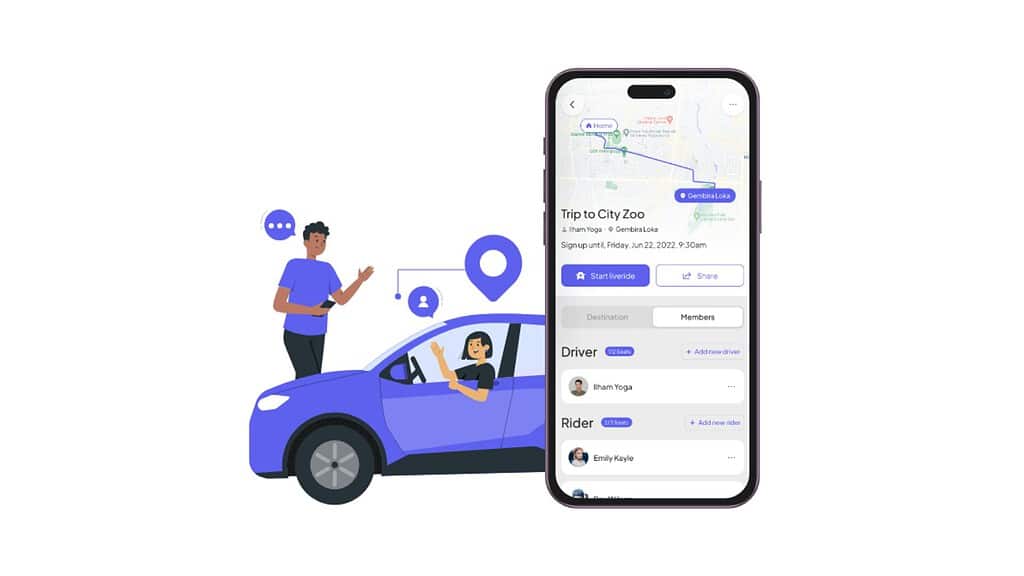
Carpooling Apps Statistics: Carpooling apps help drivers and passengers who are going the same way share one car and split the cost. These apps use maps, route matching, and online payments to fill empty car seats. People use them for daily trips to work, travel between cities, and company travel plans that aim to save money and cut pollution.
Carpooling can also help the climate. The Council on Energy, Environment and Water, an independent research institute, estimates that carpooling alone could cut G20 passenger transport emissions by up to 20% a year by 2050. Most of these savings would come from developed countries and China, where more people own cars. Carpooling apps can therefore help make road travel cheaper, more efficient and less polluting.
Must Reads in the Editor’s Eye
- The carpooling apps market is projected at USD 15.0 billion in 2026, reaching USD 34.2 billion by 2034.
- BlaBlaCar recorded 12.14 million passenger journeys in India during January–June 2026, up 42% year on year.
- BlaBlaCar’s 2025 results showed 150 million passengers across 21 countries and 4 million tonnes of avoided emissions.
- Karos acquired Daily on October 1, 2026, combining 275,000 active carpoolers and over 11 million annual rides.
- Jojob’s corporate network covers 2,790 sites and 182,265 employees; H1 2026 schemes saved about 686.6 tonnes of CO₂.
- Liftshare’s 2026 survey found 39% of 3,763 members would consider carpooling instead of their current commute.
- Poparide reported 2 million members, 58,921,975 shared kilometres, and 19,900 tonnes of avoided CO₂ in 2025.
- Carpoolio Full Send costs USD 34.99 annually (USD 2.92 monthly), advertising 58% savings versus monthly billing.
- A 2026 AI carpooling model cut modelled morning vehicles by 21.45%, equal to 38,436 cars, using 2016 data.
Carpooling Apps Usage Statistics
- BlaBlaCar recorded 12.14 million passenger journeys in India in January–June 2026, increasing 42% year-on-year.
- In Spain, BlaBlaCar served over 1.2 million carpooling passengers during July–September 2026, growing 7% year-on-year.
- In summer 2026, Spain drivers brought 42,000+ new BlaBlaCar drivers, up 8%; September ride supplies increased 27%.
Carpooling Apps Downloads Insights
- BlaBlaCar lists 100 million+ downloads; its latest listed update was October 30, 2026.
- Quick Ride lists 5 million+ downloads; its latest listed update was October 22, 2026.
- sRide lists 1 million+ downloads; its latest listed update was October 28, 2026.
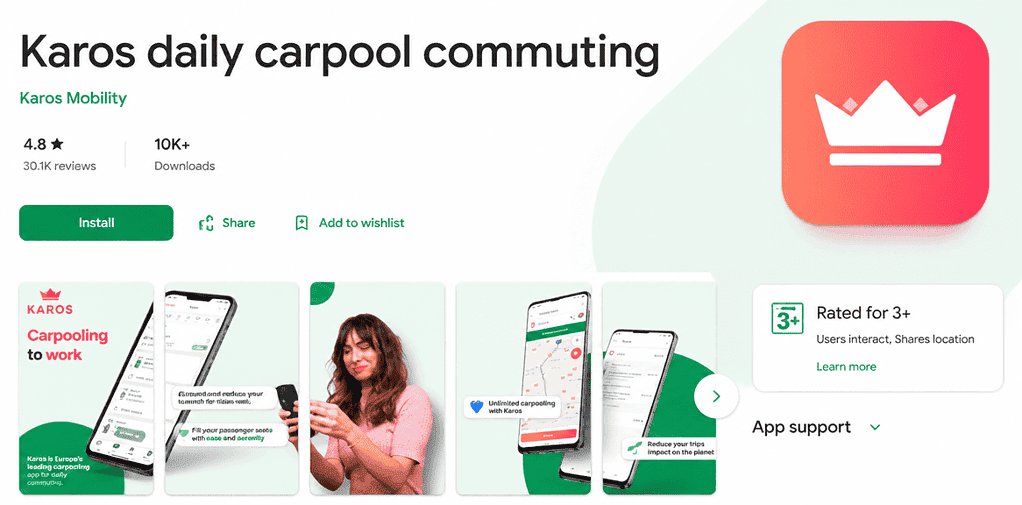
- Karos lists 1 million+ downloads; its latest listed update was September 11, 2026.
- Daily, formerly BlaBlaCar Daily, lists 1 million+ downloads; its latest listed update was September 28, 2026.
- Poparide lists 500,000+ downloads; its latest listed update was October 16, 2026.
- Kangaride lists 100,000+ downloads; its latest listed update was August 18, 2026.
Carpooling Apps by Trip Distance
- Karos supports short- and medium-distance trips of 2–80 km, according to its listing valid through 2026.
- BlaBlaCar Daily’s February 2026 company listing defines its commuter focus as trips under 80 km.
- As of November 2026, Nabogo’s Danish subsidies cover the first 5–10 km, depending on the funded area.
- Covoit IDFM’s 2026 driver subsidy increases with distance between 20–30 km; eligible subscribers receive two free daily rides.
- Tadao’s November 2026 BlaBlaCar Daily programme offers passengers free travel covering up to 80 km daily.
- BlaBlaCar Daily trips in Cœur du Jura averaged 28 km across the programme’s September 2024–June 2026 reporting period.
- A local Karos programme recorded 1,760 trips averaging 30 km between October 2025 and January 2026.
- BlaBlaCar reported increasing demand for 50–100 km journeys in October 2026, indicating growing use for shorter intercity trips.
- BlaBlaCar’s Spanish carpool journeys averaged 240 km during July–September 2026.
Corporate Carpooling Program Statistics
| Programme | Reporting period | Numeric data |
| Jojob corporate network | 2026 census | 2,790 sites, 182,265 employees, covering 20 Italian regions. |
| Jojob network growth | 2026 versus 2025 | Sites increased 3.4%, employees 5.1%, and single-organization schemes 32.9%. |
| Jojob shared journeys | January–June 2026 | Corporate carpooling schemes generated 387,151 shared journeys. |
| Jojob environmental impact | January–June 2026 | Over 5.28 million vehicle-kilometres avoided and an estimated 686.6 tonnes of direct CO₂ emissions saved. |
| Birlasoft–sRide activity | FY2025–26; published June 2026 | Top 12 employees completed 2,593 rides, covering 84,269 km. |
| Birlasoft–sRide environmental impact | FY2025–26; published June 2026 | Top 12 employees reportedly saved 16,853 kg CO₂, equivalent to 803 trees under sRide’s methodology. |
| Raheja Mindspace–sRide leaderboard | Published July 2026; measurement period unspecified | 12,788 rides, 135,244 shared kilometres, and 27,048 kg CO₂ savings reported. |
| ParkCash corporate deployment | Launched February 2026; reporting endpoint unspecified | 1,559 total journeys, including 450 journeys with passengers. |
| ParkCash incentive programme | Launched February 2026; reporting endpoint unspecified | 323 rewarded journeys and 560 rewards granted through workplace parking-linked incentives. |
| Karos–Daily corporate network | October 2026 acquisition announcement | Combined network included 1,500 corporate partners following the acquisition, effective 1 October 2026. |
Carpooling Apps Driver and Passenger Stats
- Poparide reported over 2 million members in September 2026; this represents cumulative membership, not annual passengers.
- Karos and Daily’s October 2026 announcement reported over 11 million shared rides annually, rather than completed full-year 2026 journeys.
- Covoit IDFM reported 380,000 cumulative passenger trips by February 2026, following its December 2025 launch.
- Liftshare’s 2026 census found carpooling represented 21% of employer-community commutes, versus 12% among public-community respondents.
- Liftshare’s 2026 survey of 3,763 members found 39% would consider carpooling instead of their current commute.
- Liftshare’s 2026 survey found 51% said finding someone sharing their route would encourage them to carpool.
Carpooling Apps Subscription Prices Statistics
| App / plan | Monthly price | Annual price | Free trial, savings, and conditions |
| Carpool-Q | USD 1.99 per household | Not listed | 14-day free trial. |
| GoKid Pro | USD 4.99 | USD 49.99 | US iOS pricing. |
| Carpool Kids Pro Individual | USD 2.99 | USD 14.99 | US iOS pricing. |
| Carpool Kids Pro Family | USD 4.99 | USD 24.99 | US iOS pricing. |
| Carpoolio Full Send | USD 6.99 | USD 34.99 | Annual equivalent: USD 2.92 monthly; advertised savings: 58%. |
| RideCircles Premium, monthly | USD 7.99 | USD 95.88 for 12 monthly payments | 3-month free trial offer ends December 31, 2026. |
| RideCircles Premium, annual | Not billed monthly | USD 69.99 | Advertised savings: 27% versus monthly billing. |
| Carpool.School Verified Community | Not listed | USD 400 per organization | First 30 days free; families pay USD 0. |
| Poparide, US | – | – | Passenger booking fee approximately 20%; driver payout fee 3.15%, separate from subscriptions. |
AI’s Impact in Carpooling Apps
- A 2026 study, using 2016 data, modelled AI carpooling reducing morning vehicles by 21.45%, equivalent to 38,436 cars.
- The 2026 commuter-pool study modelled aggregate vehicle-hour reductions of 5.17% in the mornings and 6% in the evenings, although individual journeys could lengthen.
- The 2026 commuter-pool study achieved a 29.4% matching rate with 2,000 commuters during AI matching sensitivity experiments.
- 2026 DualG-MARL simulations reduced Manhattan/Queens waiting times by 0.27/0.35 minutes and detour ratios by 0.05/0.06 versus CoopRide.
- 2026 DualG-MARL simulations improved Manhattan/Queens vehicle utilization by 3.5/3.9 percentage points and response rates by 2.3/2.7 points versus CoopRide.
Top Carpooling Apps
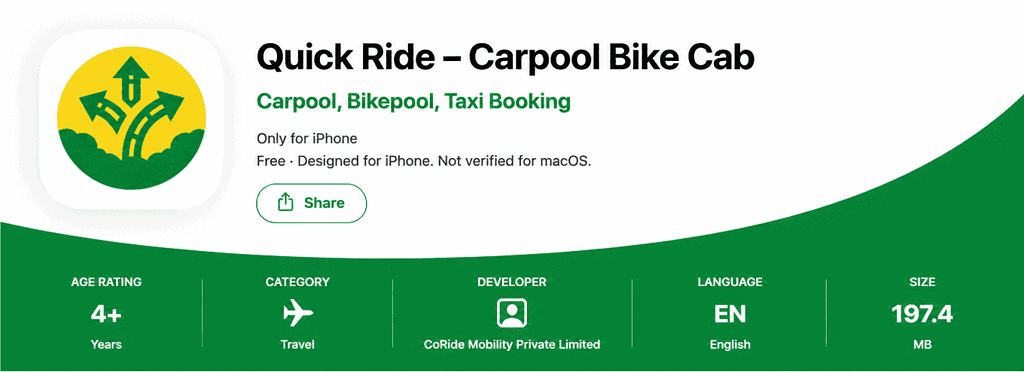
- Quick Ride lists 9 Indian metropolitan areas, offering recurring carpools, live tracking, and profile verification.
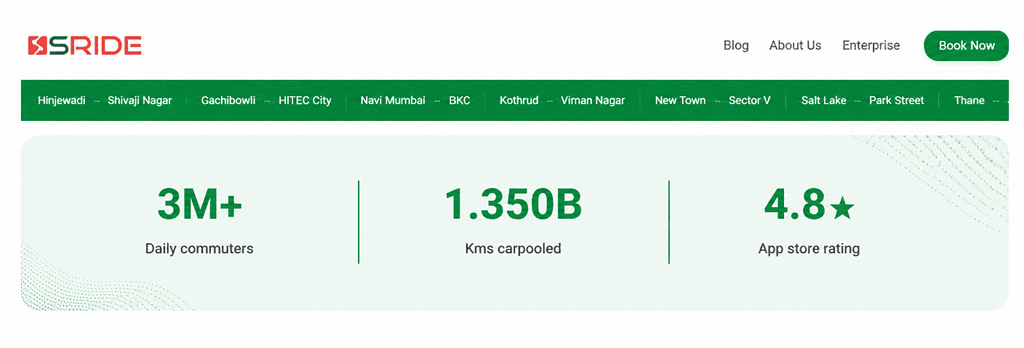
- sRide reports 3 million+ commuters across 8 Indian cities, offering workplace verification, route matching, and automatic payment splitting.
- Karos reports 1.6 million users, 18.5 million cumulative carpools, operations across 6 countries, and 600 company partners.
- Scoop offers US workplace carpools without subscriptions; typical driver reimbursements range from USD 2–9 per passenger per trip.
- Liftshare, accessible through Mobilityways, reported 750,000 public-network members in April 2026; joining is free.
- Mobicoop Covoit’ offers everyday carpooling with 0% commission, no advertising, and no hidden platform fees.
- Hitch advertises intercity rides from USD 15 per seat and reports over 1 million seats sold.
Carpooling Apps Market Statistics
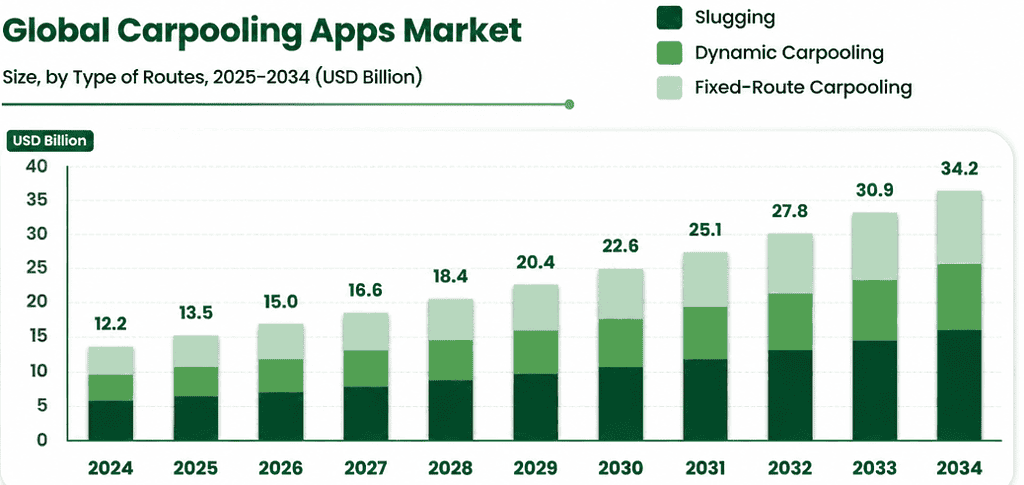
- The global carpooling apps market is projected to reach USD 13.5 billion in 2025 and USD 15.0 billion in 2026.
- The market is forecast to reach USD 30.9 billion in 2033 and USD 34.2 billion in 2034.
- The forecast indicates a compound annual growth rate of 10.9% during 2025–2034.
- The market covers slugging, dynamic carpooling, and fixed-route carpooling, although individual segment values are not provided.
Recent Carpooling Apps Development
- On October 1, 2026, Karos acquired Daily, combining 275,000 active carpoolers, over 11 million annual rides, 250-plus authorities, 1,500 corporate partners, and 140 employees.
- On August 18, 2026, WAIIS announced its 3rd funding round, approximately USD 1.16 million at ECB rates, targeting over 100,000 active users in 2026.
- On June 30, 2026, BlaBlaCar announced 20 new markets, reaching 41 countries, after adding over 800,000 drivers between March and June.
- BlaBlaCar’s June 2026 report disclosed 2025 group results: 150 million passengers across 21 countries, 10% annual growth, and 4 million tonnes of avoided emissions.
- A February 2026 government update introduced Covoit IDFM, offering eligible adult Navigo subscribers 2 free daily rides, following 3 lines launched in 2025.
- In 2026, Poparide reported 2025 milestones: over 2 million members, 58,921,975 shared kilometres, 747 connected communities, and 19,900 tonnes of avoided CO2.
- BlaBlaCar’s September 2025 announcement ranked India first, reporting 2 million August passengers, 95% mobile bookings, and 70% of users aged 18–34.
- In May 2025, BlaBlaCar added French rail bookings covering 350 stations across 200 cities, alongside 270 bus destinations and 843,000 carpooling meeting points.
Ending
Carpooling apps are growing as drivers and passengers look to cut costs and emissions, with BlaBlaCar expanding across countries and European players consolidating through deals such as Karos and Daily. Corporate programs and public subsidies are widening access to commuter carpooling, while AI matching shows promising simulated gains.
Even so, most figures reflect cumulative or program-level activity, and pricing and fees vary widely. Apps that combine reliable matching, clear costs, and trusted verification are best placed to scale.
FAQ
Carpooling means sharing a private vehicle with others who are already traveling in the same direction, with costs split among them. Ridesharing usually refers to on-demand services where a driver is hired to take a passenger somewhere, as with ride-hailing apps. Carpooling is cost-sharing, while ridesharing is closer to a paid transport service.
Carpooling is legal in most places, but rules differ by country and state. Drivers are generally allowed to share fuel, toll, and vehicle costs without running a taxi business, but charging more than actual trip costs can classify the activity as commercial transport, which may require licenses and different insurance.
Standard personal policies often cover passengers when costs are simply shared, but coverage can change if the driver is paid beyond expenses. Some apps provide additional insurance for trips booked through their platform. Drivers should confirm the terms with their insurer, and riders should check what the app itself covers.
Matching algorithms compare routes, departure times, pickup and drop-off points, and user preferences such as the number of seats or travel schedule. Many apps also factor in detour distance, ratings, and verification status so that matches are convenient and trustworthy for both sides.
Yes. Many organizations run carpooling programs for employees or students to reduce parking demand, commuting costs, and emissions. Business-focused platforms often limit matching to verified colleagues, offer incentives or rewards, and provide reporting on participation and environmental impact.
A strong carpooling app combines accurate route matching, in-app payments, user verification, ratings and reviews, live trip tracking, and in-app messaging. Safety tools such as emergency contacts and trip sharing, along with reliable notifications and an easy-to-use design, help build trust and keep users returning.