









Introduction
Newsletter Statistics: Newsletters keep on being popular with their readers and attract subscription revenues but audience growth does not always bring audience attention. In August 2026, 34% of US adults said that they receive news from email newsletters; in 2025, beehiiv says that it obtained USD 19 million in publisher subscription revenues in 2025. While social media and short films have become more widespread, they offer a different form of communication: the direct access to the audience while having better distribution control and allowing building long-term relations.
The growing email adoption is making it easier to build newsletter scenes through the use of AI technologies and the participation of different creators. The statistics about newsletters celebrate the evolution of the whole market with key insights into the monetization practices.
Featured Selection
- The worldwide number of email users was 4.73 billion in 2026.
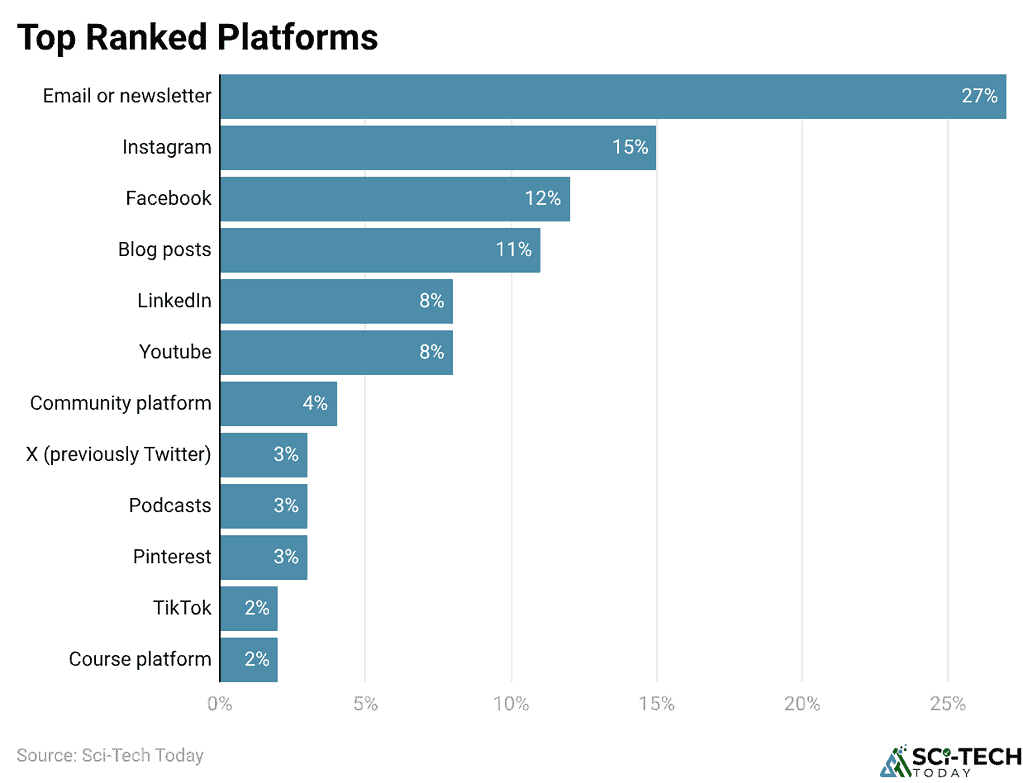
- Email and newsletters became the most preferred content delivery option by creators, with 27% intending to use it in 2025.
- Newsletters proved to be the most common content format, with 58% of all creators producing it.
- According to beehiiv, USD 19 million of publisher subscription revenue was achieved in 2025.
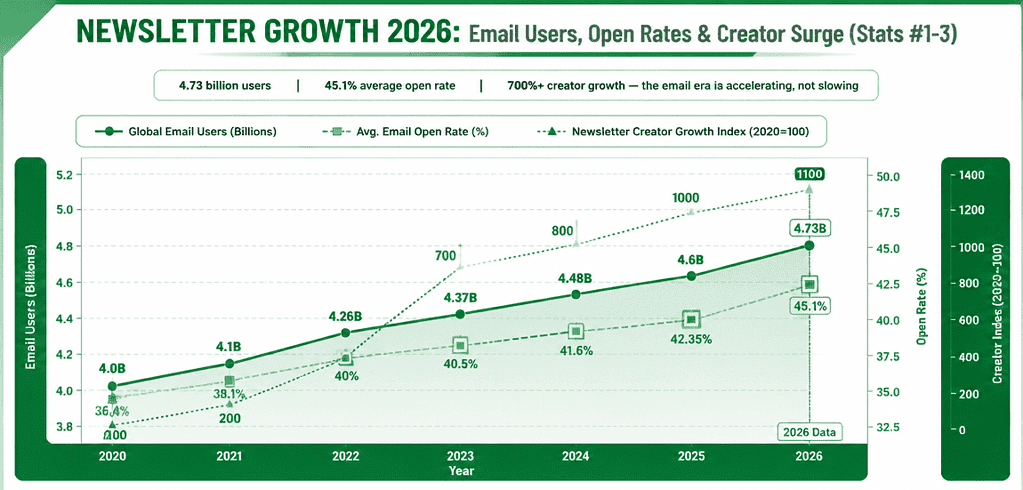
- According to Mailchimp’s statistics, the average open rate of newsletters rose from 36.5% in 2020 to 45.1% in 2026.
- According to a study by Pew Research, a majority (62%) of newsletter recipients do not read most of the newsletters they receive.
- The average value for the subscriber cancellation rate is 0.22% for every email sent, indicating the importance of subscriber retention.
- MailerLite benchmarks show that the open rates of religion newsletters are the highest at 55.71% and that the legal newsletters lead in the click rate at 4.90%.
- Manufacturing newsletters have the largest click-to-open ratio of 14.82% compared to other industries listed.
- 87% of emails are automated, which demonstrates the growing influence of AI and automation in email marketing.
Top Ranked Platforms
- Email newsletters have an edge when it comes to audience building, independence, and even making more money for creators.
- Other mediums such as Instagram, Facebook, and others did not compete well with newsletters when it comes to audience ownership, a top concern of most creators.
- According to the creator survey, email newsletters come out on top at 27%, followed by Instagram (15%), Facebook (12%), blogging (11%), LinkedIn (8%), YouTube (8%), community platforms (4%), Pinterest, X, and podcasts all at 3%, and others.
- In terms of audience content, newsletters led at 58%, followed by educational articles (51%) and courses (30%).
- Creators believe newsletters help build greater audience ownership. It’s also better for monetization. It can help create greater engagement as it offers higher open rates (45%) against the 10% on social media.
- In the same survey, 27% of creators ranked newsletters as their strongest audience engagement channel while 11% chose to focus their engagement efforts on emails in 2024.
- These survey results clearly demonstrate the shift from prioritizing reach on social media to a greater focus on more sustainable engagement methods.
Newsletter Growth Statistics 2026: Global Email Users, Creator Economy, and Engagement Trends
- Building a newsletter involves much more than gathering newsletter subscribers. A subscriber’s active engagement and appreciation of the value of a newsletter’s content is what counts.
- A February 2026 study conducted by the Pew Research Center indicates that approximately 62% of recipients end up not reading most newsletters that they receive.
- Based on Pew Research Center research, a list with 100,000 subscribers may in reality end up having an active audience that is much smaller than 100,000, and it may be more meaningful to count active subscribers rather than just subscribers.
- One metric to assess the health of newsletters is the unsubscribe rate. Based on data from Mailchimp, Campaign Monitor, and MailerLite, the average unsubscribe rate per newsletter send is 0.22%.
- Unsubscribe rates less than 0.2% are considered to be excellent, and less than 0.25% are reasonable.
- If the unsubscribe rate is above 0.5%, it may be an indication of newsletter content that is either not relevant to the recipient, is not well-targeted, or newsletter lists that have been built too aggressively.
- With email lists where permission is obtained to send email, total bounce rates should be less than 2%. It is preferable to keep hard bounces between 0.3% and 0.5% and to keep soft bounces between 1% and 1.5%.
- Data collected by Mailchimp shows the combined average of hard bounces is around 0.21%, and the soft bounce average is 0.70%, giving a combined bounce rate of around 0.9%.
- Cold outreach emails tend to experience bounce rates between 7% and 8%.
- Maintenance of an email list is very important because the email addresses in a list will eventually become outdated. Lists can decay by about 2-3% every month if they aren’t properly maintained.
- A goal that active newsletter editors should strive for is 1-5% net growth in subscribers each month, though this goal should not be considered an industry standard as it hasn’t been properly researched.
- The statistics presented by Mailchimp suggest that the average open rate for 2025 is estimated to be 42.35% and for 2026, 45.1%.
- As can be seen in the graph, open rates have risen from 36.5% in 2020 to 45.1% in 2026.
- The findings state that personalized subject lines and preview text have enabled emails to have as high as a 58.3% open rate, which is 37% higher than the average open rate in corporate branding.
- The above statistics show a significant increase in the popularity of newsletters, due to the expansion of the audience range, ability to monetize the authors, and personalization of the content.
- Nevertheless, drawing a conclusion based solely on open rates can be hard, since privacy regulations are impacting the way they are calculated.
Newsletter List Health Statistics: Unsubscribe Rates, Bounce Rates, and Subscriber Growth
- Success with a newsletter is not as simple as having more subscribers. Rather, the measure of a newsletter’s success is the extent to which it is valued and used.
- Pew Research reported that 62% of people do not read their newsletters; with that metric in mind, it is possible for a newsletter to have 100,000 subscribers and still have very little active engagement, let alone interest.
- The total number of newsletter subscribers does not reflect active newsletter interest, as much as active newsletter interest would show value.
- One way of checking the value and engagement of your newsletters is through measuring your bounce and unsubscribe rates.
- According to various newsletter vendors like Mailchimp, Campaign Monitor, and MailerLite, the average newsletter has a 0.22% unsubscribe rate.
- Newsletter rates between 0.2% and 0.25% are good, but anything greater than 0.5% would mean that the newsletter was poorly sent and/or poorly constructed.
- A newsletter’s overall bounce rate should stay under 2%, and specifically, the hard bounce rate should be between 0.3 and 0.5%, and the soft bounce rate should be less than 1.5%.
- Data shows hard bounce rates average at 0.21% and soft bounce rates average at 0.70%. This makes a newsletter’s overall bounce rate roughly 0.9%. Cold outreach emails have a bounce rate between 7% and 8%.
- An industry-estimated bounce rate for emails is between 2% and 3% each month, while the suggested rate of newsletter growth is between 1% and 5% net monthly, and this is an industry standard based on surveys that have yet to be backed by hard science.
- A growing subscriber list doesn’t do much when subscribers tend to ignore the newsletters.
- Marketers must focus on things like how engaged the readers are, how clean the mailing list is, and how relevant the content is rather than solely increasing the number of subscribers.
Newsletter Engagement Metrics and Industry Benchmarks 2026
- Open rates can be a good measure for initial interest, but in 2026 engagement is much deeper than how many subscribers open the newsletter.
- In 2026, engagement will be analyzed by tracking how subscribers interact with content (e.g. opens, clicks, unsubscribes, and conversions).
- The metric of interest to marketers will be click-through rates (CTR), defined by MailerLite as unique clickers to delivered newsletters.
- Another important metric will be the click-to-open rate (CTOR), which Campaign Monitor defines as unique clickers to unique openers.
- In the long run, unsubscribe rates, which track subscribers who opt out, as well as the conversion rate, will be important for a successful marketing newsletter.
- Finally, in an attempt to simplify unsubscribe requirements, Google now enables one-click unsubscribes from Gmail and Yahoo, further stressing the need to retain subscribers.
- There are large variances in open rates across newsletter categories, MailerLite has noted.
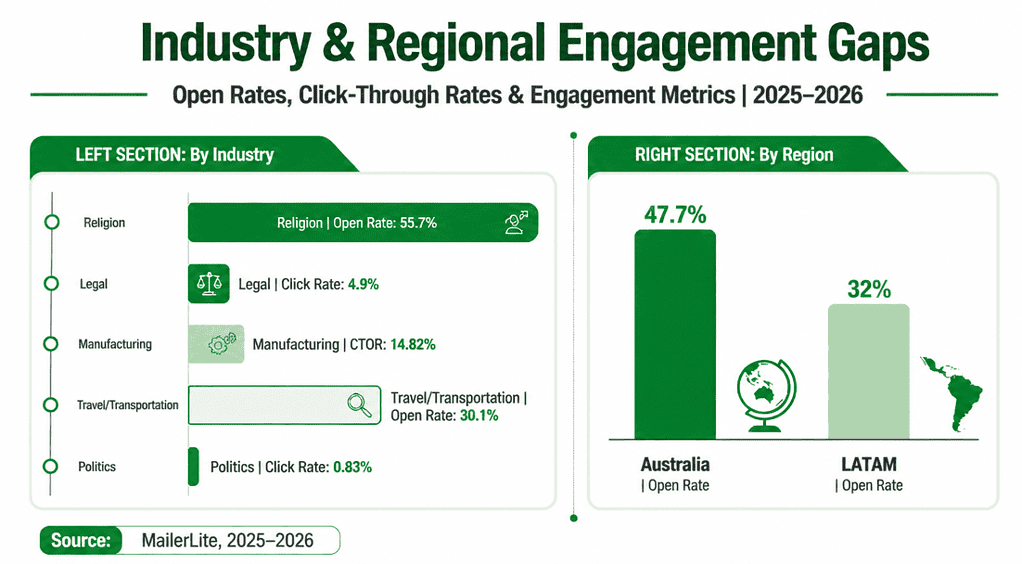
- The religion industry had the highest open rate, 55.71%, followed by manufacturing with 44.24% and legal services with 43.92%.
- For click rates, the highest rate was observed for legal newsletters at 4.90%, followed by manufacturing at 4.16%.
- Religion recorded a click rate of 3.13%, followed by travel and transportation at 1.12%, and politics with the lowest at 0.83%.
- The manufacturing sector achieved a 14.82% CTOR, and this was followed by legal services at 11.16%, and religion at 6.98%.
- Travel and transportation scored a 3.72% CTOR, and politics scored the lowest at 2.96%.
- Marketers should analyze engagement by sector and not on general benchmarks.
- If your newsletters do not get interaction beyond the opens, then they have failed. However, a successful newsletter is able to turn interest into actions, not just views.
Monetization Models: Sponsorships vs. Paid Subscriptions vs. Affiliate Integration
| Monetization scenario | Calculation using explicit assumptions | Illustrative monthly gross revenue |
| Sponsorship priced per thousand opens | 10,000 subscribers × 40% opens ÷ 1,000 × USD 30–65 × four sold placements. | USD 480–1,040. |
| Sponsorship priced per thousand subscribers | 10,000 subscribers ÷ 1,000 × USD 30–65 × four sold placements. | USD 1,200–2,600. |
| Paid subscriptions at 2%–5% conversion | 10,000 initially free subscribers × 2%–5% upgrades × USD 10 monthly. | USD 2,000–5,000. |
| Paid subscriptions at a 0.62% conversion assumption | 10,000 initially free subscribers × 0.62% upgrades × USD 10 monthly. | USD 620. |
| Affiliate sales under independent assumptions | 300 tracked monthly clicks × 3% purchase conversion × USD 100 eligible order value × 20% commission. | USD 180. |
How to Use AI in Email Newsletter Marketing Effectively
- Using artificial intelligence in email marketing provides some benefits, but the ultimate effectiveness depends on how marketing teams use this technology.
- To make newsletter marketing more efficient and effective, marketing teams should avoid the trap of being too reliant on automation, and instead should augment AI with human editorial control and judgment.
- Email newsletters can use AI-generated headlines to quickly A/B test their newsletter content.
- Likewise, AI can learn customer habits and preferences to deliver the right content at the right time. Both applications will lead to increased email open rates and conversions.
- Repetitive newsletter creation tasks are good candidates for automation. These tasks include audience segmentation and email newsletter scheduling.
- When teams automate these newsletter creation processes, they free up more time for more productive marketing endeavours, such as newsletter strategies and newsletter content creation.
- Of course, all marketing materials need to be reviewed, and AI-generated newsletter content is no exception.
- Newsletters need to be on brand, accurate, and on-tone, with the right information.
- Some AI content generation may miss the mark of newsletter marketing.
- The most efficient marketing newsletters strike a good balance of creativity and AI-powered insights.
- Businesses need a newsletter strategy, editorial review, automated newsletter scheduling, and behavioral newsletters for customer newsletter marketing.
- These newsletters will yield more customer engagement, higher email marketing ROI, and fewer newsletter emails.
Future Email Newsletter Trends 2026 and Beyond
- The domain of email marketing is witnessing profound changes as emerging technologies like artificial intelligence (AI), personalization, and automation begin to dictate the way businesses communicate with their audiences.
- Rather than simply focusing on increased email traffic, marketers are investing strategically in creating relevant content that is tailored to suit individual subscribers.
- More than 87% of emails are created with the help of automation or artificial intelligence, while only 13% of emails are created by human agents.
- AI systems are used by marketers to generate email subject lines, write messages, and improve marketing campaigns, but the human touch should still be present to help messages appear natural.
- Hyper personalisation is another important trend in today’s email production that affects the effectiveness of emails.
- Research states that 93% of marketers confirm that their conversion rates increase when emails delivered to their customers are personalized.
- Meanwhile, approximately 80% of customers prefer companies that send them personalized messages.
- More than 90% of marketers would like machines to handle their email promotions by 2026, including repetitive tasks like dividing up lists, scheduling mailings, testing subject lines, and optimizing campaigns. This brings a lot of time savings to the marketing team and allows them to concentrate on quality content and customer relationships.
- These trends create smarter and more effective email marketing. Although machines can speed up processes and help with audience targeting, communication still matters: relevant messages, creativity, and trust are essential for successful newsletters.
Conclusion
According to statistics from 2026, email is still an important way to develop the audience, create content, and earn money. Yet, increasing the number of subscribers does not mean that people will read those newsletters often, since many newsletter recipients do not bother to open them. This leads to the conclusion that performance measures must include engagement, quality of lists, and retention.
The success of the creators and companies lies in the relevant content, audience segmentation, and different monetization methods, including ads and subscriptions. AI and automation help improve efficiency and management of any campaign, but human supervision will always be needed.
Thus, the success of newsletters depends on trust among subscribers and on providing them with good value.
FAQ
According to the given data, there will be 4.73 billion email users in 2026.
According to the creators’ survey, 27% planned to concentrate on email and newsletters in 2025.
According to the benchmark from Mailchimp, the average open rate will be 45.1%.
Pew Research found that 38% read most of the newsletters they receive, while 62% do not.
AI supports subject-line generation, content drafting, personalization, segmentation, scheduling, and campaign optimization.

Sources