








Introduction
SpaceX Statistics (Space Exploration Technologies Corp.): SpaceX, founded by Elon Musk in 2002, has rapidly ascended to a leading position in the global space industry through its emphasis on reusability and high-frequency launches. In 2024, the company achieved a record-breaking 138 orbital launches, accounting for approximately 95% of all U.S. orbital missions that year. This included 132 Falcon 9 and 2 Falcon Heavy missions, alongside 4 Starship test flights
The company’s revenue in 2024 was estimated at USD 13.1 billion, marking a significant increase from USD 8.7 billion in 2023. A substantial portion of this growth is attributed to its Starlink division, which generated an estimated USD 6.5 billion in annual recurring revenue
SpaceX’s commitment to reusability is evident in its operations, with 128 of its 2024 launches utilizing previously flown boosters. The Falcon 9 Block 5 variant, in particular, has demonstrated remarkable reusability, with some boosters achieving up to 23 flights.
Looking ahead, SpaceX aims to further increase its launch cadence, with a target of 180 missions in 2025 . This ambitious goal underscores the company’s ongoing efforts to revolutionize space access and solidify its position as a dominant force in space exploration.
So, let’s dive into more important and key statistics that showcase their achievements.
Editor’s Choice
- SpaceX is an American aerospace company that manufactures spacecraft, launch services, and satellite communications.
- In 2024, SpaceX launched 52 rockets: 51 Falcon 9s, 0 Falcon Heavy, and 1 Starship.
- SpaceX is expected to be in the headlines again by the end of this year for its successful Starship launches.
- SpaceX successfully launched its first Falcon 1 in March 2006, but the mission ended prematurely due to fuel leakage and fire.
- In 2022, SpaceX’s revenue from Starlink and rocket revenue resulted in $3.2 billion.
- SpaceX Statistics also show that in 2019, the company started launching satellites for its Starlink mega constellation, which provides satellite Internet service.
- As of 2023, Starlink includes half of all active satellites in orbit, resulting in 3,660 active satellites.
- A report published by Britannica stated that SpaceX has approximately 29,988 satellites orbiting above the Earth between 340 km and 614 Km (211 to 381 miles).
- The Falcon 9 is the most successful space rocket of SpaceX, holding a success rate of 99%.
- SpaceX is estimated to account for approximately $13.3 billion by 2024.
Space Exploration Technologies Corporation Facts
- This company type of SpaceX is private and was founded by Elon Musk on March 14, 2022, in El Segundo, California, U.S.
- The company is headquartered in Hawthorne, California, United States of America.
- In 2024, SpaceX will complete its 22 years of celebration.
- In SpaceX, almost 38% of employees are between 30 years old to 40 years old.
- In 2023, Starlink-dedicated Falcon 9 missions were around 63, and by 2024, it will be 83.
- SpaceX Statistics also reported 2.3 million Starlink users by 2023 and 3.8 million users by 2024.
You May Also Like To Read
- Mercury Statistics
- Saturn Statistics
- Lunar Exploration Statistics
- Earth Statistics
- Satellite Launch Statistics
- European Space Agency Statistics
- Space Tourism Statistics
- JAXA Statistics
- ISRO Statistics
- International Space Station Statistics
- Mars Statistics
SpaceX Launch Statistics
- SpaceX Statistics further elaborates that SpaceX has made 52 launches, including 51(Falcon 9) and 1 (Starship).
- In 2024, there will be 15 Non-Start missions and 49 reused boosters.
- It is estimated that SpaceX’s launch success rate will be 100%, and the launch rate is 2.72 days (required for 148 launches).
- Furthermore, other launches of SpaceX in 2024 are East Coast: 35 (LC-39A: 11, SLC-40: 24), Gulf Coast: 1 (Starbase), and West Coast: 16 (SLC-4E).
- Meanwhile, the total payload mass (excluding classified and rideshare missions or crew) is 619,672 Kg.
- The total number of SpaceX crew resulted in 8, representing 7 (Governmental) and 1 (Commercial).
SpaceX Landings Statistics
- According to SpaceX Statistics, the total number of landings will be 50 (excluding Starship).
- On the other hand, the landing success rate of SpaceX’s mission will be 100%.
- This year, 12 ground landings and 38 Drone landings have been observed.
- The number of landings is segmented into Ground (LZ-1: 8, LZ-2: 1, LZ-4: 3) and Droneship (OCISLY: 13, JRTI: 10, ASOG: 15).
SpaceX Launch History Statistics By Year
 (Reference: spacexstats.xyz)
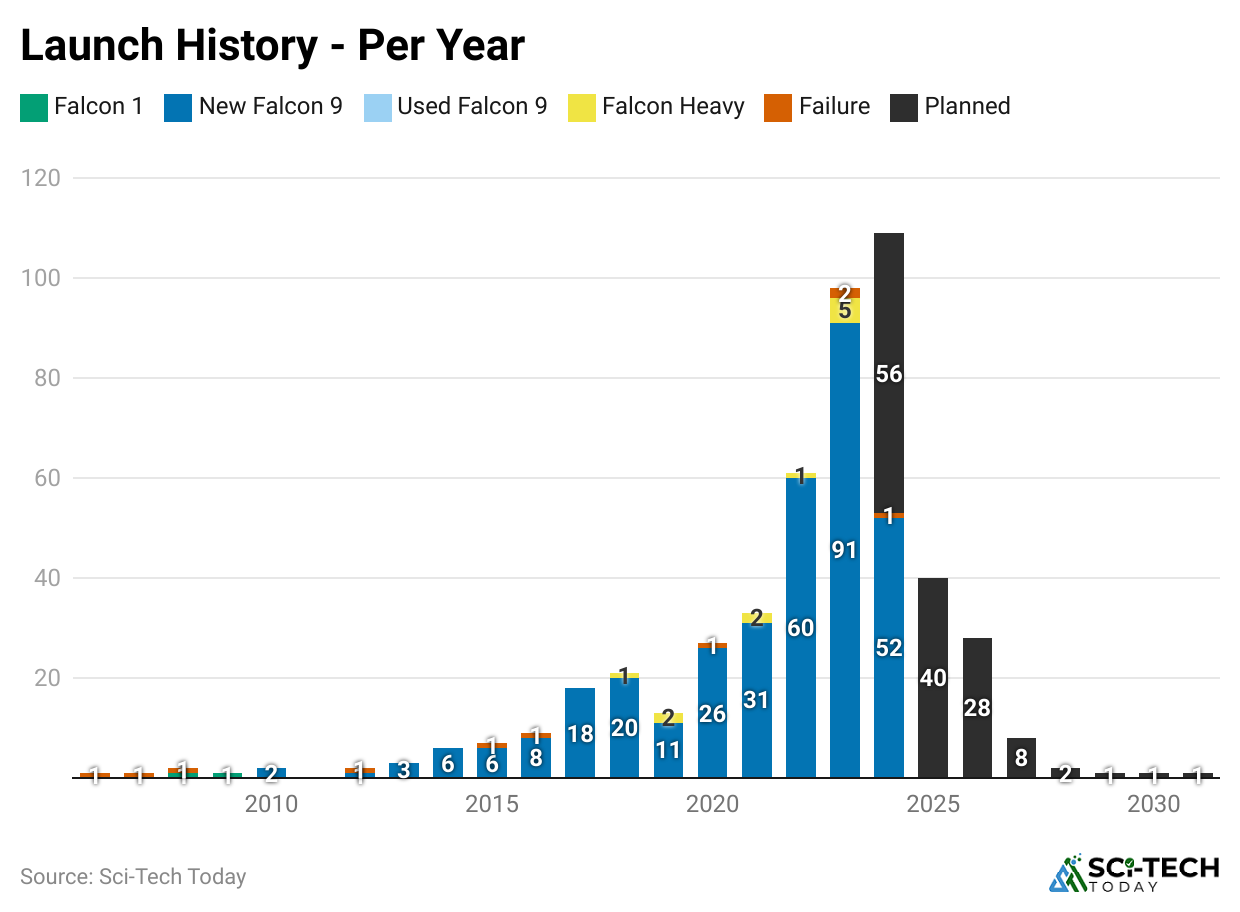
- According to SpaceX Statistics, in 2006 and 2007, there was only 1 launch each year by SpaceX using Falcon 1 that failed.
- In 2028, the number of launches by SpaceX Falcon 1 increased to two, of which 1 launch failed. Moreover, in 2009, SpaceX successfully launched a mission by Falcon 1.
- Based on Falcon 9, SpaceX Launches were in 2010 (Total: 2), 2012 (Total: 2, failure: 1), 2013 (Total: 3), 2014 (Total: 6), 2015 (Total: 7, failure: 1), 2016 (Total: 9, failure: 1), and 2017 (Total: 18).
- On the other hand, SpaceX Statistics elaborates that in 2018, SpaceX launched 20 successful missions by Falcon 9 and 1 mission by Falcon Heavy.
- In 2019, SpaceX by Falcon 9 and Falcon Heavy were 11 and 2, respectively.
- SpaceX other launches of 2020 (by Falcon 9: 27 and failure: 1), 2021 (by Falcon 9: 33 and failure: 2), 2022 (by Falcon 9: 60 and Falcon Heavy: 1), 2023 (Falcon 9: 91, Falcon Heavy: 5 and failure: 2).
- As of 2024, the total number of SpaceX missions will be 108, launched by New Falcon 9, 51, of which only 1 mission failed. The planned missions by the end of 2024 are expected to be 56.
- In the coming year, SpaceX’s total planned missions will be 2025 (40), 2026 (28), 2027 (8), 2028 (2), 2029 (1), 2030 (1), and 2031 (1).
By Rocket
(Reference: spacexstats.xyz)
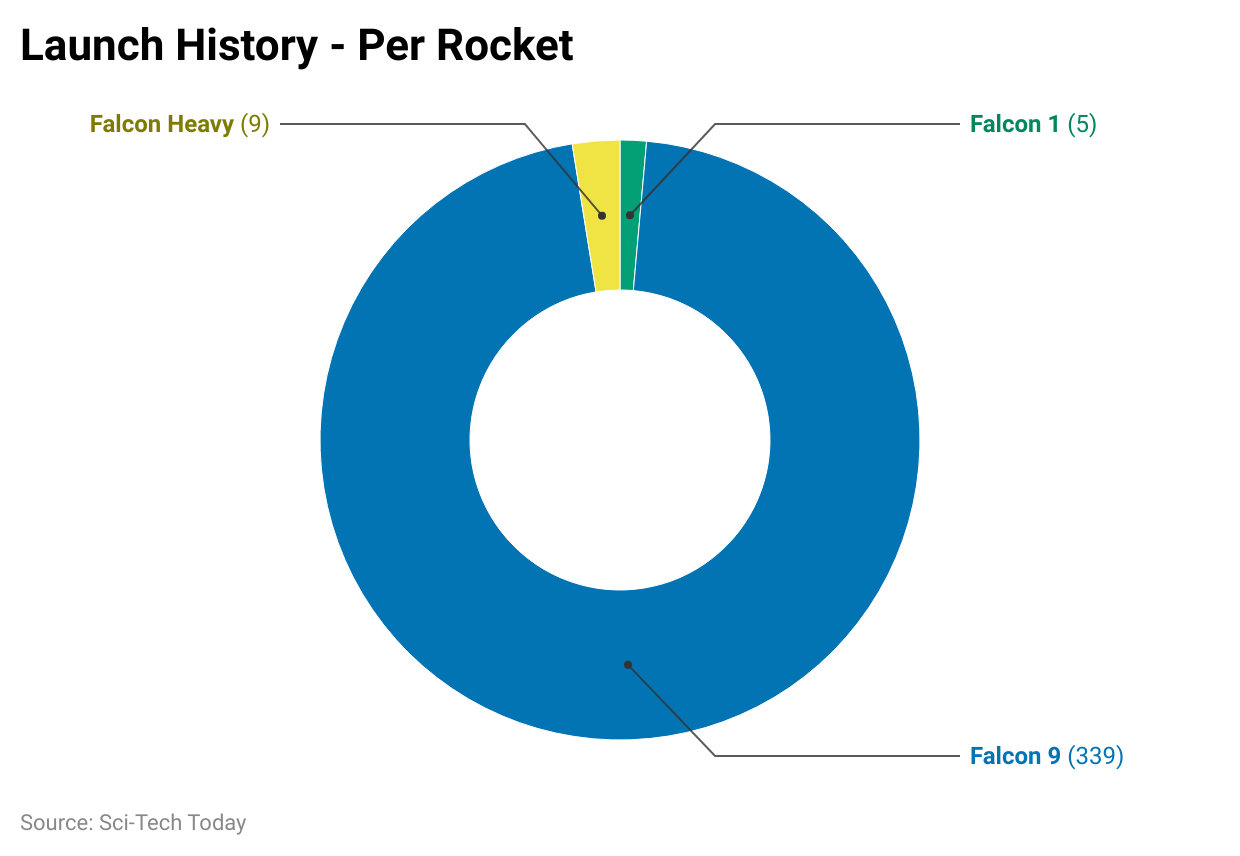
- SpaceX Statistics also mentioned that as of today, SpaceX has launched 364 rockets, including various missions to multiple destinations such as LEO, GTO, L1, and the ISS.
- SpaceX launched only one Falcon 1 rocket and 9 rockets by Falcon Heavy.
- Meanwhile, around Halcon 9 launched 338 rockets were launched
By Per Launchpad
(Reference: spacexstats.xyz)
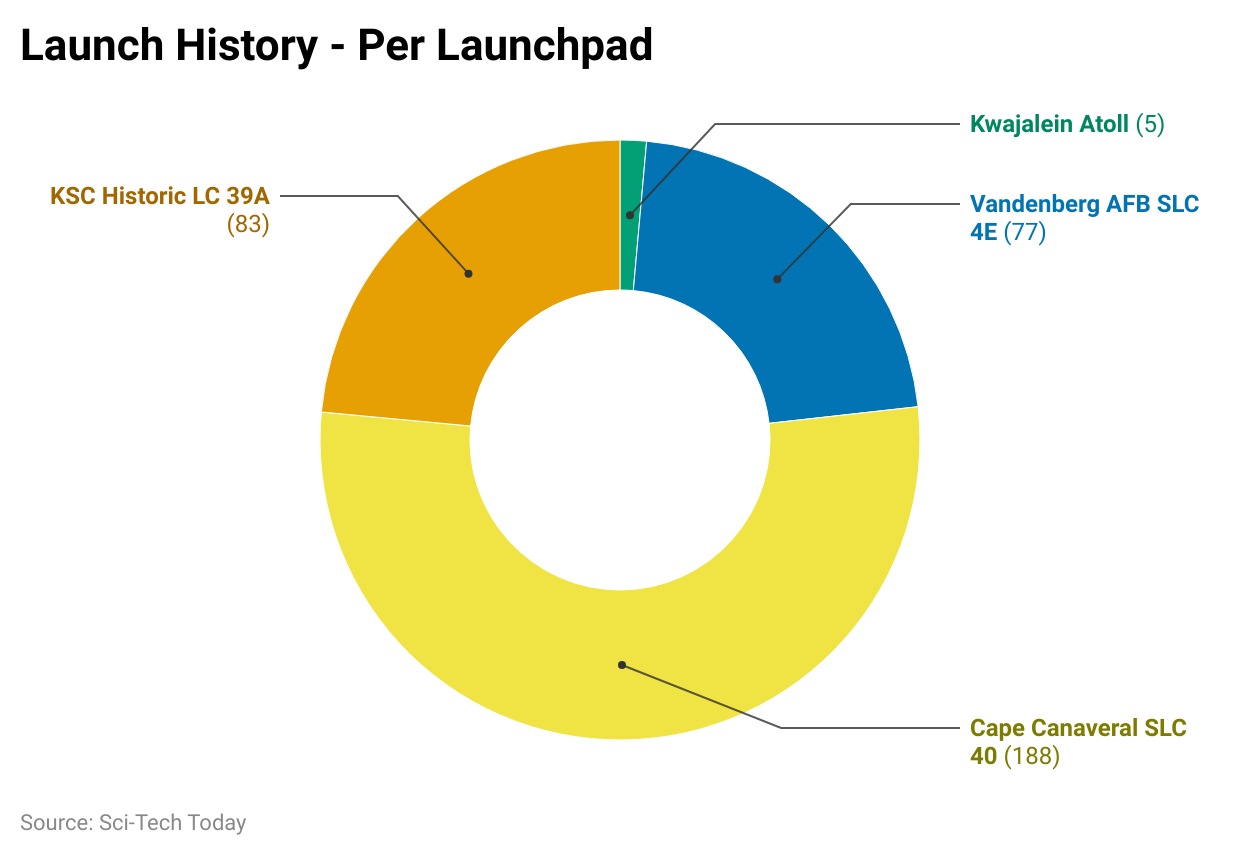
- SpaceX Statistics also show that SpaceX’s first launch site is Omelek Island in Kwajalein Atoll, where the company has launched five missions to date.
- The most popular launchpad of SpaceX is Cape Canaveral SLC 40, with 187 launches.
- Other launchpads of SpaceX by number of launches are KSC Historic LC 39A (83) and Vandenberg AFB SLC 4E (77)
By Success Rate
(Source: spacexstats.xyz)
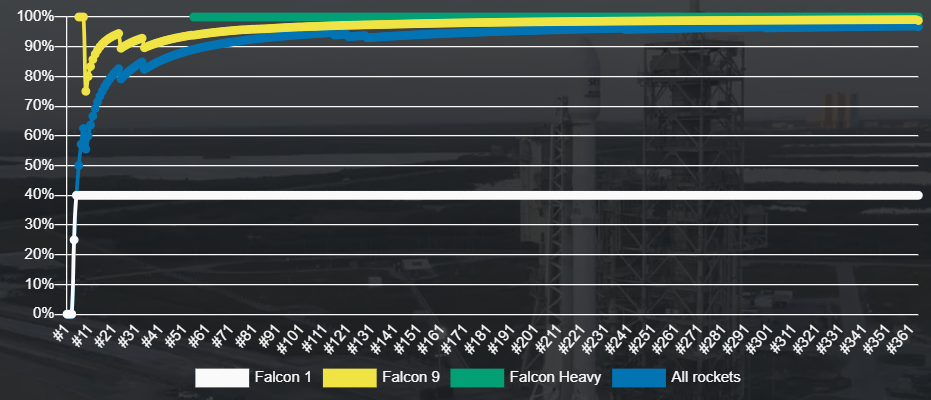
- SpaceX statistics further state that the success rate of SpaceX’s 352 rockets in 2024 was 96.97%.
- Additionally, the success rate of a total of 364 Falcon Heavy launches was 100%.
- Besides, the total success rate for Falcon 1 and Falcon 9 is 40% and 99.11%, respectively.
SpaceX Statistics By Employee Demographics
(Reference: techreport.com)
- In recent years, SpaceX has had a total of 9,500 employees, of whom 86% are men and only 14% are women.
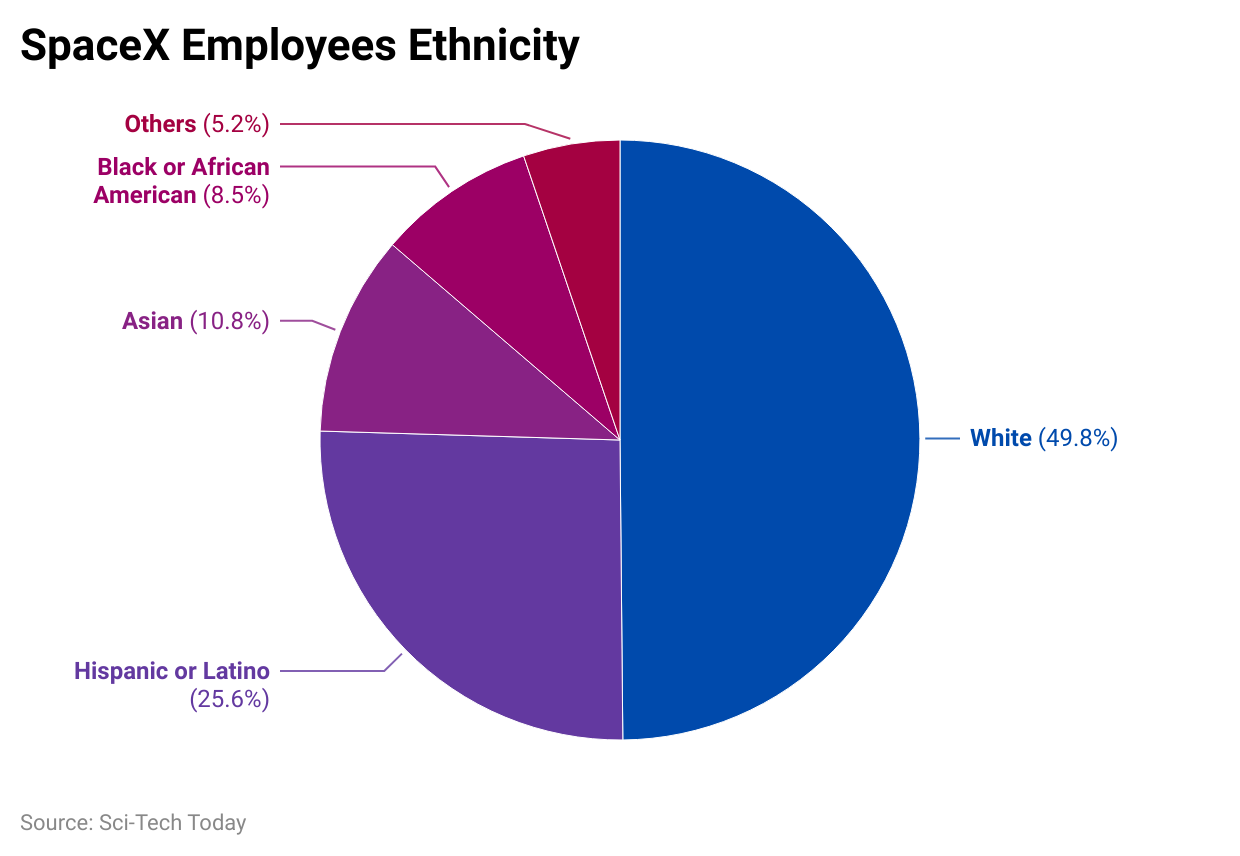
- The share of employees by ethnicity includes 49.8% (White), 25.6% (Hispanic/Latino), 10.8% (Asian), Black/African American (8.5%), and others (5.2%).
- In contrast, the annual salary earned by average SpaceX employees is $52,155.
Falcon 9 and Falcon Heavy Launches by SpaceX
- Based on SpaceX Statistics 2023, SpaceX launched around 96 vehicles of the Falcon family, resulting in Falcon 9 (91) and Falcon Heavy launches (5).
- In September 2023, the launch cadence of SpaceX recorded 64 launches by a rocket family.
- On the other hand, the number of launches is followed by October (70), November (80), and December (90).
| Date & Time | Booster or Rocket Version | Launch site | Mission | Payload mass |
| January 3,
14:56 |
F9 B5
B1060.15 |
CCSFS,
SLC-40 |
Transporter-6 | – |
| 10 January,
04:50 |
F9 B5
B1076.2 |
CCSFS,
SLC-40 |
OneWeb Flight #16 / SpaceX Flight 2 | 6,000 kg (13,000 lb) |
| 15 January,
22:56 |
Falcon Heavy B5
B1070 (core), B1064.2 (side), and B1065.2 (side) |
KSC,
LC-39A |
USSF-67 (CBAS-2 & LDPE-3A) | 3,750 kg (8,270 lb) |
| 18 January,
12:24 |
F9 B5
B1077.2 |
CCSFS,
SLC-40 |
USA-343 / GPS III-06 (Amelia Earhart) | 4,352 kg (9,595 lb) |
|
19 January, 15:43 |
F9 B5
B1075.1 |
VSFB,
SLC-4E |
Starlink Group2–4 | 15,000 kg (33,000 lb) |
| 26 January,
09:32 |
F9 B5
B1067.9 |
CCSFS,
SLC-40 |
Starlink Group 5-2 | 17,400 kg (38,400 lb) |
| 31 January,
16:15 |
F9 B5
B1071.7 |
VSFB,
SLC-4E |
Starlink Group 2–6 and
ION SCV009 Eclectic Elena |
15,200 kg (33,500 lb) |
| 2 February,
07:58 |
F9 B5
B1069.5 |
KSC,
LC-39A |
Starlink Group 5-3 | 16,500 kg (36,400 lb) |
| 7 February, 01:32 | F9 B5
B1073.6 |
CCSFS,
SLC-40 |
Amazonas Nexus | 4,146 kg (9,140 lb) |
| 12 February,
05:10 |
F9 B5
B1062.12 |
CCSFS,
SLC-40 |
Starlink Group 5-4 | 17,100 kg (37,700 lb) |
|
17 February, 19:12 |
F9 B5
B1063.9 |
VSFB,
SLC-4E |
Starlink Group 2–5 | 15,900 kg (35,100 lb) |
| 18 February,
03:59 |
F9 B5
B1077.3 |
CCSFS,
SLC-40 |
Inmarsat-6 F2 | 5,470 kg (12,060 lb) |
|
27 February, 23:13 |
F9 B5
B1076.3 |
CCSFS,
SLC-40 |
Starlink Group 6-1 | 15,300 kg (33,700 lb) |
| 2 March,
05:34 |
F9 B5
B1078.1 |
KSC,
LC-39A |
Crew-6
(Crew Dragon C206.4 Endeavour) |
13,000 kg (29,000 lb) |
|
3 March, 18:38 |
F9 B5
B1061.12 |
VSFB,
SLC-4E |
Starlink Group 2–7 | 15,900 kg (35,100 lb) |
| 9 March,
19:13 |
F9 B5
B1062.13 |
CCSFS,
SLC-40 |
OneWeb #17 / SpaceX OneWeb-3 | 6,000 kg (13,000 lb) |
|
15 March, 00:30 |
F9 B5
B1073.7 |
KSC,
LC-39A |
SpaceX CRS-27
(Dragon C209.3) |
2,852 kg (6,288 lb) |
| 17 March,
19:26 |
F9 B5
B1071.8 |
VSFB,
SLC-4E |
Starlink Group 2–8 | 16,200 kg (35,700 lb) |
|
17 March, 23:38 |
F9 B5
B1069.6 |
CCSFS,
SLC-40 |
SES-18 and SES-19 | 7,000 kg (15,000 lb) |
| 24 March,
15:43 |
F9 B5
B1067.10 |
CCSFS,
SLC-40 |
Starlink Group 5-5 | 17,400 kg (38,400 lb) |
|
29 March, 20:01 |
F9 B5
B1077.4 |
CCSFS,
SLC-40 |
Starlink Group 5–10 | 17,400 kg (38,400 lb) |
| 2 April,
14:29 |
F9 B5
B1075.2 |
VSFB,
SLC-4E |
Transport and Tracking Layer (Tranche 0A) | – |
|
7 April, 04:30 |
F9 B5
B1076.4 |
CCSFS,
SLC-40 |
Intelsat 40e
TEMPO |
5,588 kg (12,319 lb) |
| 15 April,
06:47 |
F9 B5
B1063.10 |
VSFB,
SLC-4E |
Transporter-7 | – |
|
19 April, 14:31 |
F9 B5
B1073.8 |
CCSFS,
SLC-40 |
Starlink Group 6-2 | 15,300 kg (33,700 lb) |
| 27 April 2023
13:40 |
F9 B5
B1061.13 |
VSFB,
SLC-4E |
Starlink Group 3–5 | 14,100 kg (31,100 lb) |
|
28 April, 22:12 |
F9 B5
B1078.2 |
CCSFS,
SLC-40 |
O3b mPOWER 3 & 4 | 4,100 kg (9,000 lb) |
| 1 May,
00:26 |
Falcon Heavy B5
B1068 (core), B1052.8 (side), and B1053.3 |
KSC,
LC-39A |
ViaSat-3 | 6,722 kg (14,819 lb) |
|
4 May, 07:31 |
F9 B5
B1069.7 |
CCSFS,
SLC-40 |
Starlink Group 5–6 | 17,400 kg (38,400 lb) |
| 10 May,
20:09 |
F9 B5
B1075.3 |
VSFB,
SLC-4E |
Starlink Group 2-9 | 15,900 kg (35,100 lb) |
| 14 May, 05:03 | F9 B5
B1067.11 |
CCSFS,
SLC-40 |
Starlink Group 5–9 | 17,400 kg (38,400 lb) |
| 19 May,
06:19 |
F9 B5
B1076.5 |
CCSFS,
SLC-40 |
Starlink Group 6-3 | 16,100 kg (35,500 lb) |
|
20 May, 13:16 |
F9 B5
B1063.11 |
VSFB,
SLC-4E |
Iridium-NEXT, and OneWeb | 6,600 kg (14,600 lb) |
| 21 May,
21:37 |
F9 B5
B1080.1 |
KSC,
LC-39A |
Ax-2
(Crew Dragon C212.2 Freedom ♺) |
13,000 kg (29,000 lb) |
| 27 May,
04:30 |
F9 B5
B1062.14 |
CCSFS,
SLC-40 |
ArabSat 7B | 4,500 kg (9,900 lb) |
| 31 May,
06:02 |
F9 B5
B1061.14 |
VSFB,
SLC-4E |
Starlink Group 2–10 | 16,400 kg (36,200 lb) |
|
4 June, 12:20 |
F9 B5
B1078.3 |
CCSFS,
SLC-40 |
Starlink Group 6-4 | 16,100 kg (35,500 lb) |
| 5 June,
15:47 |
F9 B5
B1077.5 |
KSC,
LC-39A |
SpaceX CRS-28
(Dragon C208.4) |
9,525 kg (20,999 lb) |
|
12 June, 07:10 |
F9 B5
B1073.9 |
CCSFS,
SLC-40 |
Starlink Group 5–11 | 16,400 kg (36,200 lb) |
| 12 June,
21:35 |
F9 B5
B1071.9 |
VSFB,
SLC-4E |
Transporter-8 | – |
|
18 June, 22:21 |
F9 B5
B1067.12 |
CCSFS,
SLC-40 |
SATRIA | 4,580 kg (10,100 lb) |
| 22 June,
07:19 |
F9 B5
B1075.4 |
VSFB,
SLC-4E |
Starlink Group 5–7 | 14,500 kg (32,000 lb) |
|
23 June, 15:35 |
F9 B5
B1069.8 |
CCSFS,
SLC-40 |
Starlink Group 5–12 | 17,400 kg (38,400 lb) |
| 1 July,
15:12 |
F9 B5
B1080.2 |
CCSFS,
SLC-40 |
Euclid | 2,160 kg (4,760 lb) |
|
7 July, 19:29 |
F9 B5
B1063.12 |
VSFB,
SLC-4E |
Starlink Group 5–13 | 14,900 kg (32,800 lb) |
| 10 July,
03:58 |
F9 B5
B1058.16 |
CCSFS,
SLC-40 |
Starlink Group 6-5 | 16,100 kg (35,500 lb) |
|
16 July, 03:50 |
F9 B5
B1060.16 |
CCSFS,
SLC-40 |
Starlink Group 5–15 | 16,700 kg (36,800 lb) |
| 20 July,
04:09 |
F9 B5
B1071.10 |
VSFB,
SLC-4E |
Starlink Group 6–15 | 12,000 kg (26,000 lb) |
|
24 July, 00:50 |
F9 B5
B1076.6 |
CCSFS,
SLC-40 |
Starlink Group 6-6 | 16,100 kg (35,500 lb) |
| 28 July,
04:01 |
F9 B5
B1062.15 |
CCSFS,
SLC-40 |
Starlink Group 6–7 | 16,100 kg (35,500 lb) |
|
29 July, 03:04 |
Falcon Heavy B5
B1074 (core), B1064.3 (side), and B1065.3 (side) |
KSC,
LC-39A |
Jupiter-3 (EchoStar-24) | 9,200 kg (20,300 lb) |
| 3 August,
05:00 |
F9 B5
B1077.6 |
CCSFS,
SLC-40 |
Galaxy 37 | 5,063 kg (11,162 lb) |
| 7 August, 02:41 | F9 B5
B1078.4 |
CCSFS,
SLC-40 |
Starlink Group 6–8 | 16,100 kg (35,500 lb) |
| 8 August,
03:57 |
F9 B5
B1075.5 |
VSFB,
SLC-4E |
Starlink Group 6–20 | 12,000 kg (26,000 lb) |
|
11 August, 05:17 |
F9 B5
B1069.9 |
CCSFS,
SLC-40 |
Starlink Group 6–9 | 16,100 kg (35,500 lb) |
| 17 August,
03:36 |
F9 B5
B1067.13 |
CCSFS,
SLC-40 |
Starlink Group 6–10 | 16,100 kg (35,500 lb) |
|
22 August, 09:37 |
F9 B5
B1061.15 |
VSFB,
SLC-4E |
Starlink Group 7-1 | 15,300 kg (33,700 lb) |
| 26 August,
07:27 |
F9 B5
B1081.1 |
KSC,
LC-39A |
Crew-7
(Crew Dragon C210.3 Endurance) |
13,000 kg (29,000 lb) |
|
27 August, 01:05 |
F9 B5
B1080.3 |
CCSFS,
SLC-40 |
Starlink Group 6–11 | 16,100 kg (35,500 lb) |
| 1 September, 02:21 | F9 B5
B1077.7 |
CCSFS,
SLC-40 |
Starlink Group 6–13 | 16,100 kg (35,500 lb) |
| 2 September, 14:25 | F9 B5
B1063.13 |
VSFB,
SLC-4E |
Transport and Tracking Layer (Tranche 0B) | – |
| 4 September, 02:47 | F9 B5
B1073.10 |
KSC,
LC-39A |
Starlink Group 6–12[ | 15,300 kg (33,700 lb) |
| 9 September, 03:12 | F9 B5
B1076.7 |
CCSFS,
SLC-40 |
Starlink Group 6–14 | 16,100 kg (35,500 lb) |
| 12 September, 06:57 | F9 B5
B1071.11 |
VSFB,
SLC-4E |
Starlink Group 7-2 | 15,300 kg (33,700 lb) |
| 16 September, 03:38 | F9 B5
B1078.5 |
CCSFS,
SLC-40 |
Starlink Group 6–16 | 16,100 kg (35,500 lb) |
|
20 September, 03:38 |
F9 B5
B1058.17 |
CCSFS,
SLC-40 |
Starlink Group 6–17 | 16,100 kg (35,500 lb) |
| 24 September,
03:38 |
F9 B5
B1060.17 |
CCSFS,
SLC-40 |
Starlink Group 6–18 | 16,100 kg (35,500 lb) |
|
25 September, 08:48 |
F9 B5
B1075.6 |
VSFB,
SLC-4E |
Starlink Group 7-3 | 15,300 kg (33,700 lb) |
| 30 September,
02:00 |
F9 B5
B1069.10 |
CCSFS,
SLC-40 |
Starlink Group 6–19 | 16,100 kg (35,500 lb) |
|
5 October, 05:36 |
F9 B5
B1076.8 |
CCSFS,
SLC-40 |
Starlink Group 6–21 | 16,100 kg (35,500 lb) |
| 9 October,
07:23 |
F9 B5
B1063.14 |
VSFB,
SLC-4E |
Starlink Group 7-4 | 15,300 kg (33,700 lb) |
| 13 October, 14:19 | Falcon Heavy B5
B1079 (core), B1064.4 (side), and B1065.4 (side) |
KSC,
LC-39A |
Psyche | 2,608 kg (5,750 lb) |
| 13 October, 23:01 | F9 B5
B1067.14 |
CCSFS,
SLC-40 |
Starlink Group 6–22 | 16,100 kg (35,500 lb) |
|
18 October, 00:39 |
F9 B5
B1062.16 |
CCSFS,
SLC-40 |
Starlink Group 6–23 | 16,100 kg (35,500 lb) |
| 21 October,
08:23 |
F9 B5
B1061.16 |
VSFB,
SLC-4E |
Starlink Group 7-5 | 15,300 kg (33,700 lb) |
| 22 October,
02:17 |
F9 B5
B1080.4 |
CCSFS,
SLC-40 |
Starlink Group 6–24 | 16,800 kg (37,000 lb) |
| 29 October,
09:00 |
F9 B5
B1075.7 |
VSFB,
SLC-4E |
Starlink Group 7-6 | 16,100 kg (35,500 lb) |
| 30 October,
23:20 |
F9 B5
B1077.8 |
CCSFS,
SLC-40 |
Starlink Group 6–25 | 16,800 kg (37,000 lb) |
| 4 November,
00:37 |
F9 B5
B1058.18 |
CCSFS,
SLC-40 |
Starlink Group 6–26 | 16,800 kg (37,000 lb) |
|
8 November, 05:05 |
F9 B5
B1073.11 |
CCSFS,
SLC-40 |
Starlink Group 6–27 | 16,800 kg (37,000 lb) |
| 10 November,
01:28 |
F9 B5
B1081.2 |
KSC,
LC-39A |
SpaceX CRS-29
(Dragon C211.2) |
9,525 kg (20,999 lb) |
|
11 November, 18:49 |
F9 B5
B1071.12 |
VSFB,
SLC-4E |
Transporter-9 | – |
| November 12, 21:08 | F9 B5
B1076.9 |
CCSFS,
SLC-40 |
O3b mPOWER 5 & 6 | 4,100 kg (9,000 lb) |
|
November 18, 05:05 |
F9 B5
B1069.11 |
CCSFS,
SLC-40 |
Starlink Group 6–28 | 16,800 kg (37,000 lb) |
| November 20,
10:30 |
F9 B5
B1063.15 |
VSFB,
SLC-4E |
Starlink Group 7-7 | 16,100 kg (35,500 lb) |
|
November 22, 07:47 |
F9 B5
B1067.15 |
CCSFS,
SLC-40 |
Starlink Group 6–29 | 16,800 kg (37,000 lb) |
| November 28,
04:20 |
F9 B5
B1062.17 |
CCSFS,
SLC-40 |
Starlink Group 6–30 | 16,800 kg (37,000 lb) |
|
December 1, 18:19 |
F9 B5
B1061.17 |
VSFB,
SLC-4E |
EIRSAT-1 and the other 23 secondary payloads | 800 kg (1,800 lb) |
| December 3,
04:00 |
F9 B5
B1078.6 |
CCSFS,
SLC-40 |
Starlink Group 6–31 | 16,800 kg (37,000 lb) |
|
December 7, 05:07 |
F9 B5
B1077.9 |
CCSFS,
SLC-40 |
Starlink Group 6–33 | ~16,800 kg (37,000 lb) |
| December 8,
08:03 |
F9 B5
B1071.13 |
VSFB,
SLC-4E |
Starlink Group 7–8 | 16,100 kg (35,500 lb) |
|
December 19, 04:01 |
F9 B5
B1081.3 |
CCSFS,
SLC-40 |
Starlink Group 6–34 | 16,800 kg (37,000 lb) |
| December 23,
05:33 |
F9 B5
B1058.19 |
CCSFS,
SLC-40 |
Starlink Group 6–32 | 16,800 kg (37,000 lb) |
|
December 24, 13:11 |
F9 B5
B1075.8 |
VSFB,
SLC-4E |
SARah 2 & 3 | 3,600 kg (7,900 lb) |
| December 29,
01:07 |
Falcon Heavy B5
B1084 (core), B1064.5 (side), and B1065.5 (side) |
KSC,
LC-39A |
USSF-52 (Boeing X-37B OTV-7) | 6,350 kg (14,000 lb) |
|
December 29, 04:01 |
F9 B5
B1069.12 |
CCSFS,
SLC-40 |
Starlink Group 6–36 | 16,800 kg (37,000 lb) |
(Source: wikipedia.org)
Falcon 9 and Falcon Heavy Launches In 2024
- SpaceX Statistics further state that SpaceX has completed 51 launches by May 18, 2024.
- By the end of 2024, the company has targeted to launch around 144 flights or month (12 flights).
- In 2024, the Falcon family of SpaceX also aimed to increase the total launch mass to orbit by 50%.
| Launch Date | Mission | Rocket / Booster(s) | Launch Pad | Landing |
| January 3 | Starlink Group 7-9 | Falcon 9 (B1082.1) | SLC-4E | OCISLY |
| January 3 | Ovzon-3 | Falcon 9 (B1076.10) | SLC-40 | LZ-1 |
| January 7 | Starlink Group 6-35 | Falcon 9 (B1067.16) | SLC-40 | ASOG |
| January 14 | Starlink Group 7-10 | Falcon 9 (B1061.18) | SLC-4E | OCISLY |
| January 15 | Starlink Group 6-37 | Falcon 9 (B1073.12) | SLC-40 | ASOG |
| January 18 | Axiom-3 | Falcon 9 (B1080.5) | LC-39A | LZ-1 |
| January 24 | Starlink Group 7-11 | Falcon 9 (B1063.16) | SLC-4E | OCISLY |
| January 29 | Starlink Group 6-38 | Falcon 9 (B1062.18) | LC-39A | ASOG |
| January 29 | Starlink Group 7-12 | Falcon 9 (B1075.9) | SLC-4E | OCISLY |
| January 30 | CRS NG-20 | Falcon 9 (B1077.10) | SLC-40 | LZ-1 |
| February 8 | NASA PACE | Falcon 9 (B1081.4) | SLC-40 | LZ-1 |
| February 10 | Starlink Group 7-13 | Falcon 9 (B1071.14) | SLC-4E | OCISLY |
| February 14 | USSF-124 | Falcon 9 (B1078.7) | SLC-40 | LZ-2 |
| February 15 | Nova-C IM-1 | Falcon 9 (B1060.18) | LC-39A | LZ-1 |
| February 15 | Starlink Group 7-14 | Falcon 9 (B1082.2) | SLC-4E | OCISLY |
| February 20 | Merah Putih 2 | Falcon 9 (B1067.17) | SLC-40 | JRTI |
| February 23 | Starlink Group 7-15 | Falcon 9 (B1061.19) | SLC-4E | OCISLY |
| February 25 | Starlink Group 6-39 | Falcon 9 (B1069.13) | SLC-40 | ASOG |
| February 29 | Starlink Group 6-40 | Falcon 9 (B1076.11) | SLC-40 | JRTI |
| March 3 | Crew-8 | Falcon 9 (B1083.1) | LC-39A | LZ-1 |
| March 4 | Transporter-10 | Falcon 9 (B1081.5) | SLC-4E | LZ-4 |
| March 5 | Starlink Group 6-41 | Falcon 9 (B1073.13) | SLC-40 | ASOG |
| March 10 | Starlink Group 6-43 | Falcon 9 (B1077.11) | SLC-40 | JRTI |
| March 11 | Starlink Group 7-17 | Falcon 9 (B1063.17) | SLC-4E | OCISLY |
| March 14 | Starship Flight 3 | Starship (Ship 28, Booster 10) | OLM-1 | Splashdown |
| March 16 | Starlink Group 6-44 | Falcon 9 (B1062.19) | LC-39A | ASOG |
| March 19 | Starlink Group 7-16 | Falcon 9 (B1075.10) | SLC-4E | OCISLY |
| March 21 | CRS-30 | Falcon 9 (B1080.6) | SLC-40 | LZ-1 |
| March 24 | Starlink Group 6-42 | Falcon 9 (B1060.19) | LC-39A | JRTI |
| March 25 | Starlink Group 6-46 | Falcon 9 (B1078.8) | SLC-40 | ASOG |
| March 30 | Eutelsat 36D | Falcon 9 (B1076.12) | LC-39A | JRTI |
| March 31 | Starlink Group 6-45 | Falcon 9 (B1067.18) | SLC-40 | ASOG |
| April 2 | Starlink Group 7-18 | Falcon 9 (B1071.15) | SLC-4E | OCISLY |
| April 5 | Starlink Group 6-47 | Falcon 9 (B1069.14) | SLC-40 | ASOG |
| April 7 | Starlink Group 8-1 | Falcon 9 (B1081.6) | SLC-4E | OCISLY |
| April 7 | Bandwagon-1 | Falcon 9 (B1073.14) | LC-39A | LZ-1 |
| April 10 | Starlink Group 6-48 | Falcon 9 (B1083.2) | SLC-40 | JRTI |
| April 11 | USSF-62 | Falcon 9 (B1082.3) | SLC-4E | LZ-4 |
| April 13 | Starlink Group 6-49 | Falcon 9 (B1062.20) | SLC-40 | ASOG |
| April 17 | Starlink Group 6-51 | Falcon 9 (B1077.12) | LC-39A | JRTI |
| April 18 | Starlink Group 6-52 | Falcon 9 (B1080.7) | SLC-40 | ASOG |
| April 23 | Starlink Group 6-53 | Falcon 9 (B1078.9) | SLC-40 | JRTI |
| April 28 | Galileo L12 | Falcon 9 (B1060.20) | LC-39A | No Attempt |
| April 28 | Starlink Group 6-54 | Falcon 9 (B1076.13) | SLC-40 | JRTI |
| May 2 | WorldView Legion | Falcon 9 (B1061.20) | SLC-4E | LZ-4 |
| May 3 | Starlink Group 6-55 | Falcon 9 (B1067.19) | SLC-40 | ASOG |
| May 6 | Starlink Group 6-57 | Falcon 9 (B1069.15) | SLC-40 | JRTI |
| May 8 | Starlink Group 6-56 | Falcon 9 (B1083.3) | LC-39A | ASOG |
| May 10 | Starlink Group 8-2 | Falcon 9 (B1082.4) | SLC-4E | OCISLY |
| May 13 | Starlink Group 6-58 | Falcon 9 (B1073.15) | SLC-40 | ASOG |
| May 14 | Starlink Group 8-7 | Falcon 9 (B1063-18) | SLC-4E | OCISLY |
| May 18 | Starlink Group 6-59 | Falcon 9 (B1062.21) | SLC-40 | ASOG |
(Source: spaceexplored.com)
Future Falcon 9 and Falcon Heavy Launches of SpaceX in 2024
| Date & Time (UTC) | Mission | Rocket / Booster(s) | Launch Site |
| May 22, 08:00 | NROL-146 (Starshield satellites) | F9 B5
B1071.16 |
VSFB,
SLC-4E |
| May 23, 02:33 | Starlink Group 6–62 | F9 B5 |
CCSFS, SLC-40 |
| May 23, 22:45 | Starlink Group 6–63 | F9 B5 | KSC,
LC-39A |
| May 28, 22:20 | EarthCARE | F9 B5 |
VSFB, SLC-4E |
| June 25, 21:16 | GOES-U | Falcon Heavy B5
B1087 (core), B1072.1 (side), and B1086.1 (side) |
KSC,
LC-39A |
| June | Starlink Group 7–19 | F9 B5 |
KSC, LC-39A |
| June | Starlink Group 8-3 | F9 B5 | VSFB,
SLC-4E |
| June | Starlink Group 7–20 | F9 B5 |
VSFB, SLC-4E |
| June | Nusantara Lima | F9 B5 | CC,
SLC-40/LC-39A |
| June | SpaceX CRS-31 | F9 B5 |
CC, SLC-40 / LC-39A |
| Q2 | BlueBird Block 1 (5 Satellites) | F9 B5 | VSFB or CC |
| Q2 | GSAT-20 | F9 B5 |
CC, SLC-40/LC-39A |
| Q2 | NROL-69 | F9 B5 | CC,
SLC-40/LC-39A |
| Q2 | MicroGEO (4 satellites) | F9 B5 |
CC, SLC-40/LC-39A |
| Q2 | ASBM 1 (GX 10A), ASBM 2 (GX 10B) | F9 B5 | VSFB,
SLC-4E |
| July 8 | Türksat 6A | F9 B5 |
CC, SLC-40/LC-39A |
| July | 2× Galileo | F9 B5 | TBD |
| July | Transporter-11, SmallSat Rideshare | F9 B5 | VSFB or CC |
| Mid-August | Crew-9 | F9 B5 | CC,
SLC-40/LC-39A |
| August | CRS NG-21 (Cygnus (enhanced)) | F9 B5 |
CC, SLC-40 / LC-39A |
| H2 | Polaris Dawn | F9 B5 | KSC,
LC-39A |
| Q3 | Astra 1P/SES-24 | F9 B5 |
CC, SLC-40/LC-39A |
| H2 | Spainsat-NG I | F9 B5 | CC,
SLC-40/LC-39A |
| September | SDA Tranche 1 Tracking layer T1TL-B | F9 B5 |
VSFB, SLC-4E |
| Late Q3 / Early Q4 | Blue Ghost M1 | F9 B5 | KSC,
LC-39A |
| October 8 | Hera with Juventas and Milani | F9 B5 | CCSFS, SLC-40 |
| October 10 | Europa Clipper | Falcon Heavy B5
B1090 (core), B1064.6 (side), and B1065.6 (side) |
KSC,
LC-39A |
| October | Transporter-12 | F9 B5 | VSFB or CC |
| October | SDA Tranche 1 Tracking layer T1TL-C | F9 B5 | VSFB,
SLC-4E |
| October | Ax-4 | F9 B5 |
KSC, LC-39A |
| November | Griffin Mission 1 | Falcon Heavy B5
B10××.1 (core), B1072.2 (side), and B1086.2 (side) |
KSC,
LC-39A |
| November | Bandwagon-2 | F9 B5 | VSFB or CC |
| November | SDA Tranche 1 Tracking layer T1TL-D | F9 B5 | VSFB,
SLC-4E |
| November | 425 Project SAR satellite flight 3 | F9 B5 | VSFB or CC |
| December | SDA Tranche 1 Tracking layer T1TL-E | F9 B5 | VSFB,
SLC-4E |
| Q4 | SDA Tranche 1 Transport layer T1TR-C | F9 B5 |
VSFB, SLC-4E |
| Q4 | IM-2 Nova-C lunar lander
Sherpa-ES |
F9 B5 | KSC,
LC-39A |
| Q4 | Koreasat 6A | F9 B5 |
CC, SLC-40/LC-39A |
| H2 | USSF-36 | F9 B5 | CC,
SLC-40/LC-39A |
| H2 | O3b mPOWER 7 & 8 | F9 B5 |
CC, SLC-40/LC-39A |
| H2 | WorldView Legion 3–4 Mission 2 | F9 B5 | CCSFS,
SLC-40 |
| H2 | WorldView Legion 5 & 6 Mission 3 | F9 B5 |
CC, SLC-40/LC-39A |
Falcon 9 and Falcon Heavy Launches in 2025 and Beyond
| Date | Booster Version | Launch site | Mission |
| February, 2025 | F9 B5 | VSFB or CC | Transporter-13, SmallSat Rideshare |
| February, 2025 | F9 B5 | VSFB or CC | Bandwagon-3, SmallSat Rideshare |
| February, 2025 | F9 B5 | KSC, LC-39A | Interstellar Mapping and Acceleration Probe (IMAP) |
| Q1, 2025 | F9 B5 | KSC,
LC-39A |
IM-3 Nova-C lunar lander |
| April 2025 | F9 B5 | VSFB,
SLC-4E |
SPHEREx
PUNCH |
| April 2025 | F9 B5 | VSFB or CC | TRACERS |
| April 2025 | F9 B5 | VSFB,
SLC-4E |
12 launches for Rivada broadband constellation |
| May 2025 | F9 B5 | VSFB or CC | Bandwagon-4, SmallSat Rideshare |
| June 2025 | F9 B5 | VSFB or CC | Transporter-14, SmallSat Rideshare |
| H2, 2025 | F9 B5 | VSFB or CC | CC Project Kuiper constellation deployment |
| August 2025 | F9 B5 | VSFB or CC | Haven-1 |
| September 2025 | F9 B5 | KSC, LC-39A | Vast-1 |
| October, 2025 | F9 B5 | VSFB or CC | Transporter-15 |
| November, 2025 | F9 B5 | VSFB | Sentinel-6B |
| 2025 | F9 B5 | VSFB or CC | CAS500-4 |
| 2025 | F9 B5 | CC,
SLC-40 / LC-39A |
Globalstar-3 M104–120 |
| 2025 | F9 B5 | CC, SLC-40 / LC-39A | O3b mPOWER 9-11 |
| 2025 | F9 B5 | CC,
SLC-40 / LC-39A |
Mission Robotic Vehicle (MRV) × 1 Mission Extension Pod (MEP) × 3 |
| 2025 | F9 B5 | CC,
SLC-40/LC-39A |
Skynet 6A |
| 2025 | F9 B5 | CC,
SLC-40/LC-39A |
Spainsat NG II |
| Q1 2026 | F9 B5 | VSFB or CC | Transporter-16 |
| Q2 2026 | F9 B5 | VSFB or CC | Transporter-17 |
| Q4 2026 | F9 B5 | VSFB or CC | Transporter-18 |
| Q1 2027 | F9 B5 | VSFB or CC | Transporter-19 |
| May 2027 | May 2027 | KSC,
LC-39A |
Nancy Grace Roman Space Telescope |
| Q2 2027 | F9 B5 | VSFB or CC | Transporter-20 |
| Q4 2027 | F9 B5 | VSFB or CC | Transporter-21 |
| 2028 | Falcon Heavy B5 | KSC,
LC-39A |
GLS-1 |
| 2029 | Falcon Heavy B5 | KSC,
LC-39A |
GLS-2 (Dragon XL) |
(Source: wikipedia.org)
Falcon 1 Launches By SpaceX
| Date/time (UTC) | Launch site | Payload | Launch outcome |
| March 24, 2006, 22:30 | Omelek Island | FalconSAT-2 | Failure |
| March 21, 2007, 01:10 | Omelek Island | DemoSat | Failure |
| August 3, 2008, 03:34 | Omelek Island | Trailblazer PRESat NanoSail-D Explorers |
Failure |
| September 28, 2008, 23:15 | Omelek Island | RatSat | Success |
| July 14, 2009, 03:35 | Omelek Island | RazakSAT | Success |
(Source: wikipedia.org)
SpaceX Statistics By Revenue
(Reference: assets-global.website-files.com)
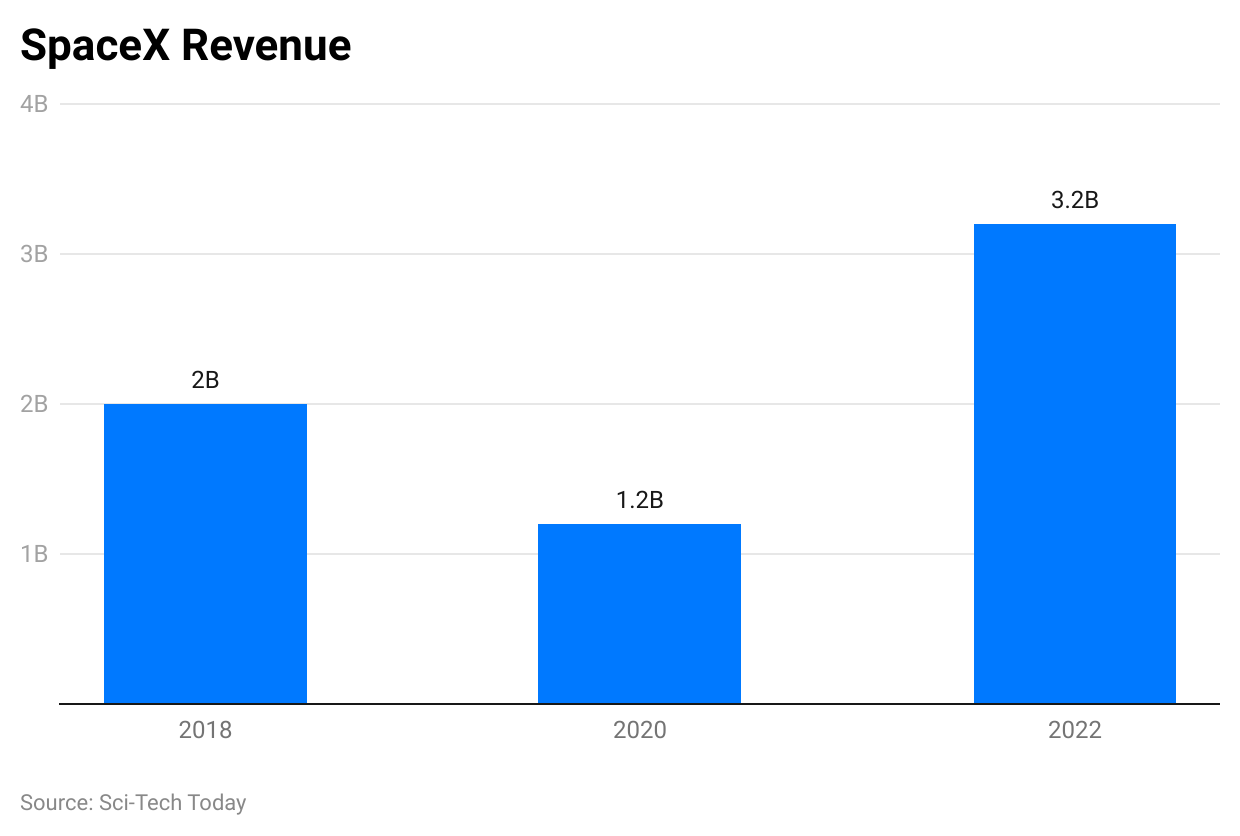
- In 2018 and 2020, SpaceX’s total revenue from rocket launches was $2 billion and $1.2 billion, respectively.
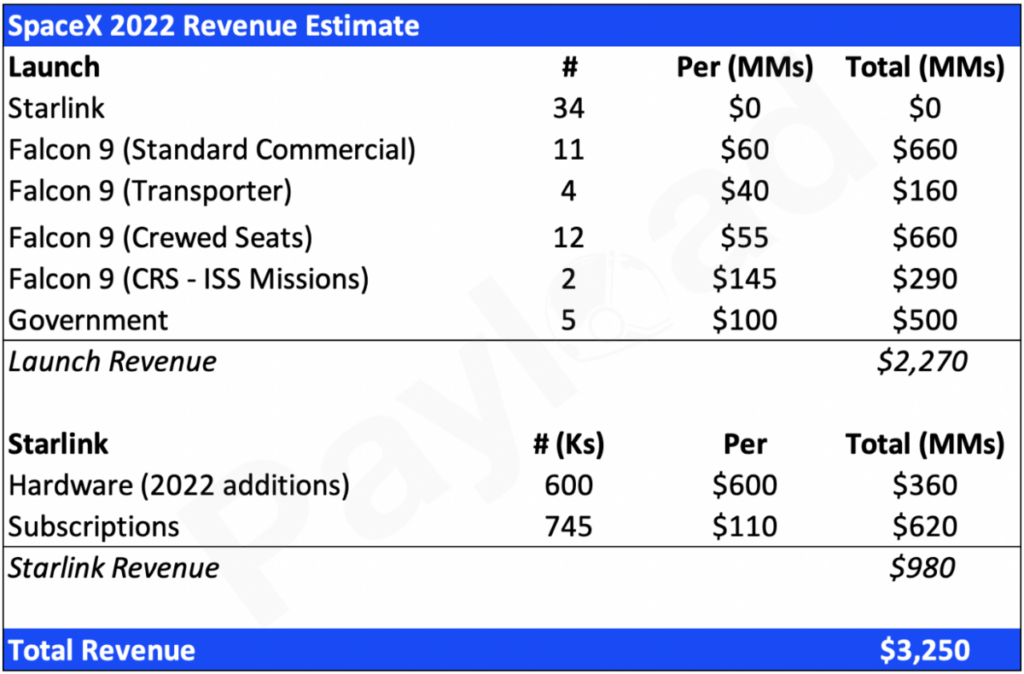
- Moreover, in 2022, SpaceX’s total revenue was $3.2 billion, with launch revenue of $2.2 billion and Starlink revenue of $980 million.
Detailed Revenue Estimates of SpaceX
(Source: payloadspace.com)
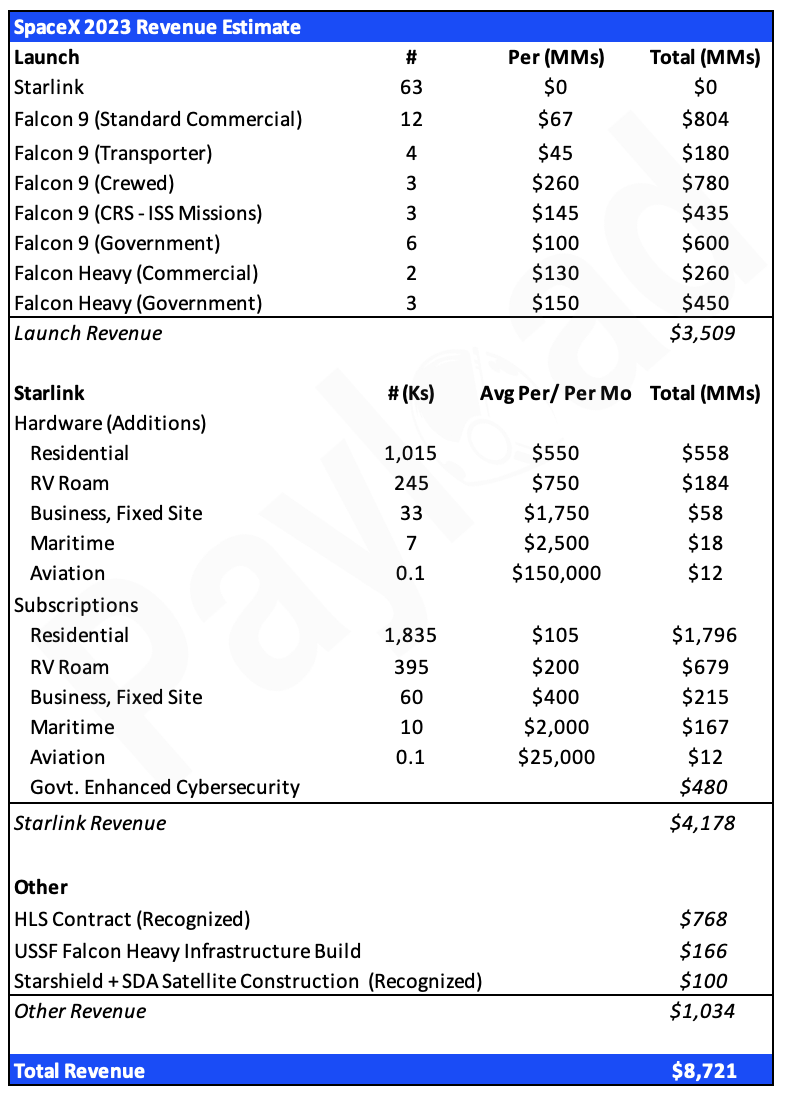
- According to SpaceX Statistics, in 2023, the overall revenue accounted for by SpaceX was $8.7 billion.
- The launch revenue generated around $3.5 million, followed by Starlink ($4.1 million) and other segments ($1.03 million).
All Detailed Revenue Analyses
(Source: payloadspace.com)
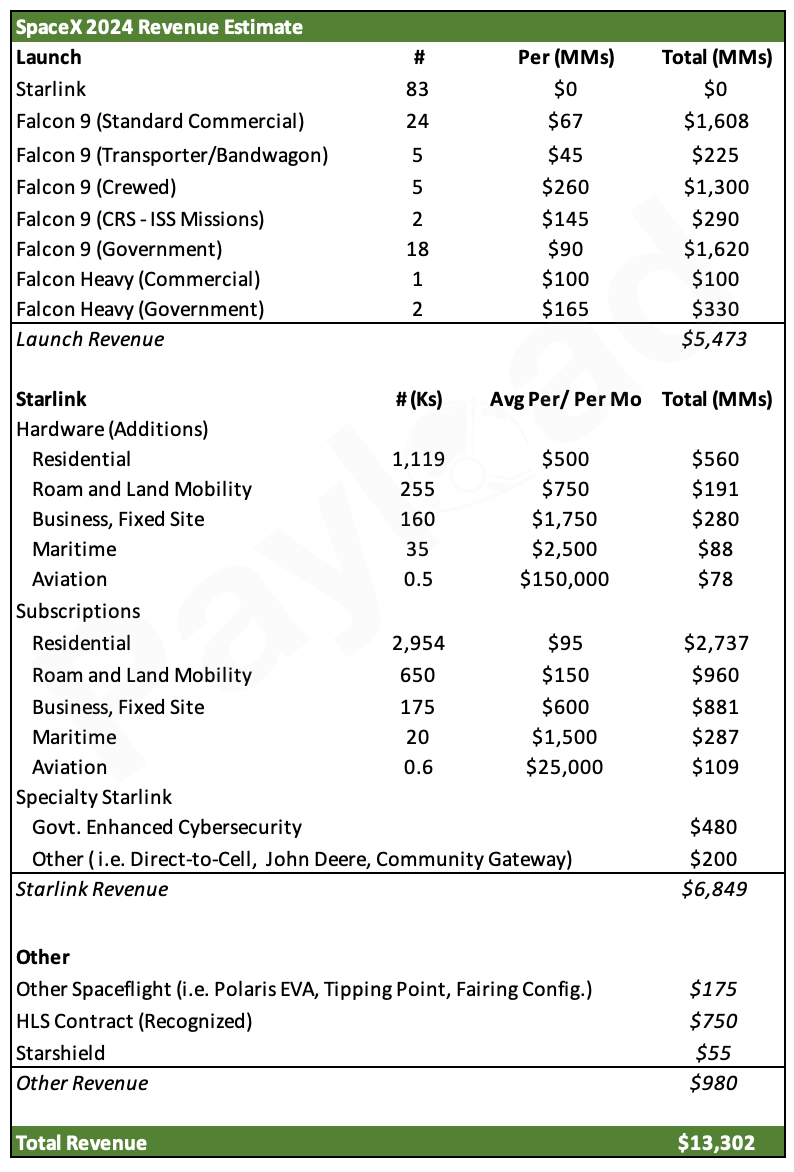
- In 2024, SpaceX is estimated to account for approximately $13.3 billion.
- SpaceX’s total launch revenue will be $5.4 billion, followed by Starlink ($6.8 billion) and other revenue ($980 million).
Detailed Revenue Distribution
(Source: payloadspace.com)
SpaceX Funding Statistics
- SpaceX is known to be the leading company in the global space industry.
- On August 8, 2022, the total money raised by Secondary Market SpaceX resulted in $250 million.
| Announced Date | Transaction Name | Number of investors | Money Raised | Lead Investors |
| July 15, 2022 | Private Equity Round- SpaceX | 3 | $250M | Mirae Asset Venture Investment |
| June 14, 2022 | Venture Round- SpaceX | 3 | $1.7B | — |
| April 21, 2022 | Grant- SpaceX | 1 | $70M | NASA |
| December 30, 2021 | Venture Round- SpaceX | — | $337.4M | — |
| October 8, 2021 | Secondary Market- SpaceX | 6 | $755M | — |
| September 24, 2021 | Grant- SpaceX | 1 | $14.5M | United States Space Force |
| April 14, 2021 | Venture Round – SpaceX | 5 | $314M | — |
| February 16, 2021 | Venture Round- SpaceX | 1 | $850M | — |
| October 16, 2020 | Series E- SpaceX | 1 | — | — |
(Source: usesignhouse.com)
SpaceX is the Game Changer for NASA
(Source: statcdn.com)
- A report published by Statista claimed that in 2011, after the retirement of the Space Shuttle, NASA completely lost the ability to send its astronauts into orbit.
- However, in 2020, the situation changed when SpaceX’s Falcon 9 rocket and Crew Dragon capsule launched from the Kennedy Space Center.
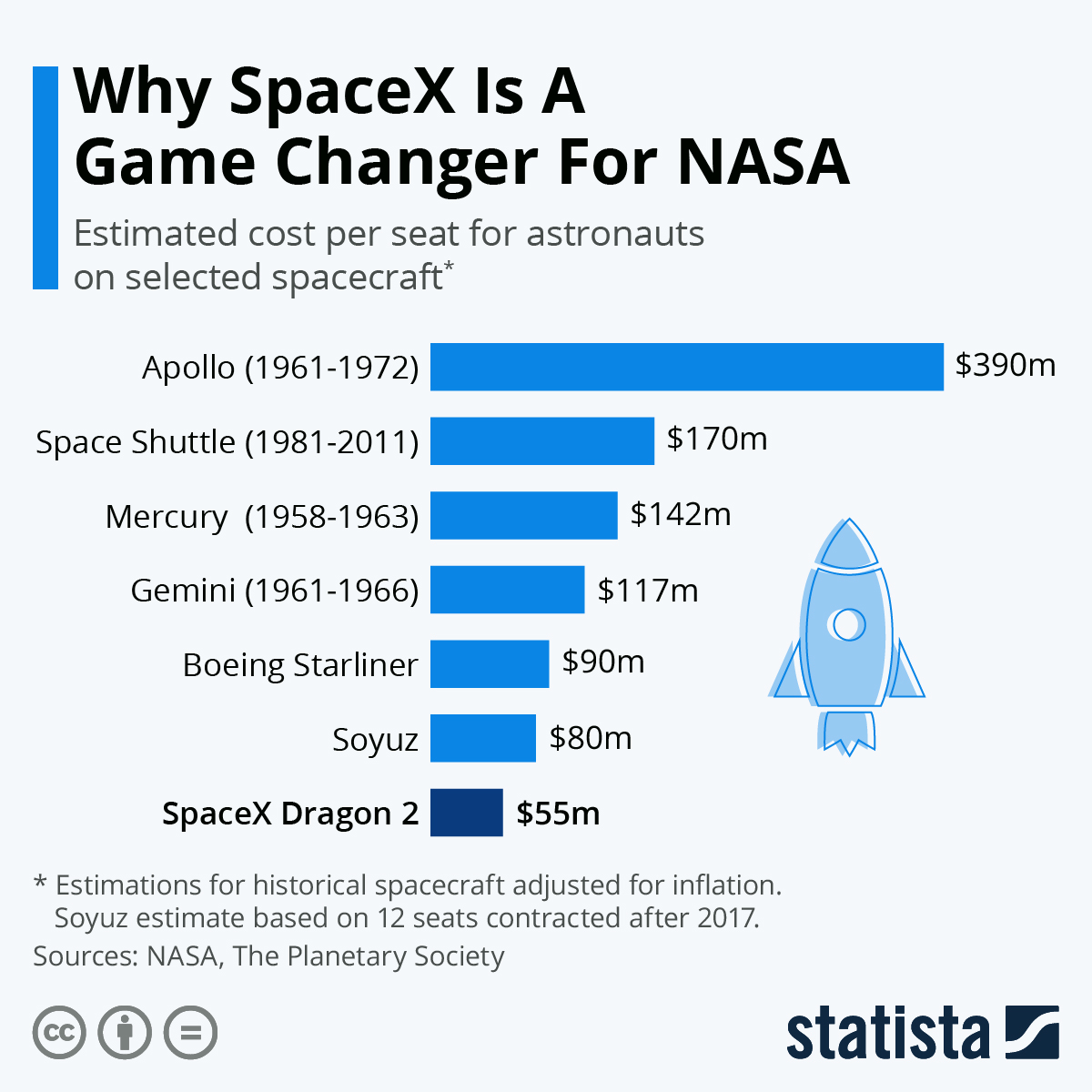
- The above chart describes the estimated cost per seat for astronauts on selected spacecraft Apollo (1961 to 1972): $390 million; Space Shuttle (1981-2011): $170 million; Mercury (1958 to 1963): $142 million; Gemini (1961 to 1966): $117 million; Soyuz: $80 million, and SpaceDragon 2 ($55 million).
2023 and Counting:
- Launch Supremacy: 2023 saw SpaceX further solidify its position as the world’s leading launch provider. They shattered their record by achieving a staggering 96 launches, translating to roughly one launch every four days.
- Reusable Rocket Revolution: Their commitment to reusability continues. In 2023, a significant portion of Falcon 9 boosters successfully landed after launch, highlighting their efforts to reduce launch costs.
- Starlink’s Expansion: Starlink continues its rapid growth. By 2023, it had launched over 3,660 satellites, making up half of all active satellites in orbit. It’s well on its way to achieving its ambitious goal of providing global internet access.
2024 and Beyond: Eyes on the Horizon
- Breaking New Records: 2024 promises to be another record-breaking year for SpaceX. They’ve set an ambitious target of 148 launches, aiming for a launch every other day. With over 50 successful launches completed so far (as of May 22), they’re on track to achieve this phenomenal feat.
- Starship Takes Flight: May 2024 marked a significant milestone with the successful third developmental launch of Starship. This massive spacecraft, designed for Mars missions, signifies crucial progress toward interplanetary travel.
- Financial Future: Revenue is projected to surge in 2024. Estimates suggest SpaceX could reach a total revenue of $13.3 billion due to the increased launch cadence and Starlink subscriptions. This could even be lower than their projections, highlighting their confidence in their financial success.
Launch Frenzy:
- Record Holder: In 2022, SpaceX set a blistering pace, averaging a launch every six days! This incredible feat resulted in a record-breaking 61 launches for the year, making the Falcon 9 the most-launched single rocket type in a year.
- Nailing the Landing: SpaceX is a champion of reusability. By 2022, out of 117 Falcon 9 launches, a staggering 111 successfully landed their booster rockets after launch! This reusability significantly reduces launch costs.
- High Success Rate: They boast an impressive launch success rate. Falcon 9 rockets have a remarkable track record, flying 346 times with only two malfunctions, translating to a very high success rate of 99.4%.
Starlink Takes Center Stage:
- Mega Constellation Ambitions: SpaceX is building Starlink, a massive constellation of internet-providing satellites. By 2023, they had launched a mind-boggling 3,660 Starlink satellites, making up a whopping half of all active satellites in orbit!
- Global Reach: Their goal is audacious – to launch a total of 29,988 satellites, providing internet access almost everywhere on Earth.
- Dominating the Skies: With so many operational Starlink satellites, SpaceX has surpassed the total number of satellites from all other countries combined!
Financial Force:
- Rapid Ascent: SpaceX has witnessed phenomenal financial growth. By 2021, they had secured over $6 billion through various funding rounds. Their valuation has skyrocketed to a staggering $74 billion in February 2021.
Beyond the Numbers:
These statistics showcase SpaceX’s leadership in space exploration. Here are some additional noteworthy achievements:
- Space Tourism Takes Off: In 2020, SpaceX sent the first private citizens on a historic trip to orbit aboard a Crew Dragon capsule, marking a giant leap forward in space tourism.
- Reaching for Mars: Colonizing Mars is a major goal for SpaceX. They are developing Starship, a massive reusable launch vehicle and spacecraft system designed to carry humans and cargo to Mars and beyond.
- Revolutionizing Spaceflight: SpaceX’s focus on reusable rockets and cost reduction has the potential to make Space travel more accessible and affordable, opening doors for future space exploration endeavors.
Looking Ahead – A Brighter Space Age
SpaceX’s unwavering commitment to innovation is shaping the future of space exploration:
- Making Space Affordable: Their focus on reusable rockets has significantly reduced launch costs, paving the way for a more affordable space industry. This opens doors for more scientific missions, space tourism, and exploration endeavors.
- Connecting the World: Starlink’s global internet access has the potential to bridge the digital divide, providing internet connectivity to remote and underserved areas.
- Inspiring the Next Generation: SpaceX’s achievements are inspiring a new generation to dream big and pursue careers in science, technology, engineering, and mathematics (STEM) fields. This will be crucial for continued advancements in space exploration.
Conclusion
With its relentless pursuit of innovation and ambitious goals, SpaceX is sure to continue making headlines. They are pushing the boundaries of what’s possible in space exploration, inspiring a new generation to reach for the stars. Hopefully, all the analyses of SpaceX Statistics described have guided you well in understanding the success behind the company and its current status.