








Beginning
Abortion Statistics: Abortion is a medical procedure that ends a pregnancy. It is a common part of healthcare and may be chosen for many reasons, including health problems, pregnancy complications, personal choice, or difficult life situations. Depending on the stage of pregnancy, abortion can be done with medicines or a simple medical procedure.
Although it is a common medical service, abortion remains one of the most discussed topics around the world because of different legal, religious, and personal beliefs. Learning the facts about abortion, its types, benefits, risks, and laws can help people make informed decisions and better understand this important healthcare topic.
Top Recommendation
- 1,126,000 abortions were provided by US clinicians in 2025, a 21% increase compared to 2020.
- The US abortion rate reached 16.7 abortions per 1,000 women aged 15–44 in 2025.
- Around 93% of abortions occur within the first 13 weeks of pregnancy, making the procedure very safe in most cases.
- 53.3% of US abortions in 2022 were early medication abortions, reflecting the growing use of abortion pills.
- Telehealth accounted for 27% of abortions in early 2025, highlighting the rapid growth of remote abortion care.
- Online-only clinics provided 24% of clinician-performed abortions in 2025, up from 12% in 2023.
- Around 142,000 people traveled to another state for abortion care in 2025, representing 13% of all abortion patients.
- Globally, about 34 million abortions each year are unsafe, and 97% occur in low- and middle-income countries.
- Financial concerns were the leading reason for abortion, cited by around 40% of people, followed by timing (36%) and partner-related reasons (31%).
- Greenland has the world’s highest abortion rate at 84.7 abortions per 1,000 women, followed by Vietnam (64) and Madagascar (60).
Interesting Facts about Abortion
- Approximately 1 in 4 women in the U.S. will have an abortion by age 45, making it a relatively common medical procedure.
- Abortions, particularly in the first Trimester, are extremely safe, with major complications occurring in less than 0.3% of cases.
- In 2021, medication abortions accounted for 53% of all abortions in the U.S., offering a non-invasive option for early pregnancy termination.
- The majority of abortions (93%) occur within the first 13 weeks of pregnancy, significantly reducing the risk of complications.
- Access to safe abortions is linked to better economic outcomes for women. Legal abortion is associated with higher educational attainment and greater workforce participation among women.
Global Unsafe Abortion Statistics
- According to msichoices.org, 34 million abortions each year are considered unsafe, representing nearly half of all abortions worldwide.
- About 97% of unsafe abortions occur in low- and middle-income countries.
- Approximately 247,000 women die each year from pregnancy, abortion, and childbirth-related causes.
- Unsafe abortions account for 8%-11% of all maternal deaths globally.
- 40% of women live in countries where abortion is restricted or difficult to access.
Key Abortion Statistics in the United States
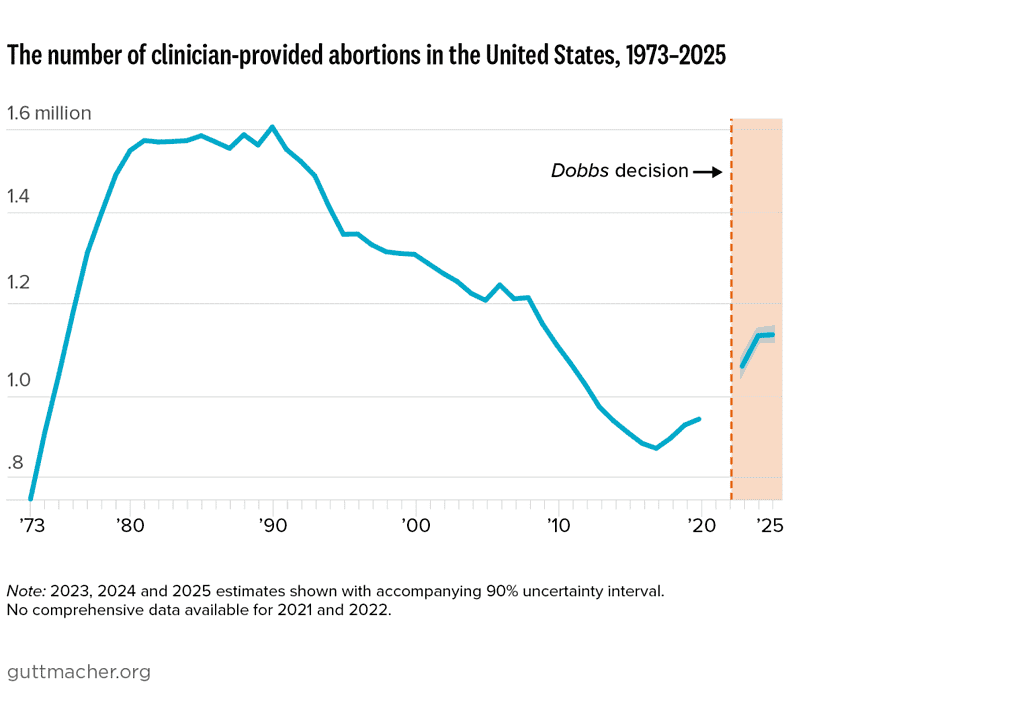
(Source: guttmacher.org)
- An estimated 1,126,000 abortions were provided by US clinicians in 2025.
- The total number of abortions increased by 21% compared to 2020, the last full year before the Dobbs decision.
- The abortion rate was 16.7 abortions per 1,000 women aged 15-44 in 2025.
Abortion Providers
- According to guttmacher.org, by the end of 2025, the United States had 753 clinics providing abortion services, down 2% from 765 clinics in 2024 and 7% lower than 807 clinics in 2020.
- The 13 states with total abortion bans had no abortion clinics in 2025, compared with 62 clinics in 2020.
- In the other 37 states and the District of Columbia, the number of clinics increased by 8, representing a 1% rise since 2020.
- Online-only clinics became more important, providing 24% of all clinician-performed abortions in 2025, up from 20% in 2024 and 12% in 2023.
Out-of-State Travel
- Around 142,000 people traveled to another state for abortion care in 2025, down 8% from 154,000 in 2024 and 16% below the 2023 peak.
- In 2025, 13% of all abortion patients received care outside their home state.
U.S. Public Views on Abortion Decisions and Embryo Rights
(Source: pewresearch.org)
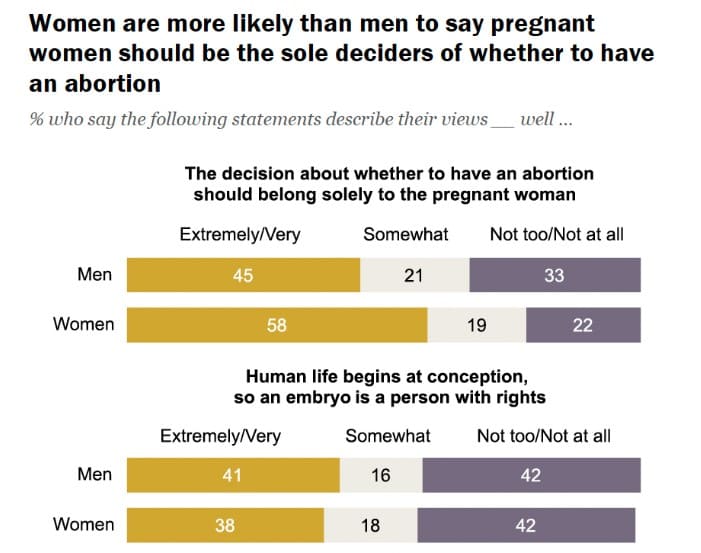
- In a January 2026 U.S. survey, 58% of women and 45% of men said the decision to have an abortion should belong entirely to the pregnant woman.
- A further 21% of men and 19% of women somewhat agreed with this statement.
- However, 33% of men and 22% of women felt this description did not match their views well.
- On the belief that human life begins at conception and an embryo has rights, 41% of men and 38% of women felt this described their views extremely or very well.
- An additional 16% of men and 18% of women somewhat agreed, while 42% of both men and women said this did not describe their views well at all.
Abortions Safety Statistics
- The Centers for Disease Control and Prevention (CDC) reports that the risk of death associated with childbirth is approximately 14 times higher than that associated with abortion.
- Most abortions (93%) occur within the first Trimester, significantly reducing the risk of complications.
- Early medication abortions (up to 9 weeks of gestation) account for 53% of all abortions.
- As mentioned in Abortion Statistics, globally, about 45% of all abortions are unsafe, often performed by untrained individuals using dangerous methods.
- Only about 2% of women undergoing abortions experience minor complications such as infection or incomplete abortion.
- Severe complications, such as heavy bleeding or uterine perforation, are extremely rare and occur in less than 0.3% of cases.
Views on Abortion Statistics by Gender
(Reference: pewresearch.org)
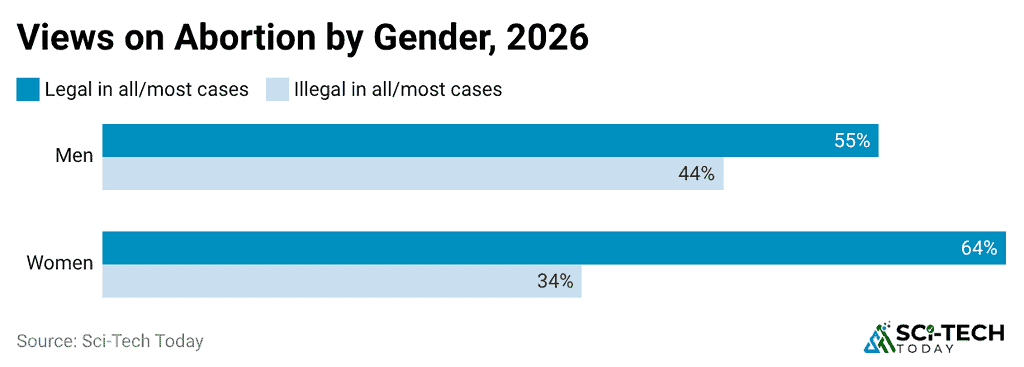
- In 2026, 64% of women think abortion should be legal in all or most cases, while 34% say it should be illegal in all or most cases.
- Among men, 55% support abortion being legal in all or most cases, and 44% believe it should be illegal in all or most cases.
By Race and Ethnicity
- A report by Pew Research found that in 2026, 58% of White adults say abortion should be legal in all or most cases, while 40% say it should be illegal in all or most cases.
- Among Black adults, 71% support legal abortion in all or most cases, and 26% oppose it as illegal in all or most cases.
- For Hispanic adults, 56% favor legality and 42% view abortion as illegal in all or most cases.
- Asian adults show the highest support, with 73% legal versus 27% illegal.
By Age
(Reference: pewresearch.org)
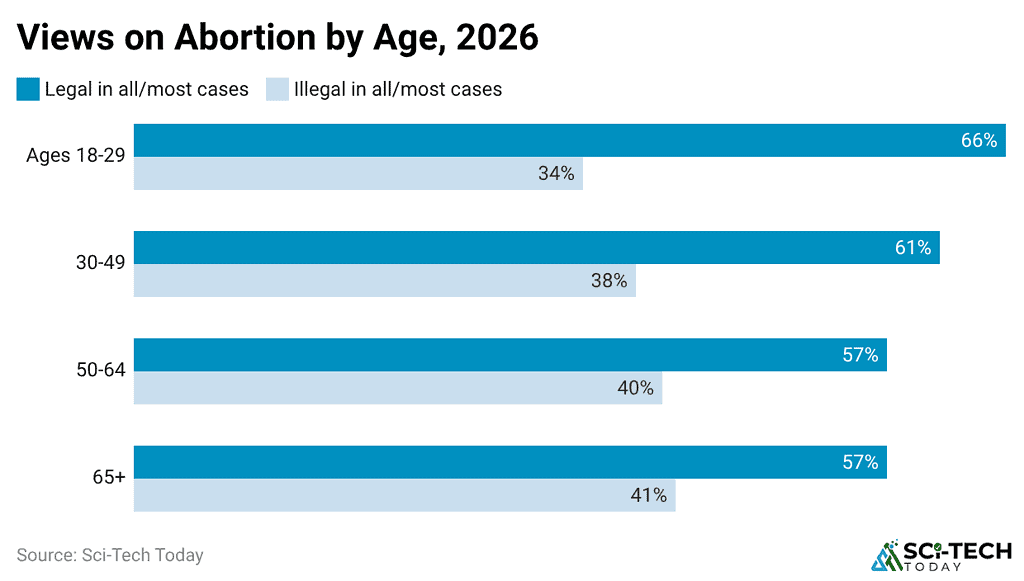
- As of 2026, 66% of adults aged 18-29 say abortion should be legal in all or most cases, while 34% believe it should be illegal in all or most cases.
- Among adults aged 30-49, 61% support legal abortion and 38% think it should be illegal in all or most cases.
- For adults aged 50-64, 57% favor legality, compared with 40% who prefer it to be illegal.
- Adults aged 65+ show similar views, with 57% supporting legal abortion and 41% opposing it as illegal in all or most cases.
By Education Level
- Around 54% of adults with high school or less say abortion should be legal in all or most cases, while 44% think it should be illegal in all or most cases.
- Among adults with some college, 61% support legal abortion and 38% oppose it as illegal in all or most cases.
- For college graduates and above, 65% favor legality, compared with 33% who say abortion should be illegal in all or most cases.
Countries with the Highest Abortion Rates
(Source: worldpopulationreview.com)
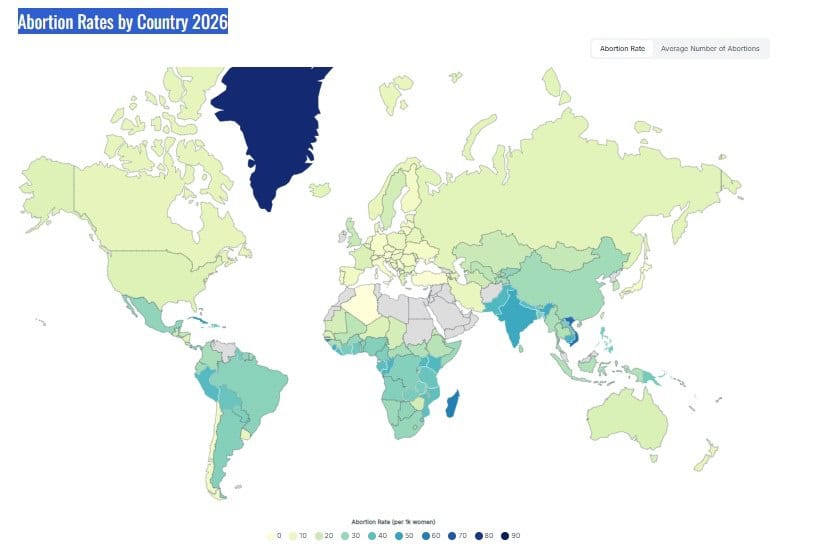
- Greenland recorded the world’s highest abortion rate at 84.7 abortions per 1,000 women.
- Vietnam ranked second with 64.0 abortions per 1,000 women.
- Madagascar reported 60.0 abortions per 1,000 women.
| Country | Abortion Rate (per 1K Women) | Average Number of Abortions |
| Guinea-Bissau | 59.0 | 26.6K |
| Cuba | 55.0 | 147K |
| Cape Verde | 49.0 | 7.1K |
| India | 48.0 | 16.6M |
| Trinidad and Tobago | 48.0 | 17.1K |
| Cambodia | 45.0 | 195K |
| Sierra Leone | 45.0 | 82.6K |
| Barbados | 45.0 | 3K |
| Republic of the Congo | 44.0 | 54.7K |
| Pakistan | 43.0 | 2.2M |
| Kenya | 43.0 | 551K |
| Uganda | 43.0 | 418K |
| Samoa | 43.0 | 1.8K |
| Peru | 42.0 | 353K |
| Liberia | 42.0 | 47.6K |
| Maldives | 42.0 | 4.7K |
| Nepal | 41.0 | 348K |
| Gabon | 41.0 | 21.1K |
| Mozambique | 40.0 | 277K |
| Vanuatu | 39.0 | 2.8K |
| Sao Tome and Principe | 39.0 | 1.9K |
| Tanzania | 38.0 | 482K |
| Bolivia | 38.0 | 108K |
| Haiti | 38.0 | 111K |
| Jamaica | 38.0 | 29.8K |
| Ghana | 37.0 | 266K |
| Dominican Republic | 37.0 | 101K |
| Saint Lucia | 37.0 | 1.9K |
| Philippines | 36.0 | 973K |
| Papua New Guinea | 36.0 | 77.2K |
| Guyana | 36.0 | 7.3K |
| Bangladesh | 35.0 | 1.6M |
| Ivory Coast | 35.0 | 207K |
| Zambia | 35.0 | 140K |
| Cameroon | 34.0 | 201K |
| Laos | 34.0 | 64.1K |
| Paraguay | 34.0 | 60.9K |
| Timor-Leste | 34.0 | 10.1K |
| Nigeria | 33.0 | 2M |
| DR Congo | 33.0 | 593K |
| Argentina | 33.0 | 368K |
| Angola | 33.0 | 229K |
| Brazil | 32.0 | 1.8M |
| Benin | 32.0 | 84.3K |
| Togo | 32.0 | 60.3K |
| Solomon Islands | 32.0 | 4.9K |
| Bhutan | 32.0 | 6.4K |
| Belize | 32.0 | 3.3K |
| Mexico | 31.0 | 1M |
| Malawi | 31.0 | 134K |
| Kyrgyzstan | 31.0 | 49.5K |
| Puerto Rico | 31.0 | 23.1K |
| Botswana | 31.0 | 18.6K |
| Comoros | 31.0 | 6.1K |
| Suriname | 31.0 | 4.5K |
| South Africa | 30.0 | 461K |
| Burkina Faso | 30.0 | 136K |
| Panama | 30.0 | 31.2K |
| Somalia | 29.0 | 93.2K |
| Namibia | 29.0 | 18.6K |
| Eswatini | 29.0 | 8.8K |
| French Guiana | 29.0 | 2.1K |
| China | 28.0 | 9.7M |
| Sri Lanka | 28.0 | 149K |
| Ecuador | 28.0 | 123K |
| Rwanda | 28.0 | 84.3K |
| Colombia | 27.0 | 360K |
| Central African Republic | 27.0 | 28.5K |
| Myanmar | 26.0 | 387K |
| Guinea | 26.0 | 77.4K |
| Burundi | 26.0 | 65K |
| Tajikistan | 26.0 | 58.1K |
| Indonesia | 25.0 | 1.8M |
| Thailand | 25.0 | 437K |
| South Sudan | 25.0 | 63.6K |
| Tonga | 25.0 | 620 |
| Ethiopia | 24.0 | 632K |
| El Salvador | 24.0 | 43.3K |
| Uzbekistan | 23.0 | 198K |
| Mali | 23.0 | 92.6K |
| Lesotho | 23.0 | 12.8K |
| South Korea | 21.0 | 50K |
| Honduras | 21.0 | 53K |
| Costa Rica | 21.0 | 27.5K |
| Eritrea | 21.0 | 16.5K |
| Mongolia | 21.0 | 17.4K |
| Djibouti | 21.0 | 5.1K |
| United Kingdom | 20.6 | 252.1K |
| Kazakhstan | 20.1 | 71.4K |
| Guatemala | 19.0 | 85.4K |
| Turkmenistan | 19.0 | 28.9K |
| Zimbabwe | 18.0 | 67.3K |
| Sweden | 18.0 | 35.5K |
| Moldova | 18.0 | 19.4K |
| Taiwan | 17.0 | 93.2K |
| Chad | 17.0 | 58.4K |
| Mauritania | 17.0 | 17.8K |
| Australia | 16.0 | 93.8K |
| Gambia | 16.0 | 8.8K |
| France | 15.7 | 243K |
| Niger | 15.0 | 69K |
| Senegal | 15.0 | 57.9K |
| Greece | 15.0 | 34.6K |
| United States | 14.4 | 930.2K |
| Nicaragua | 14.0 | 26.8K |
| North Macedonia | 14.0 | 7.3K |
| Russia | 13.1 | 553.5K |
| Iceland | 13.0 | 990 |
| Armenia | 12.8 | 10.7K |
| Canada | 12.0 | 97.5K |
| Denmark | 12.0 | 14.6K |
| New Zealand | 12.0 | 13.1K |
| Bulgaria | 11.9 | 19.3K |
| Azerbaijan | 11.8 | 34.7K |
| Belarus | 11.4 | 16.7K |
| Norway | 11.0 | 13.1K |
| Uruguay | 11.0 | 9.5K |
| Bosnia and Herzegovina | 11.0 | 8.5K |
| Iran | 10.7 | 450K |
| Estonia | 10.3 | 3.7K |
| Poland | 10.0 | 93K |
| Hungary | 9.8 | 23.9K |
| Israel | 8.4 | 17.6K |
| Belgium | 8.0 | 19.5K |
| Spain | 7.5 | 88.3K |
| Chile | 7.0 | 33K |
| Netherlands | 7.0 | 26.5K |
| Romania | 6.7 | 31.9K |
| Finland | 6.5 | 8.3K |
| Czechia | 6.4 | 16.9K |
| Latvia | 6.4 | 2.8K |
| Slovenia | 6.1 | 2.9K |
| Ukraine | 6.0 | 64.9K |
| Montenegro | 6.0 | 860 |
| Portugal | 5.6 | 14.1K |
| Germany | 5.4 | 99.9K |
| Luxembourg | 5.2 | 559 |
| Japan | 5.1 | 122.7K |
| Switzerland | 5.1 | 10.8K |
| Singapore | 5.0 | 7.4K |
| Italy | 4.9 | 65.8K |
| Serbia | 4.8 | 8K |
| Slovakia | 4.4 | 6.2K |
| Lithuania | 4.3 | 2.8K |
| Turkey | 2.7 | 43K |
| Croatia | 2.7 | 2.6K |
| Austria | 1.3 | 1.8K |
| Albania | 1.2 | 873 |
| Algeria | 0.4 | 8K |
| Total | – | 53.8M |
Telehealth and Medication Abortion Statistics
(Source: kff.org)
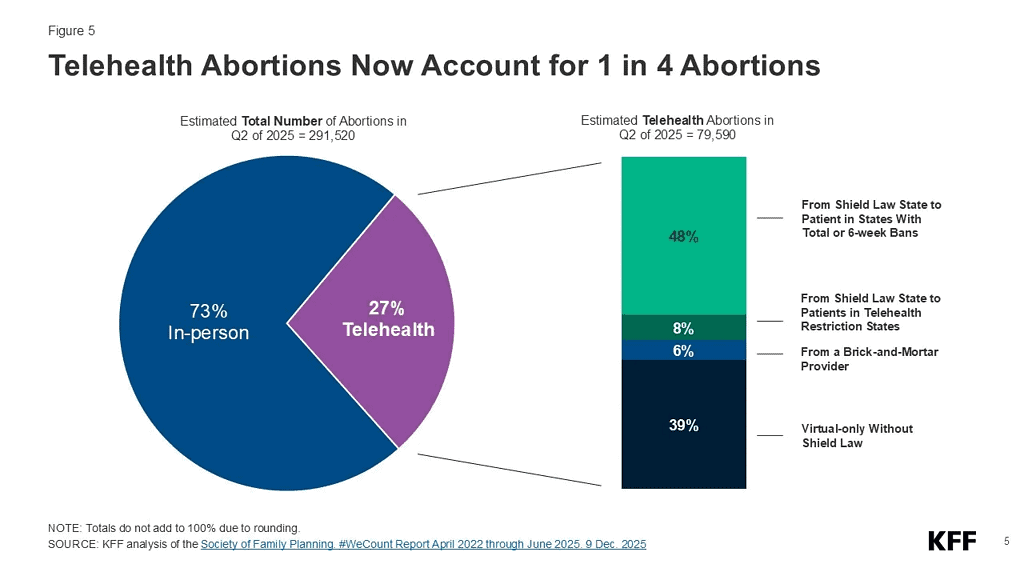
- In Q2 2025, an estimated 291,520 total abortions occurred, with 73% in-person and 27% via telehealth.
- Of the 79,590 telehealth abortions, 48% went from shield law states to patients in states with total or 6-week bans.
- Another 39% were virtual-only without shield law protection, while 8% faced telehealth restrictions and 6% came from brick-and-mortar providers.
- Online-only clinics performed 24% of clinician-provided abortions in 2025, up from 20% in 2024 and 12% in 2023.
- In 2021, about 40% of abortion facilities offered only medication abortions.
- According to the CDC, 53.3% of abortions in 2022 were early medication abortions (up to 9 weeks of pregnancy). This increased 4% from 2021 and 129% from 2013.
- The WHO estimates 73 million induced abortions occur worldwide each year, with about 45% considered unsafe.
- One large study found self-managed medication abortion was about 96% effective without surgical treatment.
- In 2026, the global abortion drugs market was valued at about USD 2,100.1 million and is projected to grow at a 7% CAGR through 2033.
- Preliminary 2026 estimates suggest medication abortions account for more than 60% of US clinician-provided abortions, although final national figures are not yet available.
Common Reasons People Choose Abortion
- A report published by Medical News Today reported that 40% of people said financial problems influenced their decision, while 4% cited unemployment and 0.6% mentioned a lack of insurance or government support.
- About 36% felt the timing was not right because they were not ready or felt too old to have a child.
- Nearly 31% gave partner-related reasons, including unstable relationships, lack of support, abuse, or wanting to marry first. Around 8% wanted to be married before having children.
- 29% wanted to focus on their existing children, and 20% said pregnancy would affect their education or career goals.
- 19% felt emotionally or mentally unprepared for parenthood.
- Approximately 12% cited health-related concerns, while another 12% wanted a better future for the child or lacked suitable housing.
- Just under 7% felt too young or dependent on others.
- Around 5% said family or friends influenced their decision.
Demand Influencing Factors
Socioeconomic Factors
- Income Levels: Higher-income countries generally have lower abortion rates due to better access to family planning services. For instance, in the United States, the rate is approximately 11.4 per 1,000 women in higher-income brackets.
- Education: Women with higher levels of education are more likely to use effective contraception, reducing the need for abortions. In countries with higher education levels, such as Germany, the abortion rate is 6 per 1,000 women.
Healthcare Access
- Contraception Availability: Easy access to a range of contraceptive methods is crucial. Countries with widespread availability of contraception, like the Netherlands, see lower rates (8 per 1,000 women).
- Healthcare Infrastructure: Strong healthcare systems that provide comprehensive reproductive health services contribute to lower abortion rates. For example, in the U.K., where healthcare is universally accessible, the rate is 17 per 1,000 women.
Cultural and Legal Factors
- Social Stigma: In societies where abortion is stigmatized, women may seek unsafe abortions, which can affect reported statistics. The rate is difficult to estimate in countries like Poland, where stigma is high.
- Legal Restrictions: Countries with restrictive laws often have higher rates of unsafe abortions. In Nigeria, the rate of unsafe abortions is estimated to be 25 per 1,000 women.
Summary
Abortion is a medical procedure that can be needed for many personal or health reasons. Knowing the facts helps people make informed decisions and avoid unsafe practices. It is important to get advice and care from a qualified healthcare provider.
Every person’s situation is different, so support, accurate information, and proper medical care are essential. Making safe and informed choices can protect both physical and emotional health.
FAQ
The main types are medical abortion (using medicines) and surgical abortion (performed by a healthcare provider).
Most people recover within a few days, though light bleeding may continue for weeks sometimes.
Common side effects include cramping, light bleeding, nausea, tiredness, and mild discomfort for a few days.

Sources