








Introduction
BYOD Security Statistics: The practice of Bring Your Own Device (BYOD), where employees use their personal smartphones, tablets, and laptops for work, has fundamentally changed the corporate perimeter.
Driven by the change to remote and hybrid work models, BYOD has become a foundational element of modern business operations. While it offers undeniable benefits in cost savings and productivity, it simultaneously introduces a sprawling, heterogeneous threat landscape that demands robust BYOD security measures.
In this article, I’d like to discuss more about the risks; it quantifies them, providing the definitive, data-packed overview of the current state and future trajectory of BYOD Security. Our analysis is built entirely on the latest market data, breach reports, and expert forecasts for 2026 and beyond. Let’s get started.
Handpicked by the Editor
- The BYOD security market is expected to rise sharply from USD 41.7 billion in 2024 to about USD 363.7 billion by 2033, according to market.us.
- 82% of organizations currently operate some form of BYOD program, and over 80% of businesses actively encourage the trend.
- Around 68% of organizations notice higher productivity after adopting BYOD practices.
- Firms using BYOD smartphones save up to USD 341 per employee, reducing hardware costs significantly.
- Data loss remains the most serious security issue related to BYOD usage.
- 91% of Americans own a smartphone in 2025, with 97% penetration among adults under 50, up from the older “95% among 18-49.”
- About 45% of employees fail to update their passwords even after a data breach.
- Almost 48% of organizations have faced data breaches linked to unsecured personal devices.
- Nearly 64% of cybersecurity experts identify data loss and leakage as their main BYOD-related worry.
- Roughly 45% of employees admit to taking risky actions on their personal mobile devices.
- Businesses can cut costs by up to 11% when switching from employer-provided devices to BYOD systems.
- The average company saves about $350 per employee each year through BYOD programs.
- Using personal devices for work can improve employee productivity by up to 55%.
- About 30% of IT leaders say that security risks are the biggest reason for delaying BYOD adoption.
- The laptop segment continues to dominate the BYOD security market, commanding approximately 48.6% market share in 2025, reflecting the laptop’s central role in remote and hybrid work environments.
- Mobile Data Security remains the leading solution segment in the BYOD security market in 2025, having commanded approximately 47%+ market share in 2023 and maintaining dominance through 2025.
- In 2025, it is projected that 71% of organizations with BYOD policies will have implemented at least a partial Zero Trust security strategy.
The Current State of BYOD Adoption
(Source: technavio.com)
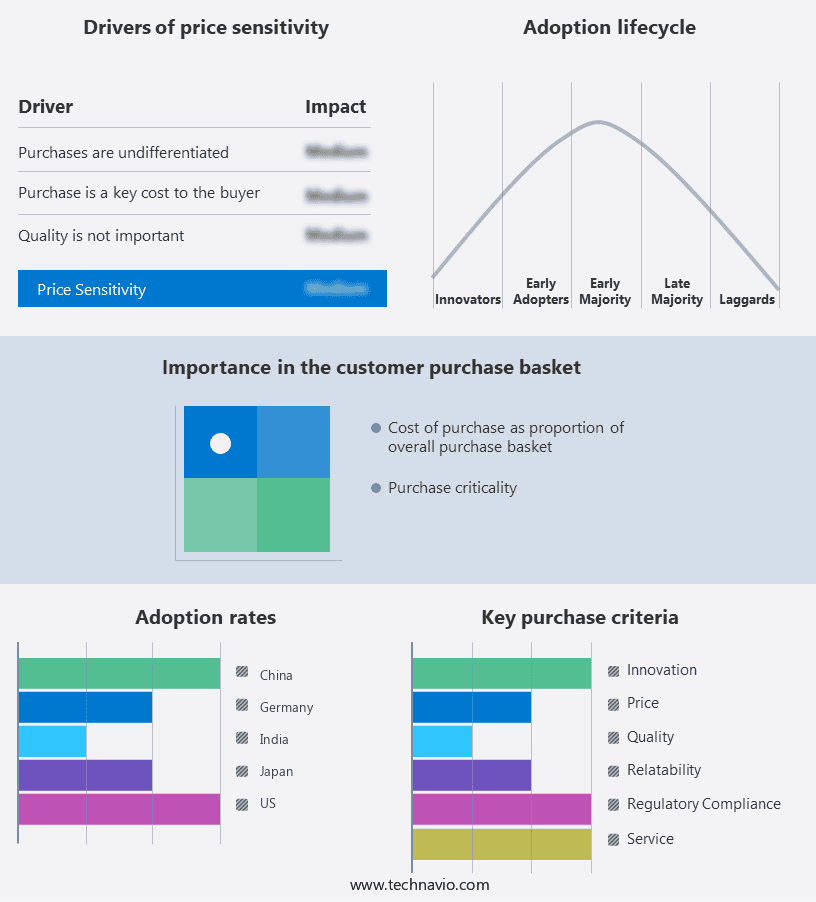
- Massive Organizational Adoption: 82% of organizations currently operate some form of BYOD program, and over 80% of businesses actively encourage the trend.
- Near-Universal Device Allowance: Nearly 95% of organizations allow employees to use personal devices for work in some capacity.
- The Unmanaged Reality: 75% of employees now use personal devices for work regardless of official BYOD policy, with 78% doing so even in organizations that explicitly prohibit it.
- Executive Reliance: A high percentage, specifically 97% of business executives, report accessing work accounts on their personal devices.
General BYOD Statistics and Trends
- Workplaces today operate under three main setups: some rely completely on company-issued devices, others follow a full Bring Your Own Device (BYOD) model, while many prefer a hybrid system that includes both.
- The global BYOD and enterprise mobility market is valued at around USD 98.8 billion and is expected to reach nearly USD 157.3 billion by 2026, showing a steady 16.7% CAGR.
- In the United States alone, this market is valued at over USD 26 billion, reflecting strong adoption across industries.
- Around 82% of organizations have already adopted BYOD practices, allowing employees to use personal devices for work-related tasks.
- Research shows that 70% of companies let employees bring their own devices, while others extend BYOD access to contractors (26%), business partners (21%), customers (18%), and suppliers (14%).
- Nearly 82% of IT executives agree that smartphones play an important role in improving employee productivity and helping them make quicker decisions.
- Over 75% of business leaders believe that mobile usage enhances innovation, teamwork, and customer service.
- About 61% of organizations expect employees to stay reachable outside the office even without providing a company device.
- Roughly 31% of IT executives report that their organizations operate fully on the BYOD model, often to cut costs and simplify device management.
- On average, companies can save about USD 300 per employee every year through mobile BYOD programs.
- Only 15% of organizations currently give employees company-issued smartphones, showing a growing preference for personal device use at work.
- Around 46% of firms follow a hybrid approach, offering phones to some staff while others use personal devices. Another 39% have fully shifted to BYOD with no issued devices.
- Businesses switching from company-issued phones to BYOD can save up to USD 341 per employee each year.
- The total cost of providing a work phone is about USD 1,234 per employee annually, covering hardware, service plans, software, and management. With BYOD, this cost falls to around USD 893.
- After introducing BYOD, 68% of organizations experience higher productivity levels among employees.
- Additional benefits include increased employee satisfaction (53%), reduced operating costs (45%), and improved workplace mobility (7%).
- Around 30% of IT teams are exploring “Bring Your Own Enhancement (BYOE)” concepts, which include wearable devices and augmented reality tools.
BYOD User Statistics
- The average employee uses 2.5 devices for work-related activities, showing how common multi-device use has become in the workplace.
- Among employees using technology, 97% rely on a desktop or laptop, 66% use smartphones, and 24% regularly use tablets for their daily tasks.
- 91% of Americans own a smartphone in 2025, with 97% penetration among adults under 50, up from the older “95% among 18-49.”
- Nearly 75% of individuals believe smartphones help them be more productive at work, and 60% say smartphones make them feel more confident and prepared.
- Employees gain an average of 58 minutes of extra work time daily when they use smartphones for job-related tasks, adding up to more than 240 hours per year. Productivity levels can increase by up to 34%, especially in large organizations that adopt smartphone-enabled work processes.
- About 50.3% of employees participate in BYOD practices, while 49.7% use only company-provided devices. Around 36.1% use both company and personal devices, and 14.4% rely solely on their own.
- Even though BYOD is common, 4 out of 5 employees would still prefer to keep separate devices for personal and work use. Only 19.3% prefer using a single device for both.
- More than half of employers allow their staff to choose between company-provided and personal devices, while 49.7% do not offer that option.
- Around 48% of employees believe BYOD adoption would increase if IT departments had no access to personal data stored on their devices. Among surveyed employees, 20% expected adoption to increase significantly and 28% predicted a moderate rise.
- Nearly 20% of organizations provide no technical support for employees using personal devices. Around 25% offer informal help, 26% only support approved devices, and 22% deliver full BYOD support programs.
BYOD Market Size Trends
(Source: market.us)
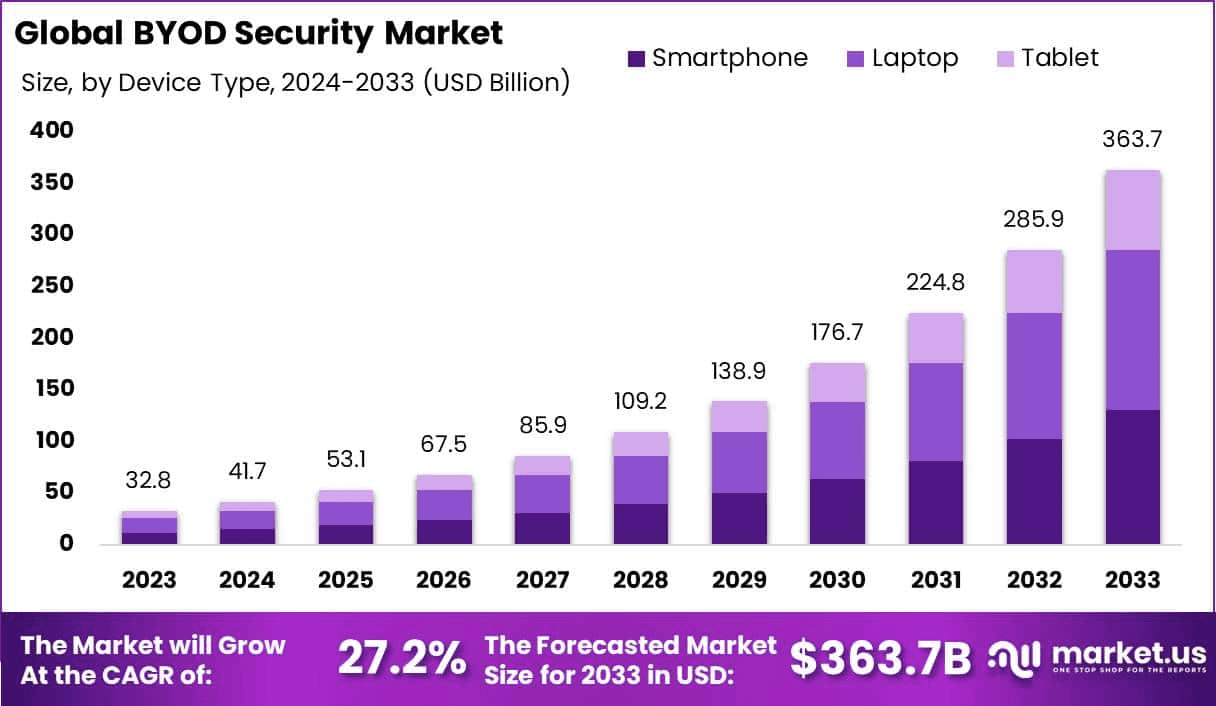
- The Global BYOD Security Market is projected to reach USD 363.7 billion by 2033, growing from USD 32.8 billion in 2023 at a CAGR of 27.2% between 2024 and 2033.
- The growing use of personal devices for work has made security a critical focus area for companies across all sectors.
- Reports indicate that the BYOD market has already reached nearly USD 100 billion, showing its rapid adoption worldwide.
- Around 82% of organizations now have a BYOD policy, proving that the use of personal devices at work has become standard practice.
- Productivity gains are a key reason for this shift, with 68% of organizations reporting better efficiency after adopting BYOD.
- Companies also achieve notable cost savings, with potential savings of up to USD 341 per employee when using personal smartphones instead of company-issued ones.
- Security concerns remain the main challenge, with data loss identified as the most common risk for businesses implementing BYOD systems.
- A concerning 45% of employees fail to change their passwords even after a data breach, which adds further vulnerability to corporate systems.
- Demand for remote accessibility continues to increase, as 61% of organizations expect employees to remain reachable without company-provided phones.
- Nearly half of all businesses now ask employees to use their own smartphones for work purposes, showing how BYOD has become a regular part of business operations.
- InThe laptop segment continues to dominate the BYOD security market, commanding approximately 48.6% market share in 2025, reflecting the laptop’s central role in remote and hybrid work environments.
- The total BYOD security market now stands at roughly USD 85 billion in 2025, on a trajectory toward USD 225 – USD 315 billion by 2033.
- North America’s leadership in the market is linked to its strong digital infrastructure and high rate of mobile technology adoption across industries.
| Productivity Boost | 68% of organizations report increased productivity after adopting BYOD policies. |
| Employee Cost Savings | Companies can save up to $341 per employee by switching to personal smartphones instead of providing them. |
| Mobility & Satisfaction | The rise of remote work and the use of familiar, flexible personal technology drive adoption |
Where the Security Battle is Being Fought?
As of 2025, the market share analysis clearly defines the biggest areas of investment and concern:
#1. Device Dominance: The Laptop’s Crucial Role
While smartphones drive the majority of overall BYOD revenue, the security focus is still heavily on traditional workhorses.
- The laptop segment continues to dominate the BYOD security market, commanding approximately 48.6% market share in 2025, reflecting the laptop’s central role in remote and hybrid work environments.
- The total BYOD security market now stands at roughly USD 85 billion in 2025, on a trajectory toward USD 225 – USD 315 billion by 2033
#2. Segment Leadership: Securing the Mobile Data Pipeline
The data being accessed and stored on these mobile devices is the top priority for security professionals.
- Mobile Data Security remains the leading solution segment in the BYOD security market in 2025, having commanded approximately 47%+ market share in 2023 and maintaining dominance through 2025.
#3. Enterprise Investment: The Titans of Security Spending
The scale of risk at the world’s largest companies mandates the most rigorous security investments.
- Large Enterprises led the security market in 2023 with more than a 58.3% share. Their vast IT infrastructures and immense data volumes require comprehensive.
#4. The Global: North America’s Cyber Focus
A region’s technological maturity and its emphasis on digital defense dictate its market leadership.
- North America remains the global frontrunner, holding the largest share of the BYOD security market at 36.4%, generating USD 11.9 billion in revenue.
BYOD Security Statistics
- Many companies choose BYOD because it reduces costs and increases employee satisfaction and efficiency. However, security remains the biggest concern for organizations.
- About 30% of companies say that security risks are the main reason stopping them from adopting BYOD, while 15% report that even employees are worried about data protection.
- Nearly 62% of cybersecurity professionals believe that data loss and leaks are the most serious threats linked to BYOD usage.
- Around 54% of companies are concerned about employees downloading unsafe content or apps on their personal devices.
- About 53% worry about lost or stolen devices exposing company data.
- Around 51% are concerned about unauthorized access to business systems and malware infections.
- Nearly 48% mention vulnerabilities in connected devices, and 45% say they struggle to maintain control over endpoint security.
- To address these challenges, firms such as CrowdStrike provide tools to protect BYOD users against data breaches and cyberattacks.
- Research shows that 45% of employees do not change their passwords even after a breach. Although 79% understand the risks of weak passwords, 51% still rely on memory, and 65% reuse similar password variations.
- Around 30% of organizations have no control or visibility over how employees use mobile messaging on personal devices.
- Nearly 41% can monitor file sharing, 37% can track cloud apps, and only 28% have visibility over private or public messages sent by employees.
- Almost 75% of companies can see employee emails on BYOD devices, but visibility drops in other areas such as calendars, contact lists, and messaging apps.
- Only 57% of firms can monitor calendars and contacts, while 50% can oversee messaging apps. Less than half can track document sharing, cloud backups, or file editing activities.
- Around 22% of companies confirm that employee devices downloaded malware within the last year, while 49% are unsure whether this has occurred.
- About 30% of companies lack proper malware protection measures, and 41% depend only on endpoint security solutions.
- Another 22% of organizations report that employees have connected to malicious Wi-Fi networks in the past year, and 51% do not know if such connections have happened.
BYOD Security Concerns Statistics
- Around 60% of IT professionals consider security their top concern when allowing employees to use personal devices for work.
- Nearly 84% of IT leaders worry about the rise of shadow IT, where employees use unauthorized applications or systems.
- The most common risks linked to BYOD include network attacks, software flaws, and ransomware infections.
- More than 20% of organizations reported malware infections caused by unmanaged personal devices in the past year.
- Nearly half of IT professionals remain unsure if similar incidents have affected their organization, suggesting that the actual figure may be higher.
- Allowing unmanaged devices increases the chance of unauthorized applications being used, creating hidden risks for IT teams.
- Lack of visibility into employee-used applications affects 32% of organizations, while 24% lack proper SaaS or asset management systems.
- About 31% of businesses say their employees move faster than IT can manage, creating security gaps.
- 29% of IT teams face difficulties in communicating security policies with partners, and 36% admit limited resources make it difficult to address shadow IT.
- Other major security concerns include overly permissive access rights (14%), fatigue from frequent multi-factor authentication (20%), and stolen or shared credentials (24%).
- Threats such as network attacks (45%), software exploits (35%), ransomware (33%), and unsecured networks (25%) are among the most reported risks.
- According to Verizon’s 2024 report, more than 90% of security incidents involving lost or stolen devices led to data breaches.
- Around 88% of such breaches involved internal actors, increasing insider threats.
- Personal data was exposed in 97% of these cases, internal business data in 42%, and financial data in 25%.
- About 68% of breaches were caused by human error or social engineering.
- Laptops remain the most frequently lost or stolen devices in enterprises.
- Misuse of personal privileges for profit has grown sharply, as personal devices hold valuable private information.
- Most people lose devices in supposedly safe places like their home, car, or office, and are six times more likely to be pickpocketed at work than in a bar.
- Around 97% of executives use personal devices to access work accounts, and 95% use them for multi-factor authentication.
- Nearly 89% of executives believe companies should provide cybersecurity software for protection.
- About 88% receive work-related phishing or spam messages on personal accounts, especially in smaller firms with fewer than 1,000 employees.
- Eight out of ten executives see monitoring of personal devices as an invasion of privacy, yet 73% are open to installing company security software on them.
- Around 80% of executives send work emails or texts from personal devices, higher than the 74% average among other employees.
- Three-quarters of executives say their organizations have faced cyberattacks, with high rates seen in Information Research (100%), Education (89%), and Manufacturing (81%).
- About 58% of executives say their spouse or partner can access their device, 38% say their children can, and only 30% maintain exclusive access.
Smartphones Leading the BYOD Charge
(Reference: nordlayer.com)
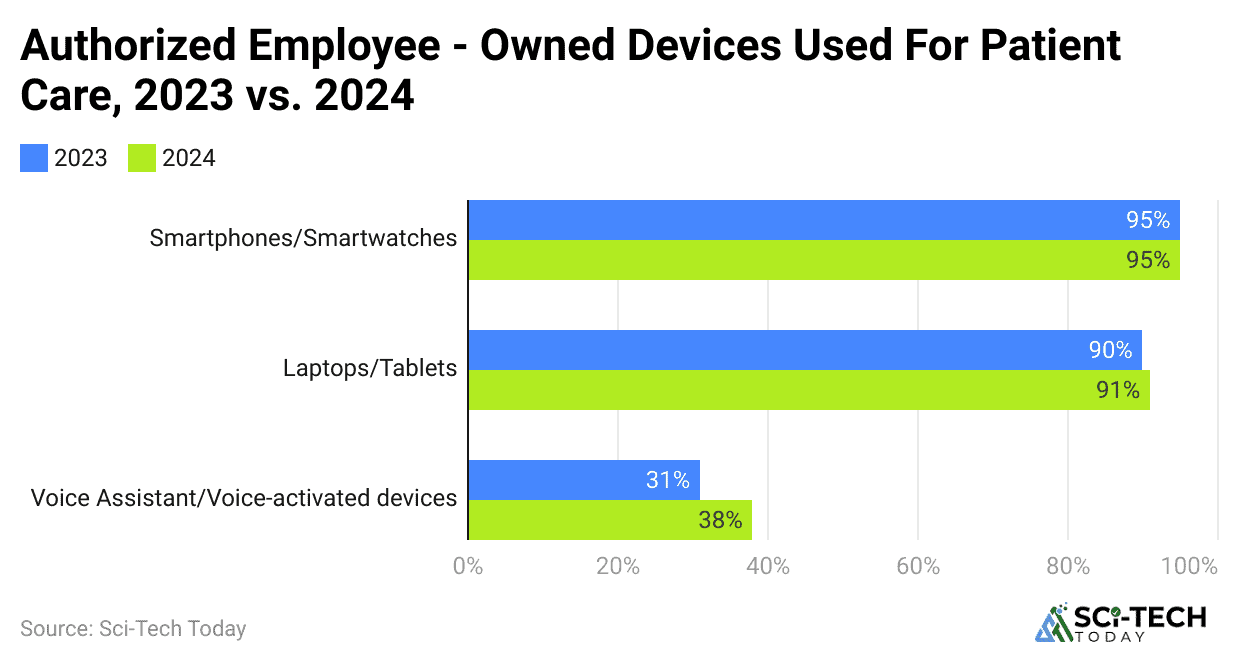
- Smartphones, tablets, and laptops all facilitate BYOD programs, but smartphones accounted for over 49% of the overall revenue in 2025..
- The development of mobile applications that replicate essential work tools, like those similar to Microsoft Word, Excel, and PowerPoint, has cemented the smartphone’s role as a primary business device.
BYOD Security Risks By Quantifying the Vulnerability Landscape
(Reference: mdpi.com)
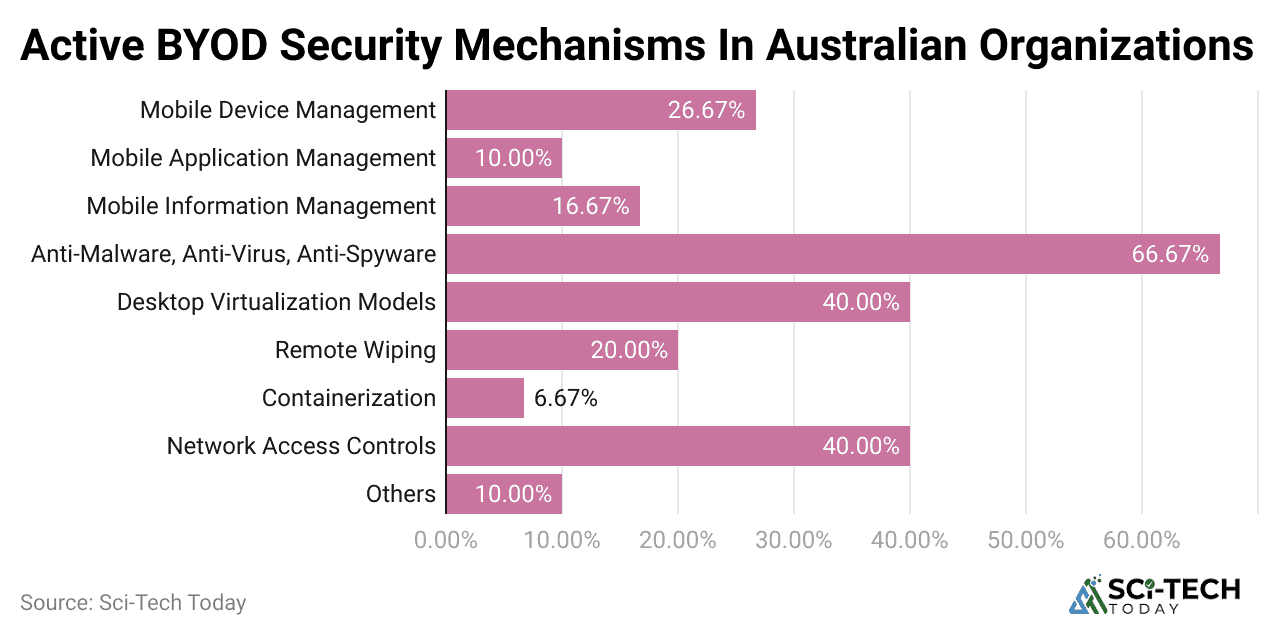
- Approximately 48% of organizations have reported suffering a data breach that was directly linked to an unsecured or unmanaged personal device within the past year.
- Incident Rate: Over 53% of organizations experienced a mobile or IoT-related security incident that resulted in data loss or downtime during 2024..
- Data loss and leakage is cited as the number one concern for approximately 64% of cybersecurity professionals when considering BYOD security protocols.
- More than one in five organizations confirmed that a digital asset had downloaded malware as a direct result of connecting an unmanaged device to the network within the last 12 months.
- A concerning 45% of employees admitted to engaging in actions they knew were risky on mobile devices.
- A majority of security leaders, around 84%, are worried about the risks introduced by “Shadow IT”.
- Nearly 45% of employees confess to using the same password for both work and personal accounts.
| Organizations reporting a breach linked to unsecured personal devices | 48% |
| Cybersecurity professionals naming data loss as the top BYOD security concern | 64% |
| Percentage of employees who admit to risky mobile behavior | 45% |
| Percentage of organizations who experienced a mobile-related incident in 2024 | 53% |
Financial and Productivity Implications
(Reference: cisco.com)
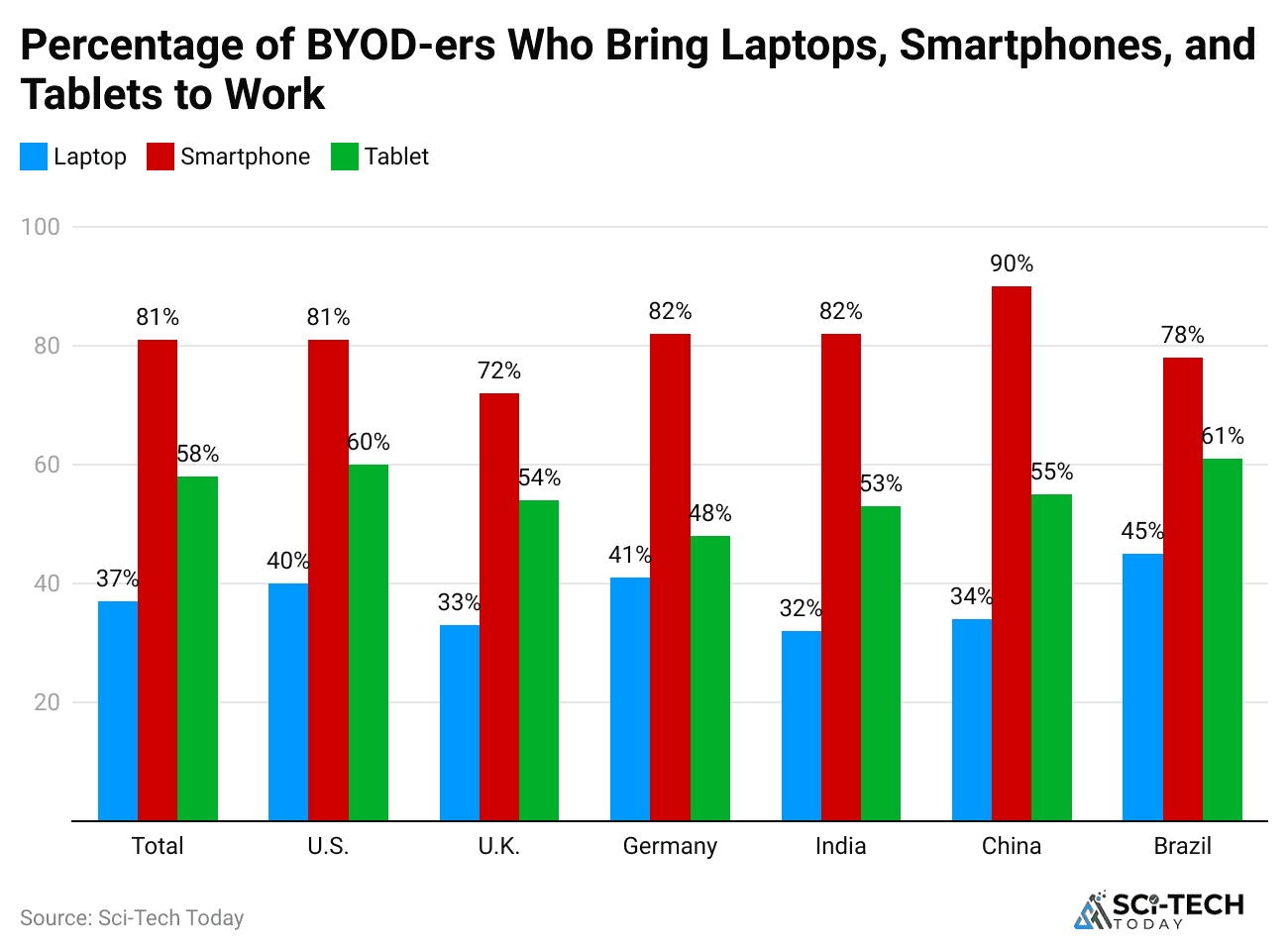
- Companies can realize cost savings of up to 11% by transitioning from providing Employer-Provided Devices (EPD) to a fully implemented BYOD policy for their staff.
- Implementing a sound BYOD program can save an organization an average of $350 per team member each year.
- Boosted Productivity and Job Satisfaction: Working with personal devices is linked to boosting employee productivity by up to 55% and increasing overall job satisfaction by 56%.
- The average cost of a data breach is estimated to be in the millions of dollars, meaning the savings gained from a BYOD program can be negated instantly by a single.
- Despite the clear benefits, 30% of IT leaders still cite information security concerns as the single biggest obstacle to officially adopting a comprehensive BYOD program.
| Potential savings from switching to BYOD (percentage) | 11% |
| Average annual cost saving per BYOD employee | 350% |
| Productivity increase linked to BYOD usage | 55% |
| IT leaders citing security as the main obstacle to BYOD adoption | 30% |
Adoption of BYOD Security Solutions
(Source: mdpi.com)
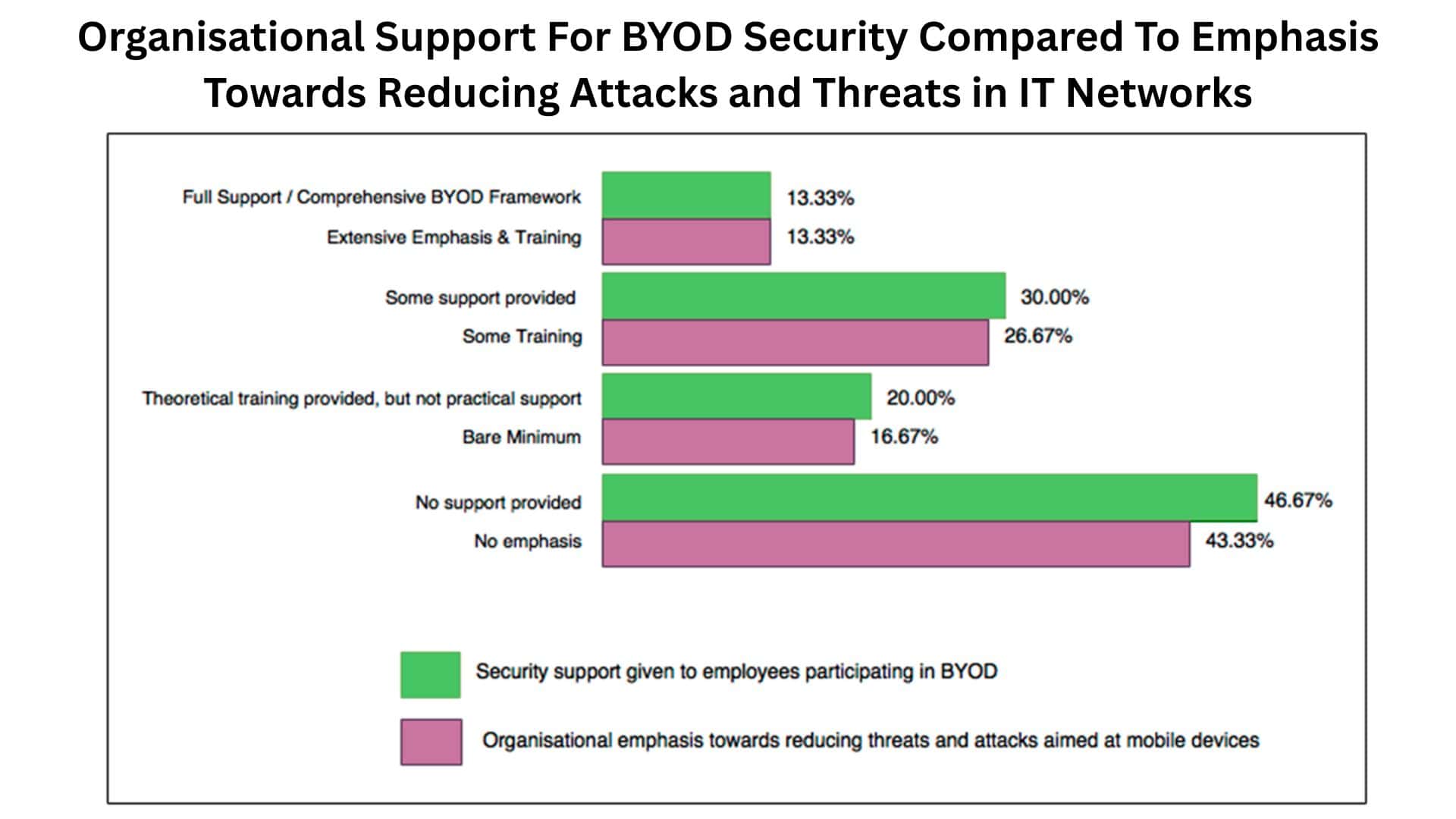
- The number of companies operating with a formal, written BYOD policy rose from 39% in 2023 to an estimated 67% by late 2025.
- In 2025, it is projected that 71% of organizations with BYOD policies will have implemented at least a partial Zero Trust security strategy.
- Mobile Device Management (MDM) solutions held the largest share of the BYOD security market, approximately 41.08% in 2025.
- AI-driven security solutions are expected to constitute nearly 30% of the overall security market share in 2025.
- A substantial 73% of employees have stated they would allow their employer to install company security software on their personal device to improve operational BYOD security.
- The Large Enterprises segment is poised to capture over 66.4% of the total BYOD security market revenue by 2035.
| Organizations with a formal BYOD policy (Late 2025) | 67% |
| Organizations with a partial Zero Trust strategy (End of 2025) | 71% |
| Market share of Mobile Device Management (MDM) (2025) | 41.08% |
| Projected market share of AI-driven BYOD security solutions (2025) | 30% |
BYOD and Emerging Threats
(Reference: helpwire.app)
- The market for wearables and other endpoints is projected to record a high CAGR of 16.43% through 2030.
- The proliferation of 5G-enabled smart devices is expected to contribute a 3.2% increase to the overall BYOD market CAGR.
- The rising cost of cyber-insurance premiums, which is directly linked to the presence of unmanaged endpoints, is acting as a major restraint with a projected 1.8% impact on the CAGR in North America and Europe.
- While North America currently dominates the market for BYOD security solutions, the Asia Pacific region is projected to be the fastest-growing market, with a forecast 16.30% CAGR.
- Modern strategies are heavily integrating solutions like Virtual Desktop Infrastructure (VDI) and Secure Access Service Edge (SASE) to manage unmanaged devices.
BYOD Security Concerns
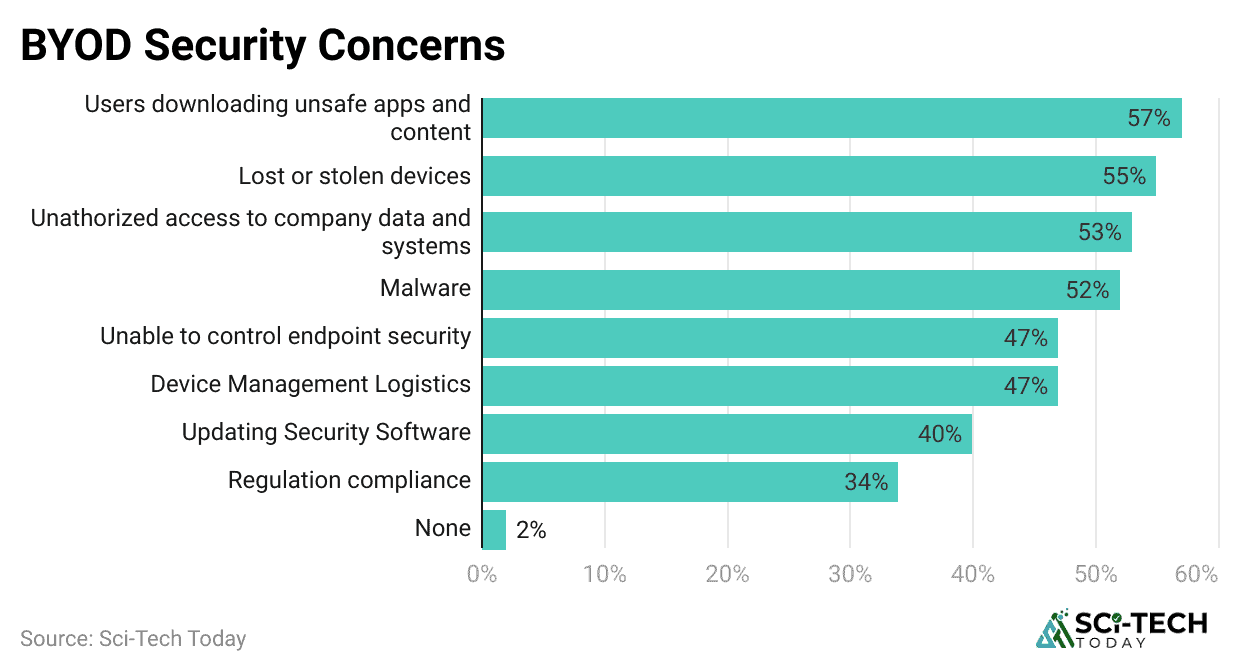
- 60% of JumpCloud survey respondents stated that security was their main concern.
- 84% of IT professionals expressed their fear about the threats associated with shadow IT.
- Attacks on the network, software vulnerabilities, and ransomware were also considered as security problems related to BYOD.
- More than 20% of organizations acknowledged that their digital assets were hit by malware because of unmanaged connections of devices in the previous year.
- Almost half of the respondents were unsure whether their organization faces such problems or not, indicating that the true figure may be much bigger.
- 32% of respondents pointed out the absence of visibility regarding what applications are used by employees when accessing the company’s assets.
- Absence of SaaS or asset management tools to deal with shadow IT-related problems was reported by 24% of organizations.
- 31% of businesses claimed that users act too fast for the company to cope with their needs.
- 29% of respondents indicated the absence of effective communication channels with business partners to build necessary policies.
- Insufficient resources to fight against shadow IT threats, along with other high-priority tasks, were stated by 36% of respondents.
- 14% of respondents named excessive permissions as one of the primary concerns.
Summary
Overall, Bring Your Own Device (BYOD) is the new corporate standard, with adoption rates nearing 95% and the supporting BYOD security market swelling toward an estimated $276 billion by 2030. This trend is driven by an impressive 55% increase in productivity and significant cost-saving opportunities.
However, these gains come with a quantified cost of risk. The fact that nearly 50% of organizations have experienced a breach linked to an unsecured personal device serves as the starkest warning.
So, organizations that embrace a Zero Trust model, invest in MDM/UEM platforms, and commit to continuous employee training will be the ones that effectively harness the benefits of a highly mobile, flexible workforce without succumbing to the escalating threat of mobile-induced data breaches. I hope you guys like this piece of content. If you have any questions, kindly let us know. We will try to answer you ASAP, thanks for staying till the end.
FAQ
Former employees who still have company data stored in their own devices become a risk for data breach because of unauthorised access. Without proper measures for data transfer and disposal from personal devices, companies risk a data breach.
82% of all organisations have a BYOD policy. Organisations depend on employees having their personal smartphones to access mobile applications and corporate network. 61% of companies expect employees to be reachable remotely even without providing them with a company phone
Educated employees are crucial when it comes to mitigating BYOD risks. Organisations should conduct regular training for employees concerning security practices for personal devices. Employees need to understand risks related to BYOD and how they can avoid them.


