





Brief Overview
Social Media Attention Span Statistics: The current time presents an introduction to a world where people establish connections through multiple channels, which makes their ability to pay attention to things more important than their financial resources. The average consumer today demonstrates the ability to handle multiple tasks while watching social media content because they lose interest at an even faster rate than before.
The year 2025 shows a fundamental change in social media usage because people now use multiple devices to watch content, which results in brands and creators competing for brief periods of user attention while advertisers spend billions on quick-moving online advertisements.
This article presents a comprehensive analysis of 2026 social media attention span statistics, which include research data, usage statistics, and data about industry advertising expenditures.
The Editor’s Ultimate Picks
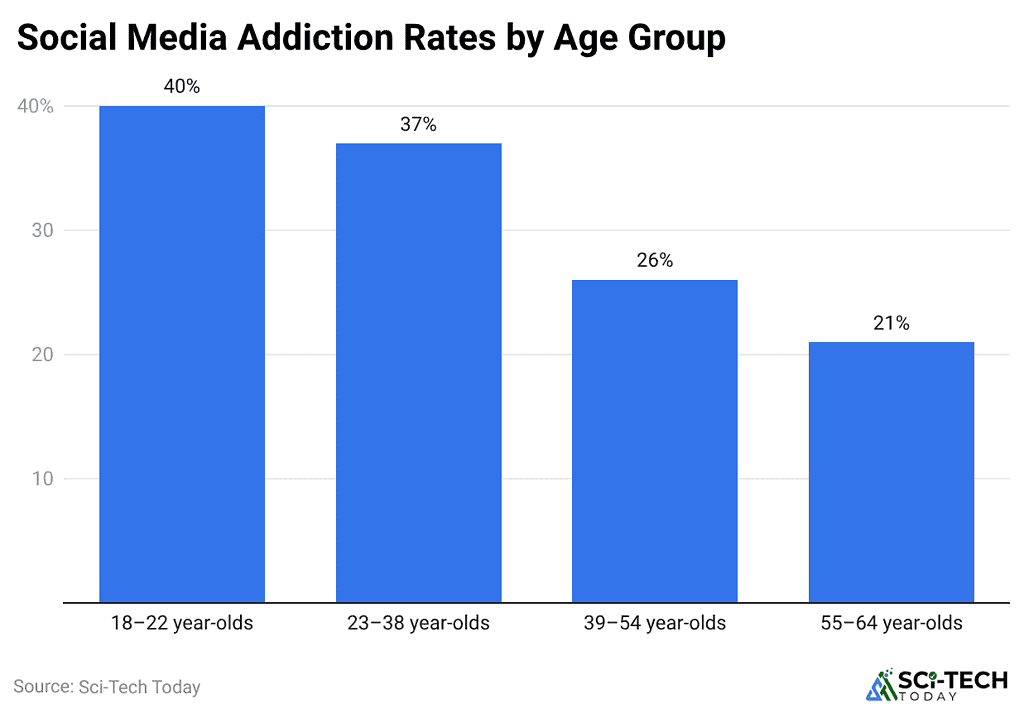
- Social media addiction affects 40% of users aged 18 to 22 because they struggle to maintain their focus on tasks.
- Millennials (23–38) follow closely with a 37% addiction rate, driven by habitual and work-related usage.
- Users aged 55 to 64 show a 21% social media addiction rate, which shows they have learned to manage their time better.
- Gen Z averages just 6.5 seconds of attention per social media post.
- Pre-teens demonstrate the shortest digital focus at 4.2 seconds on fast-scroll platforms.
- The attention span of people who reach their 25th birthday decreases by 19% because they develop better skills to filter out unnecessary content.
- Influencer reels under 20 seconds generate 3.7× higher engagement, but only 12% brand recall.
- TikTok users spend 69 minutes daily, the highest across platforms.
- YouTube users watch content for 59 minutes per day, which helps them maintain their focus on longer videos.
- People who check their phones 96 times per day face interruptions that break their focus multiple times throughout the day.
- People who use their devices for more than five hours every day have a 33% greater chance of developing attention problems.
- Users who primarily use mobile devices demonstrate 20% lower ability to maintain focus compared to users who primarily use desktop computers.
Social Media Addiction Levels Across Different Age Groups
(Reference: sqmagazine.co.uk)
- According to SQ Magazine, the above data shows that digital dependency decreases as people get older, which connects to changing social media attention span patterns that different generations experience.
- The group of young adults, ages 18-22, is the most addicted group at 40% due to their constant interaction with social media platforms, consumption of short videos, and their multitasking skills.
- Social media addiction among this group is driven by reels, stories, and feeds that have algorithms making them watch for longer periods.
- Those millennials aged between 23 and 38 years have an addiction rate of 37%, thus showing how digital life in the workplace and the tendency to scroll make them become overly active online.
- Those individuals aged between 39 and 54 years have an addiction rate of 26%, thus showing how they are less inclined to social media and have long periods of undivided attention.
- Those users aged between 55 and 64 years have an addiction rate of 21%, thus making them the least addicted since they use the social media less and are more intentional in its use.
- The statistics show that younger people face higher chances of experiencing digital overexposure, while older people display improved control over their online time because they prefer different types of content and demonstrate distinct ways of focusing.
Key Reasons Behind The Decline Of Attention On Social Media Platforms
- Social media platforms have developed shorter attention spans because of their fundamental design, which allows users interact.
- People experience information overload because they encounter between 9,000 and 12,000 ads every day, which forces them to evaluate content within two seconds.
- Platform architecture further accelerates this behavior. Platforms use features like infinite scroll, autoplay video, and algorithmic feeds, which enable users to consume content at high speeds while their content engagement time stays below two seconds for each post.
- Social media platforms receive more than 82% of their traffic from smartphones, which causes users to interact with content during brief periods of time instead of maintaining extended periods of engagement.
- The competition for user engagement has reached extreme levels because brand content must compete with personal updates, entertainment, and news, which appear in the same feed.
- The problem gets worse because frequent users now need only milliseconds to decide what content matters to them, which results in shorter engagement times.
- The combination of these forces leads to decreasing social media attention span, which requires businesses to demonstrate value through rapid communication methods in current online business environments.
Social Media Attention Span Differences Across Age Groups
- A clear generational divide in social media attention span, which analysts use to identify different content format preferences and digital consumption habits between generations.
- Generation Z spends only 6.5 seconds on each post, whereas pre-teens have an even shorter digital attention span of 4.2 seconds when using platforms like TikTok and Snapchat.
- The number of users who are paying attention drops by 22% because of the age difference between 25-year-old people and 18-year-old people since 25-year-olds can filter content faster than 18-year-olds.
- The retention rate for tutorials in the form of short videos is 45%, due to the fact that millennials spend 8.3 seconds viewing content on average.
- Gen X users spend 10.7 seconds watching content, while Baby Boomers watch content for 13.2 seconds because they prefer static posts and carousels.
- Users who belong to the 55 and above age group show 23% longer attention spans than younger user groups.
- Social media attention span shows different patterns across various age groups, which requires brands to develop specific content strategies that match the needs of each customer group.
Effects Of Short-Form Content On User Focus And Engagement
- Social media attention span across digital audiences has been significantly transformed by the fast-growing popularity of short-form video content, according to the data.
- Users who watch videos that last less than 30 seconds show a 27% decrease in their ability to sustain attention during task performance because they can only maintain cognitive focus for entertainment purposes.
- Scroll-based platforms like TikTok and Reels help create “scroll fatigue” among 61% of 18-34 years-old users, as continuous exposure to microcontent restricts one’s single-task attention span to less than 9 minutes.
- The presence of behavioural spillover can be observed since short-form consumers are 2.5 times more prone to leave long-form learning content, and 52% of users would skip videos longer than 60 seconds despite having an interest in them.
- While reels from influencers that last less than 20 seconds produce 3.7× higher engagement rates, just 12% of viewers remember the brand mentioned in them.
- Overall, the findings suggest that while short-form formats boost immediate engagement, they erode long-term social media attention span and retention, creating trade-offs between visibility and meaningful cognitive impact.
Average Time Spent on Social Media by App
(Source: shopify.com)
- The design of scroll-based platforms like TikTok and Reels creates “scroll fatigue”, which impacts 61% of users between 18 and 34 years old. The people who watch micro-content for extended periods show a typical attention span that lasts less than 9 minutes.
- The first evidence of behavioural spillover shows that short-form content users will abandon long-form educational materials 2.5 times more than other users do.
- The users who watch videos that exceed 60 seconds skip content 52% of the time, which demonstrates their lack of interest.
- Social media platforms use short-form content to attract users, but they hurt users’ ability to think deeply about important content.
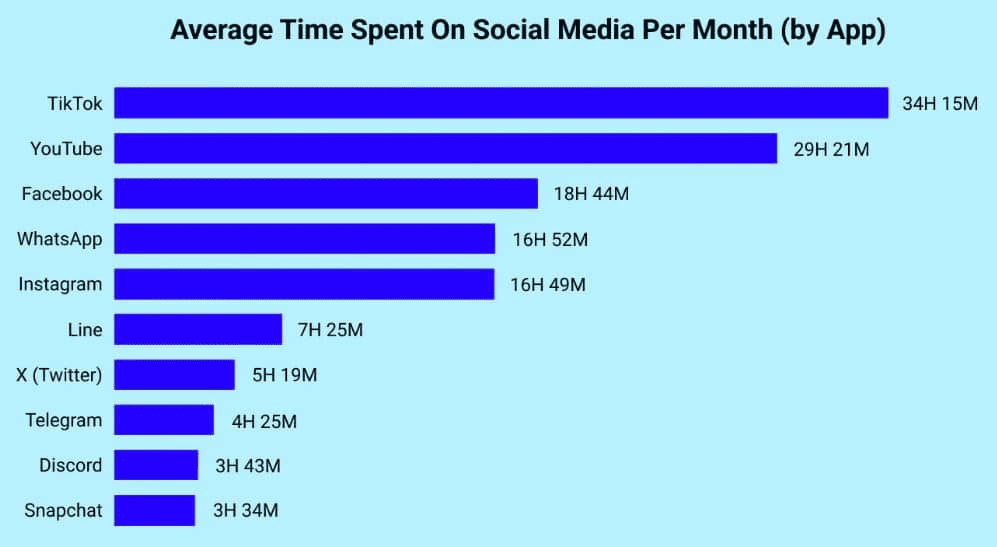
- The most prominent social media platform is TikTok since the users are spending 35 hours and 10 minutes on the platform monthly, which makes 69 minutes each day because of its use of short videos using algorithms.
- The second prominent one is YouTube since the users spend 29 hours and 21 minutes monthly, i.e., 50 minutes daily, due to the huge need for consuming short and long videos.
- The third platform is Facebook since the users spend 19 hours and 40 minutes monthly on the platform.
- The usage patterns of WhatsApp and Instagram show similar results, which show users spend 16 hours and 50 minutes per month on these visual platforms, resulting in 34 minutes of daily usage.
- The platforms X, Telegram, Discord, and Snapchat attract users who spend less than 12 minutes daily, which shows that these platforms serve specialized or task-oriented purposes.
Cognitive Impact Of Extended Social Media Consumption
- The prolonged period of social media usage demonstrates an analytical result because it decreases cognitive abilities while showing users’ ability to concentrate on social media content.
- Users who spend more than three hours on social media platforms face a 28% increased difficulty because they need to concentrate on their offline activities.
- Users who spend more than five hours on these platforms experience a 33% increased risk of experiencing attention interruptions.
- The process of fast content consumption leads to working memory decline because it causes an 11% decrease in mental capacity, which creates additional cognitive burden.
- Gen Z users experience scrolling fatigue because at least 40% of users need to take breaks after scrolling for more than 45 minutes.
- The average person checks their phone 96 times daily, which leads to multiple interruptions that break their focus and cause a 2.2 times increase in mistakes that happen during studying or working.
- The neurocognitive studies found that multiscreen users exhibit decreased prefrontal cortex activity and diminished function in brain regions that control their attention.
- Users who take breaks from social media platforms disclose a 42% increase in their capacity to complete tasks, which demonstrates that excessive platform usage decreases their ability to pay attention.
Most Utilized Social Media Platforms by Marketers
(Reference: sqmagazine.co.uk)
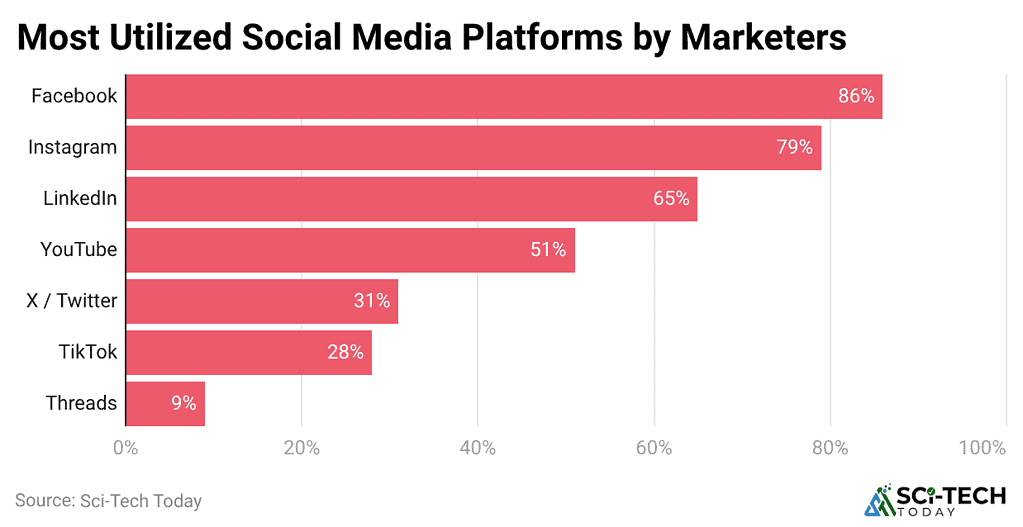
- Marketer adoption closely aligns with platform-level algorithm efficiency and its impact on social media attention span.
- The 86% usage rate of Facebook shows that its targeting tools and ranking systems have reached maturity, which enables businesses to achieve consistent ROI through mid-funnel campaigns.
- Instagram follows at 79% because its visual discovery features and influencer amplification enable users to maintain social media attention span during brief engagement periods.
- LinkedIn achieves 68-72% adoption because its algorithmic precision successfully identifies B2B segments that show professional relevance through their attentive behaviour.
- YouTube usage at 51% occurs because its algorithm prioritizes watch time, which supports extended storytelling and maintains viewer engagement on social media platforms.
- Marketers show reduced adoption of X TikTok and Threads because they face three challenges, which include the changes in ranking systems, the errors in reach measurement, and the need to predict sustained audience engagement and conversion results.
Social Media Algorithm-Driven Changes In User Engagement Metrics
- Algorithmically generated prioritizations by social media platforms give rise to user engagement metrics which indicate how social media platforms motivate their users to engage with the content.
- The platforms today reward creators who make such kind of content that ensures building up strong connection with the audiences through various interactive mediums such as likes, comments, shares, and watch time.
- The research findings demonstrate that the number of comments and shares gets posts three times more distributed than the passive impressions and thereby encourage shorter social media attention span cycles.
- The past data indicates that controversial posts used to be twenty times slower to spread out compared to their present-day behavior because users used to share emotionally triggered content after algorithms started distributing it through emotional triggers.
- The existing algorithms act as access control mechanisms that define if the creators and celebrities could get quick visibility gains or visibility losses.
- The social media platforms are now witnessing users engaging with video-first content such as reels at forty to sixty percent more frequency than usual because users today spend less time on social media and choose content based on formats.
Recent Advances In Attention Span Research And Digital Behaviour
- Current studies from academic institutions and industry researchers demonstrate that when people consume digital content and use social media, they show distinct changes in their cognitive functions.
- A 2025 Harvard study shows mobile-first users exhibit 20% lower sustained attention than desktop users, reinforcing concerns about on-the-go usage patterns.
- 78% of Gen Z members experience phantom notification syndrome, according to MIT Media Lab research, which shows this condition takes Gen Z members out of their focused work periods.
- The analysis, which studied different times of day, found that users who scroll during the evening lost concentration at a rate that reached 32%.
- Neurotracking data from wearables displayed a 17% decrease in attention during the initial 90 seconds of using multiple applications.
- Meta research shows that users below 25 years of age now shift their attention every 39 seconds, which represents an increase from their 2020 attention span of 47 seconds.
- Stanford developed the Digital Focus Quotient in 2025 to measure digital focus changes.
- Startups and researchers create focus-first platforms that use attention cues to help people recover from cognitive fatigue while protecting their digital resource usage.
Wrapping Up
Social media attention span Statistics: The data from 2025 proves one truth that all people must understand because it shows how social media platforms use the scarcest resource, which they need to create their platforms. Social media attention span is shrinking because platforms use algorithms together with short video content, and their users who watch videos on mobile devices, and the current excess of available content. The platforms create better user experiences through their engagement speed improvements, yet these enhancements cause users to experience cognitive exhaustion, which leads to less focus ability and memory retention problems that will affect future generations.
Brands and creators need to achieve success through exact delivery methods, which should provide value within seconds while creating memorable experiences that deliver value to users. Digital platforms that present content through social media attention spans should use content delivery formats that pace their material and develop audience-specific methods.
FAQ
The average social media attention span ranges between 4 and 8 seconds, depending on age group and platform, with younger users showing the shortest focus duration.
Pre-teens and Gen Z have the shortest social media attention span, averaging 4.2 to 6.5 seconds per post on fast-scroll platforms.
TikTok leads with 69 minutes per day, driven by algorithmic short-form video that fragments social media attention span into frequent micro-sessions.
Mobile-first users show 20% lower sustained attention than desktop users due to fragmented, on-the-go consumption patterns.
Facebook (86%) and Instagram (79%) dominate marketer usage due to stable algorithms that efficiently capture social media attention spans.

Sources