








Opening
Cell Phones At Workplace Statistics: Cell phones are now a regular part of everyday work. Employees use them to check emails, join meetings, communicate with coworkers, and handle tasks on the go. However, smartphones can also become a major source of distraction. Constant notifications, social media, personal calls, and messaging can take attention away from important work. As a result, businesses are trying to find the right balance between staying connected and staying productive. From employee phone habits to workplace policies, cell phone use can significantly impact how people work.
This article explores the latest statistics on cell phone use in the workplace, including usage trends, distractions, productivity, and how companies are managing smartphone use.
Editor’s Choice
- 66% of U.S. employees use cell phones several times a day at work.
- Employees spend 56 minutes per day on non-work-related phone activities.
- 87% of employers say cell phones reduce workplace efficiency.
- Employees check smartphones around 150 times a day.
- 92% of employees report losing focus at work.
- Phone distractions can cost organizations about USD 650 billion annually.
- 80% of organizations allow employees to use personal devices for work.
- The global BYOD market could reach USD 315.1 billion by 2031.
- 64% of cybersecurity professionals consider data loss their main BYOD concern.
- 64% of employees worry that monitored work phones may invade their privacy.
Historical Growth and Prevalence of Cell-Phone Use in the Workplace
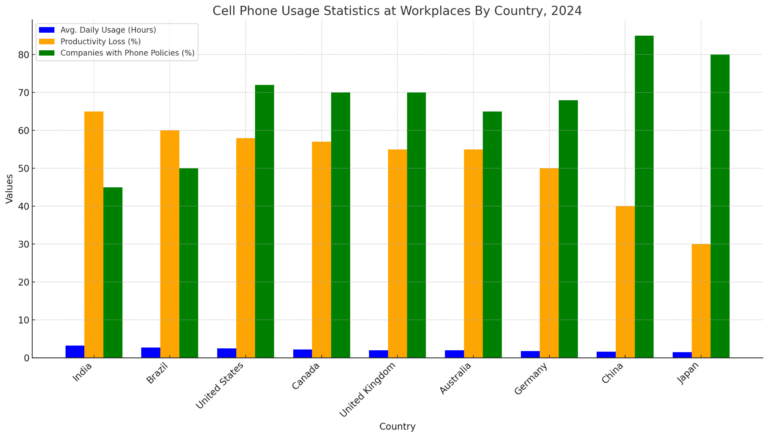
(Source: electroiq.com)
- In 2023, nearly 66% of U.S. employees admitted to using personal cell phones several times daily at work, showing a sharp rise from around 55% in 2020, indicating a 20% relative growth in habitual use.
- Roughly 56 minutes per working day on average is spent by employees on non-work-related phone activity, which accumulates to nearly two full workweeks per year per person in lost time. That’s about 8 hours weekly, or 416 hours annually, of personal browsing during office hours.
- Approximately 58% of employees report regularly engaging in personal phone activity during work hours, such as text messaging, social media, or news reading, leaving just 42% who strictly limit usage to work tasks.
- Average daily phone use at work totals about 2.5 hours, combining both personal and work usage phases, amounting to nearly 12.5% to 15% of an 8-hour shift.
- Over a five-day work week, that’s 12.5 hours per employee, or 50 hours monthly, directed at the handheld screen.
- Around 69% of global employees are “constantly using cell phones during working hours”, including checking work apps, messaging, task coordination, and personal tasks, implying that only 31% remain mostly phone-free at work. In fast-paced workplaces, this nearly universal use shows deep reliance on mobile connectivity.
- In 2023, roughly 84% of businesses had a formal or informal BYOD (Bring Your Device) policy, up from about 70% in 2020, implying an increase of over 20% in corporate acceptance of personal devices.
- On average, each BYOD employee uses 1.7 devices for work, smartphone plus often a tablet or laptop, resulting in 2.5 devices total per person, and companies estimate savings of $341 per employee annually versus company-issued devices.
- Productivity benefits are notable: 68% of organizations report productivity gains from BYOD, with studies showing mobile device use can boost efficiency by up to 34 to 55%, translating into roughly one hour saved per workday, or 240 hours per year. That’s nearly 30 extra days of productive output annually per employee.
- Cell-phone distractions reduce productivity by as much as 14 to 40%, depending on job role; in numerical terms, if a worker produces 100 units in distraction-free conditions, that output drops to 60 to 86 units when constantly phone-interrupted.
- Frequent checking, every 10 minutes by 36% of employees, leads to cognitive disruption and error introduction.
- Daily average: 54% of employees check their phone at least once an hour, 36% every 10 minutes, and 71% feel pressure to be reachable outside office hours via personal phones, leading many to essentially work beyond scheduled hours, sometimes unpaid.
- That extended availability adds up: checking 9 to 10 times per hour over 9 hours means 70 to 90 interruptions per day.
Usage Patterns and Distraction Effects of Cell Phones at Work
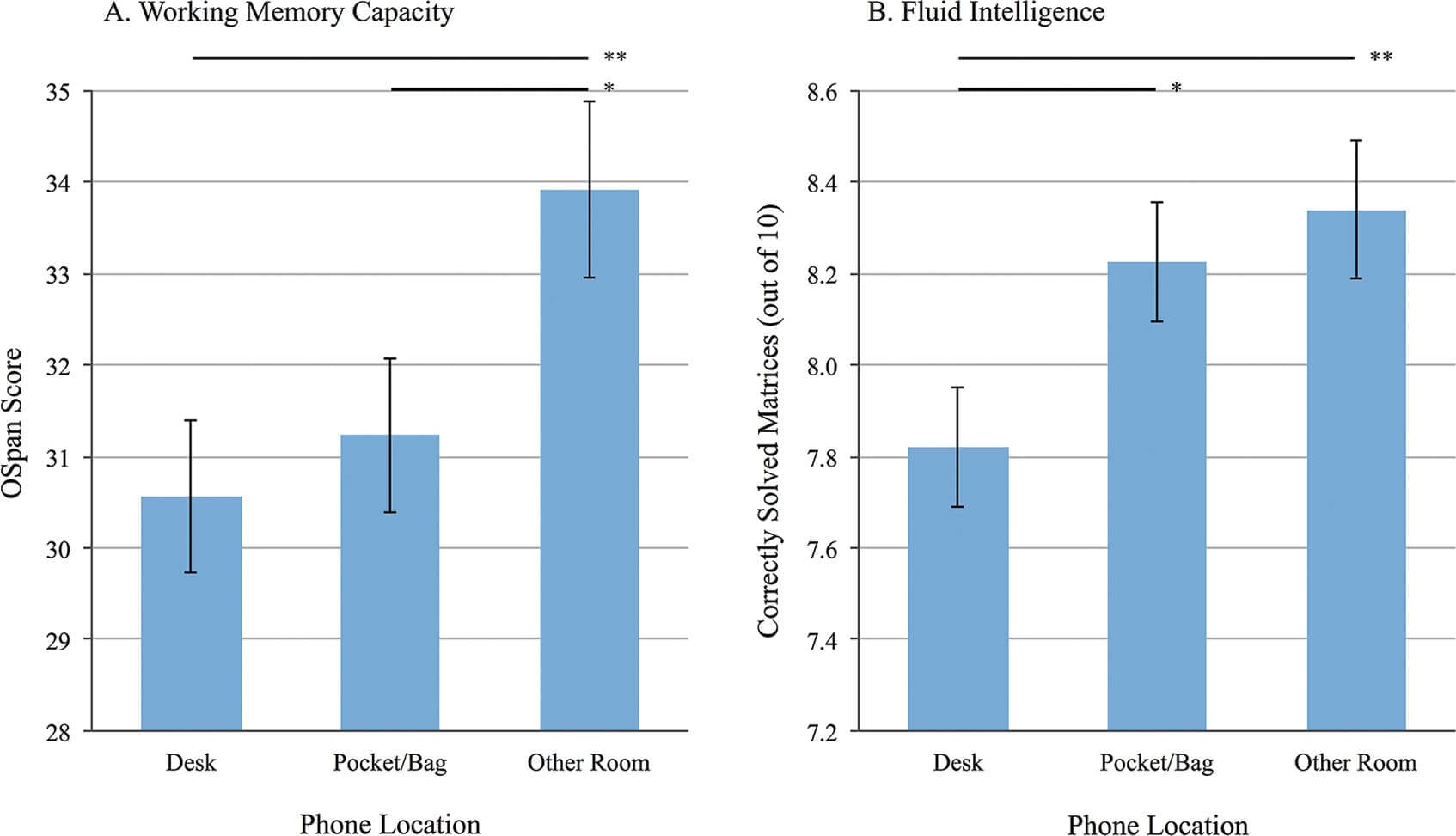
(Reference: dataquest.io)
- 66% of U.S. employees report using their cell phones several times a day at work, up from roughly 55% just a few years prior, a roughly 20% relative increase in habitual workplace phone checking.
- 55% say personal messaging (text or chat apps) is their top reason for workplace phone use, while 28% check social media, and 30% browse personal email, showing diversified non-work usage slices.
- Employees spend an average of 56 minutes per workday on non-work phone activities, adding up to about 8 hours per week or 416 hours annually, nearly one full work month per person.
- Total daily phone use averages 2.5 hours, mixing personal and job-related tasks; that’s about 12.5 hours per week and roughly 50 hours per month logged on the device.
- 69% of employees admit to constant cell-phone usage during working hours, meaning almost 7 out of 10 people have their phone active in some way throughout the shift.
- 87% of employers say cell phones distract from employee efficiency, while 48% of employees acknowledge that having phones blurs their work-life boundaries, exhibiting acknowledgement on both sides of the gap.
- 40% of employees admit to using phones for personal chatting with colleagues during work hours, and 31% use phones for personal tasks in meetings, undermining meeting engagement and team cohesion.
- Employees check smartphones around 150 times per day, which is approximately every 6 waking minutes, leading to 720 lost work hours annually per person due to distraction cycles and refocusing delays.
- 92% of employees say loss of focus is a problem, with 80% unable to go a full hour without distraction, and 11% distracted at least every five minutes, meaning serious fragmentation of attention spans.
- After each distraction, it takes an average of 23 minutes to resume the original task, and 23% of interrupted tasks are not resumed that same day, greatly reducing deep work and concentration efficiency.
Distraction, Focus Loss, and Recovery Time
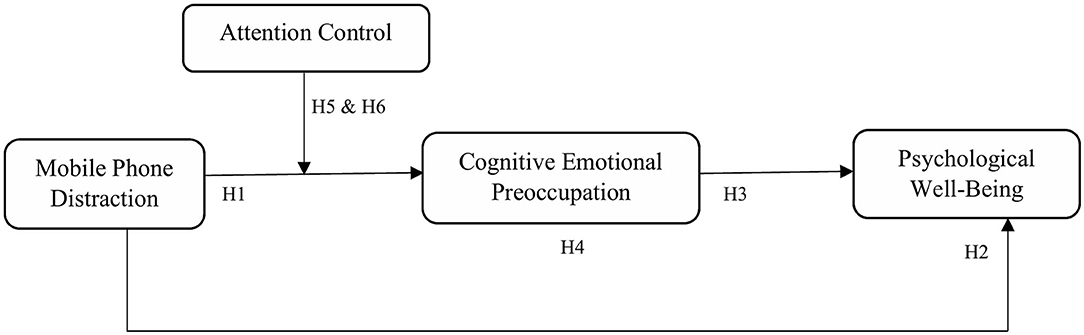
(Source: frontiersin.org)
- Interruptions average 60 per 8-hour shift, meaning a worker faces about 7.5 interruptions per hour, most often from phones or notifications, allowing barely 8 minutes per continuous work chunk.
- 79% of employees report workplace distractions, with cell phones being the second most common source at about 50% of all reported distractions, trailing only chatty coworkers at 80%.
- Each phone-related interruption costs an average of 23 minutes and 15 seconds for the employee to regain full focus, adding up to nearly 2.6 hours of lost deep work per day when multiplied by 6 to 7 interruptions.
- About 98% of the workforce faces at least 3 to 4 interruptions daily, and 60 interruptions over an 8-hour day translates to 720 lost work hours per employee annually.
- 23% of interrupted tasks are never resumed the same day, which, when applied to daily interruption counts, means an average employee leaves 1 to 2 tasks unfinished each workday, leading to backlog buildup.
- Distracted employees make twice as many errors; with phone-induced distraction comprising half of such incidents, error rates spike by up to 100%, with safety events affecting 14% of respondents.
- Distraction-induced morale dips: 34% report liking their job less when distracted, 54% admit their performance slips, and 50% see meaningful productivity decline, all traced partly to phone interruptions.
- Organizations lose an estimated US $650 billion annually to distractions, stemming from lost hours (720 hours per worker) plus error-correction and low morale in an American workforce of 160 million.
- Training help: 75% of staff become measurably more productive after distraction-reduction training, showing that structured guidance can reclaim time otherwise lost to phone-initiated multitasking.
- Cognitive switching costs bite hard: after a quick phone glance or notification, employees take nearly 23 minutes to re-engage, and cognitive residuals can linger as low-grade brain drain even if they’re not actively using the device.
Bring Your Own Device Adoption and Market Growth
- According to NordLayer, more than 80% of organizations have formal BYOD policies, while 95% allow employees to use personal devices for work in some capacity.
- Despite widespread policies, only about two-thirds of organizations have formal BYOD security measures, showing a gap between policy and actual enforcement.
(Source: mordorintelligence.com)
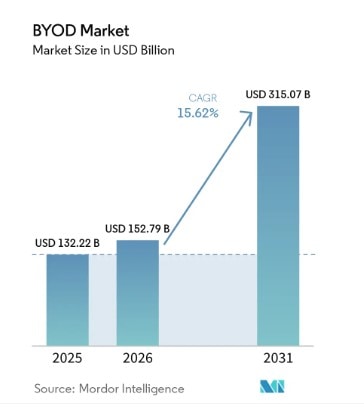
- The global BYOD market is projected to grow from USD 152.8 billion in 2026 to USD 315.1 billion by 2031.
Security Risks and Enforcement
- According to market.biz, 39% of companies identify security as the biggest barrier to BYOD adoption, while 64% of cybersecurity professionals consider data loss their main BYOD concern.
- More than 20% of organizations have experienced malware infections linked to unsecured BYOD use.
- Around 84% of IT leaders are concerned about shadow IT caused by unauthorized apps on personal devices.
- 28% of companies do not enforce multi-factor authentication on employee-owned devices, increasing security risks.
- 20% of companies provide no IT support for personal devices used for work.
- About 39% of organizations have experienced a data breach involving a lost or stolen device.
- Mobile devices account for 20% of enterprise data breaches, with 56% of these incidents involving personally identifiable information.
Mobile Phone Usage by Industry in 2026
- Retail and e-commerce: Smartphones generate nearly 78% of global retail-site traffic, while about 1.65 billion people are expected to shop through smartphones in 2026. Mobile commerce could represent nearly 60% of online retail sales, worth around USD 4.01 trillion, according to Flowlu.
- U.S. retail: Statista reported that smartphones accounted for more than 75% of retail-site visits in Q4 2024 but about two-thirds of orders. Desktops accounted for 21% of visits but 33% of purchases, highlighting the need for seamless cross-device shopping.
- Banking and financial services: Bankrate reported that about 54% of consumers use mobile devices as their main way to manage bank accounts, while 78% use mobile banking apps weekly. Mobile banking is most common among 63% of Gen Z and 67% of Millennials.
- Global digital banking: Digital banking is expected to exceed 4.2 billion users in 2026, representing 53% of the global population, according to a report shared by sqmagazine.co.uk.
- Payments and social commerce: eMarketer also stated that more than 54% of mobile commerce transactions occur through shopping apps. In the U.S., 31.2% of consumers used digital wallets in stores as of September 2025.
- Healthcare: A report published by Emerline shows mobile medical app usage reaches 69% in India, 61% in China, 49% in the UK, and 43% in both Germany and the U.S.
- Gaming: The Entertainment Software Association mentioned that around 212.3 million Americans play video games weekly, with 80% playing on mobile devices. Globally, mobile gaming is projected to generate USD 92.6 billion in 2026, accounting for 49% of the games market, with more than 2 billion players, according to Instreamly.
- Enterprise mobility: Spherical Insights mentioned that the enterprise mobile-device market is projected to grow from USD 28.5 billion in 2025 to USD 112.0 billion by 2035, at a CAGR of 14.67%.
- Workplace phone use: According to ElectroIQ, average daily work-hour phone use ranges from 3.5 hours in telecom and 3.0 in technology to 2.8 in hospitality, 2.5 in retail, 1.8 in finance, 1.5 in construction/manufacturing, 1.3 in legal, 1.2 in healthcare, and 1.0 in education.
Impact of Cell Phone Use on Company Productivity
(Reference: jobmarketmonitor.com)
- Employees spend an average of 56 minutes per workday on their cell phones for non-work activities, which translates to over 4.5 hours per week, significantly lowering individual output over time.
- A study across 11 industries revealed that 37% of workplace productivity loss could be traced directly to mobile phone distractions, making it the single largest factor in modern digital workplace inefficiencies.
- Organizations that implemented strict mobile phone policies experienced a 21% increase in employee productivity, especially in logistics, call centers, and manufacturing sectors, where focus is critical.
- 65% of managers believe that excessive personal phone use by employees negatively affects team output, and 42% have issued warnings or formal write-ups for mobile-related performance issues.
- On average, employees check their phones 96 times per day, often disrupting deep focus cycles, which research indicates can take over 23 minutes to resume full concentration after a single interruption.
- Companies using productivity tracking tools found that employees lose up to 10% of their billable work hours weekly due to mobile usage, costing businesses millions annually in avoidable payroll leakage.
- 53% of surveyed business leaders cited smartphone use during meetings as a major disruption, often extending meetings by an average of 12 minutes due to side conversations, repeated clarifications, and distraction loops.
- In creative teams, mobile phone distractions have been associated with a 17% drop in quality, as constant notifications prevent the kind of mental incubation necessary for complex ideation.
- When companies introduced “phone-free work zones,” 75% reported a noticeable improvement in time-on-task metrics, especially during critical workflows like inventory audits, coding sprints, or sales outreach blocks.
- A Gallup report found that employees who self-report high mobile usage at work are 2.5 times more likely to miss deadlines, leading to delays in project delivery and measurable dips in client satisfaction scores.
Workplace Cell Phone Policies: Restrictions
- A report published by Apollo Technical found that 38% of companies prohibit employees from using phones in conference rooms.
- Around 21% of companies ban phones on production floors to reduce distractions and safety risks.
- 18% of companies restrict phone use in customer-facing spaces.
- Only 44% of companies actively enforce written phone policies, while 56% do not consistently enforce them.
- PRNewswire reported that 14% of surveyed workers reported at least one workplace accident linked to smartphone distraction; 59% involved property damage and 50% involved injury or death.
Enforcement and Business Impact
- According to ElectroIQ, 31% of employers do not provide phones to employees, while only 17% provide phones to all employees.
- Personal phone use can reduce productivity by about 34% and overall work efficiency by 45%.
- Employees can take up to 23 minutes to refocus after a phone notification, while 62% report that smartphone notifications affect concentration.
- The RSS.com report also mentioned that workplaces with strict phone bans averaged 183 minutes of personal phone use daily, compared with 163 minutes under moderate policies, suggesting rigid bans may sometimes backfire.
- About 14% of surveyed workers reported a phone-related workplace accident; 59% involved property damage and 50% resulted in injury or death. One manufacturing case study reported a 40% reduction in accidents after introducing phone-free factory zones
Health, Well‑Being, and Ergonomic Impacts of Cell Phone Use at Work
 (Source: mdpi.com)
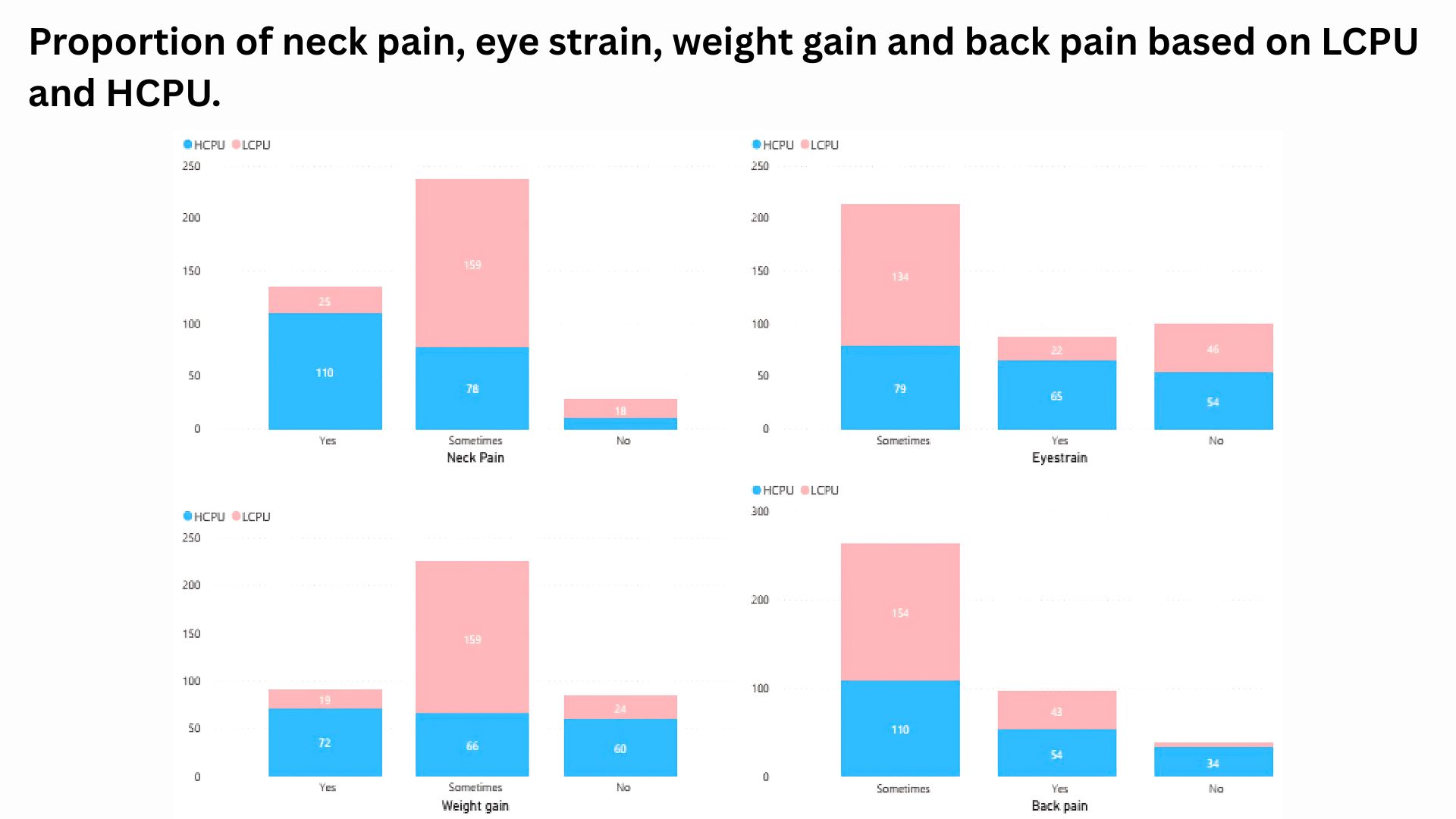
- 68% of employees report neck or shoulder pain, citing an average of 2.3 incidents per week directly associated with prolonged phone viewing or texting posture. That equates to around 4 to 5 hours of discomfort monthly per employee.
- 63% admit to eye strain or headaches, which they experience 3 to 4 days per workweek, due to screen glare and small-font reading on phones. This translates to roughly 12 to 16 days a month with reduced visual acuity symptoms.
- On average, each worker spends 17 minutes per day cradling a phone between their shoulder and ear, increasing the risk of trapezius muscle strain, adding up to 1 hr 15 minutes weekly of poor posture-induced tension.
- Smartphone-related wrist discomfort (texting thumb/gamer’s thumb) is reported by 44% of staff, averaging 5 to 8 days per month with tingling or mild pain. Roughly 22% require ergonomic intervention or splints as a resolution.
- Mental well-being impacted: 59% of employees feel increased anxiety due to being reachable via phone outside of work hours.
- They report an average 47% increase in off-hours message frequency, leading to disrupted rest time.
- Sleep deprivation is common: 54% of workers sleep 30 to 45 minutes less nightly because they check work messages before bed or after waking.
- Cumulatively, this is 210 to 315 minutes of lost sleep weekly, prompting fatigue and impaired focus.
- 51% of employees admit to poor work-life balance due to after-hours phone use, averaging 2.1 hours of mobile engagement outside of work, equivalent to 10.5 hr/week spent on work intrusions via personal phone.
- Phone usage while driving on the job: 28% admit using a smartphone behind the wheel, averaging 6 minutes per shift, representing over 30 minutes weekly of distracted driving risk on the job.
- 33% of staff use phones to self-diagnose health issues, investing 12 minutes per episode, leading to increased health anxiety and unnecessary medical visits in about 1 of 6 situations.
- Only 19% of organizations provide ergonomic phone-use training, despite 71% recognizing health complaints tied to mobile use, suggesting a large gap in proactive well-being support.
Workplace Safety and Operational Impacts
| Safety Metrics | Affected Share | Average Frequency / Impact |
| Accidents due to phone distraction | 43% | 2.7 incidents per 100 employees per year |
| Near-miss incidents in construction | 31% | 8.2 incidents per site per quarter |
| Injuries in warehouses | 19% | 3.1 falls/collisions per 100 workers per year |
| Forklift error rate increases | 26% | 15.4 risky actions per operator per month |
| Healthcare safety distractions | 22% | 1.8 distraction incidents per nurse per month |
| Unauthorized security breaches | 17% | 9 events per 1,000 devices per month |
| Emergency-response delay | 12% | 16.2 seconds slower per response |
| Drivers using phones on routes | 28% | 39 minutes per week of distracted driving |
| Safety-rule violations without a policy | 3.6x increase | 14 violations per employee per month |
| Compensation claim cost without a policy | 21% more claims | USD 1,720 higher cost per incident |
Cell Phone Usage and Employee Performance Metrics
(Reference: statcrunch.com)
- Employees using mobile phones for non-work activities more than 2 hours daily show a 26% decrease in productivity, with output reducing by an average of 3.4 tasks/day compared to focused counterparts.
- On average, 64 interruptions per employee per day are linked to mobile phones, each costing approximately 3.2 minutes of refocus time, totaling over 3.4 hours of lost efficiency daily in distracted work.
- Organizations with unrestricted mobile usage reported a 17% lower work quality index, equating to 9.8 additional errors per 100 tasks completed due to distractions from messaging, social apps, and videos.
- Employees checking personal phones every 10 minutes show a 38% slower task completion rate, with time-on-task efficiency dropping from 82% to 51% on high-concentration assignments.
- 82% of managers agree that cell phone distractions reduce team collaboration by 27%, especially during brainstorming or agile sprint meetings, causing 1.6 missed insights per session.
- Customer support agents using mobile phones during work hours handle 21% fewer queries and average 2.3 more unresolved cases per shift, directly impacting Net Promoter Scores (NPS).
- Self-reported mobile distractions increase during remote work, with 41% of remote employees admitting to 3 hours/day on personal phone use, correlating to a 22% decline in performance scorecards.
- Sales professionals using mobile phones for non-sales tasks during peak hours experience a 14% drop in close rate, making 1.9 fewer successful sales calls per day compared to mobile-restricted colleagues.
- Software developers receiving mobile alerts every 15 minutes see a 35% decline in code quality, with bug reports rising by 4.7 per project iteration, extending QA cycles by an average of 2.1 days.
- Mobile notifications during deep work sessions result in a 25% increase in context-switching errors, with employees requiring 11.6 minutes on average to regain original workflow focus post-interruption.
Smartphone Distraction and Productivity Statistics
- An article published by Speakwiseapp stated that American employees check their phones 96 times per day, a 20% increase over the past four years.
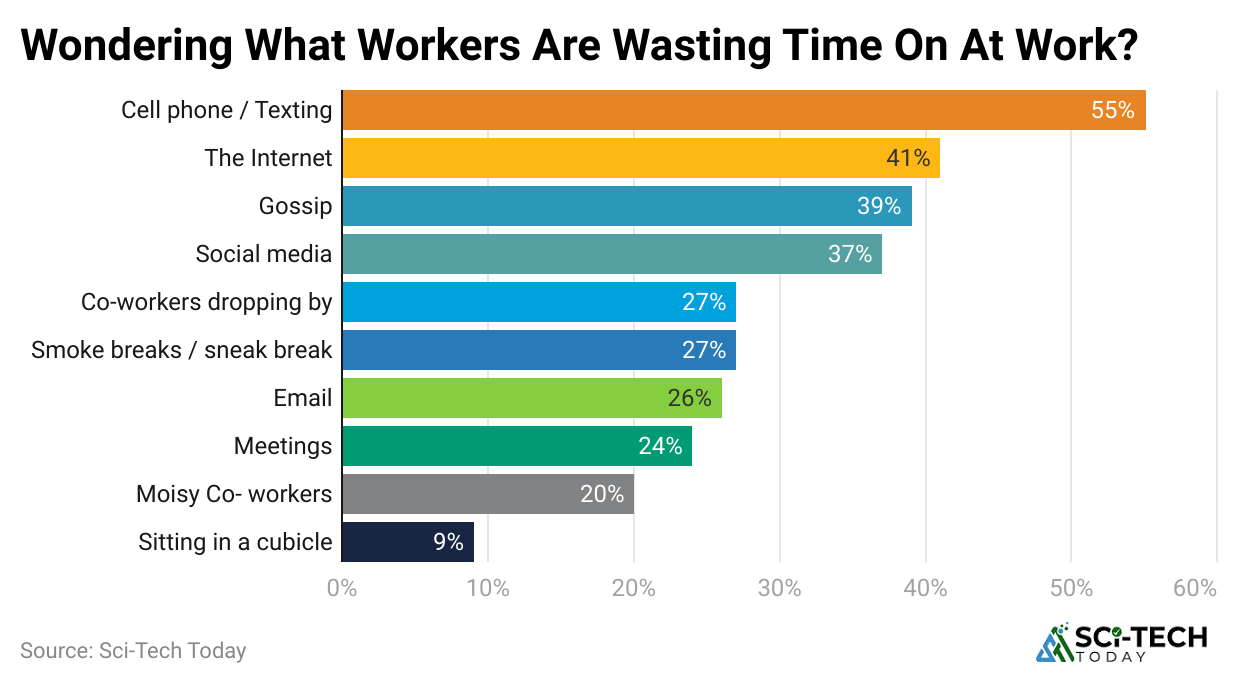
- 70% of workers say smartphones distract them at work, with texting at 55%, social media at 41%, and news at 37%.
- Workers can need 23 minutes and 15 seconds to recover from an interruption.
- Smartphone distractions reportedly cost U.S. businesses USD 600 billion annually, or about USD 4 million for a company with 1,000 employees.
- People spend an average of 3 hours and 15 minutes on their phones daily, while the top 20% spend more than 4.5 hours.
- 55% of employers consider smartphones the biggest workplace productivity killer, ahead of internet browsing at 41%, gossip at 39%, and social media at 37%.
- 47% of workers describe themselves as smartphone addicts, rising to 59% among millennials.
- About 80% of workers do not need smartphones for their core job tasks.
- Social media users spend 2 hours and 31 minutes per day on these platforms.
- Workers using phones during meetings can miss about 25% of the information presented.
- 75% of workers admit to using phones during bathroom breaks to avoid work.
- Compulsive phone checking is associated with a 26% increase in anxiety symptoms.
- Phone-free workspaces can increase productivity by 26% during focused work periods.
- 89% of workers check their phones within 10 minutes of arriving at work
Impact of Cell Phones on Workplace Communication Patterns
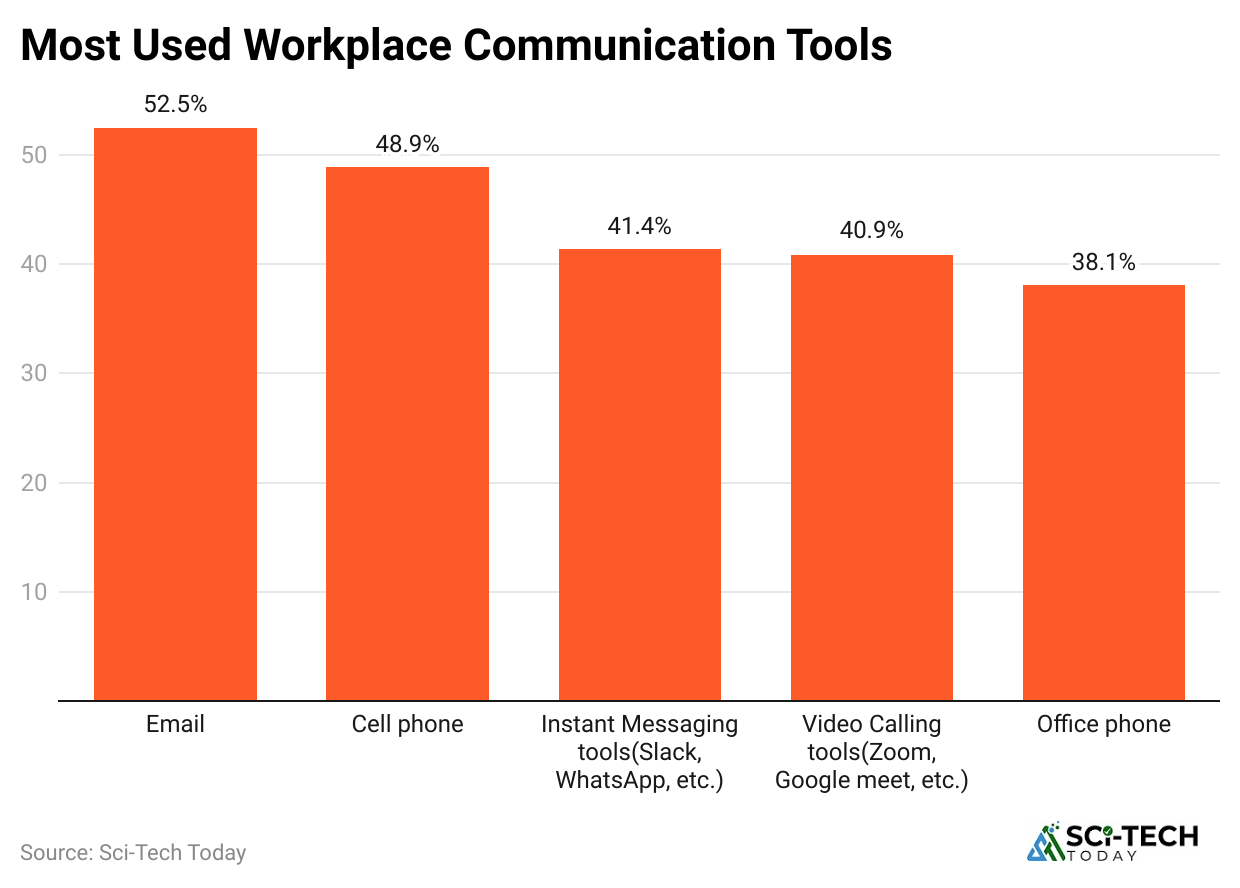
(Reference: electroiq.com)
- 68% of employees admit to texting or using instant messaging apps during meetings, reducing face-to-face engagement levels by 34%, often leading to 1.7 missed verbal cues per meeting.
- In companies where mobile-based communication apps dominate, email usage dropped by 49%, but miscommunication incidents rose by 21%, contributing to an average of 3.2 internal conflict reports monthly.
- 37% of workers say they avoid direct verbal communication, preferring messaging apps, which delays tasks by 2.5 hours/day and causes project milestone delays in 18% of cases.
- Teams relying on personal messaging platforms like WhatsApp for work saw a 24% increase in misaligned expectations, resulting in 2.1 more task revisions per sprint cycle than teams using official tools.
- In hybrid offices, employees check their mobile phones an average of 52 times during meetings, causing attention lapses that lead to incomplete action items in 29% of meeting summaries.
- Phone call avoidance has risen by 61% in workplaces, favoring text-based communication, reducing urgent issue resolution speed by up to 38 minutes per case, affecting SLA targets.
- Employees receiving mobile messages from different platforms (Slack, Teams, SMS) face a 46% communication overload, reducing retention of key info from 72% to just 48% within daily briefings.
- Poor mobile communication etiquette leads to 23% of managers rating team interactions as “inefficient”, citing constant interruptions, cross-talk, and off-topic messaging as performance blockers.
- 43% of HR complaints involving workplace miscommunication now stem from misunderstandings caused by mobile text tone, emojis, or message brevity, escalating interpersonal tensions.
- In cross-functional teams, mobile-first communication models caused a 19% increase in redundant efforts, where 1 in 4 teams duplicated tasks due to unclear or missed mobile instructions.
Workplace Phone Use: Economic and Security Impact
- BLS reported that 22.6% of U.S. workers teleworked in March 2026, compared with 23.0% in January, increasing the need for secure mobile access.
- According to Maker Stations, distractions cost the U.S. economy about USD 650 billion annually.
- About 82% of employees keep phones within view, while 76% respond to notifications within 5 minutes, increasing interruptions.
- Personal texting and messaging affect 44% of workers.
- Knowledge workers can lose nearly 4 hours per day to distractions and task switching.
- Employees may need about 23 minutes to regain focus after a phone interruption, according to Speakwise.
- Employer losses: Cell-phone distractions are estimated to cost U.S. employers USD 15.5 billion annually.
- BYOD savings: BYOD can save up to USD 341 per employee annually, with costs below USD 900 per employee.
- Cybersecurity: Mobile social-engineering attacks have a 40% higher success rate than traditional email phishing, according to Verizon.
- Unapproved workplace AI use increased from 15% to 45% of employees, highlighting growing mobile data-security risks.
- The global average cost of a data breach reached USD 4.99 million in IBM’s 2026 report.
Workplace Mobile Privacy and Employee Monitoring
(Source: thehartford.com)
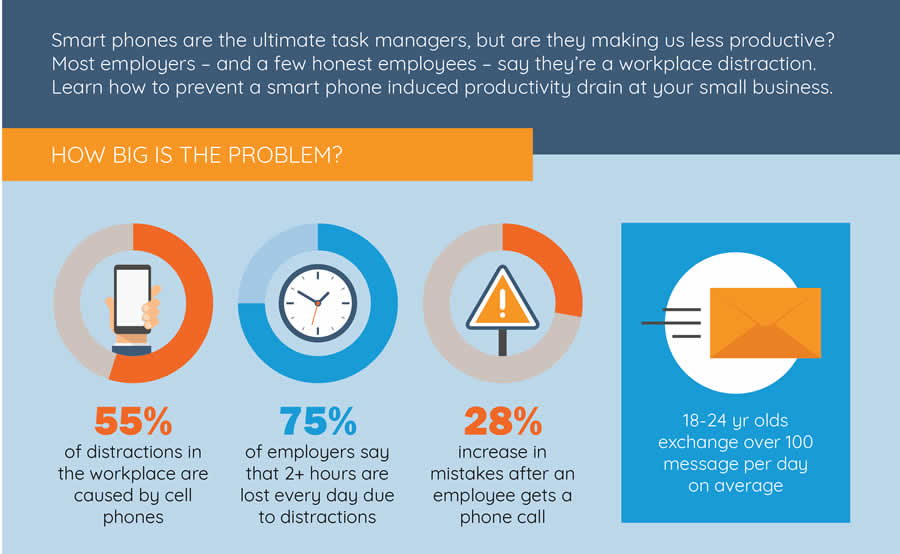
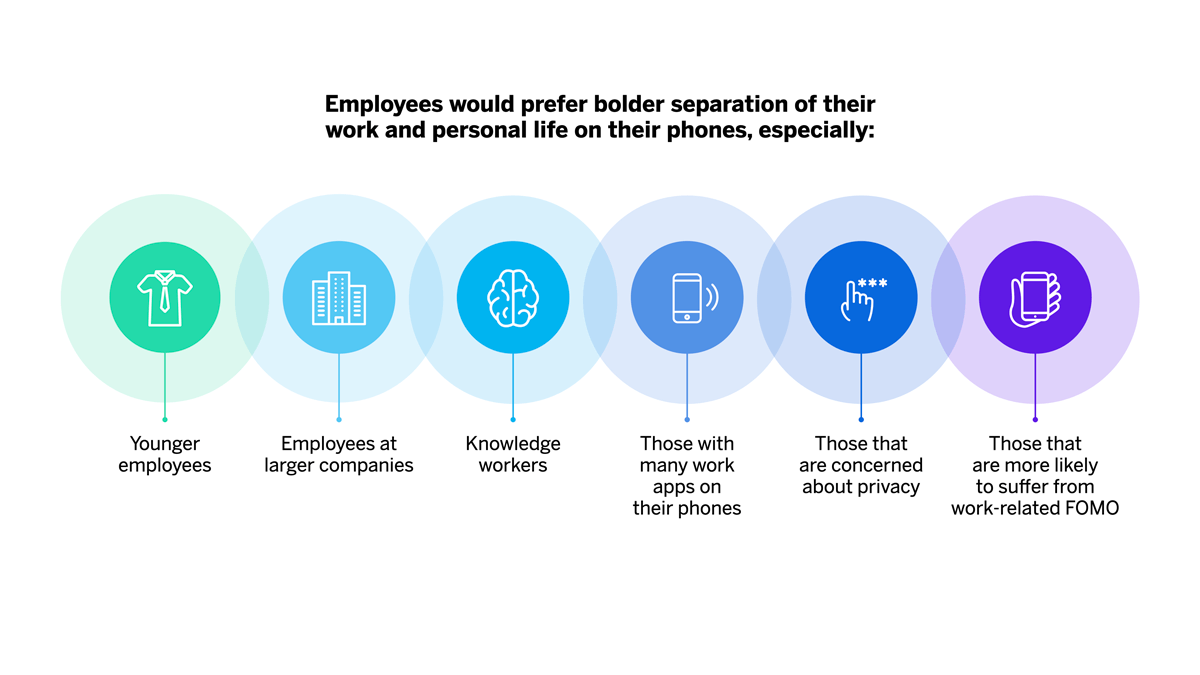
- Over 64% of employees express concern that company-issued or monitored cell phones invade their privacy, especially with location tracking features that remain active outside work hours.
- 48% of companies with BYOD policies admit they have access to personal data like text messages, photos, or call logs due to mobile device management (MDM) tools, creating tension between productivity and privacy.
- 7 in 10 employees (71%) worry that their mobile activity could be used in performance reviews, and 38% report modifying behavior (limiting communication or app usage) due to monitoring concerns.
- 20% of data breaches in enterprises originate from mobile devices, and 56% of these involve personally identifiable information (PII) like health records or financial info, raising privacy alarms for both users and companies.
- 34% of U.S. workers state they are unaware of what their employers can track on mobile devices, while 52% believe companies do not fully disclose surveillance practices, indicating a transparency gap.
- Nearly 40% of employees who use phones for work say they feel uncomfortable using personal apps like WhatsApp or Instagram during breaks because of device tracking capabilities installed by employers.
- 67% of employees in the healthcare and finance sectors are hesitant to use mobile devices for work-related messaging due to HIPAA or regulatory compliance risks, despite the availability of encrypted tools.
- Mobile device surveillance lawsuits have increased 21% year over year, with notable settlements exceeding US $10 million involving cases where companies failed to inform employees of real-time app usage monitoring.
- 58% of IT professionals admit their companies have no clear separation between personal and business data on mobile phones, risking legal liability in the event of audits, subpoenas, or internal investigations.
- 82% of employees state they would be more willing to use mobile tools for work if employers provided full transparency and gave consent-based access controls, suggesting privacy-conscious policies can boost adoption.
Future Trends in Cell Phone Usage at Workplaces
(Source: qualtrics.com)
| Trend Area | Projected Statistic | Expected Change & Impact |
| Employee mobile usage by 2027 | 91% globally | Nearly universal device integration |
| Enterprise mobility market by 2026 | $180 billion (CAGR 24.3%) | Rapid tech adoption in mobile-first workflows |
| Mobile productivity monitoring tools | 43% adoption by 2026 | AI-driven governance rise |
| AR mobile tools growth | $15.5B market by 2028 | Enhanced visualization in hands-on industries |
| Mobile-first training by 2030 | 58% of training delivered on mobile | Shift toward m-learning |
| Smart phone policy enforcement | 65% with automated restrictions | Smarter workplace discipline tools |
| Speed from 5G adoption | 30 to 40% latency reduction | Faster, better remote access |
| Mobile cybersecurity investment | $13B by 2027 | Focus on securing phone-based access |
| Deskless workforce dependence | 72% jobs will be mobile-integrated by 2028 | Traditional tools replaced by mobile apps |
| AI assistants on mobile | 22% of repetitive tasks will be handled by AI by 2029 | Role reshaping and automation |
Summary
Cell phones are useful in the workplace, but they can also cause distractions. Employees use them to communicate, manage tasks, and access important information. However, too much personal phone use can reduce focus and productivity.
Therefore, companies should set simple and fair rules for phone use at work. A balanced approach can help employees stay connected while keeping their attention on their jobs. This can create a more productive and focused workplace.
Cell phones can reduce productivity by causing distractions, interruptions, and frequent breaks from important tasks.
Yes, cell phones enable quick communication through calls, messages, emails, and workplace apps.
Employees can silence notifications, keep phones away while working, and check personal messages only during breaks.

Sources


