









Introduction
Trampoline Statistics: Trampolines have come a long way from being mere toys in the backyard; they have turned into an indispensable part of the global leisure, fitness, and recreation market. The year 2024 saw a significant trend in trampoline usage, and the trampoline market was influenced by the growing health consciousness, safety technologies, and the ever-increasing commercial applications (trampoline parks being the most important one).
Nonetheless, trampolines are not without their hazards; the injury facts are a continuous concern for both home and commercial users. This article will discuss the recent Trampoline statistics.
Editor’s Choice
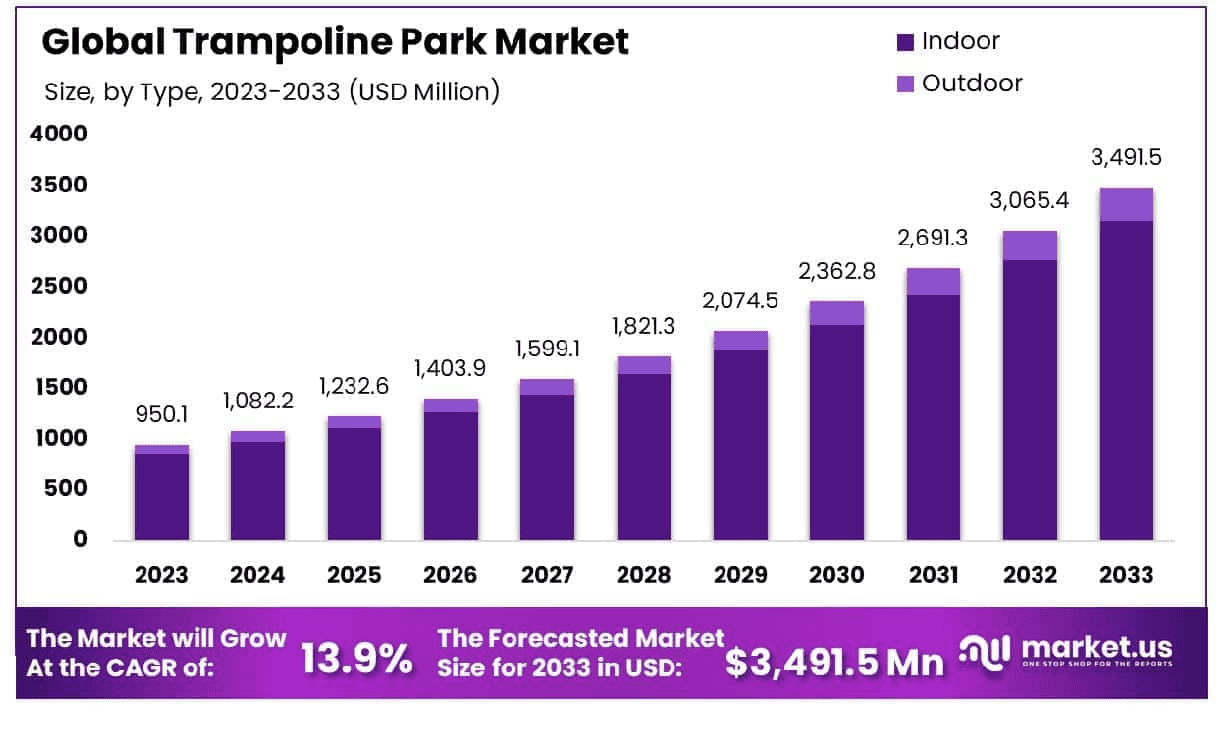
- The trampoline park industry globally is witnessing a strong annual growth rate of 13.90%, and the market is estimated to rise from around USD 950.1 million in 2023 to USD 3.49 billion by 2033.
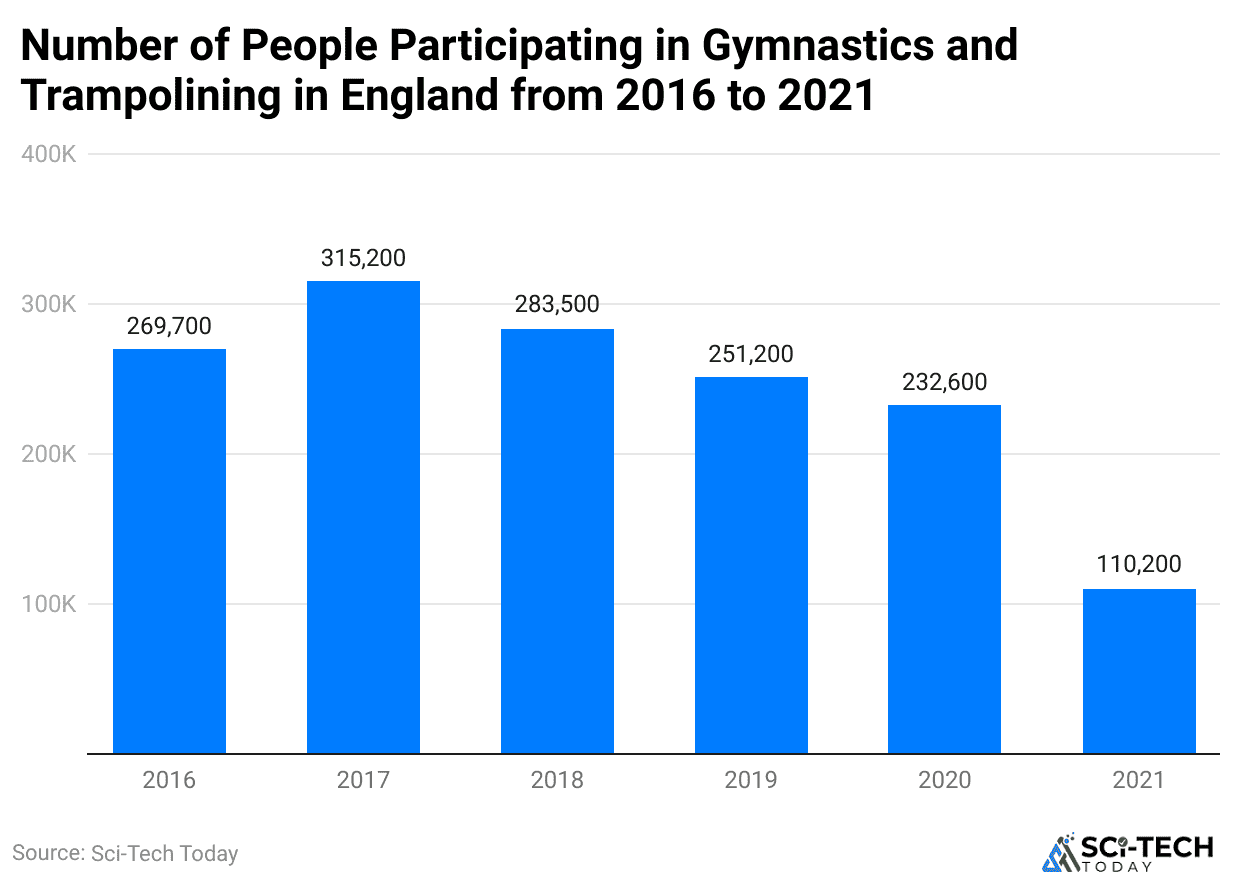
- The participation in gymnastics and trampolining hit its peak in 2017 and then saw a sharp decline, dropping to its lowest level in 2021, primarily as a result of COVID-19 restrictions and the shutdown of facilities.
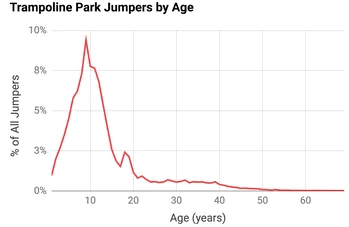
- The majority of trampoline users are kids and teenagers, with the biggest age group of 6-10 years accounting for 35%, followed by 11-15 years for 26%, though there is a growing interest among adults in their 20s and 30s.
- The trampoline events at the Olympics have been marked by extraordinary performances of athletes from China, Canada, Belarus, and Great Britain, with such champions as Rosie MacLennan, Ivan Litvinovich, Bryony Page, Zhu Xueying, and Uladzislau Hancharou earning fame.
- Injuries caused by trampolining are still among the biggest health risks, with the annual number of over 100,000 incidents reported in the United States alone.
- Kids between 5 and 15 years old are responsible for more than 90% of all trampoline injuries, making them the high-risk group.
- Trampoline parks account for approximately 34% of all trampoline injuries, with a greater share, over 50%, involving fractures or dislocations.
Trampoline Park Market Globally
(Source: media.market.us)
- The trampoline park sector is not slowing down; on the contrary, it is growing steadily at a rate of 13.90% per year, which is a clear indication that worldwide demand for fun and family-friendly entertainment is increasing.
- In the year 2023, the market is estimated to be worth around USD 950.1 million, yet it is anticipated to surpass the USD 1 billion threshold in 2024 and to be on the rise thereafter.
- By 2025, it is estimated to be over USD 1.2 billion, and at the end of 2027, it is likely already to be USD 1.6 billion, which indicates that the growth is steady and consistent.
- The growth is so significant in the last part of the decade that the market is projected to be more than USD 1.8 billion already in 2028 and over USD 2 billion in 2029.
- The positive trend will persist into the early 2030s, and the market value will go above USD 2.3 billion in 2030 and up to nearly USD 3.1 billion in 2032.
- The year 2033 will see the market reach around USD 3.49 billion, which is almost four times the size it was in 2023.
- This constant growth is a consequence of urbanisation, demand for more entertaining experiences, and indoor sports and leisure activities becoming increasingly popular with kids, teens, and families all over the place.
Gymnastics and Trampolining Participation
(Reference: statista.com)
- According to statistics on trampoline usage, the number of people who participated in gymnastics and trampolining during the period from 2016 to 2021 is given, and it indicates fluctuations in participation levels throughout the years.
- First, there were 269,700 participants in 2016, after which there was an enormous increase to 315,200 in 2017; the trend was at its peak then.
- After that, 283,500 showed up; so, participation is seen to have decreased in 2018, and it went down even more to 251,200 the next year. It was a downward trend going into 2020, with the number of participants being 232,600.
- So, the most severe drop will occur in 2021 when the participants suddenly shrink to 110,200.
- This considerable reduction might have been caused by something outside itself, for example, the closure of sports facilities and reduced opportunities for training access during the COVID-19 pandemic.
- This suggests that, after peak participation in 2017, participation fell consistently and had a steep fall in 2021.
Global Trampoline Park Market Size – By Type
2023–2027
- The worldwide trampoline park market is characterised by indoor and outdoor segments, where both are gradually increasing in size over time.
- The market size in 2023 is at USD 950.1 million, and indoor trampoline parks are very much to blame for this, as they account for USD 858.89 million, while outdoor parks are very little to blame, as they only account for USD 91.21 million.
- This trend continues in 2024 as the total market value goes up to USD 1,082.2 million. It is the indoor parks that lead this increase by obtaining USD 978.31 million, whereas outdoor parks get only USD 103.89 million.
- 2025 is then going to be the year of a further increase in the total market to USD 1,232.6 million, where indoor parks will still be in the lead with USD 1,114.27 million, and outdoor parks will have a share of only USD 118.33 million.
- The industry is going to witness a strong gain in the next year, 2026, when it is anticipated that the total market will reach USD 1,403.9 million, comprising USD 1,269.13 million from indoor and USD 134.77 million from outdoor parks.
- By the end of 2027, the market is likely to go up to USD 1,599.1 million, from which indoor parks’ share will be around USD 1,445.59 million, and outdoor parks will take USD 153.51 million.
- The trend of this period is unmistakable: indoor trampoline parks are the primary force behind the growth of the industry’s sales.
2028–2033
- The strong growth trend is supposed to continue from 2028 until forever.
- The trampoline park market in 2028 is expected to reach USD 1,821.3 million, where the support comes from indoor parks with USD 1,646.46 million and outdoor parks with USD 174.84 million.
- The total value in 2029 is going to be more than USD 2,074.5 million, with indoor parks sharing USD 1,875.35 million and outdoor parks having USD 199.15 million as their contribution, which is not much.
- The indoor park and outdoor park markets together will be contributing USD 2,135.97 million and USD 226.83 million, respectively, which makes the market in total with an upward trend of USD 2,691.3 million for 2031.
- Then the market for total size will be USD 3,065.4 million at the end of the year, the main part of which will be coming from indoor parks, USD 2,771.12 million, and the remaining part will be from outdoor parks at USD 294.28 million.
- In the last year of this projection period, 2033, the global trampoline park market is expected to be about USD 3,491.5 million.
- It is also projected that indoor parks will still be the biggest part of the market, being responsible for USD 3,156.32 million, with outdoor parks taking the USD 335.18 million.
Trampoline Jumpers by Age
(Source: blog.akrobat.com)
- Among people in their twenties and thirties, trampoline parks are getting more and more popular.
- The fact that a larger segment of the population is participating in this activity suggests that older people are still trying to keep up with the trends in trampolining.
- Nevertheless, kids still account for the larger part of the jumpers.
- Those aged 11-15 contribute 26%, while toddlers amount to 13%. Adults are not as favoured in jumping or having fun as they may seem.
Trampoline Olympics Statistics
#1. London 2012
- The 2008 Beijing Olympics gold medalists could not repeat their success at the London Games.
- In the women’s final, the reigning Chinese champion He Wenna made a mistake at the very end of her routine and had to settle for the bronze medal.
- Canada, on the other hand, enjoyed a historic moment as Rosie MacLennan scored her personal best of 57.305 and thus won the gold medal, which was also the first for Canada in trampoline events at the London Games.
- For the United States, it was also an important occasion as Savannah Vinsant turned out to be the first American to qualify for an Olympic trampoline final since the sport’s inclusion in the 2000 Games.
- In the men’s competition, China’s Lu Chunlong, who was a gold medalist in the past, was eclipsed by his fellow countryman Dong Dong, who turned out to be the ruler of the event and finished more than a point ahead of Russia’s silver medalist, Dmitry Ushakov.
- The U.S. men’s squad could not hold the spotlight as Steven Gluckstein was at the bottom of the qualification round after he crashed into the safety pads and could not manage to complete his performance.
#2. Rio 2016
- The men’s category was in favour of Belarus, who was the winner of Uladzislau Hancharou for the country’s first-ever Olympic gold medal awarded in trampoline, which was 61.745 in his Olympic debut and quite impressive.
- China’s Dong Dong, who was the previous gold winner, took the silver, while the bronze was for his teammate.
- On the contrary, in the women’s events, Canada’s Rosie MacLennan retained her crown with a score of 56.465, thus becoming the first player to be awarded the Olympic gold medal in trampoline two times in a row.
- Great Britain’s Bryony Page received silver while China’s reigning champion Li Dan had to settle for bronze.
#3. Tokyo 2020
- Rose MacLennan was again a bold contender; however, her race for the third consecutive gold was cut short by China’s Zhu Xueying, who, after scoring 56.635, took first place.
- Her partner Liu Lingling secured silver, thus giving China the top two spots on the podium, while Bryony Pag,e with a score of 55.735, added the bronze to the silver she got in Rio.
- The sixth place of Nicole Ahsinger for Team USA marked the alternation of the best-ever finish of an American woman in the Olympic trampoline, previously achieved in 2012.
- Belarus continued its dominance in the men’s category as 20-year-old Ivan Litvinovich, whose routine was the most difficult in nature, benefited from the impeccable performance and captured gold.
- He just about made it past China’s Dong Dong while New Zealand’s Dylan Schmidt took third place with a score of 60.675, thus marking his country’s first-ever Olympic medal in the gymnastics discipline, whatever it may be.
#4. Paris 2024
- Ivan Litvinovich of Belarus, competing as an Individual Neutral Athlete, was the gold winner agai,n and no man in the history of the Olympic Games had ever done so in trampoline.
- Along with the gold, China also received the remaining two podium positions. Wang Zisai benefited from his execution score and was awarded silver, while Yan Langyu got the bronze.
- An American, Aliaksei Shostak, who was a competitor, fell in qualifications and was thus not among the finalists.
- Great Britain’s Bryony Page, in the women’s event, finally won Olympic gold at 33 years of age, completing her full set of Olympic medals.
- Viyaleta Bardzilouskaya of Belarus, also competing as an Individual Neutral Athlete, won silver in her first Olympics, while Canada’s Sophiane Méthot took bronze after making it to the final.
- Zhu Xueying, China’s defending champion, was fourth after an off-centre landing. This event marked the first time since 2000 that no Chinese athlete has reached the Olympic trampoline podium.
- Jessica Stevens of the U.S. was only able to secure 13th position in qualifications, despite her strong showing at the 2023 World Championships, and thus did not make it to the final.
Trampoline Injury Risks and Safety Concerns
- The data reveal that trampolines, although fun for children and adults alike, can be a source of accidents when safety precautions are not implemented.
- More than 100,000 injuries from trampolines per year in the United States alone mean that the healthcare system has to deal with this problem, which is quite serious.
- The estimated cost for the emergency room visits related to the injuries during 2002-2011 was about US$1 billion, which indicates the financial impact of trampoline misuse in the long run.
- The kids aged from 5 to 15 years are the most affected category, responsible for about 90% of the injuries.
- Over half of the injuries are soft tissue damage, such as strains and bruises are the most common ones.
- One of the main causes is the simultaneous usage of trampolines by more than one child, which doubles the chances of collisions and awkward landings.
- Among others, falling off the trampoline and coming in contact with the springs or the metal frame are the usual factors.
Conclusion
Trampoline Statistics: The trampoline market is rising, and it is unlikely to stop anytime soon. The major reasons are the popularity of trampoline parks, the growing interest in active recreation, and more urban parks. Indoor trampoline parks are still leading the market, not only drawing kids but also young people who want to enjoy fitness and fun with friends. On the other hand, participation trends reveal how the COVID-19 pandemic and similar external factors can greatly affect the pattern of recreational activities.
But safety always remains a concern despite the good market outlook. A large number of injuries, particularly to children, make it clear that supervision, maintenance of the equipment in good condition, and following of the safety rules must be universal practices if trampolining is to remain both fun and safe.