









Introduction
Ubuntu Statistics: Ubuntu keep on being one of the most influential Linux operating systems in 2026, powering everything from personal computers to cloud infrastructure, AI workloads, IoT devices, Kubernetes clusters, and enterprise servers as well. It’s built by Canonical, and Ubuntu has kind of grown into a go-to operating system for developers, companies, and hyperscale cloud providers because of its long-term support (LTS) model, solid security, and an open source ecosystem that just keeps expanding.
With the release of Ubuntu 26.04 LTS, there were noticeable upgrades in protection, AI readiness, speed, and overall system resilience, so it felt like it tightened its grip on the enterprise side even more. Companies are increasingly spreading Ubuntu across AWS, Azure, Google Cloud, edge environments, and AI infrastructure, while millions of developers continue using it as their main Linux distribution. This article on Ubuntu statistics shows the market share, data adoption, release data, and AI impact in 2026.
Top Insights
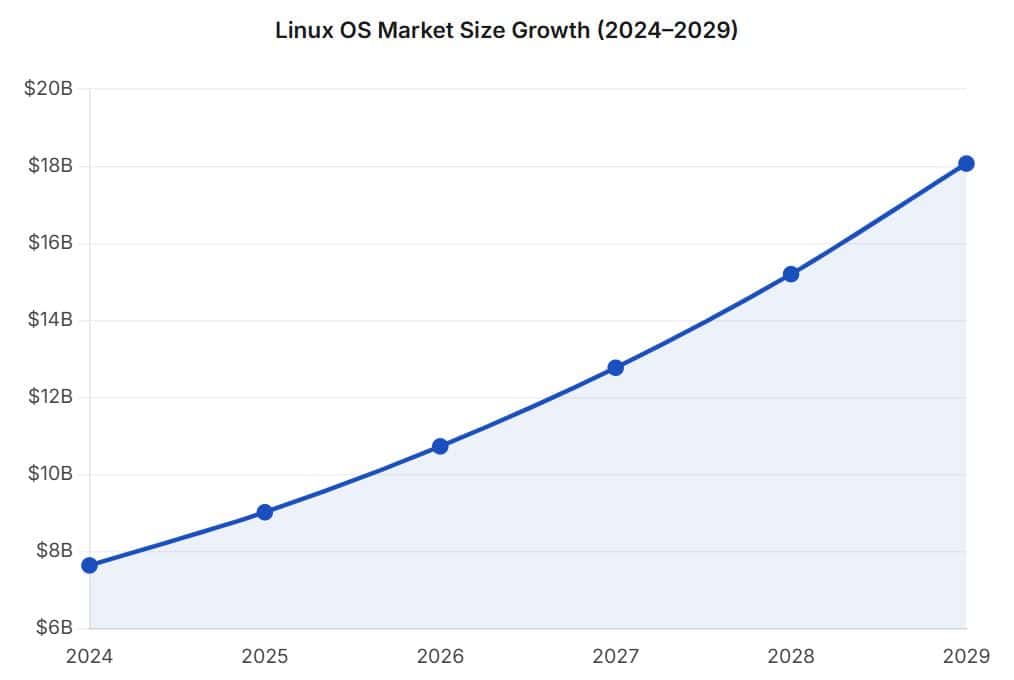
- The Linux operating system market is expected to hit USD 10.73 billion in 2026 and then rise at around a 19% CAGR through 2029.
- Ubuntu holds 33.9% of the enterprise Linux market, so it sits as the second-largest enterprise distribution after RHEL at 43.1%.
- Over 60% of public cloud Linux instances run Ubuntu, reinforcing how strong it is across AWS, Microsoft Azure, and Google Cloud, without much question.
- Ubuntu also powers 13.7% of Linux web servers, while it reaches 16.8% of the top one million websites.
- 75.4% of Ubuntu installs are still on supported versions, meaning teams really like the Long-Term Support (LTS) approach rather than jumping around too often.
- Linux is sorta the go-to platform for AI, with about 78.5% of developers using it for AI/ML tasks, and Ubuntu is kind of leading the pack for AI development settings, with a 27.7% share.
- When it comes to cloud infrastructure, AWS (28%), Microsoft Azure (21%) and Google Cloud (14%) add up to more than 60% of the global market.
- Ubuntu Server runs enterprise infrastructure with a pretty lightweight setup, around 1.5 GB RAM and just 5 GB storage.
- Linux now drives roughly 58% of global IoT devices, and Linux-based smart TV platforms show up in 61.3% of worldwide unit sales.
- Ubuntu grabs 33.9% of machine learning deployments, and that further solidifies its position as a favored platform for cloud-native AI workloads.
Linux OS Market Share
(Source: fosspost.org)
- The Linux operating system market is still keeping a strong pace, since enterprises are more and more adopting open-source platforms, cloud-native environments, and enterprise-grade Linux solutions.
- In 2024, the market was valued at USD 7.64 billion; then it moved up to USD 9.02 billion in 2025, and it is expected to land around USD 10.73 billion in 2026. This kind of steady climb shows that businesses and public sector organizations need operating systems that are secure, scalable, and also fairly cost-friendly.
- Looking ahead, the market is forecast to expand at about a 19% CAGR from 2024 to 2029, and total revenue could reach USD 18.07 billion by 2029, which basically signals continued investment in Linux-based infrastructure.
- Fortune Business Insights puts the Linux OS market at USD 21.97 billion in 2024, and they project it will jump to USD 99.69 billion by 2032, giving a strong 20.9% CAGR.
- Linux is also not just “a standalone OS” anymore; it is turning into a base layer technology behind cloud computing, enterprise infrastructure, embedded devices, and modern digital ecosystems.
- So even though the market figures differ because of what each study counts, both versions still suggest double-digit growth that keeps rolling, and more commercial opportunities showing up over time.
Ubuntu’s Market Share
| Metric | Ubuntu Desktop | Ubuntu Server |
| Linux desktop share (2025) | 4.7% (Linux total) | N/A |
| Linux distribution share | 33.9% (combined) | |
| Web server share | N/A | 13.70% |
| Public cloud Linux instances | N/A | 60%+ |
| Developer adoption (personal) | 27.80% | |
| New cloud instances daily | N/A | 67000.00 |
(Source: commandlinux.com)
Enterprise Linux Market Share Highlights in 2025
| Distribution | Enterprise Market Share (2025) | Primary Use Case |
| Red Hat Enterprise Linux | 43.10% | Enterprise servers |
| Ubuntu | 33.90% | Cloud & development |
| Debian | 16.00% | Stability-focused systems |
| SUSE | 11.20% | Manufacturing & retail |
(Source: fosspost.org)
- The enterprise Linux market stays pretty competitive, and organizations tend to choose distributions based on performance, stability, and what their workloads really need.
- Red Hat Enterprise Linux (RHEL) is still in front, taking about 43.1% of the enterprise market share, which basically signals a strong foothold in corporate server setups where security, paid vendor backing, and long- term reliability are not just nice to have.
- Ubuntu comes next at 33.9%, largely because it is widely used in cloud computing, software development, and DevOps-related environments.
- You can see that its adaptability and broad cloud readiness keep it as a go-to for current infrastructure. Meanwhile, SUSE sits at 11.2% mainly due to adoption in manufacturing and retail-type sectors.
- SAP says 78.5% of its clients run applications on Linux platforms.
- Debian holds 16.0% for teams that want stability-first deployments. And CentOS, together with AlmaLinux, account for 9.3% of server environments.
Ubuntu Leads Linux Web Server Market Across High-Traffic Websites
(Source: commandlinux.com)
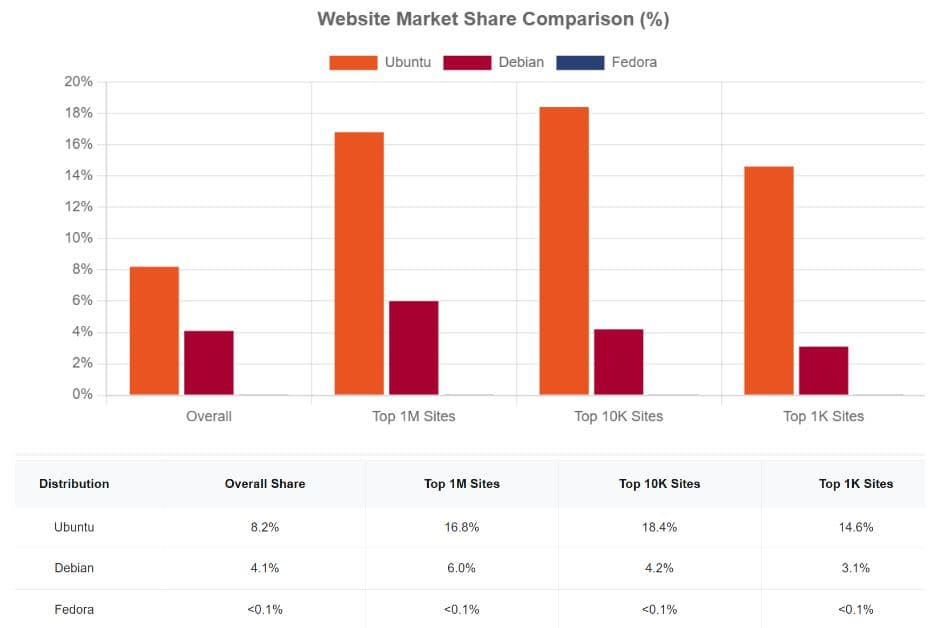
- According to W3Techs, Ubuntu kind of established itself as the go-to Linux distribution for web server deployments, especially with those high-traffic sites where you really need reliability, long‑term support, and enterprise stability.
- It shows an 8.2% website market share, but once you zoom into higher-tier categories, it gets stronger. Like, you see 16.8% of the top 1 million websites using it, 18.4% for the top 10,000, and 14.6% for the top 1,000.
- Big organisations and production‑grade web platforms are increasingly picking Ubuntu rather than “just testing”, for real server environments.
- Debian still keeps a solid spot, though at a smaller scale. It lands at 4.1% overall, plus 6.0% among the top 1 million websites, 4.2% across the top 10,000, and 3.1% within the top 1,000.
- On the other hand, Fedora stays under 0.1% across the board, including overall deployments plus the top 1 million, top 10,000, and top 1,000 websites. This low server usage suggests it leans more toward quick software changes, because of its six-month release rhythm.
- The data basically shows Ubuntu leading for enterprise web hosting, Debian acting like a dependable alternative and Fedora taking up a smaller, niche type role outside large-scale server infrastructure.
Ubuntu Version Adoption And Support Trends
| Ubuntu release cycle – Support | Ubuntu version | Percentage | Separate computers | IPv6 computers | IPv6 percentage |
| Ubuntu supported version: the current LTS | Ubuntu 26.04 LTS | 2.954 % | 31678 | 13998 | 44.2 % |
| Ubuntu supported version: the n-1 LTS | Ubuntu 24.04 LTS | 37.340 % | 400367 | 108591 | 27.1 % |
| Ubuntu supported, except the n and n-1 LTS | Ubuntu 22.04 LTS + 25.10 | 35.071 % | 376035 | 56523 | 15.0 % |
| End of standard support for less than 2 years | Ubuntu 20.04 LTS + 23.10 + 24.10 + 25.04 | 14.867 % | 159406 | 17561 | 11.0 % |
| End of standard support between 2 and 4 years | Ubuntu 18.04 LTS + 21.10 + 22.10 + 23.04 | 4.806 % | 51538 | 11149 | 21.6 % |
| End of standard support for more than 4 years | Ubuntu 21.04 and older, except 18.04 and 20.04 | 4.959 % | 53179 | 4728 | 8.9 % |
| Total still supported today | 75.366 % | 808080 | 179112 | 22.2 % | |
| Total end of life (standard support) | 24.633 % | 264123 | 33438 | 12.7 % | |
| Total amount | 100.000 % | 1072203 | 212550 | 19.8 % | |
(Source: ubuntu.com)
Ubuntu Server vs Desktop Software And Security
| Category | Ubuntu Desktop | Ubuntu Server |
| Web server | Not installed | Apache, Nginx available |
| Database | Not installed | MySQL, PostgreSQL available |
| Office suite | LibreOffice pre-installed | Not installed |
| Browser | Firefox pre-installed | Not installed |
| SSH server | Available | OpenSSH pre-installed |
| LTS support | 5 years standard | 5 years standard |
| Ubuntu Pro extended | Up to 12 years | Up to 12 years |
(Source: commandlinux.com)
Ubuntu Core And Server Drive Linux Expansion Across IoT And Cloud
- Ubuntu’s ecosystem has basically grown into something that can serve very specialized workloads, so organizations can just pick an edition based on performance, security, and how they plan to deploy.
- Ubuntu Core turns out to be a pretty convincing option for IoT and embedded systems, mainly because it keeps the root filesystem read-only, uses snap-only packages and also supports automatic transactional updates that can roll back if the update goes sideways.
- Linux runs 58% of IoT devices worldwide, and Linux-based smart TV software, like Tizen and webOS, makes up 61.3% of global unit sales.
- Raspberry Pi OS crossed 10.2 million active devices in 2025, and automotive Linux stacks are showing up in 32.4% of new vehicles, which signals Linux’s bigger role across connected gear and embedded systems.
- Ubuntu Server is still the go-to pick for web hosting, cloud computing, and database workloads, mostly due to a lightweight approach; it typically needs about 1.5 GB of RAM and around 5 GB of storage.
- Ubuntu’s track record gets more support from the fact that it powers over 60% of cloud Linux instances and 13.7% of Linux web servers.
- Ubuntu Desktop keeps aiming at developers and regular users with a full graphical experience. For example, version 26.04 requires 6 GB of RAM.
- The above versions show Ubuntu’s capacity to match different computing situations, from low-resource IoT boards up to large-scale cloud environments.
Ubuntu Deployment Data
- Ubuntu deployment data makes it clear organizations and regular users keep leaning toward Long-Term Support (LTS) releases, mostly because they feel more steady and they keep getting patched for longer, you know.
- By 4 August 2024, Ubuntu 22.04 LTS (Jammy Jellyfish) was clearly the big one in the mix, holding a 50.075% share across 492,796 separate computers, and out of those systems, about 25.1% had IPv6 switched on.
- The next deployment heavyweight was Ubuntu 20.04 LTS (Focal Fossa), with 25.429% of connections across 250,257 computers, and IPv6 showed up in 15.4% of them. That release is still backed until April 2025.
- When we look at more recent LTS options, Ubuntu 24.04 LTS (Noble Numbat) came in at 3.231% of connections. It was installed on 31,803 computers, and it also logged the strongest IPv6 adoption rate among the main LTS lines at 54.7%.
- The shorter cycle releases like Ubuntu 23.10 and 23.04 were way smaller, at 0.532% and 0.330% of connections, respectively.
- IPv6 adoption in that group sat somewhere between 50% and 54%. Older versions too, including Ubuntu 22.10, accounted for 0.192% of deployments, with IPv6 usage at 40.4%, though these versions are already past standard support.
- Ubuntu users mostly stick with supported LTS releases for reliable long-run operation, while the newer versions tend to get picked up by early adopters and for testing setups, where people can move faster.
Ubuntu in Cloud-Native & Container Infrastructure (AWS, Azure, GCP, K8S)
| Cloud Provider | Linux VM / Instance Share (2025) | Cloud Market Share (Q2 2025) |
| Google Cloud Platform | 91.6% | 13% |
| Amazon Web Services (AWS) | 83.5% | 30% |
| OpenStack (private cloud) | 87.1% | — |
| Microsoft Azure | 61.8% | 20% |
(Source: commandlinux.com)
- Ubuntu sort of became the de facto Linux distribution for modern cloud setups, mainly because it’s used so often by the biggest public cloud providers out there.
- As reported in Canonical’s own disclosures and later summarized by CommandLinux, over 60% of public cloud Linux instances use Ubuntu. So yeah, it ends up being the most common Linux operating system across AWS, Microsoft Azure, and Google Cloud.
- When you look at Infrastructure-as-a-Service market share, Amazon Web Services (AWS) sits around 31–33%, Microsoft Azure comes in at about 22–28%, and Google Cloud Platform (GCP) lands near 11–13%.
- More than 70% of global cloud infrastructure, and on those platforms Linux is still the default choice for virtual machines.
- Linux usage is especially heavy if you zoom in on specific providers. For example, 91.6% of Google Cloud virtual machines, 83.5% of AWS EC2 instances, and 61.8% of Azure virtual machines run Linux workloads.
- Within that Linux picture, Ubuntu tends to take the largest portion among the various Linux distributions.
- Ubuntu is moving closer to the network edge with MicroK8s, Canonical’s lean Kubernetes platform.
- Several industry reports InfluxData, CloudThat, Snuc, Mirantis, and Plural point to MicroK8s as one of the more prominent Kubernetes options for edge computing.
- The usual reasons are the small footprint deployment, built-in clustering support, GPU-related capability, and the presence of integrated add-ons.
- Vendor reports further note that Kubernetes-based edge platforms can scale to tens of thousands of devices, with some deployments supporting up to 100,000 edge devices, positioning Ubuntu as a sort of key foundation for next-generation cloud native and edge infrastructure.
AI, Machine Learning, And Workstation Adoption
- Linux has become the main backbone for modern artificial intelligence infrastructure, with 78.5% of developers using Linux as their primary or secondary environment for AI and machine learning development.
- In this whole ecosystem, Ubuntu holds a 27.7% share of AI development environments, making it the most broadly used Linux distribution among AI practitioners.
- Red Hat Enterprise Linux (RHEL) leads dedicated AI servers with a 43.1% market share, while Ubuntu accounts for 33.9% of general machine learning deployments, which kinda highlights its advantage in cloud native, research-minded, and adaptable AI workloads.
- Canonical’s collaboration with NVIDIA also pushes Ubuntu further ahead.
- Ubuntu 22.04 LTS is the only supported operating system for remote machines in NVIDIA AI Workbench, and Ubuntu 26.04 makes GPU deployment easier by letting developers install the CUDA toolkit directly with a single package command, reducing the setup friction.
- Cloud adoption also helps keep Ubuntu in a leadership role, since AI workloads are increasingly running on Kubernetes and containerized platforms like Kubeflow and MLFlow, where Ubuntu stays as the operating system.
- TensorFlow has about 37.5% of enterprise AI deployments, while PyTorch reaches 25.7%.
- In research, however, 85% of AI papers use PyTorch, compared with 15% that rely on TensorFlow, which really points to Linux and especially Ubuntu as the chosen base for crafting the next wave of AI models, before they move into the enterprise environment.
Conclusion
Ubuntu keeps getting stronger in 2026 as one of the more important enterprise Linux operating systems around the world, largely because cloud adoption is speeding up, AI work is expanding fast, and enterprise digital transformation has real momentum. You can see this momentum in how Ubuntu is used on public cloud platforms, in developer communities, in web servers, and especially in Kubernetes setups. So it’s not only “traditional computing” anymore; it’s turning into a kind of strategic base layer for a lot of organizations. Between Long-Term Support, solid security practices, and a smooth fit with AI frameworks plus cloud-native tech, Ubuntu ends up feeling like a default pick for both businesses and developers. And since more companies are putting money into artificial intelligence, edge computing, IoT, and hybrid cloud infrastructure, Ubuntu looks set to keep serving as a foundational platform for the next round of enterprise innovation.
FAQ
Ubuntu sits at 33.9% of the enterprise Linux market, which puts it at the second-largest distribution.
Ubuntu runs more than 60% of public cloud Linux instances across AWS, Microsoft Azure, and Google Cloud.
Ubuntu has a 27.7% share in Linux AI development environments, and it’s also common in Kubernetes clusters, GPU computing, and a range of AI frameworks.
Ubuntu powers 13.7% of Linux web servers, and it has noticeable adoption among high-
traffic enterprise sites.
Ubuntu LTS versions come with up to five years of standard support, and that can be extended to 12 years with Ubuntu Pro, which helps teams keep long-term stability, security, and more predictable enterprise reliability.